








Oxygen Sensor Technical Guide
A Chevrolet oxygen sensor replacement guide focused on diagnosis, exact vehicle and engine identity, sensor position, fitment evidence and safe verification.
Quick answer
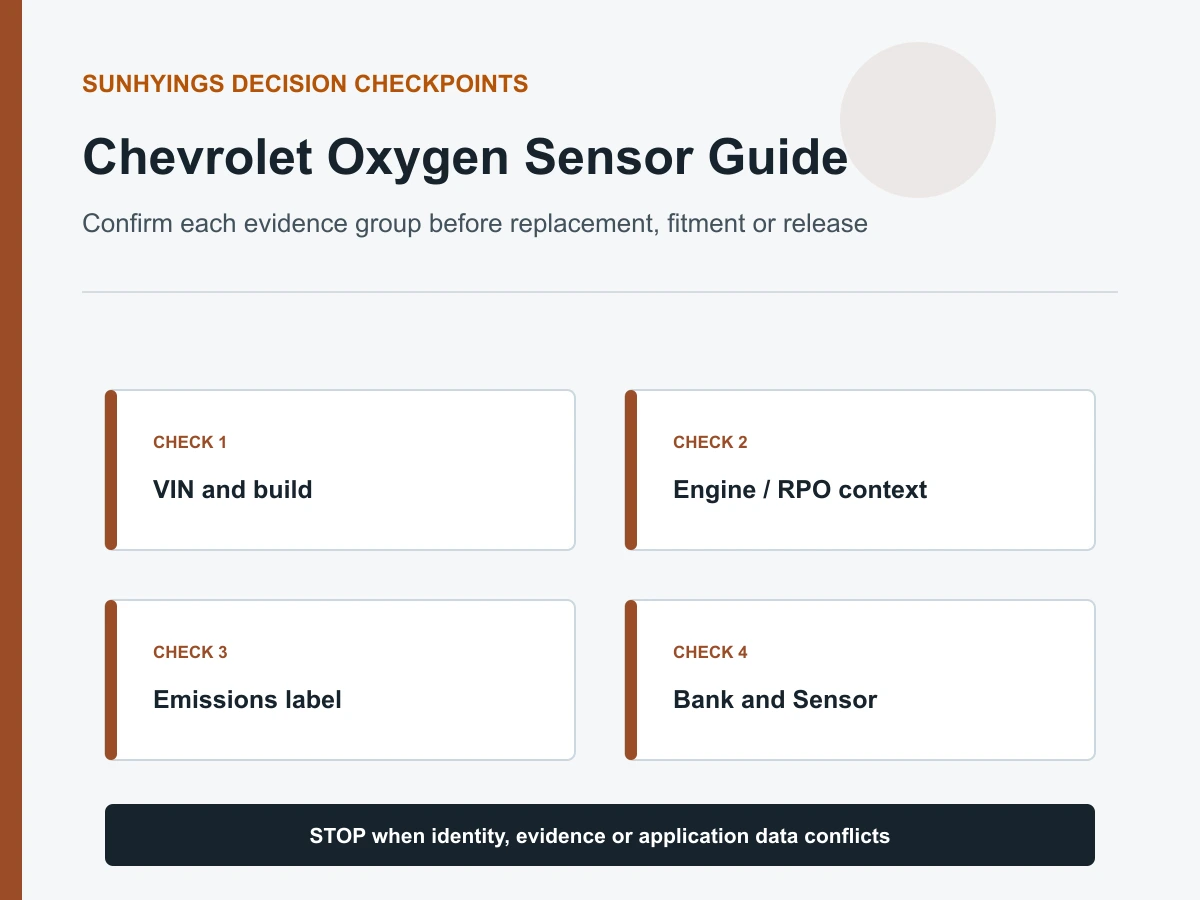
For a Chevrolet vehicle, do not select or replace an oxygen sensor by model name or trouble code alone. Confirm the exact year, model, engine, VIN/build data, sales market and emissions configuration; then identify Bank and Sensor position, sensor technology, OE reference, connector and lead. Chevrolet/GM vehicle identity can depend on engine, VIN/build data, emissions configuration and RPO information; do not choose by model badge alone. A code narrows the test path but does not prove the sensor failed.
What this Chevrolet guide can and cannot confirm
This is a neutral diagnostic and fitment-verification guide. It does not publish an unverified Chevrolet OE number, model-year application, sensor count, labor time or torque value. Sunhyings inventory, manufacture and approved fitment are not claimed. Exact service information and current application data for the VIN/configuration control the repair.
Popular Chevrolet model names are not complete fitment identities
| Model search | Information still required | Why it matters |
|---|---|---|
| Silverado oxygen sensor | Year, engine, VIN/build, market/emissions and exact position | One model name can cover different exhaust and sensor systems. |
| Equinox oxygen sensor | Year, engine, VIN/build, market/emissions and exact position | One model name can cover different exhaust and sensor systems. |
| Malibu oxygen sensor | Year, engine, VIN/build, market/emissions and exact position | One model name can cover different exhaust and sensor systems. |
| Tahoe oxygen sensor | Year, engine, VIN/build, market/emissions and exact position | One model name can cover different exhaust and sensor systems. |
Build the vehicle and sensor identity
- VIN and exact year/model/trim context
- Engine displacement/code and fuel type where applicable
- Sales market and emissions label/configuration
- Bank 1 or Bank 2 and Sensor 1 or Sensor 2
- OE number from a verified source or readable old-part label
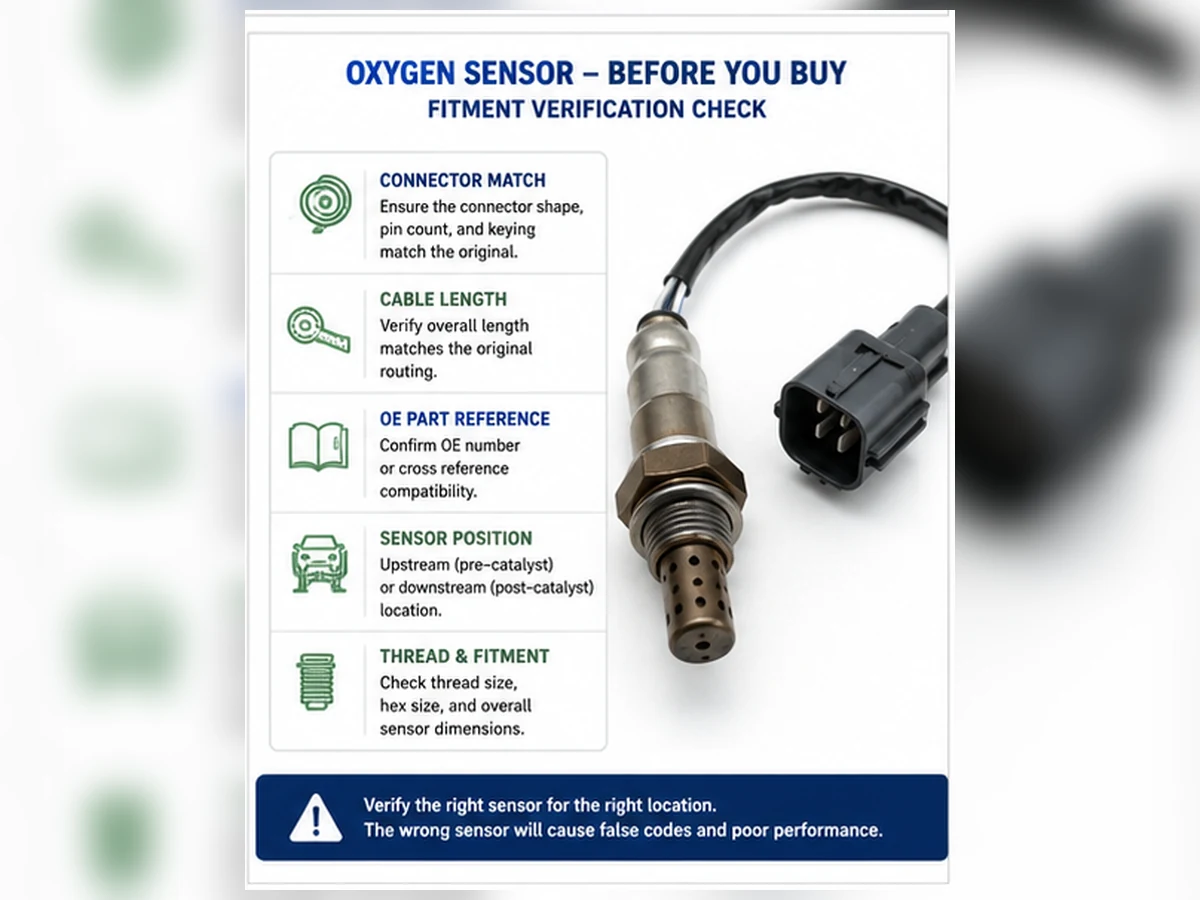
- Sensor technology, connector keying, pins, lead and clips
Diagnose before ordering
Record current, pending and permanent codes, freeze frame and readiness. Inspect harness routing, terminals and exhaust leaks. Test heater power/ground/control for heater codes. Compare fuel trims and technology-specific sensor response for mixture or response codes. P0420/P0430 concerns catalyst-system efficiency and is not an automatic rear-sensor order.
Safe installation boundary
Let the exhaust cool and use approved vehicle support. Follow the exact Chevrolet service procedure and replacement-sensor instructions for access, torque and thread compound. Do not cut a direct-fit harness. Route the lead away from heat, sharp edges and moving parts, and restore every clip and shield.
Post-repair verification
Check the connector, routing and exhaust sealing, then confirm heater/circuit and sensor response under specified conditions. Complete the applicable legal monitor procedure. Clearing codes, using a spacer/simulator or disabling a monitor does not prove repair.
A Chevrolet verification sequence that avoids model-name guessing
| Step | Evidence to record | Stop condition |
|---|---|---|
| Vehicle identity | VIN, year, model, engine/build and sales market | Engine or configuration remains ambiguous |
| Emissions identity | Under-hood label and applicable regional configuration | Catalog does not distinguish the configuration |
| Physical position | Bank, Sensor number and catalyst relationship | Service and physical diagrams do not agree |
| Part identity | OE reference, technology, connector, lead and clips | Any critical field conflicts |
| Failure evidence | Codes, circuit checks, leaks, trims and response test | Sensor failure is not supported |
Chevrolet/GM vehicle identification may require engine and RPO/build context in addition to VIN and model year. A Silverado or Tahoe badge can cover several engines; Equinox and Malibu also change powertrains across generations. Preserve the exact emissions label and market.
Questions to answer for common Chevrolet model searches
| Search phrase | Questions before diagnosis or ordering |
|---|---|
| Silverado oxygen sensor | Which model year, engine/RPO, emissions configuration, bank and Sensor position? Is the connector route correct for that exhaust path? |
| Equinox oxygen sensor | Which engine or turbo configuration, build range and market? Is the requested position upstream or downstream of which catalyst? |
| Malibu oxygen sensor | Which engine/powertrain, emissions label and production range? What OE reference and technology are verified? |
| Tahoe oxygen sensor | Which V8/engine configuration and RPO context? Where is cylinder 1, and which Bank/Sensor circuit is named? |
A model-family table is a verification checklist, not a fitment list. It intentionally contains no sensor count, side, OE number or year range. Those facts must come from current information matching the exact vehicle.
Read Chevrolet terminology in context
Oxygen sensor, heated oxygen sensor and A/F sensor
Chevrolet/GM data commonly uses HO2S and Bank/Sensor descriptions, while parts listings may shorten them to upstream or downstream O2 sensor. “Oxygen sensor” and “O2 sensor” name the broad family. A/F, wideband and heated labels can imply different circuits or roles, but the complete service description controls. Do not infer technology from the number of wires or from a marketplace title.
Bank and Sensor designation
Bank 1 contains cylinder 1. Sensor 1 is commonly before the relevant catalyst and Sensor 2 after it. This common naming helps orient the reader but does not provide a universal physical side. Confirm cylinder numbering and exhaust flow for the exact engine.
Generic scan-tool labels
A scan tool may display HO2S voltage, A/F current, lambda or equivalence ratio. Confirm that the PID is supported, matches the physical circuit and uses the expected units. A generic menu can list positions or values that are not implemented for the vehicle.
Map engine banks, catalysts and connectors
Silverado and Tahoe V-engine configurations require cylinder-1 bank identification, while Equinox and Malibu layouts can use different engine and catalyst arrangements. Do not use a universal left/right rule. Map each exhaust path and follow its connector in the correct wiring diagram.
| Map item | Evidence source | Common error prevented |
|---|---|---|
| Cylinder 1 and bank | Exact engine service diagram | Driver/passenger or front/rear shortcut |
| Catalyst order | Exhaust layout for the configuration | Wrong Sensor 1/Sensor 2 position |
| Connector route | Wiring diagram and cool physical inspection | Testing a nearby but different circuit |
| Sensor technology | Service and approved application data | Narrowband/wideband test mismatch |
Account for engine, build and emissions variants
RPO and engine information can distinguish components that share a model badge and year. OE numbers can also supersede, so record the source and revision rather than copying a marketplace cross-reference. A visible connector match remains only a physical check.
A registration year or model badge does not necessarily equal production date or VIN breakpoint. Imported vehicles can also differ from the market assumed by a local catalog. Record the under-hood emissions label and use a catalog that explicitly covers the sales market.
Turn Chevrolet codes into test paths, not part orders
| Code type | First checks | Do not conclude |
|---|---|---|
| Heater circuit | Correct position, fuse/supply, ground/control, connector and element | The sensor is failed from code alone |
| Low/high/no activity | Signal/reference circuit, operating state and real mixture | A displayed limit identifies the failed component |
| Slow response | Enable criteria, leaks, technology and controlled response | Every slow graph requires replacement |
| P0420/P0430 | Misfire, fuel control, leaks, both sensors and catalyst | The downstream sensor is automatically bad |
Save all current, pending and permanent codes, freeze frame and readiness before clearing. Multiple codes can reveal a shared supply, system-wide mixture fault or misfire. Clearing memory can remove context and reset monitors without repairing anything.
Interpret live data with technology and operating state
Confirm warm-up and control state
A cold sensor or engine outside closed-loop conditions should not be compared with a warm response specification. Record coolant temperature, load, speed and commanded state with the sensor value.
Compare response with fuel trims
Positive or negative correction shows what the control module is attempting, not which component failed. Intake leaks, airflow/load error, fuel delivery, purge, ignition and mechanical condition can create the exhaust result a healthy sensor reports.
Use downstream data in catalyst context
The downstream signal is evaluated with upstream behavior and catalyst monitor conditions. A waveform comparison without exhaust sealing, engine condition and valid monitor criteria cannot establish a failed sensor or catalyst.
Build the replacement identity only after diagnosis
| Fitment field | Required evidence | Reject when |
|---|---|---|
| OE reference | Readable part or current controlled catalog source | Unverified cross-reference or unresolved supersession |
| Vehicle scope | VIN/build, engine, market and emissions configuration | Model/year only |
| Position | Bank/Sensor and catalyst relationship | “Front” or “rear” remains ambiguous |
| Technology | Specified narrowband, wideband/A/F or other circuit | Wire count is the only match |
| Interface | Thread, shield, connector, pins, lead and clips | Harness must be forced, cut or stretched |
For Chevrolet, submit VIN/build and engine/RPO context, emissions market, complete Bank/Sensor description, OE reference and connector/cable photos. A candidate GM cross-reference must be reconciled with the exact configuration before any fit statement.
Direct-fit and universal are separate decisions
A direct-fit sensor supplies an application connector and lead arrangement, but it still needs exact coverage. A universal sensor requires manufacturer-approved circuit compatibility and splice instructions; universal does not mean every Chevrolet vehicle. Wire colors are not a universal pinout standard. Do not cut a direct-fit harness or improvise a splice near the exhaust.
Installation and safety checks
- Let the exhaust cool and use approved vehicle lifting/support.
- Confirm the physical sensor and connector before disconnection.
- Protect exhaust threads and nearby components during removal.
- Compare old and replacement technology and interface details.
- Follow exact product/service torque and thread-compound instructions.
- Restore heat sleeves, clips, shields and safe cable routing.
There is no responsible universal torque or labor time for every Chevrolet application. Access, corrosion, sensor design and surrounding components vary. Stop when threads, bung, connector or harness damage changes the job scope.
Use an evidence hierarchy when sources disagree
Search results often combine owner discussions, marketplace listings, generic code definitions and application catalogs. They do not have equal authority. Start with exact Chevrolet service information for circuit identity, diagnostic conditions, connector views and installation procedure. Use a current controlled parts source for OE identity and supersession. Use the under-hood label, VIN/build data and the removed part to resolve configuration. Aftermarket catalogs can then be evaluated as cross-references, not treated as proof merely because several sellers repeat the same row.
| Evidence source | Appropriate use | Boundary |
|---|---|---|
| Exact service information | Position, circuit, test conditions and repair procedure | Must match engine, market and configuration |
| Controlled OE parts data | Part identity, position and supersession path | A supersession still needs application reconciliation |
| VIN/build and emissions label | Vehicle and regulatory configuration | VIN decoding alone does not provide the repair test |
| Removed sensor and connector | Physical comparison and readable identifiers | Appearance cannot prove electrical compatibility |
| Aftermarket catalog | Candidate cross-reference and commercial coverage | Source, revision and exclusions must be known |
| Forum or marketplace page | Possible symptom or terminology lead | Not approval evidence for diagnosis or fitment |
When two controlled sources conflict, record both values, their dates and the exact vehicle fields used. Do not average the answers or choose the listing with the clearest product photo. Hold the affected application until the conflict is resolved by an authoritative source or a documented physical and electrical comparison.
Build a diagnostic evidence packet before replacement
A useful record lets another technician understand why replacement was approved. Capture the full DTC description and status, freeze-frame conditions, relevant service-test step, battery/system voltage, heater power and control checks where applicable, harness and terminal condition, intake and exhaust leak findings, fuel trims, misfire evidence and the technology-specific sensor response. Identify the physical connector tested. A graph without vehicle state, units and sensor position cannot be interpreted reliably.
Separate observations from conclusions. “P0135 stored” is an observation. “The heater has specified supply but an open element at the identified connector” is evidence supporting a sensor decision. “The sensor is bad” based only on a code is an unsupported conclusion. The same discipline applies to mixture and catalyst-monitor codes: document the competing causes that were tested and the condition under which the monitor or response failed.
Preserve evidence after the repair
Record the installed part identity and lot if available, connector engagement, cable route, exhaust sealing and post-repair values under comparable conditions. Do not erase the before-state before it is saved. If a concern returns, this packet separates wrong fitment, installation damage, circuit recurrence, unresolved engine faults and possible product nonconformity. It also gives a supplier enough information to investigate without assuming every warning light is a warranty defect.
Compare the old and replacement sensor as a system
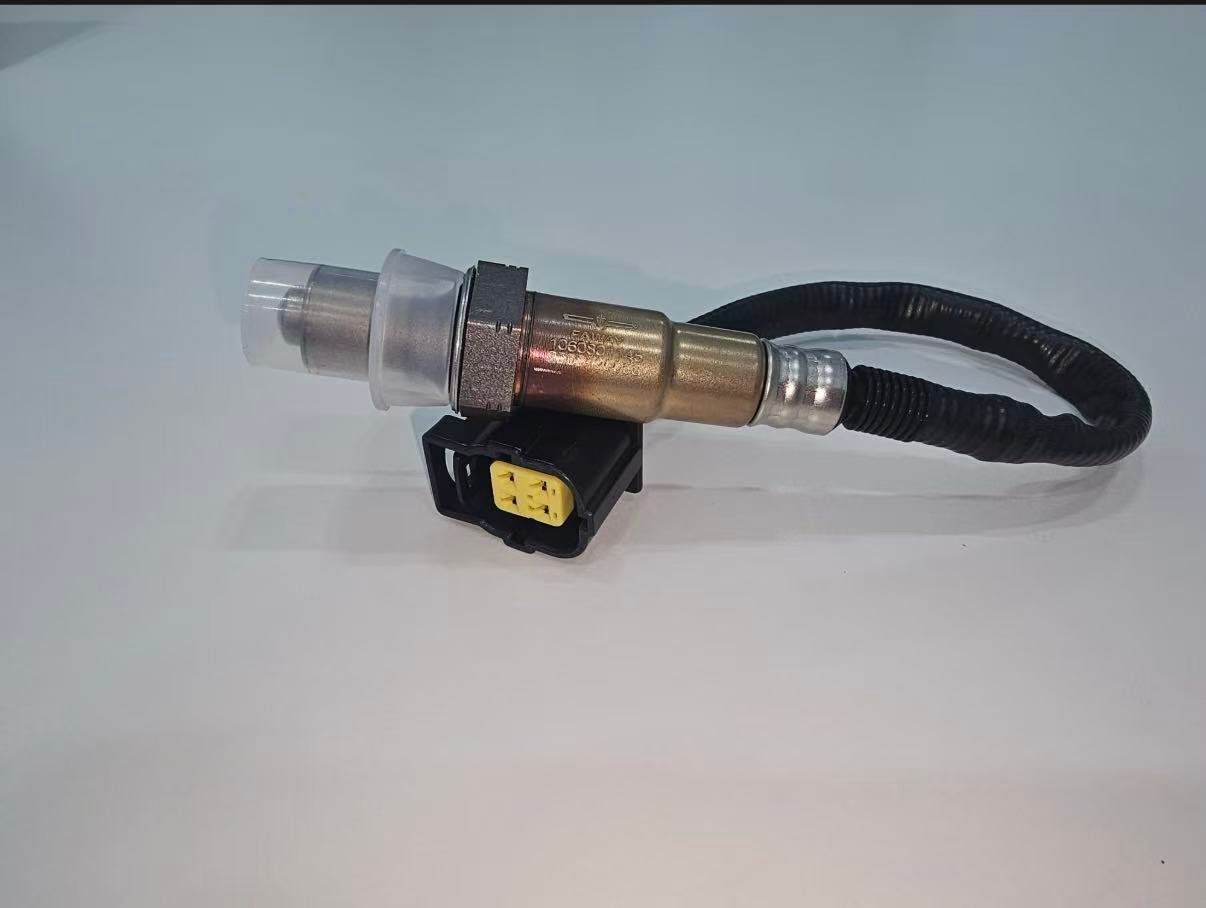
Place the parts side by side without contaminating or striking the sensing element. Compare the stamped or labeled identifiers, thread and sealing seat, hex access, shield length and hole pattern, cable protection, overall lead length, grommets and clips, connector housing, keying, latch, terminal count and secondary lock. Then compare the drawing or application specification. A visible match is a rejection screen, not final approval: heater resistance range, signal strategy, calibration and pin assignment may differ while housings look alike.
Reject or stop the installation if the cable must be stretched across the exhaust, the connector needs force, a clip cannot return to its original location, the shield contacts another component, the thread or seat differs, or the specified technology cannot be confirmed. Do not modify a direct-fit connector to make a candidate fit. If a universal sensor is expressly approved, use only its manufacturer’s application and splice procedure and retain the harness protection required near the exhaust.
Use explicit stop, diagnose and release decisions
A good workflow does not force every inquiry toward a sale. Use three visible states. Stop when vehicle identity, emissions configuration, physical position or sensor technology is ambiguous, or when two authoritative sources conflict. Diagnose when fitment is known but the evidence does not establish sensor failure; complete the circuit, leak, fuel-control and response checks required by the complaint. Release only when both the replacement need and the part identity are supported. Record who made the decision and which evidence was used.
This separation prevents a correct diagnostic conclusion from being paired with the wrong part, and it prevents a correct-looking part from being sold for an undiagnosed fault. It also gives customer service a truthful response when key data is absent: the status is Pending, not “probably fits.” For an RFQ, quote only released application rows and list blocked rows separately. For a repair, keep the original evidence until the relevant circuit response and legal monitor are verified after installation.
| Decision state | Typical evidence | Permitted next action |
|---|---|---|
| Stop | Engine, market, position, technology or source conflict | Request authoritative data; do not order or claim fitment |
| Diagnose | Vehicle/circuit known, failure cause still open | Run the exact service test and competing-cause checks |
| Release | Failure evidence and complete replacement identity agree | Approve the controlled part/application and installation plan |
| Verify | Installed identity, routing, sealing and response documented | Confirm repair under specified conditions and monitor status |
Use VIN, build and RPO evidence together
A Chevrolet badge and model year do not fully identify the powertrain. Silverado and Tahoe can offer multiple engines and emissions configurations, while Equinox and Malibu change engines and exhaust layouts across generations and markets. Begin with the VIN/build record and exact engine. Where GM RPO information is relevant and available from an authoritative vehicle record, preserve the codes that define the powertrain or emissions configuration. Do not copy an RPO list from an unrelated vehicle or decode it through an unverified marketplace page.
The under-hood emissions label is a separate check. Record the applicable certification or configuration information needed by the catalog without turning the label into a public vehicle identifier. If VIN/build, RPO context, label and current parts data do not agree, stop the application decision. The conflict may indicate an imported configuration, a catalog selection error, a previous engine or exhaust change, or simply incomplete data; none is solved by choosing the most common Silverado listing.
| Chevrolet identity layer | Decision supported | What it cannot prove alone |
|---|---|---|
| VIN/build data | Vehicle, production and engine context | Exact repair procedure or part fitment |
| Engine/RPO context | Configuration distinctions within a model | Physical sensor condition |
| Emissions label | Regulatory configuration and market check | OE supersession |
| Service diagram | Bank, Sensor, circuit and connector mapping | Current sellable part number |
| Controlled parts data | OE identity and supersession | Proof the sensor caused the code |
Translate GM HO2S and Bank/Sensor wording carefully
Chevrolet/GM diagnostic information may use HO2S with Bank and Sensor identifiers, while retail listings use upstream, downstream, front, rear, left or right. Preserve the full service term. Bank 1 is the cylinder bank containing cylinder 1, not a universal driver or passenger side. Sensor 1 is generally ahead of the relevant catalyst and Sensor 2 behind it, but the exact exhaust diagram controls where multiple catalysts or merged paths exist.
For an inline engine, do not assume a generic Bank 2 menu describes a physical circuit. For a V engine, identify cylinder 1 in the matching engine information before going under the vehicle. Map the exhaust path and connector number, then verify the physical harness when the exhaust is cool. This avoids disconnecting a nearby sensor, especially where leads cross or connectors mount above heat shields.
Keep Chevrolet engine and exhaust layouts separated
Silverado and Tahoe searches often focus on model name or engine displacement, but an application record should preserve engine family, build range, market/emissions configuration and drivetrain details where the catalog requires them. Equinox and Malibu may use inline engines, turbocharged variants or different powertrains across generations. A sensor used at one position on one engine cannot be transferred to another configuration from connector appearance alone.
- Resolve exact vehicle, engine and build from authoritative records.
- Match the emissions configuration and current service information.
- Locate cylinder 1 and map every relevant catalyst path.
- Identify the named HO2S circuit and connector in the wiring diagram.
- Resolve OE identity and supersession in current parts data.
- Compare thread, shield, connector, lead and clips before release.
Retain the source revision and excluded configurations in a distributor catalog. A broad row with hidden engine exclusions is harder to correct after inventory has been labeled and syndicated to marketplaces.
Chevrolet diagnostic evidence before a sensor decision
For heater-circuit codes, inspect shared supplies and fuses where the exact diagram shows them, the control circuit, connector terminals, harness heat exposure and element values under the GM procedure. Multiple related heater codes can point toward a shared vehicle-side issue. For signal or mixture codes, establish whether the sensor is reporting a real exhaust condition: inspect intake and exhaust leaks, airflow/load data, fuel delivery, purge, ignition, misfire and engine mechanical evidence.
For slow response or no activity, confirm the engine is warm and the required monitor conditions are present. Use the correct PID, units and controlled response test for the sensor technology. Do not condemn an upstream device because a generic scan value does not switch like a narrowband sensor. For P0420/P0430, preserve engine and fuel-control history, verify exhaust sealing and evaluate the correct sensor pair with catalyst evidence. The code does not nominate a downstream sensor for replacement.
Account for prior repairs and exhaust changes
Inspect whether a previous repair installed a universal sensor, altered a connector, damaged threads, omitted a clip or changed an exhaust component. Record modifications without assuming they are the cause. A replaced catalyst or sensor still requires correct identity and monitor diagnosis. Do not provide spacer, simulator, delete or software-defeat guidance; restoring lawful system operation is the objective.
Chevrolet application release record
| Field | Release evidence | Hold condition |
|---|---|---|
| Vehicle/build | VIN-derived context and production information | Only badge and model year provided |
| Engine/RPO | Authoritative configuration record where applicable | Engine variant remains ambiguous |
| Emissions/market | Label and catalog scope agree | Imported or regional configuration unresolved |
| Position | Bank/Sensor mapped to catalyst and connector | Left/right or front/rear shortcut |
| OE identity | Current source and supersession reconciled | Uncontrolled cross-reference conflict |
| Interface | Technology, pinning, thread, shield, lead and clips | Modification or forced routing needed |
For a Sunhyings sourcing inquiry, submit this record with expected quantity and packaging or approval requirements. The record supports a responsible capability review; it does not by itself confirm stock, MOQ, delivery, OE equivalence or fitment. Those claims remain project-specific and must be supported before quotation or publication.
Composite Chevrolet verification scenario
Composite engineering scenario: a Silverado request includes year and model but no engine/RPO or emissions label. A generic diagram labels Bank 1 by vehicle side, while the exact engine’s cylinder numbering has not been checked. The reviewer pauses the order, resolves vehicle and position identity, and then follows the correct circuit test. This scenario combines common catalog and diagnostic risks; it is not a Sunhyings customer case, fitment record or claim about a particular vehicle.
Composite Chevrolet diagnostic scenario
Composite diagnostic scenario: An Equinox has a lean code and a seller recommends the upstream sensor from year and model alone. Exact build and engine information first identifies the application and circuit. Fuel-trim review and a leak test then find unmetered air, while the installed sensor responds in the expected direction during the specified test. The air leak is repaired and the sensor is not replaced merely for reporting the lean condition.
The sequence is intentionally evidence-led: confirm the exact circuit, test the vehicle-side causes and compare the response with the applicable procedure before approving a part. It is a composite training example, not a Sunhyings customer, warranty result or statement that the named model commonly has this fault.
Verify the repair and monitor
After repair, confirm connector lock, lead routing, heat clearance and exhaust sealing. Check the heater/circuit and technology-specific sensor response under defined conditions. Complete the applicable legal readiness monitor. A warning light that was cleared manually is not evidence that the original monitor passed; permanent codes may remain until the control module confirms a successful result.
Emissions and product-claim boundary
Do not use spacers, defoulers, simulators, sensor deletes or software changes to conceal catalyst monitoring. These methods do not repair the root cause and may violate emissions law. This educational page does not confirm that Sunhyings sells, stocks, manufactures or guarantees a sensor for any Chevrolet application. Fitment remains Pending until project-specific evidence is matched.
Prepare a fitment or sourcing request
Send the OE number, year/make/model, engine or VIN details, market and emissions package, exact bank/sensor position, connector and old-part photos, quantity and any packaging or approval requirements. Sunhyings will review the supplied data for capability and sourcing feasibility; fitment is not confirmed until application evidence is matched.
Frequently asked questions
How do I find the correct Chevrolet oxygen sensor?
Use the VIN/configuration, engine, market/emissions package, exact bank and position, OE reference, technology and connector/cable details.
Does a Chevrolet oxygen-sensor code prove the sensor failed?
No. Diagnose wiring, heater supply/control, exhaust leaks, fuel trims and sensor response using exact service information.
Is Bank 1 always on one side of a Chevrolet?
No. Bank 1 contains cylinder 1; its physical side depends on the engine and installation.
Can Sensor 1 and Sensor 2 use the same part?
Only when current verified application data lists that exact part for both positions.
Does P0420 mean replace the downstream sensor?
No. P0420 is a catalyst-system efficiency code and requires engine, exhaust, sensor and catalyst diagnosis.
Can Sunhyings confirm Chevrolet fitment from a model name?
No. Submit complete vehicle, engine, emissions, position and OE/physical evidence for a fitment review.