






Oxygen Sensor Technical Guide
Oxygen sensor and O2 sensor mean the same component, but lambda, air-fuel-ratio and wideband terms can describe different technologies and signals.
Quick answer
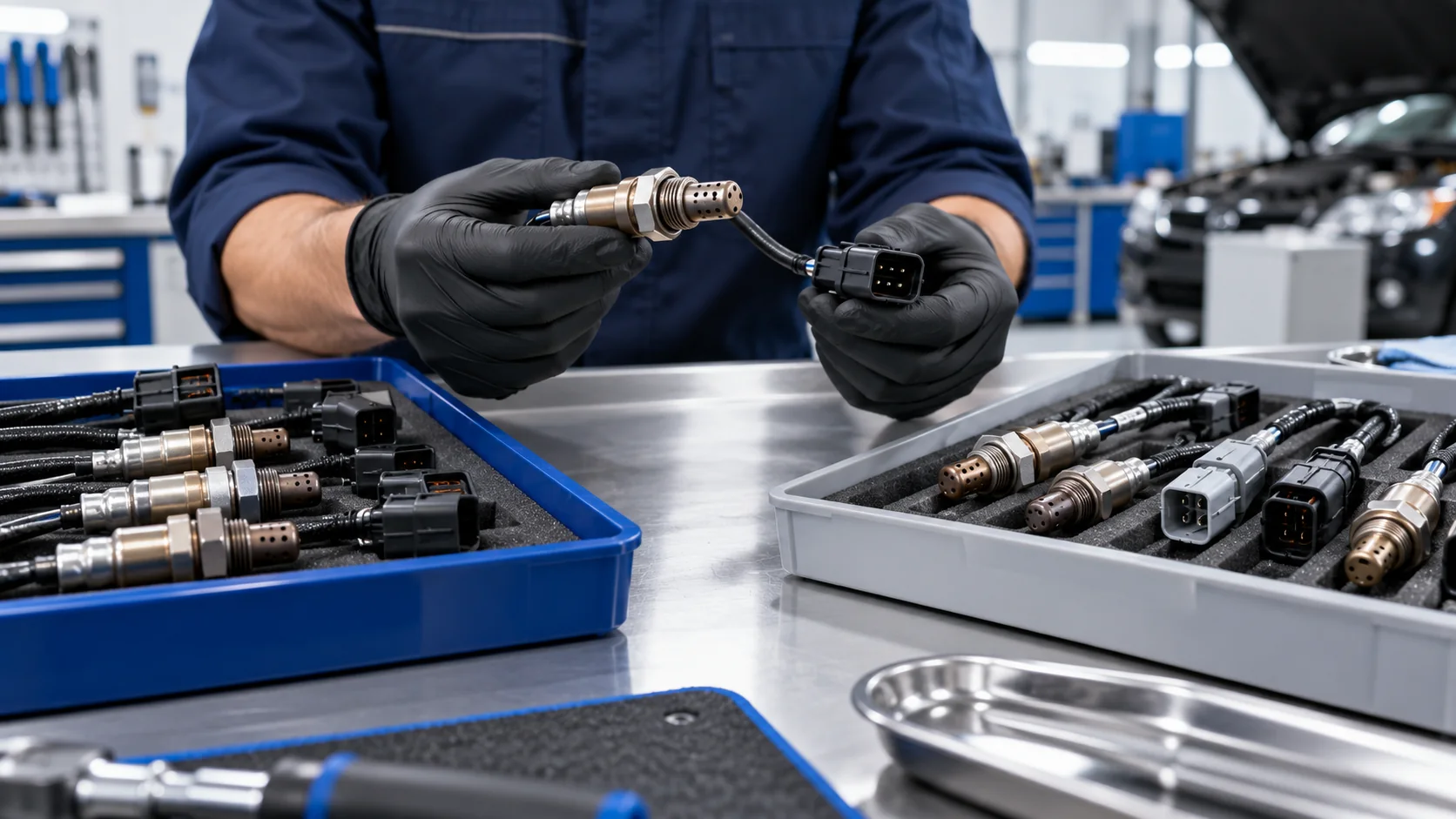
Yes. “O2 sensor” is the common short name for an oxygen sensor; O2 is the chemical notation for molecular oxygen. “Lambda sensor” is another widely used name. However, narrowband oxygen sensors and wideband or air-fuel-ratio sensors do not necessarily use the same signal or diagnostic method, so the names should not be used to assume parts interchangeability.
Why the same part has several names
Service manuals, scan tools, catalogs and regional markets use different terminology. Oxygen sensor is the descriptive English name, O2 sensor is the shortened workshop term, and lambda sensor is common in European material. All refer broadly to a sensor that responds to oxygen in the exhaust. The label alone does not identify position, connector, calibration or technology.
| Term | What it usually means | What it does not prove |
|---|---|---|
| Oxygen sensor / O2 sensor | General product family | Narrowband or wideband, front or rear, exact fit |
| Lambda sensor | Regional name for the same broad family | Signal type or interchangeability |
| A/F or AFR sensor | Often a wide-range sensor used for precise mixture feedback | That every catalog uses the term consistently |
| Heated oxygen sensor / HO2S | Sensor with an integrated heater circuit | Connector pinout or vehicle application |
The important distinction is technology, not abbreviation
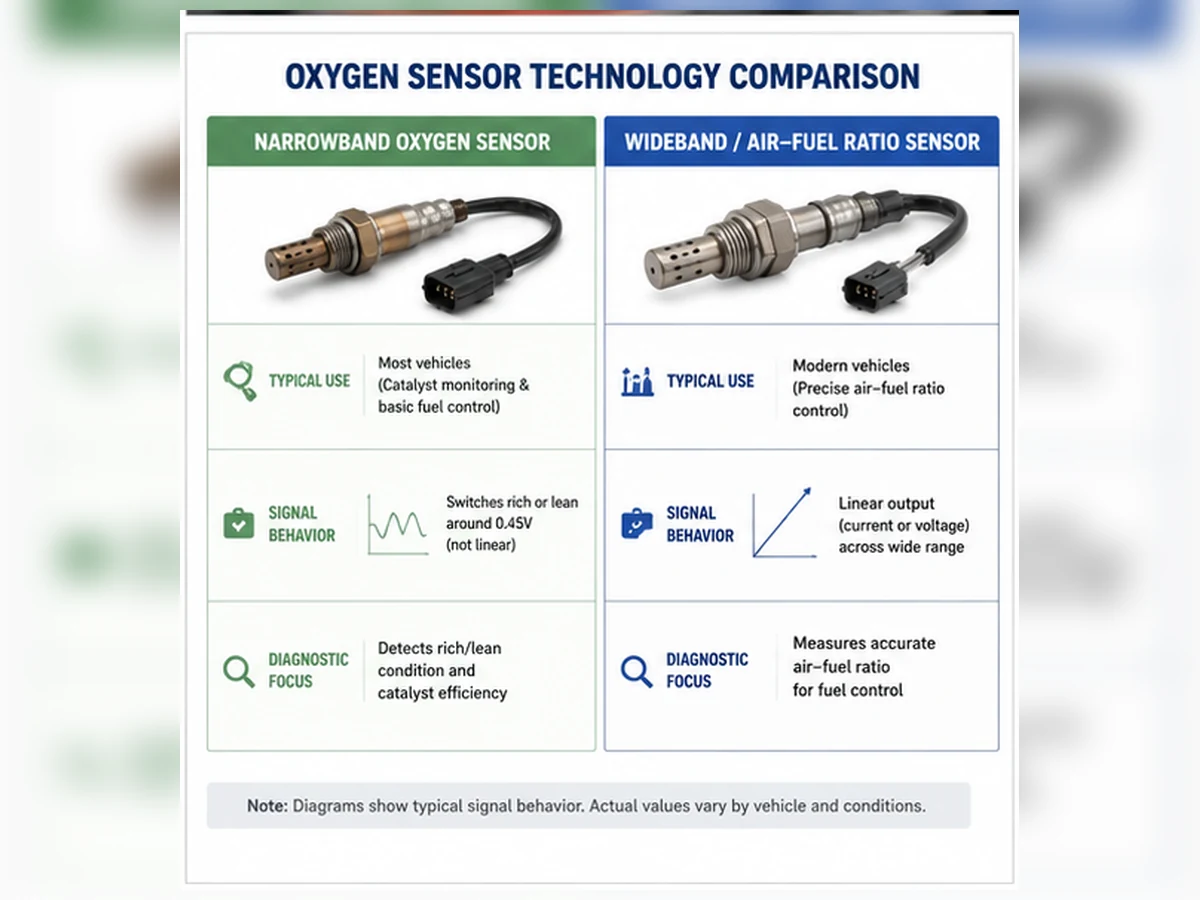
A conventional zirconia narrowband sensor switches around a rich/lean threshold. A wideband or A/F sensor uses control electronics to report mixture over a broader range. Titania sensors use a different operating principle. Scan data, circuit tests and replacement selection must follow the technology specified for the vehicle.
Names also do not identify exhaust position
Upstream, pre-catalyst and Sensor 1 commonly describe the sensor before a catalyst. Downstream, post-catalyst and Sensor 2 commonly describe the sensor after it. Bank 1 contains cylinder 1. Because exhaust layouts differ, confirm the complete position in service information rather than ordering from a short label such as “rear O2 sensor.”
How to read a catalog listing safely
Use the OE reference, year/make/model, engine, market or emissions package, exact bank and position, connector keying, lead length and sensor technology. Treat cross-references as candidates until the application record is verified. A listing that says only “oxygen/O2/lambda sensor” is not enough for a fitment decision.
Map the term to the information source
“Oxygen sensor,” “O2 sensor” and “lambda sensor” can refer to the same broad exhaust-sensing family, but catalogs, service manuals and scan tools may use narrower labels. Read the whole description. A service manual may use HO2S for a heated narrowband sensor and A/F sensor for a wide-range design, while a retailer may group both under O2 sensors. The broad name never proves technology or fitment.
| Source | Possible wording | Decision rule |
|---|---|---|
| Service manual | HO2S, A/F sensor, lambda sensor, Bank/Sensor | Follow the defined circuit and test for the exact vehicle |
| Scan tool | O2S, B1S1, lambda, equivalence ratio, current | Confirm the PID and units are supported |
| Parts catalog | Oxygen, O2, wideband, universal, direct-fit | Verify OE/application, technology and position |
| Emissions literature | Lambda sensor or oxygen sensor | Use the term in context; do not infer a part number |
What the O2 abbreviation actually means
O2 is the chemical notation for molecular oxygen. The sensor responds to oxygen-related conditions in exhaust and provides an electrical signal to a control system. The abbreviation does not mean the device outputs an oxygen percentage like a laboratory gas analyzer. Its useful signal, reference strategy and control circuit depend on the sensor design.
Technology names matter more than the shorthand
Zirconia narrowband
A conventional zirconia narrowband sensor is useful around a rich/lean switching region. Under defined warm closed-loop conditions, its behavior may be shown as a switching voltage. One stationary value is rarely enough to judge response, and outside air leaks or mixture faults can change the signal while the sensor is operating correctly.
Wideband or air-fuel-ratio sensor
A wideband/A/F system uses a more complex control circuit and can represent mixture across a broader range. Scan data may appear as pump current, lambda or equivalence ratio. Applying a narrowband voltage rule to this circuit can create a false failure conclusion or damage the circuit if probed incorrectly.
Titania
Titania designs use a different operating strategy defined by the vehicle. Wire count, connector shape and the word “heated” do not identify titania versus zirconia. Use the wiring diagram and service specification.
| Question | Name alone answers? | Evidence required |
|---|---|---|
| Is it narrowband or wideband? | No | OE/application and service circuit data |
| Is it upstream or downstream? | No | Bank/Sensor and exhaust diagram |
| Will it fit the connector? | No | Keying, pin assignment and application record |
| Can the signals be compared? | No | Technology, units and operating conditions |
What “heated oxygen sensor” adds
An integrated heater helps the sensing element reach and maintain its operating range. The term HO2S confirms that a heater circuit is involved, but it does not establish the heater resistance, supply strategy, connector pinout or position. A heater DTC may be caused by the element, fuse, power, ground, control, connector or harness.
Position terms are a separate identity layer
Upstream, pre-cat and Sensor 1
These commonly describe the sensor before the relevant catalyst and often the primary mixture-feedback position. “Front” may be ambiguous on a transverse engine, so use the bank and exhaust path.
Downstream, post-cat and Sensor 2
These commonly describe the sensor after the catalyst and often a catalyst-monitoring position. A rear-sensor listing does not prove it fits every post-catalyst location, and P0420/P0430 does not automatically identify that sensor as failed.
Translate a catalog title into a fitment record
| Catalog phrase | Missing information | Required action |
|---|---|---|
| Universal O2 sensor | Compatible technology, application and splice method | Check manufacturer instructions; universal is not universal fit |
| 4-wire oxygen sensor | Signal strategy and pin assignment | Reject wire count as sole identity |
| Front lambda sensor | Bank, exact position and engine | Resolve with service/application data |
| Wideband replacement | Exact circuit, calibration and connector | Verify OE number and current catalog coverage |
Read scan-tool labels and units before judging data
Confirm that the displayed identifier maps to the physical sensor and is supported by the vehicle. Generic tools can simplify manufacturer-specific names or display a calculated value. Record voltage, current, lambda or equivalence-ratio units, engine temperature, control state and load. A graph without the units and operating state cannot establish normal or failed behavior.
Composite scenario: an A/F sensor is tested as narrowband
Composite diagnostic scenario: a scan-tool label contains “O2,” so a wide-range upstream sensor is expected to switch like a narrowband sensor. The service information instead specifies a current-based A/F response. Using the correct PID and test procedure shows a plausible response. This is a composite teaching example, not a Sunhyings customer or vehicle claim.
Terminology checklist before diagnosis or purchase
- Copy the full service or catalog description, not only “O2.”
- Identify technology and supported scan-data units.
- Confirm Bank/Sensor position and catalyst relationship.
- Verify OE number, vehicle, engine, market and emissions package.
- Compare connector keying, pins, lead and clips.
- Keep diagnosis evidence separate from fitment approval.
The practical answer remains simple: oxygen sensor and O2 sensor are the same broad name. Every consequential decision begins after that answer, with technology, position, circuit and application evidence.
Keep terminology consistent across teams and languages
For a repair order, catalog or RFQ, choose one preferred term and preserve the source term in a separate field. For example, record “oxygen sensor” as the family, “A/F sensor” as the technology label from service information and “Bank 1 Sensor 1” as the position. This prevents a translation from silently collapsing three different identity layers.
Distributors should map synonyms to one controlled product record without merging incompatible parts. Search aliases can include O2 and lambda sensor, but the backend record still needs OE references, technology, position and application revision. Customer-service staff should ask which label came from the code, old part or catalog rather than assuming those sources agree.
What to write on a technical inquiry
Include the exact displayed term and units, complete code description, vehicle/engine/market, bank and position, OE number and clear connector photos. A statement such as “need lambda probe” is a topic description, not enough information to diagnose or quote an exact replacement.
If the inquiry comes from a translated marketplace listing, attach the original listing and package label. Do not translate brand-specific abbreviations into a technology claim without evidence. The reviewer can then separate a search synonym from the official service term and identify which missing fields must be confirmed before advice or quotation.
Oxygen sensor and O2 sensor usually name the same category
O2 is the chemical notation for molecular oxygen, so “O2 sensor” is everyday shorthand for “oxygen sensor.” The names alone do not identify technology, position or fitment. A catalog result still needs a part-level identity. “Lambda sensor” is also widely used because lambda expresses mixture relative to the stoichiometric reference, but terminology varies by market and manufacturer.
| Term | Common meaning | Missing selection information |
|---|---|---|
| Oxygen sensor | Broad automotive exhaust-sensor category | Technology, bank/position, connector and application |
| O2 sensor | Short form of oxygen sensor | Same missing identity fields |
| Lambda sensor | Common regional/technical name for exhaust oxygen sensing | Exact design and vehicle mapping |
| A/F sensor | Often a wideband air-fuel-ratio feedback sensor | Manufacturer terminology and exact circuit |
| HO2S | Heated oxygen sensor in service/DTC terminology | Technology, bank and sensor number |
| Front/rear sensor | Informal physical shorthand | Bank and catalyst-relative position |
A synonym is not a product number
Search engines can treat oxygen sensor, O2 sensor and lambda sensor as related queries. A parts system must not merge all matching results into one SKU. The sellable record needs OE/application mapping, exact Bank/Sensor position, technology, electrical requirements and physical interface.
| Search phrase | Useful first interpretation | Clarifying question |
|---|---|---|
| O2 sensor for my car | User needs fitment selection | VIN/YMME, engine, emissions and exact position? |
| Front oxygen sensor | May mean upstream/Sensor 1 | Which bank and catalyst layout? |
| Rear O2 sensor | May mean downstream/Sensor 2 | Which bank and are there additional sensors? |
| Wideband O2 sensor | Technology-focused request | Controller/application and connector specification? |
| Lambda sensor fault | Diagnostic request | Complete code, status, bank/position and tests? |
| Universal O2 sensor | Splice-in product request | Technology, pinout and approved joining method? |
Names that do identify meaningful technology differences
| Technology label | Useful distinction | Diagnostic boundary | Selection proof |
|---|---|---|---|
| Narrowband zirconia | Rich/lean transition behavior | Not wide-range AFR measurement | Vehicle and product specification |
| Wideband / A/F | Pump-cell controlled broader mixture feedback | Do not expect narrowband switching voltage | Controller/circuit and exact application |
| Titania | Different resistance-based operating principle | Zirconia assumptions do not apply | Service and product specification |
| Heated sensor | Includes heater circuit | Heater presence does not define sensing technology | Pinout and electrical limits |
| Direct-fit | Application connector and route supplied | Still requires exact fitment verification | Controlled catalog and interface |
| Universal | Approved adaptation may be required | Not universal technology or wire colors | Manufacturer compatibility/instructions |
Translate position language carefully
| Language | Typical mapping | Boundary |
|---|---|---|
| Upstream / pre-cat | Before relevant catalyst, usually Sensor 1 | Verify exact layout and sensor count |
| Downstream / post-cat | After relevant catalyst, usually Sensor 2 | Additional catalyst stages can add sensors |
| Bank 1 | Bank containing cylinder 1 | Not universal driver/passenger side |
| Bank 2 | Opposite bank on multi-bank engine | Requires cylinder numbering |
| Front/rear | Seller or workshop shorthand | Vehicle direction can conflict with catalyst position |
| Left/right | Physical side under a stated orientation | Must define viewpoint and engine layout |
DTC terminology describes a monitor, not a sellable part
A code such as P0135 may be described as an O2 sensor heater circuit concern, while service data uses HO2S or A/F sensor language. Read the complete manufacturer-supported description. The code routes diagnosis to a bank, position and circuit; it does not prove the sensor failed or supply an OE number.
| Code wording element | What it helps identify | Separate task still required |
|---|---|---|
| Bank number | Cylinder bank in monitored path | Locate cylinder 1 physically |
| Sensor number | Position relative to catalyst | Confirm actual exhaust diagram |
| Heater/circuit/response | Diagnostic test family | Test vehicle circuit and system context |
| Low/high/slow/no activity | Observed monitor condition | Separate real mixture, wiring, leak and sensor |
| P0420/P0430 | Catalyst efficiency monitor result | Diagnose complete engine/exhaust/sensor/catalyst path |
Catalog governance for synonyms
Use synonyms to improve search and customer service, but map them to a controlled technical taxonomy. One SKU record should define product technology and interfaces; one application table should define OE, vehicle, engine, market/emissions and exact position. Search aliases must never overwrite those fields.
| Catalog layer | Allowed content | Control |
|---|---|---|
| Search alias | Oxygen sensor, O2 sensor, lambda sensor and regional terms | Redirect to relevant family/results |
| Technology field | Narrowband, titania, wideband/A/F | Part specification and revision |
| Position field | Bank and Sensor/catalyst relationship | Application source and vehicle layout |
| Cross-reference | OE and aftermarket candidate mappings | Source, revision, conflict resolution |
| Interface | Connector, pins, lead, clips, thread and shield | Drawing and product inspection |
| Claims | Validated fitment/quality scope only | Approval and evidence owner |
Composite ecommerce case: synonyms merge incompatible parts
Composite distributor scenario: a store imports listings tagged O2 sensor and lambda sensor and merges records by shared OE text. The merged SKU contains narrowband and wideband variants. The team separates search aliases from product identity, restores engine/emissions/position fields and blocks uncertain rows.
The scenario shows a data-governance risk and is not a Sunhyings customer case or a claim about a named marketplace.
Composite parts case: “rear O2 sensor” is not enough
Composite parts scenario: a customer requests a rear O2 sensor for a V-engine vehicle. The parts specialist asks for engine, Bank/Sensor and OE evidence and finds separate left/right downstream parts with different lead routing. The order is completed only after position is verified.
The correct result comes from exact fitment data, not the choice of words O2 or oxygen. This is a composite scenario without a claimed Sunhyings transaction.
Information needed after terminology is clarified
- VIN/YMME, engine and market/emissions configuration
- Bank and Sensor position relative to catalyst
- OE reference and controlled cross-reference source
- Sensor technology and electrical/heater specification
- Connector, pins, lead, clips, thread and shield
- Direct-fit or documented universal method
- Diagnostic evidence if replacement is being requested
Route each search intent to the right page type
| User query pattern | Primary task | Correct page destination | Do not force |
|---|---|---|---|
| What is an O2 sensor? | Definition/function | Educational function guide | Immediate product CTA without explanation |
| Bad O2 sensor symptoms | Diagnosis/triage | Symptoms and test-path guide | Code-to-part recommendation |
| Bank 1 Sensor 2 | Position identification | Bank/Sensor location guide | Generic front/rear catalog result |
| O2 sensor for [vehicle] | Fitment buying | Verified application/product results | Unverified model-level list |
| Wideband O2 sensor supplier | Technical procurement | Product/RFQ page with evidence | Broad educational synonym page |
| O2 sensor code P0141 | Circuit diagnosis | DTC diagnostic guide | Replacement listing as answer |
This terminology page owns the naming distinction. It should link to deeper diagnostic, fitment and purchasing pages instead of duplicating their entire content. That sovereignty helps readers choose the next step and reduces internal keyword competition.
Regional and manufacturer language can differ
North American retail searches often use O2 sensor. European technical content often uses lambda sensor. Some OEM service information distinguishes an upstream A/F sensor from a downstream heated oxygen sensor. Translations may use one local term for several technologies. Keep the original technical label alongside the normalized category when precision matters.
| Content surface | Recommended terminology treatment | Risk if oversimplified |
|---|---|---|
| SEO title | Use primary regional term plus natural synonym where useful | Keyword stuffing or misleading technology label |
| Product title | Lead with controlled part identity and exact technology/position | Synonym replaces specification |
| Fitment table | Use standardized Bank/Sensor and vehicle fields | Translated front/rear terms create wrong position |
| Technical support | Repeat customer’s term, then confirm exact definition | Assuming A/F and narrowband are interchangeable |
| Packaging | Use approved market language with part/trace fields | Marketing name hides wrong SKU |
| Translation memory | Lock technology and position terms by context | One-to-one translation merges categories |
Customer-service clarification sequence
- Ask where the term came from: code reader, removed part, catalog, workshop or general search.
- Capture VIN/YMME, exact engine and market/emissions configuration.
- Confirm Bank and Sensor position from cylinder and exhaust information.
- Ask for readable old-part and connector/route photographs.
- Separate diagnostic evidence from fitment evidence.
- Match technology and interface before discussing price or availability.
- Record uncertain fields rather than answering from the synonym alone.
A support agent can say that O2 sensor and oxygen sensor generally mean the same category while still refusing to claim that every result is interchangeable. This is both clearer for the customer and safer for the catalog.
Packaging and warehouse controls for synonymous names
| Label field | Purpose | Control |
|---|---|---|
| Sellable part number | Primary SKU identity | Unique and revision-controlled |
| Product name | Human-readable category/technology | Approved terminology by market |
| OE references | Candidate lookup support | Verified sources and legal wording |
| Position/application | Picking and customer confirmation | Only approved rows; no broad “fits all” |
| Lot/date/barcode | Receiving, traceability and claims | Scan-tested against master data |
| Certification/approval marks | Scoped quality/regulatory claims | Use only with authorization for exact entity/scope |
What this synonym answer does not prove
It does not prove that an O2 sensor and an A/F sensor are electrically interchangeable, that Sensor 1 and Sensor 2 use the same part, or that a universal sensor fits every circuit. It does not confirm any OE number, vehicle coverage, Sunhyings stock, manufacturing claim, certification, price, MOQ or lead time.
For a commercial request, submit the exact part/application record. Sunhyings can review sourcing feasibility, but public synonym content must remain neutral until product-level evidence is confirmed.
Common terminology myths corrected
| Myth | Correct boundary | Next evidence |
|---|---|---|
| O2 sensor means narrowband | O2 is a broad category term | Technology specification |
| A/F sensor is a completely unrelated product | It is commonly a wideband oxygen-sensing strategy | OEM terminology and circuit |
| Lambda sensor is only European | It is a technical/regional synonym used broadly | Exact product identity |
| Heated O2 sensor means four wires | Heater presence does not create one universal pin count | Pinout and electrical data |
| Front O2 always means Bank 1 Sensor 1 | Front is ambiguous across engine/exhaust layouts | Cylinder 1 and catalyst diagram |
| Rear O2 controls all fuel trim | Rear commonly supports catalyst monitoring, with strategy exceptions | Exact service strategy |
| Same name and thread means interchangeable | Technology, calibration and interface can differ | OE/application and drawing |
| Universal O2 fits all vehicles | Universal still requires verified technology/circuit and approved joining | Manufacturer compatibility instructions |
How to write accurate oxygen-sensor content
Use the broad synonyms naturally for discoverability, then introduce precise technology and position terms at the decision point. Do not stuff all make/model names into a definition page. Do not publish a cross-reference list without ownership, source and revision. Link readers to the dedicated symptoms, DTC, position, replacement or buying guide according to their task.
| Content claim | Required qualifier or evidence |
|---|---|
| O2 sensor and oxygen sensor are the same | Same broad category name, not automatic part interchangeability |
| Sensor 1 is upstream | Usually; verify vehicle service layout |
| Bank 1 side | Bank containing cylinder 1; no universal physical side |
| A code means failure | Code defines diagnostic path, not failed component |
| Product fits a vehicle | OE/YMME/engine/emissions/position evidence |
| Quality/certification | Exact entity, site, scope, validity and part-level evidence |
Normalize an RFQ without losing the buyer’s original language
Keep the submitted term in the inquiry record, then map it to controlled fields. For example, record “rear O2 sensor” as the customer’s phrase while separately confirming Bank 2 Sensor 2, exact vehicle and OE candidate. This preserves search/customer context without allowing shorthand to control the quote.
- Original customer phrase and language
- Normalized product category and technology
- Confirmed Bank/Sensor and catalyst-relative position
- Vehicle/engine/emissions identity and OE candidate
- Connector/lead/thread/shield evidence
- Unresolved terms or conflicts marked open
Quotes and labels should use the controlled identity. Search aliases can remain in metadata and customer-service tools, but they should never overwrite the technical master record.
Classify terminology-related returns correctly
| Return symptom | Possible data cause | Required correction |
|---|---|---|
| Customer ordered O2 but received A/F sensor | Technology terms merged or mislabeled | Verify actual application; correct taxonomy/title |
| Front sensor lead does not reach | Front shorthand mapped to wrong bank/position | Correct position fields and affected rows |
| Universal wires do not match colors | Universal interpreted as common pinout | Require approved technology/circuit instructions |
| Code remains after “O2 sensor” replacement | Diagnostic term converted directly to SKU | Restore diagnosis-versus-fitment workflow |
| Warehouse picks similar package | Synonym dominates unique part identity | Strengthen SKU/barcode/position controls |
Correct the customer order and the underlying content or data record. Otherwise the same language ambiguity continues to generate returns. Preserve the original query, selected result, catalog revision, delivered label and fitment evidence so ownership can be assigned.
Audit search logs and confirmed returns to discover new aliases, but do not auto-promote every phrase into product taxonomy. A misspelling can be a search synonym; it should not become a label claim. A regional term can be accepted for navigation while the technical record continues to use the controlled English and market-specific translation.
When two teams disagree on a term, resolve it with the product specification and exact application, then update glossary, search mapping, support script and affected content together. Partial corrections leave the inconsistency active.
The final test is simple: a synonym may help the user find the category, but only verified technical fields may select, label or approve the part. Keep those two functions separate in every channel.
Prepare a fitment or sourcing request
Send the OE number, year/make/model, engine or VIN details, market and emissions package, exact bank/sensor position, connector and old-part photos, quantity and any packaging or approval requirements. Sunhyings will review the supplied data for capability and sourcing feasibility; fitment is not confirmed until application evidence is matched.
Frequently asked questions
Is an O2 sensor different from an oxygen sensor?
No. O2 sensor is the shortened name for an oxygen sensor.
Is a lambda sensor the same thing?
Lambda sensor is another common name for the broad oxygen-sensor family, especially in European usage.
Is an air-fuel-ratio sensor an O2 sensor?
It belongs to the oxygen-sensing family, but it may be a wideband design with different circuitry and scan-data interpretation.
Can I replace a wideband sensor with a narrowband sensor?
No, unless the verified application data explicitly specifies that part. The technologies and control circuits are different.
Why do scan tools use HO2S?
HO2S means heated oxygen sensor and identifies the integrated heater, but the full code description is still needed for bank and position.