






Oxygen Sensor Technical Guide
A biased or slow oxygen sensor can contribute to poor fuel economy, but mileage changes require diagnosis of fuel trims, temperature, airflow, leaks and driving conditions.

Quick answer
Yes. A slow or biased upstream oxygen sensor can cause the engine control module to apply incorrect fuel correction, which may reduce gas mileage. But poor fuel economy alone does not prove sensor failure. Driving pattern, tire pressure, thermostat operation, airflow measurement, fuel pressure, injectors, ignition, exhaust leaks and stored adaptations can produce the same complaint.
How an oxygen sensor can affect fuel use
When the engine is warm and operating in closed loop, upstream sensor feedback helps the control module evaluate mixture. If the signal is biased lean, the module may add fuel. If it is slow or biased rich, correction can also become inappropriate. Vehicle strategy may use fallback values when a circuit fault is detected, so the effect varies by application and operating condition.
Why a mileage drop is not proof
| Check | How it can imitate an O2 sensor problem |
|---|---|
| Trip pattern and weather | Short trips, idling, load and low temperature reduce measured economy. |
| Tires and alignment | Low pressure or rolling resistance raises fuel demand. |
| Thermostat / coolant data | An engine that stays cold may remain in enrichment longer. |
| MAF/MAP and intake leaks | Incorrect air calculation changes fuel trim and sensor readings. |
| Fuel pressure or injectors | Delivery faults can create rich or lean operation. |
| Ignition or mechanical condition | Misfire and low efficiency waste fuel and affect exhaust oxygen. |
Use measured evidence
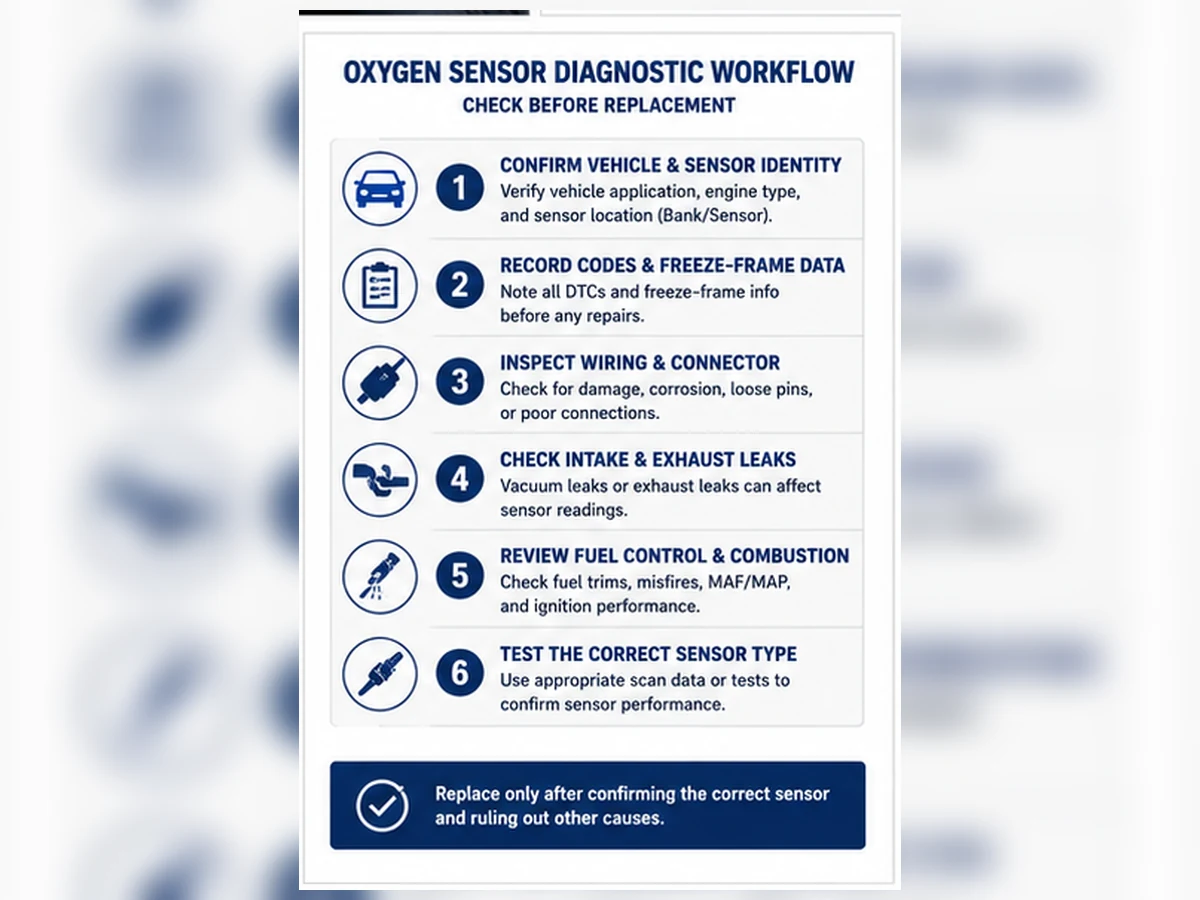
Compare fuel economy over similar routes and fill methods, then record codes, freeze-frame data and fuel trims. Inspect the intake and exhaust for leaks. Check coolant temperature, airflow data and sensor response under the operating conditions specified by service information. A healthy sensor can correctly report a problem created elsewhere.
Upstream and downstream effects are different
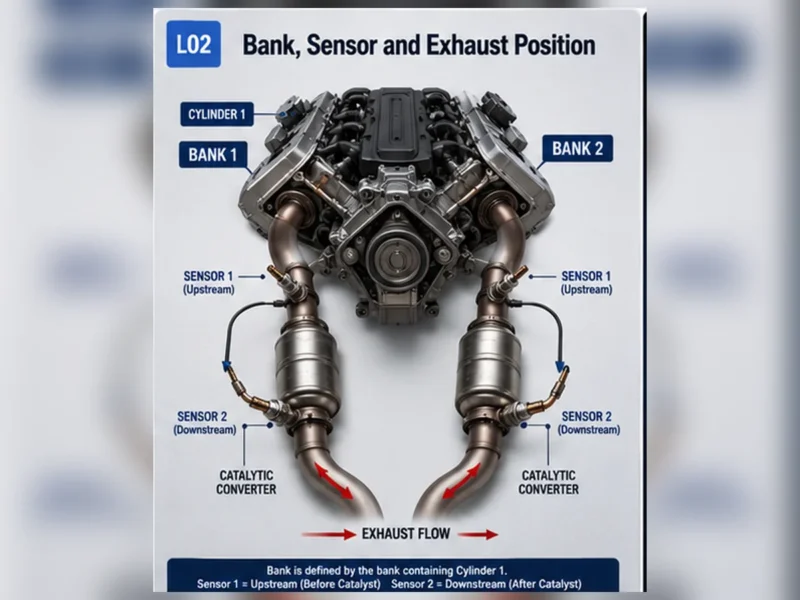
The upstream sensor is normally more directly involved in fuel-control feedback. A downstream sensor commonly monitors catalyst performance, although strategies differ. Replacing a rear sensor solely because mileage declined is therefore especially weak reasoning unless circuit tests and service data support it.
What to verify after repair
Correct the root cause, confirm that fuel trims and sensor data respond normally, and allow required monitors to run legally. Reset procedures differ by vehicle. Compare mileage only over enough similar driving to reduce normal variation; an immediate dashboard estimate is not reliable proof of savings.
How a sensor fault can change fuel use
When a warm engine meets closed-loop conditions, upstream oxygen-sensor feedback helps the control module evaluate mixture. A biased lean report can lead the module to add fuel; a slow or biased rich report can disrupt correction in another direction. The effect depends on the control strategy, operating time in closed loop and whether other inputs remain plausible. A downstream sensor commonly supports catalyst monitoring and should not automatically be blamed for a mileage complaint.
| Possible path | Supporting evidence | What can imitate it |
|---|---|---|
| Biased lean feedback adds fuel | Positive correction with failed response test | Intake leak, low fuel delivery or exhaust leak |
| Slow response delays correction | Technology-specific response outside specification | Slow real mixture change or low scan rate |
| Heater fault delays feedback | Verified heater circuit failure and enable conditions | Fuse, wiring, ground or control fault |
| Fallback strategy after fault | Service information and stored diagnostic evidence | Other failed inputs or open-loop command |
Build a credible fuel-economy baseline
Dashboard estimates are useful for trends but can change with trip length and reset history. For a stronger baseline, record fuel added and distance over several comparable fill cycles, using consistent fill practice. Note ambient temperature, route, average speed, load, tire pressure, fuel blend and idling. Do not compare a winter short-trip period with a warm highway period and assign the difference to one sensor.
Normalize the driving conditions
Cold starts and short trips keep the engine and catalyst below stable operating conditions for a larger share of the journey. Towing, roof loads, traffic and high speed increase energy demand independently of mixture feedback. Record these factors before diagnosis.
Check measurement and maintenance factors
Verify tire size and pressure, dragging brakes, alignment symptoms, fuel leaks and maintenance condition. An odometer or tire-size change can distort calculated mileage. Strong raw-fuel odor or a visible leak is a safety issue, not a sensor experiment.
Use a diagnostic order before replacing the sensor
- Record current, pending and permanent codes, freeze frame and readiness before clearing.
- Confirm engine reaches the expected operating temperature and closed-loop state.
- Review short- and long-term fuel trims by load and speed.
- Inspect intake and exhaust leakage, airflow/load data and fuel delivery.
- Identify the exact upstream sensor technology and run the specified response/circuit test.
- Repair the supported root cause and repeat the baseline under comparable conditions.
| Observation | Question it raises | Next evidence |
|---|---|---|
| High positive trim mainly at idle | Unmetered air or low-flow exhaust leak? | Leak test and trim comparison at higher load |
| High positive trim across load | Fuel delivery, airflow or sensor bias? | Pressure/volume, load data and response test |
| Negative trim | Excess fuel or biased input? | Injectors, purge, pressure, temperature and sensor data |
| Normal trims but mileage complaint | Non-mixture operating factor? | Baseline, tires, brakes, route, load and warm-up |
Inputs that commonly imitate an oxygen-sensor problem
Coolant temperature and thermostat operation
An engine that runs colder than intended may use a richer strategy and spend more time outside normal control conditions. Compare actual temperature data with the vehicle procedure; do not replace the oxygen sensor because the dashboard gauge appears normal.
Airflow, load and intake leakage
Incorrect MAF/MAP data or unmetered air changes the control module’s fuel calculation. A healthy oxygen sensor may report the resulting lean exhaust accurately. Compare load data, fuel trims and leak evidence.
Fuel delivery, injectors and purge
Excessive pressure, injector leakage or uncontrolled purge flow can create rich operation. Low pressure or restricted delivery can create lean operation. These causes must be tested rather than inferred from the oxygen-sensor signal alone.
Interpret narrowband and wideband data correctly
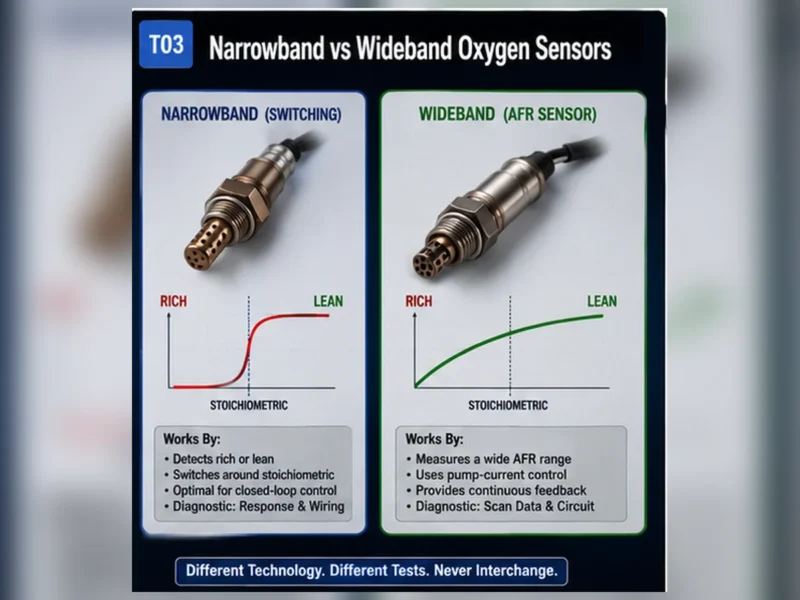
A narrowband upstream trace and a wideband/A/F current or lambda parameter require different expectations. Confirm units, supported PID, engine temperature and commanded state. A single screenshot cannot show response over time or establish whether the sensor caused the fuel correction.
| Data item | Useful question | Limitation |
|---|---|---|
| Short-term fuel trim | What correction is occurring now? | Changes rapidly with state and load |
| Long-term fuel trim | What repeated trend was learned? | Can retain history after a prior fault |
| Sensor voltage/current/lambda | Does response match technology? | Needs commanded state and test conditions |
| Closed-loop status | Is feedback currently enabled? | Does not prove every input is correct |
Composite scenario: cold operation drives the complaint
Composite diagnostic scenario: fuel economy falls during short winter trips and an older oxygen-sensor code is stored in history. Current trims are plausible when warm, but coolant-temperature data shows the engine does not reach the expected operating range. Thermostat diagnosis changes the repair direction. This is a composite example, not a Sunhyings customer case or savings claim.
Why no universal savings percentage is responsible
The benefit of replacement ranges from none, when the sensor was not faulty, to a meaningful correction when biased feedback affected fuel control. Vehicle, route, climate and other faults dominate the result. Do not promise a percentage improvement or calculate payback until diagnosis identifies the fault and a repeatable baseline exists.
Verify both the repair and the economy trend
After repair, confirm circuit and technology-specific sensor response, plausible fuel trims and completion of the relevant monitor. Then compare fuel use over similar routes and conditions. Learned adaptations may require the vehicle’s specified procedure and time to stabilize. Clearing memory repeatedly can erase diagnostic evidence without proving improvement.
Do not convert a mileage complaint directly into an order
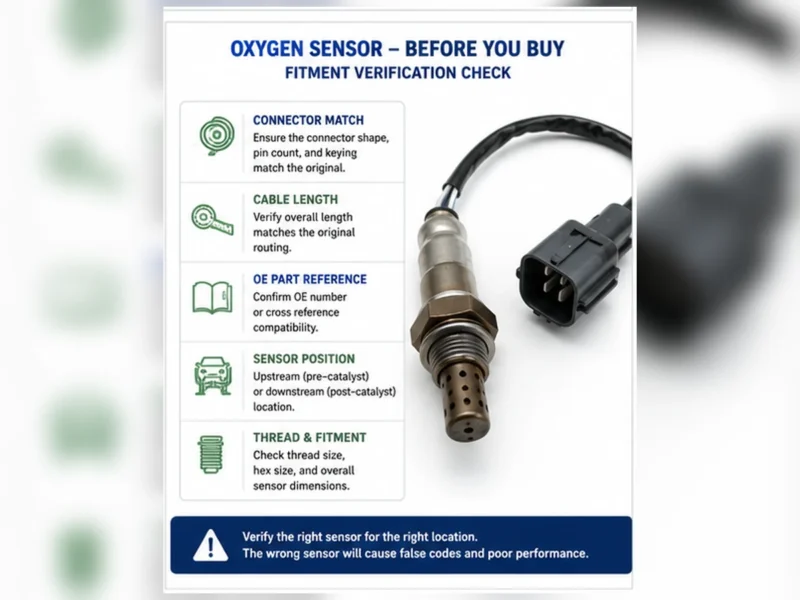
A parts request should include the diagnostic basis as well as fitment identity. Record the tested sensor position, technology, OE reference, complete vehicle and engine, market/emissions package, connector and cable details. “Uses too much fuel” does not identify which sensor is involved or prove that any sensor failed.
For fleet or distributor analysis, separate catalog mismatch, no-fault-found returns and confirmed response failures. Do not advertise a guaranteed fuel-saving percentage. Product evidence can support fitment and specification; only controlled before/after vehicle data under comparable conditions can support an economy result.
If diagnosis supports replacement, verify the OE number, exact Bank/Sensor position, sensor technology, connector, lead and regional application before installation. A correctly diagnosed failure can still produce an unsuccessful repair when the replacement belongs to another position or calibration. Fitment approval and causal diagnosis remain separate gates.
Prepare a fitment or sourcing request
Send the OE number, year/make/model, engine or VIN details, market and emissions package, exact bank/sensor position, connector and old-part photos, quantity and any packaging or approval requirements. Sunhyings will review the supplied data for capability and sourcing feasibility; fitment is not confirmed until application evidence is matched.
Frequently asked questions
How much mileage can a bad oxygen sensor reduce?
There is no dependable universal percentage. The effect depends on sensor bias, control strategy, driving conditions and other faults.
Will replacing an O2 sensor improve gas mileage?
Only when the sensor is actually faulty and affecting control. Replacement will not correct tire, thermostat, airflow, injector or driving-pattern causes.
Can a downstream sensor cause poor mileage?
Its primary role is commonly catalyst monitoring, so diagnose the vehicle strategy and circuit rather than assuming the rear sensor controls fuel.
Can poor mileage occur without a check-engine light?
Yes. Operating conditions, maintenance issues and some biased inputs may affect economy before a monitor sets a code.
What data should I check first?
Record consistent fuel use, codes and freeze frame, then inspect fuel trims, coolant temperature, airflow data, intake/exhaust leaks and sensor response.