







Automotive Nut Coating Selection
Zinc Plated vs Zinc Flake vs Zinc Nickel Nuts: Automotive Coating Selection Guide
Selecting the right coating for automotive nuts is not only a corrosion decision. Zinc plated, zinc flake and zinc nickel nuts can behave differently after coating, thread inspection, assembly torque, vibration, salt exposure and production approval.
This guide compares the three coating options by corrosion exposure, internal thread fit, hydrogen embrittlement risk, friction control, topcoat, RFQ data and automotive document requirements.
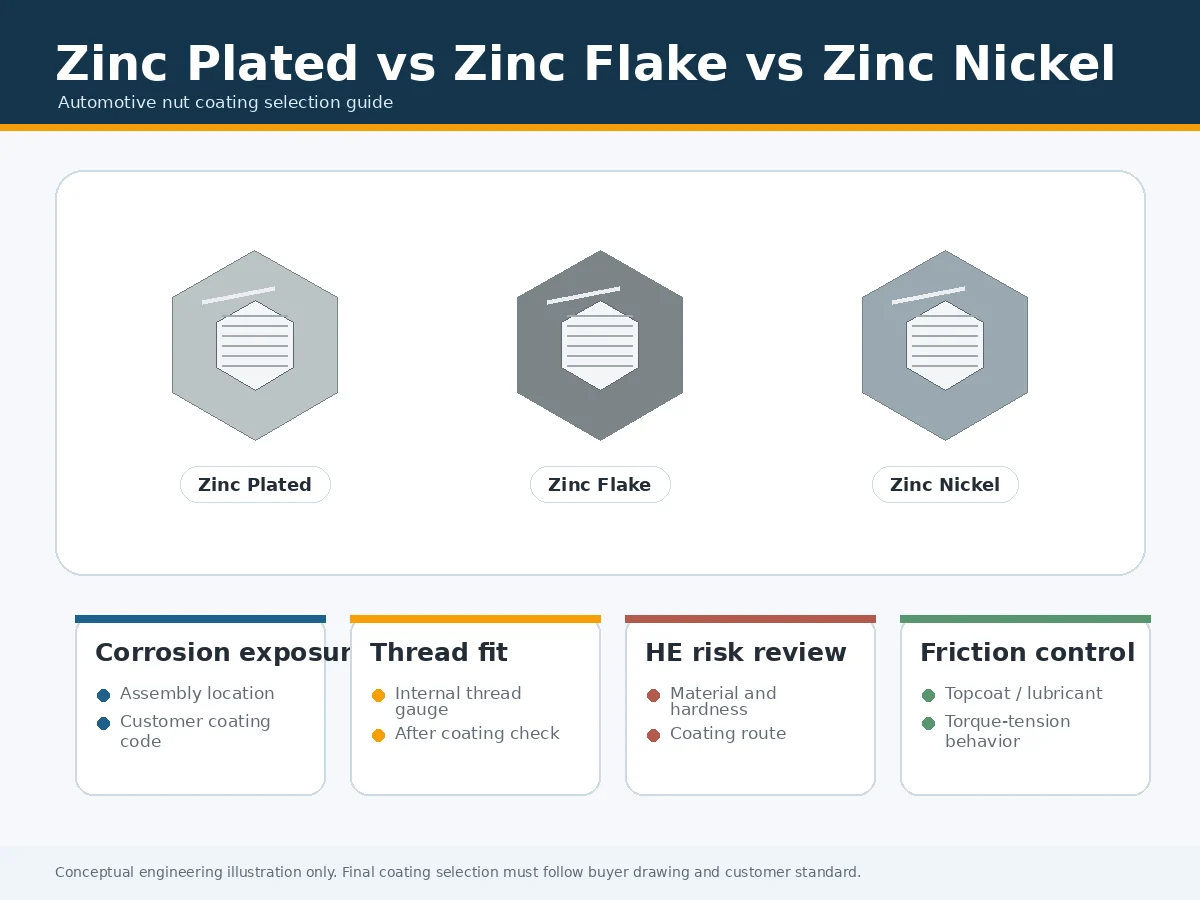
Conceptual coating comparison only; final coating selection must follow the buyer drawing and customer standard.
Quick Answer: Which Coating Should Automotive Buyers Choose?
There is no universal best coating for every automotive nut. The correct choice depends on application environment, material strength, heat treatment, thread fit requirement, customer coating code, topcoat, lubricant, friction range, inspection method and approval document scope.
Zinc plated nuts are often selected for cost-sensitive applications, lower corrosion exposure or projects where the customer drawing already specifies an electroplated zinc finish. They can be practical and widely available, but high-strength or hardened parts require hydrogen embrittlement risk review when electroplating is involved.
Zinc flake nuts are often considered for higher corrosion requirements, externally exposed automotive fasteners or projects where a non-electrolytic coating route is preferred. However, zinc flake does not remove the need to confirm thread fit, coating build-up, topcoat, coefficient of friction and final gauge inspection.
Zinc nickel nuts are often selected when an automotive specification requires stronger corrosion performance than standard zinc plating, a defined appearance, conductive surface behavior or a specific customer coating code. Zinc nickel is still an electroplated system, so material hardness and hydrogen embrittlement review may still matter.
| Application Condition | Zinc Plated Nuts | Zinc Flake Nuts | Zinc Nickel Nuts |
|---|---|---|---|
| Cost-sensitive application | Often suitable | Usually higher cost | Usually higher cost |
| Lower corrosion exposure | Often suitable if specified | May be more than needed | May be more than needed |
| High corrosion exposure | Limited unless customer-approved | Often strong candidate | Often strong candidate |
| High-strength or hardened nut | Needs hydrogen embrittlement review | Often considered when non-electrolytic coating is preferred | Needs hydrogen embrittlement review |
| Internal thread fit sensitivity | Needs post-plating thread control | Needs coating thickness and gauge control | Needs thread allowance and gauge control |
| Torque-tension control | Needs finish and lubricant control | Needs topcoat / friction control | Needs finish / friction control |
| Electrical grounding or conductivity concern | Needs customer confirmation | May be unsuitable unless specified | Needs customer confirmation |
| Weld or clinch function | Needs process-specific review | Needs coating / installation compatibility review | Needs process-specific review |
Selection Rule
Choose the coating by confirmed engineering requirements, not by coating name alone. For automotive nuts, the buyer should confirm assembly location, nut function, thread condition, material hardness, customer coating code, topcoat, friction target, corrosion test method, approval document scope and packaging requirement before quotation.
Zinc Plated vs Zinc Flake vs Zinc Nickel Nuts: Comparison Table
The first comparison should separate coating route, performance expectation and engineering risk. A coating name alone is not enough for quotation. Buyers should specify the exact customer coating code, coating system, topcoat, thread inspection condition and document requirements.
| Factor | Zinc Plated Nuts | Zinc Flake Nuts | Zinc Nickel Nuts |
|---|---|---|---|
| Coating route | Electroplated zinc coating system | Non-electrolytically applied zinc flake system | Electroplated zinc-nickel alloy coating system |
| Main advantage | Cost, availability and common finish options | Corrosion performance and non-electrolytic route when specified | Corrosion performance, appearance and customer-code fit |
| Main engineering concern | Hydrogen embrittlement review for high-strength parts; thread build-up after plating | Topcoat, coating thickness, friction and thread gauge control | Cost, exact specification, system control and hydrogen embrittlement review |
| Typical buyer question | Is standard zinc plating enough for this location? | Does the project require zinc flake with topcoat and friction control? | Does the drawing or OEM standard require zinc nickel? |
| Thread fit risk | Internal thread may tighten after plating | Coating build-up may affect internal thread gauge | Thickness, passivation or sealer may affect final thread fit |
| Torque-tension behavior | Finish and lubricant can change friction | Topcoat and lubricant can change friction | Finish system can change friction |
| Hydrogen embrittlement review | Important for high-strength or hardened parts | Often considered where non-electrolytic coating route is preferred | Important for high-strength or hardened parts |
| RFQ must confirm | Coating code, thickness if specified, post-plating gauge and baking if required | Coating system, basecoat, topcoat, friction range and post-coating gauge | Zinc nickel specification, passivation / sealer, thread fit and report scope |
| Do not assume | All zinc plating is acceptable for automotive | All zinc flake systems perform the same | Zinc nickel automatically solves every corrosion or assembly problem |

Matrix is for selection discussion only; final coating approval depends on drawing, customer coating code and test requirement.
Why Automotive Nut Coating Selection Is Not Only About Salt Spray Hours
Salt spray hours are easy to compare, but they do not fully define automotive nut performance. A coating may look strong in a corrosion test but still create assembly problems if the internal thread becomes tight, the coefficient of friction is not controlled, the wrong topcoat is used, or the customer coating code is not followed.
Automotive nut coating selection should start with the real joint and environment. An interior bracket nut, welded seat-frame nut, underbody nut, clinching nut in sheet metal, electrical grounding nut and all-metal lock nut may have different coating priorities. Corrosion resistance matters, but so do thread fit, seating behavior, weldability or clinching performance, friction, torque-tension behavior, appearance, conductivity and documentation.
The buyer should also confirm whether the corrosion requirement is based on neutral salt spray, cyclic corrosion, customer-specific testing or another validation method. Generic claims should not replace the drawing or customer specification.
Engineering Rule
Do not select coated automotive nuts only by advertised corrosion hours. Confirm the assembly location, customer coating code, material hardness, thread requirement, friction range and inspection method before quotation.
Joint location
Interior, exterior, underbody, engine bay and electrical areas may require different coating systems and different inspection scope.
Thread condition
Internal threads can become tight after coating. Post-coating gauge requirement should be defined if final thread fit is critical.
Assembly friction
Topcoat, lubricant and mating bolt finish can change torque-tension behavior. Torque values should not be guessed from coating name.
Why Nut Function Changes Coating Selection
The same coating may not create the same risk on every nut type. A standard hex nut, flange nut, weld nut, self-clinching nut, all-metal lock nut or grounding nut can have different coating priorities because the failure mode is different.
For example, serrated flange nuts may need bearing-face condition and friction control, while weld nuts may need coating review around weld projection condition and later corrosion protection. A self-clinching nut needs compatibility with sheet material and installation behavior. An all-metal lock nut needs prevailing torque behavior. A grounding nut may require surface conductivity confirmation.
| Nut Function | Coating Selection Concern | Buyer Should Confirm |
|---|---|---|
| Standard internal-thread nut | Thread fit after coating and corrosion exposure | Thread gauge condition, coating code and corrosion requirement |
| Flange nut | Bearing-face friction and seating behavior | Topcoat, lubricant, mating surface and torque-tension requirement if applicable |
| Flange weld nut / hex weld nut | Weld projection behavior and corrosion protection after assembly | Weld process compatibility, coating sequence and post-weld requirement |
| Self-clinching nut | Installation behavior in sheet material and coating damage risk | Sheet material, sheet thickness, coating condition and push-out / torque-out if required |
| All-metal lock nut | Prevailing torque and friction stability | Coating system, lubricant, friction range and prevailing torque test if required |
| Grounding or electrical nut | Surface conductivity and contact reliability | Customer-approved coating and conductivity requirement if applicable |
Functional boundary: Coating selection cannot be finalized from nut geometry alone. The supplier needs assembly location, joint type, mating material, failure mode, thread requirement and any torque, pull-out, torque-out, push-out, prevailing torque or grounding requirement specified by the buyer.
Zinc Plated Nuts: When They Are Suitable and Where They Are Risky
Zinc plated nuts are widely used because they are available, economical and familiar to many buyers. For lower corrosion environments, cost-sensitive assemblies or customer-approved applications, zinc plating may be a practical choice.
However, zinc plated nuts should not be selected automatically for every automotive project. Electroplated coatings require more careful review when the nut material is high-strength, hardened or heat-treated. ISO 4042 covers electroplated coating systems for steel fasteners and includes recommendations for minimizing hydrogen embrittlement risk.
When zinc plated nuts may be suitable
Zinc plated nuts may be suitable when the drawing or customer specification already calls for zinc plating, the corrosion exposure is moderate or low, the nut is not used in a severe underbody or exterior environment, and the coating system has been approved by the customer.
They may also be suitable for non-critical brackets, enclosed assemblies, service parts or applications where cost and availability are important. Even in these cases, the buyer should confirm thread fit after plating, coating thickness if specified, passivation, topcoat, baking if required and inspection report scope.
Main risks of zinc plated nuts
The main risks include hydrogen embrittlement review for high-strength or hardened parts, internal thread build-up after plating, inconsistent friction if lubricant or finish condition is not controlled, and insufficient corrosion performance for severe automotive environments.
A zinc plated nut may pass dimensional inspection before coating but fail thread gauge after plating if the allowance and final gauge condition are not defined. This is especially important for internal threads, small thread sizes or tight thread tolerance requirements.
| Zinc Plated RFQ Item | Why It Matters | Needs Confirmation |
|---|---|---|
| Coating standard or customer code | Avoids generic “zinc plated” substitution | Buyer drawing or customer coating specification |
| Coating thickness if specified | Affects corrosion, thread fit and inspection | Customer standard or drawing note |
| Passivation / sealer / topcoat | Affects appearance and corrosion behavior | Finish code and approved system |
| Cr(VI)-free requirement if applicable | Supports customer compliance requirement | Customer or regulatory requirement |
| Baking / embrittlement relief if required | Supports hydrogen embrittlement risk control | Material hardness and coating standard |
| Post-plating thread gauge | Confirms final assembly fit | Before coating, after coating or both |
| Coating report / corrosion test | Defines document and validation scope | Only if required by customer or program |
Zinc Plating Boundary
Zinc plating can be a practical coating, but it should not be treated as a default automotive answer. If the nut is hardened, heat-treated, thread-critical, torque-sensitive or exposed to severe corrosion, the coating route and customer requirement must be reviewed before quotation.
Zinc Flake Nuts: High Corrosion Targets, High-Strength Parts and Friction Control
Zinc flake coatings are often considered for automotive fasteners because they are non-electrolytically applied and can be specified with topcoat and lubricant systems. ISO 10683 covers non-electrolytically applied zinc flake coating systems for steel fasteners and applies to nuts, bolts, screws, studs and other fastener types.
For automotive nuts, zinc flake may be considered when corrosion resistance is important, the application is exposed to road environment, or the project wants to avoid an electroplating route for high-strength or hardened parts. Still, zinc flake should be specified carefully. Different systems, basecoats, topcoats and lubricants can behave differently.
Why zinc flake is often considered for automotive fasteners
Zinc flake systems are often used where corrosion resistance and process-route risk are important. They can be useful for underbody, chassis, exposed brackets or other automotive assemblies when the customer specification allows or requires them.
Zinc flake is also often discussed for high-strength fasteners because it is not an electroplated coating route. However, buyers should not write “zinc flake means no risk” without engineering confirmation. Material condition, pre-treatment, coating process, topcoat and customer standard still matter.
Main risks of zinc flake nuts
Zinc flake coatings can still affect thread fit. Coating build-up, topcoat thickness or uneven coverage may influence internal thread gauge. Friction behavior can also change depending on topcoat and lubricant. For torque-controlled automotive assemblies, the coefficient of friction should be confirmed if required by the drawing or customer standard.
Not every zinc flake system has the same performance. A buyer should avoid writing only “zinc flake” in an RFQ without specifying the coating system, topcoat, friction range, corrosion requirement and inspection condition.
| Zinc Flake RFQ Item | Required Clarification | Risk If Missing |
|---|---|---|
| Coating system | Customer code, approved system or coating supplier specification | Supplier may quote a different zinc flake system |
| Basecoat + topcoat | Required when corrosion or friction depends on topcoat | Friction or corrosion expectation may not match |
| Lubricant condition | Dry, lubricated or specified friction condition | Torque-tension behavior may change |
| Coefficient of friction | Target range if required | Assembly torque scatter |
| Post-coating thread gauge | Final nut acceptance condition | Thread gauge dispute after coating |
| Corrosion test method | Salt spray, cyclic corrosion or customer-specific test | Generic performance claim may not satisfy buyer requirement |
| Document package | Coating report, IMDS or PPAP only if required | Late document conflict |
Zinc Flake Boundary
Zinc flake should be specified as a coating system, not just a coating name. Basecoat, topcoat, lubricant, friction condition, corrosion test method, post-coating thread gauge and document scope should be confirmed when they affect approval.
Zinc Nickel Nuts: Corrosion Resistance, Thread Control and Specification Fit
Zinc nickel nuts are often selected for automotive projects that require better corrosion resistance than standard zinc plating, a defined finish appearance, conductive surface behavior or a specific OEM coating code. Zinc nickel can be a strong option when the drawing and customer standard require it.
However, zinc nickel is not simply “better zinc plating” in every project. It usually costs more than standard zinc plating, and the exact zinc nickel system must be specified. Buyers should confirm the coating code, thickness range if specified, passivation, sealer, thread inspection condition, corrosion requirement and document scope.
Why zinc nickel may be selected
Zinc nickel may be selected when the part is exposed to more demanding corrosion conditions, when the customer specification calls for zinc nickel, or when the project needs a finish system with defined appearance and engineering behavior.
It may also be selected when the assembly requires a balance of corrosion protection, dimensional control and conductive surface properties. These benefits depend on the exact coating system and customer approval, not only the words “zinc nickel.”
Main risks of zinc nickel nuts
The main risks include higher cost, unclear specification, incorrect coating thickness, post-coating thread-fit problems and hydrogen embrittlement review for high-strength or hardened parts. Because zinc nickel is an electroplated system, buyers should not ignore material hardness and process-route risk.
If the RFQ only says “zinc nickel” without a customer code or coating specification, suppliers may quote different systems. That can lead to sample approval problems, report mismatch or coating performance disagreement.
| Zinc Nickel RFQ Item | Why It Matters | Needs Confirmation |
|---|---|---|
| Zinc nickel coating code | Prevents quoting the wrong system | Customer drawing or coating specification |
| Nickel content / system requirement if specified | Must follow customer standard | Approved zinc nickel system |
| Thickness range if specified | Affects corrosion and thread fit | Specification range and inspection method |
| Passivation / sealer / topcoat | Affects appearance and corrosion behavior | Customer finish code |
| Post-coating thread gauge | Confirms final assembly fit | Before coating, after coating or both |
| Hydrogen embrittlement review | Needed depending on material and hardness | Material, hardness and customer process requirement |
| Coating report / IMDS / PPAP | Defines approval evidence if required | Program-specific document scope |
Zinc Nickel Boundary
Zinc nickel should be selected when it matches the customer coating code and project requirement. It should not be used as a generic substitute for all automotive corrosion problems without confirming cost, thread fit, hydrogen embrittlement review, friction behavior and approval documentation.
Thread Fit After Coating: Internal Thread Gauge and Post-Coating Inspection
Nuts are internal-thread components, so coating selection must consider thread fit after coating. A coating system that works well on an external bolt may still create risk inside a nut if the thread allowance, coating build-up or final gauge condition is not controlled.
Thread inspection before coating does not automatically guarantee final coated thread acceptance. The buyer should clarify whether the nut must pass a thread plug gauge before coating, after coating or both. This is especially important when the drawing calls for tight thread tolerance, small thread size, thick coating system or post-coating functional assembly.
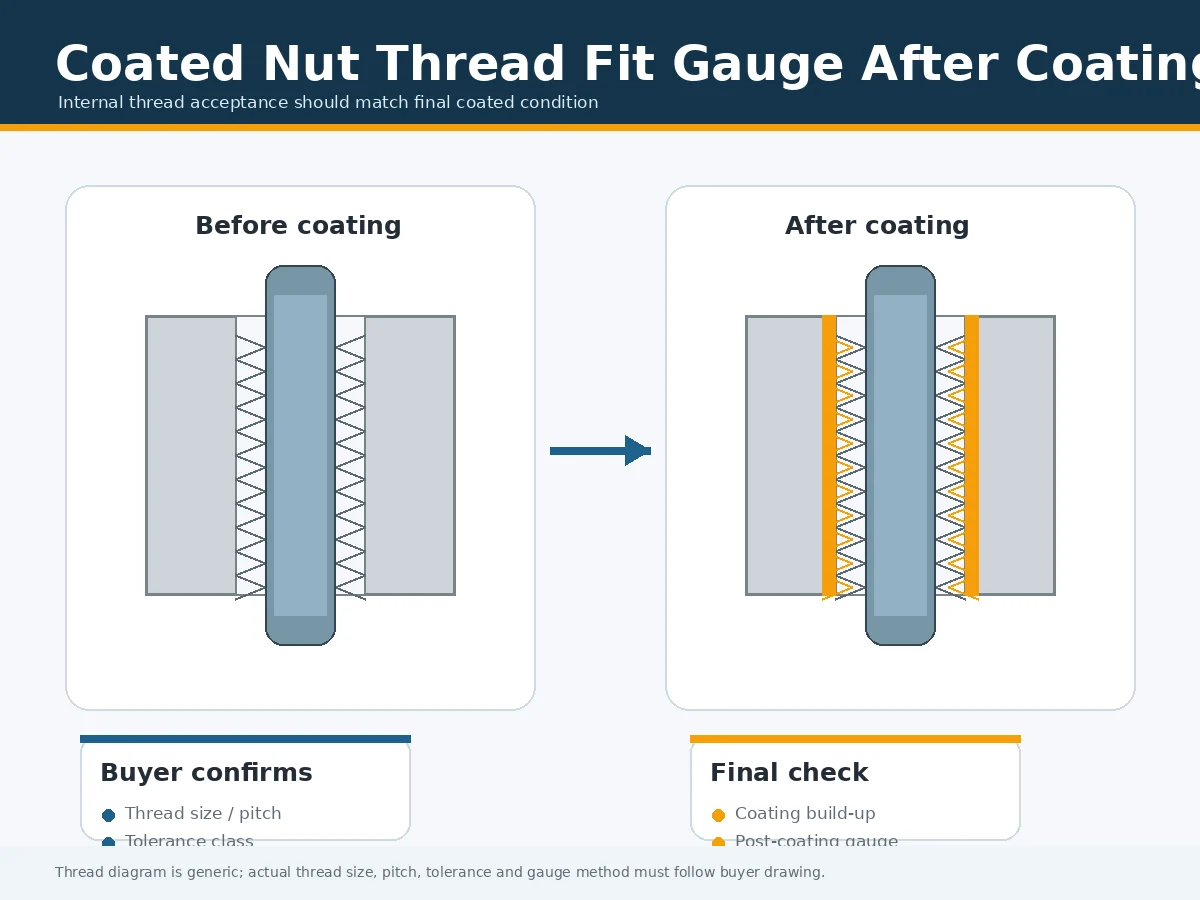
Thread diagram is generic; actual thread size, pitch, tolerance and gauge method must follow the buyer drawing.
For zinc plated nuts and zinc nickel nuts, electroplated build-up can reduce internal thread clearance. For zinc flake nuts, coating film and topcoat can also affect gauge entry and assembly. The solution is not to guess. The drawing or RFQ should define the final inspection condition.
| Thread Item | Buyer Should Confirm | Risk If Missing |
|---|---|---|
| Thread size and pitch | Drawing callout | Wrong mating bolt, screw or stud |
| Thread tolerance | Class or fit requirement | Gauge disagreement |
| Coating thickness if specified | Customer standard or coating code | Tight thread or inconsistent fit |
| Gauge condition | Before coating, after coating or both | Sample approval dispute |
| Chamfer / lead-in | Drawing-controlled entry condition | Difficult assembly or gauge entry issue |
| Topcoat / lubricant | If friction requirement applies | Torque scatter or preload variation |
| Inspection record | Gauge report if required | Missing approval evidence |
Drawing connection: For custom projects, coating and thread requirements should be shown clearly in the drawing or RFQ package. For more drawing-control context, review SUNHYINGS made-to-print special nuts.
Hydrogen Embrittlement Risk: What Buyers Should Confirm
Hydrogen embrittlement risk is one of the most important engineering considerations when selecting coatings for high-strength or hardened steel fasteners. It is especially relevant when electroplated coating systems are used.
For automotive nuts, the buyer should confirm the material, hardness, heat treatment and coating route before assuming that a finish is acceptable. Zinc plated and zinc nickel nuts are electroplated systems, so high-strength or hardened parts may require hydrogen embrittlement review, baking or customer-specific process controls if specified.

Risk workflow is explanatory only; final process control must follow the customer standard and approved coating specification.
Zinc flake is a non-electrolytically applied coating system and is often considered where avoiding electroplating-related hydrogen embrittlement risk is important. But this should not be written as “zinc flake eliminates all risk.” The project still needs correct pre-treatment, coating process control, topcoat, inspection and customer approval.
| Risk Factor | Why It Matters | Buyer Should Confirm |
|---|---|---|
| Material grade | Determines strength and process sensitivity | Drawing or customer standard |
| Hardness / property class | Higher hardness can increase concern | Hardness range and test method |
| Heat treatment | Affects mechanical behavior | Heat treatment requirement and records |
| Coating route | Electroplated vs non-electrolytic route changes risk review | Coating standard or approved process |
| Baking / relief treatment | May be required by standard or customer | Required timing and condition if specified |
| Customer approval | Final decision depends on program rules | Customer coating code and approval process |
No Universal Zero-Risk Claim
A non-electrolytic coating route can be an important selection factor, but hydrogen embrittlement risk review still depends on material, hardness, heat treatment, process controls and customer requirement. Do not claim guaranteed zero hydrogen embrittlement without project-specific validation.
Topcoat, Lubricant and Torque-Tension Behavior
Coating is not only a corrosion layer. It changes the surface condition of the nut and can affect friction during tightening. At the same tightening torque, different coating systems, topcoats or lubricants may create different clamp load.
This matters for automotive joints where preload, loosening resistance, prevailing torque or assembly consistency is important. It is especially relevant when coated nuts are used with mating bolts that also have their own coating, lubricant or surface condition.

No torque or friction value is implied; test values must come from the buyer drawing or assembly standard.
For zinc plated nuts, passivation, sealer and lubricant condition can affect friction. For zinc flake nuts, topcoat and integrated or added lubricant can be critical. For zinc nickel nuts, the exact finish system may also influence friction and assembly behavior.
The buyer should not ask the supplier to guess the torque value or coefficient of friction. If torque-tension behavior matters, the RFQ should include the required coefficient of friction range, test method, lubricated or dry condition, mating bolt condition and acceptance criteria.
| Variable | Why It Matters | Buyer Should Confirm |
|---|---|---|
| Topcoat | Changes friction and corrosion behavior | Required topcoat code |
| Lubricant | Changes torque-tension behavior | Lubricated or dry condition |
| Coefficient of friction | Controls assembly consistency | Target range if required |
| Mating bolt finish | Affects complete joint behavior | Bolt coating and surface condition |
| Locking feature | Affects prevailing torque | Test method and acceptance |
| Coating thickness | Affects thread fit and friction | Final gauge and inspection condition |
For locking function and torque-sensitive applications, buyers can also review SUNHYINGS all-metal lock nuts and common automotive assembly problems solved by special nuts.
Drawing and RFQ Checklist for Coated Automotive Nuts
A coated automotive nut RFQ should not say only “zinc plated,” “zinc flake” or “zinc nickel.” Those names are not enough for engineering review. The supplier needs the drawing, coating code, customer standard, application context, thread condition, material condition, friction requirement and document scope.

Checklist is for RFQ preparation only; PPAP, IMDS and coating reports apply only when required by the customer or program.
A complete RFQ helps prevent wrong coating substitution, post-coating thread failure, torque scatter, corrosion disagreement and late document conflict. For supplier-side review context, see SUNHYINGS as a special nuts supplier for automotive applications.
| RFQ Item | Required? | Why It Matters | Needs Confirmation |
|---|---|---|---|
| Latest drawing revision | Yes | Controls technical baseline | Current drawing and approved revision |
| Nut type and function | Yes | Weld, clinch, lock and flange nuts have different risks | Function, mating part and failure mode |
| Assembly location | Yes | Determines corrosion exposure and joint function | Interior, exterior, underbody, engine bay or electrical area |
| Thread size, pitch and tolerance | Yes | Controls final assembly fit | Gauge method and before / after coating condition |
| Material / hardness / heat treatment | Yes if specified | Supports hydrogen embrittlement review | Material grade, property class, hardness range or heat-treatment note |
| Coating type | Yes | Zinc plated, zinc flake or zinc nickel is only the starting point | Exact coating family and route |
| Customer coating code | Strongly recommended | Prevents generic coating substitution | Customer drawing, OEM code or purchase specification |
| Coating thickness | If specified | Affects thread fit and corrosion expectation | Specified range, inspection method and final condition |
| Topcoat / sealer / lubricant | If required | Controls friction and finish behavior | Approved system and dry / lubricated condition |
| Corrosion test method | If required | Defines validation expectation | Neutral salt spray, cyclic corrosion or customer-specific test |
| Post-coating thread gauge | If thread critical | Prevents final fit dispute | Before coating, after coating or both |
| Coefficient of friction | If required | Supports torque-tension consistency | Target range, test method and mating bolt condition |
| PPAP / IMDS / coating report | If required | Defines approval document scope | Customer or program requirement |
| Annual volume | Yes | Affects coating route and process planning | Prototype, sample approval and production volume |
| Packaging | If required | Prevents coating damage and mixed lots | Bulk, bag, tray, label, lot separation and rust prevention |
PPAP should be treated as a customer- or program-specific requirement. IMDS should also be treated as an automotive material-data requirement when required. These should be confirmed before quotation instead of added after price approval.
How SUNHYINGS Reviews Coating Requirements Before Quotation
SUNHYINGS should review coated automotive nut projects by checking the drawing, coating requirement, thread condition, material risk and application context before quotation. The goal is not to select the most expensive coating, but to confirm the coating system that matches the buyer’s drawing and customer requirement.
Drawing and coating code review
The review starts with the latest drawing revision and coating note. If the drawing says only “zinc,” “Zn,” “black finish” or “corrosion resistant,” the coating requirement is not clear enough for automotive quotation. The coating code, finish color, topcoat, sealer, lubricant, corrosion requirement and report scope should be confirmed.
Material, hardness and hydrogen embrittlement risk review
SUNHYINGS should review material grade, hardness, heat treatment and strength requirement before confirming an electroplated coating route. If hydrogen embrittlement risk is relevant, the project should be reviewed according to the customer standard and coating process requirement.
Thread and functional requirement review
For nuts, the final internal thread condition is critical. The review should confirm thread size, pitch, tolerance, chamfer, post-coating gauge requirement and functional test needs. Flange weld nuts, hex weld nuts, self-clinching nuts, all-metal lock nuts and flange nuts may require different review points.
Sample and production control review
Before sampling, the buyer and supplier should confirm whether the sample route matches the production route. They should also define coating report scope, inspection plan, packaging, lot traceability, PPAP if required and IMDS if required.
What can be checked before quotation
For coating-sensitive automotive nut projects, SUNHYINGS can review the buyer’s drawing and RFQ package to identify missing technical data before price confirmation. This review is a quotation-stage engineering check, not a substitute for customer approval, coating laboratory validation or formal PPAP submission.
| Review Item | What SUNHYINGS Can Check | Boundary |
|---|---|---|
| Drawing revision and coating note | Whether the coating callout is clear enough for quotation and sampling | Customer drawing and coating specification remain the final authority |
| Internal thread fit | Whether post-coating thread gauge condition needs to be defined | Actual gauge acceptance must follow the buyer drawing and inspection method |
| Material, hardness and heat treatment | Whether electroplating-related hydrogen embrittlement review may be relevant | No coating route should be approved without customer requirement review |
| Coating report requirement | Whether coating report, corrosion test data or supplier documentation is requested | Report scope depends on customer, program and coating partner capability |
| Friction and torque-tension requirement | Whether topcoat, lubricant, coefficient of friction or mating bolt finish is missing | Torque and friction values must come from customer standard or qualified testing |
| Packaging and lot traceability | Whether coating damage prevention, lot separation and label requirements are defined | Final packaging method should follow purchase order and customer logistics requirement |
Open questions before quotation
If coating data is incomplete, SUNHYINGS should clarify the missing points before final quotation. Typical open questions include: What is the exact coating code? Is the nut high-strength or heat-treated? Must the thread pass gauge after coating? Is a friction range required? Is the corrosion requirement salt spray, cyclic corrosion or customer-specific? Are PPAP, IMDS or coating reports required?
Buyers can review SUNHYINGS as a custom nut manufacturer for custom automotive nut projects involving drawing review, thread fit, coating requirements and production control.
Review boundary: Missing coating or inspection data should be marked as “needs confirmation.” It should not be replaced by a generic assumption.
Before You Request a Quote for Coated Automotive Nuts
Prepare the drawing revision, coating code, nut function, assembly location, material / hardness, thread tolerance, post-coating gauge requirement, topcoat, lubricant, corrosion test method, friction range if required, annual volume and packaging requirement before quotation.
If any of these items are missing, the coating choice should be treated as “needs confirmation” rather than assumed. This is especially important for zinc plated, zinc flake and zinc nickel nuts used in automotive joints where thread fit, hydrogen embrittlement review or torque-tension behavior affects approval.
Minimum technical package
Send the latest drawing revision, thread size and tolerance, nut function, coating note, material or hardness requirement, assembly location and annual volume.
Extra data for coating-sensitive projects
Confirm customer coating code, topcoat, lubricant, corrosion test method, post-coating thread gauge, coefficient of friction if required, PPAP if required and IMDS if required.
Technical References and Standards Context
The references below are provided as technical context for coating route, fastener coating systems, hydrogen embrittlement risk review and automotive document requirements. They do not replace the buyer drawing, customer-specific standard, coating specification or qualified engineering review.
| Reference | How It Supports This Guide | Use Boundary |
|---|---|---|
| ISO 4042: Fasteners — Electroplated coating systems | Provides context for electroplated coating systems on fasteners and hydrogen embrittlement risk minimization guidance. | Use as coating-route context only; final requirement must follow customer standard and approved drawing. |
| ISO 10683: Non-electrolytically applied zinc flake coating systems | Provides context for zinc flake coating systems for steel fasteners, including nuts, with or without topcoat or lubricant. | Use as zinc flake coating context only; final system must be specified by customer code or approved coating specification. |
| AIAG PPAP-4 | Provides context for production part approval when customer engineering design records and specification requirements must be demonstrated. | PPAP applies only when required by the customer, program or purchase specification. |
| IMDS: International Material Data System | Provides context for automotive material data reporting when required by automotive programs. | IMDS should be treated as a customer or automotive-program requirement, not a default requirement for every custom nut order. |
For more SUNHYINGS engineering resources, review the technical guides archive and the custom special nuts product hub.
FAQ
Which is better for automotive nuts, zinc plated, zinc flake or zinc nickel?
There is no universal best option. Zinc plated nuts may be suitable for cost-sensitive and lower-corrosion applications. Zinc flake nuts are often considered for higher corrosion requirements and non-electrolytic coating needs. Zinc nickel nuts are often selected when the customer specification requires stronger corrosion performance or a defined finish system. The final choice depends on the drawing, customer standard, material, hardness, thread fit, friction requirement and approval scope.
Are zinc plated nuts suitable for automotive applications?
Yes, zinc plated nuts can be suitable for some automotive applications when the drawing or customer specification allows them. They are often used in cost-sensitive or lower-corrosion environments. However, high-strength or hardened parts require hydrogen embrittlement review, and final thread fit after plating should be confirmed when required.
Why are zinc flake coatings used on automotive fasteners?
Zinc flake coatings are often used because they can provide strong corrosion protection and are non-electrolytically applied. They are often considered for exposed automotive fasteners or high-strength fasteners when the customer specification allows them. The buyer still needs to confirm coating system, topcoat, friction range, thread gauge and corrosion test requirements.
Is zinc nickel better than zinc plating for nuts?
Zinc nickel may provide better corrosion performance than standard zinc plating when properly specified, but it is not automatically the best choice for every nut. It usually costs more and still requires exact coating code, thread fit control, corrosion requirement and hydrogen embrittlement review when high-strength or hardened parts are involved.
Does coating affect internal thread fit on nuts?
Yes. Coating can reduce internal thread clearance and affect gauge inspection. A nut may pass thread inspection before coating but fail after coating if thread allowance, coating thickness or final gauge condition is not defined. Buyers should confirm whether final acceptance is before coating, after coating or both.
Which coating has the lowest hydrogen embrittlement risk?
Hydrogen embrittlement risk depends on material, hardness, heat treatment, coating route and customer requirement. Zinc plated and zinc nickel are electroplated systems, so high-strength or hardened parts may require review. Zinc flake is non-electrolytically applied and is often considered when avoiding electroplating-related risk is important, but final approval must follow customer engineering requirements.
Does zinc flake coating change torque-tension behavior?
Yes, it can. Zinc flake systems often include topcoat or lubricant, and these can affect friction. If torque-tension behavior matters, the buyer should define coefficient of friction, mating bolt finish, test method and assembly condition instead of relying on generic coating names.
What should I include in an RFQ for coated automotive nuts?
Include the latest drawing revision, nut type, application location, thread size, pitch, tolerance, material, hardness, coating code, topcoat, lubricant, post-coating thread gauge, corrosion test requirement, coefficient of friction if required, PPAP if required, IMDS if required, annual volume and packaging requirement.
Related SUNHYINGS Pages
Review related pages for custom nuts, automotive applications, special nut function and engineering guidance.
Technical Review Note
This article was prepared for sourcing managers, purchasing engineers, SQE teams, fastener engineers and automotive project teams comparing zinc plated, zinc flake and zinc nickel nuts before RFQ, sampling or production approval.
Reviewed scope: coating route, corrosion exposure, internal thread fit, post-coating gauge condition, hydrogen embrittlement risk review, topcoat, lubricant, torque-tension behavior, material hardness, nut function, RFQ data, PPAP if required and IMDS if required.
Standards and limitation note: This article is a practical sourcing and engineering guide. It does not replace the customer drawing, coating specification, customer-specific requirement, qualified engineering review, formal PPAP submission, IMDS reporting requirement or supplier process approval. Missing coating, thread, friction, material or document data should be treated as needs confirmation, not assumed as fact.