Nylon Insert Lock Nuts vs All-Metal Lock Nuts: Temperature, Vibration and Reuse Decision Guide
Nylon insert lock nuts and all-metal lock nuts are both prevailing torque lock nuts, but they are not selected for the same operating conditions. The right choice depends on temperature exposure, vibration condition, reuse requirement, thread fit, coating, installation torque and customer standard.
This guide helps buyers compare nylon insert and all-metal lock nuts before RFQ, sampling or drawing review. Missing project data should be marked as needs confirmation, not assumed as fact.
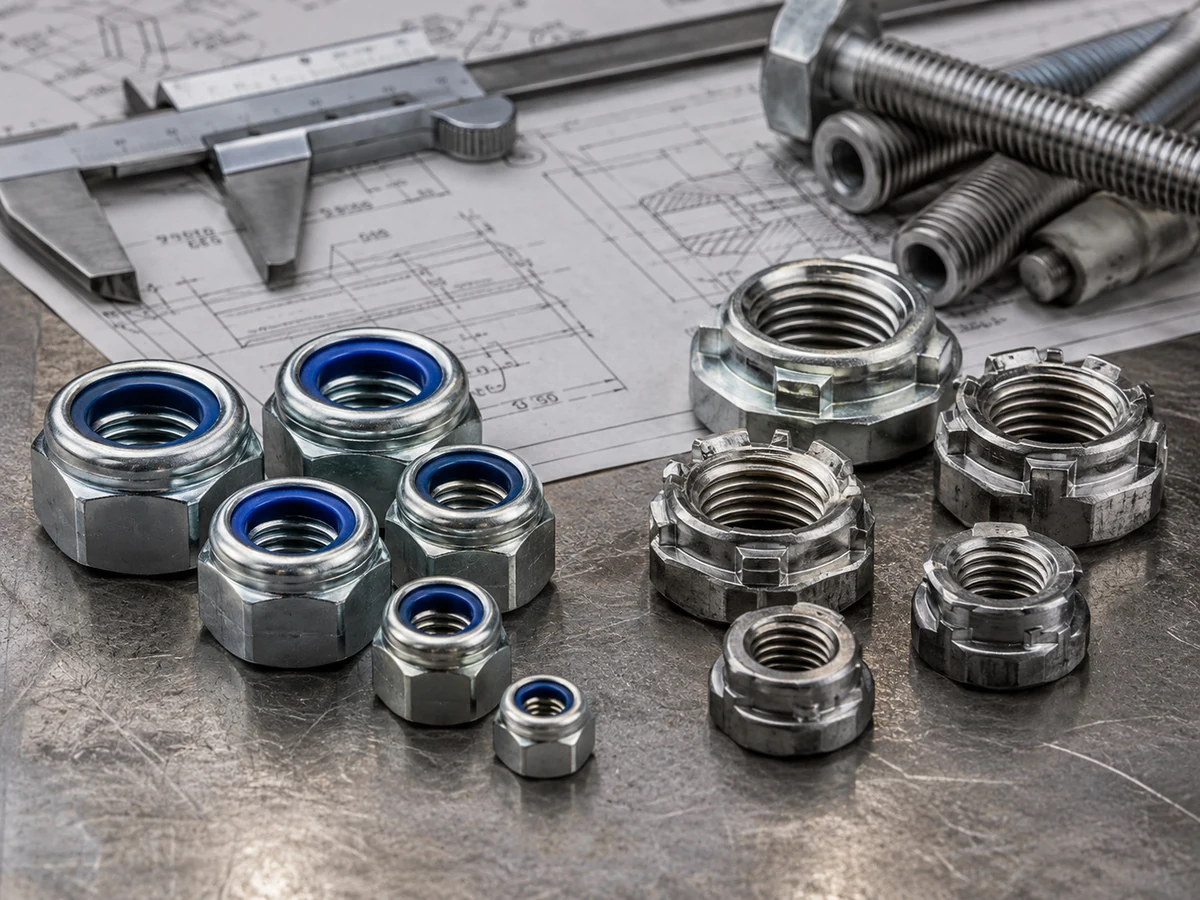
Nylon insert and all-metal lock nuts should be compared by actual joint temperature, vibration condition, reuse rule and prevailing torque requirement.
Conceptual engineering visual only; final lock nut selection depends on drawing, joint condition and customer requirement.
Quick Answer: Which Lock Nut Should Buyers Choose?
A nylon insert lock nut is commonly reviewed when the operating temperature, chemical exposure, service condition and reuse expectation are compatible with the insert material. The non-metallic insert creates resistance against the mating thread and helps reduce loosening under suitable conditions.
An all-metal lock nut is commonly reviewed when the application requires a metal-to-metal locking feature, higher temperature resistance, no polymer insert, or a locking method less dependent on insert material. However, all-metal does not automatically mean suitable for every vibration or reuse condition.
Buyer Condition
Usually Review Nylon Insert Lock Nuts
Usually Review All-Metal Lock Nuts
Needs Confirmation
Moderate temperature application
May be suitable if insert material is compatible
Also possible
Actual joint temperature, exposure duration and insert material
High temperature application
Needs insert material confirmation
Often reviewed first
Material, coating, lubrication, hardness and customer standard
Vibration-sensitive joint
Possible with validation
Possible with validation
Joint design, preload, clamp length and test method
Reuse after removal
Depends on remaining prevailing torque
Depends on remaining prevailing torque
Customer service rule, thread condition and inspection method
Metal-only locking requirement
Usually not preferred
Usually reviewed
Drawing, customer standard or application requirement
Automotive approval project
Conditional
Conditional
Drawing revision, inspection plan and PPAP scope if required
No Universal Winner
The safest decision is not “nylon is better” or “all-metal is better.” The correct decision is based on assembly location, joint type, temperature exposure, vibration condition, thread size, thread tolerance, coating, prevailing torque, installation torque, reuse rule, inspection method and customer standard.
What Are Nylon Insert Lock Nuts?
Nylon insert lock nuts use a non-metallic insert inside the nut to create prevailing torque. When the mating bolt enters the insert, the insert creates interference against the thread. This resistance helps reduce loosening when the joint is designed and assembled correctly.
The locking behavior depends on more than the nut name. Buyers should confirm the insert material, operating temperature, chemical exposure, thread size, pitch, tolerance, mating bolt condition, coating, installation method and reuse requirement.
The main limitation is that the insert is not a metal locking feature. Insert behavior can change with temperature, exposure duration, chemical contact, repeated installation, thread damage and service conditions. Any temperature limit must come from the material datasheet, product standard, customer drawing or project specification.
Buyer warning: If an RFQ only says “nylon lock nut” without insert material, operating temperature, chemical exposure, thread tolerance or reuse requirement, the project should remain open for technical confirmation before quotation or sampling.
What Are All-Metal Lock Nuts?
All-metal lock nuts create prevailing torque through metal-to-metal locking features. Instead of using a nylon insert, they rely on controlled thread deformation, distorted thread geometry, elliptical locking sections, top-lock features, side-lock features or other engineered metal locking designs.
For buyers comparing nylon insert and all-metal lock nuts, the key difference is the locking mechanism. All-metal lock nuts do not rely on a polymer insert, so they are commonly reviewed when temperature, chemical exposure, metal-only requirements or severe service conditions make a nylon insert unsuitable.
However, all-metal lock nuts still require careful specification. The buyer should confirm thread size, pitch, tolerance, material, hardness, heat treatment, coating, lubrication, prevailing torque, installation torque and inspection method. Coating or plating can change thread fit and torque behavior, especially when the locking feature depends on controlled metal-to-metal thread interference.
Engineering boundary: All-metal lock nuts remove polymer insert concerns, but they do not remove the need for torque validation, coating control, thread inspection or customer approval.
Locking Mechanism Comparison: Nylon Insert vs All-Metal
The locking mechanism affects temperature behavior, vibration response, reuse expectation, inspection method and RFQ requirements. Buyers should understand the locking principle before deciding which nut type belongs in the drawing or RFQ.
Nylon insert lock nuts use insert interference, while all-metal lock nuts rely on metal-to-metal prevailing torque features.
Explanatory visual only; locking feature geometry must follow the approved drawing or product standard.
Standards context: Prevailing torque lock nuts may be defined by different standards depending on whether the locking feature is a non-metallic insert or an all-metal feature. Buyers should follow the latest drawing revision or customer-specified standard rather than selecting by part name only.
Comparison Item
Nylon Insert Lock Nut
All-Metal Lock Nut
Locking mechanism
Polymer insert interference against mating thread
Metal-to-metal prevailing torque
Polymer component
Yes
No
Heat sensitivity
Depends on insert material and exposure
Depends on nut material, hardness, coating, lubrication and thread design
Vibration review
Requires joint validation
Requires joint validation
Reuse behavior
Depends on insert condition and remaining prevailing torque
Depends on thread deformation, wear and remaining prevailing torque
Thread condition sensitivity
Insert engagement and mating thread condition matter
Locking zone geometry and thread tolerance matter
Coating influence
Coating may affect thread engagement and assembly
Coating may strongly affect metal-to-metal torque behavior
Inspection focus
Insert condition, thread fit and prevailing torque
Locking feature, thread form, coating and prevailing torque
For buyers sourcing custom special nuts, the lock nut type should be treated as a functional decision, not just a commodity price item.
Temperature Decision: When Heat Changes the Choice
Temperature is one of the most important reasons buyers compare nylon insert lock nuts with all-metal lock nuts.
For nylon insert lock nuts, the insert material is the first concern. A polymer insert may be affected by operating temperature, heat cycles, exposure time, chemical contact or assembly environment. If the joint temperature is close to the insert material limit, or if the service condition is uncertain, the buyer should not approve the nut without checking the material datasheet, customer standard or product specification.
For all-metal lock nuts, the absence of a nylon insert removes the polymer insert temperature concern. This is why all-metal lock nuts are often reviewed for high-temperature areas, engine-adjacent assemblies, exhaust-adjacent locations, braking-related components, underbody zones, industrial equipment and other applications where a polymer insert may not be acceptable.
However, all-metal lock nuts are not free from temperature-related review. Material, hardness, heat treatment, coating, lubrication, thread deformation and prevailing torque behavior still need confirmation. High temperature may affect coating performance, lubrication behavior or joint preload retention depending on the application.
Temperature exposure can change the selection between nylon insert and all-metal lock nuts.
No fixed temperature limit is implied; temperature limits must come from material datasheet, drawing or project specification.
Temperature Input
Why It Matters
Buyer Should Confirm
Actual joint temperature
Determines whether insert, material and coating are suitable
Measured or specified joint temperature, not only ambient temperature
Peak temperature
Important for short-term exposure or heat spikes
Maximum exposure condition if required
Continuous temperature
Important for long-term material behavior
Normal operating temperature range from application data
Heat cycle frequency
May affect insert, coating and joint relaxation
Cycle condition if defined by the customer
Assembly location
Engine bay, underbody, exhaust-adjacent or general chassis location changes risk
Vehicle zone or equipment location
Customer standard
Controls acceptance criteria and material limits
Latest drawing revision or customer requirement
Temperature Values Must Not Be Guessed
Temperature limit must come from the material datasheet, product standard, customer drawing or project specification. It should not be invented during quotation.
Vibration Decision: Which Lock Nut Resists Loosening Better?
Both nylon insert lock nuts and all-metal lock nuts are used to resist loosening, but vibration resistance is not controlled by the nut alone.
A lock nut is part of a joint system. Vibration performance depends on joint design, preload, clamp length, thread engagement, mating bolt grade, surface condition, coating, lubrication, installation torque, relaxation, temperature, service load and the test method used to evaluate loosening.
A nylon insert lock nut may perform well in a compatible environment when the insert material, thread fit and assembly condition are suitable. An all-metal lock nut may be preferred when the application needs a metal-only locking feature, higher temperature capability or resistance to conditions that may degrade a polymer insert.
Vibration and reuse decisions should be reviewed at joint level, not by nut type alone.
Vibration and reuse performance must be validated under actual joint condition; no universal reuse cycle is implied.
Vibration Factor
Why It Matters
Needs Confirmation
Joint type
Different joints loosen differently under dynamic load
Rigid joint, soft joint, bracket, panel or structural connection
Clamp load / preload
Insufficient preload can increase loosening risk
Preload target if specified
Thread engagement
Affects load transfer and prevailing torque behavior
Engaged thread length and mating bolt condition
Surface condition
Coating, lubrication and friction influence torque behavior
Nut coating, bolt coating and lubrication condition
Reuse is one of the most misunderstood lock nut questions. The answer depends on the remaining prevailing torque, thread condition, insert or locking feature condition, coating condition and customer service rule.
A nylon insert lock nut may lose locking performance if the insert is worn, damaged, overheated, chemically affected or repeatedly assembled. Whether it can be reused depends on the customer standard, service procedure or prevailing torque inspection after removal and reinstallation.
An all-metal lock nut may also lose performance after repeated use. The metal locking feature may change due to thread wear, deformation, coating damage or galling. All-metal does not automatically mean unlimited reuse.
Reuse Factor
Nylon Insert Lock Nut
All-Metal Lock Nut
Main reuse concern
Insert wear, damage, heat exposure or loss of interference
Locking thread wear, deformation change, coating damage or galling
Inspection focus
Remaining prevailing torque, insert condition and thread condition
Remaining prevailing torque, locking zone condition and thread condition
Heat exposure effect
May affect insert material
May affect coating, lubrication or joint behavior
Thread damage risk
Possible during repeated assembly
Possible during repeated assembly
Customer rule
May allow or prohibit reuse
May allow or prohibit reuse
Do Not Assume Reuse Cycles
Do not assume a fixed number of reuse cycles. Reuse must be confirmed by customer standard, service procedure or prevailing torque inspection.
Prevailing Torque, Installation Torque and Clamp Load Are Not the Same
Prevailing torque is often confused with installation torque or clamp load. These are related, but they are not the same.
Prevailing torque is the torque required to rotate the nut because of the locking feature. Depending on the test method, it may be measured before seating, during rotation, after removal, or during reuse evaluation.
Installation torque is the torque applied during assembly to tighten the joint. It is affected by thread friction, bearing friction, coating, lubrication and the locking feature. Clamp load, or preload, is the axial force created in the joint after tightening.
Prevailing torque, installation torque and clamp load are different concepts that must be reviewed separately.
Diagram explains concept separation only; acceptance torque values must come from drawing, customer standard or test method.
Term
Meaning
Buyer Should Confirm
Prevailing torque
Torque caused by the locking feature
Test method and acceptance criteria
Installation torque
Torque used to assemble the joint
Customer drawing or assembly standard
Clamp load / preload
Axial force created in the joint
Joint design and validation requirement
Removal torque
Torque needed to remove the nut
Service or reuse requirement
Reuse prevailing torque
Locking torque after reinstallation
Customer standard or inspection method
A lock nut can have prevailing torque but still be unsuitable if the joint does not achieve the required clamp load. Buyers should confirm the full torque and joint requirement instead of specifying only the nut type.
Material, Hardness, Thread Tolerance and Mating Bolt Compatibility
Lock nut selection should not stop at nylon insert versus all-metal. The buyer must also confirm material, hardness, heat treatment, thread tolerance, mating bolt grade and coating compatibility.
For all-metal lock nuts, thread form and locking-zone geometry are critical because the locking function is created by metal-to-metal interference. If coating thickness, thread tolerance or mating bolt condition changes, prevailing torque may also change.
For nylon insert lock nuts, the insert creates the locking effect, but thread size, pitch, tolerance, mating bolt condition and coating still affect assembly behavior. Poor thread compatibility can create false torque readings, difficult assembly or inconsistent reuse results.
Technical Item
Why It Matters
Buyer Should Provide
Thread size and pitch
Defines basic mating bolt compatibility
Full thread callout
Thread tolerance
Affects fit, prevailing torque and gauge inspection
Drawing tolerance or product standard
Nut material
Affects strength, forming and temperature suitability
Material grade if specified
Hardness / heat treatment
Affects locking feature behavior and mechanical performance
Hardness range or standard if required
Mating bolt grade
Affects joint strength, thread interaction and torque behavior
Bolt grade and coating condition
Thread gauge condition
Confirms functional thread after coating or forming
Gauge method and inspection requirement
Coating, Plating and Thread Allowance
Coating and plating can strongly affect lock nut performance. This applies to both nylon insert lock nuts and all-metal lock nuts.
For all-metal lock nuts, the locking feature depends on metal-to-metal contact and thread interference. Coating thickness, lubrication, wax, sealing layer or plating buildup can change prevailing torque and thread fit. Post-plating thread allowance and inspection method should be confirmed before production.
For nylon insert lock nuts, coating can still affect thread engagement, mating bolt fit, corrosion resistance and assembly torque. If the insert is installed after plating, or if the coating process affects nut temperature or cleanliness, the process sequence should be clarified.
Coating Item
Why It Matters
Needs Confirmation
Coating type
Affects corrosion protection and thread behavior
Zinc, zinc-nickel, phosphate, black oxide or other specified finish
Coating thickness
May affect thread fit and prevailing torque
Drawing or customer specification if required
Lubrication / wax
Changes friction and assembly torque
Lubricant condition and torque validation method
Post-plating thread tolerance
Confirms functional thread after coating
Gauge requirement after coating
Corrosion requirement
May control coating selection
Customer corrosion test requirement if specified
Insert assembly sequence
Important for nylon insert lock nut process planning
Whether insert is assembled before or after finishing
Inspection method
Confirms gauge, torque and coating compliance
Inspection plan, sample size and acceptance criteria if required
Do not assume a salt spray requirement, coating thickness or plating system unless it is specified by the drawing, customer standard or RFQ.
Common Selection and Assembly Failure Modes
Many lock nut problems are caused by incomplete application data, not by the lock nut type alone. Buyers should separate product design risk, assembly risk and validation risk.
Problem
Possible Cause
Buyer Check
Nut loosens during vibration
Insufficient preload, wrong joint design, wrong locking type or unvalidated test condition
Joint design, installation torque, preload and vibration test method
Nylon insert damage
Excessive heat, incompatible chemical exposure, thread damage or repeated installation
Insert material, application temperature and reuse rule
All-metal nut difficult to assemble
Locking feature, thread tolerance, coating thickness or lubrication condition
Prevailing torque requirement and post-coating thread inspection
Inconsistent torque results
Mixed coatings, poor thread control, mating bolt variation or unclear test method
Nut and bolt coating, thread gauge, test method and lot control
Reuse performance drops
Insert wear, locking thread wear, coating damage or service rule mismatch
Remaining prevailing torque after removal and reinstallation
Wrong type specified in RFQ
Buyer selected by price or part name without application data
Temperature, vibration, reuse, assembly location and customer standard
Engineering value: A lock nut RFQ should define the joint condition first. Otherwise, suppliers may quote the correct-looking part while the application requirement remains unresolved.
Automotive Application Decision Checklist
For automotive lock nut projects, buyers should confirm more than the nut type. A useful selection review should include the complete assembly condition.
Automotive Review Item
Why It Matters
Required Status
Assembly location
Temperature, vibration, corrosion and service exposure differ by location
Needs confirmation
Joint type
Determines load direction and loosening risk
Needs confirmation
Temperature exposure
Controls insert and material suitability
Needs confirmation
Vibration or fatigue requirement
Defines validation method
Needs confirmation if applicable
Thread size, pitch and tolerance
Controls fit and torque behavior
Must be defined
Mating bolt grade and coating
Affects thread engagement and friction
Needs confirmation
Nut material and hardness
Affects strength, forming and locking feature behavior
Must follow drawing or standard
Coating and post-plating thread allowance
Affects thread fit and corrosion protection
Needs confirmation
Installation torque and prevailing torque
Controls assembly and locking performance
Acceptance criteria must be defined if required
Reuse or service rule
Determines whether reinstallation is allowed
Needs confirmation
Inspection method
Confirms functional compliance
Needs confirmation
Annual volume and packaging
Affects tooling, process route and part protection
Needs confirmation
PPAP scope
Required only if customer or program specifies it
Conditional
If these items are not provided, the project should be marked as needs confirmation.
Buyer RFQ Checklist Before Sampling
A weak RFQ says only: “Please quote M8 lock nut.” A strong RFQ explains the locking mechanism, thread requirement, operating environment and validation need.
A lock nut RFQ should include thread, material, temperature, vibration, reuse, coating, prevailing torque, inspection and document requirements.
Checklist is for RFQ preparation only; PPAP and validation documents apply only when required by customer or program.
RFQ Item
Why It Matters
Buyer Should Provide
Nut type
Determines locking mechanism
Nylon insert or all-metal
Drawing or standard
Controls geometry and acceptance baseline
Latest drawing revision
Thread
Controls fit and torque behavior
Size, pitch and tolerance
Material and hardness
Affects strength and manufacturing route
Material grade and hardness if specified
Temperature
Controls insert and material suitability
Actual joint temperature
Vibration
Defines loosening risk
Test method if required
Reuse
Controls service decision
Reuse allowed, prohibited or inspection-based
Coating
Affects corrosion and thread behavior
Coating type and inspection requirement
Prevailing torque
Defines locking performance
Acceptance criteria if required
Installation torque
Defines assembly condition
Assembly torque if specified by drawing or standard
Documents
Controls automotive submission
PPAP only if required
Volume and packaging
Affects process and quotation
Sample quantity, annual volume and packing method
For drawing-controlled projects, buyers can review SUNHYINGS guidance on made-to-print special nuts to understand why drawing revision and technical notes should be clarified before quotation.
How SUNHYINGS Reviews Lock Nut RFQs
SUNHYINGS can review lock nut RFQs from the perspective of drawing completeness, manufacturability and quotation risk. The review helps buyers identify missing information before sampling.
For all-metal lock nuts, SUNHYINGS can review the drawing, thread callout, locking feature, material, hardness, heat treatment, coating, prevailing torque requirement and inspection scope. Buyers can also refer to SUNHYINGS all-metal lock nuts page for product category context.
For nylon insert lock nuts, the insert material, temperature exposure, chemical environment and reuse requirement must be confirmed by the drawing, standard, datasheet or customer specification. SUNHYINGS should not assume a universal insert temperature limit or universal reuse rule without project data.
SUNHYINGS can review whether the lock nut drawing, thread callout, material, hardness, coating and prevailing torque requirement are complete enough for quotation, but final joint performance must still be validated under the buyer’s actual assembly condition.
Review boundary: Final joint validation still depends on the buyer’s assembly condition, mating bolt, coating, installation torque, preload, vibration environment, temperature exposure and customer standard.
Nylon Insert vs All-Metal Lock Nuts: Summary Decision Matrix
Buyer Condition
Usually Review Nylon Insert
Usually Review All-Metal
Needs Confirmation
Moderate temperature
Yes, if insert material is compatible
Possible
Actual joint temperature
High temperature
Needs insert datasheet confirmation
Often reviewed first
Material, coating and standard
Strong vibration
Possible with validation
Possible with validation
Joint design and test method
Frequent reuse
Needs prevailing torque check
Needs prevailing torque check
Service rule
Metal-only requirement
Usually not suitable
Usually reviewed
Drawing or customer standard
Chemical exposure
Needs insert compatibility review
Needs material and coating review
Exposure medium and duration
Corrosion requirement
Depends on coating
Depends on coating
Coating and inspection requirement
Automotive approval
Conditional
Conditional
Customer program requirement
The safest buyer decision is to define the application first, then select the lock nut type. If the assembly condition is unclear, the RFQ should not force a lock nut type without engineering review.
External Technical References
The following external references are provided for technical context only. Buyers should always follow the latest customer drawing, project specification or customer-specified standard for actual part approval.
What is the main difference between nylon insert lock nuts and all-metal lock nuts?
The main difference is the locking mechanism. Nylon insert lock nuts use a non-metallic insert to create prevailing torque, while all-metal lock nuts use metal-to-metal locking features such as controlled thread deformation or distorted thread geometry.
Which lock nut is better for high temperature?
All-metal lock nuts are often reviewed first when a polymer insert is not acceptable because of temperature. However, the final choice still depends on actual joint temperature, material, coating, hardness, thread condition and customer standard.
Which lock nut is better for vibration?
Neither type is universally better for vibration. Vibration resistance depends on joint design, preload, thread fit, coating, lubrication, temperature, installation torque and test method.
Can nylon insert lock nuts be reused?
They may or may not be reusable depending on insert condition, thread condition, heat exposure and remaining prevailing torque. The decision should follow the customer standard, service rule or inspection method.
Can all-metal lock nuts be reused?
All-metal lock nuts may also lose prevailing torque after repeated use because of thread wear, deformation change, coating damage or galling. Reuse should be based on customer requirement, service procedure or prevailing torque inspection.
Is prevailing torque the same as installation torque?
No. Prevailing torque is caused by the locking feature. Installation torque is the torque used to assemble the joint. Clamp load is the axial force created in the joint.
Does coating affect lock nut performance?
Yes. Coating, plating, lubrication and post-plating thread allowance can affect thread fit, prevailing torque and installation torque.
Can buyers replace a nylon insert lock nut with an all-metal lock nut directly?
No. A direct replacement should not be made by part name alone. Buyers should confirm thread size, pitch, tolerance, material, hardness, coating, mating bolt condition, installation torque, prevailing torque, temperature exposure, vibration condition, reuse rule and customer approval before changing from a nylon insert lock nut to an all-metal lock nut.
What information should buyers send before requesting a lock nut quotation?
Buyers should send the latest drawing revision, nut type, thread size, pitch, tolerance, material, hardness, coating, actual joint temperature, vibration requirement, reuse rule, prevailing torque requirement, installation torque if specified, inspection method, document scope, annual volume and packaging requirement.
Related SUNHYINGS Pages
Review related pages for special nuts, all-metal lock nuts, drawing-controlled sourcing and automotive fastener applications.
This article was prepared for sourcing managers, SQE teams, design engineers, purchasing engineers and automotive project teams comparing nylon insert lock nuts and all-metal lock nuts before RFQ, sampling or drawing review.
Reviewed scope: locking mechanism, temperature exposure, vibration condition, reuse rule, prevailing torque, installation torque, clamp load, material, hardness, thread tolerance, coating, inspection and RFQ data completeness.
Standards and limitation note: This article is a practical sourcing and engineering checklist. It does not replace the customer drawing, product standard, material datasheet, qualified joint validation, formal PPAP submission or customer-specific requirement. Missing temperature, vibration, reuse, torque, coating or inspection data should be treated as needs confirmation, not assumed as fact.