








Sanitary Threaded Adapters & Union Fittings (316L Stainless Steel)
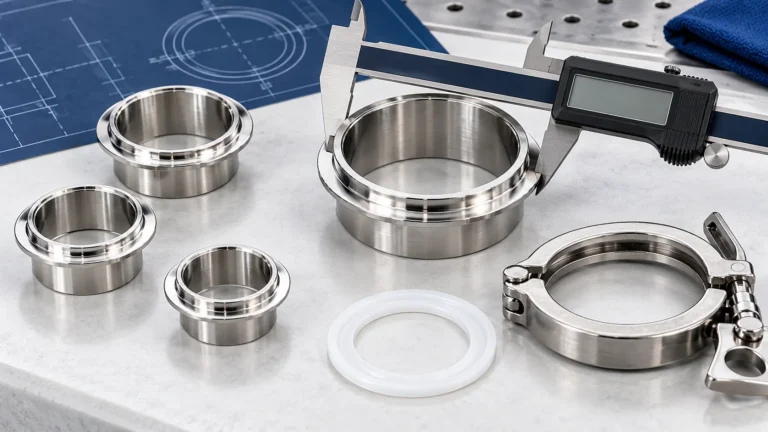
In hygienic process systems, transitioning between sanitary standards (Tri-Clamp/Weld) and threaded utility components (sensors, spray balls, or legacy piping) presents a critical contamination risk. Our Sanitary Threaded Fittings are engineered to mitigate bio-burden at these transition points. Whether utilizing NPT/BSP adapters for instrumentation or DIN 11851/SMS 1145 unions for high-pressure disconnects, we ensure the wetted surface integrity meets ASME BPE and 3-A requirements. Manufactured via precision CNC machining to ensure thread engagement accuracy and prevent galling, these fittings maintain a crevice-free flow path where possible to support validated CIP/SIP cycles.
Types of Sanitary Clamp Fittings We Supply
 Sanitary Fittings
Sanitary Threaded
Sanitary Clamp Fittings
Sanitary Weld
Components


Hygiene & Material Science
The Challenge of Threads in Sterile Processing: Standard threads (like NPT) are inherently non-sanitary due to the crevices created at the root and crest of the thread, which harbor bacteria and residue. Our Engineering Solution:
Adapters (TC to NPT/BSP): We design our adapters to keep the threaded connection outside the primary sanitary seal. The wetted side features a hygienic Tri-Clamp face, ensuring the process fluid contacts only smooth, non-porous 316L steel before transitioning to the threaded instrument/utility.
Hygienic Unions (DIN/SMS): Unlike standard pipe unions, our DIN 11851 and SMS fittings utilize a D-shaped or square section gasket that sits flush with the ID of the pipe. This “flush-face” design eliminates the entrapment zone, allowing for effective Clean-in-Place (CIP) velocity and turbulence.
Corrosion Resistance: All fittings are passivated to remove free iron, maximizing the formation of the passive chromium oxide layer to resist pitting corrosion from aggressive chloride-based cleaning agents.
What is Sanitary Threaded Fittings?
Sanitary threaded fittings are specialized stainless steel connectors (typically 316L) used in hygienic fluid systems, such as food, beverage, and pharmaceutical processing. Unlike standard NPT or BSP pipe fittings which can harbor bacteria in thread crevices, sanitary threaded unions (such as DIN 11851, SMS 1145, or RJT) utilize a flush-mounted gasket and external threads. This design ensures the threaded connection remains outside the fluid path, maintaining a smooth, non-porous internal surface (Ra < 0.8µm) that allows for effective Clean-in-Place (CIP) cycles and frequent disassembly without compromising sterility.

Why are they called "Sanitary" if they have threads?
In hygienic engineering, standard threads (like NPT) are generally considered “non-sanitary” because product residue can get trapped in the thread roots. Sanitary Threaded Fittings solve this problem through specific design features:
The “Dry” Thread: The threads are located on the exterior of the liner. The process fluid never touches the threads.
The Flush Seal: They rely on a specific gasket (EPDM, Viton, or PTFE) that sits flush with the pipe’s inner diameter (ID), eliminating “dead legs” or entrapment zones.
High-Pressure Capability: Unlike Tri-Clamp® fittings which rely on a hinge, threaded unions (especially DIN 11851) can often withstand higher pressures and vibrations, making them ideal for pump connections and transfer panels.
Common Standards (Types of Sanitary Threaded Fittings)
Engineers must select the correct standard based on regional equipment compatibility:
DIN 11851 (German): Uses a round “Knuckle” thread (Rd) and a D-shaped gasket. Most common in European breweries and dairies.
SMS 1145 (Swedish): Features a square-section gasket and a shorter nut. Popular in Scandinavian processing equipment.
RJT (BS 4825-5): Ring Joint Type, uses an O-ring seal. Common in the UK but less hygienic than DIN/SMS due to potential crevices.
IDF (ISO 2853): International Dairy Federation standard, uses a T-shaped gasket.
Dimension Table
Below represents typical dimensions for a Tri-Clamp to Male NPT Adapter.
| Tri-Clamp Size | NPT Thread Size | Overall Length (L) | Ferrule OD | ID (Bore) |
| 1.0″ | 1/2″ NPT | 50.8mm | 50.5mm | 22.1mm |
| 1.5″ | 3/4″ NPT | 50.8mm | 50.5mm | 34.8mm |
| 1.5″ | 1.0″ NPT | 60.3mm | 50.5mm | 34.8mm |
| 2.0″ | 1.5″ NPT | 63.5mm | 64.0mm | 47.5mm |
| 2.0″ | 2.0″ NPT | 70.0mm | 64.0mm | 47.5mm |
| Custom lengths and reducing adapters available upon request. |
Assembly & Maintenance Guide
Preveting Galling (Cold Welding): Stainless steel threads are prone to galling under high torque.
Action: Always apply a food-grade anti-seize or PTFE tape to NPT/BSP threads before assembly.
For DIN/SMS Unions: Ensure the nut is tightened to the specified torque. Do not over-tighten, as this can extrude the gasket into the flow path (Gasket Intrusion), creating a dam that creates turbulence and soil buildup.
Inspection Protocol:
Periodically inspect the male threads for burrs or deformation.
For Union fittings (SMS/DIN), check the liner face for scratches. A scratched seal face will bypass the gasket, leading to micro-leaks and sterility breaches.
RELATED INDUSTRIES & APPLICATIONS
FAQ
What is the difference between SMS 1145 and DIN 11851 fittings?
While both are threaded sanitary unions, they are not compatible. DIN 11851 (German standard) uses a round, knuckle thread (Rd) and a D-shaped semi-circular gasket. SMS 1145 (Swedish standard) uses a coarser round thread and a square cross-section gasket. Always check the thread pitch and nut design; SMS nuts often have slots on the outside, while DIN nuts have slots on the face (though designs vary).
Can I use NPT threads in a food contact zone?
Generally, no. NPT threads create crevices that cannot be cleaned via CIP (Clean-in-Place). NPT fittings should only be used for:
Utilities (steam, air, water) that do not contact the product.
Adapting sensors/instruments where the thread is sealed off from the product flow.
Applications where the system is disassembled and manually brushed cleaned (COP) daily.
How do I identify if my fitting is BSP or NPT?
NPT (National Pipe Taper) has tapered threads (the diameter gets wider effectively wedging the seal). BSPP (British Standard Pipe Parallel) has straight threads and requires a bonded washer or O-ring to seal. BSPT is tapered like NPT but has a different thread angle (55° vs. 60°). You cannot mix these; doing so will damage the stainless steel threads and cause leaks.