






Seleção de Revestimento para Porcas Automotivas
Porca Zincada vs Zinco Floco vs Zinco Níquel: Guia de Seleção de Revestimento Automotivo
Selecionar o revestimento correto para porcas automotivas não é apenas uma decisão de corrosão. Porcas zincadas, com revestimento de zinco em flocos e zinco-níquel podem se comportar de forma diferente após o revestimento, inspeção de rosca, torque de montagem, vibração, exposição ao sal e aprovação de produção.
Este guia compara as três opções de revestimento quanto à exposição à corrosão, ajuste da rosca interna, risco de fragilização por hidrogênio, controle de atrito, acabamento, dados de RFQ e requisitos de documentação automotiva.
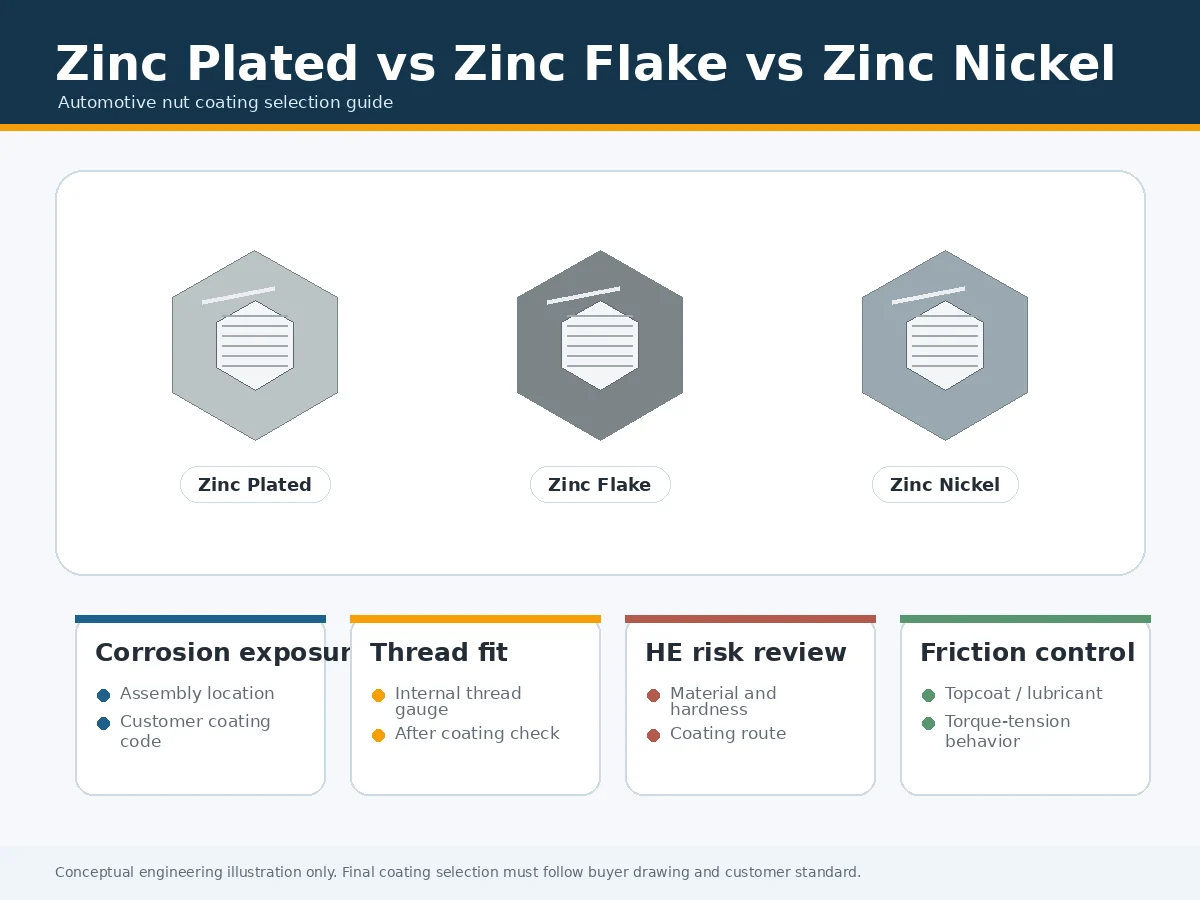
Comparação conceitual de revestimentos apenas; a seleção final do revestimento deve seguir o desenho do comprador e a norma do cliente.
Resposta Rápida: Qual Revestimento os Compradores Automotivos Devem Escolher?
Não existe um revestimento universalmente melhor para cada porca automotiva. A escolha correta depende do ambiente de aplicação, resistência do material, tratamento térmico, requisito de ajuste de rosca, código de revestimento do cliente, acabamento, lubrificante, faixa de atrito, método de inspeção e escopo do documento de aprovação.
Porcas zincadas são frequentemente selecionadas para aplicações sensíveis a custo, menor exposição à corrosão ou projetos onde o desenho do cliente já especifica um acabamento de zinco eletrogalvanizado. Elas podem ser práticas e amplamente disponíveis, mas peças de alta resistência ou temperadas exigem revisão do risco de fragilização por hidrogênio quando a eletrodeposição está envolvida.
Porcas com flocos de zinco são frequentemente consideradas para requisitos de corrosão mais elevados, fixadores automotivos expostos externamente ou projetos onde uma rota de revestimento não eletrolítico é preferida. No entanto, o floco de zinco não elimina a necessidade de confirmar o ajuste da rosca, acúmulo de revestimento, acabamento, coeficiente de atrito e inspeção final com calibrador.
Porcas de zinco-níquel são frequentemente selecionadas quando uma especificação automotiva exige desempenho de corrosão superior ao da zincagem padrão, aparência definida, comportamento de superfície condutiva ou um código de revestimento específico do cliente. O zinco-níquel ainda é um sistema eletrodepositado, portanto a dureza do material e a revisão de fragilização por hidrogênio ainda podem ser relevantes.
| Condição de aplicação | Porcas Zincadas | Porcas com Revestimento de Flocos de Zinco | Porcas de Zinco-Níquel |
|---|---|---|---|
| Aplicação sensível a custo | Geralmente adequado | Geralmente custo mais alto | Geralmente custo mais alto |
| Menor exposição à corrosão | Geralmente adequado se especificado | Pode ser mais do que o necessário | Pode ser mais do que o necessário |
| Alta exposição à corrosão | Limitado, a menos que aprovado pelo cliente | Frequentemente candidato forte | Frequentemente candidato forte |
| Porca de alta resistência ou endurecida | Requer revisão de fragilização por hidrogênio | Frequentemente considerado quando revestimento não eletrolítico é preferido | Requer revisão de fragilização por hidrogênio |
| Sensibilidade do ajuste da rosca interna | Requer controle de rosca pós-revestimento | Requer controle de espessura e calibre do revestimento | Requer controle de tolerância e calibre da rosca |
| Controle torque-tração | Requer controle de acabamento e lubrificante | Requer controle de revestimento/atrito | Requer controle de acabamento/atrito |
| Preocupação com aterramento elétrico ou condutividade | Requer confirmação do cliente | Pode ser inadequado, a menos que especificado | Requer confirmação do cliente |
| Função de solda ou cravação | Requer revisão específica do processo | Requer revisão de compatibilidade de revestimento / instalação | Requer revisão específica do processo |
Regra de Seleção
Escolha o revestimento com base nos requisitos de engenharia confirmados, não apenas pelo nome do revestimento. Para porcas automotivas, o comprador deve confirmar o local de montagem, função da porca, condição da rosca, dureza do material, código de revestimento do cliente, acabamento superior, alvo de atrito, método de teste de corrosão, escopo do documento de aprovação e requisito de embalagem antes da cotação.
Porcas Zincadas vs Zinc Flake vs Zinco Níquel: Tabela Comparativa
A primeira comparação deve separar rota de revestimento, expectativa de desempenho e risco de engenharia. Apenas o nome do revestimento não é suficiente para cotação. Os compradores devem especificar o código exato de revestimento do cliente, sistema de revestimento, acabamento superior, condição de inspeção da rosca e requisitos de documentação.
| Fator | Porcas Zincadas | Porcas com Revestimento de Flocos de Zinco | Porcas de Zinco-Níquel |
|---|---|---|---|
| Rota de revestimento | Sistema de revestimento por zincagem eletrolítica | Sistema de revestimento por flocos de zinco não eletrolítico | Sistema de revestimento por liga de zinco-níquel eletrolítico |
| Principal vantagem | Custo, disponibilidade e opções de acabamento comuns | Desempenho de corrosão e rota não eletrolítica quando especificado | Desempenho de corrosão, aparência e ajuste conforme código do cliente |
| Principal preocupação de engenharia | Revisão de fragilização por hidrogênio para peças de alta resistência; acúmulo de rosca após galvanoplastia | Acabamento, espessura do revestimento, controle de atrito e calibre da rosca | Custo, especificação exata, controle do sistema e revisão de fragilização por hidrogênio |
| Pergunta típica do comprador | A zincagem padrão é suficiente para esta localização? | O projeto requer zinco laminado com acabamento e controle de atrito? | O desenho ou padrão OEM exige zinco-níquel? |
| Risco de ajuste da rosca | A rosca interna pode apertar após a galvanização | O acúmulo de revestimento pode afetar o calibre da rosca interna | A espessura, passivação ou selante pode afetar o ajuste final da rosca |
| Comportamento torque-tração | O acabamento e o lubrificante podem alterar o atrito | Revestimento de acabamento e lubrificante podem alterar o atrito | O sistema de acabamento pode alterar o atrito |
| Avaliação de fragilização por hidrogênio | Importante para peças de alta resistência ou endurecidas | Frequentemente considerado quando a rota de revestimento não eletrolítico é preferida | Importante para peças de alta resistência ou endurecidas |
| O RFQ deve confirmar | Código do revestimento, espessura se especificada, calibre pós-revestimento e têmpera se necessário | Sistema de revestimento, base, acabamento, faixa de atrito e calibre pós-revestimento | Especificação de zinco-níquel, passivação/selante, ajuste de rosca e escopo do relatório |
| Não assuma | Toda zincagem é aceitável para automotivo | Todos os sistemas de flocos de zinco têm o mesmo desempenho | Zinco-níquel resolve automaticamente todo problema de corrosão ou montagem |

A matriz é apenas para discussão de seleção; a aprovação final do revestimento depende do desenho, código de revestimento do cliente e requisito de teste.
Por que a seleção de revestimento para porcas automotivas não se resume apenas a horas de névoa salina
Horas de névoa salina são fáceis de comparar, mas não definem completamente o desempenho da porca automotiva. Um revestimento pode parecer forte em um teste de corrosão, mas ainda criar problemas de montagem se a rosca interna ficar apertada, o coeficiente de atrito não for controlado, o topcoat errado for usado ou o código de revestimento do cliente não for seguido.
A seleção do revestimento de porcas automotivas deve começar pela junta real e pelo ambiente. Uma porca para suporte interno, porca soldada para estrutura de assento, porca de underbody, porca de estampagem em chapa metálica, porca de aterramento elétrico e porca de travamento totalmente metálica podem ter diferentes prioridades de revestimento. A resistência à corrosão é importante, mas também o ajuste da rosca, o comportamento de assentamento, a soldabilidade ou o desempenho de estampagem, o atrito, o comportamento torque-tração, a aparência, a condutividade e a documentação.
O comprador também deve confirmar se o requisito de corrosão é baseado em névoa salina neutra, corrosão cíclica, teste específico do cliente ou outro método de validação. Alegações genéricas não devem substituir o desenho ou a especificação do cliente.
Regra de Engenharia
Não selecione porcas automotivas revestidas apenas por horas de corrosão anunciadas. Confirme o local de montagem, o código de revestimento do cliente, a dureza do material, o requisito de rosca, a faixa de atrito e o método de inspeção antes da cotação.
Local da junta
Áreas internas, externas, underbody, compartimento do motor e elétricas podem exigir diferentes sistemas de revestimento e diferentes escopos de inspeção.
Condição da rosca
As roscas internas podem ficar apertadas após o revestimento. O requisito de calibragem pós-revestimento deve ser definido se o ajuste final da rosca for crítico.
Atrito de montagem
O acabamento superior, o lubrificante e o acabamento do parafuso de acoplamento podem alterar o comportamento torque-tração. Os valores de torque não devem ser adivinhados a partir do nome do revestimento.
Por que a Função da Porca Altera a Seleção de Revestimento
O mesmo revestimento pode não criar o mesmo risco em cada tipo de porca. Uma porca sextavada padrão, porca flangeada, porca de solda, porca de auto-encaixe, porca de trava totalmente metálica ou porca de aterramento pode ter diferentes prioridades de revestimento porque o modo de falha é diferente.
Por exemplo, porcas flangeadas serrilhadas pode necessitar de condição da face de apoio e controle de atrito, enquanto porcas de solda podem precisar de revisão do revestimento ao redor da condição da projeção de solda e proteção contra corrosão posterior. Uma porca auto-rosqueante precisa de compatibilidade com o material da chapa e comportamento de instalação. Uma porca de travamento totalmente metálica precisa de comportamento de torque predominante. Uma porca de aterramento pode exigir confirmação de condutividade superficial.
| Função da Porca | Preocupação com Seleção de Revestimento | Comprador Deve Confirmar |
|---|---|---|
| Porca padrão com rosca interna | Ajuste da rosca após revestimento e exposição à corrosão | Condição do calibrador de rosca, código de revestimento e requisito de corrosão |
| Porca para flange | Atrito da face de apoio e comportamento de assentamento | Requisito de acabamento, lubrificante, superfície de contato e torque-tensão, se aplicável |
| Porca de solda para flange / porca de solda sextavada | Comportamento da projeção de solda e proteção contra corrosão após montagem | Compatibilidade do processo de solda, sequência de revestimento e requisito pós-solda |
| Porca autoestampável | Comportamento de instalação em chapa e risco de dano ao revestimento | Material da chapa, espessura da chapa, condição do revestimento e push-out / torque-out se necessário |
| Porca de travamento totalmente metálica | Torque predominante e estabilidade do atrito | Sistema de revestimento, lubrificante, faixa de atrito e teste de torque predominante se necessário |
| Porca de aterramento ou elétrica | Condutividade superficial e confiabilidade do contato | Revestimento aprovado pelo cliente e requisito de condutividade, se aplicável |
Limite funcional: A seleção do revestimento não pode ser finalizada apenas com base na geometria da porca. O fornecedor precisa da localização da montagem, tipo de junta, material de acoplamento, modo de falha, requisito de rosca e qualquer especificação de torque, arrancamento, torque de saída, empuxo, torque predominante ou aterramento fornecida pelo comprador.
Porcas Zincadas: Quando São Adequadas e Onde Apresentam Risco
Porcas zincadas são amplamente utilizadas porque estão disponíveis, são econômicas e familiares para muitos compradores. Para ambientes de baixa corrosão, montagens sensíveis ao custo ou aplicações aprovadas pelo cliente, o zincado pode ser uma escolha prática.
No entanto, porcas zincadas não devem ser selecionadas automaticamente para todos os projetos automotivos. Revestimentos eletrogalvanizados exigem uma revisão mais cuidadosa quando o material da porca é de alta resistência, temperado ou tratado termicamente. A ISO 4042 abrange sistemas de revestimento eletrogalvanizado para fixadores de aço e inclui recomendações para minimizar o risco de fragilização por hidrogênio.
Quando as porcas zincadas podem ser adequadas
Porcas zincadas podem ser adequadas quando o desenho ou a especificação do cliente já exige zincado, a exposição à corrosão é moderada ou baixa, a porca não é usada em um ambiente severo de baixo do veículo ou externo, e o sistema de revestimento foi aprovado pelo cliente.
Elas também podem ser adequadas para suportes não críticos, montagens fechadas, peças de serviço ou aplicações onde custo e disponibilidade são importantes. Mesmo nesses casos, o comprador deve confirmar o ajuste da rosca após a zincagem, espessura do revestimento se especificada, passivação, acabamento, cozimento se necessário e escopo do relatório de inspeção.
Principais riscos das porcas zincadas
Os principais riscos incluem revisão de fragilização por hidrogênio para peças de alta resistência ou temperadas, acúmulo de rosca interna após a zincagem, atrito inconsistente se o lubrificante ou condição de acabamento não for controlado, e desempenho de corrosão insuficiente para ambientes automotivos severos.
Uma porca zincada pode passar na inspeção dimensional antes do revestimento, mas falhar no calibrador de rosca após a zincagem se a tolerância e a condição final do calibrador não forem definidas. Isso é especialmente importante para roscas internas, tamanhos de rosca pequenos ou requisitos de tolerância de rosca apertados.
| Item de Cotação de Porca Zincada | Por que é Importante | Necessita confirmação |
|---|---|---|
| Norma de revestimento ou código do cliente | Evita substituição genérica por “zincada” | Desenho do comprador ou especificação de revestimento do cliente |
| Espessura do revestimento, se especificada | Afeta corrosão, ajuste da rosca e inspeção | Padrão do cliente ou nota no desenho |
| Passivação / selante / acabamento | Afeta aparência e comportamento de corrosão | Código de acabamento e sistema aprovado |
| Requisito livre de Cr(VI), se aplicável | Atende requisito de conformidade do cliente | Exigência do cliente ou regulatória |
| Alívio de fragilização por hidrogênio, se necessário | Suporta o controle de risco de fragilização por hidrogênio | Padrão de dureza do material e revestimento |
| Calibrador de rosca pós-revestimento | Confirma o ajuste da montagem final | Antes da aplicação do revestimento, após a aplicação ou ambos |
| Relatório de revestimento / teste de corrosão | Define o escopo de documentação e validação | Somente se exigido pelo cliente ou programa |
Limitação do Zincamento
O zincamento pode ser um revestimento prático, mas não deve ser tratado como uma solução automotiva padrão. Se a porca for endurecida, tratada termicamente, crítica para rosca, sensível ao torque ou exposta a corrosão severa, o tipo de revestimento e a exigência do cliente devem ser revisados antes da cotação.
Porcas com Revestimento de Flocos de Zinco: Altos Alvos de Corrosão, Peças de Alta Resistência e Controle de Atrito
Os revestimentos de flocos de zinco são frequentemente considerados para fixadores automotivos porque são aplicados não eletroliticamente e podem ser especificados com sistemas de topcoat e lubrificante. A ISO 10683 abrange sistemas de revestimento de flocos de zinco aplicados não eletroliticamente para fixadores de aço e se aplica a porcas, parafusos, parafusos de cabeça, pinos e outros tipos de fixadores.
Para porcas automotivas, os flocos de zinco podem ser considerados quando a resistência à corrosão é importante, a aplicação está exposta ao ambiente rodoviário ou o projeto deseja evitar um processo de eletrodeposição para peças de alta resistência ou endurecidas. Ainda assim, os flocos de zinco devem ser especificados com cuidado. Diferentes sistemas, primers, topcoats e lubrificantes podem se comportar de maneira diferente.
Por que os flocos de zinco são frequentemente considerados para fixadores automotivos
Os sistemas de flocos de zinco são frequentemente usados onde a resistência à corrosão e o risco do processo são importantes. Eles podem ser úteis para conjuntos automotivos de assoalho, chassi, suportes expostos ou outros, quando a especificação do cliente permite ou exige.
Os flocos de zinco também são frequentemente discutidos para fixadores de alta resistência porque não são um revestimento eletrodepositado. No entanto, os compradores não devem assumir que “flocos de zinco significa sem risco” sem confirmação de engenharia. Condição do material, pré-tratamento, processo de revestimento, topcoat e padrão do cliente ainda são importantes.
Principais riscos das porcas com flocos de zinco
Os revestimentos de flocos de zinco ainda podem afetar o ajuste da rosca. O acúmulo de revestimento, a espessura do topcoat ou a cobertura irregular podem influenciar o calibre da rosca interna. O comportamento de atrito também pode mudar dependendo do topcoat e do lubrificante. Para conjuntos automotivos controlados por torque, o coeficiente de atrito deve ser confirmado se exigido pelo desenho ou padrão do cliente.
Nem todo sistema de zinco laminado tem o mesmo desempenho. O comprador deve evitar escrever apenas “zinco laminado” em uma RFQ sem especificar o sistema de revestimento, acabamento, faixa de atrito, requisito de corrosão e condição de inspeção.
| Item de RFQ de Zinco Laminado | Esclarecimento necessário | Risco se Ausente |
|---|---|---|
| Sistema de revestimento | Código do cliente, sistema aprovado ou especificação do fornecedor de revestimento | O fornecedor pode cotar um sistema de zinco laminado diferente |
| Primário + acabamento | Necessário quando a corrosão ou o atrito dependem do acabamento | A expectativa de atrito ou corrosão pode não corresponder |
| Condição do lubrificante | Condição de atrito seca, lubrificada ou especificada | O comportamento torque-tração pode mudar |
| Coeficiente de atrito | Faixa alvo, se necessário | Dispersão do torque de montagem |
| Calibrador de rosca pós-revestimento | Condição final de aceitação da porca | Disputa de calibrador de rosca após revestimento |
| Método de teste de corrosão | Névoa salina, corrosão cíclica ou teste específico do cliente | Afirmação genérica de desempenho pode não atender ao requisito do comprador |
| Pacote de documentos | Relatório de revestimento, IMDS ou PPAP somente se exigido | Conflito de documentos atrasados |
Limite de Flocos de Zinco
Flocos de zinco devem ser especificados como um sistema de revestimento, não apenas como um nome de revestimento. Primer, camada superior, lubrificante, condição de atrito, método de teste de corrosão, calibragem de rosca pós-revestimento e escopo do documento devem ser confirmados quando afetarem a aprovação.
Porcas de Zinco Níquel: Resistência à Corrosão, Controle de Rosca e Adequação à Especificação
Porcas de zinco-níquel são frequentemente selecionadas para projetos automotivos que exigem melhor resistência à corrosão do que a zincagem padrão, uma aparência definida, comportamento de superfície condutivo ou um código de revestimento OEM específico. O zinco-níquel pode ser uma opção forte quando o desenho e a norma do cliente o exigem.
No entanto, o zinco-níquel não é simplesmente uma “zincagem melhor” em todos os projetos. Geralmente custa mais do que a zincagem padrão, e o sistema exato de zinco-níquel deve ser especificado. Os compradores devem confirmar o código de revestimento, a faixa de espessura se especificada, passivação, selante, condição de inspeção de rosca, requisito de corrosão e escopo da documentação.
Por que o zinco-níquel pode ser selecionado
O zinco-níquel pode ser selecionado quando a peça é exposta a condições de corrosão mais exigentes, quando a especificação do cliente exige zinco-níquel, ou quando o projeto precisa de um sistema de acabamento com aparência e comportamento de engenharia definidos.
Também pode ser selecionado quando a montagem requer um equilíbrio entre proteção contra corrosão, controle dimensional e propriedades de superfície condutivas. Esses benefícios dependem do sistema de revestimento exato e da aprovação do cliente, não apenas das palavras “zinco-níquel”.”
Principais riscos das porcas de zinco-níquel
Os principais riscos incluem custo mais alto, especificação pouco clara, espessura de revestimento incorreta, problemas de ajuste de rosca pós-revestimento e revisão de fragilização por hidrogênio para peças de alta resistência ou temperadas. Como o zinco-níquel é um sistema eletrorevestido, os compradores não devem ignorar a dureza do material e o risco do processo.
Se o RFQ disser apenas “zinco-níquel” sem um código do cliente ou especificação de revestimento, os fornecedores podem cotar sistemas diferentes. Isso pode levar a problemas de aprovação de amostra, incompatibilidade de relatórios ou discordância no desempenho do revestimento.
| Item de cotação de zinco-níquel | Por que é Importante | Necessita confirmação |
|---|---|---|
| Código de revestimento de zinco-níquel | Evita cotar o sistema errado | Desenho do cliente ou especificação de revestimento |
| Teor de níquel / requisito do sistema se especificado | Deve seguir o padrão do cliente | Sistema de zinco-níquel aprovado |
| Faixa de espessura se especificada | Afeta a corrosão e o ajuste da rosca | Faixa de especificação e método de inspeção |
| Passivação / selante / acabamento | Afeta aparência e comportamento de corrosão | Código de acabamento do cliente |
| Calibrador de rosca pós-revestimento | Confirma o ajuste da montagem final | Antes da aplicação do revestimento, após a aplicação ou ambos |
| Avaliação de fragilização por hidrogênio | Necessário dependendo do material e dureza | Material, dureza e requisito de processo do cliente |
| Relatório de revestimento / IMDS / PPAP | Define a evidência de aprovação, se necessário | Escopo de documento específico do programa |
Limite de Zinco Níquel
O zinco níquel deve ser selecionado quando corresponder ao código de revestimento do cliente e ao requisito do projeto. Não deve ser usado como substituto genérico para todos os problemas de corrosão automotiva sem confirmar custo, ajuste de rosca, revisão de fragilização por hidrogênio, comportamento de atrito e documentação de aprovação.
Ajuste da Rosca Após Revestimento: Calibrador de Rosca Interna e Inspeção Pós-Revestimento
Porcas são componentes com rosca interna, portanto a seleção do revestimento deve considerar o ajuste da rosca após o revestimento. Um sistema de revestimento que funciona bem em um parafuso externo pode ainda criar risco dentro de uma porca se a tolerância da rosca, o acúmulo de revestimento ou a condição final do calibrador não forem controlados.
A inspeção da rosca antes do revestimento não garante automaticamente a aceitação final da rosca revestida. O comprador deve esclarecer se a porca deve passar por um calibrador de rosca antes do revestimento, após o revestimento ou ambos. Isso é especialmente importante quando o desenho exige tolerância de rosca apertada, tamanho de rosca pequeno, sistema de revestimento espesso ou montagem funcional pós-revestimento.
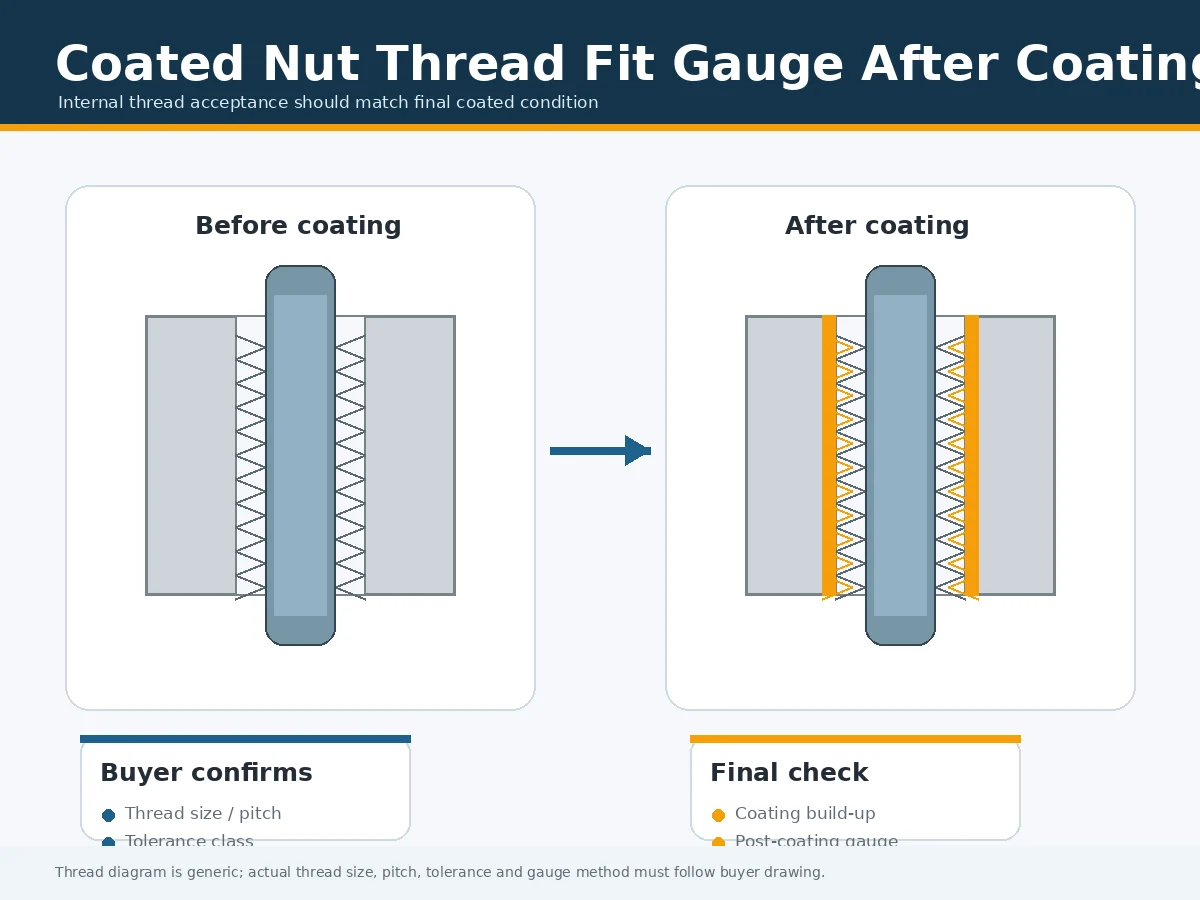
O diagrama da rosca é genérico; o tamanho real da rosca, passo, tolerância e método de calibragem devem seguir o desenho do comprador.
Para porcas zincadas e porcas de zinco-níquel, o acúmulo de eletrodeposição pode reduzir a folga da rosca interna. Para porcas com flocos de zinco, o filme de revestimento e o topcoat também podem afetar a entrada do calibrador e a montagem. A solução não é adivinhar. O desenho ou RFQ deve definir a condição final de inspeção.
| Item de Rosca | Comprador Deve Confirmar | Risco se Ausente |
|---|---|---|
| Tamanho e passo da rosca | Indicação do Desenho | Parafuso, porca ou pino de acoplamento incorreto |
| Tolerância da rosca | Requisito de classe ou ajuste | Discrepância de calibre |
| Espessura do revestimento, se especificada | Código de revestimento ou padrão do cliente | Rosca apertada ou ajuste inconsistente |
| Condição do calibre | Antes da aplicação do revestimento, após a aplicação ou ambos | Disputa de aprovação de amostra |
| Chanfro / entrada | Condição de entrada controlada por desenho | Problema de montagem difícil ou entrada de calibre |
| Acabamento / lubrificante | Se houver requisito de atrito | Dispersão de torque ou variação de pré-carga |
| Registro de inspeção | Relatório de calibre, se necessário | Evidência de aprovação ausente |
Conexão do desenho: Para projetos personalizados, os requisitos de revestimento e rosca devem ser claramente indicados no desenho ou no pacote de RFQ. Para mais contexto de controle de desenhos, revise SUNHYINGS porcas especiais fabricadas sob desenho.
Risco de Fragilização por Hidrogênio: O que os Compradores Devem Confirmar
O risco de fragilização por hidrogênio é uma das considerações de engenharia mais importantes ao selecionar revestimentos para fixadores de aço de alta resistência ou temperados. É especialmente relevante quando sistemas de revestimento eletrolítico são utilizados.
Para porcas automotivas, o comprador deve confirmar o material, dureza, tratamento térmico e rota de revestimento antes de assumir que um acabamento é aceitável. Porcas zincadas e de zinco-níquel são sistemas eletrolíticos, portanto, peças de alta resistência ou temperadas podem exigir revisão de fragilização por hidrogênio, têmpera ou controles de processo específicos do cliente, se especificado.

O fluxo de risco é apenas explicativo; o controle final do processo deve seguir a norma do cliente e a especificação de revestimento aprovada.
O floco de zinco é um sistema de revestimento aplicado não eletroliticamente e é frequentemente considerado onde evitar o risco de fragilização por hidrogênio relacionado à eletrodeposição é importante. Mas isso não deve ser escrito como “floco de zinco elimina todo o risco.” O projeto ainda precisa de pré-tratamento correto, controle do processo de revestimento, acabamento, inspeção e aprovação do cliente.
| Fator de Risco | Por que é Importante | Comprador Deve Confirmar |
|---|---|---|
| Grau do material | Determina resistência e sensibilidade ao processo | Desenho ou padrão do cliente |
| Dureza / classe de propriedade | Maior dureza pode aumentar a preocupação | Faixa de dureza e método de ensaio |
| Tratamento térmico | Afeta o comportamento mecânico | Requisito e registros de tratamento térmico |
| Rota de revestimento | Revisão de risco entre rota eletrogalvanizada e não eletrolítica | Norma de revestimento ou processo aprovado |
| Tratamento de alívio / têmpera | Pode ser exigido por norma ou pelo cliente | Prazo e condição exigidos, se especificado |
| Aprovação do cliente | A decisão final depende das regras do programa | Código de revestimento do cliente e processo de aprovação |
Nenhuma Alegação de Risco Zero Universal
Um revestimento não eletrolítico pode ser um fator de seleção importante, mas a revisão do risco de fragilização por hidrogênio ainda depende do material, dureza, tratamento térmico, controles de processo e requisitos do cliente. Não alegue fragilização por hidrogênio zero garantida sem validação específica do projeto.
Acabamento, Lubrificante e Comportamento Torque-Tensão
O revestimento não é apenas uma camada de corrosão. Ele altera a condição superficial da porca e pode afetar o atrito durante o aperto. No mesmo torque de aperto, diferentes sistemas de revestimento, acabamentos ou lubrificantes podem gerar diferentes cargas de aperto.
Isso é importante para juntas automotivas onde pré-carga, resistência ao afrouxamento, torque predominante ou consistência de montagem são importantes. É especialmente relevante quando porcas revestidas são usadas com parafusos de acoplamento que também possuem seu próprio revestimento, lubrificante ou condição superficial.

Nenhum valor de torque ou atrito está implícito; os valores de teste devem vir do desenho do comprador ou da norma de montagem.
Para porcas zincadas, a condição de passivação, selante e lubrificante pode afetar o atrito. Para porcas com flocos de zinco, o acabamento e o lubrificante integrado ou adicionado podem ser críticos. Para porcas de zinco-níquel, o sistema de acabamento exato também pode influenciar o atrito e o comportamento de montagem.
O comprador não deve solicitar que o fornecedor adivinhe o valor de torque ou o coeficiente de atrito. Se o comportamento torque-tração for relevante, o RFQ deve incluir a faixa necessária do coeficiente de atrito, método de teste, condição lubrificada ou seca, condição do parafuso de acoplamento e critérios de aceitação.
| Variável | Por que é Importante | Comprador Deve Confirmar |
|---|---|---|
| Acabamento superior | Altera o comportamento de atrito e corrosão | Código de acabamento superior obrigatório |
| Lubrificante | Altera o comportamento torque-tração | Condição lubrificada ou seca |
| Coeficiente de atrito | Controla a consistência da montagem | Faixa alvo, se necessário |
| Acabamento do parafuso de acoplamento | Afeta o comportamento completo da junta | Revestimento e condição superficial do parafuso |
| Recurso de travamento | Afeta o torque de atrito | Método de teste e aceitação |
| Espessura do revestimento | Afeta o ajuste da rosca e o atrito | Condição final de calibragem e inspeção |
Para função de travamento e aplicações sensíveis a torque, os compradores também podem consultar a SUNHYINGS porcas autotravantes totalmente metálicas e comuns problemas de montagem automotiva resolvidos por porcas especiais.
Desenho e Lista de Verificação de RFQ para Porcas Automotivas Revestidas
Um RFQ de porca automotiva revestida não deve dizer apenas “zincado”, “zinc floco” ou “zinco-níquel”. Esses nomes não são suficientes para revisão de engenharia. O fornecedor precisa do desenho, código de revestimento, norma do cliente, contexto de aplicação, condição da rosca, condição do material, requisito de atrito e escopo documental.

A lista de verificação é apenas para preparação da RFQ; PPAP, IMDS e relatórios de revestimento se aplicam apenas quando exigidos pelo cliente ou programa.
Um RFQ completo ajuda a evitar substituição incorreta de revestimento, falha de rosca pós-revestimento, dispersão de torque, discordância sobre corrosão e conflito documental tardio. Para contexto de revisão do lado do fornecedor, veja a SUNHYINGS como um fornecedor especializado em porcas para aplicações automotivas.
| Item do RFQ | Obrigatório? | Por que é Importante | Necessita confirmação |
|---|---|---|---|
| Última revisão do desenho | Sim | Controla a linha de base técnica | Desenho atual e revisão aprovada |
| Tipo e função da porca | Sim | Porcas de solda, estampagem, trava e flange têm riscos diferentes | Função, peça de acoplamento e modo de falha |
| Local de montagem | Sim | Determina exposição à corrosão e função da junta | Interior, exterior, assoalho, compartimento do motor ou área elétrica |
| Tamanho da rosca, passo e tolerância | Sim | Ajuste final da montagem controlado | Condição do medidor e antes/depois do revestimento |
| Material / dureza / tratamento térmico | Sim, se especificado | Suporta revisão de fragilização por hidrogênio | Grau do material, classe de propriedade, faixa de dureza ou nota de tratamento térmico |
| Tipo de revestimento | Sim | Zincado, floco de zinco ou zinco-níquel é apenas o ponto de partida | Família e rota exatas do revestimento |
| Código de revestimento do cliente | Fortemente recomendado | Evita substituição genérica de revestimento | Desenho do cliente, código OEM ou especificação de compra |
| Espessura do revestimento | Se especificado | Afeta o ajuste da rosca e a expectativa de corrosão | Faixa especificada, método de inspeção e condição final |
| Acabamento / selante / lubrificante | Se necessário | Controla o atrito e o comportamento do acabamento | Sistema aprovado e condição seca / lubrificada |
| Método de teste de corrosão | Se necessário | Define a expectativa de validação | Névoa salina neutra, corrosão cíclica ou teste específico do cliente |
| Calibrador de rosca pós-revestimento | Se a rosca for crítica | Evita disputas no ajuste final | Antes da aplicação do revestimento, após a aplicação ou ambos |
| Coeficiente de atrito | Se necessário | Garante consistência torque-tração | Faixa alvo, método de teste e condição do parafuso de acoplamento |
| Relatório PPAP / IMDS / revestimento | Se necessário | Define o escopo do documento de aprovação | Requisito do cliente ou programa |
| Volume anual | Sim | Afeta a rota de revestimento e o planejamento do processo | Aprovação de protótipo, amostra e volume de produção |
| Embalagem | Se necessário | Previne danos ao revestimento e lotes mistos | Separação de granel, saco, bandeja, etiqueta, lote e prevenção de ferrugem |
O PPAP deve ser tratado como um requisito específico do cliente ou programa. O IMDS também deve ser tratado como um requisito de dados de materiais automotivos quando necessário. Estes devem ser confirmados antes da cotação, em vez de adicionados após a aprovação do preço.
Como a SUNHYINGS Revisa os Requisitos de Revestimento Antes da Cotação
A SUNHYINGS deve revisar projetos de porcas automotivas revestidas verificando o desenho, requisito de revestimento, condição da rosca, risco do material e contexto de aplicação antes da cotação. O objetivo não é selecionar o revestimento mais caro, mas confirmar o sistema de revestimento que atende ao desenho e requisito do cliente.
Revisão do desenho e código de revestimento
A revisão começa com a revisão mais recente do desenho e a nota de revestimento. Se o desenho disser apenas “zinco”, “Zn”, “acabamento preto” ou “resistente à corrosão”, o requisito de revestimento não é claro o suficiente para cotação automotiva. O código de revestimento, cor do acabamento, camada de topo, selante, lubrificante, requisito de corrosão e escopo do relatório devem ser confirmados.
Revisão do material, dureza e risco de fragilização por hidrogênio
A SUNHYINGS deve revisar o grau do material, dureza, tratamento térmico e requisito de resistência antes de confirmar uma rota de revestimento eletrolítico. Se o risco de fragilização por hidrogênio for relevante, o projeto deve ser revisado de acordo com a norma do cliente e o requisito do processo de revestimento.
Revisão da rosca e requisitos funcionais
Para porcas, a condição final da rosca interna é crítica. A revisão deve confirmar o tamanho da rosca, passo, tolerância, chanfro, requisito de calibragem pós-revestimento e necessidades de teste funcional. Porcas para solda de flange, porcas de solda sextavadas, porcas autoperfurantes, porcas de travamento totalmente metálicas e porcas de flange podem exigir diferentes pontos de revisão.
Revisão de controle de amostra e produção
Antes da amostragem, o comprador e o fornecedor devem confirmar se a rota da amostra corresponde à rota de produção. Eles também devem definir o escopo do relatório de revestimento, plano de inspeção, embalagem, rastreabilidade de lote, PPAP se necessário e IMDS se necessário.
O que pode ser verificado antes da cotação
Para projetos de porcas automotivas sensíveis a revestimento, a SUNHYINGS pode revisar o desenho do comprador e o pacote de RFQ para identificar dados técnicos ausentes antes da confirmação do preço. Esta revisão é uma verificação de engenharia em estágio de cotação, não um substituto para a aprovação do cliente, validação de laboratório de revestimento ou envio formal de PPAP.
| Revisar Item | O que a SUNHYINGS pode verificar | Limite |
|---|---|---|
| Revisão de desenho e nota de revestimento | Se a especificação de revestimento é clara o suficiente para cotação e amostragem | O desenho do cliente e a especificação de revestimento permanecem como autoridade final |
| Ajuste de rosca interna | Se a condição do calibrador de rosca pós-revestimento precisa ser definida | A aceitação real do calibrador deve seguir o desenho do comprador e o método de inspeção |
| Material, dureza e tratamento térmico | Se a revisão de fragilização por hidrogênio relacionada à eletrodeposição pode ser relevante | Nenhum roteiro de revestimento deve ser aprovado sem revisão dos requisitos do cliente |
| Requisito de relatório de revestimento | Se o relatório de revestimento, dados de teste de corrosão ou documentação do fornecedor são solicitados | O escopo do relatório depende do cliente, programa e capacidade do parceiro de revestimento |
| Requisito de atrito e torque-tensão | Se falta acabamento, lubrificante, coeficiente de atrito ou acabamento do parafuso de acoplamento | Os valores de torque e atrito devem vir do padrão do cliente ou de testes qualificados |
| Embalagem e rastreabilidade de lote | Se a prevenção de danos ao revestimento, separação de lotes e requisitos de etiqueta estão definidos | O método de embalagem final deve seguir a ordem de compra e os requisitos logísticos do cliente |
Perguntas em aberto antes da cotação
Se os dados de revestimento estiverem incompletos, a SUNHYINGS deve esclarecer os pontos faltantes antes da cotação final. Perguntas abertas típicas incluem: Qual é o código exato do revestimento? A porca é de alta resistência ou tratada termicamente? A rosca deve passar pelo calibrador após o revestimento? É necessária uma faixa de atrito? O requisito de corrosão é névoa salina, corrosão cíclica ou específico do cliente? São necessários PPAP, IMDS ou relatórios de revestimento?
Os compradores podem revisar a SUNHYINGS como SUNHYINGS para projetos personalizados de porcas automotivas que envolvem revisão de desenho, ajuste de rosca, requisitos de revestimento e controle de produção.
Limite da revisão: Dados de revestimento ou inspeção ausentes devem ser marcados como “precisa de confirmação”. Não devem ser substituídos por uma suposição genérica.
Antes de Solicitar um Orçamento para Porcas Automotivas Revestidas
Prepare a revisão do desenho, código de revestimento, função da porca, local de montagem, material/dureza, tolerância da rosca, requisito de calibre pós-revestimento, acabamento, lubrificante, método de teste de corrosão, faixa de atrito se necessário, volume anual e requisito de embalagem antes da cotação.
Se algum desses itens estiver faltando, a escolha do revestimento deve ser tratada como “precisa de confirmação” em vez de assumida. Isso é especialmente importante para porcas zincadas, zinc flake e zinco-níquel usadas em juntas automotivas onde o ajuste da rosca, revisão de fragilização por hidrogênio ou comportamento torque-tração afetam a aprovação.
Pacote técnico mínimo
Envie a revisão mais recente do desenho, tamanho e tolerância da rosca, função da porca, nota de revestimento, requisito de material ou dureza, local de montagem e volume anual.
Dados extras para projetos sensíveis a revestimento
Confirme o código de revestimento do cliente, acabamento, lubrificante, método de teste de corrosão, calibre de rosca pós-revestimento, coeficiente de atrito se necessário, PPAP se necessário e IMDS se necessário.
Referências Técnicas e Contexto de Normas
As referências abaixo são fornecidas como contexto técnico para rota de revestimento, sistemas de revestimento de fixadores, revisão de risco de fragilização por hidrogênio e requisitos de documentos automotivos. Elas não substituem o desenho do comprador, a norma específica do cliente, a especificação de revestimento ou a revisão de engenharia qualificada.
| Referência | Como Isso Apoia Este Guia | Usar Limite |
|---|---|---|
| ISO 4042: Fixadores — Sistemas de revestimento eletrolítico | Fornece contexto para sistemas de revestimento eletrolítico em fixadores e orientação para minimização do risco de fragilização por hidrogênio. | Usar apenas como contexto de rota de revestimento; o requisito final deve seguir a norma do cliente e o desenho aprovado. |
| ISO 10683: Sistemas de revestimento de flocos de zinco aplicados não eletroliticamente | Fornece contexto para sistemas de revestimento de flocos de zinco para fixadores de aço, incluindo porcas, com ou sem camada superior ou lubrificante. | Usar apenas como contexto de revestimento de flocos de zinco; o sistema final deve ser especificado pelo código do cliente ou especificação de revestimento aprovada. |
| AIAG PPAP-4 | Fornece contexto para aprovação de peça de produção quando os registros de engenharia do cliente e os requisitos de especificação devem ser demonstrados. | O PPAP se aplica apenas quando exigido pelo cliente, programa ou especificação de compra. |
| IMDS: Sistema Internacional de Dados de Materiais | Fornece contexto para relatórios de dados de materiais automotivos quando exigido por programas automotivos. | O IMDS deve ser tratado como um requisito do cliente ou do programa automotivo, não como um requisito padrão para cada pedido de porca personalizada. |
Para mais recursos de engenharia da SUNHYINGS, consulte o guias técnicos arquivo e o porcas especiais personalizadas hub de produtos.
PERGUNTAS FREQUENTES
Qual é melhor para porcas automotivas, zincado, zinc flake ou zinco-níquel?
Não existe uma opção universalmente melhor. Porcas zincadas podem ser adequadas para aplicações sensíveis a custo e com baixa corrosão. Porcas com revestimento de flocos de zinco são frequentemente consideradas para requisitos de corrosão mais elevados e necessidades de revestimento não eletrolítico. Porcas de zinco-níquel são frequentemente selecionadas quando a especificação do cliente exige desempenho de corrosão mais forte ou um sistema de acabamento definido. A escolha final depende do desenho, padrão do cliente, material, dureza, ajuste da rosca, requisito de atrito e escopo de aprovação.
Porcas zincadas são adequadas para aplicações automotivas?
Sim, porcas zincadas podem ser adequadas para algumas aplicações automotivas quando o desenho ou a especificação do cliente as permite. Elas são frequentemente usadas em ambientes sensíveis a custos ou de baixa corrosão. No entanto, peças de alta resistência ou temperadas exigem revisão de fragilização por hidrogênio, e o ajuste final da rosca após a zincagem deve ser confirmado quando necessário.
Por que os revestimentos de flocos de zinco são usados em fixadores automotivos?
Revestimentos de flocos de zinco são frequentemente usados porque podem fornecer forte proteção contra corrosão e são aplicados não eletroliticamente. Eles são frequentemente considerados para fixadores automotivos expostos ou fixadores de alta resistência quando a especificação do cliente os permite. O comprador ainda precisa confirmar o sistema de revestimento, acabamento, faixa de atrito, calibre de rosca e requisitos de teste de corrosão.
O zinco-níquel é melhor que a zincagem para porcas?
O zinco-níquel pode oferecer melhor desempenho de corrosão do que a zincagem padrão quando especificado corretamente, mas não é automaticamente a melhor escolha para toda porca. Geralmente custa mais e ainda exige código de revestimento exato, controle de ajuste de rosca, requisito de corrosão e revisão de fragilização por hidrogênio quando peças de alta resistência ou temperadas estão envolvidas.
O revestimento afeta o ajuste da rosca interna nas porcas?
Sim. O revestimento pode reduzir a folga da rosca interna e afetar a inspeção por calibrador. Uma porca pode passar na inspeção de rosca antes do revestimento, mas falhar após o revestimento se a tolerância da rosca, a espessura do revestimento ou a condição final do calibrador não forem definidas. Os compradores devem confirmar se a aceitação final é antes do revestimento, após o revestimento ou ambos.
Qual revestimento apresenta o menor risco de fragilização por hidrogênio?
O risco de fragilização por hidrogênio depende do material, dureza, tratamento térmico, rota de revestimento e requisito do cliente. Zinco eletroplacado e zinco-níquel são sistemas eletroplacados, portanto peças de alta resistência ou endurecidas podem exigir revisão. Flocos de zinco são aplicados não eletroliticamente e são frequentemente considerados quando é importante evitar riscos relacionados à eletroplacagem, mas a aprovação final deve seguir os requisitos de engenharia do cliente.
O revestimento de flocos de zinco altera o comportamento torque-tração?
Sim, pode. Sistemas de flocos de zinco geralmente incluem camada de acabamento ou lubrificante, e estes podem afetar o atrito. Se o comportamento torque-tração for relevante, o comprador deve definir o coeficiente de atrito, o acabamento do parafuso de acoplamento, o método de teste e a condição de montagem, em vez de confiar em nomes genéricos de revestimento.
O que devo incluir em um RFQ para porcas automotivas revestidas?
Incluir a última revisão do desenho, tipo de porca, local de aplicação, tamanho da rosca, passo, tolerância, material, dureza, código de revestimento, acabamento, lubrificante, calibre de rosca pós-revestimento, requisito de teste de corrosão, coeficiente de atrito se necessário, PPAP se necessário, IMDS se necessário, volume anual e requisito de embalagem.
Páginas Relacionadas da SUNHYINGS
Consulte as páginas relacionadas para porcas personalizadas, aplicações automotivas, função especial da porca e orientação de engenharia.
Nota de Revisão Técnica
Este artigo foi preparado para gerentes de sourcing, engenheiros de compras, equipes de SQE, engenheiros de fixadores e equipes de projetos automotivos que comparam porcas zincadas, zinc flake e zinco-níquel antes de RFQ, amostragem ou aprovação de produção.
Escopo revisado: rota de revestimento, exposição à corrosão, ajuste da rosca interna, condição do calibre pós-revestimento, revisão de risco de fragilização por hidrogênio, camada de acabamento, lubrificante, comportamento torque-tração, dureza do material, função da porca, dados de RFQ, PPAP se necessário e IMDS se necessário.
Nota sobre normas e limitações: Este artigo é um guia prático de sourcing e engenharia. Ele não substitui o desenho do cliente, a especificação de revestimento, o requisito específico do cliente, a revisão de engenharia qualificada, a submissão formal de PPAP, o requisito de relatório IMDS ou a aprovação do processo do fornecedor. Dados ausentes de revestimento, rosca, atrito, material ou documento devem ser tratados como necessidade de confirmação, não assumidos como fato.