







Selezione del Rivestimento per Dadi Automobilistici
Dado Zincato vs Zinc Flake vs Zinco-Nichel: Guida alla Scelta del Rivestimento per Automotive
La scelta del rivestimento giusto per i dadi automobilistici non è solo una decisione anticorrosione. I dadi zincati, con zincatura lamellare e zinco-nichel possono comportarsi diversamente dopo il rivestimento, l'ispezione della filettatura, la coppia di montaggio, le vibrazioni, l'esposizione al sale e l'approvazione di produzione.
Questa guida confronta le tre opzioni di rivestimento in base all'esposizione alla corrosione, all'accoppiamento della filettatura interna, al rischio di infragilimento da idrogeno, al controllo dell'attrito, al topcoat, ai dati RFQ e ai requisiti documentali automobilistici.
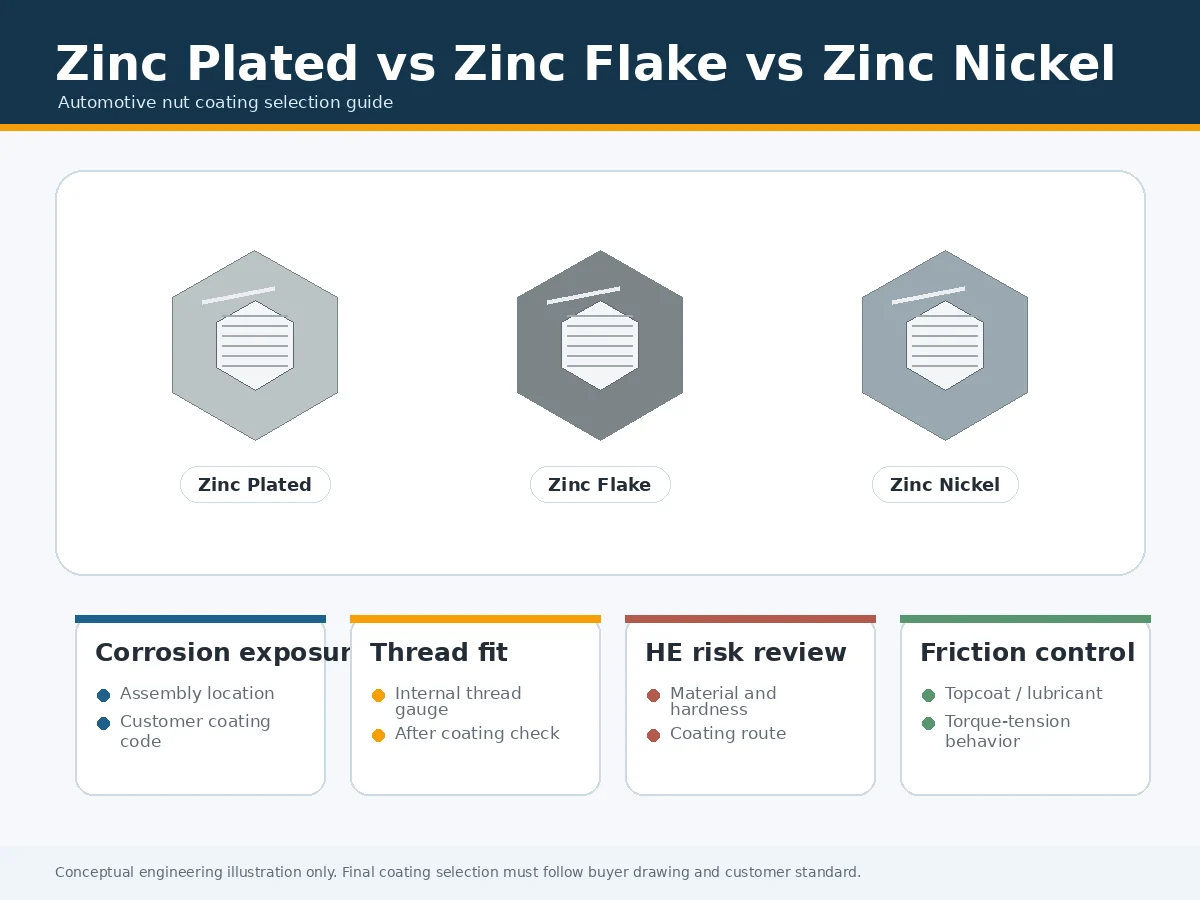
Confronto concettuale dei rivestimenti solo a scopo informativo; la selezione finale del rivestimento deve seguire il disegno dell'acquirente e lo standard del cliente.
Risposta rapida: quale rivestimento dovrebbero scegliere gli acquirenti automobilistici?
Non esiste un rivestimento universale migliore per ogni dado automobilistico. La scelta corretta dipende dall'ambiente di applicazione, dalla resistenza del materiale, dal trattamento termico, dal requisito di accoppiamento della filettatura, dal codice di rivestimento del cliente, dal topcoat, dal lubrificante, dal range di attrito, dal metodo di ispezione e dall'ambito dei documenti di approvazione.
I dadi zincati sono spesso scelti per applicazioni sensibili al costo, esposizione a corrosione inferiore o progetti in cui il disegno del cliente specifica già una finitura elettrozincata. Possono essere pratici e ampiamente disponibili, ma le parti ad alta resistenza o temprate richiedono una valutazione del rischio di infragilimento da idrogeno quando è coinvolta la zincatura elettrolitica.
I dadi con rivestimento in scaglie di zinco sono spesso considerati per requisiti di corrosione più elevati, fissaggi automobilistici esposti esternamente o progetti in cui si preferisce un rivestimento non elettrolitico. Tuttavia, le scaglie di zinco non eliminano la necessità di verificare l'accoppiamento della filettatura, l'accumulo del rivestimento, il topcoat, il coefficiente di attrito e l'ispezione finale con calibro.
I dadi in zinco-nichel sono spesso scelti quando una specifica automobilistica richiede prestazioni di corrosione superiori rispetto alla zincatura standard, un aspetto definito, un comportamento superficiale conduttivo o un codice di rivestimento specifico del cliente. Lo zinco-nichel è ancora un sistema elettrolitico, quindi la durezza del materiale e la valutazione della fragilità da idrogeno possono ancora essere rilevanti.
| Condizione di applicazione | Dadi zincati | Dadi con scaglie di zinco | Dadi in zinco-nichel |
|---|---|---|---|
| Applicazione sensibile ai costi | Spesso adatto | Di solito costo più elevato | Di solito costo più elevato |
| Minore esposizione alla corrosione | Spesso adatto se specificato | Potrebbe essere più del necessario | Potrebbe essere più del necessario |
| Elevata esposizione alla corrosione | Limitato salvo approvazione del cliente | Spesso candidato valido | Spesso candidato valido |
| Dado ad alta resistenza o temprato | Richiede valutazione della fragilità da idrogeno | Spesso considerato quando si preferisce un rivestimento non elettrolitico | Richiede valutazione della fragilità da idrogeno |
| Sensibilità all'accoppiamento della filettatura interna | Richiede controllo della filettatura dopo la zincatura | Richiede controllo dello spessore del rivestimento e del calibro | Richiede tolleranza filettatura e controllo calibro |
| Controllo coppia-tensione | Richiede controllo finitura e lubrificante | Richiede controllo verniciatura/attrito | Richiede controllo finitura/attrito |
| Problema di messa a terra o conducibilità elettrica | Richiede conferma cliente | Potrebbe non essere adatto se non specificato | Richiede conferma cliente |
| Funzione di saldatura o aggraffatura | Richiede una revisione specifica del processo | Necessita di verifica di compatibilità con rivestimento/installazione | Richiede una revisione specifica del processo |
Regola di Selezione
Scegliere il rivestimento in base ai requisiti tecnici confermati, non solo al nome del rivestimento. Per i dadi per automotive, l'acquirente deve confermare la posizione di montaggio, la funzione del dado, le condizioni della filettatura, la durezza del materiale, il codice rivestimento del cliente, la finitura superiore, l'obiettivo di attrito, il metodo di prova di corrosione, l'ambito del documento di approvazione e i requisiti di imballaggio prima del preventivo.
Dadi Zincati vs Zinc Flake vs Zinco-Nichel: Tabella Comparativa
Il primo confronto dovrebbe separare il tipo di rivestimento, le aspettative di prestazione e il rischio tecnico. Il solo nome del rivestimento non è sufficiente per un preventivo. Gli acquirenti devono specificare il codice rivestimento esatto del cliente, il sistema di rivestimento, la finitura superiore, le condizioni di ispezione della filettatura e i requisiti documentali.
| Fattore | Dadi zincati | Dadi con scaglie di zinco | Dadi in zinco-nichel |
|---|---|---|---|
| Percorso del rivestimento | Sistema di rivestimento con zincatura elettrolitica | Sistema di rivestimento con zincatura non elettrolitica (Zinc Flake) | Sistema di rivestimento con lega zinco-nichel elettrolitica |
| Vantaggio principale | Costo, disponibilità e opzioni di finitura comuni | Prestazioni anticorrosione e via non elettrolitica quando specificato | Prestazioni anticorrosione, aspetto e adattamento al codice cliente |
| Principale preoccupazione ingegneristica | Revisione della fragilità da idrogeno per parti ad alta resistenza; accumulo di filettatura dopo la placcatura | Controllo del topcoat, spessore del rivestimento, attrito e calibro della filettatura | Costo, specifica esatta, controllo del sistema e revisione della fragilità da idrogeno |
| Domanda tipica dell'acquirente | La zincatura standard è sufficiente per questa applicazione? | Il progetto richiede zincatura in scaglie con finitura e controllo dell'attrito? | Il disegno o lo standard OEM richiede zinco-nichel? |
| Rischio di accoppiamento filettato | La filettatura interna potrebbe stringersi dopo la zincatura | L'accumulo di rivestimento può influenzare il calibro della filettatura interna | Lo spessore, la passivazione o il sigillante possono influenzare l'accoppiamento finale della filettatura |
| Comportamento coppia-trazione | La finitura e il lubrificante possono modificare l'attrito | Il topcoat e il lubrificante possono modificare l'attrito | Il sistema di finitura può modificare l'attrito |
| Revisione della fragilità da idrogeno | Importante per parti ad alta resistenza o temprate | Spesso considerato quando si preferisce un rivestimento non elettrolitico | Importante per parti ad alta resistenza o temprate |
| L'RFQ deve confermare | Codice del rivestimento, spessore se specificato, calibro post-placcatura e tempra se richiesto | Sistema di rivestimento, basecoat, topcoat, intervallo di attrito e calibro post-rivestimento | Specifica zinco-nichel, passivazione/sigillante, accoppiamento filettatura e ambito del rapporto |
| Non dare per scontato | Tutta la zincatura è accettabile per l'automotive | Tutti i sistemi a scaglie di zinco funzionano allo stesso modo | Lo zinco-nichel risolve automaticamente ogni problema di corrosione o assemblaggio |

La matrice è solo per discussione sulla selezione; l'approvazione finale del rivestimento dipende dal disegno, dal codice di rivestimento del cliente e dal requisito di prova.
Perché la selezione del rivestimento per dadi automotive non riguarda solo le ore di nebbia salina
Le ore di nebbia salina sono facili da confrontare, ma non definiscono completamente le prestazioni del dado automobilistico. Un rivestimento può sembrare resistente in un test di corrosione, ma può comunque creare problemi di montaggio se la filettatura interna diventa stretta, il coefficiente di attrito non è controllato, viene utilizzato il topcoat sbagliato o non viene seguito il codice di rivestimento del cliente.
La scelta del rivestimento per dadi automobilistici dovrebbe iniziare dal giunto reale e dall'ambiente. Un dado per staffa interna, dado per sedile saldato, dado sottoscocca, dado di aggraffatura in lamiera, dado di messa a terra elettrica e dado autobloccante in metallo possono avere priorità di rivestimento diverse. La resistenza alla corrosione è importante, ma lo sono anche l'accoppiamento della filettatura, il comportamento di seduta, la saldabilità o le prestazioni di aggraffatura, l'attrito, il comportamento coppia-trazione, l'aspetto, la conduttività e la documentazione.
L'acquirente dovrebbe anche confermare se il requisito di corrosione si basa su nebbia salina neutra, corrosione ciclica, test specifici del cliente o un altro metodo di validazione. Affermazioni generiche non dovrebbero sostituire il disegno o la specifica del cliente.
Regola tecnica
Non selezionare dadi automobilistici rivestiti solo in base alle ore di corrosione pubblicizzate. Confermare la posizione di montaggio, il codice di rivestimento del cliente, la durezza del materiale, il requisito della filettatura, la gamma di attrito e il metodo di ispezione prima del preventivo.
Posizione del giunto
Le aree interne, esterne, sottoscocca, vano motore ed elettriche possono richiedere diversi sistemi di rivestimento e diversi ambiti di ispezione.
Condizione della filettatura
Le filettature interne possono diventare strette dopo il rivestimento. Il requisito di calibro post-rivestimento dovrebbe essere definito se l'accoppiamento finale della filettatura è critico.
Attrito di montaggio
Il rivestimento finale, il lubrificante e la finitura del bullone di accoppiamento possono modificare il comportamento coppia-tensione. I valori di coppia non devono essere dedotti dal nome del rivestimento.
Perché la funzione del dado modifica la scelta del rivestimento
Lo stesso rivestimento potrebbe non creare lo stesso rischio su ogni tipo di dado. Un dado esagonale standard, un dado a flangia, un dado da saldare, un dado autofilettante, un dado autobloccante in metallo o un dado di messa a terra possono avere priorità di rivestimento diverse perché la modalità di guasto è differente.
Ad esempio, dadi flangiati dentati potrebbe richiedere la condizione della superficie di appoggio e il controllo dell'attrito, mentre i dadi da saldare potrebbero necessitare una revisione del rivestimento intorno alla zona di proiezione di saldatura e la successiva protezione dalla corrosione. Un dado autofilettante richiede compatibilità con il materiale della lamiera e comportamento durante l'installazione. Un dado autobloccante in metallo richiede un comportamento di coppia prevalente. Un dado di messa a terra può richiedere la conferma della conducibilità superficiale.
| Funzione del dado | Problema di selezione del rivestimento | L'acquirente deve confermare |
|---|---|---|
| Dado standard con filettatura interna | Accoppiamento della filettatura dopo rivestimento ed esposizione alla corrosione | Condizione del calibro della filettatura, codice del rivestimento e requisito di corrosione |
| Dado flangiato | Attrito della superficie di appoggio e comportamento di seduta | Rivestimento superiore, lubrificante, superficie di accoppiamento e requisito di coppia-tensione se applicabile |
| Dado di saldatura per flangia / dado esagonale di saldatura | Comportamento della proiezione di saldatura e protezione dalla corrosione dopo il montaggio | Compatibilità del processo di saldatura, sequenza di rivestimento e requisiti post-saldatura |
| Dado autofilettante | Comportamento di installazione in lamiera e rischio di danneggiamento del rivestimento | Materiale della lamiera, spessore della lamiera, condizione del rivestimento e push-out / torque-out se richiesto |
| Dado autobloccante interamente metallico | Coppia prevalente e stabilità dell'attrito | Sistema di rivestimento, lubrificante, intervallo di attrito e test di coppia prevalente se richiesto |
| Dado di messa a terra o elettrico | Conducibilità superficiale e affidabilità del contatto | Rivestimento approvato dal cliente e requisito di conducibilità, se applicabile |
Limite funzionale: La selezione del rivestimento non può essere finalizzata solo dalla geometria del dado. Il fornitore necessita della posizione di montaggio, del tipo di giunto, del materiale di accoppiamento, della modalità di guasto, del requisito di filettatura e di qualsiasi requisito di coppia, estrazione a trazione, estrazione a torsione, spinta, coppia prevalente o messa a terra specificato dall'acquirente.
Dadi Zincati: Quando Sono Adatti e Dove Sono Rischiosi
I dadi zincati sono ampiamente utilizzati perché sono disponibili, economici e familiari a molti acquirenti. Per ambienti a bassa corrosione, assemblaggi sensibili ai costi o applicazioni approvate dal cliente, la zincatura può essere una scelta pratica.
Tuttavia, i dadi zincati non dovrebbero essere selezionati automaticamente per ogni progetto automobilistico. I rivestimenti elettrodeposti richiedono una revisione più attenta quando il materiale del dado è ad alta resistenza, temprato o trattato termicamente. La norma ISO 4042 copre i sistemi di rivestimento elettrodeposto per elementi di fissaggio in acciaio e include raccomandazioni per ridurre al minimo il rischio di infragilimento da idrogeno.
Quando i dadi zincati possono essere adatti
I dadi zincati possono essere adatti quando il disegno o la specifica del cliente richiedono già la zincatura, l'esposizione alla corrosione è moderata o bassa, il dado non è utilizzato in un ambiente severo sottoscocca o esterno, e il sistema di rivestimento è stato approvato dal cliente.
Possono anche essere adatti per staffe non critiche, gruppi chiusi, parti di ricambio o applicazioni dove costo e disponibilità sono importanti. Anche in questi casi, l'acquirente deve verificare l'accoppiamento della filettatura dopo la zincatura, lo spessore del rivestimento se specificato, la passivazione, il topcoat, la cottura se richiesta e l'ambito del rapporto di ispezione.
Principali rischi dei dadi zincati
I principali rischi includono la revisione della fragilità da idrogeno per parti ad alta resistenza o temprate, accumulo di filettatura interna dopo la zincatura, attrito incoerente se il lubrificante o la condizione di finitura non sono controllati, e prestazioni di corrosione insufficienti per ambienti automobilistici severi.
Un dado zincato può superare l'ispezione dimensionale prima del rivestimento ma fallire il calibro della filettatura dopo la zincatura se la tolleranza e la condizione finale del calibro non sono definite. Questo è particolarmente importante per filettature interne, dimensioni di filettatura piccole o requisiti di tolleranza stretti.
| Articolo RFQ per dadi zincati | Perché è importante | Richiede conferma |
|---|---|---|
| Norma di rivestimento o codice cliente | Evita la sostituzione generica con “zincato” | Disegno dell'acquirente o specifica di rivestimento del cliente |
| Spessore del rivestimento se specificato | Influisce su corrosione, accoppiamento filettato e ispezione | Norma del cliente o nota sul disegno |
| Passivazione / sigillante / vernice di finitura | Influisce su aspetto e comportamento alla corrosione | Codice di finitura e sistema approvato |
| Requisito senza Cr(VI) se applicabile | Supporta i requisiti di conformità del cliente | Requisito del cliente o normativo |
| Cottura / distensione dalla fragilità se necessario | Supporta il controllo del rischio di fragilità da idrogeno | Standard di durezza del materiale e rivestimento |
| Calibro filettatura post-rivestimento | Verifica l'accoppiamento dell'assieme finale | Prima della verniciatura, dopo la verniciatura o entrambe |
| Rapporto di rivestimento / prova di corrosione | Definisce l'ambito del documento e della validazione | Solo se richiesto dal cliente o dal programma |
Limiti della zincatura
La zincatura può essere un rivestimento pratico, ma non deve essere considerata una soluzione automobilistica predefinita. Se il dado è temprato, trattato termicamente, critico per la filettatura, sensibile alla coppia o esposto a corrosione severa, il percorso di rivestimento e il requisito del cliente devono essere rivisti prima della quotazione.
Dadi con rivestimento zincato a scaglie: obiettivi di alta resistenza alla corrosione, parti ad alta resistenza e controllo dell'attrito
I rivestimenti a scaglie di zinco sono spesso considerati per i fissaggi automobilistici perché vengono applicati non elettroliticamente e possono essere specificati con sistemi di finitura e lubrificante. La ISO 10683 copre i sistemi di rivestimento a scaglie di zinco applicati non elettroliticamente per fissaggi in acciaio e si applica a dadi, bulloni, viti, prigionieri e altri tipi di fissaggio.
Per i dadi automobilistici, il rivestimento a scaglie di zinco può essere considerato quando la resistenza alla corrosione è importante, l'applicazione è esposta all'ambiente stradale o il progetto vuole evitare un percorso di elettrodeposizione per parti ad alta resistenza o temprate. Tuttavia, il rivestimento a scaglie di zinco deve essere specificato con attenzione. Diversi sistemi, primer, finiture e lubrificanti possono comportarsi in modo diverso.
Perché il rivestimento a scaglie di zinco è spesso considerato per i fissaggi automobilistici
I sistemi a scaglie di zinco sono spesso utilizzati quando la resistenza alla corrosione e il rischio del percorso di processo sono importanti. Possono essere utili per sottoscocca, telaio, staffe esposte o altri assemblaggi automobilistici quando la specifica del cliente lo consente o lo richiede.
Il rivestimento a scaglie di zinco è spesso discusso anche per i fissaggi ad alta resistenza perché non è un percorso di rivestimento elettrolitico. Tuttavia, gli acquirenti non dovrebbero scrivere “rivestimento a scaglie di zinco significa nessun rischio” senza conferma ingegneristica. Condizione del materiale, pretrattamento, processo di rivestimento, finitura e standard del cliente contano ancora.
Principali rischi dei dadi con rivestimento zinc flake
I rivestimenti zinc flake possono ancora influenzare l'accoppiamento della filettatura. L'accumulo del rivestimento, lo spessore del topcoat o una copertura non uniforme possono influenzare il calibro della filettatura interna. Il comportamento di attrito può anche variare a seconda del topcoat e del lubrificante. Per assemblaggi automobilistici a controllo di coppia, il coefficiente di attrito dovrebbe essere confermato se richiesto dal disegno o dalla norma del cliente.
Non tutti i sistemi zinc flake hanno le stesse prestazioni. Un acquirente dovrebbe evitare di scrivere solo “zinc flake” in una richiesta di offerta senza specificare il sistema di rivestimento, il topcoat, l'intervallo di attrito, il requisito di corrosione e la condizione di ispezione.
| Articolo RFQ Zinc Flake | Chiarimento richiesto | Rischio se mancante |
|---|---|---|
| Sistema di rivestimento | Codice cliente, sistema approvato o specifica del fornitore del rivestimento | Il fornitore potrebbe quotare un sistema zinc flake diverso |
| Basecoat + topcoat | Richiesto quando la corrosione o l'attrito dipendono dal topcoat | L'attrito o la corrosione previsti potrebbero non corrispondere |
| Condizione del lubrificante | Condizione di attrito secca, lubrificata o specificata | Il comportamento coppia-tensione può variare |
| Coefficiente di attrito | Intervallo target se richiesto | Dispersione della coppia di montaggio |
| Calibro per filettatura post-rivestimento | Condizione finale di accettazione del dado | Controversia sul calibro di filettatura dopo la verniciatura |
| Metodo di prova della corrosione | Spray salino, corrosione ciclica o prova specifica del cliente | Un'affermazione generica sulle prestazioni potrebbe non soddisfare i requisiti dell'acquirente |
| Pacchetto documenti | Rapporto di verniciatura, IMDS o PPAP solo se richiesto | Conflitto di documenti in ritardo |
Limite di scaglie di zinco
La scaglia di zinco deve essere specificata come sistema di rivestimento, non solo come nome del rivestimento. Il fondo, il topcoat, il lubrificante, la condizione di attrito, il metodo di prova della corrosione, il calibro del filetto post-rivestimento e l'ambito della documentazione devono essere confermati quando influenzano l'approvazione.
Dadi in zinco-nichel: resistenza alla corrosione, controllo del filetto e conformità alle specifiche
I dadi in zinco-nichel sono spesso scelti per progetti automobilistici che richiedono una resistenza alla corrosione superiore rispetto alla zincatura standard, un aspetto superficiale definito, un comportamento conduttivo o un codice di rivestimento OEM specifico. Lo zinco-nichel può essere una valida opzione quando il disegno e la norma del cliente lo richiedono.
Tuttavia, lo zinco-nichel non è semplicemente una “zincatura migliore” in ogni progetto. Di solito costa più della zincatura standard e il sistema esatto di zinco-nichel deve essere specificato. Gli acquirenti devono confermare il codice di rivestimento, l'intervallo di spessore se specificato, la passivazione, il sigillante, la condizione di ispezione del filetto, il requisito di corrosione e l'ambito della documentazione.
Perché lo zinco-nichel può essere scelto
Lo zinco-nichel può essere scelto quando il componente è esposto a condizioni di corrosione più severe, quando la specifica del cliente richiede zinco-nichel, o quando il progetto necessita di un sistema di finitura con aspetto e comportamento ingegneristico definiti.
Può anche essere scelto quando l'assemblaggio richiede un equilibrio tra protezione dalla corrosione, controllo dimensionale e proprietà conduttive della superficie. Questi vantaggi dipendono dal sistema di rivestimento esatto e dall'approvazione del cliente, non solo dalle parole “zinco-nichel”.”
Principali rischi dei dadi in zinco-nichel
I rischi principali includono costo più elevato, specifiche poco chiare, spessore del rivestimento errato, problemi di filettatura post-rivestimento e revisione della fragilità da idrogeno per parti ad alta resistenza o temprate. Poiché lo zinco-nichel è un sistema elettroplaccato, gli acquirenti non dovrebbero ignorare la durezza del materiale e il rischio del percorso di processo.
Se la RFQ indica solo “zinco-nichel” senza un codice cliente o una specifica di rivestimento, i fornitori potrebbero quotare sistemi diversi. Ciò può portare a problemi di approvazione del campione, discrepanze nei rapporti o disaccordo sulle prestazioni del rivestimento.
| Articolo RFQ Zinco-Nichel | Perché è importante | Richiede conferma |
|---|---|---|
| Codice rivestimento zinco-nichel | Previene la quotazione del sistema sbagliato | Disegno del cliente o specifica di rivestimento |
| Contenuto di nichel / requisito di sistema se specificato | Deve seguire lo standard del cliente | Sistema zinco-nichel approvato |
| Intervallo di spessore se specificato | Influisce sulla corrosione e sull'accoppiamento della filettatura | Intervallo di specifica e metodo di ispezione |
| Passivazione / sigillante / vernice di finitura | Influisce su aspetto e comportamento alla corrosione | Codice di finitura del cliente |
| Calibro per filettatura post-rivestimento | Verifica l'accoppiamento dell'assieme finale | Prima della verniciatura, dopo la verniciatura o entrambe |
| Revisione della fragilità da idrogeno | Necessario in base al materiale e alla durezza | Requisiti di materiale, durezza e processo del cliente |
| Rapporto di rivestimento / IMDS / PPAP | Definisce l'evidenza di approvazione se richiesta | Ambito documentale specifico del programma |
Zinco Nichel Bordo
Lo zinco nichel deve essere selezionato quando corrisponde al codice di rivestimento del cliente e ai requisiti del progetto. Non deve essere utilizzato come sostituto generico per tutti i problemi di corrosione automobilistica senza confermare costi, accoppiamento filettatura, revisione della fragilità da idrogeno, comportamento di attrito e documentazione di approvazione.
Accoppiamento Filettatura Dopo Rivestimento: Calibro Filettatura Interna e Ispezione Post-Rivestimento
I dadi sono componenti a filettatura interna, quindi la selezione del rivestimento deve considerare l'accoppiamento della filettatura dopo il rivestimento. Un sistema di rivestimento che funziona bene su un bullone esterno può comunque creare rischi all'interno di un dado se la tolleranza della filettatura, l'accumulo di rivestimento o la condizione finale del calibro non sono controllati.
L'ispezione della filettatura prima del rivestimento non garantisce automaticamente l'accettazione finale della filettatura rivestita. L'acquirente deve chiarire se il dado deve superare un calibro a tampone per filettatura prima del rivestimento, dopo il rivestimento o entrambi. Ciò è particolarmente importante quando il disegno richiede tolleranza stretta della filettatura, dimensione della filettatura piccola, sistema di rivestimento spesso o assemblaggio funzionale post-rivestimento.
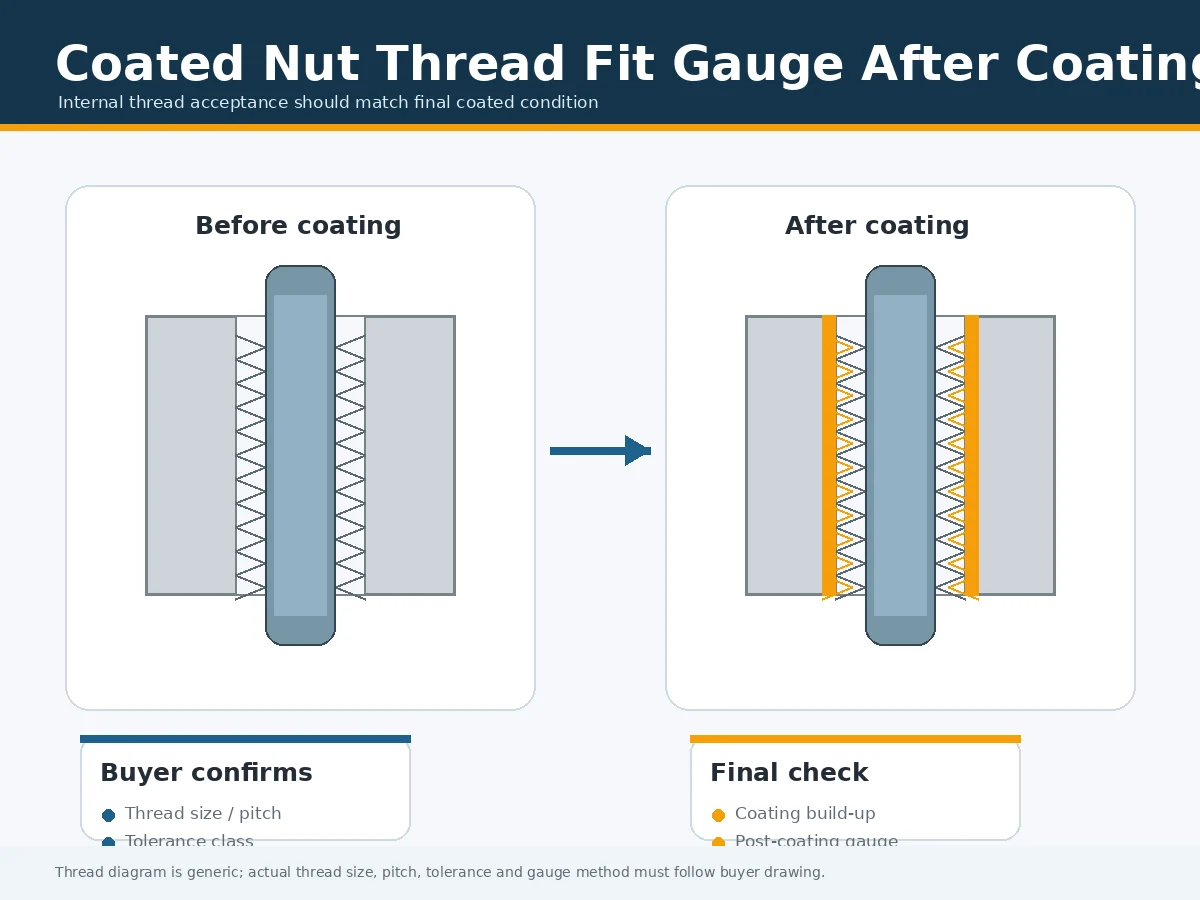
Il diagramma della filettatura è generico; la dimensione effettiva della filettatura, il passo, la tolleranza e il metodo di calibrazione devono seguire il disegno dell'acquirente.
Per dadi zincati e dadi zinco nichel, l'accumulo di elettrodeposizione può ridurre il gioco della filettatura interna. Per dadi a scaglie di zinco, il film di rivestimento e il topcoat possono anche influenzare l'ingresso del calibro e l'assemblaggio. La soluzione non è indovinare. Il disegno o la RFQ devono definire la condizione finale di ispezione.
| Articolo filettato | L'acquirente deve confermare | Rischio se mancante |
|---|---|---|
| Dimensione e passo della filettatura | Richiamo del disegno | Bullone, vite o prigioniero di accoppiamento errato |
| Tolleranza del filetto | Requisito di classe o accoppiamento | Disaccordo del calibro |
| Spessore del rivestimento se specificato | Standard del cliente o codice di rivestimento | Filettatura stretta o accoppiamento irregolare |
| Condizione del calibro | Prima della verniciatura, dopo la verniciatura o entrambe | Controversia di approvazione del campione |
| Smusso / ingresso | Condizione di ingresso controllata dal disegno | Problema di montaggio difficile o di ingresso del calibro |
| Topcoat / lubrificante | Se è richiesto l'attrito | Dispersione di coppia o variazione del precarico |
| Registro di ispezione | Rapporto del calibro se richiesto | Prova di approvazione mancante |
Connessione del disegno: Per progetti personalizzati, i requisiti di rivestimento e filettatura devono essere chiaramente indicati nel disegno o nel pacchetto RFQ. Per ulteriori informazioni sul controllo dei disegni, consultare SUNHYINGS dadi speciali realizzati su disegno.
Rischio di infragilimento da idrogeno: cosa devono verificare gli acquirenti
Il rischio di infragilimento da idrogeno è una delle considerazioni ingegneristiche più importanti nella scelta dei rivestimenti per elementi di fissaggio in acciaio ad alta resistenza o temprato. È particolarmente rilevante quando si utilizzano sistemi di rivestimento elettrolitico.
Per i dadi automobilistici, l'acquirente deve verificare il materiale, la durezza, il trattamento termico e il processo di rivestimento prima di presumere che una finitura sia accettabile. I dadi zincati e zinco-nichel sono sistemi elettrolitici, quindi le parti ad alta resistenza o temprate potrebbero richiedere una valutazione dell'infragilimento da idrogeno, un trattamento di baking o controlli di processo specifici del cliente, se specificato.

Il flusso di lavoro del rischio è solo esplicativo; il controllo finale del processo deve seguire lo standard del cliente e la specifica di rivestimento approvata.
La zincatura a scaglie è un sistema di rivestimento applicato per via non elettrolitica ed è spesso considerata quando è importante evitare il rischio di infragilimento da idrogeno associato alla galvanica. Tuttavia, ciò non significa che la zincatura a scaglie elimini ogni rischio. Il progetto richiede comunque un corretto pretrattamento, controllo del processo di rivestimento, finitura, ispezione e approvazione del cliente.
| Fattore di Rischio | Perché è importante | L'acquirente deve confermare |
|---|---|---|
| Grado del materiale | Determina la resistenza e la sensibilità al processo | Disegno o standard cliente |
| Durezza / classe di proprietà | Una durezza maggiore può aumentare la preoccupazione | Intervallo di durezza e metodo di prova |
| Trattamento termico | Influisce sul comportamento meccanico | Requisiti e registrazioni del trattamento termico |
| Percorso del rivestimento | La via elettrolitica vs non elettrolitica modifica la valutazione del rischio | Norma di rivestimento o processo approvato |
| Trattamento di cottura / distensione | Può essere richiesto da normativa o cliente | Tempi e condizioni richiesti se specificati |
| Approvazione del cliente | La decisione finale dipende dalle regole del programma | Codice di rivestimento del cliente e processo di approvazione |
Nessuna affermazione di rischio zero universale
Un trattamento di rivestimento non elettrolitico può essere un importante fattore di selezione, ma la valutazione del rischio di infragilimento da idrogeno dipende ancora dal materiale, dalla durezza, dal trattamento termico, dai controlli di processo e dai requisiti del cliente. Non dichiarare la garanzia di zero infragilimento da idrogeno senza una validazione specifica del progetto.
Rivestimento finale, lubrificante e comportamento coppia-tensione
Il rivestimento non è solo uno strato anticorrosivo. Modifica la condizione superficiale del dado e può influenzare l'attrito durante il serraggio. A parità di coppia di serraggio, diversi sistemi di rivestimento, rivestimenti finali o lubrificanti possono generare carichi di serraggio differenti.
Questo è importante per i giunti automobilistici dove il precarico, la resistenza all'allentamento, la coppia prevalente o la consistenza del montaggio sono importanti. È particolarmente rilevante quando i dadi rivestiti vengono utilizzati con bulloni di accoppiamento che hanno anch'essi il proprio rivestimento, lubrificante o condizione superficiale.

Non è implicito alcun valore di coppia o attrito; i valori di prova devono provenire dal disegno dell'acquirente o dallo standard di assemblaggio.
Per i dadi zincati, la passivazione, il sigillante e la condizione del lubrificante possono influenzare l'attrito. Per i dadi con rivestimento di zinco, il topcoat e il lubrificante integrato o aggiunto possono essere critici. Per i dadi zinco-nichel, il sistema di finitura esatto può influenzare l'attrito e il comportamento di assemblaggio.
L'acquirente non deve chiedere al fornitore di indovinare il valore di coppia o il coefficiente di attrito. Se il comportamento coppia-tensione è importante, la richiesta di offerta deve includere l'intervallo richiesto del coefficiente di attrito, il metodo di prova, la condizione lubrificata o asciutta, la condizione del bullone di accoppiamento e i criteri di accettazione.
| Variabile | Perché è importante | L'acquirente deve confermare |
|---|---|---|
| Topcoat | Modifica il comportamento di attrito e corrosione | Codice topcoat richiesto |
| Lubrificante | Modifica il comportamento coppia-tensione | Condizione lubrificata o asciutta |
| Coefficiente di attrito | Controlla la coerenza del gruppo | Intervallo target se richiesto |
| Finitura del bullone di accoppiamento | Influisce sul comportamento del giunto completo | Rivestimento e condizione superficiale del bullone |
| Dispositivo di bloccaggio | Influisce sulla coppia prevalente | Metodo di prova e accettazione |
| Spessore del rivestimento | Influisce sull'accoppiamento della filettatura e sull'attrito | Condizione finale di calibro e ispezione |
Per applicazioni con funzione di bloccaggio e sensibili alla coppia, gli acquirenti possono anche consultare SUNHYINGS dadi autobloccanti completamente metallici e comuni problemi di assemblaggio automobilistico risolti da dadi speciali.
Disegno e lista di controllo RFQ per dadi automobilistici rivestiti
Una richiesta di offerta per un dado automobilistico rivestito non dovrebbe dire solo “zincato”, “scaglie di zinco” o “zinco-nichel”. Questi nomi non sono sufficienti per la revisione tecnica. Il fornitore ha bisogno del disegno, del codice di rivestimento, dello standard del cliente, del contesto applicativo, della condizione della filettatura, della condizione del materiale, del requisito di attrito e dell'ambito documentale.

La checklist è solo per la preparazione della richiesta di offerta; PPAP, IMDS e rapporti di rivestimento si applicano solo se richiesti dal cliente o dal programma.
Una RFQ completa aiuta a prevenire la sostituzione errata del rivestimento, il cedimento della filettatura post-rivestimento, la dispersione della coppia, il disaccordo sulla corrosione e il conflitto documentale tardivo. Per il contesto di revisione dal lato fornitore, vedere SUNHYINGS come fornitore specializzato di dadi per applicazioni automobilistiche.
| Articolo RFQ | Obbligatorio? | Perché è importante | Richiede conferma |
|---|---|---|---|
| Ultima revisione del disegno | Sì | Controlla la base tecnica | Disegno corrente e revisione approvata |
| Tipo e funzione del dado | Sì | I dadi per saldatura, ribattitura, bloccaggio e flangiati hanno rischi diversi | Funzione, componente di accoppiamento e modalità di guasto |
| Posizione di assemblaggio | Sì | Determina l'esposizione alla corrosione e la funzione del giunto | Interno, esterno, sottoscocca, vano motore o area elettrica |
| Dimensione, passo e tolleranza della filettatura | Sì | Controlla l'accoppiamento del montaggio finale | Metodo di calibro e condizione prima/dopo rivestimento |
| Materiale / durezza / trattamento termico | Sì, se specificato | Supporta la revisione della fragilità da idrogeno | Grado del materiale, classe di proprietà, intervallo di durezza o nota sul trattamento termico |
| Tipo di rivestimento | Sì | Zincato, zincatura lamellare o zinco-nichel è solo il punto di partenza | Famiglia e percorso di rivestimento esatti |
| Codice rivestimento cliente | Fortemente raccomandato | Previene la sostituzione generica del rivestimento | Disegno cliente, codice OEM o specifica di acquisto |
| Spessore del rivestimento | Se specificato | Influisce sull'accoppiamento della filettatura e sulle aspettative di corrosione | Intervallo specificato, metodo di ispezione e condizione finale |
| Rivestimento finale / sigillante / lubrificante | Se richiesto | Controlla l'attrito e la finitura superficiale | Sistema approvato e condizione a secco / lubrificata |
| Metodo di prova della corrosione | Se richiesto | Definisce le aspettative di validazione | Nebbia salina neutra, corrosione ciclica o test specifico del cliente |
| Calibro per filettatura post-rivestimento | Se la filettatura è critica | Previene controversie sul montaggio finale | Prima della verniciatura, dopo la verniciatura o entrambe |
| Coefficiente di attrito | Se richiesto | Supporta la coerenza coppia-tensione | Intervallo target, metodo di prova e condizione del bullone di accoppiamento |
| PPAP / IMDS / rapporto di rivestimento | Se richiesto | Definisce l'ambito del documento di approvazione | Requisito del cliente o del programma |
| Volume annuale | Sì | Influisce sul percorso di rivestimento e sulla pianificazione del processo | Prototipo, approvazione del campione e volume di produzione |
| Imballaggio | Se richiesto | Previene danni al rivestimento e lotti misti | Sfuso, sacco, vassoio, etichetta, separazione dei lotti e prevenzione della ruggine |
Il PPAP deve essere trattato come un requisito specifico del cliente o del programma. Anche l'IMDS deve essere trattato come un requisito di dati sui materiali automobilistici quando richiesto. Questi devono essere confermati prima della quotazione anziché aggiunti dopo l'approvazione del prezzo.
Come SUNHYINGS esamina i requisiti di rivestimento prima della quotazione
SUNHYINGS deve esaminare i progetti di dadi automobilistici rivestiti controllando il disegno, il requisito di rivestimento, la condizione della filettatura, il rischio del materiale e il contesto applicativo prima della quotazione. L'obiettivo non è selezionare il rivestimento più costoso, ma confermare il sistema di rivestimento che corrisponde al disegno dell'acquirente e al requisito del cliente.
Revisione del disegno e del codice di rivestimento
La revisione inizia con l'ultima revisione del disegno e la nota sul rivestimento. Se il disegno indica solo “zinco”, “Zn”, “finitura nera” o “resistente alla corrosione”, il requisito di rivestimento non è sufficientemente chiaro per una quotazione automobilistica. Il codice di rivestimento, il colore della finitura, il topcoat, il sigillante, il lubrificante, il requisito di corrosione e l'ambito del rapporto devono essere confermati.
Revisione del materiale, della durezza e del rischio di infragilimento da idrogeno
SUNHYINGS deve verificare il grado del materiale, la durezza, il trattamento termico e i requisiti di resistenza prima di confermare un processo di rivestimento per elettrodeposizione. Se esiste il rischio di infragilimento da idrogeno, il progetto deve essere esaminato secondo lo standard del cliente e i requisiti del processo di rivestimento.
Revisione dei requisiti funzionali e della filettatura
Per i dadi, la condizione finale della filettatura interna è critica. La revisione deve confermare le dimensioni della filettatura, il passo, la tolleranza, lo smusso, il requisito di calibro post-rivestimento e le esigenze di test funzionali. Dadi per saldatura su flangia, dadi esagonali per saldatura, dadi autobloccanti, i dadi autobloccanti interamente in metallo e i dadi flangiati possono richiedere punti di revisione diversi.
Revisione del campione e del controllo di produzione
Prima del campionamento, l'acquirente e il fornitore devono confermare se il percorso del campione corrisponde al percorso di produzione. Devono inoltre definire l'ambito del rapporto di rivestimento, il piano di ispezione, l'imballaggio, la tracciabilità dei lotti, il PPAP se richiesto e l'IMDS se richiesto.
Cosa può essere verificato prima del preventivo
Per progetti di dadi automobilistici sensibili alla verniciatura, SUNHYINGS può esaminare il disegno del cliente e il pacchetto RFQ per identificare dati tecnici mancanti prima della conferma del prezzo. Questa revisione è un controllo tecnico in fase di quotazione, non sostituisce l'approvazione del cliente, la validazione del laboratorio di verniciatura o la presentazione formale PPAP.
| Elemento di revisione | Cosa può verificare SUNHYINGS | Limite |
|---|---|---|
| Revisione del disegno e nota sulla verniciatura | Se la specifica di verniciatura è sufficientemente chiara per la quotazione e il campionamento | Il disegno del cliente e la specifica di verniciatura rimangono l'autorità finale |
| Accoppiamento filettatura interna | Se è necessario definire la condizione del calibro filettato post-verniciatura | L'accettazione effettiva del calibro deve seguire il disegno del cliente e il metodo di ispezione |
| Materiale, durezza e trattamento termico | Se la revisione della fragilità da idrogeno correlata alla zincatura può essere rilevante | Nessuna procedura di rivestimento deve essere approvata senza la revisione dei requisiti del cliente |
| Requisito del rapporto di rivestimento | Se è richiesto il rapporto di rivestimento, i dati di prova di corrosione o la documentazione del fornitore | L'ambito del rapporto dipende dal cliente, dal programma e dalla capacità del partner di rivestimento |
| Requisito di attrito e coppia-tensione | Se mancano il topcoat, il lubrificante, il coefficiente di attrito o la finitura del bullone di accoppiamento | I valori di coppia e attrito devono provenire da uno standard del cliente o da test qualificati |
| Imballaggio e tracciabilità del lotto | Se sono definiti la prevenzione dei danni al rivestimento, la separazione dei lotti e i requisiti delle etichette | Il metodo di imballaggio finale deve seguire l'ordine di acquisto e i requisiti logistici del cliente |
Domande aperte prima del preventivo
Se i dati del rivestimento sono incompleti, SUNHYINGS deve chiarire i punti mancanti prima del preventivo finale. Le domande aperte tipiche includono: Qual è il codice esatto del rivestimento? Il dado è ad alta resistenza o trattato termicamente? La filettatura deve passare al calibro dopo il rivestimento? È richiesto un intervallo di attrito? Il requisito di corrosione è nebbia salina, corrosione ciclica o specifico del cliente? Sono richiesti PPAP, IMDS o rapporti sul rivestimento?
Gli acquirenti possono valutare SUNHYINGS come produttore personalizzato di dadi per progetti personalizzati di dadi automobilistici che coinvolgono revisione del disegno, accoppiamento filettato, requisiti di rivestimento e controllo produzione.
Limite di revisione: I dati mancanti sul rivestimento o sull'ispezione devono essere contrassegnati come “da confermare”. Non devono essere sostituiti da un'ipotesi generica.
Prima di richiedere un preventivo per dadi automobilistici rivestiti
Preparare la revisione del disegno, il codice del rivestimento, la funzione del dado, la posizione di montaggio, il materiale/durezza, la tolleranza della filettatura, il requisito del calibro post-rivestimento, la vernice di finitura, il lubrificante, il metodo di prova di corrosione, l'intervallo di attrito se richiesto, il volume annuale e il requisito di imballaggio prima del preventivo.
Se uno qualsiasi di questi elementi è assente, la scelta del rivestimento deve essere considerata “da confermare” piuttosto che data per scontata. Ciò è particolarmente importante per dadi zincati, a scaglie di zinco e zinco-nichel utilizzati in giunti automobilistici dove l'accoppiamento della filettatura, la valutazione della fragilità da idrogeno o il comportamento coppia-tensione influenzano l'approvazione.
Pacchetto tecnico minimo
Inviare l'ultima revisione del disegno, la dimensione e tolleranza della filettatura, la funzione del dado, la nota sul rivestimento, il requisito di materiale o durezza, la posizione di montaggio e il volume annuale.
Dati aggiuntivi per progetti sensibili ai rivestimenti
Confermare il codice di rivestimento del cliente, il topcoat, il lubrificante, il metodo di prova della corrosione, il calibro di filettatura post-rivestimento, il coefficiente di attrito se richiesto, il PPAP se richiesto e l'IMDS se richiesto.
Contesto dei riferimenti tecnici e degli standard
I riferimenti seguenti sono forniti come contesto tecnico per il percorso di rivestimento, i sistemi di rivestimento per elementi di fissaggio, la revisione del rischio di infragilimento da idrogeno e i requisiti documentali automobilistici. Non sostituiscono il disegno dell'acquirente, la specifica specifica del cliente, la specifica di rivestimento o la revisione tecnica qualificata.
| Riferimento | Come supporta questa guida | Limite di utilizzo |
|---|---|---|
| ISO 4042: Elementi di fissaggio — Sistemi di rivestimento elettrolitico | Fornisce contesto per i sistemi di rivestimento elettrolitico sugli elementi di fissaggio e indicazioni per la minimizzazione del rischio di infragilimento da idrogeno. | Utilizzare solo come contesto per la via di rivestimento; il requisito finale deve seguire la norma del cliente e il disegno approvato. |
| ISO 10683: Sistemi di rivestimento a scaglie di zinco non elettrolitici | Fornisce contesto per i sistemi di rivestimento a scaglie di zinco per elementi di fissaggio in acciaio, inclusi i dadi, con o senza sovrarivestimento o lubrificante. | Utilizzare solo come contesto per il rivestimento a scaglie di zinco; il sistema finale deve essere specificato dal codice cliente o dalla specifica di rivestimento approvata. |
| AIAG PPAP-4 | Fornisce il contesto per l'approvazione del pezzo di produzione quando devono essere dimostrati i documenti di progettazione tecnica del cliente e i requisiti specifici. | PPAP si applica solo quando richiesto dal cliente, dal programma o dalle specifiche di acquisto. |
| IMDS: Sistema Internazionale di Dati sui Materiali | Fornisce il contesto per la segnalazione dei dati sui materiali automobilistici quando richiesto dai programmi automobilistici. | IMDS deve essere considerato un requisito del cliente o del programma automobilistico, non un requisito predefinito per ogni ordine di dadi personalizzati. |
Per ulteriori risorse tecniche SUNHYINGS, consultare l' guide tecniche archivio e l' dadi speciali personalizzati hub dei prodotti.
FAQ
Qual è il migliore per dadi automobilistici, zincato, zincato in scaglie o zinco-nichel?
Non esiste un'opzione universale migliore. I dadi zincati possono essere adatti per applicazioni sensibili ai costi e a bassa corrosione. I dadi con rivestimento in scaglie di zinco sono spesso considerati per requisiti di corrosione più elevati e necessità di rivestimento non elettrolitico. I dadi in zinco-nichel sono spesso selezionati quando la specifica del cliente richiede prestazioni di corrosione più elevate o un sistema di finitura definito. La scelta finale dipende dal disegno, dallo standard del cliente, dal materiale, dalla durezza, dall'accoppiamento della filettatura, dal requisito di attrito e dall'ambito di approvazione.
I dadi zincati sono adatti per applicazioni automobilistiche?
Sì, i dadi zincati possono essere adatti per alcune applicazioni automobilistiche quando il disegno o la specifica del cliente lo consente. Sono spesso utilizzati in ambienti sensibili ai costi o a bassa corrosione. Tuttavia, le parti ad alta resistenza o temprate richiedono una verifica della fragilità da idrogeno, e l'accoppiamento finale della filettatura dopo la zincatura deve essere confermato quando richiesto.
Perché i rivestimenti a scaglie di zinco vengono utilizzati sui fissaggi automobilistici?
I rivestimenti a scaglie di zinco sono spesso utilizzati perché forniscono una forte protezione dalla corrosione e vengono applicati non elettroliticamente. Sono spesso considerati per elementi di fissaggio automobilistici esposti o per elementi di fissaggio ad alta resistenza quando la specifica del cliente lo consente. L'acquirente deve comunque confermare il sistema di rivestimento, la finitura superficiale, il range di attrito, il calibro per filettatura e i requisiti del test di corrosione.
La zincatura al nichel è migliore della zincatura per i dadi?
La zincatura al nichel può offrire prestazioni di corrosione migliori rispetto alla zincatura standard se specificata correttamente, ma non è automaticamente la scelta migliore per ogni dado. Di solito costa di più e richiede comunque un codice di rivestimento esatto, il controllo dell'accoppiamento della filettatura, i requisiti di corrosione e la verifica della fragilità da idrogeno quando sono coinvolte parti ad alta resistenza o temprate.
Il rivestimento influisce sull'accoppiamento della filettatura interna dei dadi?
Sì. La verniciatura può ridurre il gioco della filettatura interna e influenzare l'ispezione con calibro. Un dado può superare l'ispezione della filettatura prima della verniciatura ma fallire dopo se la tolleranza della filettatura, lo spessore della verniciatura o le condizioni finali del calibro non sono definite. Gli acquirenti dovrebbero confermare se l'accettazione finale è prima della verniciatura, dopo la verniciatura o entrambe.
Quale rivestimento presenta il minor rischio di infragilimento da idrogeno?
Il rischio di infragilimento da idrogeno dipende dal materiale, dalla durezza, dal trattamento termico, dal processo di rivestimento e dai requisiti del cliente. La zincatura e la zincatura al nichel sono sistemi elettrodeposti, pertanto le parti ad alta resistenza o temprate potrebbero richiedere una valutazione. La zincatura a scaglie viene applicata per via non elettrolitica ed è spesso considerata quando è importante evitare i rischi legati all'elettrodeposizione, ma l'approvazione finale deve seguire i requisiti tecnici del cliente.
Il rivestimento a scaglie di zinco modifica il comportamento coppia-tensione?
Sì, è possibile. I sistemi a scaglie di zinco spesso includono un topcoat o un lubrificante, e questi possono influenzare l'attrito. Se il comportamento coppia-tensione è importante, l'acquirente dovrebbe definire il coefficiente di attrito, la finitura del bullone di accoppiamento, il metodo di prova e la condizione di montaggio, invece di basarsi su nomi generici di rivestimenti.
Cosa dovrei includere in una richiesta di preventivo per dadi automobilistici rivestiti?
Includere l'ultima revisione del disegno, tipo di dado, posizione di applicazione, dimensione della filettatura, passo, tolleranza, materiale, durezza, codice del rivestimento, verniciatura finale, lubrificante, calibro della filettatura post-rivestimento, requisito del test di corrosione, coefficiente di attrito se richiesto, PPAP se richiesto, IMDS se richiesto, volume annuale e requisito di imballaggio.
Pagine correlate SUNHYINGS
Consulta le pagine correlate per dadi personalizzati, applicazioni automobilistiche, funzione speciale del dado e guida tecnica.
Nota di revisione tecnica
Questo articolo è stato preparato per responsabili acquisti, ingegneri acquisti, team SQE, ingegneri di elementi di fissaggio e team di progetto automobilistici che confrontano dadi zincati, zinc-flake e zinco-nichel prima di RFQ, campionatura o approvazione di produzione.
Ambito revisionato: percorso di rivestimento, esposizione alla corrosione, accoppiamento filettatura interna, condizione del calibro post-rivestimento, revisione del rischio di infragilimento da idrogeno, topcoat, lubrificante, comportamento coppia-tensione, durezza del materiale, funzione del dado, dati RFQ, PPAP se richiesto e IMDS se richiesto.
Nota su standard e limitazioni: Questo articolo è una guida pratica di approvvigionamento e ingegneria. Non sostituisce il disegno del cliente, la specifica di rivestimento, il requisito specifico del cliente, la revisione tecnica qualificata, la presentazione formale PPAP, il requisito di segnalazione IMDS o l'approvazione del processo del fornitore. La mancanza di dati su rivestimento, filettatura, attrito, materiale o documenti deve essere considerata come necessità di conferma, non data per scontata.