For engineers and buyers, the first decision is not simply whether to purchase galvanized or weathering steel bolts. It is whether the proposed bolt, nut, washer, and protective finish form an acceptable assembly for the actual bridge connection—and whether the required inspection evidence can be obtained.
Start with the Exposure at the Connection, Not Just the Bridge Location
Two bolted connections on the same bridge can experience very different corrosion conditions.
A connection beneath a well-drained girder may experience periodic rain followed by drying. Another connection beneath a leaking deck joint may receive repeated deposits of chloride-contaminated runoff. Although both connections are outdoors, their moisture retention, salt accumulation, and opportunities for drying are not equivalent.
This distinction matters because atmospheric corrosion is affected by more than the presence of water. Moisture provides the electrolyte required for electrochemical corrosion, while dissolved salts can increase conductivity and remain on exposed surfaces after water evaporates. Deposits and sheltered crevices may also retain moisture longer than open steel surfaces.
The geometry of a connection can therefore change its local exposure. Water may collect around bolt heads, washer edges, lap joints, and poorly drained horizontal surfaces. A protective system that performs acceptably on an exposed, regularly drying member may require additional scrutiny where water and contaminants accumulate.
The FHWA’s guidance on uncoated weathering steel identifies marine environments, persistent moisture, and unfavorable drainage or structural details as important considerations. Its October 1989 technical advisory remains useful for understanding these mechanisms, although the project’s current governing design and maintenance requirements must be established independently.
An initial exposure assessment can be organized as follows:
| Connection exposure | Main concern | Protection decision to investigate |
|---|---|---|
| Periodic atmospheric wetting with effective drainage and limited chloride deposition | Whether the surfaces can dry and avoid persistent deposits | Evaluate the specified weathering or coated assembly against the actual structural system |
| Uncoated weathering steel with sheltered or poorly drained bolted joints | Moisture retention may interfere with the intended corrosion behavior | Review connection detailing and whether local protection or drainage changes are needed |
| Connections exposed to deicing-salt runoff | Repeated chloride deposition and moisture at joint details | Evaluate a project-approved protective system and the associated maintenance conditions |
| Coastal locations with persistent salt exposure or frequent condensation | Increased corrosion risk at exposed surfaces and crevices | Obtain an exposure-specific material and coating assessment rather than assuming one finish is universally suitable |
These are screening considerations, not automatic acceptance categories. No corrosion-life prediction or universal environmental threshold can be established from the location description alone.
Hypothetical example — two connections on the same highway bridge
Assume a steel highway bridge has two structurally comparable bolted connections. Connection A is located beneath a girder with effective drainage. Connection B is beneath a deck expansion joint that periodically leaks runoff containing deicing salts.
Both connections are assumed to use the same nominal bolt diameter and structural bolt grade. No difference in mechanical demand is assumed for this illustration.
Connection B nevertheless requires additional corrosion evaluation because its local exposure includes a potential chloride source and recurring moisture at the joint. The engineer may need to review the protective coating, runoff control, surface detailing, and inspection accessibility separately from Connection A.
When Uncoated Weathering Bolts Are Appropriate—and When They Are Not
Weathering steel is used in suitable atmospheric environments because its corrosion products can develop into a relatively protective surface layer. This behavior depends on exposure conditions, including opportunities for surfaces to dry.
The distinction between ordinary weathering and persistent wetness is important. Repeated wetting and drying under suitable conditions can support the development of a more protective patina. Continued exposure to water or concentrated contaminants can interfere with that process.
For bolted connections in uncoated weathering steel structures, the fasteners must also be appropriate for the intended weathering assembly. Under the ASTM F3125 structural bolting system, Type 3 identifies a weathering-related material classification. The corresponding nuts and washers must be selected according to the applicable assembly requirements rather than matched merely because their nominal dimensions fit.
A Type 3 designation, however, is not a general-purpose marine corrosion approval. Nor does it guarantee that every sheltered bolted connection will experience the same weathering behavior as an exposed bridge member.
This becomes particularly relevant around washers and overlapping plates. These locations may retain water or deposits differently from the surrounding steel. Their corrosion conditions are affected by geometry and drainage even when the bolt material has suitable atmospheric corrosion resistance.
The correct judgment is therefore not that weathering bolts eliminate the need for corrosion assessment. Rather, they can be part of an appropriate uncoated weathering steel connection when the environment, structural detailing, and complete component combination support that choice.
Where chloride deposition is substantial or drying is poor, engineers should reassess the suitability of the uncoated system. Possible responses may involve drainage improvements, local protective measures, or an alternative protection strategy approved for the structure.
A supplier’s Type 3 material description cannot independently establish the suitability of a proposed bolt for a particular bridge. That judgment requires the governing material specification, compatible components, and exposure assessment.
Protective Coatings Must Match the Bolt Grade and Approved Assembly
Applying a corrosion-resistant coating to a structural bolt is not interchangeable with coating an ordinary commercial fastener.
Structural bolts are subject to product specifications and installation requirements that may restrict the coating process according to bolt strength group, assembly configuration, and the effects of the treatment on the fastener.
Three coating routes commonly discussed in structural bolting specifications are hot-dip galvanizing, mechanical galvanizing, and qualified zinc-flake systems. They should be treated as different technical processes, not as equivalent ways of purchasing a zinc-coated bolt.
Hot-dip galvanizing
Hot-dip galvanizing creates a zinc-based protective coating through immersion in molten zinc. For fasteners within its scope, ASTM F2329/F2329M addresses the galvanizing process and associated coating requirements.
Whether that process is permitted on a specific structural bolting assembly is a separate question.
Under the RCSC specification dated June 5, 2025, hot-dip galvanizing is not permitted for Group 150 heavy hex bolts, spline-end matched bolting assemblies of any group, or direct tension indicators. Other permitted assemblies must still meet the applicable product, coating, and matching-component requirements.
This distinction matters when a purchase order lists only the bolt grade and requests a hot-dip galvanized finish. The grade designation alone does not establish whether the chosen bolt style and assembly permit that finish.
Mechanical galvanizing
Mechanical galvanizing deposits zinc through a mechanical process rather than immersion in molten zinc. RCSC 2025 refers to ASTM B695 Class 55 for permitted mechanically galvanized structural bolting components.
Mechanical galvanizing is not permitted for Group 150 bolts or assemblies under that specification. For specified spline-end assemblies, the process is also subject to manufacturer direction and the applicable assembly standard.
Consequently, a mechanically galvanized bolt should not be substituted for a hot-dip galvanized or plain assembly solely because its diameter, grade designation, and nominal coating description appear similar.
The permitted process, component compatibility, and order requirements must be checked together.
Zinc-flake coating systems
Zinc-flake coatings require separate consideration. RCSC 2025 addresses coating systems meeting specified classifications under ASTM F3393, together with restrictions relating to the type of assembly and components being coated.
This is important when evaluating high-strength structural bolts. A restriction on hot-dip or mechanical galvanizing does not automatically prohibit every qualified protective coating.
Equally, the existence of an approved zinc-flake route does not mean that any product marketed as zinc-flake coated will satisfy the specification. The actual coating classification, bolt configuration, matching components, manufacturer controls, and governing edition must agree.
Coating selection must also account for the installation process. A coating may change thread dimensions or frictional behavior, while certain treatments require measures to manage the potential effects on high-strength bolt materials.
The engineering question is therefore broader than coating thickness or corrosion resistance: Is this coating permitted for this specific bolting assembly, and can the assembled connection be installed and inspected as required?
ASTM F3125/F3125M defines structural bolt product requirements, while the RCSC specification addresses structural joint assemblies and their installation. A project may invoke particular editions or additional bridge-owner requirements. The current ASTM catalog identifies F3125/F3125M-26, but publication of a newer edition does not automatically change the edition specified in an existing contract.
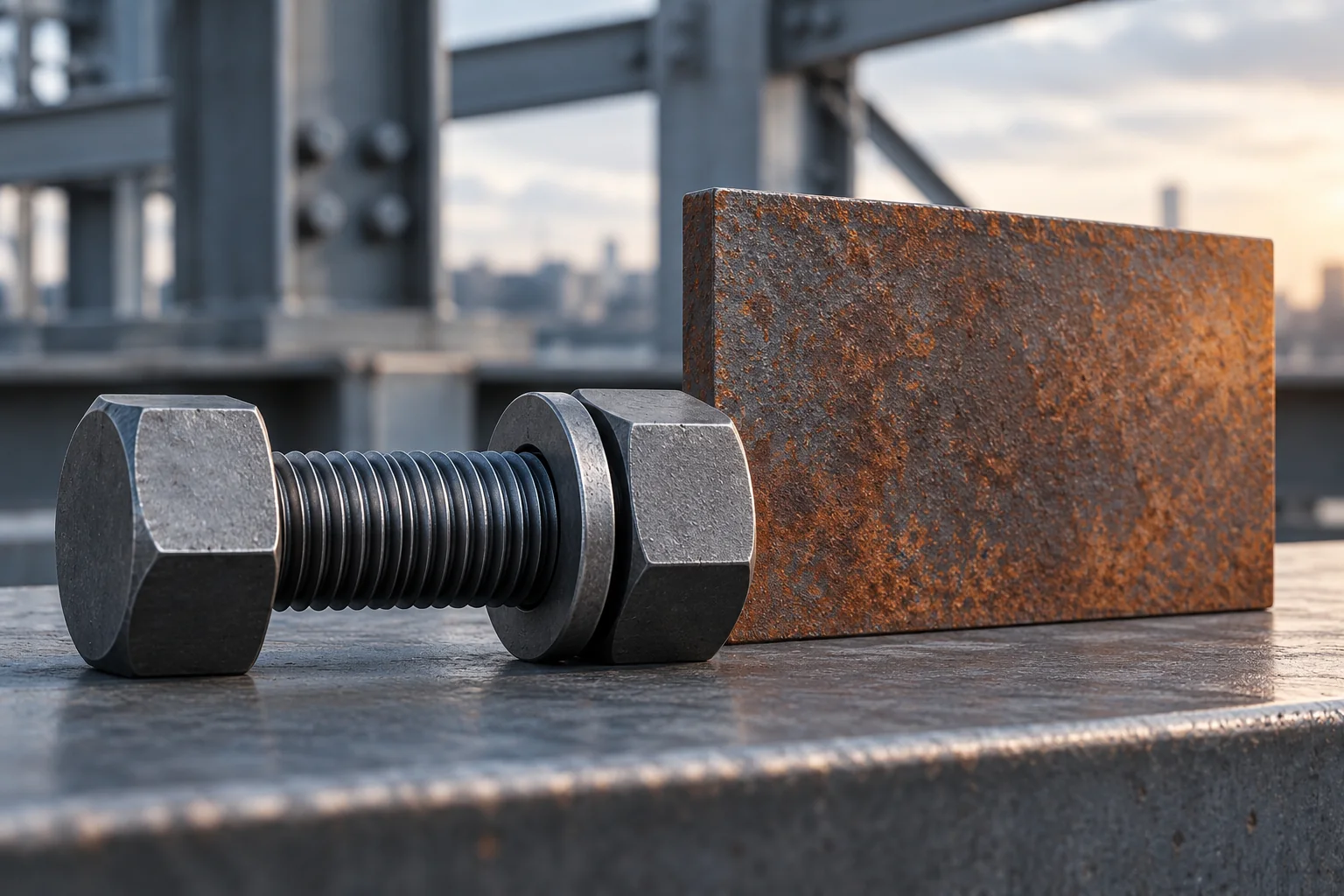
Why Nuts, Washers, Lubrication and Contact Surfaces Matter
The corrosion protection of a structural connection cannot be evaluated by examining the bolt alone.
A coated bolt must work with a suitable nut, required washer arrangement, and installation method. These components affect both mechanical compatibility and the behavior of the assembly during tightening.
Coated threads and nut fit
Galvanizing increases the dimensions of coated threaded surfaces. To accommodate this, applicable structural bolting specifications provide for overtapping certain coated nuts.
Overtapping enlarges the internal thread after or in conjunction with the specified coating process. This permits assembly with the coated bolt but also affects thread engagement geometry. The nut’s strength and compatibility therefore need to be established under the applicable specification.
A standard uncoated nut selected only by nominal thread designation may not be an acceptable replacement for the specified coated nut.
RCSC 2025 also requires compatible coating processes for threaded components within the relevant coated assembly systems. Buyers should not assume that bolts and nuts from separate stock lots or different coating processes can be combined without verification.
Lubrication changes the tightening behavior
Thread lubrication affects the relationship between applied tightening effort, friction, and the resulting bolt tension.
Two assemblies with the same bolt grade and diameter can behave differently when their coating and lubrication conditions differ. A greater proportion of applied torque may be consumed by friction in one assembly than in another.
That is why a universal torque value is an unreliable way to establish the pretension of an unspecified structural bolting assembly.
For applicable galvanized assemblies, the supplier’s rotational-capacity testing addresses the compatibility of the components and lubricant. This testing is distinct from the pre-installation verification and installation inspection procedures required for the connection.
An assembly should not be accepted simply because a torque wrench reaches a nominal setting. The project-specified installation method and associated verification requirements remain controlling.
The faying surface is not the bolt coating
The faying surface is the contact surface between connected steel elements. In a slip-critical connection, resistance to slip depends in part on the condition of these contact surfaces.
A bolt may have an approved corrosion-protective finish while the connection’s faying surfaces require a separately qualified coating or surface condition.
Under RCSC 2025, slip-critical faying surfaces are subject to distinct requirements. Qualified Class A or Class B coating systems may be used within the applicable conditions, while certain alternative surface treatments require testing and approval by the Engineer of Record.
This prevents a common specification error: approving the bolt coating and assuming that the same approval covers every coated surface inside the connection.
For example, a project could specify appropriately coated bolts but still require a particular surface preparation or qualified coating system between connected plates. The two requirements must be documented separately.
Even connections that are not designed as slip-critical may warrant attention to thick or compressible coatings at loaded contact locations, particularly where maintaining bolt pretension is important. Coating compressibility and relaxation can affect the installed assembly.
The buyer should therefore confirm both the fastener finish and the connection surface requirements before treating a corrosion protection package as complete.
In an illustrative repair order, a corrosion-protection change is applied only to the bolts while the mating nuts and supplied lubricant remain undefined. The new finish can alter fit and installation behavior. Reconcile the complete component package, retain the coating and lot records and verify the installation procedure. A corrosion upgrade cannot be accepted solely from its appearance.
Inspection Checks from Receiving to Bridge Service
Inspection requirements change as the structural bolting assembly moves from delivery to installation and ultimately into service.
A mill or product test report addresses component conformity. An installation inspection addresses the assembled joint. A bridge maintenance inspection addresses the condition of the connection after environmental exposure.
These checks are related, but none is a universal substitute for the others.
Receiving inspection: confirm what was actually supplied
When coated structural bolting assemblies arrive, receiving inspection should establish that the delivered materials match the approved purchase and project requirements.
The first checks concern identification. Inspectors should compare bolt markings, nominal diameter, length, grade, type, style, and coating designation with the purchase documentation. The specified nuts and washers must also match the assembly requirements.
Physical condition matters. Look for corrosion or coating damage, contaminated or visibly damaged threads, damaged packaging, and evidence that components may have been mixed or stored in unsuitable conditions.
Documentation should provide the level of conformity and traceability required by the applicable product specifications and contract. Depending on the assembly and order, this may include product test reports, coating documentation, matched-assembly records, and applicable rotational-capacity results.
A material test report is not automatically the same as a finished assembly test report. A bolt head marking identifies a product classification but does not, by itself, prove that all chemical, mechanical, coating, and assembly tests have been satisfied.
Likewise, receiving inspectors should not assume that a certificate issued for one component lot covers a later substitution of nuts or washers.
The important question is whether the documents actually relate to the delivered configuration and the required inspection scope.
Pre-installation and installation: verify the assembled connection
Before installation, coated bolting assemblies should be protected from avoidable contamination or deterioration. The condition of threaded surfaces and any specified lubricant must remain suitable for the installation procedure.
The required verification depends on the connection type and tightening method.
For pretensioned or slip-critical joints, applicable RCSC provisions require pre-installation verification of the selected installation method and prescribe corresponding inspection activities. The test assemblies and method must represent the configuration being used.
For snug-tightened joints, the inspection objective is different. Under the RCSC procedure, inspectors verify suitable components, properly prepared connecting elements, and firm contact between the connected plies rather than attempting to demonstrate an installed pretension that is not required for that joint.
The distinction is essential because a correctly installed snug-tightened joint and a properly verified pretensioned joint are not judged by the same acceptance procedure.
Where a project requires independent or third-party inspection, responsibilities should be defined by the invoking specification and contract documents. A supplier’s certificate cannot substitute for inspection of work performed at the bridge site.
In-service inspection: identify where the protection is changing
After the bridge enters service, corrosion inspection should consider both the protective condition of the fasteners and the surrounding connection details.
Potential observations include localized rusting around bolt heads or washer edges, damaged or missing coating, salt deposits, trapped moisture, abnormal runoff patterns, and deterioration concentrated at sheltered surfaces.
However, not every visible oxide film has the same significance. A uniform patina on a correctly exposed weathering steel component is different from pronounced localized corrosion associated with persistent leakage or trapped contaminants.
Similarly, rust staining does not independently quantify bolt section loss or remaining connection capacity.
An inspector should record the location, extent and apparent cause of the condition, compare it with the expected protection system, and refer potentially consequential deterioration for appropriate engineering assessment.
The same principle applies to maintenance intervention. Tightening a weathered structural bolt to an arbitrary torque is not a reliable way to restore a joint’s specified condition. Existing bolt tension, component condition, coating damage, reusability restrictions and the approved repair method must be considered before work proceeds.
For bridge owners, drainage correction can be as important as coating repair. Repeated coating damage at a location exposed to continuing salt-laden runoff may not be effectively addressed unless the source of contamination or moisture retention is also controlled.
Inspection intervals, corrosion acceptance limits, and repair decisions belong to the applicable bridge-owner maintenance program and engineering assessment. They should not be inferred from a generic coating description.
What Engineers and Buyers Should Specify Before Ordering
A technically useful request should make the following items clear:
- Project and application: Bridge or outdoor steelwork application, relevant environmental exposure, and any project-specific corrosion protection requirements.
- Governing documents: Applicable structural design, bolting, product and coating standards, including the contractual editions.
- Bolt identity: Required ASTM F3125 grade, type, style, nominal diameter, length, and threading configuration, as applicable.
- Protective finish: Plain/weathering configuration or specified coating process and qualification requirements, without assuming that finishes are interchangeable.
- Matching components: Permitted nut grades and types, washer configuration, matched-assembly requirements and lubricant condition.
- Connection requirements: Snug-tightened, pretensioned or slip-critical joint designation, relevant installation procedure and any special faying-surface requirements.
- Quality documents: Required component and coating test reports, applicable assembly verification records, lot traceability and purchaser inspection requirements.
- Delivery condition: Assembly identification, segregation, preservation, packaging and any conditions needed to protect specified lubricated or coated components.
These fields do not replace the Engineer of Record’s connection design. They allow the supplier to identify the specified product correctly and disclose any proposed deviation before an order is placed.
Consider an RFQ that requests only “high-strength galvanized bridge bolts.” It leaves unresolved whether the required grade and assembly permit the intended galvanizing process, which nuts and washers are compatible, how the connection will be installed, and what reports will support acceptance.
Adding those details early is more valuable than trying to establish compatibility after components have been delivered.
When comparing supplier proposals, the lowest quoted price should therefore not be evaluated independently of assembly conformity and inspection obligations. A proposal for bolts without the specified matching components or required verification evidence is not necessarily equivalent to a proposal for a complete, conforming assembly.
For bridges and outdoor steelwork, the practical selection sequence is to establish the connection exposure, confirm the approved material and coating system, verify the complete bolting assembly, and define the appropriate inspection evidence. The final choice must remain consistent with the governing structural design and project documents.
Frequently asked questions
Are Type 3 bolts suitable for every outdoor bridge?
No. Evaluate chloride exposure, drainage, wetting and drying, retained moisture and the actual connection detail before selecting an uncoated weathering system.
Does coating the bolt establish slip-critical surface suitability?
No. Bolt coating and the required faying-surface condition are separate decisions. Verify each against the governing connection requirements.
Can corrosion protection be changed without reviewing installation?
Do not assume so. Confirm permitted coatings, mating components, lubrication and any resulting verification requirements for the actual assembly.