Für Planer und Einkäufer ist die erste Entscheidung nicht einfach, ob verzinkte oder wetterfeste Stahlbolzen beschafft werden sollen. Entscheidend ist, ob der vorgesehene Bolzen, die Mutter, die Unterlegscheibe und die Schutzbeschichtung eine zulässige Anordnung für die tatsächliche Brückenverbindung bilden – und ob die geforderten Prüfnachweise erhältlich sind.
Beginnen Sie mit der Exposition an der Verbindung, nicht nur mit dem Standort der Brücke
Zwei geschraubte Verbindungen an derselben Brücke können sehr unterschiedlichen Korrosionsbedingungen ausgesetzt sein.
Eine Verbindung unter einem gut entwässerten Träger kann periodischem Regen mit anschließender Trocknung ausgesetzt sein. Eine andere Verbindung unter einer undichten Fahrbahnübergangsfuge kann wiederholt chloridhaltigen Ablauf erhalten. Obwohl beide Verbindungen im Freien liegen, sind ihre Feuchtigkeitsrückhaltung, Salzansammlung und Trocknungsmöglichkeiten nicht gleichwertig.
Diese Unterscheidung ist wichtig, weil die atmosphärische Korrosion von mehr als nur der Anwesenheit von Wasser beeinflusst wird. Feuchtigkeit liefert den für die elektrochemische Korrosion erforderlichen Elektrolyten, während gelöste Salze die Leitfähigkeit erhöhen und nach dem Verdunsten des Wassers auf freiliegenden Oberflächen verbleiben können. Ablagerungen und geschützte Spalte können Feuchtigkeit zudem länger zurückhalten als offene Stahloberflächen.
Die Geometrie einer Verbindung kann daher ihre lokale Exposition verändern. Wasser kann sich um Bolzenköpfe, Scheibenränder, Überlappungsverbindungen und schlecht entwässerte horizontale Flächen sammeln. Ein Schutzsystem, das an einem exponierten, regelmäßig trocknenden Bauteil zufriedenstellend funktioniert, kann dort, wo sich Wasser und Verunreinigungen ansammeln, zusätzlicher Prüfung bedürfen.
Das FHWA-Leitfaden zu unbeschichtetem wetterfestem Stahl benennt Meeresumgebungen, dauerhafte Feuchtigkeit sowie ungünstige Entwässerung oder konstruktive Details als wichtige Aspekte. Der technische Hinweis von Oktober 1989 ist nach wie vor hilfreich, um diese Mechanismen zu verstehen; die aktuell geltenden Auslegungs- und Instandhaltungsanforderungen des Projekts sind jedoch unabhängig davon festzulegen.
Eine erste Expositionsbewertung kann wie folgt gegliedert werden:
| Exposition der Verbindung | Hauptproblem | Zu prüfende Schutzentscheidung |
|---|---|---|
| Periodische atmosphärische Benetzung mit wirksamer Entwässerung und begrenzter Chloridablagerung | Ob die Oberflächen abtrocknen können und dauerhafte Ablagerungen vermieden werden | Die spezifizierte wetterfeste oder beschichtete Ausführung mit dem tatsächlichen Tragwerk abgleichen |
| Unbeschichteter wetterfester Stahl mit geschützten oder schlecht entwässerten Schraubverbindungen | Feuchtigkeitsstau kann das beabsichtigte Korrosionsverhalten beeinträchtigen | Detailausbildung der Verbindung prüfen und ob lokaler Schutz oder Änderungen an der Entwässerung erforderlich sind |
| Verbindungen, die Streusalz-Abflusswasser ausgesetzt sind | Wiederholte Chloridablagerung und Feuchtigkeit an Fugen- und Anschlussdetails | Ein projektseitig freigegebenes Schutzsystem und die zugehörigen Wartungsbedingungen bewerten |
| Küstenstandorte mit dauerhafter Salzbelastung oder häufiger Kondensation | Erhöhtes Korrosionsrisiko an freiliegenden Oberflächen und in Spalten | Eine expositionsspezifische Werkstoff- und Beschichtungsbewertung einholen, statt davon auszugehen, dass eine Oberflächenausführung universell geeignet ist |
Dies sind Prüfkriterien für die Vorauswahl, keine automatischen Annahmekategorien. Eine Vorhersage der Korrosionslebensdauer oder ein allgemeingültiger Umgebungsschwellenwert lässt sich allein aus der Standortbeschreibung nicht ableiten.
Hypothetisches Beispiel — zwei Verbindungen an derselben Straßenbrücke
Angenommen, eine Stahl-Straßenbrücke besitzt zwei strukturell vergleichbare geschraubte Verbindungen. Verbindung A befindet sich unter einem Träger mit wirksamer Entwässerung. Verbindung B befindet sich unter einem Fahrbahn-Übergangsfugenprofil, das periodisch Abflusswasser mit Streusalzen durchlässt.
Für beide Verbindungen wird derselbe Nenn-Bolzendurchmesser und dieselbe Festigkeitsklasse für Strukturbolzen angenommen. Für diese Darstellung wird kein Unterschied in der mechanischen Beanspruchung angenommen.
Verbindung B erfordert dennoch eine zusätzliche Korrosionsbewertung, da ihre lokale Exposition eine potenzielle Chloridquelle und wiederkehrende Feuchtigkeit an der Fuge umfasst. Der Planer muss möglicherweise den Schutzanstrich, die Abflusskontrolle, die Oberflächendetaillierung und die Zugänglichkeit für die Inspektion getrennt von Verbindung A prüfen.
Wann unbeschichtete Wetterfeststahl-Bolzen geeignet sind – und wann nicht
Wetterfester Baustahl wird in geeigneten atmosphärischen Umgebungen eingesetzt, weil sich aus seinen Korrosionsprodukten eine relativ schützende Oberflächenschicht entwickeln kann. Dieses Verhalten hängt von den Expositionsbedingungen ab, einschließlich der Möglichkeiten für Oberflächen abzutrocknen.
Der Unterschied zwischen gewöhnlicher Bewitterung und anhaltender Nässe ist wichtig. Wiederholtes Benetzen und Trocknen unter geeigneten Bedingungen kann die Entwicklung einer schützenderen Patina fördern. Anhaltende Wassereinwirkung oder konzentrierte Verunreinigungen können diesen Prozess beeinträchtigen.
Bei Schraubverbindungen in unbeschichteten wetterfesten Stahlkonstruktionen müssen auch die Verbindungselemente für die vorgesehene Bewitterungskonstruktion geeignet sein. Im ASTM F3125-System für strukturelle Schraubverbindungen kennzeichnet Typ 3 eine wetterfeste Werkstoffklassifizierung. Die zugehörigen Muttern und Unterlegscheiben sind nach den geltenden Montageanforderungen auszuwählen und nicht allein deshalb zu paaren, weil ihre Nennmaße passen.
Eine Typ-3-Kennzeichnung ist jedoch keine allgemeine Freigabe für Meereskorrosion. Sie garantiert auch nicht, dass jede geschützte Schraubverbindung dasselbe Bewitterungsverhalten zeigt wie ein exponiertes Brückenbauteil.
Dies wird besonders im Bereich von Unterlegscheiben und überlappenden Blechen relevant. Diese Stellen können Wasser oder Ablagerungen anders zurückhalten als der umgebende Stahl. Ihre Korrosionsbedingungen werden durch Geometrie und Entwässerung beeinflusst, selbst wenn das Schraubenmaterial eine geeignete atmosphärische Korrosionsbeständigkeit aufweist.
Die richtige Schlussfolgerung ist daher nicht, dass wetterfeste Schrauben die Notwendigkeit einer Korrosionsbewertung beseitigen. Vielmehr können sie Teil einer geeigneten unbeschichteten wetterfesten Stahlverbindung sein, wenn Umgebung, konstruktive Durchbildung und die vollständige Komponentenkombination diese Wahl stützen.
Bei erheblicher Chloridablagerung oder schlechter Trocknung sollten Ingenieure die Eignung des unbeschichteten Systems neu bewerten. Mögliche Maßnahmen können Verbesserungen der Entwässerung, lokale Schutzmaßnahmen oder eine alternative, für die Konstruktion zugelassene Schutzstrategie umfassen.
Die Typ-3-Werkstoffbeschreibung eines Lieferanten kann die Eignung einer vorgeschlagenen Schraube für eine bestimmte Brücke nicht eigenständig belegen. Diese Beurteilung erfordert die maßgebliche Werkstoffspezifikation, kompatible Komponenten und eine Expositionsbewertung.
Schutzbeschichtungen müssen zur Bolzengüte und zur zugelassenen Anordnung passen
Das Aufbringen einer korrosionsbeständigen Beschichtung auf eine strukturelle Schraube ist nicht gleichbedeutend mit der Beschichtung eines gewöhnlichen Handelsschraubenelements.
Strukturelle Schrauben unterliegen Produktspezifikationen und Montageanforderungen, die das Beschichtungsverfahren je nach Festigkeitsgruppe der Schraube, Montagekonfiguration und Auswirkungen der Behandlung auf das Verbindungselement einschränken können.
Drei in Spezifikationen für strukturelle Schraubverbindungen häufig diskutierte Beschichtungswege sind Feuerverzinkung, mechanische Verzinkung und qualifizierte Zinklamellensysteme. Sie sind als unterschiedliche technische Verfahren zu behandeln und nicht als gleichwertige Möglichkeiten, eine verzinkte Schraube zu beschaffen.
Feuerverzinkung
Die Feuerverzinkung erzeugt durch Tauchen in flüssiges Zink eine Schutzschicht auf Zinkbasis. Für Verbindungselemente im Geltungsbereich behandelt ASTM F2329/F2329M das Feuerverzinkungsverfahren und die zugehörigen Anforderungen an die Beschichtung.
Whether that process is permitted on a specific structural bolting assembly is a separate question.
Under the RCSC specification dated June 5, 2025, hot-dip galvanizing is not permitted for Group 150 heavy hex bolts, spline-end matched bolting assemblies of any group, or direct tension indicators. Other permitted assemblies must still meet the applicable product, coating, and matching-component requirements.
This distinction matters when a purchase order lists only the bolt grade and requests a hot-dip galvanized finish. The grade designation alone does not establish whether the chosen bolt style and assembly permit that finish.
Mechanical galvanizing
Mechanical galvanizing deposits zinc through a mechanical process rather than immersion in molten zinc. RCSC 2025 refers to ASTM B695 Class 55 for permitted mechanically galvanized structural bolting components.
Mechanical galvanizing is not permitted for Group 150 bolts or assemblies under that specification. For specified spline-end assemblies, the process is also subject to manufacturer direction and the applicable assembly standard.
Consequently, a mechanically galvanized bolt should not be substituted for a hot-dip galvanized or plain assembly solely because its diameter, grade designation, and nominal coating description appear similar.
The permitted process, component compatibility, and order requirements must be checked together.
Zinc-flake coating systems
Zinc-flake coatings require separate consideration. RCSC 2025 addresses coating systems meeting specified classifications under ASTM F3393, together with restrictions relating to the type of assembly and components being coated.
This is important when evaluating high-strength structural bolts. A restriction on hot-dip or mechanical galvanizing does not automatically prohibit every qualified protective coating.
Equally, the existence of an approved zinc-flake route does not mean that any product marketed as zinc-flake coated will satisfy the specification. The actual coating classification, bolt configuration, matching components, manufacturer controls, and governing edition must agree.
Coating selection must also account for the installation process. A coating may change thread dimensions or frictional behavior, while certain treatments require measures to manage the potential effects on high-strength bolt materials.
The engineering question is therefore broader than coating thickness or corrosion resistance: Is this coating permitted for this specific bolting assembly, and can the assembled connection be installed and inspected as required?
ASTM F3125/F3125M defines structural bolt product requirements, while the RCSC specification addresses structural joint assemblies and their installation. A project may invoke particular editions or additional bridge-owner requirements. The current ASTM catalog identifies F3125/F3125M-26, but publication of a newer edition does not automatically change the edition specified in an existing contract.
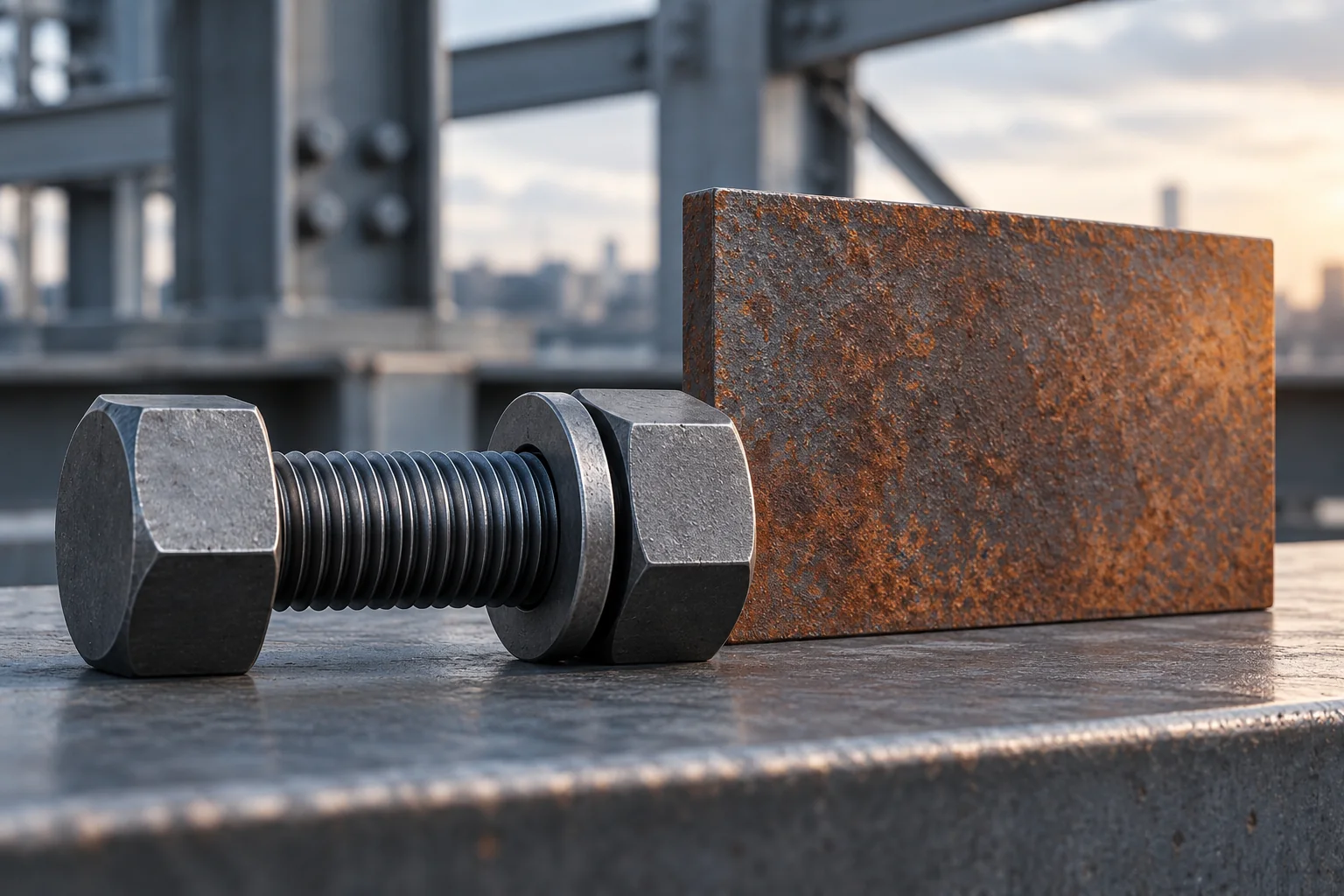
Warum Muttern, Unterlegscheiben, Schmierung und Kontaktflächen wichtig sind
The corrosion protection of a structural connection cannot be evaluated by examining the bolt alone.
A coated bolt must work with a suitable nut, required washer arrangement, and installation method. These components affect both mechanical compatibility and the behavior of the assembly during tightening.
Coated threads and nut fit
Galvanizing increases the dimensions of coated threaded surfaces. To accommodate this, applicable structural bolting specifications provide for overtapping certain coated nuts.
Overtapping enlarges the internal thread after or in conjunction with the specified coating process. This permits assembly with the coated bolt but also affects thread engagement geometry. The nut’s strength and compatibility therefore need to be established under the applicable specification.
A standard uncoated nut selected only by nominal thread designation may not be an acceptable replacement for the specified coated nut.
RCSC 2025 also requires compatible coating processes for threaded components within the relevant coated assembly systems. Buyers should not assume that bolts and nuts from separate stock lots or different coating processes can be combined without verification.
Lubrication changes the tightening behavior
Thread lubrication affects the relationship between applied tightening effort, friction, and the resulting bolt tension.
Two assemblies with the same bolt grade and diameter can behave differently when their coating and lubrication conditions differ. A greater proportion of applied torque may be consumed by friction in one assembly than in another.
That is why a universal torque value is an unreliable way to establish the pretension of an unspecified structural bolting assembly.
For applicable galvanized assemblies, the supplier’s rotational-capacity testing addresses the compatibility of the components and lubricant. This testing is distinct from the pre-installation verification and installation inspection procedures required for the connection.
An assembly should not be accepted simply because a torque wrench reaches a nominal setting. The project-specified installation method and associated verification requirements remain controlling.
The faying surface is not the bolt coating
The faying surface is the contact surface between connected steel elements. In a slip-critical connection, resistance to slip depends in part on the condition of these contact surfaces.
A bolt may have an approved corrosion-protective finish while the connection’s faying surfaces require a separately qualified coating or surface condition.
Under RCSC 2025, slip-critical faying surfaces are subject to distinct requirements. Qualified Class A or Class B coating systems may be used within the applicable conditions, while certain alternative surface treatments require testing and approval by the Engineer of Record.
This prevents a common specification error: approving the bolt coating and assuming that the same approval covers every coated surface inside the connection.
For example, a project could specify appropriately coated bolts but still require a particular surface preparation or qualified coating system between connected plates. The two requirements must be documented separately.
Even connections that are not designed as slip-critical may warrant attention to thick or compressible coatings at loaded contact locations, particularly where maintaining bolt pretension is important. Coating compressibility and relaxation can affect the installed assembly.
The buyer should therefore confirm both the fastener finish and the connection surface requirements before treating a corrosion protection package as complete.
In an illustrative repair order, a corrosion-protection change is applied only to the bolts while the mating nuts and supplied lubricant remain undefined. The new finish can alter fit and installation behavior. Reconcile the complete component package, retain the coating and lot records and verify the installation procedure. A corrosion upgrade cannot be accepted solely from its appearance.
Prüfungen von der Wareneingangskontrolle bis zum Einsatz an der Brücke
Inspection requirements change as the structural bolting assembly moves from delivery to installation and ultimately into service.
A mill or product test report addresses component conformity. An installation inspection addresses the assembled joint. A bridge maintenance inspection addresses the condition of the connection after environmental exposure.
These checks are related, but none is a universal substitute for the others.
Receiving inspection: confirm what was actually supplied
When coated structural bolting assemblies arrive, receiving inspection should establish that the delivered materials match the approved purchase and project requirements.
The first checks concern identification. Inspectors should compare bolt markings, nominal diameter, length, grade, type, style, and coating designation with the purchase documentation. The specified nuts and washers must also match the assembly requirements.
Physical condition matters. Look for corrosion or coating damage, contaminated or visibly damaged threads, damaged packaging, and evidence that components may have been mixed or stored in unsuitable conditions.
Documentation should provide the level of conformity and traceability required by the applicable product specifications and contract. Depending on the assembly and order, this may include product test reports, coating documentation, matched-assembly records, and applicable rotational-capacity results.
A material test report is not automatically the same as a finished assembly test report. A bolt head marking identifies a product classification but does not, by itself, prove that all chemical, mechanical, coating, and assembly tests have been satisfied.
Likewise, receiving inspectors should not assume that a certificate issued for one component lot covers a later substitution of nuts or washers.
The important question is whether the documents actually relate to the delivered configuration and the required inspection scope.
Pre-installation and installation: verify the assembled connection
Before installation, coated bolting assemblies should be protected from avoidable contamination or deterioration. The condition of threaded surfaces and any specified lubricant must remain suitable for the installation procedure.
The required verification depends on the connection type and tightening method.
For pretensioned or slip-critical joints, applicable RCSC provisions require pre-installation verification of the selected installation method and prescribe corresponding inspection activities. The test assemblies and method must represent the configuration being used.
For snug-tightened joints, the inspection objective is different. Under the RCSC procedure, inspectors verify suitable components, properly prepared connecting elements, and firm contact between the connected plies rather than attempting to demonstrate an installed pretension that is not required for that joint.
The distinction is essential because a correctly installed snug-tightened joint and a properly verified pretensioned joint are not judged by the same acceptance procedure.
Where a project requires independent or third-party inspection, responsibilities should be defined by the invoking specification and contract documents. A supplier’s certificate cannot substitute for inspection of work performed at the bridge site.
In-service inspection: identify where the protection is changing
After the bridge enters service, corrosion inspection should consider both the protective condition of the fasteners and the surrounding connection details.
Potential observations include localized rusting around bolt heads or washer edges, damaged or missing coating, salt deposits, trapped moisture, abnormal runoff patterns, and deterioration concentrated at sheltered surfaces.
However, not every visible oxide film has the same significance. A uniform patina on a correctly exposed weathering steel component is different from pronounced localized corrosion associated with persistent leakage or trapped contaminants.
Similarly, rust staining does not independently quantify bolt section loss or remaining connection capacity.
An inspector should record the location, extent and apparent cause of the condition, compare it with the expected protection system, and refer potentially consequential deterioration for appropriate engineering assessment.
The same principle applies to maintenance intervention. Tightening a weathered structural bolt to an arbitrary torque is not a reliable way to restore a joint’s specified condition. Existing bolt tension, component condition, coating damage, reusability restrictions and the approved repair method must be considered before work proceeds.
For bridge owners, drainage correction can be as important as coating repair. Repeated coating damage at a location exposed to continuing salt-laden runoff may not be effectively addressed unless the source of contamination or moisture retention is also controlled.
Inspection intervals, corrosion acceptance limits, and repair decisions belong to the applicable bridge-owner maintenance program and engineering assessment. They should not be inferred from a generic coating description.
Was Planer und Einkäufer vor der Bestellung festlegen sollten
A technically useful request should make the following items clear:
- Project and application: Bridge or outdoor steelwork application, relevant environmental exposure, and any project-specific corrosion protection requirements.
- Governing documents: Applicable structural design, bolting, product and coating standards, including the contractual editions.
- Bolt identity: Required ASTM F3125 grade, type, style, nominal diameter, length, and threading configuration, as applicable.
- Protective finish: Plain/weathering configuration or specified coating process and qualification requirements, without assuming that finishes are interchangeable.
- Matching components: Permitted nut grades and types, washer configuration, matched-assembly requirements and lubricant condition.
- Connection requirements: Snug-tightened, pretensioned or slip-critical joint designation, relevant installation procedure and any special faying-surface requirements.
- Qualitätsdokumente: Required component and coating test reports, applicable assembly verification records, lot traceability and purchaser inspection requirements.
- Delivery condition: Assembly identification, segregation, preservation, packaging and any conditions needed to protect specified lubricated or coated components.
These fields do not replace the Engineer of Record’s connection design. They allow the supplier to identify the specified product correctly and disclose any proposed deviation before an order is placed.
Consider an RFQ that requests only “high-strength galvanized bridge bolts.” It leaves unresolved whether the required grade and assembly permit the intended galvanizing process, which nuts and washers are compatible, how the connection will be installed, and what reports will support acceptance.
Adding those details early is more valuable than trying to establish compatibility after components have been delivered.
When comparing supplier proposals, the lowest quoted price should therefore not be evaluated independently of assembly conformity and inspection obligations. A proposal for bolts without the specified matching components or required verification evidence is not necessarily equivalent to a proposal for a complete, conforming assembly.
For bridges and outdoor steelwork, the practical selection sequence is to establish the connection exposure, confirm the approved material and coating system, verify the complete bolting assembly, and define the appropriate inspection evidence. The final choice must remain consistent with the governing structural design and project documents.
Häufig gestellte Fragen
Sind Schrauben des Typs 3 für jede Außenbrücke geeignet?
Nr. Bewerten Sie Chloridbelastung, Entwässerung, Benetzung und Trocknung, zurückgehaltene Feuchtigkeit sowie das tatsächliche Anschlussdetail, bevor Sie ein unbeschichtetes Wetterbeständigkeitssystem auswählen.
Stellt die Beschichtung der Schraube die Eignung als gleitfeste Oberfläche sicher?
Die Beschichtung der Schraube und der erforderliche Zustand der Kontaktfläche sind separate Entscheidungen. Prüfen Sie beides jeweils gegen die maßgeblichen Anforderungen der Verbindung.
Kann der Korrosionsschutz geändert werden, ohne die Installation zu überprüfen?
Gehen Sie nicht davon aus. Bestätigen Sie zulässige Beschichtungen, Gegenkomponenten, Schmierung und alle daraus resultierenden Prüfanforderungen für die tatsächliche Montage.