Quick Answer: Standard Nut, Modified Standard Nut or Custom Nut?
Use a standard nut when an available part already satisfies the drawing, thread tolerance, proof-strength requirement, bearing geometry, coating, assembly access and inspection plan. Use a modified standard nut when the base geometry is suitable but one controlled feature—such as finish, flange face, height, locking element or thread condition—must change. Move to a fully custom nut only when the joint requires geometry or function that cannot be achieved reliably with an existing form.
The decision must be made at joint level. Thread size alone does not confirm suitability: coating and lubrication influence torque–clamp-force behavior, a low-profile nut can reduce thread engagement, a locking feature changes assembly torque, and a weld nut must be validated with the actual sheet and welding process. The lowest-risk route is the least customized option that still meets every functional and approval requirement.
Standard Nut vs Custom NutAutomotive Nut SelectionModified Standard NutJoint-Level ReviewProduction Validation
Need a route check before tooling? Provide the latest drawing revision, mating bolt or stud data, coating code, assembly method, annual volume and required approval documents.
Standard Nut, Modified Standard Nut or Custom Nut: What Is the Difference?
A standard nut follows a published dimensional standard or an established supplier catalogue program. A modified standard nut starts from an existing form but changes a limited, drawing-controlled feature. A custom nut is released against a buyer drawing or approved engineering record because its geometry, function or process cannot be covered by the first two routes.
The important distinction is not the purchasing label. It is the level of engineering control needed to release the part. Changing only the coating can still require thread-gauge and torque–clamp-force revalidation. Changing a locking zone can require prevailing-torque testing. Changing a weld projection can require torque-out, push-out or pull-out validation with the production sheet and weld schedule.
Customization should therefore be treated as an escalation path, not as a default sign of higher quality. Every added feature introduces another characteristic to manufacture, measure, approve and control after launch.
Figure 1: Standard nuts, modified standard nuts and custom special nuts represent three different sourcing routes. The correct route should be selected by drawing requirement, joint function, thread fit, coating condition and production risk, not only by unit price.
Route
Best Use
Cost / Lead Time Effect
Buyer Risk
Recommended Buyer Action
Standard Nut
Catalog nut already meets drawing, load, coating and inspection requirements.
Usually lower cost and faster availability.
Can fail if selected by thread size only.
Confirm thread, property class, coating, bearing face and assembly condition.
Modified Standard Nut
Standard base part works, but coating, height, serration, material or tolerance needs adjustment.
Moderate cost and shorter development than full customization.
Still needs sample and post-coating validation.
Define the exact feature being changed and test the final condition.
Fully Custom Nut
Special geometry, welding feature, locking function, sleeve, low profile or drawing-based requirement.
May require tooling, samples, validation and longer launch planning.
Prototype may not represent mass production if process route is not controlled.
Perform DFM review and approve production-intent samples before batch release.
Engineering Conditions That Usually Require a Custom Nut
A custom route is justified when the requirement cannot be met by a verified catalogue or modified-standard part. Typical triggers are non-standard geometry, restricted tool access, application-specific locking behavior, a weld or clinch interface, controlled electrical contact or isolation, coating-sensitive internal threads, or customer-defined inspection and traceability characteristics.
Do not convert every difficult joint into a custom nut problem. Loss of clamp load may come from the joint stack, bearing-surface embedment, bolt stiffness, friction scatter or tightening strategy. A custom nut should address a confirmed requirement; it should not hide an unresolved joint-design issue.
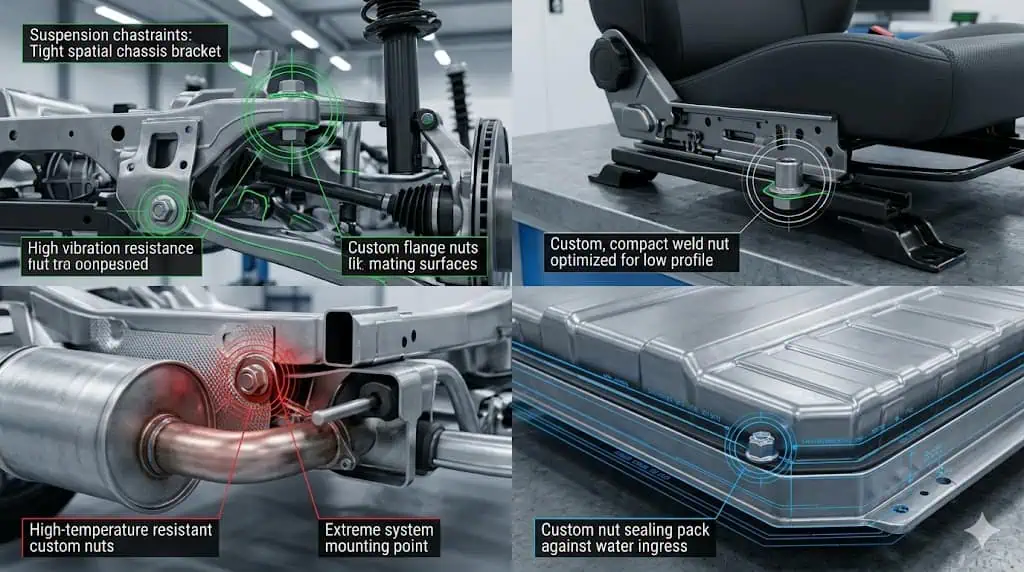
Figure 2: Chassis brackets, seat structures, exhaust systems and EV battery pack assemblies may require different nut forms because vibration, heat, corrosion, service access and clamp load requirements are not the same across vehicle systems.
Typical Engineering Review: Standard Nut Loosened on a Chassis Bracket
What problem occurred: A standard hex nut assembled correctly during bench fitting, but preload dropped after vibration testing on a chassis bracket.
Why it happened: The nut was selected by thread size and price, without reviewing vibration exposure, locking function, mating bolt coating or torque-preload scatter.
Underlying joint or process cause: Dynamic loading and shear stress allowed small joint movement after clamp load loss.
Corrective action: Review the joint as a system and evaluate a lock nut, serrated flange nut or modified standard nut with validated assembly torque.
Prevention: Do not approve a standard nut for high-vibration locations until preload stability and locking behavior are confirmed.
When a Standard Nut May Be the Better Choice
A standard nut is the preferred route when an available specification satisfies the complete engineering requirement without a special process or approval burden. Its advantages are not limited to unit price: dimensional maturity, multiple-source availability, simpler replacement, familiar gauging and shorter change-management cycles can all reduce program risk.
The part still needs application review. A catalog designation does not automatically define the required coating, lubricant, prevailing torque, proof load evidence or customer approval status. Confirm the exact standard, edition, product style, property class, thread tolerance and finish rather than ordering by a generic name such as “M10 hex nut.” Review standard hex nut programs and the broader nut range before opening custom tooling.
Condition
Why Standard Nut May Be Acceptable
Risk to Confirm
Drawing matches catalog dimensions.
No special tooling or reverse engineering is needed.
Confirm tolerance, bearing face and thread engagement.
Assembly space is not restricted.
Standard nut height and wrench clearance are usable.
Check real assembly access, not only CAD clearance.
Vibration and service load are moderate.
Standard nut with proper tightening may be enough.
Review whether washer, threadlocker or lock nut is still needed.
Coating requirement is common.
Standard finish may meet corrosion and appearance needs.
Confirm coating thickness does not affect internal thread gauge.
Replacement and maintenance are important.
Standard nut is easier to source and replace.
Ensure replacement part preserves preload and material requirements.
Typical Engineering Review: A Modified Standard Nut Was Enough
What problem occurred: A buyer planned to open tooling for a low-height custom nut, but the actual issue was socket clearance and surface finish.
Why it happened: The RFQ started from “custom nut required” rather than from the joint requirements.
Underlying joint or process cause: A standard low-profile nut with a defined coating and post-coating thread inspection could meet the assembly requirement.
Corrective action: Compare the drawing against available standard and modified standard options before tooling.
Prevention: Use a standard / modified / custom decision review before paying for custom tooling.
Decision Checklist: How to Identify the Right Nut for Your Project
Use five decision gates in order: catalogue fit, joint function, final-finish compatibility, production economics and approval evidence. Stop at the first route that meets all five. This prevents both unnecessary tooling and unsafe substitution.
Figure 3: Automotive nut selection should review drawing, thread pitch, preload, mating bolt, material, surface treatment, inspection evidence and annual volume before deciding between standard, modified standard or custom nut routes.
Five-Gate Route Decision
Catalogue fit: Does a standard form match thread, geometry, strength basis and assembly envelope?
Joint function: Does it provide the required seating, locking, welding, electrical or service function?
Final condition: Does the nut still meet gauge and assembly requirements after heat treatment, coating and lubrication?
Production route: Does annual volume justify modification or new tooling, and can the intended process hold the critical characteristics?
Approval evidence: Are the required dimensional, mechanical, functional, traceability and PPAP records defined?
Nut Selection Review Checklist
Drawing review: Does the drawing match an existing standard nut, or does it require special geometry?
Mating bolt review: Check bolt property class such as 8.8 / 10.9 where specified, coating, washer use and thread engagement.
Load and preload review: Confirm whether torque, clamp load, shear stress or vibration is critical.
Space review: Check nut height, wrench access, flange clearance and service access in the real assembly.
Material review: Confirm carbon steel, alloy steel, 304 / 316 stainless, SCM435, brass, aluminum or other requirement.
Surface treatment review: Review the complete coating system, specified thickness or coating mass, topcoat or lubricant, friction requirement, corrosion test, and final thread-gauge condition. Use the drawing or customer coating code rather than a generic thickness assumption.
Quality review: Confirm thread gauge, hardness, coating thickness, salt spray, torque or weld test if required.
Production review: Confirm sample quantity, annual volume, MOQ, tooling cost and launch schedule.
Engineering Warning: Installation Torque Is Not Clamp Force
Installation torque is influenced by thread friction, bearing friction, coating, lubricant, tightening speed and joint geometry. Two visually identical nuts can produce different clamp force at the same tool setting after a coating or lubrication change. Where clamp force or torque–angle response is critical, validate the complete production fastener pair and joint condition using the customer-approved method; ISO 16047 provides a standardized torque/clamp-force test method for applicable threaded fasteners.
Review Item
Question to Ask
Standard Route
Custom Route
Evidence Needed
Thread
Does a standard nut match size, pitch and tolerance?
Use if thread fit is proven.
Use if special pitch, depth or tolerance is required.
Thread gauge record.
Preload
Will the nut maintain clamp load under service?
Use if standard tightening is enough.
Use if locking or controlled bearing face is required.
Torque or assembly validation.
Coating
Does the coating affect internal thread fit or friction?
Use if standard coating meets requirement.
Use if coating allowance or special corrosion resistance is needed.
Coating report and post-coating gauge check.
Geometry
Does the assembly need special flange, sleeve, projection or low height?
Use if catalog geometry fits.
Use if assembly cannot be solved by existing forms.
Drawing and physical fit check.
Volume
Does production volume justify tooling?
Better for small or uncertain demand.
Better when volume and function justify process development.
Annual volume and launch plan.
Project review CTA: If you are unsure whether a standard nut is enough, send the drawing, sample photo, thread size, material, coating, application position and annual volume for a standard nut vs custom nut review.
Standard Nut vs Custom Nut Comparison for Automotive Buyers
The comparison should be made on total program risk, not on piece price. Standard nuts reduce development and replacement risk when they meet the requirement; custom nuts create value only when their added geometry or function can be validated and controlled through production.
Factor
Standard Nut
Custom Nut
Buyer Judgment
Cost
Usually lower unit cost and no tooling.
May require tooling, engineering review and sample validation.
Do not choose custom unless it solves a real joint requirement.
Lead Time
Faster if stock or mature production exists.
Longer due to drawing review, tooling, samples and testing.
Launch schedule must allow validation time.
MOQ
Often easier for smaller demand.
Depends on process route and tooling economics.
Check annual volume before selecting cold forging.
Quality Control
Established dimensions and inspection methods.
Requires custom inspection plan and production control.
Inspection must follow the actual final condition.
Maintenance
Easier replacement and sourcing.
Replacement must follow approved drawing and process.
Service strategy matters for aftermarket and repair parts.
Assembly Reliability
Reliable when correctly matched to the joint.
Reliable only after functional validation.
Fit check alone is not enough.
Manufacturing Route: When Custom Nuts Need Cold Forging, CNC Machining or Hybrid Processing
Process selection comes after the route decision. Cold forming is generally considered for repeatable volume and formable geometry; machining is useful for prototypes, low volumes or features that cannot be formed economically; a hybrid route combines forming with secondary machining, tapping or finishing. The approved route must be the route represented by the production-intent sample.
This page uses manufacturing route only as a selection criterion. The detailed DFM, sample, PPAP and mass-production controls belong in the custom special nuts for automotive OEMs guide.
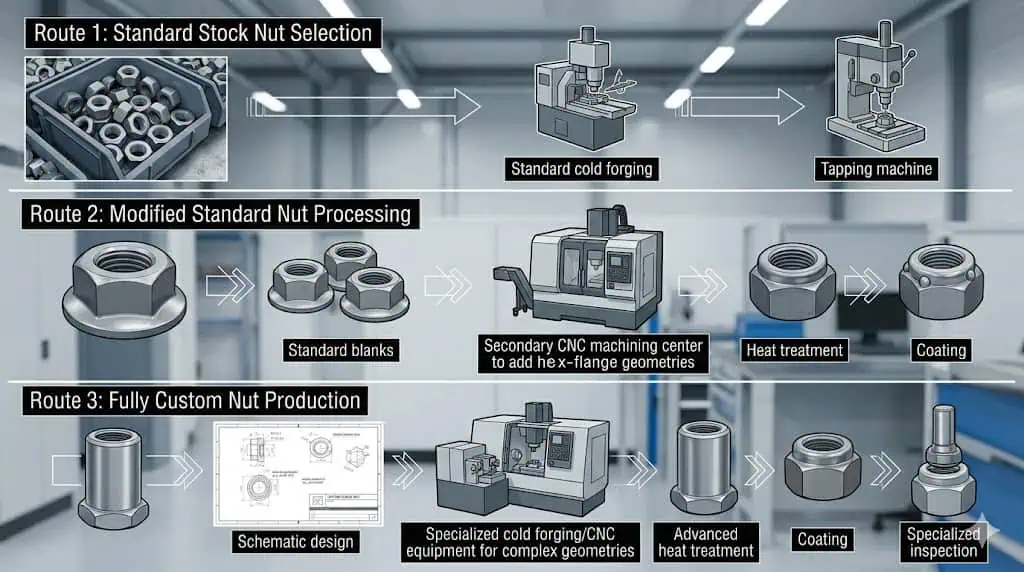
Figure 4: Standard stock selection, modified standard nut processing and fully custom nut manufacturing have different tooling cost, lead time, inspection sequence and production consistency risks. A prototype sample should not be treated as mass production approval unless the process route is aligned.
Typical Engineering Review: CNC Sample Passed but Cold-Forged Production Failed
What problem occurred: CNC samples assembled correctly, but the cold-forged batch had burrs and inconsistent thread fit after coating.
Why it happened: The sample route and production route were not aligned.
Underlying joint or process cause: Material flow, tapping and coating behavior changed when the part moved from prototype machining to mass production.
Corrective action: Revalidate the production-intent sample using the actual forming, tapping, coating and inspection route.
Prevention: Do not release mass production based only on a prototype sample if the production process will be different.
Process Route
Suitable Project
Cost / Lead Time Logic
Limitation
Cold Forging
Medium to high-volume parts with formable geometry.
Tooling cost applies, but unit cost can be stable in volume.
Geometry must suit forming and tooling limitations.
CNC Machining
Prototype, low volume, complex features or urgent validation.
Lower tooling barrier but higher unit cost.
Not always suitable for mass production cost or speed.
Modified Standard Nut
Projects where only coating, height, material or minor feature changes are needed.
Can reduce development time compared with full custom tooling.
Still requires final inspection and assembly validation.
Hybrid Processing
Cold-forged body with secondary machining, tapping, slotting or coating control.
Balances production efficiency and special feature accuracy.
More process steps require stronger control plan.
Quality Checks Before Approving a Custom Nut or Standard Nut Substitute
Before approving a new nut or substituting a standard part for a custom part, verify the characteristics that control joint performance: drawing dimensions, final thread fit, applicable proof-load or mechanical requirements, coating and friction condition, locking or weld function, assembly response, lot identity and change-control status.
Hardness is a process indicator, not complete proof of nut performance. It should be reviewed together with the applicable material, proof-load or functional test requirement. Salt-spray results are also laboratory coating evidence, not a direct prediction of vehicle service life. Use each test only for the acceptance purpose defined by the drawing or customer specification.
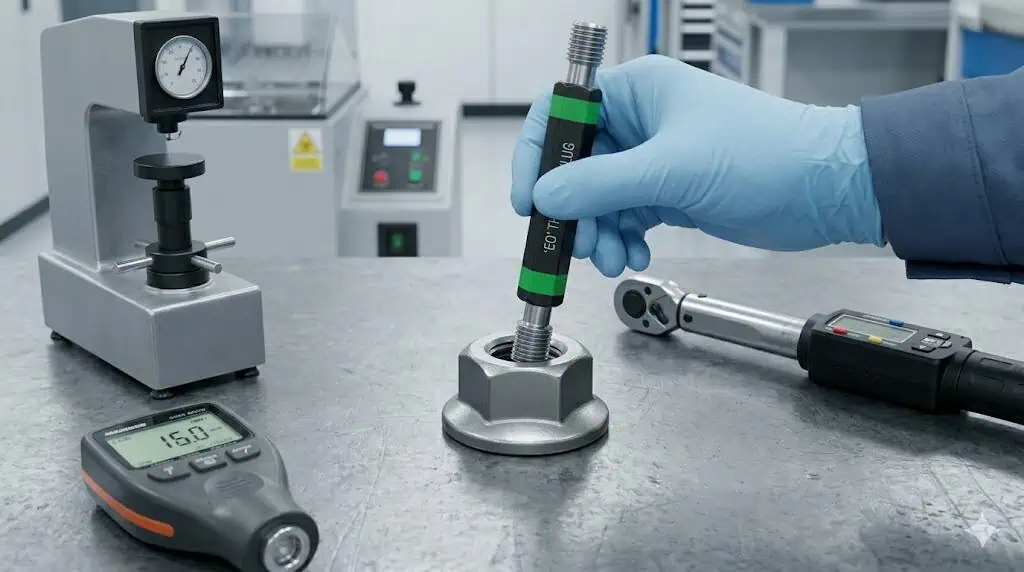
Figure 5: Nut approval should check thread gauge fit, hardness, coating thickness, corrosion requirement and torque or locking behavior. A nut that fits before coating may fail after plating if thread allowance is not reviewed.
Inspection Item
Typical Tool / Record
What It Confirms
What Can Go Wrong
Thread inspection
Go/no-go thread gauge
Thread size, pitch and final fit after coating.
Cross-threading, high torque, assembly rejection.
Hardness / mechanical verification
Hardness tester and proof-load or specified mechanical test
Heat-treatment consistency and the applicable nut performance requirement.
Hardness alone can pass while proof load, thread condition or functional performance remains unverified.
Coating thickness
Coating thickness meter
Finish consistency and thread allowance.
Corrosion failure or internal thread interference.
Corrosion test when specified
Defined neutral salt-spray or customer test method
Performance of the specified coating system under the stated laboratory method.
A test result may be misused as a direct vehicle-life claim or applied to the wrong coating condition.
Torque / locking test
Torque tool or functional test fixture
Preload, prevailing torque or locking behavior.
Vibration loosening, over-tightening or reuse failure.
What problem occurred: A standard nut was changed to a zinc-nickel finish for corrosion resistance, but the internal thread failed go/no-go gauge after plating.
Why it happened: The coating was reviewed as a finish change, not as a thread fit and assembly parameter.
Underlying joint or process cause: Coating buildup reduced thread clearance and increased assembly torque.
Corrective action: Review coating thickness, thread tolerance and final gauge requirement after coating.
Prevention: Any coating change on an internal thread should include post-coating gauge inspection and assembly validation.
Safety Note: Stainless Galling and Hydrogen Embrittlement Are Different Problems
Stainless nuts such as 304 / 316 or A2-70 / A4-80 can gall or cold weld when tightened dry against stainless mating threads. Use approved lubricant or anti-seize where the application allows. High-strength carbon steel or alloy steel nuts face a different risk when electroplated: hydrogen embrittlement. For plated high-strength parts, review the coating route, baking requirement and hardness level before approving the nut.
Common Automotive Nut Selection Mistakes
Most selection failures come from solving only one variable. Typical examples are matching the nominal thread but not the property class, changing the coating without repeating gauge and assembly checks, specifying a lock nut without defining prevailing-torque acceptance, or releasing a production route that differs from the approved prototype.
Figure 6: Wrong nut selection can lead to stainless galling, thread stripping, vibration loosening, coating interference or assembly rejection. Most of these problems can be caught earlier through drawing review, coating review and production-intent sample validation.
Mistake
Cause
Consequence
Recommended Fix
Selecting by thread size only
Buyer assumes M8 or M10 defines the part.
Wrong pitch, class, coating or bearing surface.
Review drawing, thread, material, coating and assembly load.
Ignoring preload
Torque is treated as the only assembly requirement.
Clamp load may be too low or too high.
Review nut factor K, coating, lubricant and mating bolt condition.
Over-customizing
Custom route is selected before checking standard options.
Unnecessary tooling cost, MOQ and lead time.
Compare standard, modified standard and custom routes first.
Ignoring coating effect on internal threads
Surface treatment is treated as appearance only.
Thread gauge failure, high torque or assembly stop.
Inspect after final coating.
Approving prototype only
CNC sample is approved while mass production will be cold forged.
Batch inconsistency and reapproval risk.
Use production-intent samples before release.
Replacing a custom nut by catalogue description only
The substitute matches the nominal thread but not the bearing geometry, thread engagement, locking or approval condition.
Preload change, seating damage, service-access problem or unapproved product change.
Run a drawing delta review and validate the final joint before substitution.
How to Prepare an RFQ for Nut Selection Review
The RFQ should contain enough information to decide the route before a supplier prices tooling. Separate mandatory engineering requirements from preferences, identify missing data, and state whether the request is for catalogue comparison, modification feasibility or a fully made-to-print part.
RFQ Information Checklist
Drawing or sample: 2D drawing, 3D file, physical sample or marked photo.
Thread details: size, pitch, tolerance, thread depth and gauge requirement.
Application: chassis, seat, body, exhaust, battery pack, sheet metal or aftermarket assembly.
How to Choose a Supplier for Standard and Custom Automotive Nuts
For this decision, the supplier’s first obligation is route judgment: show why an available standard works, what limited modification is needed, or why a new drawing and process are unavoidable. Evidence should include a marked drawing comparison, inspection condition and production-route explanation—not only a quotation.
A supplier should not push customization before reviewing the joint. The better supplier will ask about application position, mating bolt, coating, preload, assembly method, annual volume and quality documents before recommending a route.
Figure 7: A suitable automotive nut supplier should support route selection, drawing review, cold forging or CNC evaluation, tapping, surface treatment coordination, thread inspection, hardness testing, packaging control and batch traceability.
Supplier Capability
Question to Ask
Red Flag
Preferred Evidence
Selection judgment
Can they explain why standard, modified or custom is recommended?
They recommend custom tooling immediately.
Written engineering review or comparison note.
Drawing review
Can they identify critical dimensions, pitch, chamfer and thread depth?
No technical questions before quotation.
Marked drawing or inspection plan.
Process capability
Can they support cold forging, CNC machining or hybrid processing?
One process is used for every part.
Process route explanation.
Quality control
Can they provide thread gauge, hardness, coating and dimensional records?
Only visual inspection is offered.
Inspection records and lot traceability.
Production support
Can they control samples and mass production consistently?
No distinction between prototype and production-intent sample.
No single standard decides whether an automotive project needs a standard, modified or custom nut. Use the standard that governs the characteristic being reviewed, then apply the latest drawing revision and customer-specific requirements.
ISO 898-2:2022: mechanical and physical properties of carbon- and alloy-steel nuts with specified property classes. It does not define corrosion resistance, weldability, prevailing torque or torque–clamp-force performance.
ISO 3506-2:2020: mechanical and physical properties of corrosion-resistant stainless-steel nuts.
ISO 16047: conditions for torque/clamp-force testing of applicable threaded fasteners and related parts.
ISO 2320:2015: functional properties and combined testing for prevailing-torque steel nuts.
ISO 4042: electroplated coating systems for steel fasteners, including coating-related thread and hydrogen-embrittlement considerations.
ASTM F1941/F1941M: electrodeposited coatings on mechanical fasteners for projects using the ASTM system.
AIAG PPAP: production-part approval requirements when PPAP is contractually or customer-required; the submission level and scope must be agreed for the project.
Dimensional product standards such as ISO 4032, ISO 4161, ISO 7040 or an ASME B18 nut standard should be cited only when the proposed catalogue form actually conforms to that product standard. A similar-looking nut should not be described as standard-compliant without dimensional and performance verification.
FAQ About Standard, Modified and Custom Automotive Nuts
How do I know whether a standard automotive nut is acceptable?
A standard nut is acceptable when the exact product form meets the drawing, thread tolerance, applicable mechanical requirement, bearing geometry, coating, assembly method and inspection plan. Nominal thread size alone is not enough.
When should I use a modified standard nut?
Use a modified standard route when the base nut geometry is suitable and only a limited feature—such as coating, height, flange face, serration, locking element or thread condition—must change. Validate the completed part after all processing.
What justifies a fully custom nut?
A fully custom nut is justified when no existing or safely modified form can provide the required geometry, seating, welding, locking, electrical, access or customer-controlled function.
Can I replace a custom nut with a standard nut that has the same thread?
Not without a drawing and joint-level comparison. Confirm bearing area, height, thread engagement, property class, coating and friction condition, locking or weld function, assembly access and approval status before substitution.
Does the same tightening torque give the same clamp force after a coating change?
No. Coating, lubricant, thread condition and bearing friction can change the clamp force produced by the same tool setting. Repeat the customer-approved assembly or torque–clamp-force validation when the final finish changes.
What information should be sent for a nut route review?
Send the latest drawing revision, sample or 3D file if available, thread data, mating fastener, joint location, material and coating requirements, assembly method, functional tests, annual volume, launch timing and required approval documents.
Request a Standard, Modified or Custom Nut Route Review
Provide the latest drawing revision, mating fastener, final coating requirement, assembly method, annual volume and validation scope. The review should first determine whether a catalogue nut is compliant, whether a controlled modification is sufficient, or whether a made-to-print part and production-intent approval are necessary.
Do this before custom tooling or substitution approval. Early route selection can avoid unnecessary tooling while preventing a catalogue part from being accepted on thread fit alone.
This guide is written for automotive sourcing managers, buyer-side engineers, supplier quality teams and fastener project personnel deciding among standard, modified-standard and made-to-print nut routes.
Reviewed scope: joint function, product-standard fit, thread and final-finish compatibility, mating fastener, torque–clamp-force risk, locking and weld function, manufacturing route, inspection evidence, substitution control and automotive approval documentation. Final release remains subject to the buyer’s drawing, customer-specific requirements and validated production joint.