Technical Drawing Checklist for Custom Nuts: Thread, Tolerance, Material, Coating and Finish
A custom nut drawing is more than a shape file. It is the technical baseline for quotation, manufacturability review, sampling, inspection, coating, functional testing and production approval.
If the drawing does not clearly define thread, tolerance, material, coating, finish, function and inspection scope, the supplier may quote the wrong process, make a sample that cannot be approved, or inspect features that are not actually critical to the joint.
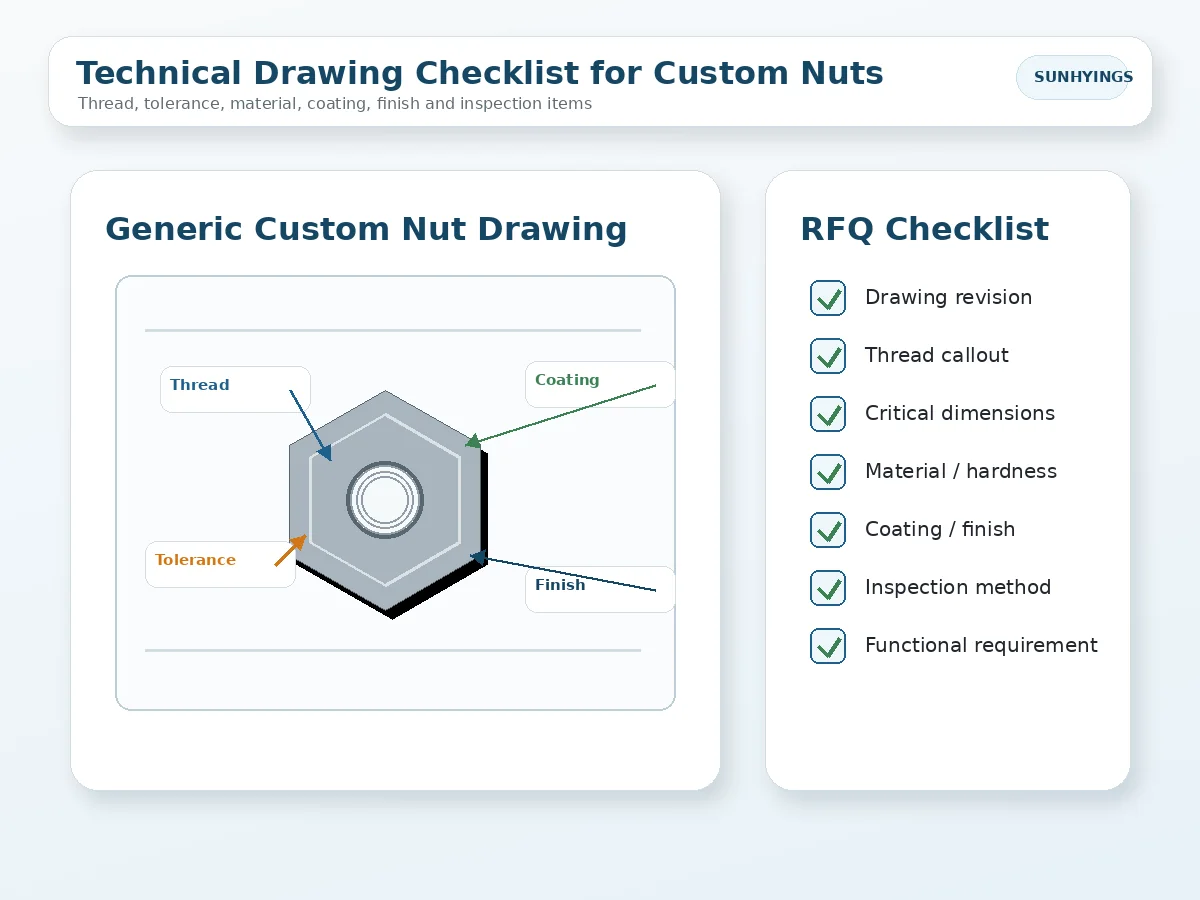
A complete custom nut drawing should define thread, tolerance, material, coating, finish, inspection and functional requirements before RFQ.
Conceptual engineering illustration only; not a real customer drawing or approved production document.
Quick Answer: What Should a Custom Nut Technical Drawing Include?
A useful custom nut technical drawing should include the latest drawing revision, part number, thread size, pitch, thread tolerance, critical dimensions, general tolerance, material, hardness or property class if specified, heat treatment if required, coating, finish, post-coating thread requirement, inspection method, functional requirement and approval notes.
The drawing should also be supported by RFQ information such as application, assembly location, joint type, mating part condition, annual volume, sample quantity, packaging and required documents. Some of this data may not appear directly on the drawing, but the supplier still needs it to review process route and production risk. For broader product categories, buyers can also review SUNHYINGS custom special nuts.
The safest rule is simple: if thread fit, strength, coating, torque, pull-out, torque-out, prevailing torque, inspection method or approval documents matter to the application, those requirements should be shown on the drawing or clearly included in the RFQ package. If they are not provided, the supplier should mark them as needs confirmation instead of treating assumptions as facts.
Confirm size, pitch, tolerance and gauge condition
Critical dimensions
Defines function and inspection focus
Wrong sample or unclear inspection plan
Separate CTQ dimensions from general dimensions
Material / hardness
Affects strength, formability and machining
Supplier may assume wrong material
Confirm material grade, property class or hardness if specified
Coating / finish
Affects corrosion, appearance and thread fit
Post-coating assembly problem
Confirm final coated condition and inspection requirement
Functional requirement
Defines proof load, pull-out, torque-out or prevailing torque if required
Part shape may pass, but function may fail
Confirm joint type, mating part and failure mode
Inspection method
Aligns supplier and buyer acceptance
Disagreement during sample approval
Confirm gauge, CMM, report or functional test scope if required
Why Custom Nut Drawings Fail During RFQ or Sampling
Custom nut RFQs often fail for simple reasons: the drawing is incomplete, the sample photo does not match the drawing, coating is not specified, thread tolerance is unclear, or the buyer and supplier are using different drawing revisions.
A supplier can usually quote a standard nut from a standard designation. A custom nut is different. The shape may include a flange, shoulder, weld projection, clinching feature, locking feature, side hole, slot, special bearing face or non-standard thread. If those features are not controlled clearly, the supplier must either ask questions, make assumptions or quote with risk.
Wrong quotation scope
If a drawing shows only the outside shape but does not define thread, material, coating, tolerance or quantity, the quote may exclude secondary machining, coating, special inspection or required documents.
Wrong sample route
A prototype may be CNC machined, while production may need cold heading, tapping, coating or other process steps. If the sample route differs from production, approval risk must be controlled.
Wrong inspection focus
If CTQ dimensions are not identified, inspection may focus on easy dimensions while missing thread fit, bearing face, weld projection, clinching geometry or locking function.
Missing Drawing Data
Possible RFQ Problem
Possible Sample Problem
Correct Handling
Thread tolerance not shown
Supplier may quote a common thread assumption
Thread gauge disagreement after sampling
Confirm thread class, gauge method and coating condition
Coating not specified
Quote may exclude surface treatment
Thread fit or corrosion expectation may fail
Confirm coating type, final condition and inspection scope
Material not defined
Supplier may quote a material that is easy to source
Strength, formability or machining behavior may not match application
Confirm material grade, standard, hardness or property class if required
Assembly function not provided
Supplier may quote part shape only
Part may fit visually but fail pull-out, torque-out or prevailing torque requirement
Confirm joint type, mating part and failure mode
Inspection requirement unclear
Quote may not include dimensional report or functional test
Buyer and supplier may disagree on acceptance criteria
Confirm report scope, gauge method and test requirement if required
Supplier Review Rule
A custom nut drawing must be reviewed for manufacturability, inspection, coating condition and functional risk. A drawing file alone does not guarantee that the part can be produced without clarification. When data is missing, the professional response is “needs confirmation,” not automatic substitution with a common material, tolerance or coating.
Drawing Revision, Part Number and Title Block: The RFQ Baseline
The first item in a custom nut drawing checklist is the title block. It may look administrative, but it controls the quotation baseline. If the drawing revision is wrong, every later discussion about thread, tolerance, material and coating may be wrong.
A supplier should know which drawing is current, whether the sample matches that drawing, and whether the project is for prototype, sample approval, production or replacement. This is especially important for made-to-print special nuts, where the drawing revision controls the quoted and inspected part.
Drawing number, part number and revision level
The RFQ should identify the drawing number, part number and revision level. If a buyer sends a sample photo and an old drawing, the supplier should ask which one controls. If an updated drawing changes a thread, flange, material or coating note, the quote must follow the updated revision.
Unit system, projection method and notes
The drawing should clearly show the unit system, such as metric or inch, and any general notes that control interpretation. General tolerance, surface finish, burr control, edge break, inspection notes and customer-specific notes should not be ignored.
Drawing versus RFQ package
The drawing does not always contain every commercial or application detail. Annual volume, sample quantity, packaging, assembly location and required document scope may be supplied in the RFQ email or purchase specification. The supplier should review both the drawing and the RFQ package before quoting.
Thread Checklist: Size, Pitch, Class, Engagement and Gauge Method
Thread information is one of the most important parts of a custom nut drawing. A thread callout should not be reduced to a simple label like “M8” or “1/2 inch” if pitch, tolerance, coating or engagement matters.
The supplier needs enough thread data to confirm manufacturability, inspection method and post-coating fit. Thread information also affects the manufacturing route because a custom nut may require tapping, thread rolling, thread forming, secondary machining, post-coating gauge inspection or functional testing depending on the drawing.
Threaded features are often represented symbolically on technical drawings, so the thread note must provide the information needed to understand the actual thread requirement. For a custom nut RFQ, this means the buyer should not rely on the sketch alone when pitch, fit, engagement or final coated thread condition matters.
Thread size, pitch, tolerance, engagement and post-coating gauge requirements should be confirmed before sampling.
Thread labels are generic; final thread requirements must follow the buyer drawing and customer standard.
Thread size and pitch
The drawing should specify nominal thread size and pitch. For metric threads, pitch should be clear when there is any chance of confusion between coarse, fine or special pitch. For inch threads, the thread series or threads per inch should be clear. If pitch is missing, the supplier may quote a common assumption that does not match the mating bolt, screw or stud.
Thread tolerance class or fit requirement
Thread tolerance controls gauge acceptance and assembly fit. If the drawing requires a specific thread tolerance class, it must be shown. If the customer has a special thread-fit requirement, it should be stated clearly. If the buyer only provides a sample nut, the supplier should not assume the thread fit until it is measured or confirmed.
Thread engagement and chamfer condition
Thread engagement can affect proof load, pull-out, stripping resistance and assembly reliability when those functions are relevant. Chamfer and lead-in conditions can affect assembly start, coating build-up and gauge entry. If thread depth, partial thread, counterbore, chamfer or lead-in condition matters, it should be controlled on the drawing.
Thread inspection before and after coating
Coating can affect thread fit. If the part is plated, coated or treated after threading, the buyer should clarify post-coating thread requirements. The supplier needs to know whether the final nut must pass thread gauge inspection after coating. If both before-coating and after-coating inspection are required, the RFQ should state that clearly.
Dimension and Tolerance Checklist: What Must Be Controlled?
A custom nut drawing should separate general dimensions from critical dimensions. Not every dimension has the same functional importance. Some dimensions affect wrench fit, thread engagement, seating, clamp load, weld location, clinching retention or assembly clearance.
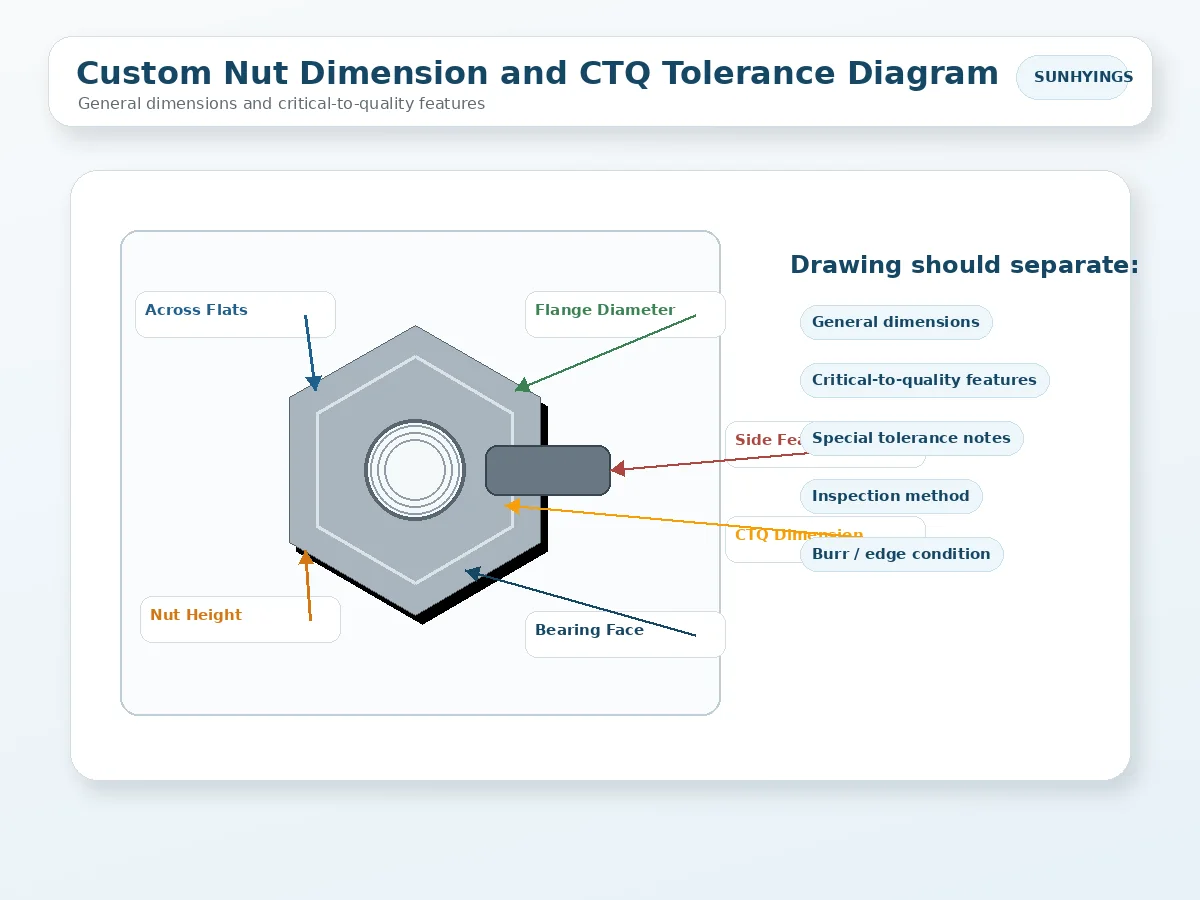
Custom nut drawings should distinguish general dimensions from critical-to-quality features that affect assembly and inspection.
Generic dimension callouts only; actual tolerance values must come from the buyer’s drawing.
Across flats, height, flange diameter and bearing surface
Across flats can affect wrench or socket fit. Nut height can affect thread engagement. Flange diameter can affect load distribution. Bearing face condition can affect seating and preload. For basic dimensional language such as thread size, across flats and nut height, buyers can also review the hex nut dimensions guide.
Critical-to-quality dimensions
Critical-to-quality dimensions should be marked or clearly communicated. These may include thread location, shoulder diameter, flange thickness, side hole location, slot width, pilot diameter, bearing face flatness, projection geometry or clinching feature profile. If a dimension controls assembly, function or inspection acceptance, it should not be hidden under a general tolerance note.
General tolerance vs special tolerance
General tolerance applies when no specific tolerance is shown. Special tolerance should be used only where needed. Overly tight tolerances can increase cost, require secondary operations and restrict manufacturing route. Missing tolerances can create disagreement during inspection. The drawing should make clear which features are process-sensitive and which features are function-sensitive.
GD&T, datum and inspection fixture notes
If position, perpendicularity, flatness, concentricity or parallelism matters to the assembly, the drawing should define the requirement and datum reference. If a special fixture or functional gauge is required, it should be discussed before quotation. A supplier should not guess datum logic from a picture or sample photo.
Material, Hardness and Heat Treatment Checklist
Material should never be guessed from appearance. Two nuts may look similar but require different materials, hardness, heat treatment or traceability. Material selection affects formability, machinability, strength, coating compatibility and cost.
Material grade and standard
The drawing should define the material grade or material standard when required. If the buyer has no confirmed material, the supplier may suggest options, but the final material must be confirmed before production. Material choice also affects whether the nut is better suited for cold forming, machining, heat treatment or secondary operations.
Property class or hardness range when specified
If the nut must meet a property class, hardness range or functional strength requirement, it should be stated. Do not assume a property class only because the nut is used in an automotive or machinery application. The requirement should come from the drawing, customer standard or qualified engineering review.
Heat treatment requirement
Some nuts may require heat treatment. Others may not. If heat treatment is required, the drawing or customer standard should define the requirement and related inspection. Heat treatment can affect hardness, distortion, thread fit and final inspection.
Traceability and material certificate boundary
If material certificate, heat treatment record or lot traceability is required, the buyer should state the scope before quotation. Not every custom nut order requires the same document package. When traceability is required, the supplier should understand the lot control, record retention and packaging separation expectations.
Coating and Finish Checklist: Avoid Post-Plating Thread-Fit Problems
Coating and finish are not only appearance issues. They can affect corrosion resistance, thread fit, torque behavior, friction, assembly, sorting, packaging and customer acceptance.
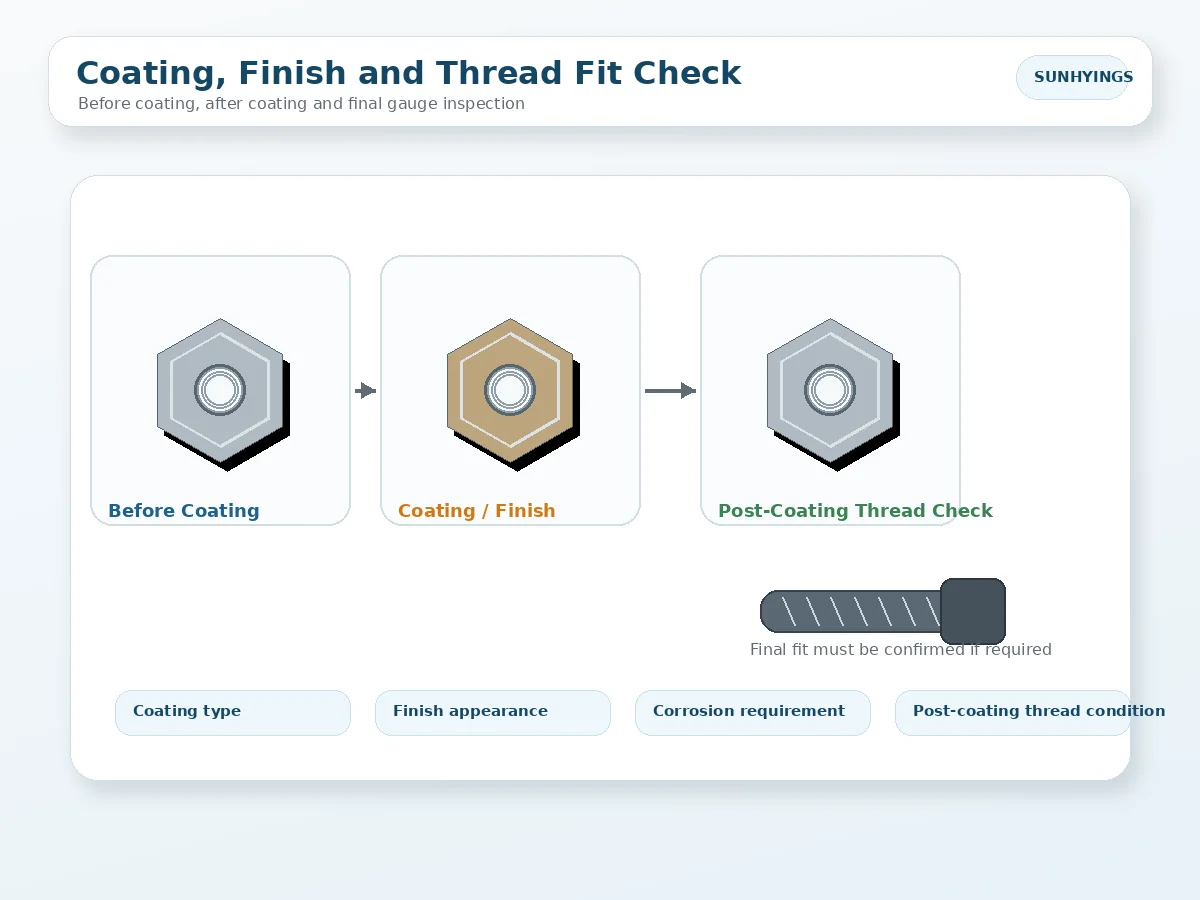
Coating and finish notes should clarify final thread-fit inspection, corrosion expectations and appearance requirements when specified.
Coating graphics are conceptual; no coating thickness or corrosion performance is implied.
Coating type and finish color
The drawing should specify coating type or finish requirement if the part is not plain. Examples may include zinc plating, zinc-nickel, phosphate, black oxide, passivation or other customer-defined finishes. The exact coating must follow the drawing or customer standard.
Post-plating thread allowance
Internal threads can become tight after coating. If the part must pass a thread gauge after plating or coating, the drawing should state this requirement. The supplier may need to consider thread allowance, process control and final inspection. The drawing should clarify whether the thread requirement applies before coating, after coating or both.
Appearance versus functional finish
A finish may be required for appearance, corrosion, friction, identification or assembly performance. The buyer should clarify whether the finish is mainly visual or functional. A cosmetic finish requirement and a functional corrosion requirement should not be treated as the same thing.
Special process notes when required
Some coatings or high-strength applications may require additional controls when specified by drawing, customer standard or purchase requirement. These may include process notes, baking requirements, corrosion testing, friction control or coating report scope. The supplier should not assume these requirements unless they are provided.
Functional Requirement Checklist: Assembly Location, Joint Type and Failure Mode
A custom nut drawing may show geometry, but the supplier also needs to understand function. The same shape can have different requirements depending on assembly location, joint type, mating part and expected failure mode.
Functional nuts require assembly and joint information, not only shape and dimensions.
Function examples are generic and do not imply fixed test values or universal approval requirements.
Assembly location and joint type
The buyer should explain where the nut is used. Is it installed in a bracket, sheet-metal panel, welded assembly, structural joint, enclosure, seat frame, chassis component, electrical housing or another assembly? The location can affect material, coating, torque, weld retention, clinching behavior and inspection.
Nut function and failure mode
The function should be clear. A weld nut, self-clinching nut, all-metal lock nut, flange nut, spacer nut or special shouldered nut may require different process and testing considerations. The drawing or RFQ should clarify the failure mode that must be avoided, such as thread stripping, pull-out, torque-out, loss of locking function, weld failure, poor clinching retention, seating problem or coating-related thread interference.
Functional test values must come from the buyer requirement
Do not invent torque, preload, pull-out, torque-out, push-out, proof load or prevailing torque values. If the project requires any functional test, the buyer should provide the value, test method, sample size and acceptance condition. If those details are missing, the supplier can only mark the requirement as needing confirmation.
Manufacturing Route Notes: What the Drawing Should Clarify Before Quotation
A custom nut drawing can affect whether the part is cold headed, CNC machined, machined from a formed blank, tapped, thread rolled, drilled, milled, faced, heat treated, coated or sorted.
This article is not a full manufacturing route comparison. The key point here is that the drawing should provide enough information for the supplier to review the route correctly. A drawing does not need to dictate every process step unless the buyer has a validated reason, but it should make functional and inspection requirements clear enough for the supplier to propose a suitable route.
Cold heading, CNC machining or hybrid route cannot be assumed
A simple-looking nut may require secondary machining. A complex-looking nut may be simplified if the function is understood. A prototype may be CNC machined, while production may require cold heading or a hybrid route. The drawing and RFQ should clarify sample stage, production volume and critical features.
Which features may require secondary operations
Side holes, slots, controlled shoulders, bearing faces, special chamfers, pilot diameters or tight local dimensions may require secondary operations. These features should be clearly shown and toleranced. If the drawing does not identify which features are CTQ, the supplier may either over-process the part or miss the feature that actually controls assembly.
Sample route and production route should not be confused
A CNC sample can help with fit checking, but it may not represent a later cold-headed or hybrid production route. If production approval depends on production-intent process, the buyer and supplier should confirm whether another sample run is needed after tooling or process-route confirmation.
Inspection and Quality Document Checklist
Inspection and quality documents should be defined before quotation when they are required. If the buyer expects a dimensional report, material certificate, heat treatment record, coating report, PPAP package or IMDS submission, this requirement should not appear after the price is agreed.
Critical dimensions and inspection method
The drawing should identify critical dimensions and any special inspection method. If a dimension requires a fixture, CMM, optical inspection or functional gauge, the supplier needs to know before quotation. The inspection plan should match the CTQ features, not only the easiest dimensions to measure.
Thread gauge and post-coating gauge
Thread inspection should be defined clearly. If the final coated nut must pass a thread gauge, the drawing or RFQ should say so. If inspection is only before coating, that also changes risk. Thread-critical projects should define whether gauge records or sample inspection data are required.
PPAP and IMDS only when required
PPAP and IMDS should be treated as customer- or program-specific requirements. They should not be assumed for every custom nut order. If PPAP is required, it should align with the engineering design record, specification requirements, approved drawing revision and production-intent route. If IMDS is required, the buyer should define the material data submission scope and timing.
RFQ Checklist: What Buyers Should Send With the Drawing
A good RFQ package helps the supplier quote faster and ask fewer clarification questions. It also reduces sample failure and approval delays. The strongest RFQ package combines the drawing, the application context, the quality-document expectation and the volume plan.
A clear RFQ package should include drawing revision, thread data, material, tolerance, coating, function, volume and required documents.
Checklist image is for RFQ preparation only; document scope must be confirmed by customer requirement.
RFQ Input
Required?
Notes
Why It Changes the Quote
2D drawing
Strongly recommended
Latest revision controls quotation
Defines dimensions, notes and acceptance baseline
3D file
Helpful
Supports geometry review but does not replace drawing notes
Helps understand complex features and interference
Sample photo or existing part
Helpful
Clarify if sample differs from drawing
Supports reverse review but cannot replace confirmed requirements
Thread callout
Yes
Size, pitch, tolerance and coating condition
Affects tapping, gauge, coating allowance and assembly fit
Critical dimensions
Yes
Mark CTQ features
Affects process route and inspection method
Material / hardness
Yes if specified
Do not infer
Affects formability, machinability and strength
Heat treatment
If required
Include inspection requirement
Affects hardness, distortion and record needs
Coating / finish
If required
Include post-coating thread condition
Affects thread fit, corrosion expectation and packaging
Assembly / joint data
Yes for functional nuts
Mating part, joint type and failure mode
Affects functional test and process risk review
Sample quantity
Yes
Affects route and timing
Prototype route may differ from production route
Annual volume
Yes
Affects tooling and production route
Determines whether tooling or CNC is reasonable
Quality documents
If required
Dimensional report, certificate, PPAP, IMDS
Affects quote scope, lead time and process evidence
Packaging
If required
Prevents coating damage or mixed lots
Affects labeling, lot separation and surface protection
How SUNHYINGS Reviews a Custom Nut Drawing Before Quotation
SUNHYINGS should review a custom nut drawing by checking completeness, function and production risk before quotation. The goal is not only to copy the drawing, but to understand which features affect manufacturing, inspection and assembly.
Drawing completeness review
The review starts with the latest drawing revision, part number, thread, dimensions, tolerance, material, coating and notes. Missing items should be marked for confirmation before pricing or sampling.
Thread and tolerance risk review
Thread size, pitch, tolerance and coating condition are checked first because they directly affect assembly and inspection. Critical dimensions are separated from general dimensions so that the inspection plan matches functional risk.
Material, coating and finish review
Material, hardness, heat treatment, coating and finish are reviewed against the drawing and application. If requirements are missing, they must be confirmed instead of assumed.
Manufacturing route and secondary operation review
The drawing is reviewed to determine whether the part may need cold heading, CNC machining, tapping, secondary machining, heat treatment, coating, sorting or special inspection. The route depends on drawing, material, tolerance, quantity and approval stage.
Open-question list before sampling
Before sampling, open items should be clarified: latest drawing revision, thread condition, post-coating gauge requirement, material, coating, annual volume, sample quantity, assembly function, required tests, document scope and packaging requirement. This prevents a sample from being made before the acceptance conditions are clear.
Buyers can review SUNHYINGS as a custom nut manufacturer before sending drawings, sample photos and technical requirements.
Technical References and Standards Context
The references below are provided as technical context for drawing communication, thread annotation and automotive approval/document expectations. They do not replace the buyer drawing, customer-specific standard, purchase specification or qualified engineering review. For more SUNHYINGS engineering resources, review the technical guides archive.
Provides context for IMDS as an automotive material data system.
IMDS submission should be treated as a customer or automotive-program requirement, not a default requirement for every custom nut order.
Reference boundary: These sources help explain why thread notes, engineering design records, production approval and material data may matter. They do not define the final acceptance criteria for a specific custom nut. Final requirements must be confirmed from the latest drawing revision, customer standard and purchase agreement.
FAQ
What should be included in a custom nut technical drawing?
A custom nut technical drawing should include drawing revision, part number, thread size, pitch, thread tolerance, critical dimensions, general tolerance, material, hardness or property class if specified, heat treatment if required, coating, finish, inspection method, functional requirement and approval notes.
Is a 3D model enough for quoting a custom nut?
A 3D model is helpful, but it is usually not enough by itself. The supplier still needs thread callouts, tolerances, material, coating, finish, inspection notes and drawing revision. A 3D file may show geometry, but it usually does not define acceptance requirements.
Why is thread tolerance important for custom nuts?
Thread tolerance affects assembly fit, gauge inspection and post-coating performance. If thread tolerance is missing, the supplier and buyer may disagree on whether the part is acceptable, especially after coating or plating.
Should coating and finish be shown on the drawing?
Yes, if coating or finish is required. Coating can affect corrosion resistance, appearance, thread fit and assembly behavior. The drawing or RFQ should clarify coating type, finish, post-coating thread condition and any customer-specific requirement.
What happens if the drawing does not show post-coating thread requirements?
The nut may pass thread inspection before coating but become too tight after coating. If the final coated part must pass a thread gauge, the drawing or RFQ should state that requirement before quotation and sampling.
Do all custom nuts need PPAP or IMDS documents?
No. PPAP and IMDS are required only when the customer, program or purchase requirement specifies them. They should not be assumed for every custom nut order. If required, the buyer should provide the submission scope and timing.
What should I send if I do not have a complete drawing?
Send a sample photo, rough dimensions, thread information, material if known, coating requirement if known, application description, assembly condition, expected quantity and any functional requirement. The supplier can begin a preliminary review, but final production still needs confirmed technical requirements.
Can SUNHYINGS recommend a manufacturing route from the drawing?
SUNHYINGS can review the drawing and RFQ data to recommend whether the custom nut may require cold heading, CNC machining, secondary machining, tapping, heat treatment, coating or inspection. The recommendation depends on geometry, material, tolerance, quantity, function and approval requirements.
Related SUNHYINGS Pages
Review related SUNHYINGS pages for custom nut manufacturing, special nut product families, dimension guidance and engineering resources.
This article was prepared for sourcing managers, purchasing engineers, SQE teams, mechanical engineers and fastener engineers preparing custom nut drawings and RFQ data. Final requirements for thread, tolerance, material, hardness, heat treatment, coating, finish, inspection, functional testing, packaging and approval documents must follow the latest drawing revision, customer standard and purchase agreement.
Reviewed scope: drawing revision, thread callout, tolerance risk, CTQ dimensions, material confirmation, coating and post-coating thread fit, functional joint data, manufacturing route notes, inspection records, RFQ completeness and missing-data boundaries.
Standards and limitation note: This article is a practical sourcing and engineering guide. It does not replace the customer drawing, customer-specific requirement, qualified engineering review, formal PPAP submission, IMDS reporting requirement or supplier process approval. Missing drawing data should be treated as needs confirmation, not assumed as fact.