Quick Answer: What Automotive Assembly Problems Can Special Nuts Solve?
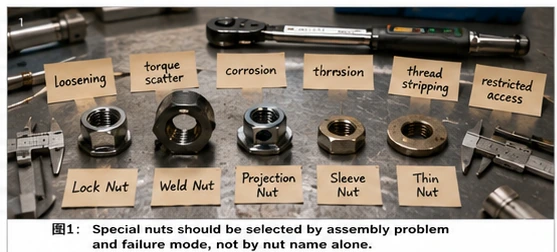
Special nuts can solve automotive assembly problems when the issue is caused by vibration loosening, clamp load loss, torque scatter, poor weld nut positioning, corrosion, heat exposure, restricted tool access, thread stripping, galling, coating interference or inconsistent production batches. The correct nut type depends on the real failure mode. Lock nuts may help with vibration, weld nuts and projection nuts may solve sheet metal fastening, sleeve nuts and thin nuts may fit limited space, and coated or stainless nuts may improve corrosion resistance. Buyers should not select special nuts by name only. A proper review should confirm drawing, thread pitch, tolerance, chamfer, bearing surface, material, property class, surface treatment, mating bolt, washer, joint stack-up, assembly torque and validation tests before RFQ or mass production approval.
Figure 1: Special nuts should be selected by assembly problem and failure mode, not by nut name alone.
Have a recurring assembly problem? Send the failed part photo, drawing, thread size, application position, mating bolt, coating, assembly torque and quantity for special nut selection review.
Definition and Scope: Special Nuts Are Problem-Solving Fasteners, Not Just Non-Standard Shapes
Practical answer: In automotive assembly, special nuts are selected or manufactured to solve a specific joint problem that a standard nut cannot handle reliably.
A special nut may be a catalog lock nut, weld nut, projection nut, serrated flange nut, sleeve nut, thin nut, high-strength nut, or a fully made-to-print nut. The word “special” should not automatically mean expensive or custom. Sometimes the correct solution is a standard all-metal lock nut. Sometimes it is a modified standard nut with a different coating. Sometimes it is a custom cold-forged or CNC-machined nut made from a drawing.
The engineering question is not whether a nut looks stronger. The question is what failure mode exists in the vehicle joint. If the issue is preload loss, the review starts with tightening condition, friction, mating bolt coating and locking feature. If the issue is sheet metal assembly, the review moves to weld positioning, projection geometry and torque-out resistance. If the issue is corrosion, the review must include material, finish, coating thickness and post-coating thread fit.
Figure 2: A special nut is useful only when its structure solves a defined assembly problem.
Corrected thread design, material change, coating or assembly review
Go/no-go gauge, material class, lubrication or anti-seize review if allowed
When a Standard Nut Is Still Enough—and When a Special Nut Is Required
Practical answer: A standard nut is still acceptable when it meets the drawing, thread fit, clamp load, material, coating, assembly access and inspection requirements. A special nut becomes necessary when the joint problem cannot be controlled by a standard nut without increasing safety, quality, lead time or maintenance risk.
This distinction matters in automotive sourcing. Replacing every standard nut with a special nut can increase tooling cost, sample approval work and supply chain complexity. Keeping a standard nut in the wrong joint can cause field loosening, thread damage, assembly downtime or corrosion failure. The buyer’s job is to identify the boundary.
Condition
Standard Nut May Be Acceptable
Special Nut May Be Needed
Buyer Check
Stable joint with normal access
Yes, if preload and thread engagement are verified
No, unless the drawing or customer specification requires it
Confirm torque condition, mating bolt grade and washer use
High vibration or repeated joint movement
Only if validation proves clamp load is stable
Lock nut, serrated flange nut or modified locking feature
Review preload loss, prevailing torque and joint stack-up
Thin sheet metal or blind location
Usually difficult unless access remains open
Weld nut, projection nut, clinch-style solution or custom nut
Check sheet thickness, weld validation and post-weld thread gauge
Restricted height or tool clearance
Only if standard hex nut fits without assembly interference
Thin nut, sleeve nut or made-to-print low-profile nut
Confirm thread engagement, bearing surface and tool access
Corrosion, heat or service removal risk
Only if material and finish meet the real environment
Coated special nut, stainless option or heat-suitable nut
Review coating thickness, salt spray requirement and service condition
Engineering Note: Do Not Use “Special” as a Shortcut
A special nut should solve a measurable assembly problem. If the standard nut already meets drawing, preload, thread fit, coating, corrosion and inspection requirements, changing to a special nut may only add cost and approval work. If the failure mode is real, the special nut should be validated with the mating bolt, washer, bracket, coating and assembly torque condition.
Problem 1: Vibration Loosening and Clamp Load Loss
Practical answer: Vibration loosening usually means the joint has lost preload or the nut cannot resist relative movement under cyclic load. A lock nut may help, but only after the joint, bolt, washer, coating and tightening condition are reviewed.
Chassis brackets, seat frames, steering-related brackets, underbody covers and engine bay supports can experience vibration and repeated load changes. When a standard nut is selected only by thread size, the assembly may pass static fitting and still loosen during vehicle testing. Increasing torque is not always the correct fix. Too much torque may damage threads, distort sheet metal, overload a bracket or create high scatter if coating friction is not controlled.
Figure 3: Vibration loosening should be reviewed as a joint preload problem, not only as a nut replacement issue.
Assembly Symptom
Likely Root Cause
Special Nut Option
Validation Needed
Buyer Note
Nut loosens after vibration test
Preload loss, joint movement or insufficient locking feature
What problem occurred: A chassis bracket nut passed initial assembly but loosened during vibration testing.
Why it happened: The nut was selected by thread size and unit price. The buyer did not review preload loss, mating bolt coating, washer condition or joint movement.
Real project or system cause: Cyclic load and small bracket movement reduced clamp load. The standard nut had no effective locking function for the application.
Corrective action: Review all-metal lock nut, serrated flange nut or modified locking feature with the actual mating bolt and tightening process.
Prevention: For high-vibration locations, confirm locking behavior and preload stability before sample approval.
Problem 2: Torque Scatter, Driver Shutdown and Inconsistent Assembly
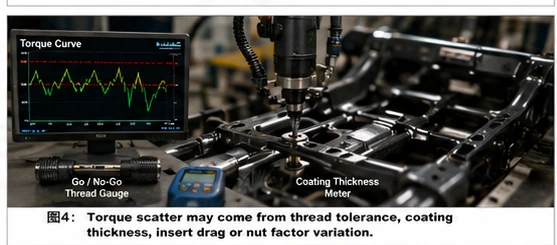
Practical answer: Torque scatter can come from thread tolerance, coating thickness, nylon insert interference, surface roughness, nut factor K, lubricant condition or inconsistent locking zones. The nut should be checked as part of the tightening system.
On an automotive assembly line, a nut problem may first appear as driver shutdown, high torque, low final clamp load, inconsistent seating or rejected assemblies. The cause is not always the tightening tool. A small change in coating thickness can change friction. A nylon insert can create a prevailing torque window that does not match the assembly process. A distorted thread or burr may pass visual inspection but fail during tightening.
Figure 4: Torque scatter may come from thread tolerance, coating thickness, insert drag or nut factor variation.
Line Symptom
Possible Cause
Nut-Related Review
Test / Evidence
High installation torque
Thread interference, coating buildup, burr or insert drag
Check thread gauge after final coating and inspect locking area
Go/no-go gauge record and torque trace
Low clamp load at normal torque
High friction or unstable nut factor K
Review coating, lubricant, washer and bearing surface
Torque-preload validation if required
Driver stops before seating
Prevailing torque too high or inconsistent
Review nylon insert or all-metal locking feature consistency
Prevailing torque measurement
Assembly varies by batch
Heat treatment, tapping or coating process variation
Review batch control and production-intent samples
What problem occurred: An automated seat frame station showed repeated tightening alarms when assembling nylon insert lock nuts.
Why it happened: The insert drag, coating friction and thread tolerance were not reviewed together. The nut passed basic dimensional inspection but created unstable prevailing torque.
Real project or system cause: The assembly tool was set for a narrow torque window, while nut-to-nut variation increased the tightening scatter.
Prevention: For automated assembly, validate torque behavior before mass production, not only thread fit.
Problem 3: Sheet Metal Fastening and Poor Nut Positioning
Practical answer: Sheet metal assemblies often need weld nuts, projection nuts or similar fastening solutions because standard loose nuts are difficult to position, hold and service in thin or blind structures.
Body-in-white, brackets, seat structures, battery trays and interior reinforcements often use thin sheet metal. A standard nut may be impossible to hold during assembly, or it may create poor access after the panel is closed. Weld nuts and projection nuts solve this by creating a fixed threaded point, but they introduce their own engineering controls. Projection height, projection shape, sheet thickness, weld current, spatter control and post-weld thread condition all matter.
Figure 5: Weld nuts and projection nuts must be validated with sheet thickness, projection geometry and post-weld thread inspection.
Sheet Metal Problem
Possible Nut Solution
Key Drawing Parameter
Validation Needed
Loose nut cannot be held during assembly
Weld nut or projection nut
Projection geometry, thread position, pilot feature
Torque-out / pull-out test if specified
Blind location after panel assembly
Weld nut, round weld nut or flange weld nut
Weld face, orientation, access clearance
Thread condition after welding
Thread damaged by weld spatter
Protected thread design or controlled weld process
Torque-out, push-out or pull-out validation as specified
Composite Sourcing Scenario: Sheet Metal Weld Nut Positioning Failure
What problem occurred: A weld nut assembled on a thin sheet panel showed unstable torque-out results and occasional thread misalignment.
Why it happened: The drawing did not clearly define projection height, sheet thickness, weld face orientation or post-weld thread inspection.
Real project or system cause: The nut and sheet metal were treated as separate parts instead of one welded joint system.
Corrective action: Add projection geometry, sheet thickness, weld validation and post-weld thread gauge requirements to the drawing and inspection plan.
Prevention: For weld nuts and projection nuts, approve the nut with the real sheet metal and welding process, not only as an individual part.
Related product directions include Flange Weld Nuts and weld nut options for sheet metal assemblies.
Problem 4: Corrosion, Heat and Surface Treatment Failure
Practical answer: Corrosion and heat problems should be solved by selecting the right material, coating and inspection method for the actual vehicle location. A thicker or darker finish is not automatically better.
Underbody, exhaust and battery pack locations face different risks. Underbody fasteners may see road water, salt and stone impact. Exhaust system nuts may see heat cycles and service removal difficulty. EV battery pack fasteners may need corrosion protection, controlled bearing surfaces and service access depending on the assembly design. The coating must also work with the thread. If plating buildup reduces internal thread clearance, the nut may fail go/no-go gauge or create high installation torque.
Figure 6: Exhaust and underbody nut failures require material, coating, temperature and service removal review.
Engineering Warning: Coating Is a Functional Requirement
For high-strength carbon steel or alloy steel nuts, electroplating should not be treated as a color choice. Coating thickness, baking requirement, hydrogen embrittlement risk, post-coating thread gauge inspection and friction behavior should be reviewed together. A common electroplated zinc thickness may fall around 5–12 μm, but the correct value must follow the drawing, coating specification and thread allowance.
Environment
Possible Finish / Material Direction
Risk to Review
Testing / Evidence
Underbody exposure
Zinc-nickel, zinc-flake or customer-specified coating
Red rust, coating damage, thread fit after coating
Coating thickness and salt spray test if specified
Exhaust system
Heat-resistant material or finish according to application
Heat degradation, corrosion, service seizure
Temperature and service removal review
Battery pack assembly
Controlled coating, stainless or project-defined material
Corrosion, joint integrity, service access
Drawing-based coating and assembly validation
Stainless assembly
304 / 316, A2-70 / A4-80 where applicable
Galling or cold welding during dry tightening
Lubrication or anti-seize review if allowed
High-strength plated nut
Controlled plating process
Hydrogen embrittlement risk
Coating route and baking requirement review
Composite Sourcing Scenario: Exhaust System Nut Corrosion and Heat Failure
What problem occurred: Nuts near an exhaust bracket corroded early and became difficult to remove during service.
Why it happened: The finish was selected by appearance and general corrosion expectation, without reviewing heat cycles, water exposure and service removal.
Real project or system cause: Heat, moisture and road exposure degraded the surface condition and increased removal risk.
Corrective action: Review material, coating, temperature exposure, thread fit and service requirements together.
Prevention: For exhaust and underbody applications, specify finish and material from the real environment, not only from standard stock availability.
Problem 5: Restricted Space, Low Clearance and Difficult Service Access
Practical answer: Restricted spaces may require thin nuts, sleeve nuts, flange nuts or made-to-print nuts, but thread engagement and bearing surface must still be confirmed.
Modern automotive assemblies often leave little space for tools. Battery trays, seat structures, interior brackets, trim parts and compact engine bay areas may not allow a standard hex nut height or wrench clearance. A lower nut is not always safer. If the nut height is reduced too far, thread engagement may be insufficient and stripping risk increases. If the bearing face is too small, local deformation or clamp loss may occur.
Figure 7: Low-clearance assemblies may need sleeve nuts or thin nuts, but thread engagement and bearing surface still need review.
Space Problem
Possible Nut Type
Engineering Check
Buyer Risk
Limited vertical height
Thin nut or low-profile custom nut
Thread engagement and proof strength
Thread stripping if selected only by height
Deep or offset fastening point
Sleeve nut or custom made-to-print nut
Sleeve length, thread depth, tool access
Cross-threading or assembly delay
Need wider load distribution
Flange nut or serrated flange nut
Bearing surface and mating material
Surface damage or uneven seating
Service removal required
Nut type selected for access and reuse rule
Tool clearance, locking feature, coating
High maintenance cost or field damage
Problem 6: Thread Stripping, Galling and Mating Bolt Mismatch
Practical answer: Thread failure is usually caused by poor thread engagement, wrong pitch or tolerance, property class mismatch, dry stainless assembly, coating interference or incorrect tightening practice.
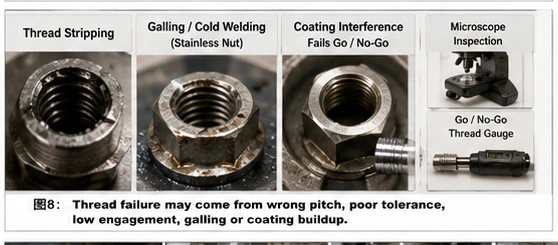
Thread stripping, galling and cold welding are different problems. Stripping often relates to insufficient engagement, weak material, wrong property class or over-tightening. Galling often appears in stainless assemblies when surfaces seize under pressure, especially during dry or high-speed tightening. Plated high-strength parts bring another risk: hydrogen embrittlement. A nut cannot be selected correctly without checking the mating bolt, thread pitch, tolerance, finish and assembly method.
Figure 8: Thread failure may come from wrong pitch, poor tolerance, low engagement, galling or coating buildup.
Failure Mode
Likely Cause
Engineering Check
Prevention
Thread stripping
Low engagement, weak material or over-tightening
Thread depth, property class, mating bolt grade
Confirm drawing, torque and mechanical class
Cross-threading
Poor lead-in, wrong pitch or damaged first thread
Chamfer, pitch, gauge inspection
Improve lead-in and thread inspection
Stainless galling
Dry stainless-to-stainless tightening under high contact pressure
Material pairing, lubricant, tightening speed
Use approved anti-seize or revised material pairing if allowed
Hydrogen embrittlement risk
High-strength plated fastener with uncontrolled process
Hardness, coating route, baking requirement
Review plating process and applicable specification
High assembly torque
Coating buildup or tight tolerance
Post-coating thread gauge
Define coating allowance and final inspection
Engineering Warning: Bolt Grade and Nut Class Must Be Reviewed Together
A nut that fits the thread may still be wrong for the joint. Grade 8.8 / 10.9 bolt assemblies, high-strength nuts, A2-70 / A4-80 stainless parts, coating friction and tightening method should be reviewed as a system. Selecting by thread size alone can lead to stripping, clamp load loss, galling or field maintenance problems.
Automotive Application Matching: Which Special Nut Solves Which Problem?
Practical answer: The best special nut depends on the automotive system, load path, environment, access condition and validation requirement.
Thread fit, coating, service access, batch traceability
Provide drawing, module location and inspection requirements
How to Select Special Nuts Based on Assembly Failure Mode
Practical answer: Start with the failure mode, not the nut category. A special nut should be selected only after the root cause is reviewed.
Failure-Mode-Based Selection Checklist
Identify the symptom: loosening, high torque, thread stripping, corrosion, poor weld, access problem or batch variation.
Confirm the joint: mating bolt grade, washer, bracket, sheet thickness, coating, joint stack-up and assembly direction.
Review the drawing: thread size, pitch, tolerance, chamfer, bearing face, material, finish and critical dimensions.
Match the nut type: lock nut for vibration, weld nut for sheet metal, sleeve or thin nut for space, coated or stainless nut for corrosion-related environments.
Check process route: standard, modified standard, cold forged, CNC machined or hybrid made-to-print route.
Define validation: thread gauge, hardness, coating thickness, torque behavior, salt spray if specified, torque-out / pull-out if welded.
Approve production-intent samples: do not rely only on a prototype if mass production uses a different route.
Manufacturing Process Considerations for Special Nuts
Practical answer: Special nuts may be produced by cold forging, CNC machining, secondary tapping, heat treatment, surface treatment or a hybrid process. The route should follow geometry, material, tolerance, volume and validation requirements.
Process Route
Suitable Situation
Buyer Risk
What to Confirm
Standard or modified standard nut
When only finish, height, serration or class adjustment is needed
Cold-forged body with secondary machining, tapping or special coating
More process steps and higher control need
Control plan and inspection sequence
Engineering Warning: A Prototype Sample Is Not Always a Production-Intent Sample
A CNC sample may confirm the geometry, but it does not automatically approve a cold-forged mass production route. Cold forging, secondary tapping, heat treatment and coating can change thread fit, hardness, surface condition and dimensional stability. Before mass production, buyers should confirm whether the approved sample was made by the same process route, material batch, heat treatment and surface treatment intended for production.
Quality Checks Before Approving Special Nuts for Automotive Assembly
Practical answer: Special nuts should be approved with evidence from the actual production condition, not only from appearance or basic fit.
Figure 9: Quality checks should match the failure mode, including thread gauge, hardness, coating, torque and functional validation.
Inspection Item
Typical Tool / Record
Why It Matters
Buyer Evidence
Thread inspection
Go/no-go thread gauge
Confirms final thread fit, especially after coating or welding
Thread gauge record
Dimensional inspection
Caliper, micrometer, CMM if needed
Confirms flange, sleeve, projection, height and CTQ dimensions
Dimensional report
Hardness test
Hardness tester
Checks heat treatment and mechanical consistency
Hardness report
Coating thickness
Coating thickness meter
Controls corrosion resistance and thread clearance
Coating report
Salt spray test
Salt spray chamber when specified
Supports corrosion requirement where specified by drawing or customer specification
Salt spray report if required
Torque / functional test
Torque tool or fixture
Checks locking, assembly torque, torque-out or pull-out condition
Functional test record
Traceability
Lot label and inspection record
Supports containment if a batch issue occurs
Batch record
For inspection planning, review Quality Control and Thread Gauge Inspection. Confirm these page URLs before publishing if your internal URL structure has changed.
Common Purchasing Mistakes When Solving Assembly Problems with Special Nuts
Practical answer: The most expensive mistakes happen when buyers treat the symptom as the cause, or approve a nut without validating the real assembly condition.
Purchasing Mistake
What Can Go Wrong
Recommended Fix
Choosing by nut name only
Wrong nut type may not solve the failure mode
Start with problem diagnosis and application review
Ignoring mating bolt and washer
Preload, stripping or friction problem remains
Review joint stack-up and mating parts together
Treating coating as appearance
Thread interference, unstable torque or early corrosion
Define coating thickness and final thread gauge condition
Approving CNC sample for cold-forged mass production
Batch dimensions or thread behavior may change
Approve production-intent sample from final process route
Missing drawing revision control
Supplier may produce against obsolete print
Confirm approved drawing revision before quotation and tooling
Skipping functional validation
Nut fits but fails under vibration, weld load or service condition
Define testing according to application risk
RFQ Checklist for Special Nuts Used in Automotive Assembly
Practical answer: A good RFQ should describe the assembly problem, not only the part name. The supplier needs enough information to identify root cause, nut type, manufacturing route and validation requirement.
Special Nut RFQ Information Checklist
Problem description: loosening, corrosion, torque scatter, weld failure, access issue, thread damage or batch inconsistency.
Application position: chassis, seat, sheet metal, exhaust, EV battery pack, interior, aftermarket or repair part.
Drawing or sample: 2D drawing, 3D file, photo, physical sample or marked dimensions.
RFQ CTA: Share the assembly problem, drawing, sample photo, thread size, material, coating, mating bolt and quantity before choosing the nut type. A short engineering review can prevent wrong samples, unnecessary tooling and repeated assembly failures.
How to Choose a Special Nuts Manufacturer for Assembly Problem Solving
Practical answer: Choose a manufacturer that can review the failure mode, drawing, mating parts, process route, coating risk and inspection plan before quoting.
Figure 10: A capable supplier should review the failure mode, drawing, process route, coating risk and inspection plan before quoting.
Supplier Capability
Question to Ask
Red Flag
Preferred Evidence
Failure review
Can they explain why the current nut failed?
They recommend a product without asking about application
Problem-solution review note
Drawing and sample review
Can they mark thread, tolerance, CTQ and missing information?
They quote from one photo only
Marked drawing or clarification list
Process route evaluation
Can they compare standard, modified, cold forged, CNC or hybrid route?
They use one process for every project
DFM or process recommendation
Surface treatment review
Can they evaluate coating thickness, corrosion and thread fit?
They treat coating only as color
Coating and inspection plan
Quality control
Can they provide thread gauge, hardness, coating and functional test evidence?
Automotive special nut selection may reference thread standards, mechanical property standards, coating standards, torque / clamp force testing methods and customer-specific documents. The drawing and purchase specification should always define which standard applies to the project.
ISO metric thread standards, to verify before publishing: relevant for thread pitch, tolerance and thread fit review.
ISO 898-2, to verify before publishing: relevant for mechanical and physical properties of carbon steel and alloy steel nuts.
ISO 898-1, to verify before publishing: relevant when reviewing mating bolt, screw or stud compatibility.
ISO 4042, to verify before publishing: relevant for electroplated coating systems and hydrogen embrittlement risk review.
ISO 16047, to verify before publishing: relevant when torque / clamp force testing is required.
ASTM F1941/F1941M, to verify before publishing: relevant for electrodeposited coatings on mechanical fasteners.
MatWeb, to verify before publishing: useful for early material property review.
These references should be used only where they support thread, material, coating, testing or production approval decisions. They should not be added as decorative authority signals.
FAQ About Automotive Assembly Problems and Special Nuts
What automotive assembly problems can special nuts solve?
Special nuts can help solve vibration loosening, torque scatter, sheet metal fastening difficulty, poor weld nut positioning, corrosion, heat exposure, restricted space, thread stripping, galling and batch consistency problems.
Are special nuts always better than standard nuts?
No. A standard nut is still suitable when it meets drawing, preload, material, coating, assembly and inspection requirements. Special nuts should be used when the assembly problem cannot be solved reliably by a standard nut.
When should automotive buyers switch from a standard nut to a special nut?
Buyers should consider a special nut when a standard nut cannot maintain preload, fit the available space, resist vibration, support sheet metal assembly, meet corrosion or heat requirements, or pass the required functional validation with the actual mating parts.
Do special nuts always require custom tooling?
No. Some special nuts are standard catalog parts, such as certain lock nuts, flange nuts or weld nuts. Custom tooling is usually needed when the nut geometry, projection, sleeve length, thread depth, bearing surface, material or coating requirement cannot be met by an existing design.
Which nut type helps prevent vibration loosening?
All-metal lock nuts, nylon insert lock nuts, serrated flange nuts and other locking designs may help, depending on temperature, vibration level, reuse requirement, mating bolt and assembly torque condition.
What nut is suitable for automotive sheet metal assembly?
Weld nuts, projection nuts, round weld nuts and flange weld nuts are often used for sheet metal assemblies, but projection geometry, sheet thickness, weld condition and post-weld thread inspection must be reviewed.
Why do automotive nuts fail after coating?
Coating may change thread clearance, friction and corrosion performance. If coating thickness is not controlled, the nut may fail thread gauge inspection or show unstable assembly torque.
What causes thread stripping in automotive nut assemblies?
Common causes include low thread engagement, wrong pitch, poor tolerance, weak material, property class mismatch, over-tightening or damaged threads after coating or welding.
What tests are required before using special nuts in mass production?
Typical checks include thread gauge inspection, dimensional inspection, hardness testing, coating thickness measurement, salt spray test if specified, torque or functional test, and batch traceability records.
What should buyers provide for a special nut RFQ?
Buyers should provide the failure description, application position, drawing or sample, thread data, material, coating, mating bolt, assembly condition, quantity and testing or documentation requirements.
Request a Special Nut Review for Your Automotive Assembly Problem
If your project has recurring loosening, torque scatter, corrosion, weld nut positioning issues, thread damage or restricted access, prepare the drawing, sample photo, failure description, thread size, material, surface treatment, mating bolt and quantity before quotation.
Ask for engineering review before changing the nut type or opening tooling. A problem-based review can help confirm whether a standard nut is enough, whether a catalog special nut is suitable, or whether a made-to-print custom nut is required.
This article is prepared from an automotive fastener engineering and B2B sourcing review perspective. It focuses on special nuts used to solve assembly problems, including vibration loosening, torque scatter, weld nut positioning, corrosion, heat exposure, restricted space, thread stripping, galling, drawing review, surface treatment selection, manufacturing route evaluation, inspection planning and batch consistency.
Engineering review note: Final nut selection should follow the buyer’s drawing, mating parts, joint condition, application environment, material requirement, surface treatment, tightening method, validation test and customer-specific approval process. This content supports RFQ preparation and technical review; it does not replace project-specific engineering approval.