






Oxygen Sensor Technical Guide
Evaluate oxygen sensor quality through controlled fitment data, product specifications, validation methods, traceability and change control—not unsupported certification claims.
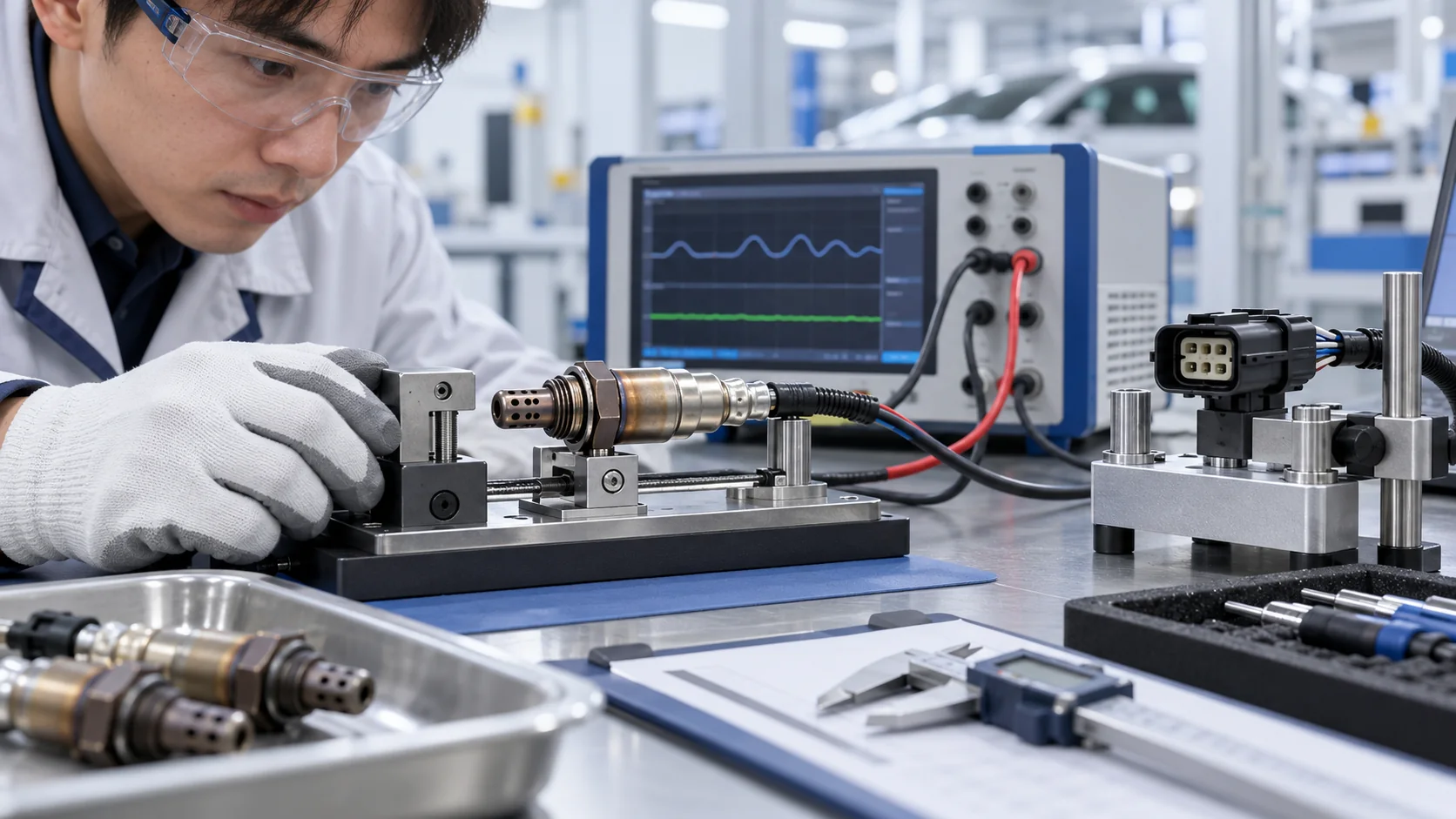
Quick answer
There is no single certificate that proves every oxygen sensor part number will fit and perform correctly. Buyers should review the product specification, application and OE cross-reference controls, electrical and response validation, thermal and vibration durability, sealing and connector checks, production inspection, lot traceability and engineering-change process. Management-system certification and part-level approval are different evidence layers.
Separate four evidence layers
| Layer | Question it answers | What it cannot prove alone |
|---|---|---|
| Quality-management system | Are processes documented and audited within a stated scope? | That a specific sensor meets a specific vehicle requirement. |
| Product specification | Are electrical, physical and environmental requirements defined? | That production parts were validated and remain controlled. |
| Validation evidence | Did samples pass defined methods and acceptance criteria? | That every lot is identical without production controls. |
| Production and traceability records | Can material, process, inspection, date and revision be traced? | That the original specification was appropriate. |
Application-data quality is a product requirement
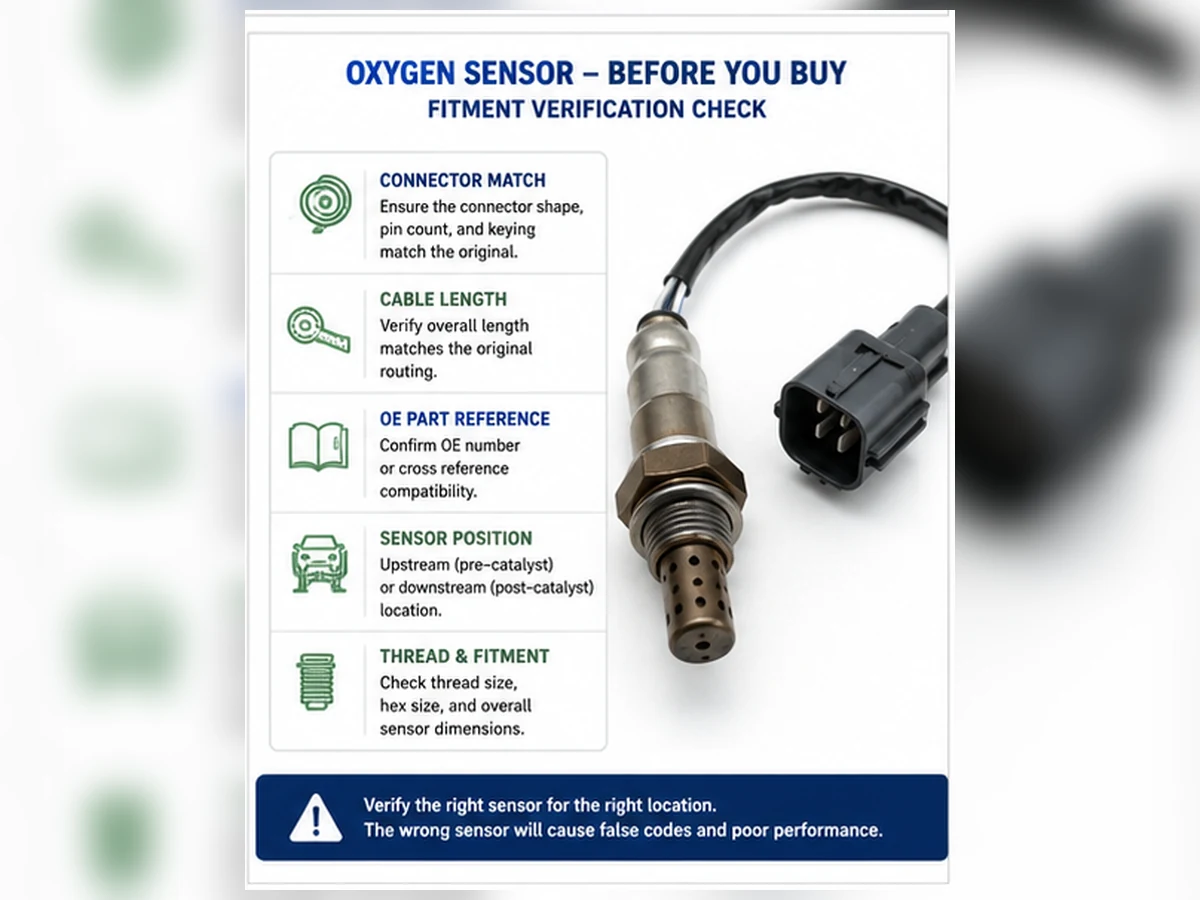
A technically sound sensor sold for the wrong engine or exhaust position is still a failed supply outcome. Control OE-number sources, supersessions, year/make/model/engine, region and emissions package, bank/sensor position, connector, lead length and technology. Record the catalog revision and how conflicting sources are resolved.
Validation categories to review
- Signal, heater and insulation characteristics under defined conditions
- Response behavior and calibration appropriate to the sensor technology
- Thermal cycling, heat exposure and thermal shock
- Vibration and mechanical retention
- Connector engagement, terminal retention, sealing and cable flex
- Corrosion or chemical exposure relevant to the installation
- Thread, hex, shield, cable and connector dimensional checks
Require the method, sample basis, acceptance criteria and report identity. A list of test names without results or traceable part numbers is not complete evidence.
Production controls and change management
Define incoming material checks, critical process parameters, end-of-line tests, sampling plans, nonconformance control and lot identification. Require notification before changes to sensing element, heater, protective coating, connector source, cable, process location or application data. The buyer should decide which changes require revalidation.
Handle certification and OEM claims carefully
Verify the certificate owner, issuing body, standard, scope, site and validity. A management-system certificate does not equal OEM approval for a part number. Claims of OE supply, PPAP status or customer approval require evidence covering the exact legal entity, product and current scope. This guide describes due diligence and does not assert that Sunhyings holds unlisted sensor certifications.
Define quality as controlled requirements and evidence
“High quality” is not a measurable oxygen-sensor requirement. A buyer needs a controlled product/application specification, defined validation methods, production controls, traceability and change management. The evidence must identify the legal supplier, manufacturing site, part revision and application scope. A certificate or test-name list cannot replace part-level results.
| Evidence layer | Required record | Question answered |
|---|---|---|
| Application | OE references, YMME/engine/market and position revision | What is the part claimed to fit? |
| Product | Electrical, physical, material and interface specification | What must the part be? |
| Validation | Methods, samples, conditions, limits and results | Was the design shown to meet requirements? |
| Production | Control plan, inspections, end-of-line tests and capability | How is conforming output maintained? |
| Traceability | Lot/date/revision linked to records | Can a shipment and change be investigated? |
Application data is a quality characteristic
A technically sound sensor delivered for the wrong engine or position is still a failed customer outcome. Control OE cross-references, supersessions, year/make/model/engine, VIN breakpoints, market/emissions configuration and Bank/Sensor position. Record source and revision and define who approves additions and corrections.
Cross-reference limitations
An OE cross-reference is a candidate mapping. It does not automatically prove identical technology, connector, lead or calibration across every application. Conflicts should stop release until resolved with controlled data.
Catalog change control
Track added and removed coverage, reason, approver and effective date. Notify affected distributors when a correction changes active listings, labels or stock. A spreadsheet without revision and ownership is not a controlled catalog.
Build a part-level specification
| Area | Examples of controlled characteristics | Evidence boundary |
|---|---|---|
| Sensing/electrical | Technology, heater, signal/control requirements and response | Values require approved design data |
| Mechanical | Thread, hex, shield, housing and sealing | Appearance is not a dimensional report |
| Interface | Connector keying, terminals, pin assignment, lead and clips | Wire count is not a circuit specification |
| Materials/environment | Cable insulation, seals, corrosion and temperature exposure | Material names alone do not prove durability |
| Identification | Part, lot/date, revision and package label | Brand logo is not traceability |
Use a validation matrix tied to failure risks
Electrical and functional validation
Define warm-up, heater, response and signal/control tests appropriate to the sensor technology. State equipment, conditions, sample identity, limits and results. Narrowband and wideband designs require different methods.
Thermal, vibration and environmental validation
Connect test severity to the approved specification and installation environment. Document cycles, mounting, powered/unpowered state, pre/post measurements and acceptance criteria. Do not claim a generic “high temperature test” without conditions.
Connector, cable and sealing validation
Evaluate terminal retention, connector engagement, cable strain, environmental sealing and heat routing risks as applicable. The report must identify the tested connector/cable revision.
| Report field | Minimum content | Reject when |
|---|---|---|
| Sample identity | Part, revision, lot and quantity | “O2 sensor samples” only |
| Method | Procedure/revision and equipment | Test name without method |
| Conditions | Temperature, cycles, loads and state | Severity cannot be reproduced |
| Acceptance | Defined limits and observations | Pass without criteria |
| Results | Measured data and deviations | Marketing summary only |
Translate design evidence into production controls
Identify critical incoming materials and process parameters, then define in-process inspection, end-of-line testing, sampling and reaction plans. Control nonconforming product and rework. A prototype report does not show that every production lot uses the same element, heater, connector, cable and processes.
End-of-line versus sampled tests
Document which characteristics are checked on every unit and which are sampled, including equipment verification and failure containment. Buyers should not assume that every validation test is repeated in production.
Capability and measurement systems
Where a characteristic is critical and measurable, review process capability and the measurement system used. A capability number is meaningful only with a stable process, defined characteristic and trustworthy measurement method.
Make traceability useful for containment
A lot/date code should connect the shipment to product revision, materials or critical suppliers, production date/line, inspection and end-of-line records, nonconformance history and package labels. Test the trace by selecting a finished unit and retrieving records, then selecting a record and locating affected shipments.
Evaluate certificates and OEM claims precisely
For a management-system certificate, verify owner, issuing body, standard, site, scope and validity. IATF 16949 describes a quality-management system; it does not certify an oxygen-sensor part or prove OEM approval. PPAP support means a supplier may prepare submissions; it does not mean a part has an approved PPAP for an unnamed customer.
Any OE-supply or customer-approval claim requires evidence covering the exact legal entity, site, product and current scope. Confidential evidence may require a controlled review, but confidentiality cannot justify publishing an unrestricted claim.
Control changes after approval
| Change area | Potential effect | Possible approval action |
|---|---|---|
| Sensing element/heater | Signal, warm-up and durability | Functional revalidation |
| Connector/cable/material | Fit, resistance, sealing and heat life | Drawing, sample and environmental review |
| Process/site/equipment | Capability and traceability | Risk review, audit or submission |
| Application data | Wrong-fit exposure | Catalog delta approval and notification |
Composite scenario: a certificate hides a part-level gap
Composite supplier-review scenario: a supplier provides a current management-system certificate and a long application list, but the quoted sensor has no controlled connector drawing or report tied to its revision. The buyer keeps approval pending until part-level evidence is supplied. This is a composite example, not a claim about Sunhyings or a named supplier.
Quality evidence to request in an RFQ
- Controlled application/cross-reference table with source and revision
- Part specification and drawings for electrical and physical interfaces
- Validation matrix and representative reports
- Production control plan and end-of-line test definition
- Lot/revision traceability and change-notification process
- Packaging/label specification and nonconformance process
- Certificate copies only where relevant to the exact legal entity and scope
This page explains due diligence. It does not assert that Sunhyings holds unlisted sensor certifications, approved vehicle applications, inventory or production capability.
Use a risk-based supplier audit
Confirm who owns design, application data, purchasing, manufacturing, testing and corrective action. Trace one quoted part from application record and drawing through materials, process controls, end-of-line result, label and shipment. Sample records should agree on part and revision. An audit tour or equipment list without this trace does not establish control.
Review how failed tests are contained, how rework is authorized, how measurement equipment is controlled and how field returns reach engineering and catalog owners. The audit scope should match the supplied site and process; an office certificate cannot substitute for evidence at an undisclosed factory.
Sample current records rather than presentation examples selected long ago. Check document approval, revision, result date and whether open deviations affect the quoted product. Evidence can become stale after a design, process, site or application-data change, so approval status must be linked to ongoing change review.
Separate five evidence layers before evaluating quality
No single certificate proves that every oxygen sensor fits, performs and remains controlled in production. Evaluate the management system, application data, product specification, validation and shipment-level production evidence separately. Then verify that the records name the same legal entity, site, part and revision.
| Evidence layer | Primary question | Typical record | Does not prove alone |
|---|---|---|---|
| Management system | How does the named organization control quality processes? | Valid scoped certificate and audit evidence | Part fitment or performance |
| Application data | Which vehicle/engine/emissions/positions are approved? | Controlled OE/YMME mapping | Physical/electrical conformity |
| Product definition | What must the part be? | Drawing, specification and bill/control characteristics | That production consistently meets it |
| Validation | Can the defined design meet requirements? | Methods, criteria, samples and results | Unchanged future production |
| Production/shipment | Did supplied lots meet controlled requirements? | Inspection, end-of-line and trace records | Correct vehicle diagnosis |
How to read a quality-system certificate
| Certificate field | Buyer check | Overclaim to avoid |
|---|---|---|
| Legal entity | Does it match the contracting/supplying organization? | Using a related company’s certificate |
| Site/address | Does it cover the manufacturing location? | Office certificate presented for undisclosed plant |
| Standard | Correct edition and certification status? | Logo without standard/validity |
| Scope | Does wording cover the actual process/product family? | Extending component scope to complete product |
| Design responsibility | Is product design included or excluded? | Assuming manufacturing certification proves design control |
| Issue/expiry/status | Is it current and verifiable with issuer/database? | Expired scan used indefinitely |
| Issuer/accreditation | Can issuing body and registration be verified? | Unverified decorative certificate |
A supplier document reviewed privately can support due diligence, but it must not be published or attributed to Sunhyings without authorization. Public claims should state only verified Sunhyings capabilities and the exact scope supported by releasable evidence.
Application-data quality is a technical characteristic
A conforming sensor supplied for the wrong engine or exhaust position is still a failed customer outcome. Control OE references, supersessions, VIN/build breakpoints, market/emissions configuration, Bank/Sensor position and connector/lead variants. Assign an owner for sources, approvals, updates and conflicts.
| Data control | Required practice | Failure prevented |
|---|---|---|
| Source | Record authoritative origin for every mapping | Copied marketplace error |
| Revision | Date/version application rows and supersessions | Stale coverage |
| Granularity | YMME, engine, emissions/region and position | Model-level overcoverage |
| Conflict workflow | Block, investigate, approve and communicate corrections | Silent guessing |
| Product linkage | Connect row to exact part/revision and interface | Family-level substitution |
| Field feedback | Feed confirmed wrong-fit evidence to data owner | Repeated return without catalog correction |
Minimum product-definition package
| Definition area | Examples of controlled content | Why it matters |
|---|---|---|
| Identity | Part number, revision, OE candidates and position | Aligns every downstream record |
| Sensor/electrical | Technology, heater, signal/control characteristics | Matches ECU strategy |
| Mechanical | Thread, seat, hex, shell and shield dimensions | Installation, sealing and exposure |
| Connector/cable | Housing, keys, pins, terminals, lead, insulation and clips | Electrical and routing interface |
| Materials/process | Critical materials and controlled assembly/process characteristics | Durability and change review |
| Marking/packaging | Part/revision/lot, label, barcode and protection | Traceability and correct picking |
| Acceptance | Inspection/test methods and criteria | Defines conformity |
Validation needs a matrix, not a test-name list
| Validation area | Questions the report must answer |
|---|---|
| Electrical/heater | Which part/revision, temperature, method, criteria and result? |
| Sensor response | Which technology, gas/vehicle condition, scale and acceptance? |
| Thermal cycling/shock | Which profiles, cycles, sample count and post-test checks? |
| Vibration/mechanical | Which axes, severity, fixture and functional inspections? |
| Sealing/environment | Which connector, cable and housing exposures and acceptance? |
| Application/vehicle | Which exact engine/emissions/position and monitor outcome? |
| Packaging/transport | Which pack configuration and damage/label criteria? |
The buyer should not invent universal limits. Applicable customer, product and service requirements control methods and acceptance. Reports need sample identity, equipment traceability, results and approved deviations.
Production control must connect approved design to each lot
| Control | Buyer question | Evidence |
|---|---|---|
| Incoming material/components | Which critical items are identified and verified? | Specification, supplier/lot and inspection records |
| Process controls | Which parameters/fixtures prevent assembly variation? | Work/control plan and result records |
| End-of-line test | Which characteristics are checked on every part? | Limits, equipment and serial/lot result linkage |
| Sampling | Which features are sampled and by what plan? | Plan, measurement and reaction rules |
| Nonconformance/rework | How are failures contained and rework authorized? | Disposition, re-test and trace history |
| Measurement system | How are equipment and methods controlled? | Calibration/verification and capability evidence as applicable |
Traceability and change notification protect the approval
Define the trace unit: lot, date, line, shift or serialized item according to risk. Link shipment to product revision, critical components/processes, inspection and packaging. Then define which changes require notification and which require documents, samples or revalidation.
| Potential change | Review question |
|---|---|
| Sensing element/heater | Does electrical response or validation change? |
| Connector/terminal/cable | Does fit, pinout, sealing or route change? |
| Shell/thread/shield | Does installation or exhaust exposure change? |
| Material/process/tooling | Are critical characteristics affected? |
| Manufacturing site/subsupplier | Do controls, certificates and validation remain applicable? |
| Application data | Are vehicle/position claims added, removed or corrected? |
| Label/packaging | Are traceability, legal or warehouse fields affected? |
Composite procurement case: certificate scope is mistaken for part approval
Composite procurement scenario: a supplier provides a valid automotive quality-system certificate. Sales copy expands this into “OEM-approved oxygen sensors.” The buyer removes the claim because the certificate covers the named system/site/scope, while exact part approval, fitment and validation require separate records.
This case is composite and intentionally does not expose the confidential supplier certificate supplied for internal reference.
Composite distributor case: product passes but application data fails
Composite distributor scenario: returned sensors meet the controlled electrical and dimensional specification, yet several do not fit one emissions variant. The investigation identifies an overbroad catalog row. The distributor blocks affected coverage, corrects source data and reviews inventory/claims rather than recording a product defect or blaming installers.
The example shows why application quality and product conformity need separate categories. It is not a Sunhyings customer case.
Supplier audit: trace one quoted part end to end
- Select one current quoted part and application row.
- Confirm drawing/specification and revision ownership.
- Trace critical incoming components and process controls.
- Review end-of-line/sampling results and failed-test containment.
- Match label, lot/date and shipment records.
- Review change notifications and open deviations.
- Trace one field claim back to catalog and engineering owners.
An audit tour or equipment photo cannot replace this trace. Internal records can remain confidential while the buyer verifies their existence and relevance under an agreed due-diligence process.
Quality evidence checklist for an RFQ
- Legal entity, manufacturing site and relevant management-system scope
- Controlled OE/application/position table with source and revision
- Part drawing/specification and critical characteristics
- Validation matrix and representative traceable reports
- Production control plan, end-of-line and sampling definitions
- Lot/revision traceability and change-notification agreement
- Packaging/label/barcode specification and claim workflow
- Project volume, samples, documents, destination and requested timing
PPAP, customer approval and OEM claims are not synonyms
A PPAP submission is a customer-specific product/process approval package with an agreed level and scope. The ability to support PPAP does not mean every catalog SKU has an approved PPAP. A signed approval for one customer part does not authorize public claims about unrelated OE numbers, vehicles or OEM relationships.
| Statement | Evidence needed | Boundary |
|---|---|---|
| PPAP support available | Defined customer/project requirements and supplier capability | Not an existing approval |
| PPAP approved | Customer approval for exact part/revision/site | Not transferable to all products |
| OEM supplier | Authorized evidence for named organization/program/scope | Do not infer from IATF certificate |
| OEM approved part | Exact part/program authorization | “OE quality” is not proof |
| IMDS/material submission | Accepted project-specific material record where required | Not fitment or performance validation |
Measurement and sampling need reaction rules
A list of gauges and test benches does not prove control. For each characteristic, define method, equipment, fixture, frequency, sample plan, acceptance, record retention and reaction to failure. Confirm that the measurement system is suitable for the tolerance and that software/scaling revisions are controlled.
| Question | Evidence | Weak answer |
|---|---|---|
| What is checked 100%? | Control plan and end-of-line result linkage | “All sensors tested” |
| What is sampled? | Characteristic, plan, frequency and lot definition | Occasional inspection |
| How is failure contained? | Last-known-good point, stock/lot review and escalation | Retest until pass |
| How is equipment controlled? | Calibration/verification, maintenance and access | Calibration sticker only |
| How are limits protected? | Approved specification and software/fixture revision | Operator memory |
| How is data retained? | Part/lot/time/equipment/result trace | Aggregate pass total |
Component capability is not automatically complete-sensor capability
A supplier can be qualified to manufacture a metal shell, shield or other component within a defined quality-system scope. That evidence does not by itself prove control of the sensing element, heater, connector, cable, calibration, complete assembly, application data or final validation. Buyers must map each supplier and process to the complete product responsibility chain.
| Scope | Evidence may support | Additional evidence for complete sensor |
|---|---|---|
| Metal component manufacturing | Controlled component material/dimensions/process at named site | Assembly, element, heater, electrical and complete validation |
| Cable/connector supply | Defined harness components and tests | Pinout, routing, environmental and application integration |
| Sensing-element supply | Element specification/process evidence | Matched control circuit, housing, contamination and assembly |
| Final assembly | Assembly/end-of-line process | Application data, design authority and validation ownership |
| Distributor/private label | Commercial, catalog and brand controls | Supplier evidence, claims approval and change governance |
Field claims and corrective action
Define required claim evidence before launch. Classify catalog error, wrong product, vehicle circuit/root cause, installation damage, product nonconformance and insufficient evidence separately. An 8D or other corrective-action request should be proportional to risk and supported by part/lot and vehicle evidence.
| Claim phase | Required output |
|---|---|
| Intake | Part/lot, application/position, codes/tests and photos |
| Containment | Affected stock, shipments and catalog rows held where warranted |
| Analysis | Vehicle, application and product evidence reviewed against specification |
| Root cause | Evidence-based cause, not symptom restatement |
| Correction | Product/process/data/label action and owner |
| Effectiveness | Defined follow-up showing recurrence risk addressed |
Supplier scorecard without invented metrics
| Area | Measured input | Escalation |
|---|---|---|
| Application data | Approved rows, conflicts and correction closure | Block affected coverage |
| Product conformity | Defined nonconformance by part/lot | Contain and corrective action |
| Delivery | Confirmed order versus receipt definition | Capacity/recovery review |
| Claims | Evidence-backed category and closure | Joint technical review |
| Changes | Notifications against agreement | Revalidation or approval hold |
| Documentation | Current, consistent and traceable records | Block release until resolved |
Define formulas, denominators and data ownership. Do not record missing information as zero defects or perfect delivery. Use DATA NOT AVAILABLE and keep the decision open.
Public claim boundary for Sunhyings
Sunhyings can state that it reviews submitted part/application and sourcing requirements and can sell oxygen sensors and automotive components where the exact project is confirmed. It should not publish a supplier’s certificate as its own, claim complete-sensor certification from a component scope, or name unverified OEM approval. Confidential evidence remains internal unless release is authorized.
Exact fitment, validation package, stock, MOQ, lead time, price and customer documentation are quotation-specific. This boundary strengthens trust because the buyer knows which claims are confirmed and which require review.
Final release gates for a new oxygen-sensor SKU
| Gate | Pass evidence | Owner decision if missing |
|---|---|---|
| Commercial scope | Market, channel, forecast and customer requirements defined | Hold quotation assumptions open |
| Application | Approved OE/YMME/engine/emissions/position rows | Block uncertain coverage |
| Product | Signed part specification/drawing and revision | No sample or production release |
| Validation | Required reports accepted with sample trace | Test, justify deviation or reject |
| Process | Control plan, equipment, inspection and site approved | Audit/correct before release |
| Traceability | Lot/revision/label and record linkage demonstrated | Correct data flow |
| Packaging | Artwork, barcode, protection and language approved | Hold shipment |
| Claims | Fitment, certification and marketing wording approved | Remove unsupported wording |
| Change/claim | Notification, warranty and corrective-action process agreed | Resolve contract gap |
Each gate needs an owner, date and evidence link. “Pending” is not PASS. A sample can proceed for investigation while the application remains blocked, but it cannot be sold with unverified coverage. A certificate can be current while product validation remains incomplete; keep the statuses separate.
The final Stage 11 page should teach this evidence discipline without pretending that Sunhyings has received every document for every possible SKU. Project-specific evidence belongs in the RFQ and approval workflow.
Internal review record for confidential supplier evidence
Record document owner, title/type, issuer, legal entity, site, scope, design inclusion/exclusion, issue/expiry, verification method, reviewer and decision. Store the file with controlled access. Public content should reference only an authorized releasable conclusion and should never expose the scan, QR code, registration number or supplier identity merely to strengthen marketing.
If the document supports only a component or process scope, keep that limitation in the sourcing decision. Request separate complete-product, application and validation evidence before approving an oxygen-sensor SKU.
Recheck validity before each approval cycle and after a site, scope or ownership change. A once-valid document can become stale while the copied marketing claim remains online.
Archive superseded evidence with its decision history.
Prepare a fitment or sourcing request
Send the OE number, year/make/model, engine or VIN details, market and emissions package, exact bank/sensor position, connector and old-part photos, quantity and any packaging or approval requirements. Sunhyings will review the supplied data for capability and sourcing feasibility; fitment is not confirmed until application evidence is matched.
Frequently asked questions
Does IATF 16949 certify an oxygen sensor part?
No. It is a quality-management-system standard; part-level compliance and customer approval require separate evidence.
What is the most important supplier document?
No single document is enough. Start with the controlled product/application specification and connect it to validation and production records.
Is an OE cross-reference proof of identical performance?
No. It is an application mapping that must be supported by specification and validation evidence.
What changes should require notification?
At minimum, review changes to sensing technology, heater, materials, connector, cable, critical processes, manufacturing site and application data.
Can a test-name list replace a report?
No. Buyers need defined methods, acceptance criteria, sample identity, results and report traceability.