








A reliable RFQ for non-standard fasteners should start with a controlled drawing, application function, thread and tolerance requirements, material grade, heat treatment, coating, inspection scope, annual volume, sample approval plan and required quality documents. A photo, part name or target price may support early discussion, but it is not enough for final quotation or production release. OEM buyers should compare the complete quotation scope, not only the unit price, especially when the part includes special threads, weld features, clinching features, shoulders, grooves, pins, studs, spacers, cold-headed geometry, CNC secondary operations, coating requirements, PPAP, IMDS or traceability.
- Prepare drawing, sample, material, thread, coating, function and quality-document data before asking for a quote.
- Separate custom nuts, special bolts, studs, pins, washers, rivets, cold-headed parts and CNC machined fasteners before supplier comparison.
- Avoid underquoted tooling, inspection, sorting, heat treatment, coating, PPAP, IMDS, packaging and traceability requirements.

Conceptual RFQ preparation image. It does not prove a specific customer project, approval status or production batch.
Quick Answer: What OEM Buyers Should Check Before RFQ
Before sending an RFQ to a non-standard fastener manufacturer in China, OEM buyers should confirm the latest drawing revision, application function, thread size and tolerance, material grade, hardness, heat treatment, coating, post-plating thread allowance, manufacturing route, inspection scope, quality documents, annual volume, sample approval plan, packaging and traceability requirements.
A photo-only RFQ may be useful for early feasibility discussion, but it is not reliable for final quotation, tooling decisions, sample approval or production release. A fastener name such as “custom bolt,” “special nut,” “pin,” “stud,” “rivet” or “washer” does not prove joint performance, thread fit, coating behavior, hardness, assembly load or inspection requirements.
What OEM Buyers Mean by a Non-Standard Fastener Manufacturer in China
A non-standard fastener manufacturer is not simply a supplier that can produce a standard bolt, nut or washer in a different size. For OEM projects, “non-standard fastener” usually means the part is made to a drawing, sample, assembly condition, customer standard or application-specific requirement.
The part may be a custom nut, special bolt, shoulder screw, weld stud, threaded insert, self-clinching fastener, locating pin, sleeve, spacer, rivet, special washer, cold-headed component, CNC machined fastener or multi-operation part. It may include special threads, reduced height, non-standard bearing surface, knurl, serration, groove, flat, collar, pilot, shoulder, weld projection, anti-rotation feature or a coating requirement that affects final fit.
When an OEM buyer searches for a non-standard fastener manufacturer in China, the real question is not only “Who can make this part?” A better question is: can this supplier read the drawing, ask the right application questions, select a realistic process route, control critical features, support required inspection and communicate clearly before RFQ, sampling and production?
For related product context, review SUNHYINGS custom fasteners manufacturer, custom special nuts and custom nut manufacturer capability pages.
Why a Non-Standard Fastener RFQ Needs More Than a Part Name or Photo
A part name such as “special bolt,” “custom nut,” “weld stud,” “pin,” “spacer,” “rivet” or “CNC fastener” is not enough for an accurate RFQ. A photo can help a supplier understand the general shape, but it cannot confirm the controlled engineering requirement.
| RFQ Input | Why It Matters | Risk If Missing |
|---|---|---|
| Drawing revision | Defines the controlled part requirement. | Supplier may quote or sample the wrong version. |
| Application function | Shows whether the part clamps, locates, welds, clinches, locks, spaces, conducts or carries load. | Supplier may inspect only basic dimensions and miss functional risk. |
| Thread tolerance | Controls mating fit, gauge condition and assembly behavior. | Thread may fail after coating or with the mating component. |
| Material and hardness | Affects forming, machining, strength, heat treatment, cracking risk and cost. | Quote may be unrealistic or technically unsuitable. |
| Coating requirement | Affects corrosion, appearance, thread fit, friction and hydrogen embrittlement review. | Supplier may quote the wrong surface treatment or ignore post-coating fit. |
| Quality documents | Affects inspection time, approval scope and lead time. | Price may exclude reports, PPAP, IMDS or traceability if required. |
Drawing and Revision Checks Before RFQ
For a non-standard fastener project, the drawing is the foundation of the RFQ. A supplier can give a more reliable quotation when the drawing shows the latest part number, revision, dimensions, tolerances, thread callout, material, coating, heat treatment and inspection notes.
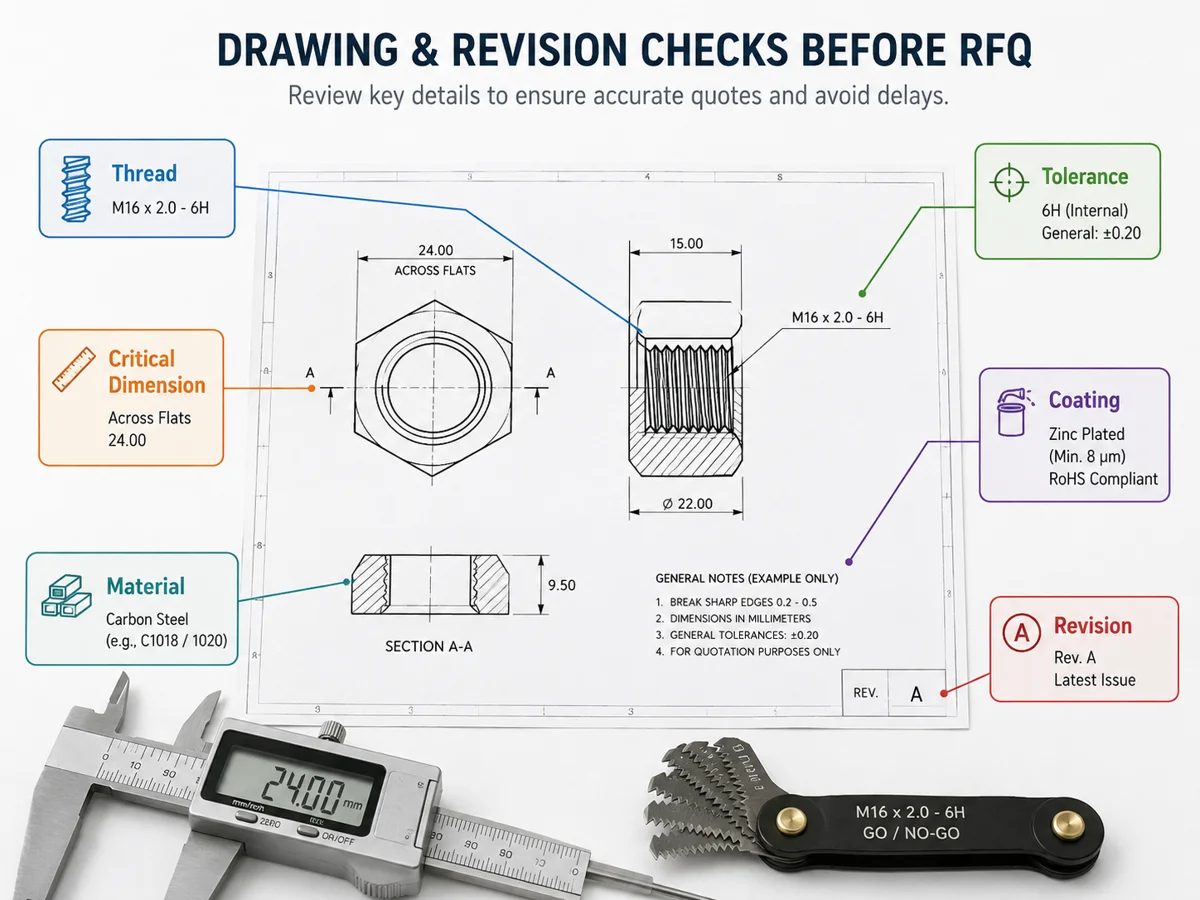
Use generic drawing visuals only. Do not show proprietary customer drawings, real part numbers or fake title blocks.
OEM buyers should confirm whether the drawing is controlled and whether it matches the current sample or application. If the buyer sends an old drawing with a new sample photo, the supplier may not know which requirement should control the quote.
For drawing-based sourcing logic in special nuts, see made-to-print special nuts.
| Buyer Input | Why It Matters | RFQ Risk If Missing |
|---|---|---|
| Latest drawing revision | Defines what must be quoted. | Supplier may quote an old version. |
| Critical dimensions | Affect tooling, process route and inspection method. | Important features may be missed. |
| Thread specification | Controls mating fit and gauge condition. | Thread may fail after coating or during assembly. |
| Material note | Affects raw material, forming route, machining behavior and heat treatment. | Wrong material assumption may change price and performance. |
| Coating note | Affects corrosion resistance, friction, thread fit and hydrogen embrittlement review. | Quote may exclude required coating or post-coating checks. |
| Customer standard | Defines approval basis beyond the supplier’s internal practice. | Supplier may quote without the required standard. |
| Special characteristics | Defines inspection priority and control plan focus. | Quality scope may be underquoted. |
Fastener Function: Clamp, Locate, Weld, Clinch, Lock or Space?
A non-standard fastener should be quoted according to its function in the assembly. Two parts may look similar but have very different risks if one carries clamp load, another locates a bracket, another is welded to sheet metal and another controls electrical grounding or spacing.
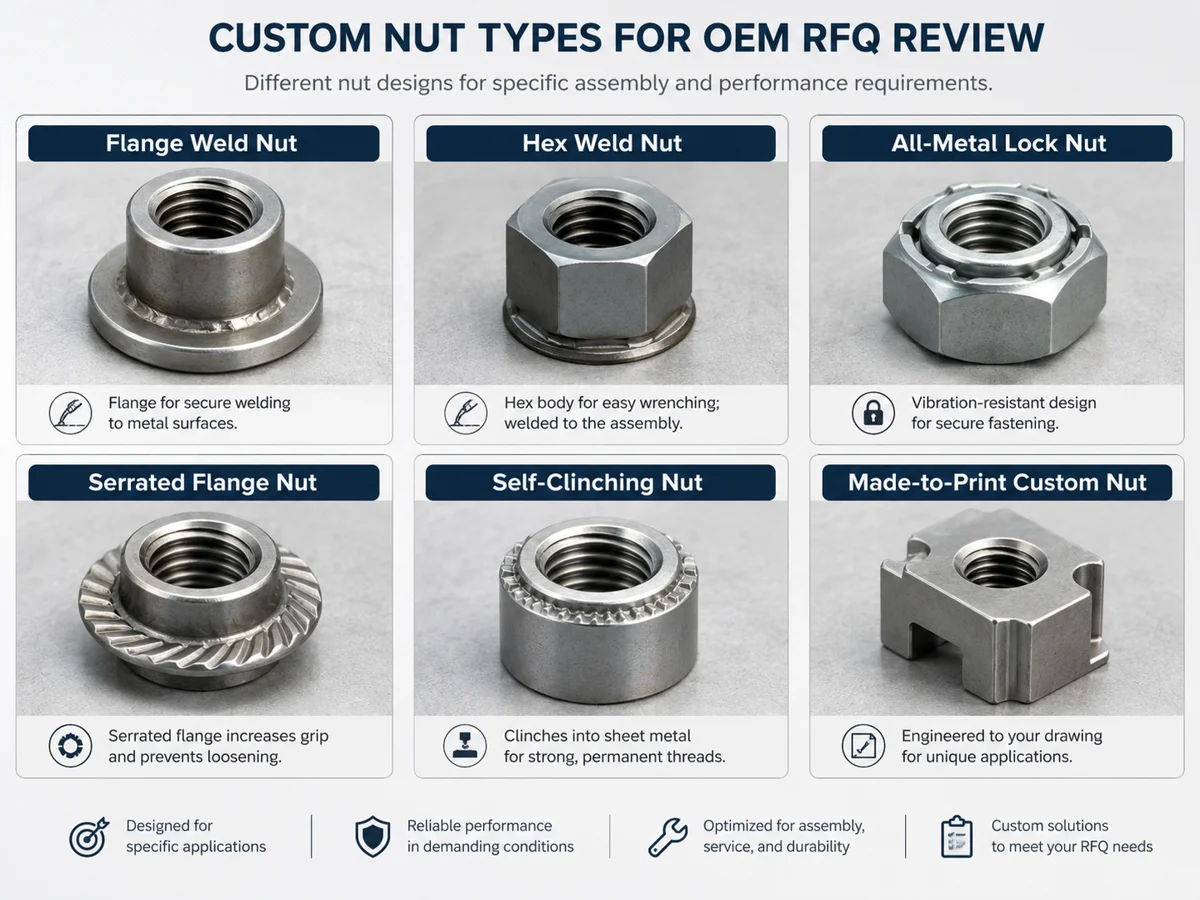
Fastener examples are conceptual. Final part configuration must follow the actual drawing and application requirement.
| Fastener Type | Buyer Should Confirm | Supplier Should Explain |
|---|---|---|
| Custom nuts and special nuts | Thread, flange, lock, weld, clinch, serration or made-to-print requirements. | Manufacturing route, thread inspection, coating influence and functional test boundary. |
| Special bolts and shoulder screws | Grip length, shoulder diameter, bearing surface, thread length, property class and application load. | Cold heading, machining, thread rolling, heat treatment and dimensional control route. |
| Studs and weld studs | Weld method, base material, thread protection, pull-out or torque requirement if applicable. | Weld-end geometry, thread alignment, coating sequence and inspection method. |
| Pins, sleeves and spacers | Locating function, outer diameter tolerance, length, surface finish and assembly clearance. | CNC, cold forming or grinding route, measurement method and packaging protection. |
| Self-clinching and press-fit fasteners | Panel material, sheet thickness, hole size, installation condition and panel hardness. | Clinching feature, push-out and torque-out evidence if required. |
| Special washers, clips and stamped fasteners | Flatness, burr direction, spring function, coating, thickness and edge condition. | Stamping route, deburring method, hardness, coating and inspection boundary. |
Thread Size, Pitch, Tolerance and Post-Coating Fit
Thread size is one of the first details buyers provide, but thread size alone is not enough. A supplier also needs thread pitch, tolerance class, thread depth, gauge condition, mating part condition and coating influence. For broader nut size and fit context, see the hex nut dimensions guide.
For example, saying “M8 fastener” does not confirm whether the thread must meet a specific tolerance class, whether it will be checked before or after plating, whether the mating bolt is coated, whether torque behavior matters or whether a prevailing torque feature is present.
Post-coating thread fit is especially important for coated internal threads and tight external threads. Coating thickness can affect gauge acceptance, assembly feel and torque behavior. If the coating requirement is added after quotation, the supplier may need to recheck tapping, thread rolling, thread allowance, gauge condition and inspection method.
Thread Data to Confirm
- Thread size and pitch
- Internal or external thread tolerance class
- Thread depth, engagement length or thread length
- Go / no-go gauge requirement
- Mating bolt, nut or insert condition
Post-Coating Fit Data
- Coating type and thickness
- Pre-coating and post-coating gauge condition
- Thread allowance after coating
- Prevailing torque requirement if applicable
- Customer inspection standard if applicable
Material, Hardness, Heat Treatment and Coating
Material and coating choices affect more than appearance. They can change forming feasibility, machining behavior, strength, hardness, corrosion resistance, thread fit, friction, hydrogen embrittlement risk and inspection requirements.
A non-standard fastener manufacturer may need to know whether the part is carbon steel, alloy steel, stainless steel, brass, copper alloy, aluminum or another specified material. The drawing may also define hardness, property class, heat treatment, case depth, core hardness or surface treatment. These requirements can affect process route, tooling life, dimensional stability and quality evidence.
| RFQ Item | Buyer Should Provide | Why It Affects Quote |
|---|---|---|
| Material grade | Steel grade, stainless grade, copper alloy, aluminum or equivalent requirement. | Affects raw material, forming route, machining behavior and cost. |
| Mechanical property / hardness | Drawing value, property class or customer standard. | Affects heat treatment, inspection and failure risk. |
| Heat treatment | Required process, property target or case requirement. | Affects strength, distortion risk and approval evidence. |
| Coating type | Zinc, zinc-nickel, phosphate, black oxide, zinc flake or specified coating. | Affects corrosion, appearance, thread fit and friction behavior. |
| Coating thickness | Drawing or customer requirement. | Affects gauge condition, fit and functional assembly. |
| Hydrogen embrittlement review | Material strength, coating route and customer requirement if applicable. | Affects plating process, baking requirement and risk control. |
| Restricted substances | Customer, automotive or regulatory requirement if applicable. | Affects material declaration, coating choice and IMDS scope. |
Buyers should avoid adding coating or heat treatment requirements after samples are approved. A late coating change may require new thread checks, functional review, hydrogen embrittlement review or customer approval depending on the project.
Manufacturing Route: Cold Heading, CNC Machining, Stamping or Secondary Operations?
A reliable RFQ should include a discussion of the manufacturing route. The route affects price, tooling, MOQ, sample lead time, inspection plan and production stability.
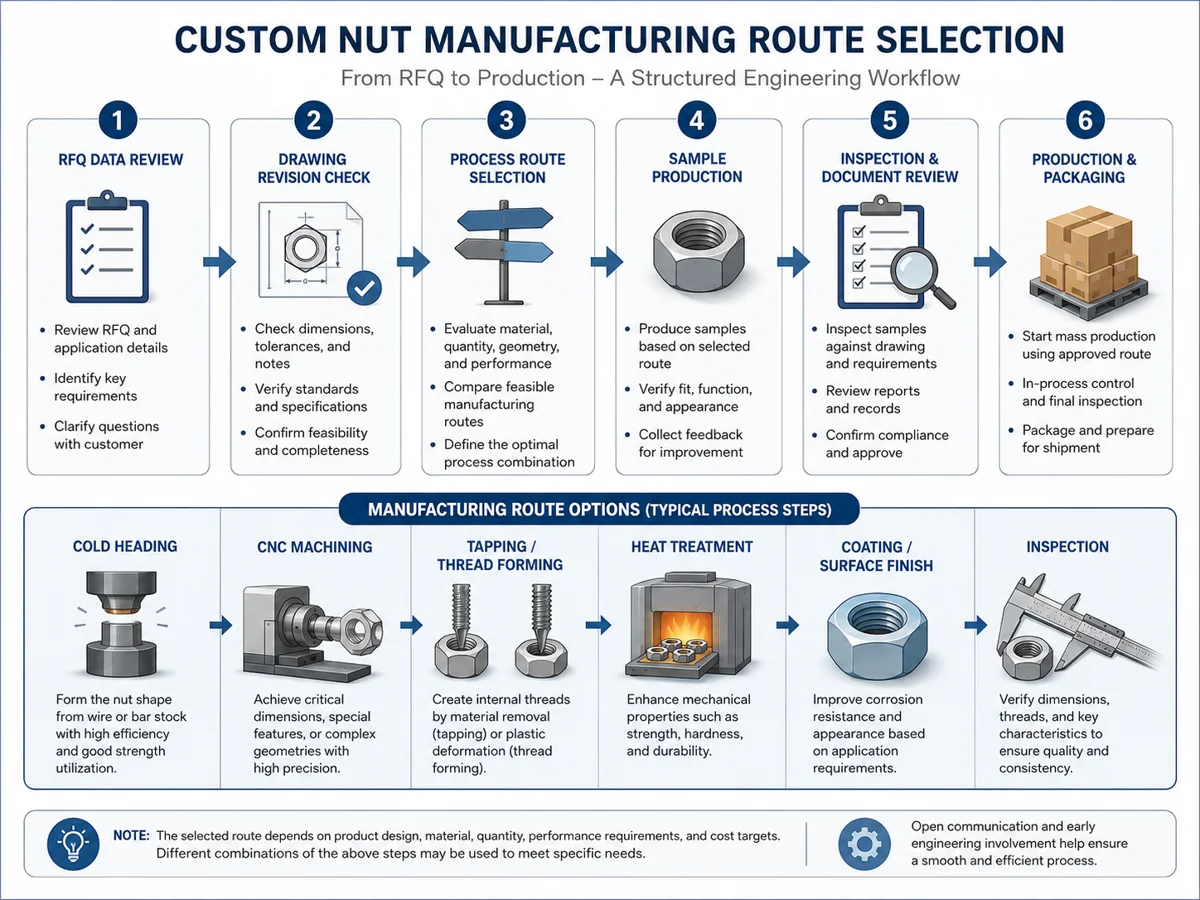
Workflow is a planning aid. Actual manufacturing route depends on geometry, material, quantity, tooling and customer requirement.
For non-standard fasteners, possible process steps may include cold heading, cold forging, stamping, CNC machining, thread rolling, tapping, thread forming, knurling, slotting, projection forming, secondary machining, heat treatment, coating, sorting and final inspection. Not every part needs every process, and not every geometry is suitable for the same route.
For broader custom fastener manufacturing context, see custom fasteners manufacturer.
| Route | When It May Fit | Buyer Should Ask |
|---|---|---|
| Cold heading / cold forging | Higher-volume bolts, nuts, studs or formed parts when geometry is suitable. | Is tooling required? What is the MOQ? Can the geometry be formed without cracking or excessive secondary machining? |
| CNC machining | Prototype, low-volume, tight local features or geometry difficult to form. | Is CNC only for samples or also for production? |
| Stamping | Flat washers, clips, brackets, thin sheet features or spring-like parts. | How will burr direction, flatness and coating be controlled? |
| Thread rolling / thread forming | External threads or internal threads when the process and material are suitable. | How will thread be inspected after coating? |
| Secondary machining | Slots, flats, reliefs, special faces, shoulders, bores or tight local features. | Which features require secondary operations and are they included in the quote? |
| Heat treatment | Strength, hardness, wear or property requirement. | What evidence is required and what distortion risk should be reviewed? |
| Coating | Corrosion, appearance, friction or customer requirement. | How will thread fit, hydrogen embrittlement risk and coating report scope be controlled? |
| Sorting / inspection | Critical dimensions, threads, functional features or customer-specific requirements. | What inspection method, sample size or sorting scope is included in the quote? |
Inspection and Quality Documents to Confirm Before Quotation
Inspection and quality documentation can significantly affect cost and lead time. OEM buyers should confirm these requirements before quotation, not after price approval.
A non-standard fastener RFQ may require dimensional reports, thread gauge records, material certificates, coating reports, hardness records, heat treatment records, functional test reports, traceability records, PPAP, IMDS or other customer-specific documents. However, these should be treated as project-specific requirements. They should not be assumed to be automatically included in every order.
| Document / Evidence | When to Discuss | Boundary |
|---|---|---|
| Dimensional report | When drawing-based approval is required. | Scope depends on drawing and inspection plan. |
| Thread gauge record | When thread fit is critical, especially after coating. | Gauge condition must be confirmed. |
| Material certificate | When material traceability is required. | Depends on project and customer requirement. |
| Hardness / heat treatment record | When hardness, property class or heat treatment is specified. | Test method and acceptance range must be defined. |
| Coating report | When coating is specified. | Coating type, thickness and test scope must be confirmed. |
| Functional test report | When torque-out, pull-out, push-out, clamp load or prevailing torque is required. | Test method and criteria must be defined. |
| PPAP | Automotive or customer-required approval. | Level and package scope must be confirmed before quotation. |
| IMDS | Automotive material data requirement. | Not automatically required for every order. |
| Traceability record | When lot control is required. | Packaging, labels and retention requirements should be stated. |
What SUNHYINGS Can Review Before Quotation
For non-standard fastener projects, the most useful supplier response is not a fast unit price. It is a clear review of drawing risk, process route, thread fit, material and coating assumptions, inspection scope and quotation boundary. SUNHYINGS can review these items before a formal RFQ so the buyer can compare suppliers on the same finished requirement.
| Review Area | What SUNHYINGS Checks | Why It Helps OEM Buyers |
|---|---|---|
| Drawing and revision | Part number, revision, critical dimensions, datum references, thread callouts, coating notes and special characteristics. | Reduces wrong-version quotation and missed inspection requirements. |
| Fastener function | Clamp, locate, lock, weld, clinch, space, conduct, support or protect function in the assembly. | Connects quotation and inspection scope to the real application, not only the part shape. |
| Process route | Cold heading, cold forging, CNC machining, stamping, thread rolling, tapping, secondary machining, heat treatment, coating and sorting options. | Helps buyers understand whether the quoted sample route can support mass production. |
| Thread and fit | Thread size, pitch, tolerance class, thread depth, go/no-go gauge condition, mating part and post-coating allowance. | Reduces thread-fit issues after plating or during final assembly. |
| Material and coating | Material grade, hardness, heat treatment, coating type, coating thickness, corrosion requirement and hydrogen embrittlement review if applicable. | Prevents late changes that affect sample approval, cost and lead time. |
| Quality documents | Dimensional report, material certificate, thread gauge record, coating report, hardness record, functional test report, PPAP, IMDS and traceability when required. | Makes quotation scope visible before supplier selection. |
| Packaging and logistics | Bulk or separated packaging, thread protection, rust prevention, carton limits, labels, barcode and lot traceability requirements. | Reduces receiving damage, missing labels and logistics-related disputes. |
Factory Equipment, Inspection Evidence and Product Photos Buyers Should Request
For non-standard fastener sourcing, buyer trust improves when the supplier can show process evidence instead of only making general claims. OEM buyers should request evidence that matches the actual product and process route. A custom machined pin, cold-headed bolt, self-clinching fastener and coated threaded insert do not need the same evidence package.
| Evidence Type | What to Request | When It Matters |
|---|---|---|
| Product photos | Clear photos of similar non-standard fasteners, including thread, head, shoulder, flange, slot, groove, pin end, coating and packaging details. | Useful during early supplier screening, but photos should not replace controlled drawings. |
| Manufacturing process photos | Cold heading, CNC machining, tapping, thread rolling, stamping, secondary machining, heat treatment, coating or sorting route evidence when relevant. | Useful when the buyer needs to confirm whether the supplier understands the required production route. |
| Inspection equipment evidence | Thread gauges, calipers, micrometers, height gauges, optical measurement, hardness testing, coating-thickness checks, salt-spray or third-party test reports when applicable. | Useful when thread fit, hardness, coating or critical dimensions affect assembly. |
| Quality document examples | Redacted dimensional report, material certificate, coating report, hardness record, thread gauge record, PPAP index or IMDS submission evidence if required. | Useful when quality documents are part of supplier selection. |
| Packaging and traceability photos | Carton labels, lot labels, barcode labels, rust-prevention packaging, separated packaging and export pallet examples. | Useful when receiving control, batch traceability or surface protection matters. |
Relevant Standards and Reference Points for Non-Standard Fastener RFQs
Standards should be used only when they match the product type, material, coating system, industry and customer requirement. A standard name should not be used as a substitute for drawing review. The buyer should ask what requirement the standard controls and whether that requirement is actually part of the RFQ.
| Reference | When It May Matter | Why It Affects Buyer Decisions |
|---|---|---|
| ISO 898-1 | Carbon steel or alloy steel bolts, screws and studs with mechanical property requirements. | Helps buyers discuss mechanical property class, strength expectation and test boundary. It should not be applied to unrelated fastener types without checking scope. |
| ISO 4042 | Steel fasteners with electroplated coating systems. | Relevant when coating thickness, thread fit, corrosion protection and hydrogen embrittlement risk need review. |
| AIAG PPAP | Automotive or customer-required production part approval. | Defines production part approval expectations. PPAP level and package scope should be confirmed before quotation. |
| IMDS | Automotive material data reporting. | Relevant when OEM or Tier customer requires material data submission. It should not be assumed for every order. |
Composite Field Scenarios for Engineering Training
The following scenarios are composite engineering examples for training. They are not customer case studies and do not identify a specific project, plant or production batch.
| Scenario | What Happened | System Cause | Correction and Prevention |
|---|---|---|---|
| Thread fails after plating | A custom internally threaded part passed pre-plating gauge inspection but failed assembly after coating. | The RFQ did not define post-coating gauge condition, coating thickness influence or mating bolt condition. | Confirm thread tolerance, coating system, post-coating inspection and mating part condition before quotation. |
| Machined sample does not represent production route | Prototype samples were CNC machined, but production quotation assumed cold heading and secondary machining. | Sample route and mass production route were not separated during approval. | State whether samples are from prototype machining or production tooling; confirm re-approval if the route changes. |
| Press-fit fastener loosens in panel | A self-clinching or press-fit part rotated during assembly. | Panel material, hole size, sheet thickness and hardness were not included in the RFQ. | Define panel condition, installation process, push-out or torque-out requirements and inspection method. |
| Low unit price excludes quality documents | A supplier quoted a low unit price, then added cost and time for PPAP, coating report and traceability after nomination. | The buyer compared price without comparing quotation scope. | List document requirements, sample approval path, packaging labels and traceability before supplier comparison. |
MOQ, Annual Volume, Tooling and Sample Approval
Annual volume is not only a purchasing number. It can influence the entire manufacturing plan. For a non-standard fastener manufacturer, annual volume may affect whether the supplier recommends tooling, CNC machining, cold heading, secondary operations, sorting automation or special packaging.
| Buyer Question | Why It Matters |
|---|---|
| What is the prototype quantity and annual volume? | Affects process route, tooling and price structure. |
| Is tooling required? | Affects upfront cost, lead time and design-change flexibility. |
| Are samples from production tooling? | Affects approval confidence and production repeatability. |
| Is inspection included in the quote? | Prevents later cost changes. |
| Is PPAP or special documentation included? | Prevents underquoted quality scope. |
| What is the sample approval path? | Prevents schedule delay. |
| Is the price valid for the quoted quantity only? | Prevents misunderstanding during production ramp-up. |
A low unit price may be misleading if tooling, sorting, functional testing, coating reports, PPAP, IMDS or special packaging are excluded. Buyers should compare quotation scope, not only price.
Packaging, Traceability and Logistics Questions
Packaging requirements are often discussed late, but they can affect cost, handling and receiving quality. For non-standard fasteners, packaging should be confirmed when the part has surface-finish requirements, thread protection needs, traceability needs, rust-prevention requirements or customer-specific labels.
Packaging Details to Confirm
- Bulk packaging or separated packaging
- Thread protection if needed
- Layered packaging for coated or cosmetic parts
- Rust-prevention packaging
- Carton weight limits
- Export carton or pallet requirements
Traceability Details to Confirm
- Lot number labels
- Barcode labels if required
- Traceability by batch, heat lot or coating lot
- Customer receiving labels
- Record retention requirement if applicable
Not every non-standard fastener project requires special packaging or barcode labels. These details should be confirmed according to the customer’s receiving standard, part function and logistics process.
Red Flags When Comparing Non-Standard Fastener Manufacturers in China
A good supplier should ask questions before quoting a non-standard fastener. If a supplier gives a fast price without discussing the drawing, material, thread, coating, function or inspection scope, the buyer should treat that quote carefully.
| Red Flag | Why It Matters | Buyer Response |
|---|---|---|
| Supplier quotes from photo only | High risk of wrong geometry, tolerance, material or process assumption. | Send drawing and ask the supplier to list assumptions. |
| No thread or coating discussion | Thread fit may fail after coating. | Confirm tolerance, coating thickness and gauge condition. |
| Supplier promises PPAP / IMDS / full inspection by default | Quality-document scope may be misunderstood. | Ask which documents are included and which are optional. |
| Supplier cannot explain process route | Sample may not represent production. | Ask route, tooling and volume plan. |
| No functional test discussion | Weld, lock, clinch, clamp or locating risks may be missed. | Define torque-out, pull-out, push-out, clamp load or prevailing torque if required. |
| Very low unit price with unclear scope | Tooling, testing, sorting, documents or packaging may be excluded. | Compare quotation scope line by line. |
| No annual volume discussion | Process route may be unrealistic. | Provide prototype and annual volume separately. |
| Supplier treats all fasteners like standard catalog parts | Special features may not be controlled. | Ask how the special feature will be manufactured, measured and approved. |
For more supplier evaluation context in automotive fastening projects, see special nuts supplier for automotive applications.
OEM RFQ Checklist for Non-Standard Fasteners
Before sending an RFQ to a non-standard fastener manufacturer in China, OEM buyers should prepare as much of the following information as possible.
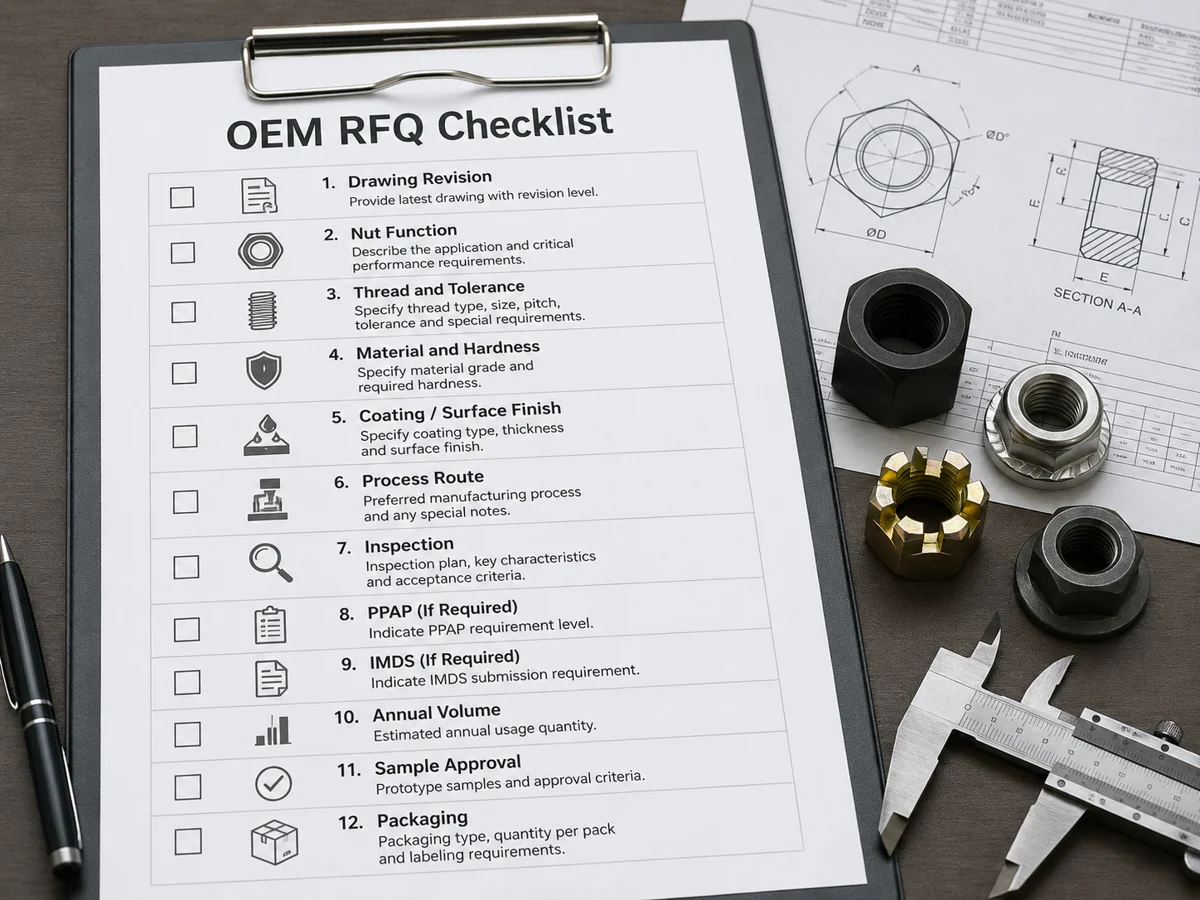
Checklist image is conceptual and should be adapted to the actual drawing, customer standard and application.
| RFQ Category | Information to Provide | Why It Helps |
|---|---|---|
| Part data | Drawing, revision, 3D model if available, sample photo and current part status. | Prevents wrong-version quotation. |
| Function | Clamp, locate, weld, clinch, lock, space, conduct, support or protect. | Connects inspection to actual use. |
| Thread and fit | Thread size, pitch, tolerance, gauge condition, mating part and post-coating requirement. | Prevents thread fit and assembly issues. |
| Material and heat treatment | Material grade, property class, hardness, heat treatment and restricted substance needs. | Supports realistic process and quality planning. |
| Coating | Coating type, thickness, corrosion requirement, friction or appearance requirement. | Affects thread fit, corrosion, friction and approval evidence. |
| Quality and approval | Dimensional report, thread record, material certificate, coating report, PPAP, IMDS or traceability. | Prevents underquoted approval scope. |
| Commercial data | Prototype quantity, annual volume, target schedule, packaging and shipping requirement. | Helps select a realistic manufacturing route. |
Ask SUNHYINGS to Review Your Non-Standard Fastener Drawing
If your project involves a non-standard fastener, send the drawing, sample photo if available, material requirement, thread requirement, coating requirement, annual volume and quality-document needs before asking for a final quotation. SUNHYINGS can help review whether the project should use cold heading, cold forging, CNC machining, stamping, secondary machining, heat treatment, coating, sorting or a combined route.
Contact SUNHYINGS for drawing review or review the custom fasteners manufacturer capability page before submitting your RFQ package.
FAQ: Non-Standard Fastener Manufacturer in China
What should I send to a non-standard fastener manufacturer in China before RFQ?
Send the latest drawing revision, sample photo if available, thread size, material, coating, application function, annual volume, sample quantity, inspection requirements, quality-document requirements and packaging needs. For functional fasteners, also include torque-out, pull-out, push-out, clamp load, prevailing torque or mating assembly requirements if applicable.
Can a non-standard fastener manufacturer quote from a photo only?
A photo can support early discussion, but it is not enough for a reliable final quotation. A photo usually cannot confirm thread tolerance, material, hardness, coating, critical dimensions, customer standards or inspection scope. A controlled drawing is strongly recommended for OEM non-standard fastener RFQs.
How do I know whether cold heading or CNC machining is better?
The best route depends on geometry, tolerance, volume, material, tooling budget and sample schedule. CNC machining may support prototypes or low-volume parts. Cold heading or cold forging may be more suitable for higher-volume production when the geometry can be formed. The sample route and production route should be confirmed before approval.
Why does coating affect thread fit?
Coating adds material to the surface and can affect internal thread fit, external thread fit, gauge condition and torque behavior. For coated threaded fasteners, buyers should confirm coating type, coating thickness, thread tolerance and post-coating gauge requirements before quotation.
What inspection evidence should I request from a non-standard fastener supplier?
Request evidence that matches the drawing risk: dimensional report, thread gauge record, material certificate, coating report, hardness or heat-treatment record, functional test report, packaging photos and traceability labels when required. Do not request every document by default; match the evidence to the part function and customer requirement.
Should I ask for PPAP before quotation?
Yes, if PPAP is required by the customer or project. The requested PPAP level, document scope, sample requirement and approval timing should be confirmed before quotation because they can affect cost and lead time. PPAP should not be assumed as automatically included in every non-standard fastener order.
Do all non-standard fastener orders need IMDS?
No. IMDS is typically relevant when the customer or automotive project requires material data reporting. It should be confirmed before quotation if needed, but it is not automatically required for every non-standard fastener order.
What affects the price of non-standard fasteners?
Price may be affected by material, size, geometry, tolerance, production route, tooling, volume, coating, heat treatment, inspection, sorting, functional testing, quality documents, packaging and delivery requirements. Buyers should compare quotation scope, not only unit price.
How should OEM buyers compare non-standard fastener suppliers in China?
Compare suppliers by drawing review quality, process-route explanation, material and coating understanding, thread inspection method, functional test discussion, quality-document boundary, sample plan, communication quality and total quotation scope. A very low price without clear scope may create later risk.
When should I ask SUNHYINGS to review my fastener drawing?
Ask for drawing review when the part is not a catalog fastener, when the thread or coating is critical, when the part has special geometry, when the sample route may differ from mass production, or when the project requires PPAP, IMDS, special inspection, traceability or functional testing.