









NPT fittings are tapered-thread connectors used in North American pressure systems. The key point is that NPT does not seal by thread contact alone. It seals through thread flank interference plus sealant filling the spiral leak path that remains between the male and female threads. That is why thread geometry, sealant choice, material combination, and make-up practice all affect sealing reliability.
In real projects, the most common NPT failures are not caused by the thread form itself, but by avoidable selection and assembly mistakes. The most frequent examples are mixing NPT with BSP threads, over-torquing stainless fittings until galling occurs, applying tape or paste incorrectly, and ordering the wrong nominal size after measuring the OD instead of checking thread standards and reference charts.
Quick checks before ordering or installation: confirm whether the thread is NPT, NPTF, BSPT, or NPS; confirm nominal size from charts rather than ruler estimates; confirm whether the service involves vibration, thermal cycling, or contamination risk; and confirm the correct sealant and material combination for the media. This guide explains how NPT fittings seal, how to identify and measure them correctly, where they work best, and how to avoid the leakage and rework problems most often seen in the field.
| Quick Check | What to Confirm | Why It Matters |
|---|---|---|
| Thread standard | NPT, NPTF, BSPT, or NPS | Mixed thread forms often appear to fit, then leak under pressure |
| Nominal size | Use charts and gauges, not OD guesswork | Wrong sizing is one of the most common ordering mistakes |
| Service conditions | Pressure, vibration, thermal cycling, contamination sensitivity | Determines whether threaded joints are appropriate at all |
| Sealant and material | PTFE tape, paste, anti-seize, stainless vs brass vs carbon steel | Affects galling risk, sealing reliability, and media compatibility |
NPT threaded systems are widely used in:
- Industrial instrumentation: pressure gauges, pressure switches, transmitters, manifolds, and flow devices
- Hydraulic and pneumatic circuits: compressed air, nitrogen, hydraulic blocks, and maintenance assemblies
- Chemical and utility piping: low- to moderate-size connections where welding is impractical or maintenance access is important
- Marine and offshore systems: washdown and skid piping where stainless or corrosion-resistant alloy selection matters
- General industrial threaded fittings: elbows, tees, couplings, adapters, plugs, bushings, and unions
For forged pressure fittings, many industrial specifications reference ASME B16.11. For thread form, the common dimensional reference is ASME B1.20.1. If you need threaded product detail, see our stainless steel threaded fittings range.
What Are NPT Fittings? (Technical Definition)
NPT Thread Basics and Geometry
NPT stands for National Pipe Taper. It is a tapered thread form used mainly in North American inch-based piping and threaded fitting systems. Unlike straight threads, NPT is designed to wedge together as the male and female parts tighten.
From an engineering perspective, three geometric details define how NPT behaves:
- Taper: NPT threads use a taper of 1 in 16 on diameter, which creates increasing interference as the fitting is tightened.
- 60-degree thread angle: This differs from BSP’s 55-degree angle and is one reason the two standards are not interchangeable.
- Truncated crests and roots: These leave a helical void that becomes the spiral leak path, which is why sealant is usually required.
Practical meaning: an NPT joint is not just a mechanical connection. It is an interference-fit sealing system that depends on correct geometry and controlled assembly. If the thread angle, pitch, or taper is wrong, the joint may seem to fit for several turns and still fail during pressure testing.
Engineering note: NPT is not a positional thread. If the fitting needs to face a certain direction, you should not back it off after reaching seal engagement. Use a union, swivel adapter, or another orientation-friendly connection strategy instead of sacrificing the seal.
How NPT Fittings Seal
NPT fittings seal through tapered thread interference plus sealant filling the spiral leak path. As torque is applied, the male thread wedges into the female thread, creating radial pressure and localized metal-to-metal contact. At the same time, the sealant fills the microscopic voids that remain between thread roots and crests.
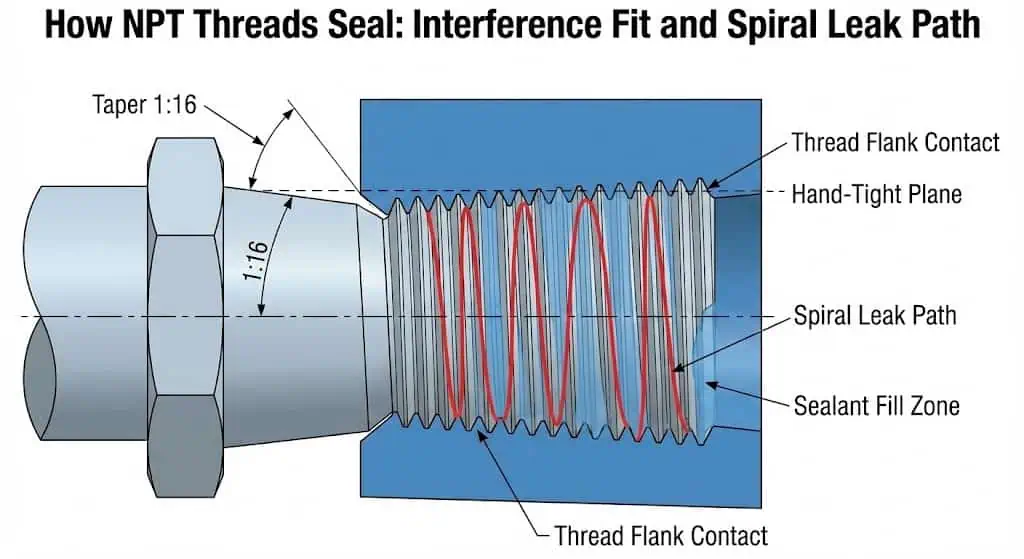
- Interference fit: the taper creates progressive flank contact as the fitting tightens
- Sealant function: sealant fills the leak path and reduces friction to lower galling risk
- Surface finish effect: rough or poorly machined threads tear tape and reduce sealing consistency
- Material response: stainless steel threads are more prone to galling than brass and often need better lubrication practice
Field Case #1 – Galling Failure: A technician installed a 316 stainless NPT plug into a manifold using an impact wrench and thin tape. The fitting seized before fully seating. Root cause: stainless-on-stainless friction and cold welding under excessive torque. Correction: remove the damaged parts, use the correct anti-seize or sealant, and assemble with controlled hand torque rather than impact tools.
Field Case #2 – System Contamination: A flow meter failed because PTFE tape shreds migrated downstream and contaminated the sensor. Root cause: tape was wrapped over the first thread and cut during assembly. Prevention: start tape one to two threads back from the end and keep the lead thread clear.
NPT vs NPTF vs BSPT vs NPS
Many leakage problems come from mixing thread systems that look similar but are not actually compatible. In real procurement and maintenance work, this is one of the most common failure causes.
| Thread Standard | Angle | Geometry | How It Seals | Compatibility Notes |
|---|---|---|---|---|
| NPT | 60° | Tapered | Interference + sealant | Compatible with matching NPT threads; commonly used in industrial threaded piping |
| NPTF | 60° | Tapered | Dryseal-oriented geometry with reduced leak path | Related to NPT but not identical in sealing intent |
| BSPT | 55° | Tapered | Interference + sealant | Not interchangeable with NPT due to angle and profile differences |
| BSPP | 55° | Parallel | Usually seals with bonded washer or O-ring, not on thread interference alone | Not interchangeable with NPT |
| NPS | 60° | Straight | Usually not a pressure seal on thread alone | Can appear close to NPT but does not behave the same under pressure |
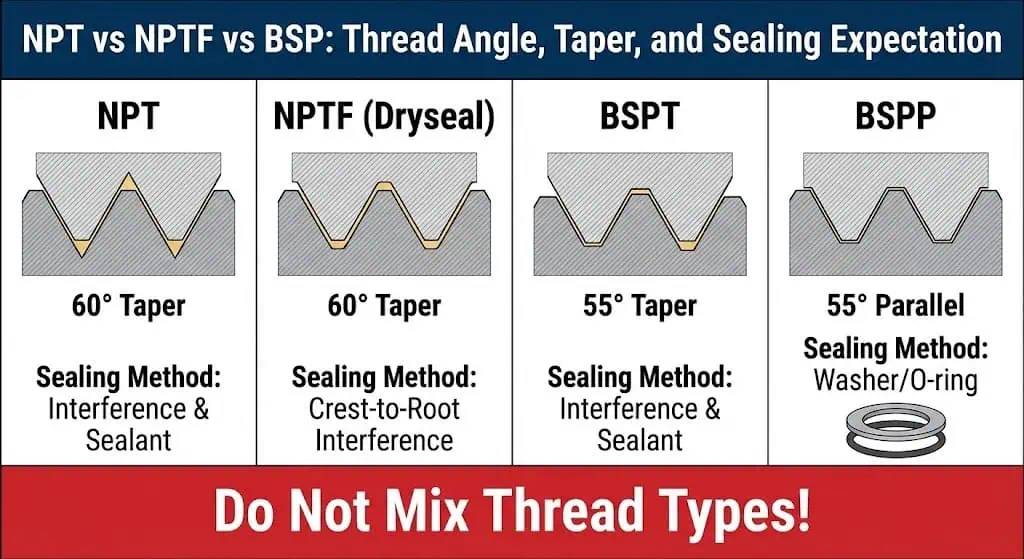
Field Case #3 – Mixed Thread Leak: A maintenance team installed a 1/2″ NPT male into a BSPT female port on imported equipment. The fitting engaged for several turns and appeared nearly correct, but leaked during pressure testing. Root cause: thread angle and profile mismatch, not poor sealant. Correction: verify the port standard and use the proper adapter instead of forcing the thread.
If you frequently encounter imported equipment, thread verification should be a standard receiving and maintenance check. For a dedicated comparison, see our related guide to BSP vs NPT thread differences in stainless fittings.
NPT Thread Features and Performance
The Physics of the Tapered Design
The taper is what makes NPT self-tightening under assembly. As the male thread advances, thread interference increases, creating radial compressive force in the female fitting. This also means assembly load must be controlled. Too little torque leaves leak paths; too much torque can crack brittle female ports or seize stainless threads.
From a practical engineering standpoint, NPT performance depends on balancing:
- adequate flank engagement
- correct sealant volume
- material strength of the female fitting or port
- service conditions such as pressure pulsation, vibration, and thermal expansion
Expert view: NPT is reliable in the right application, but it is not the best answer for every service. When vibration, repeated thermal cycling, or contamination sensitivity becomes severe, a socket-weld, flanged, face-seal, or tube adapter system may provide better long-term reliability.
Sealant Selection and Application
Sealant is part of the joint design, not an afterthought. The wrong sealant can contaminate the system, react with the media, or fail under temperature.
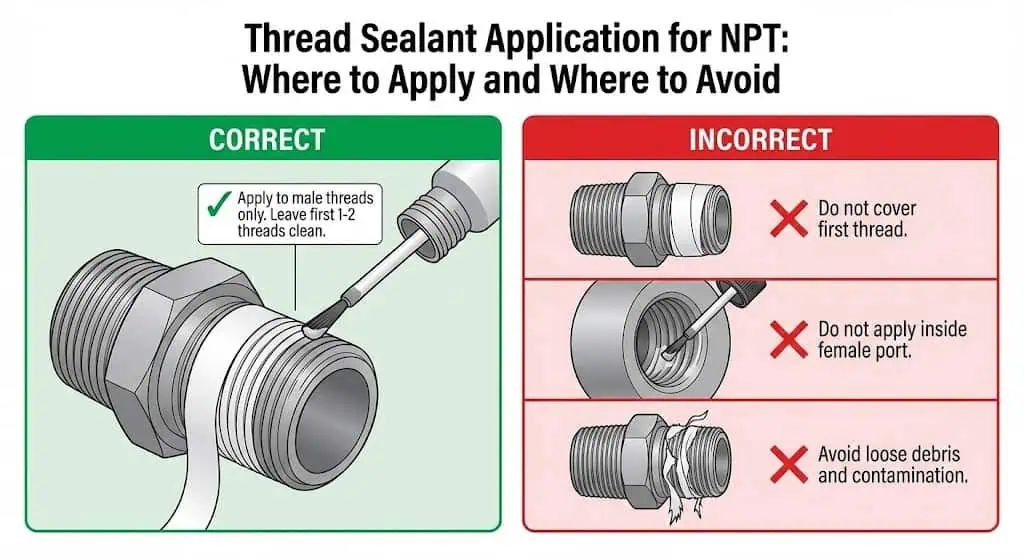
- PTFE tape: common for general air and water systems; helps seal and reduce friction
- Pipe dope / thread paste: often better where vibration resistance and void filling are more important
- Anti-seize / specialized compounds: useful where stainless galling is a known risk, but must be compatible with the service and specification
Engineer’s Tip on Sealants: Apply PTFE tape clockwise as viewed from the male end, keep the first one to two threads free, and do not overbuild the tape thickness. If paste is used, apply a controlled amount and avoid contaminating the system bore.
Material Selection Strategy
Material choice affects corrosion resistance, galling tendency, allowable torque margin, and service life. In many systems, the fitting does not fail because the thread form is wrong—it fails because the material was not matched to the environment or the mating component.
| Material | Main Advantages | Main Cautions | Typical Use |
|---|---|---|---|
| Brass | Easy assembly, low galling risk | Not suitable for every chemical or high-pressure service | Low-pressure water and air |
| Carbon Steel | Strength and cost efficiency | Needs corrosion protection in wet service | General industrial utilities and oil systems |
| 304 Stainless Steel | Good general corrosion resistance | More galling-sensitive than brass; less resistant to chlorides than 316 | General industrial and outdoor service |
| 316 / 316L Stainless Steel | Better chloride and pitting resistance | Still requires correct sealant and assembly control | Marine, chemical, and washdown environments |
| Duplex / Specialty Alloys | Higher strength or corrosion resistance in specific services | More expensive and project-specific | Severe chloride or demanding process duty |
For forged stainless threaded fittings, material references commonly include ASTM A182. For stainless bars and shapes used in machined parts, ASTM A276 is also relevant in many product and quality contexts.
Field Case #4 – Wrong Material Strategy: A 304 stainless threaded fitting assembly was used in a chloride-bearing washdown environment. The thread form sealed initially, but corrosion products built up over time and repeated maintenance increased thread damage. The correct improvement was to move to 316L, tighten sealant selection, and review whether a threaded joint was appropriate for the washdown frequency.
NPT Sizing and Measurement
How to Measure NPT Fittings Correctly
NPT size is nominal pipe size, not the measured OD of the thread. This is one of the most common ordering mistakes. A fitting described as 1/2″ NPT does not measure 0.50 inches on the outside thread diameter.
To identify NPT fittings correctly, use:
- calipers for outside diameter checks
- thread pitch gauges for TPI verification
- reference charts for nominal size conversion
- thread plug or ring gauges for inspection or QA when required
| Nominal NPT Size | Approximate Male Thread OD | Common Use |
|---|---|---|
| 1/8″ NPT | About 0.405″ | Instrumentation and small pneumatic connections |
| 1/4″ NPT | About 0.540″ | Gauges, transmitters, air lines, small hydraulic blocks |
| 3/8″ NPT | About 0.675″ | General small industrial threaded connections |
| 1/2″ NPT | About 0.840″ | Utility and process threaded fittings |
| 3/4″ NPT | About 1.050″ | Heavier utility and distribution lines |
Field Case #5 – Wrong Size Order: A buyer measured the outside of a male thread and ordered fittings by ruler estimate instead of by NPT nominal size. The delivery matched the measured OD guess, not the actual pipe-thread standard, and the fittings could not be assembled on site. The fix was to verify nominal NPT size using thread charts and pitch instead of OD alone.
Common Size and Identification Mistakes
- assuming thread OD equals nominal size
- checking only diameter but not thread pitch
- confusing NPT with BSP on imported components
- using “looks close” instead of gauges and charts
- assuming all 1/4″ process ports are NPT without checking the equipment standard
Common NPT Fitting Types and Applications
NPT is a thread system, not a single product type. In industrial purchasing, you will usually specify both the fitting geometry and the thread standard together.
- Elbows: 45-degree and 90-degree threaded elbows for direction change
- Tees: branch connections in utility or instrument systems
- Couplings: straight threaded joining of two male ends
- Unions: serviceable threaded disconnection points
- Bushings and adapters: reducing or mixed-interface transitions
- Plugs and caps: temporary or permanent closures
- Hex nipples and street elbows: compact threaded connections where space is limited
For product-level detail, see our forged threaded fittings range. If your project crosses between pipe-threaded and OD-controlled tubing systems, also review instrumentation fittings and valves.
NPT Installation and Troubleshooting
Recommended Installation Sequence
- Verify thread standard and nominal size before assembly.
- Inspect male and female threads for damage, contamination, burrs, or deformation.
- Apply the correct sealant properly, keeping the lead thread clear where appropriate.
- Hand-start the thread to avoid cross-threading.
- Tighten with controlled hand tools rather than impact tools, especially on stainless steel.
- Pressure test or leak test according to the system requirement.
Common Installation Mistakes
- over-torquing stainless fittings until galling occurs
- wrapping PTFE tape over the first thread and contaminating the system
- mixing NPT and BSPT because the threads “almost fit”
- using threaded joints on vibration-prone or heavily cycled service without reviewing suitability
- using low-grade fittings or unknown metallurgy in corrosive service
Reliability note: if the service includes severe vibration, repeated thermal cycling, or a high consequence of leak, do not default to NPT just because it is familiar. Review whether socket-weld, flanged, face-seal, or tube adapter systems are more appropriate.
When NPT May Not Be the Best Choice
NPT works well in many industrial systems, but it is not the universal answer. Consider alternatives when:
- the system is highly vibration-prone
- cleanliness and contamination control are critical
- precise orientation without backing off is required
- the line operates under repeated thermal cycling
- a more serviceable or higher-integrity seal interface is needed
How to Choose the Right NPT Fitting
The right NPT fitting is chosen by checking thread standard, nominal size, material, service conditions, and failure consequence together.
| Selection Question | What to Check | Why It Matters |
|---|---|---|
| Is the port definitely NPT? | Verify equipment standard, country of origin, and thread geometry | Avoid NPT / BSP mismatch leaks |
| What material should be used? | Match corrosion risk, temperature, and galling tendency | Improves service life and reduces maintenance issues |
| Is threaded connection appropriate? | Check vibration, thermal cycling, and leak consequence | Some services need a stronger or cleaner sealing system |
| What sealant is suitable? | Confirm media compatibility and contamination tolerance | Wrong sealant can leak or contaminate the system |
| How will the fitting be assembled? | Hand tools, controlled tightening, no impact wrench on stainless | Reduces galling, cracking, and over-tightening failure |
If your project needs adjacent topics, continue with:
- BSP vs NPT thread differences in stainless fittings
- forged threaded fittings for ASME B16.11 systems
- instrumentation fittings for OD-controlled tube systems
FAQ
What does NPT stand for?
NPT stands for National Pipe Taper.
It refers to a tapered pipe thread system widely used in North American pressure piping and threaded fitting connections.
How do NPT fittings seal?
NPT fittings seal through tapered thread interference plus sealant filling the spiral leak path.
The male and female threads wedge together as they are tightened, but proper sealant is still needed in most practical installations to improve sealing reliability and reduce leakage.
Can you use NPT fittings with BSP threads?
No, NPT and BSP threads should not be treated as interchangeable.
They differ in thread angle, pitch, and profile. In some cases they may engage for a few turns and appear close, but they often leak during testing or service because the sealing geometry does not truly match.
How do you identify NPT fitting size correctly?
You identify NPT size by thread standard and nominal size, not by OD guesswork alone.
Use thread gauges, calipers, and reference charts to confirm the correct nominal pipe size. Measuring only the outside diameter often leads to wrong orders, especially on smaller fittings.
Why do stainless steel NPT fittings gall during assembly?
Stainless steel NPT fittings can gall because stainless threads are prone to friction welding under high contact pressure.
Over-tightening, dry assembly, poor lubrication practice, and impact tools all increase the risk. Correct anti-seize or sealant selection and controlled tightening help reduce galling.