Quick Answer: How to Choose a Special Nuts Supplier for Automotive Fasteners
To choose a special nuts supplier for automotive fasteners, buyers should first check the supplier’s drawing review capability, production route judgment, thread inspection method, coating control, PPAP-style documentation support and batch traceability. Do not qualify a supplier only by unit price, product photos or fast replies. A reliable supplier should review the drawing, 3D file or sample, thread size and pitch, mating bolt, assembly position, tightening torque, preload concern, coating requirement, annual quantity, testing documents and packaging expectation before final quotation. The supplier should also explain whether a standard nut is enough, whether a modified special nut is suitable, or whether a made-to-print custom nut is required. Wrong supplier selection can cause tooling waste, repeated samples, thread gauge failure, galling, hydrogen embrittlement risk, corrosion problems, assembly stoppage, delayed shipment and avoidable cost escalation.
Figure 1: Supplier qualification should start from drawings, samples, thread gauges, coating requirements and RFQ data, not from product photos alone.
Supplier Evaluation Checklist Before RFQ
Does the supplier ask for drawing revision, sample photos and application position before quoting?
Does the supplier review thread size, pitch, tolerance class, chamfer and bearing surface?
Does the supplier ask about the mating bolt, washer, tightening torque and preload requirement?
Can the supplier explain whether a standard nut, modified special nut or made-to-print custom nut is suitable?
Does the supplier separate CNC prototype samples from cold-forged production-intent samples?
Does the supplier inspect threads after final coating, welding or heat treatment?
Can the supplier provide hardness, coating thickness, thread gauge and batch traceability records?
Does the supplier identify coating, galling, hydrogen embrittlement or torque scatter risks before tooling?
Can the supplier explain what information is missing from the RFQ before giving a final quotation?
Special Nuts SupplierAutomotive FastenersSupplier EvaluationRFQ Review
Supplier evaluation starts before quotation. Send your drawing, sample photo, thread size, material, finish, application position and estimated volume for engineering review.
What a Special Nuts Supplier Should Do for Automotive Fastener Projects
Practical answer: A special nuts supplier should not only sell nuts. For automotive applications, the supplier should help evaluate whether the part can be made, how it should be produced, what risks exist and what inspection evidence is needed before sample or mass production approval.
Special nuts may include lock nuts, flange nuts, weld nuts, projection nuts, sleeve nuts, thin nuts, high-strength nuts, stainless nuts, modified standard nuts and made-to-print custom nuts. The supplier’s responsibility is different from a catalog distributor. Automotive buyers often need support on drawing review, missing tolerances, material grade, property class, surface treatment, heat treatment, thread gauge inspection, salt spray testing, hardness testing, coating thickness and packaging control.
The useful evaluation question is not simply “Can you make this nut?” A better question is “Can you explain the manufacturing route, inspection plan and application risk before sample approval?” If the supplier cannot identify missing drawing information, coating risk, thread allowance, mating bolt compatibility or batch control requirements, low unit price may turn into long lead time, repeated samples and assembly reliability problems.
Supplier quotes from incomplete data and later requests changes
Prevents wrong samples, tooling delay and repeated RFQ cycles
Application review
Understand assembly position, load, corrosion, heat, vibration and access condition
Wrong nut type is selected for the real joint condition
Improves assembly reliability and maintenance performance
Process route evaluation
Recommend standard, modified, cold forged, CNC or hybrid route
Prototype sample does not represent mass production
Controls tooling cost, lead time and batch stability
Inspection planning
Define thread gauge, hardness, coating thickness and functional checks
Part fits visually but fails assembly or customer inspection
Reduces quality disputes and shipment risk
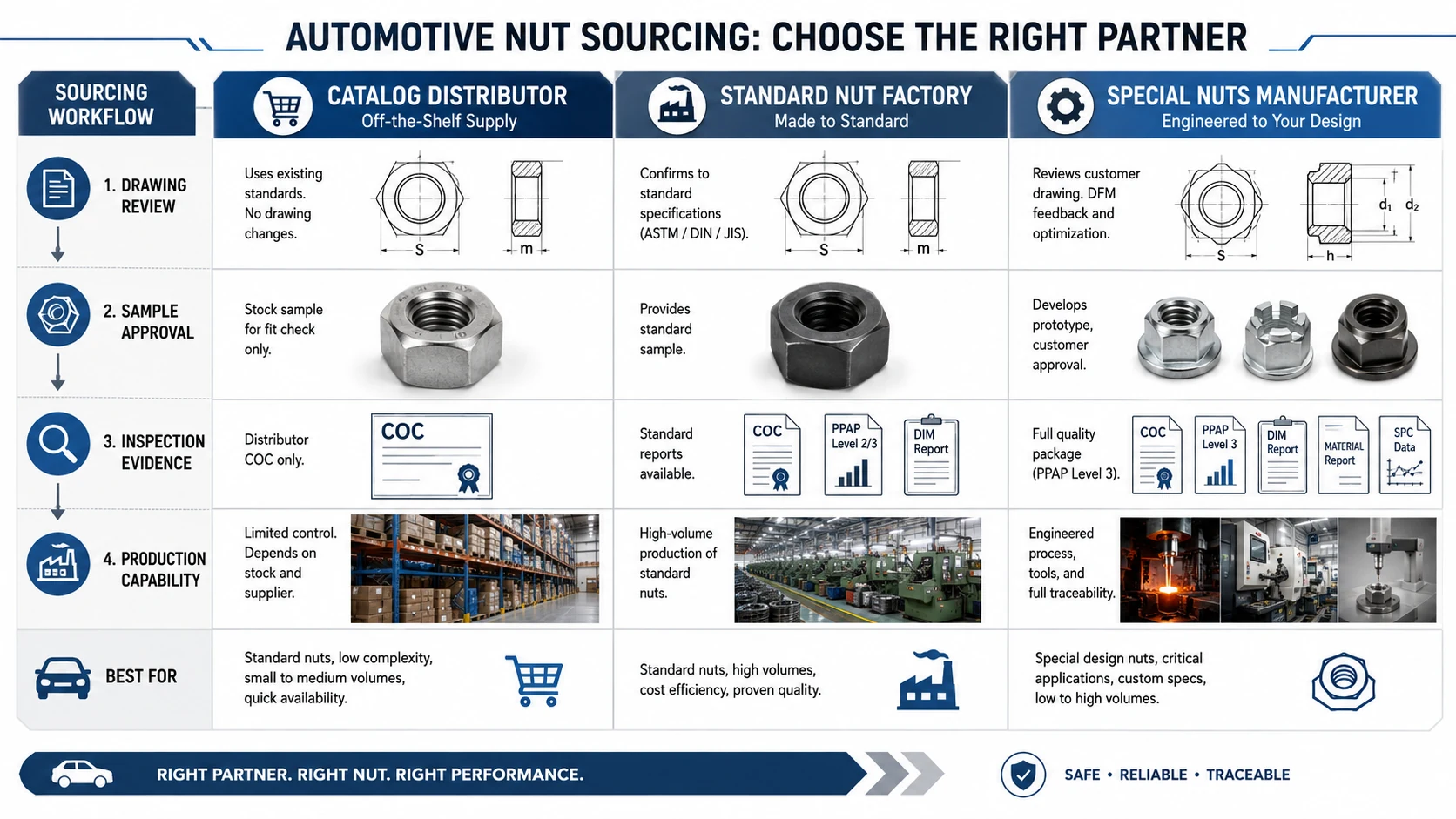
Distributor, Standard Nut Factory or Special Nuts Manufacturer: Which Supplier Type Fits Your RFQ?
Practical answer: The right supplier type depends on whether the part is a stock standard nut, a modified standard nut or a drawing-based special nut. Automotive buyers should not use the same sourcing method for all three cases.
Figure 2: Different supplier types fit different project risks. Catalog sourcing, standard production and made-to-print special nut manufacturing should not be evaluated with the same checklist.
Supplier Type
Suitable For
Limitations
Buyer Evaluation Point
Catalog distributor
Standard nuts, urgent replacement, small order with known specification
Limited drawing review, limited custom process control
Check stock accuracy, standard compliance and traceability
Standard nut factory
Hex nuts, flange nuts, lock nuts or regular grades in repeatable volume
May not support complex geometry, DFM review or custom coating route
Check whether the project is truly standard or needs modification
May require more technical information before quotation and sample approval
Check engineering review, process route, tooling, inspection and batch control
Trading company without technical support
Low-complexity sourcing when all specifications are already locked
Risk of unclear responsibility for drawing, process and quality deviation
Ask who controls production, inspection and corrective action
Engineering Warning: A Low Quote Is Not a Supplier Qualification
A lower unit price does not confirm thread accuracy, material control, coating performance or batch repeatability. For automotive special nuts, a quote without drawing clarification, process explanation and inspection plan should be treated as incomplete, not as a final sourcing decision.
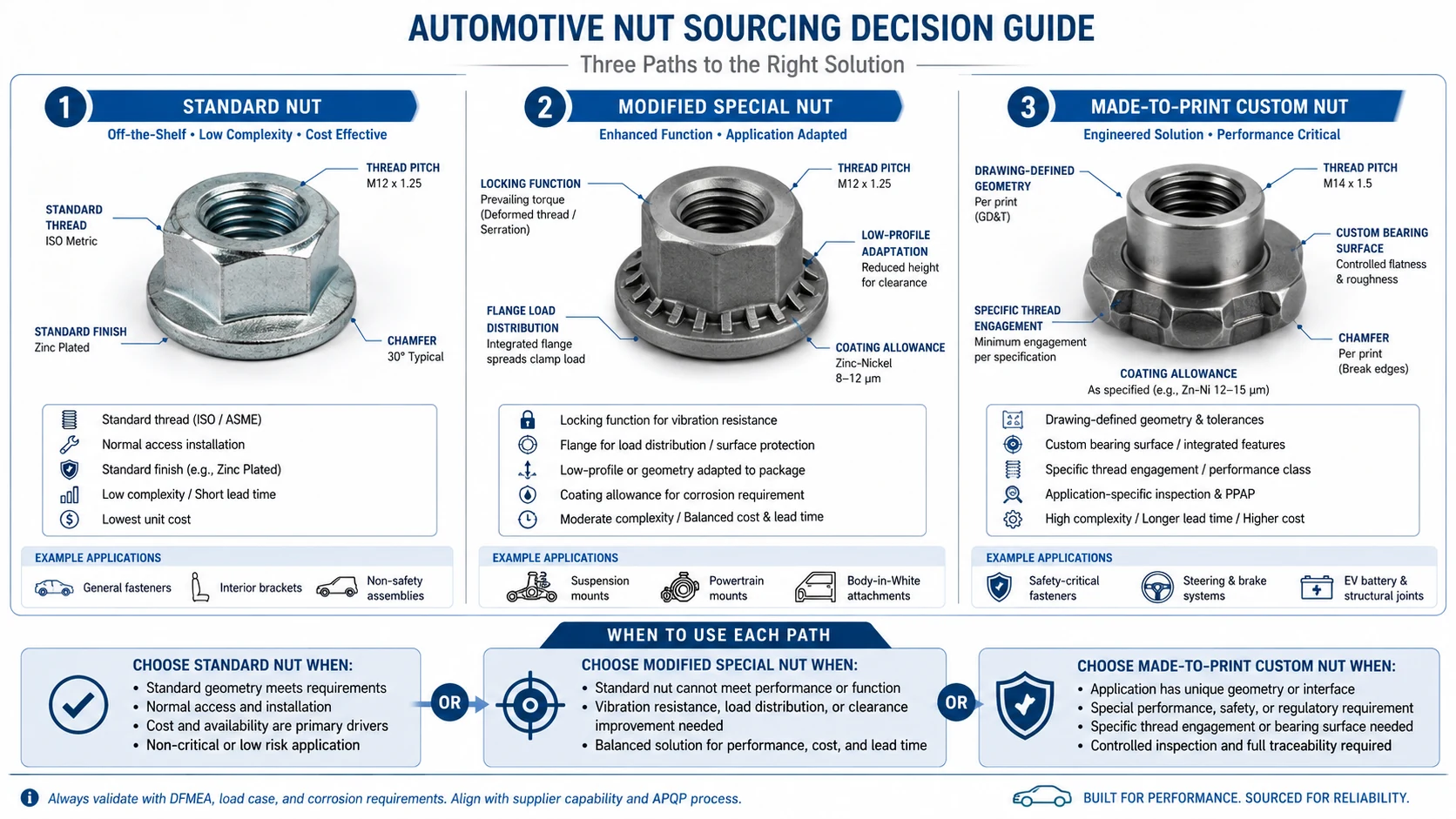
Standard Nut, Special Nut or Custom Nut: What the Supplier Should Clarify
Practical answer: A qualified supplier should help buyers decide whether the application can use a standard nut, needs a modified special nut, or requires a drawing-based custom nut. This decision affects tooling cost, sample lead time, validation work and mass production stability.
A standard nut may be acceptable when the joint only requires a known thread size, material class, surface treatment and normal assembly access. A special nut becomes necessary when the joint needs locking, welding, flange load distribution, low height, sleeve geometry, corrosion protection or controlled assembly behavior. A custom nut is required when the drawing defines unique geometry, non-standard bearing surfaces, special thread engagement, specific coating allowance or customer-defined inspection features.
Figure 3: Supplier selection should follow the real part route: stock standard nut, modified special nut or made-to-print custom nut.
Project Condition
Likely Nut Direction
Supplier Must Confirm
Risk If Misjudged
Standard thread, normal access, no special failure mode
Standard nut
Thread size, property class, finish and packaging
Overengineering and unnecessary sourcing cost
Vibration loosening, clamp load loss or driver shutdown
Lock nut, flange lock nut or modified special nut
Preload, prevailing torque, mating bolt, coating and washer condition
Field loosening, assembly rejects or maintenance risk
Thread engagement, bearing surface, tool access and assembly sequence
Thread stripping, poor seating or assembly delay
Unique drawing, sample reverse engineering or customer-specific geometry
Made-to-print custom nut
2D drawing, 3D file, CTQ dimensions, material, coating and production-intent sample
Tooling waste, sample delay and mass production inconsistency
Automotive Fastener Application Logic: The Supplier Must Understand the Joint, Not Only the Nut
Practical answer: Automotive special nuts should be evaluated by application position. Chassis, seat frame, sheet metal, exhaust, EV battery pack and aftermarket projects have different risks for vibration, heat, corrosion, preload, weld strength, service access and batch traceability.
Torque scatter, assembly speed, access space and thread engagement
Driver shutdown, cross-threading or rework
Body sheet metal
Weld nut, projection nut, flange weld nut
Projection height, sheet thickness, weld face and post-weld thread gauge
Torque-out failure, pull-out failure or thread spatter
Exhaust and underbody
Coated nut, stainless nut, heat-suitable nut
Corrosion, heat, road salt, service removal and coating durability
Corrosion seizure, thread damage or maintenance delay
EV battery pack
Sleeve nut, flange nut, custom nut, coated special nut
Low clearance, assembly repeatability, coating, traceability and service access
Assembly interference, inconsistent clamp load or quality containment issue
Engineering Review Capability: The First Supplier Evaluation Filter
Practical answer: A qualified special nuts supplier should review the application before quoting. At minimum, the supplier should ask why the nut is used, where it is assembled, what it mates with, what environment it faces and what inspection evidence is required.
Automotive nuts are not isolated components. A lock nut used in a vibrating bracket depends on preload, prevailing torque, mating bolt coating and washer condition. A weld nut depends on sheet thickness, projection geometry, welding condition and post-weld thread quality. A sleeve nut used in restricted space depends on tool access, thread engagement, bearing surface and serviceability. If the supplier evaluates only the outer shape, the real assembly risk remains hidden.
Engineering Review Checklist for Buyers
Can the supplier explain whether a standard nut, modified standard nut or custom nut is suitable?
Does the supplier ask for application position, mating bolt, washer and joint stack-up?
Does the supplier review preload, torque condition, thread engagement and bearing surface?
Does the supplier identify corrosion, heat, vibration, service access or assembly speed risks?
Does the supplier flag missing drawing tolerances, coating allowance or inspection requirements?
Does the supplier provide a process route before sample quotation?
Does the supplier explain what should be validated before mass production?
Scenario note: The following composite scenarios are written for engineering training and supplier evaluation education. They do not represent a named customer project.
What problem occurred: A buyer requested a replacement lock nut after a chassis bracket nut loosened during road simulation.
Why it happened: The original supplier quoted by thread size only and did not review preload, mating bolt coating, washer condition or bracket movement.
Real project or system cause: The joint had clamp load loss under cyclic movement, while the selected nut did not provide suitable locking behavior for the assembly condition.
Corrective action: Review all-metal lock nut, serrated flange nut or modified locking feature with the actual mating bolt and tightening process.
Prevention: Select a supplier that reviews the joint system before recommending a lock nut.
Torque, Nut Factor K and Assembly Behavior Review
Practical answer: For automotive assembly, a supplier should understand that nut geometry, thread tolerance, coating thickness, lubricant condition and locking feature can change torque scatter and clamp load. A nut that passes visual inspection may still create unstable tightening curves or inconsistent preload on an automated assembly line.
Buyers should not ask a supplier for a universal torque value without defining the mating bolt, coating, washer, bearing surface, assembly speed and lubrication condition. The supplier does not need to invent a torque table when the drawing does not define one, but it should be able to explain which factors affect nut factor K, prevailing torque, thread friction and bearing surface friction. If the supplier cannot discuss these items, the quotation may miss a real assembly risk.
Assembly Factor
Supplier Should Review
Possible Problem
Buyer Check
Mating bolt
Material grade, coating, thread condition and compatibility with nut class
Thread stripping, preload loss or galling
Provide mating bolt specification with RFQ
Coating and lubricant
Coating thickness, lubricant presence and friction behavior
Torque scatter, high tightening torque or low clamp load
Confirm coating and lubrication requirement before sample approval
Locking feature
Prevailing torque, insert drag or all-metal deformation behavior
Driver overload, assembly speed reduction or inconsistent torque curve
Request assembly trial or torque curve review when required
Bearing surface
Flange, serration, washer contact and seating face condition
Surface damage, unstable seating or clamp load variation
Review joint stack-up, washer use and contact material
Thread engagement
Engagement length, internal thread depth and chamfer entry
Thread stripping, cross-threading or poor assembly start
Confirm engagement and go/no-go thread gauge requirement
Engineering Warning: Torque Is Not Only a Number
Torque depends on friction, coating, thread fit, bearing surface and assembly condition. If the project requires stable preload, buyers should ask the supplier how the nut design and surface treatment may affect torque scatter and tightening curve behavior.
Drawing, Sample and 3D File Review Before Quotation
Practical answer: A supplier should not quote a made-to-print special nut from a photo alone unless the buyer only needs a rough budget. For production sourcing, drawings, samples and 3D files must be checked for thread, pitch, tolerance, chamfer, bearing surface, coating allowance, material and critical dimensions.
Many automotive sourcing problems begin with incomplete drawings. A sample may show the shape but not the material grade, heat treatment, coating thickness, thread class or functional requirement. A 3D file may show geometry but not tolerance or surface treatment. A drawing may specify thread size but omit thread gauge requirement after plating. A supplier that can mark these missing items helps prevent wrong samples and production delay.
Figure 4: Drawing review should confirm thread pitch, tolerance, chamfer, bearing surface, coating allowance and CTQ dimensions before quotation.
Actual shape, thread engagement, surface condition, reverse engineering reference
Material grade, heat treatment, coating specification, approved revision
Measure, identify risks and request missing data
Application photo
Assembly position, access condition, corrosion or failure symptom
Exact dimensions and quality requirements
Use for engineering diagnosis, not final production approval
Engineering Warning: Sample-Based Copying Has Limits
A supplier may reverse engineer a sample, but automotive production still needs confirmed material, strength class, surface treatment, thread tolerance, testing requirement and drawing revision. Copying visible geometry without technical confirmation can cause thread gauge failure, incorrect hardness, coating mismatch or assembly instability.
Material, Strength Grade and Surface Treatment Evaluation
Practical answer: A special nuts supplier should help confirm whether the required material, property class and surface treatment match the application environment and mating parts. The review should cover strength, corrosion, heat, friction, galling, hydrogen embrittlement and post-coating thread fit.
Automotive special nuts may use carbon steel, alloy steel, stainless steel, 304, 316, SCM435 or project-defined materials. Mechanical requirements may involve class 8, class 10, class 12, A2-70, A4-80 or drawing-specific conditions. Surface treatments may include zinc plating, zinc-nickel, zinc-flake, phosphate, black oxide, passivation, lubricant or customer-defined coatings. A common electroplated zinc thickness may fall around 5–12 μm, but the correct value must follow the drawing, coating specification and thread allowance. The supplier must understand that coating changes more than appearance. It affects thread clearance, nut factor K, torque scatter, corrosion performance and inspection sequence.
Figure 5: Material and coating review should include mechanical class, coating thickness, hardness, thread fit and corrosion requirement.
Review Area
Supplier Should Confirm
Risk If Ignored
Buyer Evidence
Material grade
Carbon steel, alloy steel, stainless steel or specified grade
Low strength, poor corrosion behavior or wrong cost basis
Material certificate or project-defined evidence
Mechanical class
Nut class and mating bolt compatibility
Thread stripping, preload loss or assembly failure
Hardness, proof load or agreed mechanical testing
Surface treatment
Coating type, thickness range, corrosion expectation and thread allowance
Salt spray failure, thread interference or unstable torque
Coating thickness report and salt spray test if specified
High-strength plated parts
Hydrogen embrittlement risk and process control
Delayed cracking or brittle failure
Plating route, baking requirement and hardness review
Stainless assembly
Material pairing and galling risk
Cold welding, seizure or service removal failure
Assembly method, lubricant or anti-seize review if allowed
What problem occurred: A plated nut sample passed visual inspection but failed go/no-go thread gauge after final surface treatment.
Why it happened: The supplier selected the coating route without confirming thread allowance, coating thickness and final thread inspection requirement.
Real project or system cause: Coating buildup reduced internal thread clearance and created high assembly torque.
Prevention: Require the supplier to inspect thread fit after the final coating process, not only before plating.
Manufacturing Route: Cold Forging, CNC Machining or Hybrid Process
Practical answer: A special nuts supplier should recommend the process route according to geometry, tolerance, material, volume, tooling cost and sample approval requirements. Cold forging is not automatically better than CNC machining, and CNC samples do not automatically approve cold-forged mass production.
Figure 6: Prototype samples and mass production routes should be reviewed separately, especially when CNC samples are later converted to cold-forged production.
Process Route
Suitable Situation
Buyer Risk
Supplier Evaluation Point
Modified standard nut
Minor change in finish, height, serration, flange or locking feature
Assuming small change has no validation impact
Check whether final thread gauge and assembly torque still pass
Cold forging
Repeatable volume, formable geometry, cost-controlled mass production
Tooling cost, trial time and geometry limitation
Ask for DFM review and production-intent sample plan
CNC machining
Prototype, low volume, complex feature or urgent sample
Higher unit cost and different behavior from cold-forged production
Confirm whether CNC is only for sample or also for production
Hybrid process
Cold-forged blank with secondary machining, tapping, heat treatment or coating
More process steps and higher batch control requirement
Review inspection points after each critical process
MOQ, Tooling Cost and Lead Time Should Be Discussed Before Sample Approval
Cold-forged special nuts may require tooling and trial validation, while CNC-machined samples may be faster but more expensive per piece. Buyers should ask whether the quoted sample route is also the planned mass production route. If the sample route and production route differ, the supplier should define when production-intent samples will be submitted for approval.
What problem occurred: A buyer approved CNC samples of a sleeve nut, but the first cold-forged production trial showed thread gauge inconsistency after coating.
Why it happened: The supplier did not clearly separate prototype route and mass production route during sample approval.
Real project or system cause: Cold forging, secondary tapping and coating changed thread behavior compared with the CNC sample.
Corrective action: Require production-intent samples made by the planned mass production route before final approval.
Prevention: Supplier evaluation should include process route disclosure, tooling trial plan and post-coating thread gauge inspection.
Quality Control and Testing Evidence Buyers Should Request
Practical answer: A supplier should provide inspection evidence matched to the drawing, application risk and buyer requirement. Visual inspection alone is not enough for automotive special nuts.
Figure 7: Supplier evaluation should check final-process inspection evidence, including thread gauge, hardness, coating thickness, salt spray and functional testing where specified.
Inspection Item
Typical Tool / Method
Why It Matters
Buyer Should Ask For
Thread inspection
Go/no-go thread gauge
Confirms final thread fit, especially after plating, tapping or welding
Thread gauge record
Dimensional inspection
Caliper, micrometer, CMM if required
Controls flange, sleeve length, projection height, chamfer and CTQ dimensions
Dimensional report
Hardness testing
Hardness tester
Confirms heat treatment and mechanical consistency
Hardness report
Coating thickness
Coating thickness meter
Controls corrosion protection and thread clearance
Coating report
Salt spray test
Salt spray chamber when specified
Supports corrosion requirement where required by drawing or customer specification
Salt spray report if required
Functional testing
Torque test, torque-out, pull-out or assembly fixture
Checks whether the nut works in the real application condition
Functional test record
Batch traceability
Lot number, inspection record, packing label
Supports containment if a batch problem occurs
Batch traceability record
Composite Sourcing Scenario: Weld Nut Supplier Failed to Control Projection Geometry
What problem occurred: A sheet metal weld nut passed incoming visual inspection but showed unstable torque-out results after welding.
Why it happened: The supplier treated the nut as a simple threaded part and did not control projection height, weld face geometry and post-weld thread condition.
Real project or system cause: The nut, projection geometry, sheet thickness and welding process were not evaluated as one joint system.
Prevention: For weld nuts and projection nuts, qualify the supplier by functional weld performance, not only nut appearance.
Engineering Warning: Inspection Must Follow the Final Process
Thread inspection before coating does not prove final thread fit after coating. A weld nut checked before welding does not prove post-weld thread condition. A machined prototype does not prove cold-forged batch consistency. Supplier qualification should focus on final-process inspection evidence.
Supplier Evaluation Scorecard for Automotive Special Nuts
Practical answer: A supplier scorecard should evaluate technical review, process capability, quality control, documentation, communication and risk response—not only unit price.
Evaluation Area
Good Signal
Red Flag
Buyer Action
Engineering communication
Supplier asks application, drawing and testing questions before quoting
Supplier quotes immediately from one photo
Request technical clarification before price comparison
Drawing capability
Supplier marks missing tolerance, thread, material or finish data
Supplier ignores unclear drawing notes
Require marked drawing review
Manufacturing route
Supplier explains standard, modified, cold forged, CNC or hybrid route
Supplier cannot explain how the sample will be made
Ask for process route and sample route consistency
Quality control
Supplier can provide thread gauge, hardness, coating and functional test evidence
Supplier offers only appearance inspection
Define inspection plan before order
Automotive logic
Supplier understands PPAP-style sample approval and batch traceability when required
Supplier treats automotive nuts like general hardware
Clarify documentation and traceability expectations
Corrective action
Supplier can analyze root cause and propose containment
Supplier only replaces parts without technical explanation
Ask for problem-solving evidence
Common Purchasing Mistakes When Choosing a Special Nuts Supplier
Practical answer: Most sourcing mistakes happen when buyers compare suppliers only by price, ignore production route differences or approve samples without final-process validation.
Figure 8: Supplier red flags include incomplete RFQ data, obsolete drawing revisions, failed thread gauge records, coating interference and sample-to-production mismatch.
Mistake
What Can Go Wrong
Recommended Fix
Asking for price before technical review
Quote changes after drawing clarification
Send drawing, sample, thread, material, finish and quantity together
Approving sample without production route confirmation
Mass production differs from approved sample
Require production-intent sample approval
Ignoring coating and thread interaction
Thread gauge failure or high assembly torque after plating
Define coating thickness and final thread inspection
Choosing a supplier without automotive inspection capability
Batch quality becomes unstable
Review thread gauge, hardness, coating and traceability records
Not controlling drawing revision
Supplier produces obsolete version
Confirm approved drawing revision in RFQ and PO
Using stainless parts without galling review
Thread seizure, cold welding or field removal failure
Review material pairing, lubrication rule and assembly speed
Ignoring high-strength plating risk
Hydrogen embrittlement risk or delayed cracking in severe cases
Review hardness, plating route and baking requirement where applicable
RFQ Information Checklist for Special Nuts Supplier Evaluation
Practical answer: A complete RFQ helps a supplier evaluate feasibility, process route, tooling cost, sample schedule, testing plan and production risk.
Figure 9: A complete RFQ should include drawing revision, thread data, material, finish, application condition, testing requirement, packaging and volume.
Special Nuts RFQ Checklist
Part information: part name, drawing number, revision, 2D drawing, 3D file or sample photo.
Strength requirement: class 8 / 10 / 12, A2-70 / A4-80 or drawing-defined mechanical requirement.
Surface treatment: zinc, zinc-nickel, zinc-flake, phosphate, black oxide, passivation, lubricant or customer-defined coating.
Application condition: chassis, seat, sheet metal, exhaust, EV battery pack, aftermarket or service part.
Assembly information: mating bolt, washer, torque, preload concern, vibration, heat, corrosion or service removal condition.
Testing: thread gauge, hardness, coating thickness, salt spray, torque, torque-out, pull-out or PPAP-style documentation if required.
Commercial data: sample quantity, trial order, annual volume, packaging, target lead time and export compliance requirements.
Project Review CTA: Send your drawing, sample photo, thread size, material, finish and application condition before requesting a final quotation. A short engineering review can help confirm whether the project needs a standard nut, modified standard nut or made-to-print special nut.
FAQ About Choosing a Special Nuts Supplier
What should engineers evaluate in a special nuts supplier?
Engineers should evaluate drawing review capability, material and strength grade control, thread tolerance understanding, surface treatment knowledge, manufacturing route selection, inspection ability, corrective action response and batch consistency.
Can a special nuts supplier make parts from samples?
Yes, but sample-based manufacturing should be supported by measurement, material confirmation, surface treatment review, thread inspection and drawing approval. A sample alone may not define all production requirements.
Is a custom nut always required for automotive applications?
No. Some automotive applications can use standard or modified standard nuts if the drawing, thread fit, preload, material, coating and inspection requirements are satisfied.
How should buyers compare cold forging and CNC machining suppliers?
Buyers should compare geometry suitability, tolerance, volume, tooling cost, sample lead time and whether the approved sample represents the final production route.
What tests should a supplier support for automotive special nuts?
Common checks include thread gauge inspection, dimensional inspection, hardness testing, coating thickness measurement, salt spray testing when specified, torque or functional testing and batch traceability.
What information should be included in a special nuts RFQ?
A useful RFQ should include drawing, revision, sample photo, thread size, material, strength class, surface treatment, application position, mating bolt, quantity, testing requirements and packaging expectations.
How can buyers reduce sample approval risk?
Buyers can reduce risk by confirming production-intent samples, final process route, coating condition, thread gauge results, dimensional report and batch traceability before mass production.
What is a red flag when evaluating a special nuts supplier?
A red flag is a supplier that quotes immediately from one photo, does not ask about drawings or application conditions, cannot explain the process route and only offers visual inspection.
Does a special nuts supplier need PPAP capability?
Not every project requires PPAP documentation, but automotive buyers should confirm whether PPAP-style sample approval, batch traceability, dimensional records or material and coating documents are required by the customer.
How should buyers evaluate surface treatment capability?
Buyers should ask how the supplier controls coating type, coating thickness, corrosion expectations, post-coating thread fit, torque behavior and hydrogen embrittlement risk for high-strength plated parts.
Standards and Technical Reference Note
Supplier evaluation for automotive special nuts may involve thread standards, mechanical property standards, coating requirements, quality management logic and customer-specific documents. The buyer’s drawing and purchasing specification should define which standards apply.
REACH compliance — relevant for export, material and coating compliance review.
RoHS compliance — relevant for restricted substance review in certain markets.
MatWeb material database — useful for early material property reference, not as a substitute for project material certification.
These references should be used as technical support directions only. They should not be inserted as decorative authority signals or used to imply certification that has not been verified.
Request a Special Nuts Supplier Review for Your Automotive Project
If your automotive project requires special nuts, custom nuts, non-standard nuts, lock nuts, weld nuts, sleeve nuts, thin nuts or made-to-print nuts, prepare the drawing, sample photo, thread data, material, finish, application condition, testing requirement and quantity before final quotation.
Ask for engineering review before sample or tooling. A structured review can help confirm whether your project needs a standard nut, modified standard nut, cold-forged nut, CNC-machined nut or hybrid custom route.
This article is prepared from an automotive fastener engineering and B2B sourcing review perspective. It focuses on special nuts supplier evaluation for automotive applications, including drawing review, sample interpretation, material and strength grade selection, surface treatment, cold forging and CNC process routes, quality inspection, batch consistency, RFQ preparation and sourcing risk control.
Engineering review note: Supplier selection should follow the buyer’s drawing, application environment, mating parts, assembly torque, material requirement, coating requirement, inspection plan and customer-specific approval process. This content supports sourcing review and RFQ preparation; it does not replace project-specific engineering approval.