






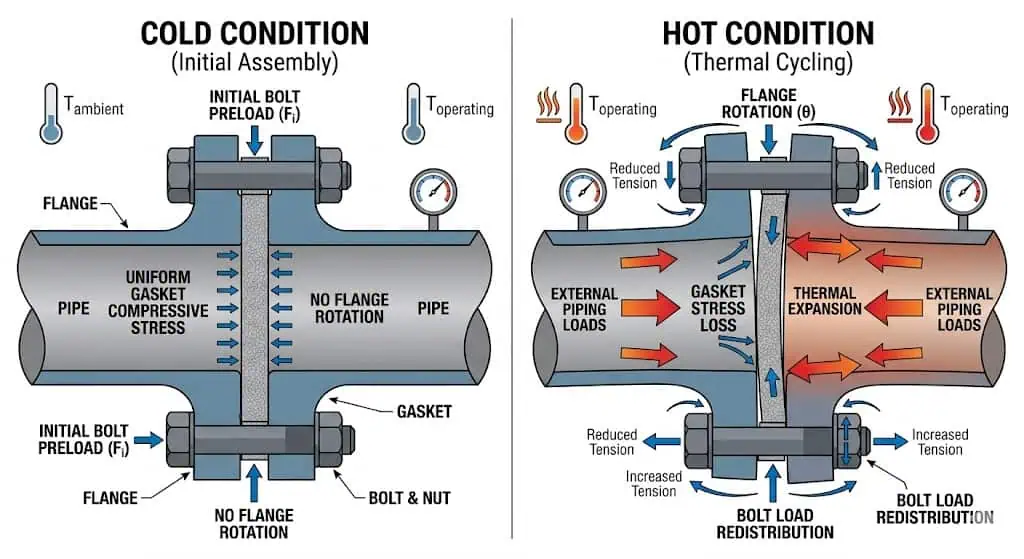
Thermal cycling effects on flanged joints are mainly seen as loss of gasket stress, redistribution of bolt load, flange rotation, and leakage that appears only after startup, shutdown, or repeated heat-up and cool-down. A flanged joint can look acceptable during cold assembly and still fail in service because the joint does not stay mechanically stable once temperature changes begin. As the joint heats and cools, bolts, flanges, gaskets, and connected piping do not respond in exactly the same way. That difference changes clamp load, gasket compression, alignment, and sealing reliability. In the field, the result is familiar: a flange that passed hydrotest leaks hot, a heat exchanger channel flange seeps after restart, or a joint that was retightened several times still does not stay sealed. The practical engineering question is not whether temperature matters. It is which part of the joint is losing control during thermal cycling, and what needs to be corrected before the next shutdown or restart.
If you are reviewing the joint as a whole rather than the flange alone, see our related pages on zero-leakage flange assembly, common flange leakage causes, and ASME B16.5 flange dimensions and ratings.
Thermal Cycling Effects on Flanged Joints at a Glance
| What Changes During Thermal Cycling | What Happens to the Joint | What Operators Usually See | What Is Often Misdiagnosed |
|---|---|---|---|
| Bolt load is redistributed during heating and cooling | Clamp load becomes uneven or drops below what the gasket needs | Leakage after startup or after several cycles | Assumed to be only a torque problem |
| Gasket creeps, relaxes, or loses recovery | Seating stress drops over time | Chronic weeping, especially after restart | Assumed to be “bad gasket quality” only |
| Flange rotates or loses parallelism | Compression becomes non-uniform across the gasket face | Leakage concentrated on one side | Assumed to be random installation error |
| External piping loads increase during thermal growth | Joint sees additional bending and separation forces | Nozzle-side leaks or repeated exchanger flange leaks | Assumed to be a flange-only issue |
| Repeated thermal duty accumulates damage | Joint becomes less tolerant to restart conditions | Leak-free cold start becomes shorter each cycle | Assumed to be solved by using stronger bolts alone |
What Thermal Cycling Does to a Flanged Joint in Real Service
Why a flange can pass cold assembly and still leak hot
A cold-tight joint is not automatically a thermally stable joint. During assembly, the gasket is compressed under the bolt load that exists at ambient conditions. Once the system heats up, that load can change because the bolts, flange hubs, gasket, and connected piping do not expand, relax, or deflect in the same way. If the load that remains on the gasket during operation is lower than the seal requires, leakage begins even though the original torque record looked acceptable.
A common field issue is a steam or hot oil flange that passes hydrotest and initial commissioning, then begins to seep after the first full heat cycle. In many of those cases, the real problem is not that the fitter failed to tighten the bolts. The real problem is that the joint was assembled as if it would behave the same way hot as it did cold.
How heating and cooling change gasket stress and bolt load
Thermal cycling changes the balance between bolt stretch and gasket compression. Bolts act like springs pulling the flanges together. If the joint is designed and assembled correctly, that spring effect helps maintain sealing load as temperature and pressure vary. If not, the available load margin is too small, and normal cycling consumes it quickly. A typical field pattern is a joint that survives one hot run but leaks earlier with each later startup because the remaining load reserve is being consumed cycle by cycle.
That is why a joint that experiences repeated startup and shutdown is often more difficult than one that simply runs at a high steady temperature. The cycling itself is the load disturbance.
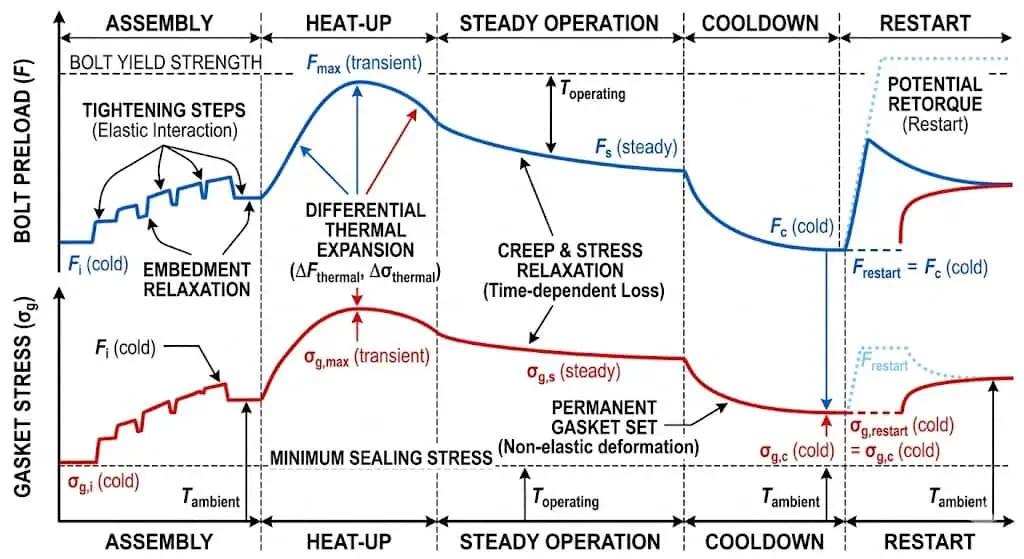
Field rule: If a flange leaks mainly after restart rather than during long steady operation, review thermal cycling behavior before blaming the gasket alone.
Why startup and shutdown are often more critical than steady operation
Many thermally cycled leaks are driven by transient conditions, not the final operating temperature. During heat-up and cooldown, different parts of the flange assembly can be at different temperatures at the same time. That creates temporary distortion, uneven bolt loading, and gasket stress gradients. Heat exchanger channel flanges, valve bonnets, and nozzle joints are especially sensitive to this because the metal mass is not heated or cooled uniformly. If the joint is restart-sensitive, do not review only the design temperature. Review the transition path into and out of that temperature.
Why Thermal Cycling Causes Flange Leakage
Bolt preload loss from relaxation and differential expansion
One of the most common thermal cycling effects on flanged joints is loss of usable bolt preload. Some of that loss comes from normal embedment and relaxation after assembly. Some comes from repeated temperature changes that alter how much of the original bolt stretch is still available to hold the gasket. When preload falls, the gasket is no longer compressed at the intended level, and the seal becomes more sensitive to pressure pulses, vibration, and flange movement.
This is why stronger bolts do not automatically solve thermal cycling leakage. If the joint geometry, gasket behavior, friction control, or external loads are wrong, changing only the bolt grade may not correct the root cause.
Gasket creep, stress loss, and reduced recovery
The gasket does not respond to thermal cycling as a perfectly elastic part. Depending on the material and service, the gasket may creep, relax, harden, oxidize, or lose recovery. Once that happens, the same flange compression no longer produces the same sealing behavior. This is especially important on joints that are opened and reassembled during shutdowns, because the maintenance team may assume the joint only needs a fresh gasket and the same old tightening approach.
For users comparing joint hardware and facing compatibility, our stainless steel flange range and flange surface finish guide are useful follow-up pages when seating stability and surface condition become part of the review.
Flange rotation and loss of parallelism
Even when the bolts and gasket are correctly specified, flange rotation can still destroy load uniformity. As the flange heats, cools, and reacts to internal pressure and external piping movement, the two faces may not stay parallel enough to maintain uniform gasket compression. One side of the gasket then carries more load, while the opposite side becomes under-compressed and starts to leak.
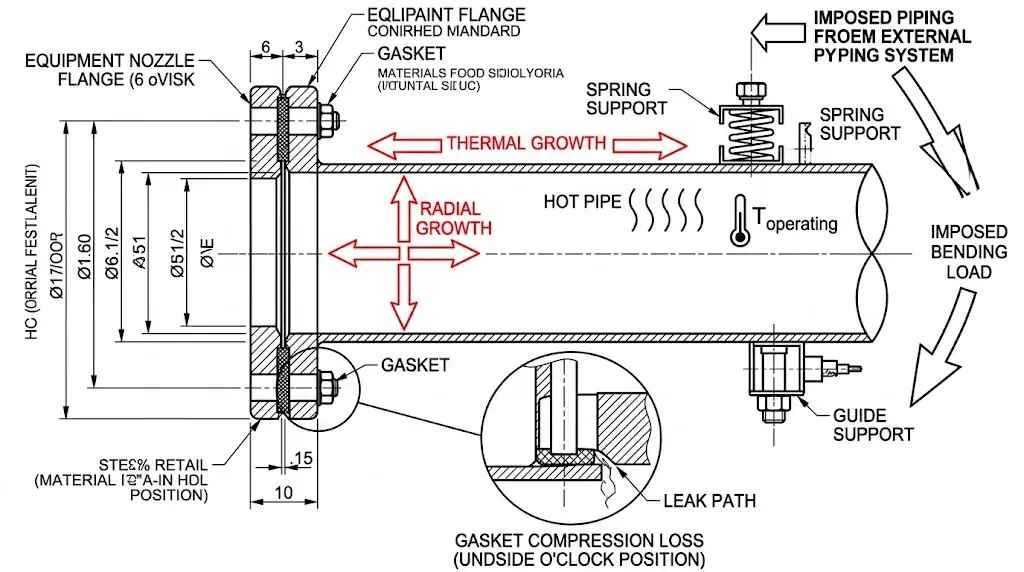
A typical clue is leakage that repeatedly appears in the same clock position on the flange. That pattern often points to joint distortion or external loading, not random installation error.
External piping loads from thermal growth and poor flexibility
Not every thermal cycling leak starts inside the flange. In many plants, thermal growth in the connected piping introduces bending, torsion, or misalignment loads that the flange was never meant to carry. The result is a flange that is technically assembled correctly but repeatedly loses sealing integrity once the system moves into its hot position.
This is one reason exchanger nozzle flanges and equipment tie-ins often behave worse than straight-line piping flanges. The joint is responding to system movement, not just internal pressure and temperature.
Which Flanged Joints Are Most Vulnerable to Thermal Cycling
| Joint Type or Service | Why It Is Vulnerable | Typical Symptom | What to Check First |
|---|---|---|---|
| Heat exchanger channel and nozzle flanges | Large thermal gradients, stiff components, restart sensitivity | Leakage after shutdown and restart | Flange rotation, bolt load uniformity, gasket type |
| Steam and condensate service | Frequent heat-up and cool-down, temperature swings, wet-dry transitions | Weeping after first hot run | Bolt preload retention, gasket recovery, assembly control |
| Hot oil and cyclic process lines | Repeated temperature excursions and long-term relaxation | Progressive leakage over time | Joint load margin and gasket stress retention |
| Equipment tie-ins with thermal growth | External piping loads shift during operation | Leak on one side or after alignment drift | Support condition and piping flexibility |
| Dissimilar-material joints | Different thermal expansion responses across components | Unstable sealing after several cycles | Material compatibility and joint stiffness balance |
If the recurring problem is on exchanger flanges or nozzle connections, our heat exchanger flange leakage guide is the most relevant next troubleshooting page.
How Materials and Joint Components Change the Outcome
Bolt and nut material effects under temperature cycling
The bolting system needs enough elasticity and stability to keep useful gasket load during thermal cycling. This is why bolting material should be reviewed together with nut grade, bolt length, thread condition, lubrication, and intended assembly method. ASTM A193 and ASTM A194 matter here because the joint is not just a flange problem. It is also a bolting system problem. If the stud is correct but the nut grade, thread condition, or friction state is uncontrolled, the actual load delivered to the gasket may still vary too much from bolt to bolt.
If the job requires review of stud format, nut pairing, or special fastener supply, see our industrial studs, hex nuts and heavy hex nuts, and ASME flange bolt length guide.
Gasket type sensitivity under repeated heating and cooling
Different gasket constructions do not tolerate thermal cycling in the same way. Some are more forgiving of minor flange separation and repeated load variation. Others are more sensitive to creep, recovery loss, or damage from uneven compression. A common field mistake is to replace a leaking gasket with the same type and assume the root cause has been removed. If the service is truly thermal-cycling duty, gasket resilience and load retention should be reviewed explicitly instead of being treated as routine stock selection.
When stronger bolting alone does not solve the problem
Higher-strength bolting does not fix a joint that is losing load because of distortion, piping strain, or poor assembly control. In one common maintenance scenario, the site upgrades the stud grade after a leak, but the joint still fails on the next restart because the actual issue was uneven gasket compression combined with external thermal movement. A bolt upgrade can be part of the solution, but it is rarely the whole solution.
Design Checks That Matter Before the Joint Is Built
Why flange standard alone is not enough
ASME B16.5 gives the dimensional and rating framework, but it does not by itself guarantee that a joint will remain tight under thermal cycling. Thermal-cycling performance depends on how flange geometry, gasket properties, bolt load, and external system behavior work together. Engineers often assume that because the flange class is correct, the joint is automatically robust enough for cyclic duty. That assumption causes trouble on services with frequent startup-shutdown patterns.
When to apply joint-integrity and load-control thinking
Thermal cycling should trigger a joint-integrity review, not just a component selection review. In practice, this means defining gasket type, target bolt load strategy, friction control, tightening sequence, and any restart inspection points before the job reaches site. If the joint is critical, these items should be written into the work package rather than left to fitter judgment at the flange stand. This is where ASME PCC-1 matters in practice: it supports repeatable assembly procedures for pressure-boundary bolted flange joints. For calculated leakage and load review on gasketed circular flange connections, EN 1591-1 is the calculation framework engineers commonly reference when thermal load stability and leak tightness must be reviewed together.
Why piping flexibility and external loads must be reviewed
If thermal movement in the system is pulling the flange out of alignment, no gasket change will permanently solve the leak. This is especially true on equipment nozzles, tie-ins, and short rigid runs where the flange is effectively acting as a movement absorber. Thermal-cycling leaks that repeatedly return at the same location should always trigger a piping-load review.
Installation and Shutdown Practices That Reduce Thermal-Cycling Leakage
| Stage | What to Control | Why It Matters | Common Site Error |
|---|---|---|---|
| Assembly | Lubrication, tightening sequence, multiple passes, flange parallelism | Creates uniform initial gasket stress | Assuming final torque number alone is enough |
| Initial hot run | Leak observation, position-specific seepage pattern, support movement | Shows how the joint behaves under real temperature | Checking only for gross leakage |
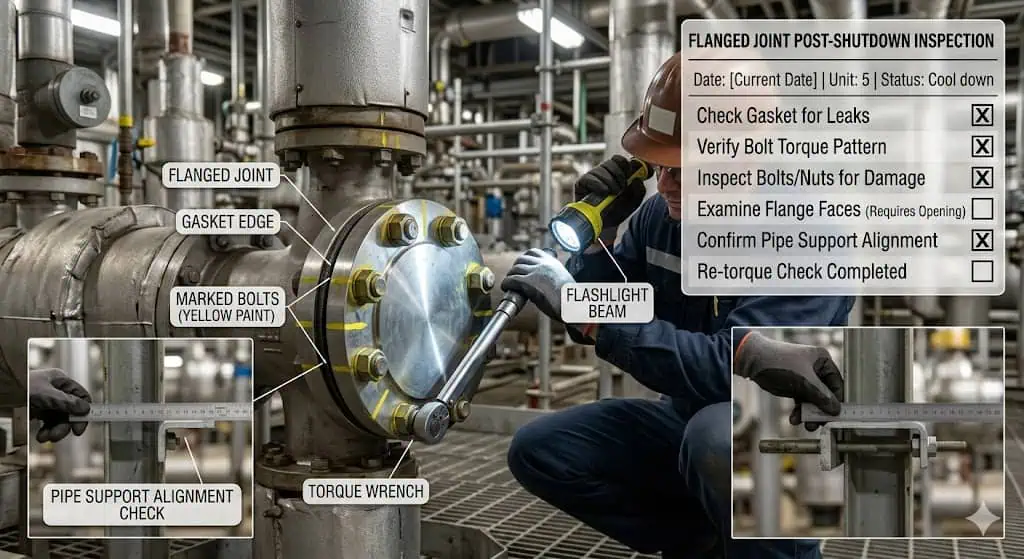
| Shutdown inspection | Bolt condition, corrosion, thread damage, gasket extrusion signs | Reveals what cycling is doing between runs | Replacing gasket without reviewing the joint condition |
| Restart preparation | Alignment, support condition, documented assembly repeatability | Prevents repeat failure on the next cycle | Treating every restart as a new isolated leak event |
For a more assembly-focused workflow, see our 4-step flange assembly guide and installation and maintenance support page.
Thermal Cycling Failure Modes and Corrective Actions
| Observed Failure | Likely Root Cause | Corrective Action | How to Prevent Recurrence |
|---|---|---|---|
| Leakage after first hot run | Loss of gasket stress during heat-up | Review gasket type, preload strategy, lubrication, and uniformity of assembly | Use a thermal-cycling review before release to site |
| Leakage after every restart | Joint distortion or cyclic relaxation not addressed | Review flange rotation, thermal gradients, and equipment-side stiffness | Classify the joint as restart-sensitive in maintenance planning |
| Leak concentrated on one side | External piping load or non-parallel flange faces | Check supports, thermal growth path, and local flange deformation | Include piping load review in the root-cause process |
| Repeated retorque with no lasting improvement | Underlying joint mechanics not corrected | Stop treating the issue as torque-only and review full joint system | Link design, assembly, and restart inspection records |
| Bolt damage or corrosion after cycling | Wrong bolting choice, poor shutdown exposure control, or assembly damage | Review material, nut pairing, and inspection findings before reuse | Define receiving, storage, and shutdown inspection requirements |
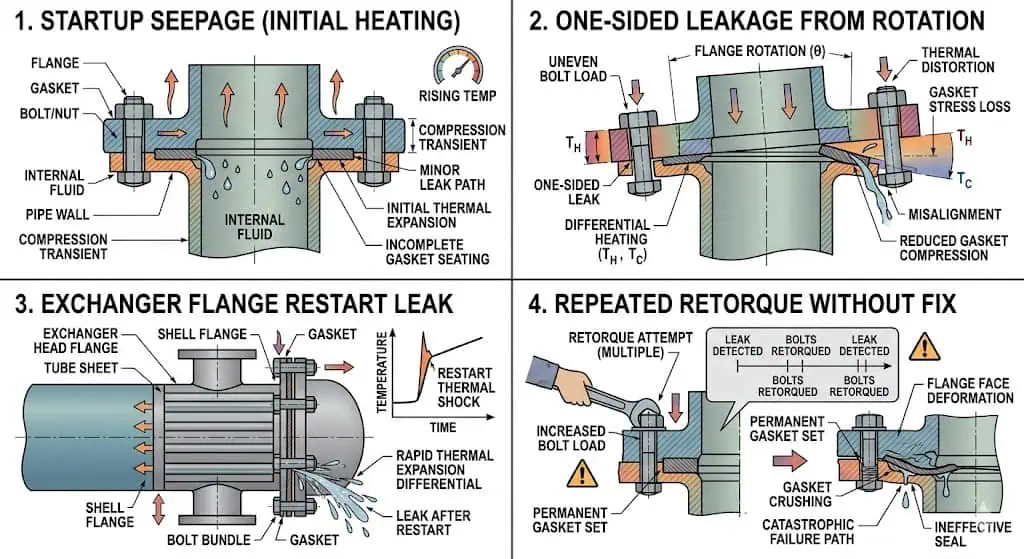
If the symptom has already become a flange leak rather than a design question, our flange gasket leakage troubleshooting page is a useful next step for field diagnosis.
Composite Field Scenarios for Engineering Training
Scenario 1: Steam flange leaks only after heat-up
What happened: A steam line flange passed hydrotest and cold commissioning, but began weeping after the first full hot run.
Why it happened: The joint was assembled correctly for cold conditions, but the remaining gasket stress during hot operation was lower than expected.
The real system cause: The team treated the connection like a static flange, not a thermally cycled flange joint.
How it was corrected: The bolting method, lubricant condition, and gasket choice were reviewed as a system rather than retorquing blindly.
How to prevent recurrence: Flag startup-sensitive joints in the work pack and review them after first heat exposure.
Scenario 2: Heat exchanger channel flange leaks after every outage
What happened: A channel flange on a heat exchanger stayed tight during long operation but leaked after shutdown and restart.
Why it happened: The flange saw repeated thermal gradients and transient distortion during restart.
The real system cause: The leak was driven by thermal-cycling mechanics, not just by gasket replacement quality.
How it was corrected: The joint was reviewed for flange rotation sensitivity, gasket suitability, and assembly load consistency.
How to prevent recurrence: Treat frequent restart duty as a design and maintenance condition, not as a routine reassembly job.
Scenario 3: Pipe thermal growth overloads an equipment flange
What happened: A nozzle flange on a hot process line repeatedly leaked on the same side after startup.
Why it happened: Thermal expansion in the connected pipe introduced a bending load into the flange.
The real system cause: The flange was reacting to system movement, not simply to internal pressure and temperature.
How it was corrected: Supports and alignment were reviewed, and the external load path was corrected.
How to prevent recurrence: Include piping flexibility and thermal movement checks in repeated flange leak investigations.
Scenario 4: Stronger bolts did not stop the leak
What happened: The site upgraded the bolting after repeated leakage, but the joint still failed during the next thermal cycle.
Why it happened: The upgrade addressed strength, but not the actual load loss mechanism.
The real system cause: The joint was losing sealing integrity through distortion, uneven compression, and cyclic movement.
How it was corrected: The team reviewed the joint as a combined flange-gasket-bolting-assembly problem.
How to prevent recurrence: Do not approve a bolt-only modification without reviewing the gasket and external load condition.
FAQ
Why do flanged joints leak after thermal cycling?
Because thermal cycling changes the load balance inside the joint. Bolt preload can redistribute or drop, gasket stress can decrease, flange faces can rotate, and connected piping can add external load during heat-up and cooldown. The leak is usually the result of load instability, not temperature alone.
Can retorque alone solve thermal cycling leakage?
Not reliably. Retorque may help in some cases, but if the real problem is gasket stress loss, flange distortion, or external piping load, the leak often returns on the next cycle. Retorque should follow diagnosis, not replace it.
Which gasket types handle thermal cycling better?
The better choice depends on flange design, available bolt load, service medium, and how much joint movement is expected. In general, thermal-cycling service requires a gasket with enough resilience and recovery to tolerate repeated load variation, not just a gasket that seals well in a single cold assembly.
When should external piping loads be suspected?
Suspect external loads when leakage repeatedly appears at the same position, especially on equipment nozzles, exchanger flanges, or short rigid runs. If the leak pattern changes with system movement rather than with gasket replacement, the joint may be reacting to thermal growth outside the flange.
What should maintenance inspect before restart?
Review bolt condition, thread damage, signs of corrosion, flange alignment, support condition, and any evidence of gasket extrusion or uneven compression. Restart-sensitive joints should not be treated as routine reassembly points.