







For personal care and cosmetic production lines, 316L stainless steel is often preferred in product-contact areas that face frequent cleaning, longer wet exposure, higher hygiene consequences, or a greater risk of localized corrosion. That does not mean every component in every line must be upgraded automatically. In real plant decisions, engineers compare 316L vs 304 stainless steel based on product chemistry, cleaning regime, drainability, weld quality, surface finish, and long-term maintenance risk.
Direct answer: If a line handles lotions, shampoos, creams, gels, serums, liquid soaps, or other personal care products and sees frequent CIP or COP cleaning, rinse holds, wet shutdowns, or repeated product changeovers, 316L is commonly reviewed first for product-contact piping, tanks, valve clusters, manifolds, pump spools, and filling feeds. Where exposure is milder and hygiene risk is lower, 304 may still be acceptable after engineering review.
That is why the practical question is not simply “Is 316L better than 304?” The better question is “Where does 316L create real lifecycle value in this personal care production line?” That approach leads to better specifications than either blanket upgrading or cost-driven downgrading.
Expert Insight:
In hygienic process systems, material failures are rarely caused by alloy grade alone. Line performance usually depends on the combined effect of product chemistry, cleaning regime, weld quality, surface finish, drainability, gasket selection, and how the system is actually shut down, rinsed, and returned to service between changeovers.
Where 316L Fits in Personal Care and Cosmetic Production Lines
Typical Product-Contact Areas Where 316L Is Commonly Considered
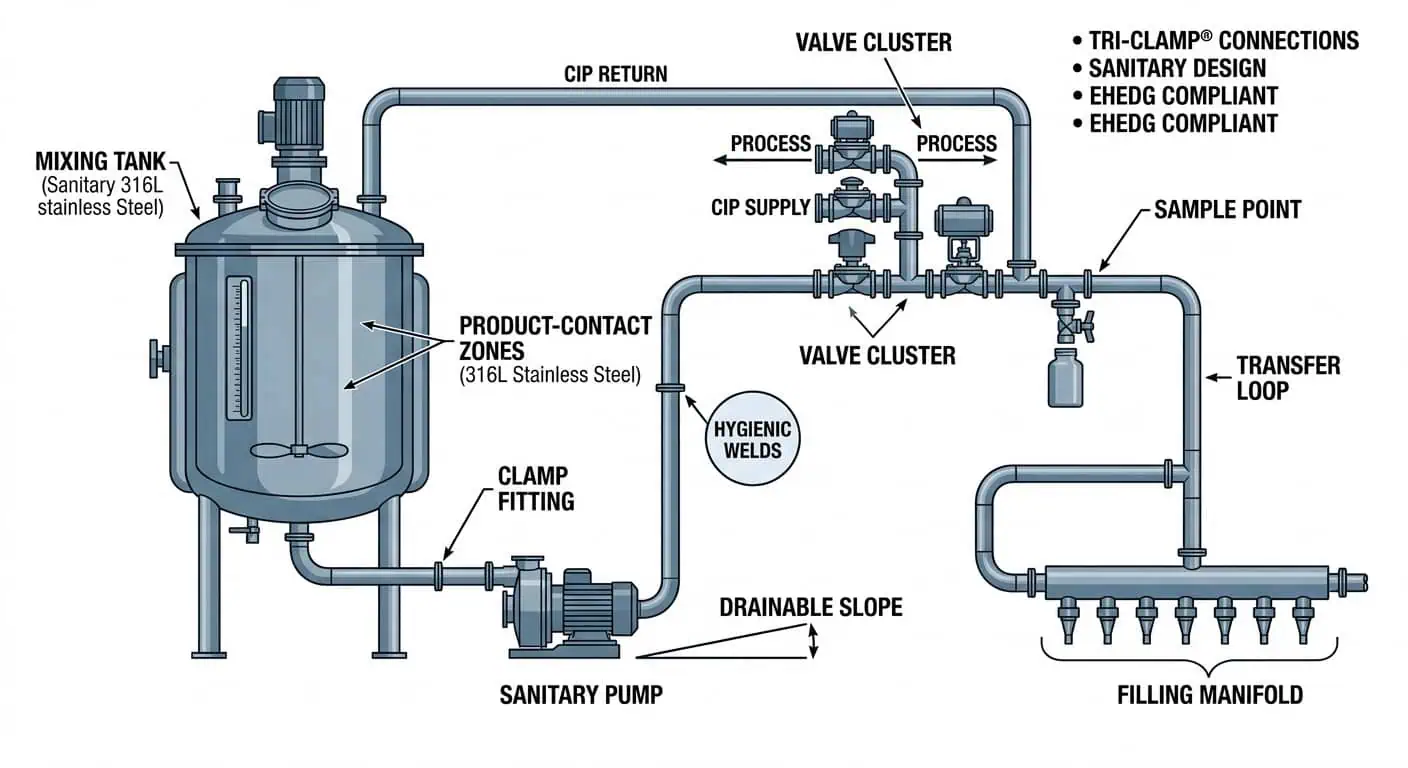
316L stainless steel is most often evaluated for product-contact zones where hygienic performance and corrosion margin matter over time. In personal care production lines, these areas commonly include mixing vessel outlets, recirculation loops, transfer manifolds, pump suction and discharge spools, filling-machine feed lines, CIP return sections, valve clusters, sample points, and other assemblies that experience repeated wet service and regular chemical cleaning.
- Mixing and transfer loops: often exposed to viscous products, repeated rinse cycles, and frequent formula changes.
- Filling and dosing manifolds: usually sensitive to hold-up, surface-condition stability, and restart hygiene risk.
- Valve clusters and sampling points: locations where geometry and cleanability are often just as important as material grade.
- Tank outlet spools and dead-leg-prone zones: areas where engineers review material choice together with hygienic layout and drainback behavior.
Not Every Section of the Line Needs the Same Material Strategy
Not all personal care production lines require a full 316L specification from end to end. Engineers usually separate product-contact zones, non-product-contact supports, utility connections, flush-only sections, and lower-risk service areas. The right question is not “Should the whole line be 316L?” but “Which sections justify the added material margin based on exposure, cleanability, changeover frequency, and lifecycle requirements?”
| Process Area | Main Risk / Exposure | Why 316L May Be Preferred | When 304 May Still Be Evaluated |
|---|---|---|---|
| Mixing tank outlet and recirculation loop | Frequent wet service, cleaning chemicals, product residue, restart exposure | Better corrosion margin and stronger long-term stability in hygienic duty | Where formulation, cleaning load, and exposure are mild and fully reviewed |
| Filling feed manifold | High cleanability requirement, short changeover expectations, low tolerance for hold-up | Helps support easier surface recovery and reduced hygiene risk | Only in lower-risk product families with well-controlled cleaning practice |
| CIP-related product-contact piping | Repeated alkaline / acid cleaning and wet-dry cycling | Often selected to reduce corrosion-related maintenance concerns | Project-dependent and should not be assumed without review |
| Non-product-contact utility section | Lower hygiene consequence | Usually not the first area driving 316L justification | 304 or other options may be acceptable depending on service |
For broader layout and drainability decisions, material selection should be reviewed together with sanitary piping design for cosmetic manufacturing, because poor geometry can undermine the value of a higher-grade material long before the alloy itself becomes the real limit.
Tip:
When a buyer sees “316L” on a sanitary line drawing, that should not end the review. Material grade should be checked together with surface finish, weld treatment, cleanability, and whether branch length, drain slope, and gasket details are suitable for the actual product family.
316L vs 304 Stainless Steel for Personal Care Production Lines
Why Engineers Commonly Choose 316L Over 304
In personal care and cosmetic production lines, the 316L vs 304 decision usually comes down to corrosion margin, welded-zone stability, cleanability, and long-term operating confidence. Engineers do not normally choose 316L because it sounds more premium. They choose it because some product-contact systems are more vulnerable to localized pitting, crevice attack, repeated wet shutdowns, and chemical cleaning exposure than buyers expect during the initial RFQ stage.
What Engineers Mean by “Better Corrosion Resistance” in Real Plant Conditions
In hygienic personal care systems, “better corrosion resistance” is not just a catalog phrase. It usually means a more stable material response under repeated exposure to product moisture, rinse water, cleaning chemicals, retained residue, and welded-zone stress in a hygienic environment. This matters most in systems that run frequent changeovers or process formulations containing salts, surfactants, actives, preservatives, fragrances, or other ingredients that raise the practical corrosion burden in local pockets rather than across the entire line.
Why the Low-Carbon “L” Grade Matters in Welded Hygienic Fabrication
Low-carbon 316L is often preferred because hygienic systems rely heavily on welded fabrication and post-weld surface quality. In practice, engineers are not just choosing between two chemistry labels. They are trying to reduce the chance that welded product-contact areas become the weak point of the system over time, especially after repeated cleaning and shutdown cycles. That is why orbital weld quality, heat tint control, and post-fabrication surface restoration should be reviewed alongside the alloy callout rather than after procurement.
Why 316L Is Often a Risk-Reduction Choice Rather Than a Universal Requirement
Many plants specify 316L because it can reduce future operating risk—not because every process absolutely demands it. Where cleaning frequency is high, line downtime is expensive, and hygiene nonconformance has real production consequences, the additional material margin may justify itself through lower maintenance sensitivity and more stable long-term service. In contrast, where exposure is mild and product chemistry is less demanding, a blanket 316L upgrade may not deliver the same payoff.
| Evaluation Factor | 304 Stainless Steel | 316L Stainless Steel | What This Means in Real Projects |
|---|---|---|---|
| General hygienic service suitability | Can be acceptable in milder duty | Often preferred for more demanding product-contact duty | Choice should follow exposure and cleaning burden, not habit alone |
| Corrosion margin in localized wet / chemical exposure | Lower margin in more challenging conditions | Typically stronger margin for aggressive hygienic service | Useful when the plant wants fewer surprises during long-term use |
| Welded sanitary fabrication | Usable, but application-dependent | Commonly preferred in welded hygienic assemblies | Especially relevant around product-contact welds and polished zones |
| Lifecycle stability | May be adequate for lower-risk systems | Often selected for stronger long-term confidence | Important where changeovers, cleaning, and uptime targets are strict |
Expert Insight:
The better engineering question is usually not “Which grade is better in general?” but “Where does the added margin of 316L actually pay back in this line?” That usually leads to a better specification than treating the whole system as one undifferentiated risk zone.
What Actually Challenges 316L in Personal Care Manufacturing
Chlorides Are Not the Only Issue Engineers Should Watch
Even when 316L is selected, that does not eliminate hygienic risk by itself. Surface condition, geometry, cleaning effectiveness, and retained moisture can still create problem areas. In personal care manufacturing, local exposure often matters more than the nominal material specification on the drawing. The most persistent corrosion and hygiene findings usually start where liquids linger, solids dry on a surface, or cleaning chemistry is trapped longer than intended.
- Retained cleaning solution: may increase local exposure at poorly drained points.
- Viscous product residue: can extend contact time and complicate surface recovery.
- Crevices and shadow zones: often create more risk than buyers initially expect.
- Weld and finish inconsistency: can reduce the benefit of specifying a higher alloy.
- Wet shutdown periods: may increase localized risk between production campaigns.
Geometry and Surface Condition Often Matter More Than Buyers Expect
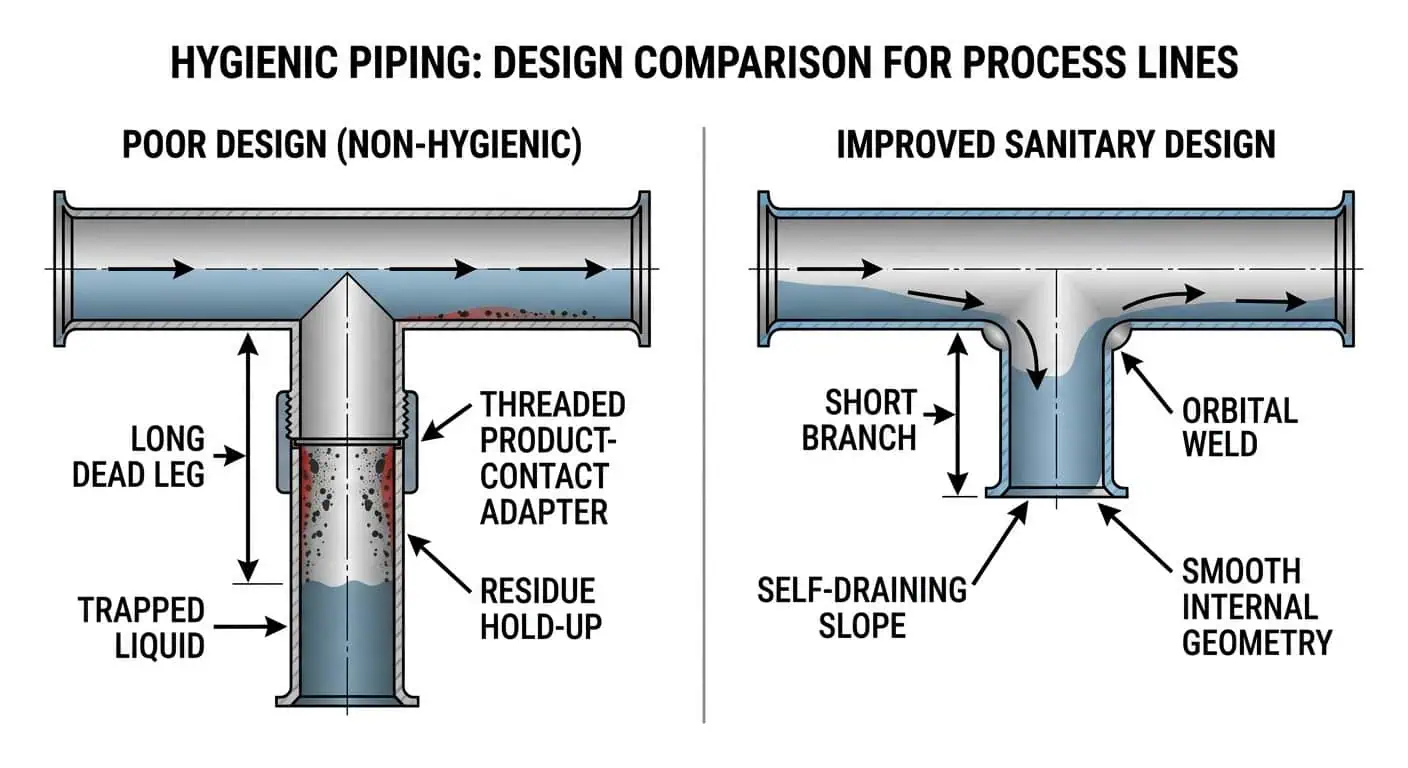
In many hygienic failures, the root cause is not that the selected steel grade was “wrong,” but that the system created local conditions the material then had to tolerate. Long dead legs, low-flow branches, improper drain slopes, unfinished weld areas, rough manual repairs, threaded product-contact adapters, and hard-to-clean connection details can all turn a sound specification into a maintenance problem.
ASME BPE treats a dead leg as an area of entrapment and evaluates it by L/D geometry, which is exactly why branch length and take-off details should not be dismissed as drafting details on hygienic lines. That geometric logic matters in personal care service just as much as it does in bioprocess piping whenever residue, slow rinsing, or validation sensitivity is high.
This is also why engineers should review material selection together with sanitary vs industrial pipe fittings. A line may carry the correct alloy grade yet still underperform if the fittings and connection geometry are not suitable for hygienic cleaning and drainage.
Practical Industry Cases
Lotion Transfer Loop: Surface Issues Appeared Earlier Than Expected
A lotion transfer loop in a multi-product personal care facility was built around a 316L product-contact specification. However, the line still developed hygiene-related maintenance concerns earlier than expected during high-frequency changeover operation. The investigation did not point to the alloy grade alone. Instead, the main contributors were incomplete drainback at a branch section, difficult-to-clean local geometry, and inconsistent post-fabrication surface quality. After the branch was redesigned, the dead-leg ratio was reduced, and the finishing requirement was tightened for the rewelded spool, line recovery improved and cleaning consistency became easier to maintain.
A second field example involved a shampoo recirculation skid where operators saw repeated discoloration near a valve cluster after caustic cleaning and rinse holds. The root cause was not bulk material substitution; it was a rough manual reweld and a local crevice at the gasket land. Replacing the affected spool with a properly finished 316L hygienic assembly and correcting gasket compression ended the recurring issue.
A third example came from a cream filling line that had one nonstandard sample connection added late in the project using a threaded adapter on the product side. The line initially passed production startup, but the adapter area became the first repeat sanitation concern because residue hold-up and poor drainability outweighed the nominal material grade. The corrective action was to remove the threaded product-contact detail and replace it with a sanitary diaphragm-style take-off that matched the surrounding hygienic design standard.
Expert Insight:
This kind of case is common in hygienic engineering: the material may be appropriate, but the system still underperforms because geometry, weld execution, or connection details were not controlled to the same standard as the material specification.
How Surface Finish, Welding, and Passivation Affect 316L Performance
Surface Finish Is a Cleanability Topic, Not Just a Visual Detail
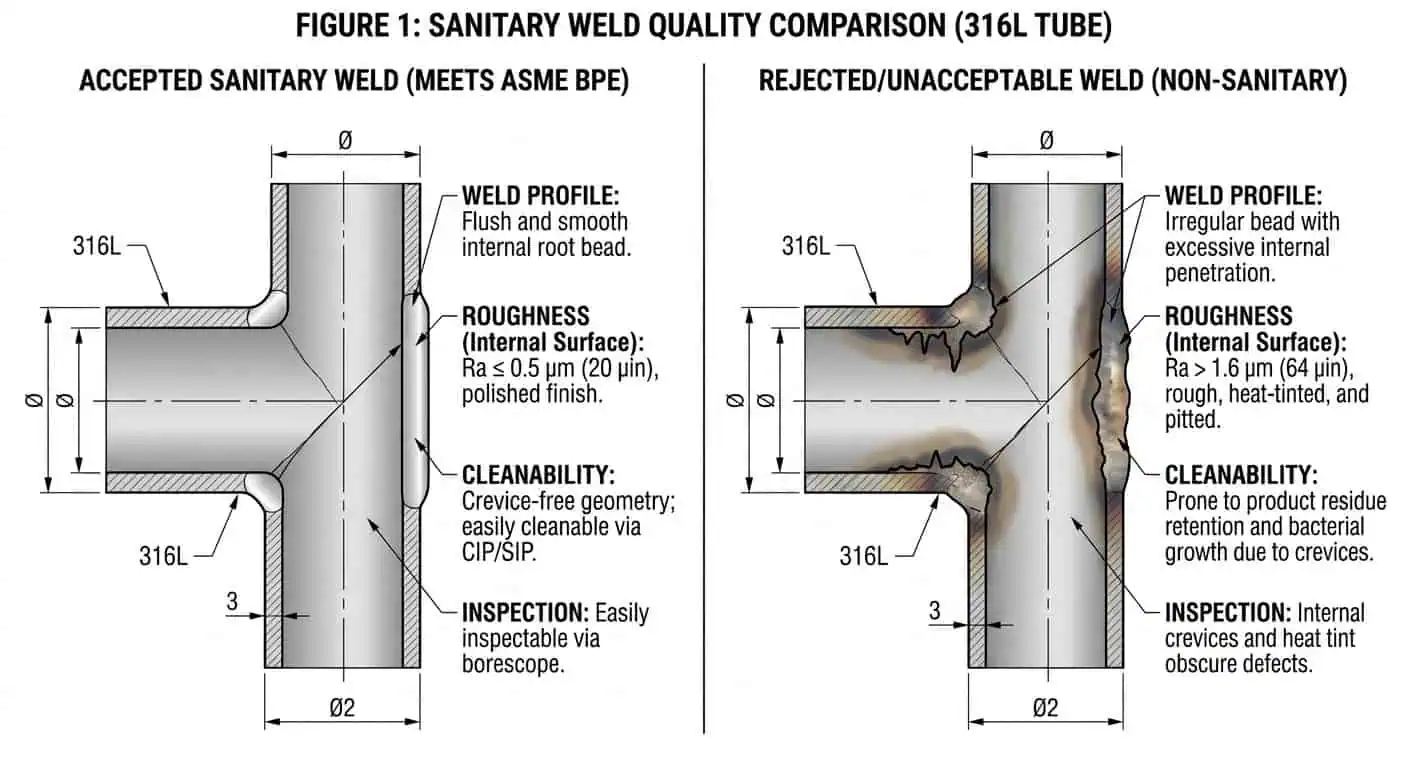
For hygienic systems, surface finish affects cleanability, residue release, changeover recovery, and long-term maintenance behavior. Buyers sometimes treat surface finish as a cosmetic item, but engineers see it as part of the process-performance specification. In 3-A sanitary guidance, product-contact finishes are generally expected to be equivalent to or smoother than 32 µin. Ra / 0.8 µm Ra, but in actual plant work the finish target still needs to reflect product rheology, cleaning method, and inspection expectations.
Why Weld Execution Matters in Product-Contact Assemblies
Weld quality is often one of the most important practical factors in a 316L sanitary system. Poorly controlled welds can create discoloration, local roughness, undercut, non-uniform internal geometry, or areas that are harder to clean and harder to inspect. In product-contact service, this becomes a real operating issue rather than a cosmetic one.
- Internal weld profile should support smooth product flow and cleanability.
- Heat tint and post-weld condition should not be ignored on hygienic product-contact surfaces.
- Fabrication controls should match the hygiene expectation of the line, not only the material callout.
- Field rewelds should be reviewed with the same discipline as shop welds if they remain on the product side.
Passivation Should Be Treated as a Controlled Finishing Step
Passivation is most useful when treated as part of a defined fabrication and finishing process. It should not be reduced to a marketing phrase. ASTM A967 covers several chemical passivation treatments for stainless steel parts, while ASTM A380 addresses cleaning, descaling, and passivation of new stainless steel parts, assemblies, equipment, and installed systems. In personal care lines, passivation only delivers reliable value when the preceding fabrication, precleaning, and surface-preparation steps are already controlled.
ASTM A380 also makes an important design point that is often missed during procurement: stainless systems should be designed to minimize areas where dirt or cleaning solutions can become trapped and to allow effective circulation and removal of cleaning solutions. That principle directly supports hygienic drainability reviews in cosmetic and personal care piping.
For cleaning-cycle planning and cleaning-related risk, this topic should also be reviewed together with cleaning considerations in hygienic process systems, because even a well-selected 316L line can still underperform if cleaning coverage, chemical selection, rinse verification, or cycle design is not appropriate.
| Fabrication / Finish Factor | Why It Matters in Hygienic Service | Practical Buyer Concern |
|---|---|---|
| Internal surface finish | Affects residue release and cleaning efficiency | Should be defined, not assumed |
| Weld execution quality | Influences cleanability and local corrosion sensitivity | Critical in product-contact sections |
| Post-weld treatment | Helps stabilize the product-contact surface condition | Needs clear fabrication scope |
| Passivation control | Supports final surface condition when process is managed correctly | Should be specified as part of finishing, not vague sales language |
Tip:
If a supplier only confirms “material = 316L” but cannot explain the product-contact finish, weld quality expectations, field-repair handling, and post-fabrication treatment, the review is not complete yet.
When 316L Makes Sense and When 304 May Still Be Enough
Good Candidates for 316L in Personal Care and Cosmetic Lines
316L usually makes the most sense where hygiene sensitivity, cleaning frequency, and lifecycle expectations are all high. This is often true for premium personal care products, frequent multi-SKU changeover lines, product-contact loops that remain wet for long periods, and systems where unplanned maintenance or contamination risk is operationally expensive. It is also a rational choice where the plant has limited tolerance for rework after startup, since local corrosion findings on sanitary product-contact piping are always more disruptive to correct once the system is qualified and running.
Situations Where 304 May Still Be Evaluated
304 may still be suitable in selected lower-risk service conditions, but only when the exposure and cleanability profile have been reviewed carefully. It is not good engineering practice to downgrade simply for initial cost if the line faces repeated cleaning, moisture retention, or demanding product chemistry. In actual project reviews, 304 tends to remain more defensible in milder exposure service, lower-consequence sections, or where the real risk drivers have been engineered out of the layout rather than left for the material to absorb.
| Condition | Does It Support 316L Justification? | Engineering Reason |
|---|---|---|
| Frequent changeovers with aggressive cleaning schedule | Yes, often strongly | Higher cleaning load increases the value of added material margin |
| Product-contact sections with hard-to-clean geometry | Yes, but design still must be corrected | 316L helps, but cannot compensate for poor hygienic design alone |
| Mild exposure, lower cleaning burden, simpler product family | Possibly not always | 304 may be reviewed where risk profile is clearly lower |
| Non-product-contact or lower-consequence area | Often weaker driver | Other materials may be acceptable depending on service |
Expert Insight:
Over-specifying material can hide a more important problem. If the line has poor drainability, unnecessary dead legs, uncontrolled rewelds, or weak gasket discipline, upgrading to 316L alone will not create a hygienic system.
What Buyers and Engineers Should Specify When Ordering 316L Sanitary Components
Material Grade Alone Is Not a Complete Specification
Writing “316L sanitary fittings” on an RFQ is not enough to control hygienic performance. Buyers should define what parts are product-contact, what finish level is expected, how welded assemblies should be delivered, what documentation is required for verification, and what gasket or seal materials are approved for the actual product and cleaning regime. Some of the most avoidable field problems come from incomplete purchasing language rather than from obviously wrong material selection.
Key RFQ and Technical Review Points
| RFQ / Review Item | Why It Should Be Defined |
|---|---|
| Product-contact material scope | Clarifies which wetted parts must meet the 316L requirement |
| Surface finish expectation | Supports hygienic cleanability and changeover consistency |
| Welded assembly requirements | Reduces uncertainty in product-contact fabrication quality |
| Post-fabrication treatment | Defines whether passivation or other finishing steps are expected |
| Traceability and certificates | Helps buyers verify that delivered material matches the approved specification |
| Seal / gasket compatibility | Material choice alone does not ensure hygienic joint performance |
| Drainability and geometry review | Prevents material upgrades from being wasted by poor hygienic layout |
Questions Procurement Teams Should Ask Before Approval
- What cleaning regime will this section actually see in daily operation, including hold times and shutdown conditions?
- Is this a true product-contact zone or only adjacent to the process?
- Are finish and weld expectations defined clearly enough for a hygienic supplier?
- Could poor geometry create more risk than the alloy grade itself?
- What evidence shows that the supplied components match the approved material and finish scope?
- Are gasket compounds, lubricants, and any elastomer backup elements compatible with both product and cleaning chemicals?
One common purchasing mistake is to specify 316L tube and fittings correctly while leaving gasket material, clamp hardware finish, repair-weld handling, or inspection acceptance too vague. In field commissioning, those omissions can create more corrective work than the metal grade itself.
Practical Buyer Note:
A strong hygienic RFQ does not just specify the steel grade. It defines the delivered condition that the plant needs for cleaning, operation, inspection, and long-term maintenance.
A Practical Evaluation Framework for 316L in Personal Care Plants
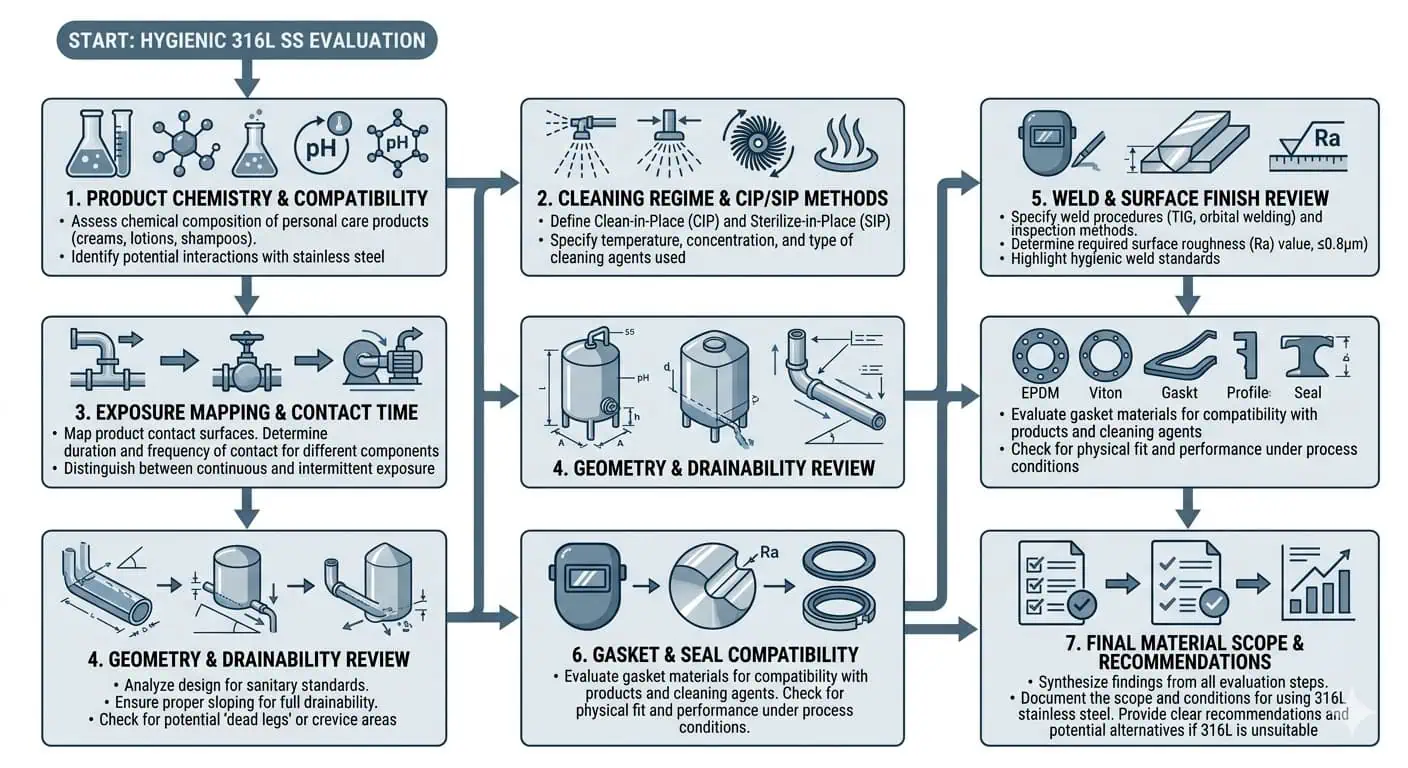
A Step-by-Step Review Sequence Engineers Can Actually Use
- Define the product family and real exposure: review viscosity, retained residue, moisture, cleaning chemistry, and shutdown behavior.
- Separate high-risk product-contact zones from lower-risk sections: not all line segments need the same material logic.
- Review geometry and drainability: check whether the system creates local stagnation, shadow zones, or slow-rinsing points.
- Check fabrication quality expectations: especially surface finish, weld execution, and delivered product-contact condition.
- Decide where 316L adds real lifecycle value: use it where it reduces maintenance sensitivity, hygiene risk, or operating uncertainty.
| Evaluation Step | Main Question | Typical Output |
|---|---|---|
| Exposure review | What chemical, moisture, and cleaning conditions will the line actually see? | Risk map for material selection |
| System zoning | Which parts are truly high-consequence product-contact areas? | Prioritized material scope |
| Geometry review | Can the line drain, rinse, and clean properly? | Design corrections before over-specifying alloy |
| Fabrication review | Will finish and weld quality match hygienic expectations? | Supplier / QA requirement list |
| Final material decision | Where does 316L create real lifecycle payoff? | Balanced specification instead of blanket upgrading |
This sequence also works well during retrofit audits. In most retrofit reviews, engineers find that a large share of future hygiene risk sits in geometry, field modifications, seal choice, or undocumented finishing rather than in the base alloy callout alone. That is exactly why material review should be part of a broader hygienic design review instead of a stand-alone purchasing exercise.
Frequently Asked Questions About 316L in Personal Care Production
Is 316L always required for cosmetic or personal care production lines?
No. 316L is often preferred for higher-risk hygienic product-contact service, but it should not be treated as a universal requirement for every section of every line. Final selection depends on product chemistry, cleaning duty, geometry, finish quality, and lifecycle expectations.
When is 304 still considered acceptable?
304 may still be reviewed for lower-risk service conditions where product exposure is milder, cleaning burden is lower, and the line design is well controlled. The decision should be based on engineering review, not a simple cost downgrade or a habit copied from a different process line.
Does 316L solve all corrosion and hygienic risks by itself?
No. Poor drainability, bad weld finish, crevice-prone geometry, seal incompatibility, and weak cleaning performance can still create operating problems even when 316L is specified correctly.
Is surface finish really as important as material grade?
In many hygienic systems, yes. Surface finish directly affects cleanability, residue release, inspection quality, and how consistently the line returns to a clean operating state after product changeover and cleaning.
What should buyers request besides 316L on the purchase order?
Buyers should request a complete delivered-condition definition, including product-contact scope, finish expectation, fabrication quality, post-treatment requirements, seal compatibility, and the documentation needed to verify what is actually supplied.
What is the real difference between 316L and 304 in personal care production lines?
The real difference is risk margin in hygienic product-contact service. 316L is often chosen where repeated cleaning, wetter service, stronger chemical exposure, or higher hygiene consequences make localized corrosion and long-term maintenance more sensitive. 304 may still work in lower-risk sections, but 316L usually offers more operating margin where the process is harder on the system.
Final Engineering Takeaway
In personal care and cosmetic production lines, 316L stainless steel is best understood as a hygienic risk-control choice—not as an automatic upgrade for every component. It usually creates the most value where product-contact service, cleaning intensity, and long-term maintenance sensitivity are high. But the final result still depends on whether the system is designed, fabricated, cleaned, and repaired to the same hygienic standard.
Expert Insight:
A well-designed hygienic system with clear drainability, controlled weld quality, realistic cleaning validation, and well-specified seals usually performs better than a poorly designed line that simply upgrades the alloy callout. Material selection should support hygienic engineering—not replace it.
If your team is reviewing whether 316L stainless steel for personal care production lines is justified in a lotion, shampoo, cream, gel, serum, or multi-product cosmetic line, the most effective next step is to assess the actual product-contact zones, cleaning regime, weld quality expectations, gasket compatibility, and system geometry together.
Related Reading
- Sanitary Piping Design for Cosmetic Manufacturing
- Sanitary vs Industrial Pipe Fittings
- Cleaning Considerations in Hygienic Process Systems
- Stainless Steel Materials Guide
- ASME BPE Bioprocessing Equipment
- 3-A Primer for Sanitary Standards and Practices
- ASTM A380 Cleaning, Descaling, Pickling, and Passivation Guidance
- ASTM A967 Chemical Passivation Treatments for Stainless Steel