








What Are Hex Nuts and How Do They Work?
A hex nut is a six-sided internally threaded fastener used with a bolt, screw, or stud to create clamp load in a bolted joint. For B2B purchasing, the correct hex nut is selected by thread standard, pitch, property class, material, coating, corrosion environment, preload requirement, and bolt compatibility.
Hex nuts look simple on a drawing, but they are not simple in service. In a bolted joint, the nut does not “hold” the assembly by itself. It works with the bolt to stretch the bolt slightly and generate preload. That preload clamps the parts together. If the nut grade, thread pitch, bearing surface, coating, or lubrication condition is wrong, the joint may loosen, strip, seize, crack, or fail under vibration.
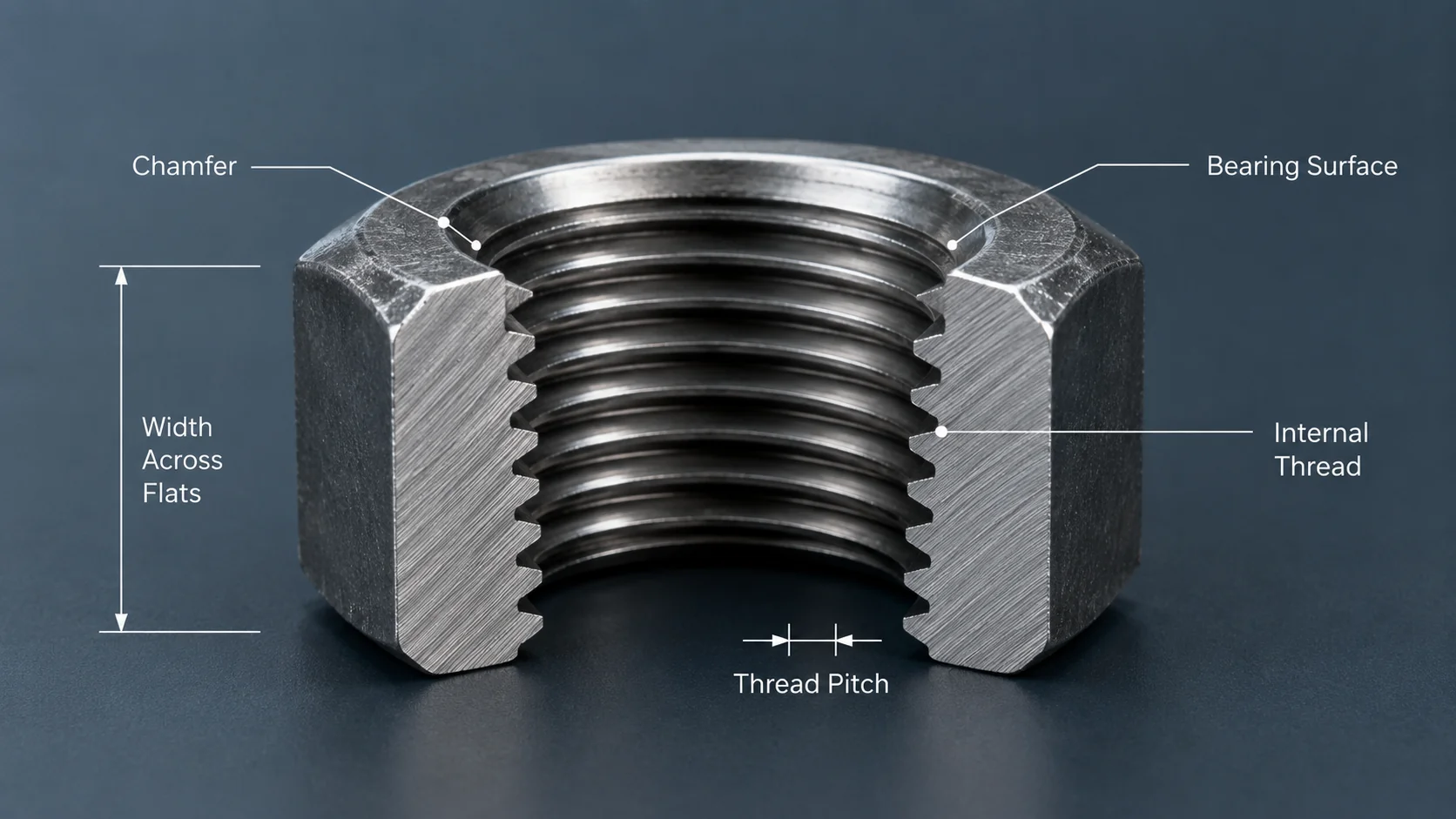
A standard hex nut includes:
- Internal thread for engagement with a bolt or stud
- Six wrenching flats for spanner, socket, or torque tool installation
- Chamfer to help start assembly and reduce edge damage
- Bearing surface that contacts the washer or connected part
- Thread pitch that must match the mating bolt
- Nut height that affects thread engagement, proof load, and stripping resistance
In the shop, the first sign of a bad nut is often not visual. It shows up when the torque wrench keeps turning but clamp load does not build, when a stainless nut locks halfway down the bolt, or when a galvanized nut refuses to pass a go/no-go thread gauge after coating.
For engineers and purchasing teams, the key question is not “what is a hex nut?” The real question is: which hex nut will safely match the bolt, load, environment, coating, installation method, and inspection requirement of this project?
Hex Nut Standards: ISO, DIN, ASME, ASTM, JIS and GB
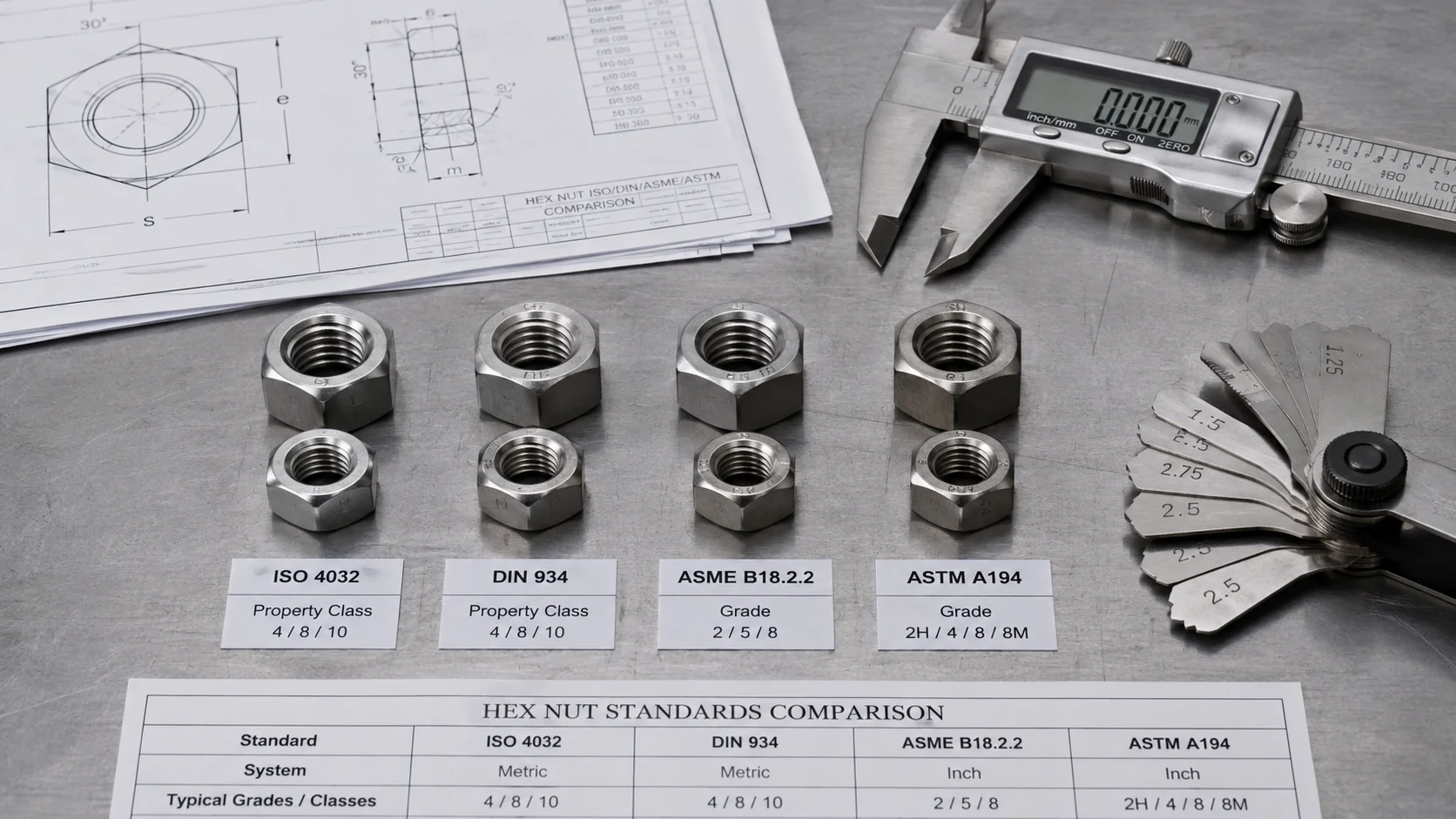
Hex nut standards control dimensions, thread fit, tolerances, product grades, markings, and in some cases mechanical requirements. The standard you choose depends on the drawing, market, application, mating bolt system, and inspection document required by the buyer.
For RFQ accuracy, do not write only “M12 hex nut” or “1/2 inch nut.” A production-ready specification should include standard + size + pitch + grade + material + coating + inspection requirement.
ISO 4032 Hexagon Regular Nuts
ISO 4032 is one of the most common standards for metric hexagon regular nuts. ISO 4032:2023 specifies hexagon regular nuts, style 1, in steel and stainless steel, with metric coarse pitch thread from M5 to M39, and product grades A and B.
Use ISO 4032 when the project requires metric hex nuts for machinery, industrial equipment, general assemblies, or export markets where ISO standards are preferred. If the project also needs mechanical property classes, check ISO 898-2 for steel nuts and ISO 3506-2 for corrosion-resistant stainless steel nuts.
Typical RFQ wording:
ISO 4032 hex nut, M12 × 1.75, property class 8, carbon steel, zinc plated Cr3+, thread tolerance 6H, packed in cartons with batch traceability and go/no-go thread gauge inspection.
DIN 934 Hex Nuts
DIN 934 is still widely seen in European machinery drawings, spare parts lists, and older equipment. Many buyers still search for “DIN 934 hex nuts,” even when a current production part may be quoted under an ISO equivalent.
For replacement parts, do not assume DIN 934 and ISO 4032 are interchangeable without checking:
- Nut height
- Width across flats
- Thread tolerance
- Property class
- Coating thickness
- Assembly clearance
- Drawing revision
For maintenance buyers, this is a common line-stop problem: the old drawing says DIN 934, the supplier quotes ISO 4032, and nobody checks socket clearance or nut height. The nut arrives on time but does not fit the tool envelope on the machine.
ASME B18.2.2 Inch Series Hex Nuts
For the U.S. market and inch fastener systems, ASME B18.2.2 is a key dimensional reference. The standard covers nuts for general applications, including machine screw nuts, hex nuts, square nuts, hex flange nuts, and coupling nuts in inch series.
Use ASME B18.2.2 when the project uses:
- UNC threads
- UNF threads
- Inch bolts
- U.S. machinery drawings
- North American industrial maintenance parts
Typical sizes include 1/4-20, 5/16-18, 3/8-16, 1/2-13, 5/8-11, and 3/4-10. Always confirm whether the buyer needs a finished hex nut, heavy hex nut, jam nut, coupling nut, or locking nut.
ASTM A563 Carbon and Alloy Steel Nuts
ASTM A563/A563M covers chemical and mechanical requirements for carbon and alloy steel nuts used on bolts, studs, and other externally threaded parts for structural and mechanical applications. The specification includes requirements such as hardness, proof load, chemistry, and mechanical properties.
ASTM A563 is especially important when the nut is used with structural bolts, heavy hex bolts, anchor rods, or high-load assemblies.
Common grades include:
- ASTM A563 Grade A
- ASTM A563 Grade C
- ASTM A563 Grade DH
- ASTM A563 Grade DH3
When hot-dip galvanizing is required, the nut may need oversize tapping to allow proper thread fit after zinc coating. This is not a packaging detail. It directly affects whether the nut can run freely on the mating bolt at the job site.
JIS B 1181 and GB/T 6170
JIS and GB standards are common in Japanese, Chinese, and Asian supply chains. For export orders, always confirm whether the customer requires exact JIS / GB compliance or accepts an ISO equivalent.
Typical issue:
A buyer orders “M10 hex nut” without standard information. The supplier ships GB/T nuts. The assembly line actually needs JIS dimensions. The wrench size, nut height, or fit-up condition may not match the existing equipment.
Hex Nut Standard Comparison Table
| Standard | Thread System | Main Use | Buyer Should Confirm |
|---|---|---|---|
| ISO 4032 | Metric | General metric hex nuts | Size, pitch, property class, product grade, thread tolerance |
| DIN 934 | Metric | Legacy European drawings | Interchangeability with ISO 4032, old drawing dimensions |
| ASME B18.2.2 | Inch | U.S. inch hex nuts | UNC / UNF, width across flats, nut type |
| ASTM A563 | Inch / metric depending on order | Structural and mechanical steel nuts | Grade, proof load, coating, bolt compatibility |
| JIS B 1181 | Metric | Japanese equipment and Asian markets | Drawing requirement and dimensional fit |
| GB/T 6170 | Metric | Chinese standard hex nuts | Export equivalence and customer acceptance |
Hex Nut Grades and Bolt Compatibility
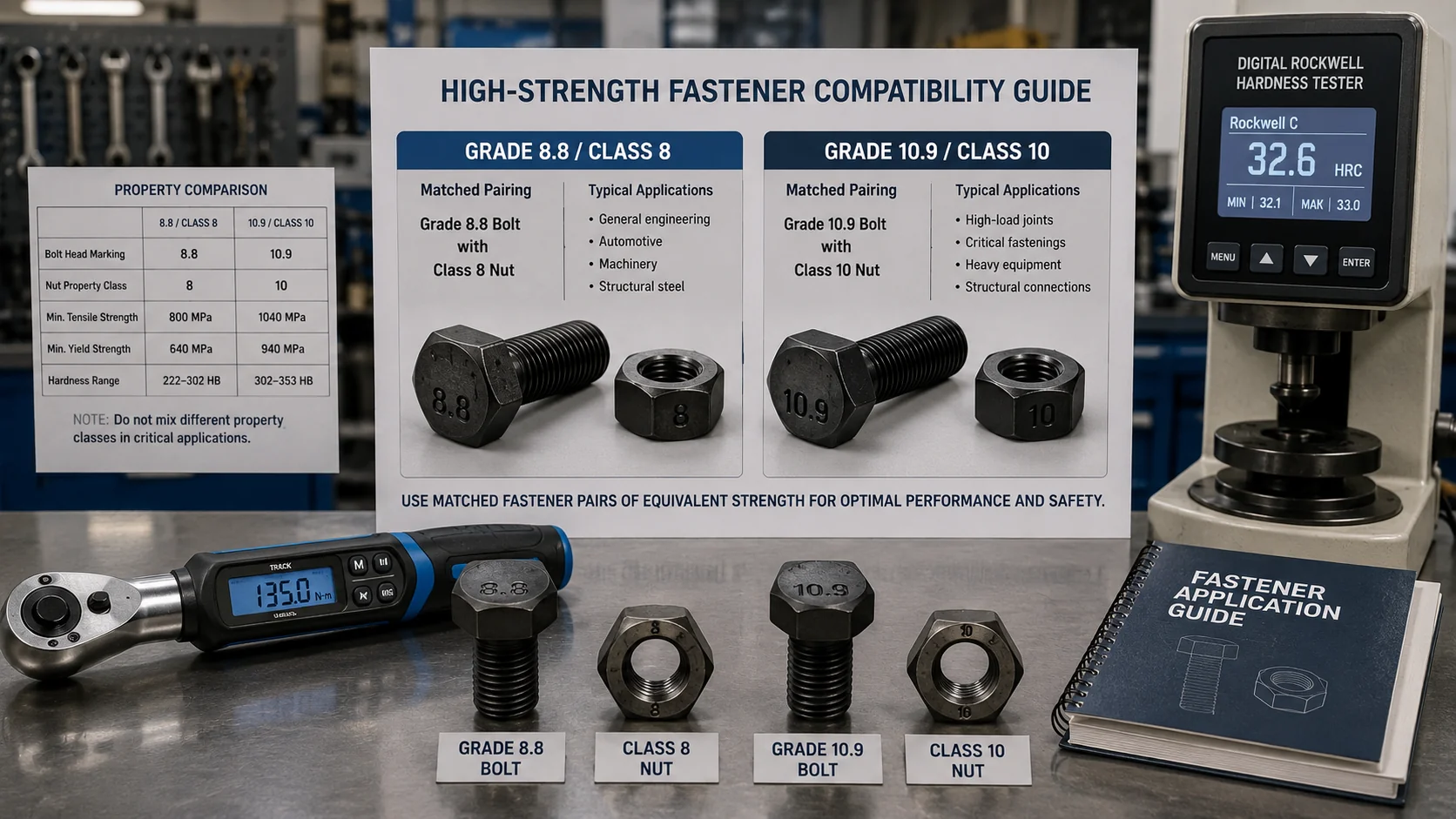
A hex nut must support the intended bolt preload without thread stripping, proof load failure, or permanent deformation. A nut selected only by diameter can fit the bolt and still be mechanically wrong.
Metric Nut Property Classes
Metric steel nuts are often specified by property classes such as:
- Class 5
- Class 6
- Class 8
- Class 10
- Class 12
ISO 898-2:2022 specifies mechanical and physical properties for nuts made of non-alloy steel or alloy steel, tested at ambient temperature, and applies to ISO metric threads including coarse pitch M5 to M39 and fine pitch M8×1 to M39×3.
A practical matching rule:
| Bolt Property Class | Common Nut Match | Typical Use | Main Risk If Wrong |
|---|---|---|---|
| 4.8 / 5.8 | Class 5 or 6 | Light machinery, brackets | Low clamp load, thread deformation |
| 8.8 | Class 8 | Machinery frames, equipment | Thread stripping if the nut is too weak |
| 10.9 | Class 10 | High-strength joints | Proof load failure or fatigue cracking if mismatched |
| 12.9 | Class 12 | High-load precision joints | Brittle failure risk if installation and lubrication are poor |
| A2-70 bolt | A2 nut | Stainless general use | Galling if installed dry |
| A4-80 bolt | A4 nut | Marine / chemical use | Higher cost, galling risk, preload scatter |
Inch Nut Grades
In inch systems, nut selection usually follows the bolt specification. ASTM A563 nuts are commonly paired with structural and mechanical bolts. For stainless inch nuts, ASTM F594 may be used when the project requires stainless steel nuts for general corrosion-resistant service.
A heavy hex nut is often required in structural bolting because it provides more thread engagement and a larger bearing area than a standard finished hex nut.
Proof Load, Hardness and Thread Stripping
The most important nut property is often not tensile strength. It is proof load. Proof load tells whether the nut can carry the required load without thread stripping or permanent deformation. In a failed joint, the nut thread can shear before the bolt reaches the target preload.
Common failure signs include:
- Bolt rotates but clamp load does not increase
- Threads pull out of the nut
- Nut feels soft under final tightening
- Torque value is reached but joint loosens later
- Threads show tearing or flattened crests after removal
For high-strength assemblies, check hardness, proof load, thread tolerance, and washer hardness together. A hard nut on a soft bearing surface can embed into the part and reduce clamp load after the first service cycle.
Why a Stronger Nut Is Not Always Better
A higher-grade nut is not automatically safer. If the mating bolt, washer, or base material is weaker, the failure point may move elsewhere.
For example:
- A Class 10 nut on a low-strength bolt may not improve the joint.
- A hardened nut on a soft bearing surface may damage the connected part.
- A high-strength electroplated nut may carry hydrogen embrittlement risk if processing is not controlled.
- A 12.9-grade assembly tightened without lubrication control may fail from excessive preload scatter.
A good fastener joint is a system: bolt, nut, washer, thread fit, surface finish, lubrication, torque tool, and working load. Treat it that way on the drawing and in the RFQ.
Hex Nut Materials: Carbon Steel, Alloy Steel, Stainless Steel, Brass and Nylon
Material selection controls strength, corrosion resistance, temperature capability, magnetic behavior, galling risk, and cost. For a buyer, the right material is not the most expensive one. It is the one that survives the load and environment with the least purchasing and assembly risk.
Carbon Steel Hex Nuts
Carbon steel is the most common material for general-purpose hex nuts. It offers good strength at low cost and accepts zinc plating, black oxide, phosphate, and hot-dip galvanizing.
Typical applications:
- Machinery
- Steel frames
- Furniture hardware
- Brackets
- Agricultural equipment
- General industrial assemblies
Common materials include low and medium carbon steels such as Q235, C1010, C1022, 35K, and similar grades depending on local standards. For Class 8 and above, heat treatment control becomes more important than the raw material name alone.
Alloy Steel Hex Nuts
Alloy steel nuts are used when higher strength, better heat treatment response, or fatigue resistance is required. Typical materials may include 35CrMo, 40Cr, SCM435, or equivalent alloy steels.
Use alloy steel hex nuts for:
- Heavy machinery
- Automotive suspension
- Wind power equipment
- Lifting systems
- High-preload bolted joints
- Fatigue-sensitive assemblies
For high-strength nuts, check the heat treatment process, hardness range, decarburization control, proof load testing, and coating process. A beautiful zinc finish does not save a nut that has poor heat treatment or uncontrolled hydrogen embrittlement risk.
304 / A2 Stainless Steel Hex Nuts
304 stainless steel, often associated with A2 stainless fasteners, is suitable for general corrosion resistance in indoor and mild outdoor environments. Stainless steel nuts are normally specified by stainless grade and property class, such as A2-70 or A4-80, where the number indicates the strength class used in stainless fastener specifications.
Use 304 / A2 when you need:
- Better corrosion resistance than zinc plated carbon steel
- Clean appearance
- Food equipment compatibility in mild environments
- General outdoor use away from heavy chloride exposure
Do not use 304 stainless steel as a universal marine material. Chloride exposure can cause pitting corrosion, especially around thread roots and crevices where moisture remains trapped.
316 / A4 Stainless Steel Hex Nuts
316 stainless steel, often associated with A4 stainless fasteners, contains molybdenum and offers better resistance to chloride and marine environments than 304.
Use 316 / A4 for:
- Marine hardware
- Coastal construction
- Chemical equipment
- Outdoor equipment exposed to salt spray
- Wastewater and humid industrial environments
Engineering warning: stainless steel bolt and stainless steel nut assemblies are prone to galling and cold welding. Use anti-seize compound, reduce installation speed, keep threads clean, and avoid final tightening with uncontrolled impact tools.
Brass, Bronze and Nylon Hex Nuts
Brass and bronze hex nuts are used where conductivity, appearance, corrosion resistance, or non-sparking behavior may matter. Nylon nuts are used in lightweight, electrical, or non-metallic assemblies where high preload is not required.
| Material | Strength | Corrosion Resistance | Cost | Best Use |
|---|---|---|---|---|
| Carbon steel | Medium to high | Low without coating | Low | General machinery |
| Alloy steel | High | Depends on coating | Medium | High-strength joints |
| 304 / A2 stainless | Medium | Good in mild environments | Medium-high | General stainless use |
| 316 / A4 stainless | Medium | Better in chloride environments | High | Marine and chemical |
| Brass | Low-medium | Good | Medium | Electrical and decorative |
| Nylon | Low | Excellent against many chemicals | Low-medium | Light-duty insulation |
Hex Nut Coatings and Surface Treatments
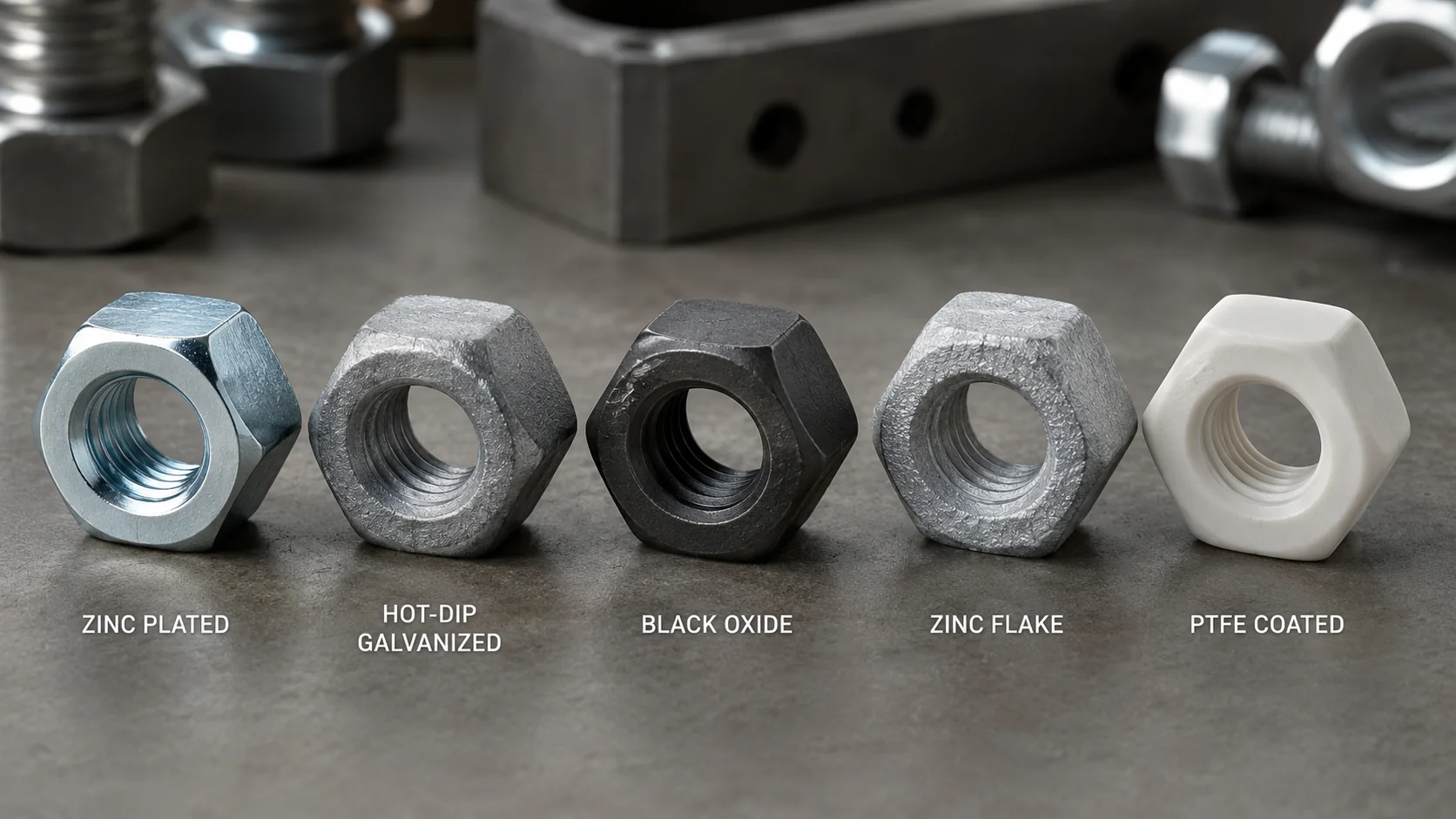
Surface treatment affects corrosion resistance, appearance, thread fit, friction coefficient, torque-preload relationship, and failure risk. For coated nuts, the buyer should check not only salt spray hours, but also thread gauge results and K factor or friction coefficient if tightening torque matters.
Zinc Plated Hex Nuts
Electro zinc plating is common for indoor and light corrosion applications. Typical commercial zinc plating thickness is often around 5–12 μm, depending on specification and supplier process. Basic zinc-plated fasteners are often specified around 24–96 hours neutral salt spray to red rust, while higher-performance passivation systems may be specified higher. Always define the acceptance criterion in the RFQ.
Best for:
- Indoor machinery
- Electrical cabinets
- Light-duty steel assemblies
- General B2B hardware
- Cost-sensitive applications
Limitations:
- Not ideal for long-term outdoor exposure
- Salt spray performance depends on chromate/passivation
- High-strength parts may require hydrogen embrittlement control
- Thread fit must be checked after plating
Hot-Dip Galvanized Hex Nuts
Hot-dip galvanized nuts are used for outdoor steel structures and harsher corrosion environments. ISO 10684 specifies hot-dip galvanized coatings for coarse threaded steel fasteners from M8 to M64 and warns against hot-dip galvanizing threaded fasteners smaller than M8 or with pitch below 1.25 mm.
Hot-dip galvanized nuts often require oversize tapping because the mating bolt threads gain zinc thickness. ISO 10684 references oversize tapping to tolerance classes such as 6AZ or 6AX for internally threaded parts after coating.
Best for:
- Outdoor structures
- Guardrails
- Poles and towers
- Agricultural equipment
- Construction steelwork
Key purchasing note:
Do not mix hot-dip galvanized bolts with standard tapped nuts unless the thread fit has been confirmed by gauge inspection. A nut that fails free-running fit on site is not a small defect; it can stop installation crews and damage coated bolt threads.
Zinc-Nickel and Zinc Flake Coatings
Zinc-nickel and zinc flake coatings are often selected for automotive, machinery, and high-corrosion applications where stronger corrosion resistance and better process control are required. In RFQs, zinc flake coatings are often specified with higher salt spray targets, commonly in the 480–1,000+ hour range depending on coating system, topcoat, part geometry, and test standard.
Advantages:
- Better salt spray performance than basic zinc plating
- More controlled friction coefficient if specified
- Lower hydrogen embrittlement risk with non-electrolytic zinc flake systems
- Suitable for high-volume industrial fasteners
For high-strength steel nuts, zinc flake coating is often worth discussing when electroplating and acid pickling create unacceptable hydrogen embrittlement risk.
Black Oxide and Phosphate
Black oxide and phosphate are used where appearance, oil retention, or short-term protection is more important than long corrosion life.
Use them for:
- Indoor machinery
- Tooling
- Low-reflection parts
- Assemblies requiring oil film protection
These finishes are not strong corrosion barriers by themselves. If the parts will be stored in a humid warehouse or shipped by sea, define oiling, VCI packaging, or corrosion-resistant packaging in the purchase order.
PTFE / Xylan Coated Hex Nuts
PTFE or Xylan-type coatings are used in chemical plants, flange bolting, offshore equipment, and applications where friction control and corrosion resistance both matter.
Benefits:
- Lower friction coefficient
- More predictable torque-preload behavior
- Good chemical resistance depending on coating system
- Easier disassembly after service
Warning:
A PTFE-coated nut may create higher preload at the same torque than a dry zinc plated nut. Never copy a dry torque value onto a lubricated or coated assembly without checking the K factor.
Coating Selection Table
| Coating | Typical Use | Corrosion Resistance | Thread Fit Risk | Engineering Note |
|---|---|---|---|---|
| Plain | Temporary indoor use | Very low | Low | Needs oil or protective packaging |
| Zinc plated | Indoor / light corrosion | Low-medium | Low-medium | Check hydrogen embrittlement risk for high-strength steel |
| Hot-dip galvanized | Outdoor steelwork | High | High | Often needs oversize tapped nuts and gauge inspection |
| Zinc flake | Automotive / machinery | High | Medium | Good option for high-strength fasteners when hydrogen risk matters |
| Zinc-nickel | Automotive / harsh service | High | Medium | Better corrosion resistance than standard zinc when specified correctly |
| Black oxide | Indoor appearance | Low | Low | Needs oil for protection |
| PTFE / Xylan | Flange / chemical / offshore | Medium-high | Medium | Changes torque-preload relationship; confirm K factor |
Hex Nut Size, Thread and Dimension Selection
Hex nut size selection begins with the mating bolt. The nut must match the bolt diameter, thread pitch, and thread system. For production orders, width across flats, nut height, chamfer, coating thickness, and thread tolerance are just as important as nominal size.
Metric Hex Nut Sizes
Common metric sizes include:
- M3
- M4
- M5
- M6
- M8
- M10
- M12
- M16
- M20
- M24
- M30
A metric callout such as M12 × 1.75 means:
- M12 = nominal thread diameter
- 1.75 = thread pitch in millimeters
If the pitch is not stated, many buyers assume coarse pitch. That assumption can be costly when the assembly uses fine pitch threads. A fine thread nut will not “almost fit” a coarse thread bolt; it will cross-thread, damage the pitch, and give a false torque reading.
UNC and UNF Inch Hex Nut Sizes
Common inch sizes include:
- 1/4-20 UNC
- 5/16-18 UNC
- 3/8-16 UNC
- 1/2-13 UNC
- 5/8-11 UNC
- 3/4-10 UNC
UNF threads have finer pitch and are often used where adjustment, vibration resistance, or higher thread engagement per length is needed. They also demand cleaner threads and better starting alignment during assembly.
Coarse Thread vs Fine Thread Hex Nuts
| Thread Type | Advantages | Limitations | Typical Use |
|---|---|---|---|
| Coarse thread | Easier assembly, better in dirty environments, less cross-threading risk | Lower adjustment precision | General machinery and construction |
| Fine thread | Better adjustment, larger minor diameter, can help in vibration-sensitive joints | Easier to damage, slower assembly | Automotive, precision machinery |
| UNC | Common U.S. coarse thread | Not compatible with metric | U.S. general assemblies |
| UNF | Common U.S. fine thread | More sensitive to damage | Automotive and equipment |
Width Across Flats, Nut Height and Thread Engagement
Do not ignore wrench size and nut height. A nut may have the right thread but still fail the assembly if:
- Socket access is limited
- Nut height interferes with clearance
- Thread engagement is insufficient
- Washer stack height changes exposed thread length
- Coating thickness causes thread drag
For critical joints, confirm the thread engagement length and at least two full threads beyond the nut after tightening, unless the drawing specifies otherwise. Where shear stress or fatigue load is present, also check that the thread runout and bearing surface do not put bending load into the bolt.
How to Choose the Right Hex Nut for Your Application
Choose a hex nut by working backward from the joint: bolt grade, load, environment, coating, installation method, inspection requirement, and service risk. A low-cost nut is only cheap if it passes assembly and does not come back as a field failure.
Step 1 — Confirm Thread System and Standard
Start with:
- Metric or inch
- Coarse or fine pitch
- ISO, DIN, ASME, ASTM, JIS, or GB
- Drawing revision
- Thread tolerance
- Nut type: standard hex, heavy hex, jam nut, lock nut, or flange nut
If the order is for maintenance or spare parts, ask for a sample or drawing photo when possible. Old machines often contain mixed DIN, ISO, JIS, and inch fasteners from repairs made over many years.
Step 2 — Match Nut Grade with Bolt Grade
Never pair a high-strength bolt with a low-strength nut just because the thread fits.
Example:
- M12 Class 8.8 bolt → normally use Class 8 nut
- M16 Class 10.9 bolt → normally check Class 10 nut and proof load requirement
- ASTM structural bolt → confirm ASTM A563 grade compatibility
- Stainless A4-80 bolt → use compatible A4 nut and anti-seize
Engineering warning: if the nut is weaker than the bolt, the joint may strip before the bolt reaches preload. If the nut is much harder than the washer or mating surface, embedment can reduce clamp load after installation.
Step 3 — Select Material by Environment
| Application Environment | Recommended Material | Common Finish |
|---|---|---|
| Indoor dry machinery | Carbon steel | Zinc plated / black oxide |
| Outdoor general use | Carbon steel | Hot-dip galvanized |
| Coastal environment | 316 / A4 stainless | Plain / passivated |
| Chemical plant | 316 stainless or coated alloy steel | PTFE / Xylan |
| High-strength machinery | Alloy steel | Zinc flake / phosphate / controlled coating |
| Electrical insulation | Nylon | Plain |
Step 4 — Choose Coating and Lubrication Condition
Coating affects friction. Friction affects preload. Preload affects whether the joint survives.
Before bulk ordering, confirm:
- Dry or lubricated assembly
- K factor or friction coefficient
- Coating thickness
- Salt spray requirement
- Whether hydrogen embrittlement relief is required
- Whether thread gauge inspection is required after coating
CTA: If you are not sure about the friction coefficient under your coating and lubrication condition, send your drawing or assembly condition to our fastener engineer for a project-specific torque recommendation.
Step 5 — Confirm Inspection, Certification and Packaging
For B2B orders, the RFQ should include:
- Standard
- Size and pitch
- Material
- Grade / property class
- Surface treatment
- Quantity
- Certificate requirement
- Salt spray test requirement
- Thread gauge inspection
- Packaging method
- Batch traceability
- Application environment
For critical applications, ask for sample approval before mass production. Check the sample with the same bolt, washer, tool, coating, and tightening procedure used in production.
Torque, Preload and Installation Notes for Hex Nuts
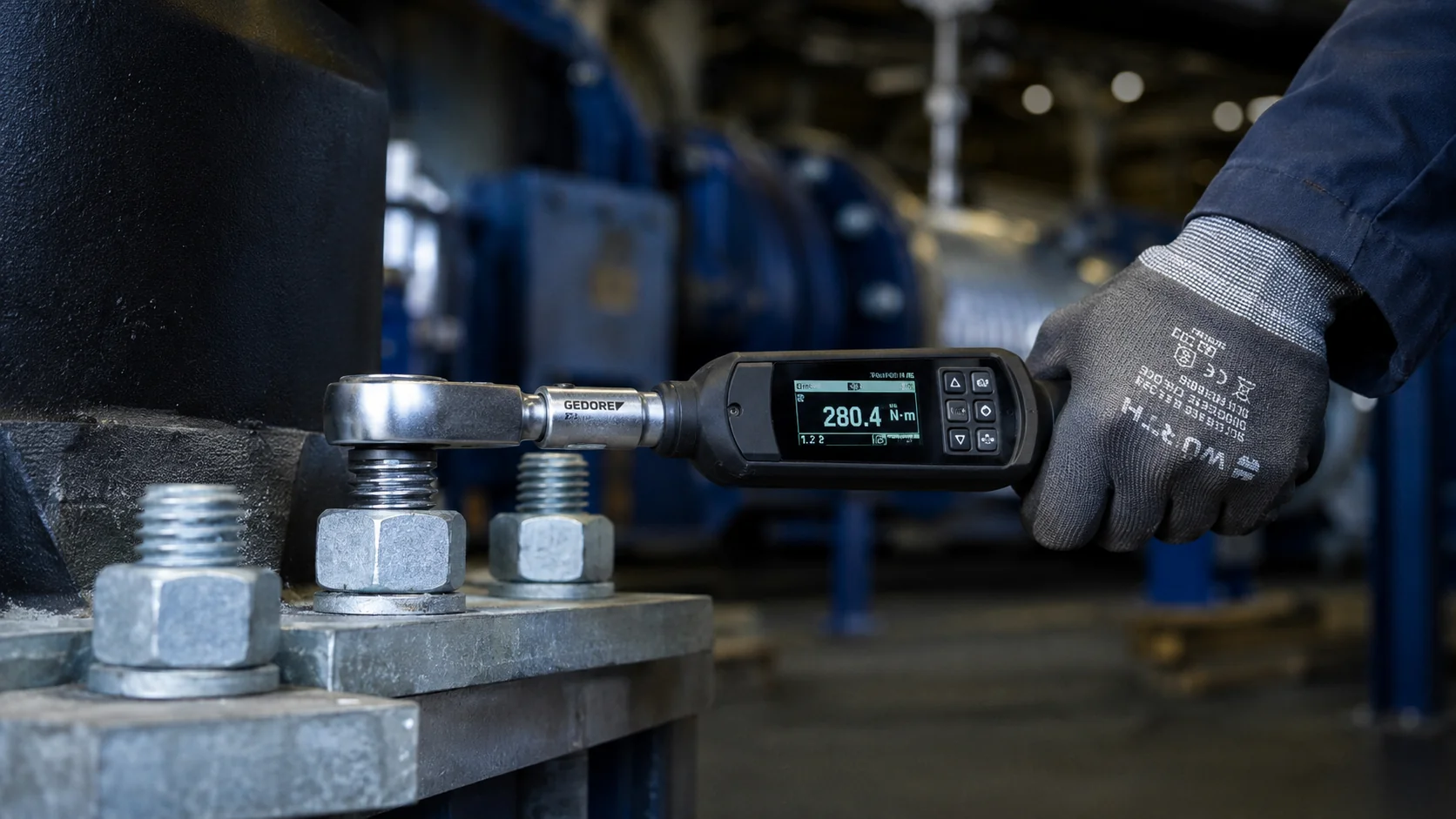
A hex nut can pass incoming inspection and still fail in assembly if tightening is uncontrolled. Torque is only an indirect method for producing preload, and preload is what keeps the joint clamped.
Why Torque Is Not Equal to Clamp Load
Torque is only an indirect way to create bolt preload. Much of the applied torque is lost to thread friction and bearing surface friction. A small change in coating, lubrication, washer hardness, or surface roughness can change the final clamp load.
A simplified relationship is:
T = K × D × F
Where:
- T = tightening torque
- K = nut factor
- D = nominal bolt diameter
- F = target preload
This formula is useful for estimation, but not enough for critical joints without testing. For safety-related joints, verify torque-preload behavior by test or supplier data instead of copying a generic torque table.
Common K Factor Range
Typical working ranges often used for preliminary discussion:
| Assembly Condition | Approximate K Factor Range |
|---|---|
| Dry plain steel | 0.20–0.30 |
| Dry zinc plated | 0.18–0.25 |
| Lightly lubricated | 0.12–0.18 |
| PTFE / low-friction coating | Often below dry zinc values; confirm by test |
Actual K factor depends on coating, lubricant, washer, surface hardness, thread condition, and tightening speed. This is why the same M16 nut can produce different preload values at the same torque.
Installation Tools
For ordinary assemblies:
- Hand wrench
- Socket wrench
- Calibrated torque wrench
- Go/no-go thread gauge
For high-load or critical joints:
- Hydraulic tensioner
- Calibrated torque multiplier
- Ultrasonic bolt elongation measurement
- Load-indicating washer
- Marking pen for torque audit
Avoid using an impact wrench for final tightening on stainless steel or critical preload joints unless the process is qualified. Impact tools are useful for rundown, but they can create large preload scatter and trigger galling on stainless threads.
Common Installation Mistakes
| Mistake | Result |
|---|---|
| Mixing metric and inch threads | Cross-threading and thread damage |
| Installing stainless nuts dry | Galling or cold welding |
| Using wrong nut grade | Thread stripping or proof load failure |
| Reusing damaged nuts | Unstable torque and preload |
| Ignoring coating friction | Over-tightening or under-tightening |
| No washer on soft surface | Bearing surface damage and preload loss |
| Final tightening with impact tool | Preload scatter and thread damage |
Common Hex Nut Failures and How to Prevent Them
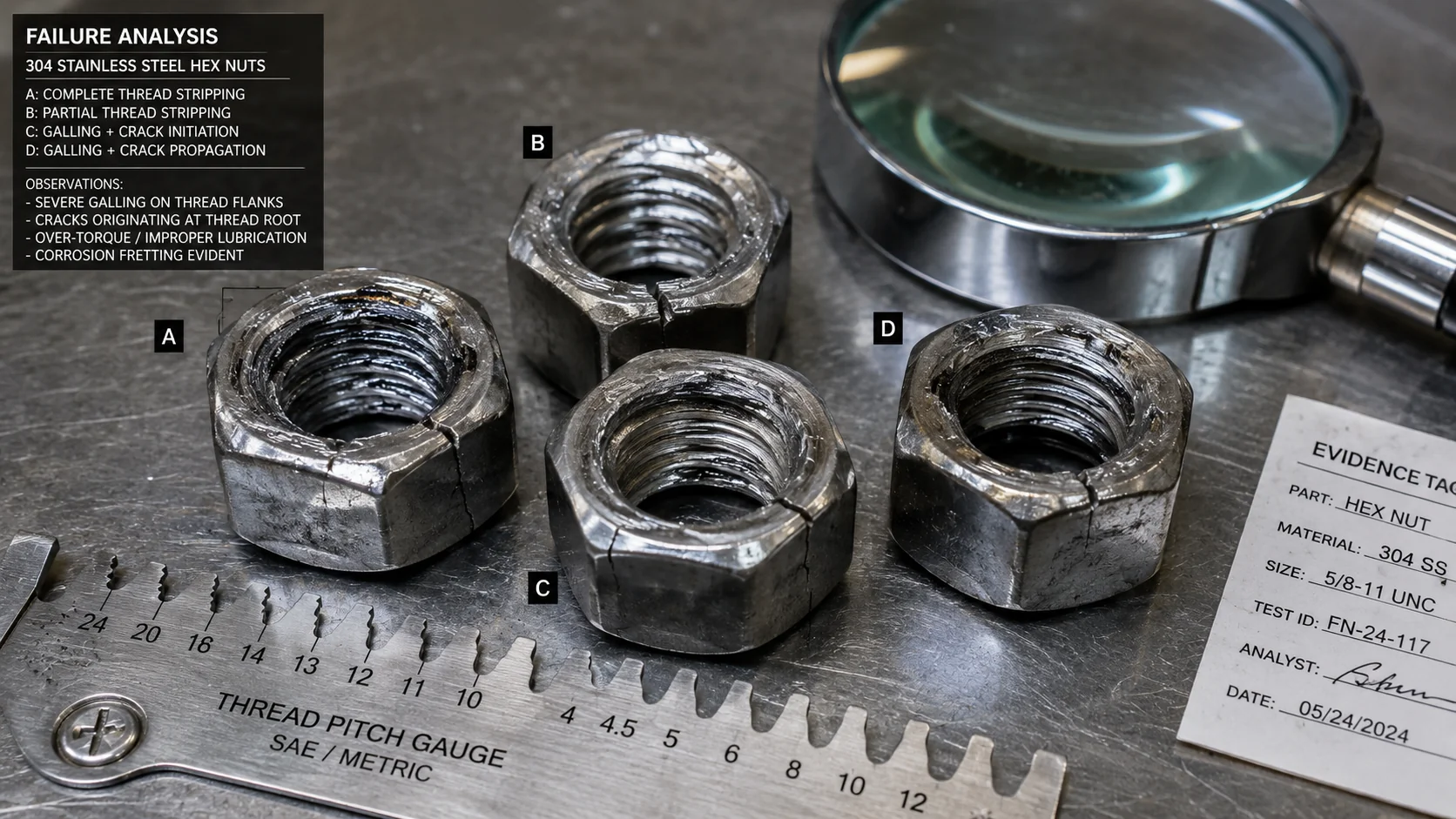
Most hex nut failures can be traced back to one of five causes: wrong grade, wrong material, wrong coating, poor installation, or unsuitable working environment. The failed surface usually tells the story if you know where to look.
Thread Stripping
Thread stripping happens when internal threads shear before the bolt reaches the required preload. The nut may still look normal from the outside, but the internal thread flanks are torn or flattened.
Common causes:
- Nut grade too low
- Insufficient nut height
- Wrong thread pitch
- Over-tapped hot-dip galvanized nut
- Soft material
- Excessive torque
Prevention:
- Match nut grade with bolt grade
- Confirm proof load
- Use go/no-go thread gauges
- Check thread engagement
- Avoid using low-strength nuts on high-strength bolts
Galling and Cold Welding
Galling is common with stainless steel fasteners. Under pressure and sliding friction, stainless surfaces can weld locally. The nut locks before reaching target torque, and removal often destroys both bolt and nut.
Common causes:
- Stainless bolt + stainless nut
- No anti-seize
- High-speed installation
- Dirty or damaged threads
- Excessive tightening pressure
Prevention:
- Use anti-seize compound
- Slow down installation speed
- Use waxed or lubricated stainless nuts
- Avoid uncontrolled power tools
- Consider pairing different stainless grades where allowed by engineering design
Hydrogen Embrittlement
High-strength steel fasteners can suffer delayed cracking if hydrogen enters the steel during processes such as acid pickling or electroplating. ASTM F1941/F1941M covers electrodeposited coatings on threaded fasteners and includes precautions for managing hydrogen embrittlement risk and relief for high-strength and surface-hardened fasteners.
Risk factors:
- High-strength steel
- Electroplating
- Acid cleaning
- Insufficient baking
- High tensile stress after tightening
Prevention:
- Use controlled plating suppliers
- Specify baking requirements where applicable
- Consider zinc flake coating for high-strength fasteners
- Require batch records
- Perform proof load or wedge tests when required
Vibration Loosening
Hex nuts can loosen under vibration if the joint loses preload or if transverse movement occurs between clamped parts. The usual root cause is not “the nut is bad”; it is often insufficient preload, poor joint design, soft bearing surfaces, or the wrong locking method.
Prevention options:
- Correct preload
- Hardened flat washer
- Nylon insert lock nut
- All-metal lock nut
- Thread locking adhesive
- Flange nut
- Proper joint design
Fatigue Cracking
Fatigue failure occurs when cyclic load repeatedly stresses the bolt-nut joint. Poor preload, soft bearing surfaces, misalignment, and damaged thread roots can increase fatigue risk.
Prevention:
- Maintain sufficient preload
- Use correct washer hardness
- Avoid bending load on the bolt
- Use clean bearing surfaces
- Control torque scatter
- Inspect thread root defects
Engineering Case Studies
The following cases are typical problems seen in real purchasing, assembly, and field maintenance work. The part is small, but the failure cost is usually not.
Case 1 — Stainless Steel Hex Nuts Seized During Assembly
Problem:
A food equipment manufacturer used 316 stainless steel bolts and 316 stainless steel hex nuts. During assembly, several nuts seized before reaching final torque.
Analysis:
The parts were installed dry with a power tool. Stainless-to-stainless contact created galling under high pressure and speed. The torque wrench reading increased, but clamp load did not rise correctly.
Solution:
- Applied food-grade anti-seize compound
- Reduced installation speed
- Replaced damaged bolts and nuts
- Added incoming thread inspection
- Updated work instruction: no dry stainless final tightening
Lesson:
For stainless steel hex nuts, lubrication is not optional in many real assemblies. It is part of the joint design.
Case 2 — Hot-Dip Galvanized Nuts Failed Thread Fit Inspection
Problem:
A steel structure project ordered hot-dip galvanized bolts and nuts. On site, some nuts could not run freely onto the bolts.
Analysis:
The galvanized bolt threads had additional zinc thickness, but the nuts were not properly tapped oversize after coating. Thread interference caused assembly delays and damaged threads.
Solution:
- Replaced nuts with correctly oversize-tapped galvanized nuts
- Added go/no-go gauge inspection
- Confirmed coating thickness range
- Updated RFQ wording to include hot-dip galvanized thread fit requirement
Lesson:
For hot-dip galvanized fasteners, coating thickness and thread allowance must be treated as one system.
Case 3 — High-Strength Nuts Cracked After Electroplating
Problem:
A machinery customer reported delayed cracking in high-strength nuts after assembly. Cracks appeared several hours after tightening.
Analysis:
The nuts were electroplated after heat treatment. Process review showed weak control of hydrogen embrittlement relief baking. The parts looked clean and bright, but the plating process introduced a delayed fracture risk.
Solution:
- Changed to a qualified plating supplier
- Required baking records
- Added batch traceability
- Considered zinc flake coating for future orders
- Added proof load sampling to the inspection plan
Lesson:
High-strength electroplated fasteners need controlled process documentation, not just a good-looking zinc finish.
Case 4 — Low-Grade Nuts Caused Thread Stripping on 10.9 Bolts
Problem:
An equipment frame used Class 10.9 bolts but low-grade nuts from a mixed stock bin. During final tightening, several nuts stripped.
Analysis:
The nut proof load was not suitable for the bolt preload. The assembly team reached the torque value, but the internal threads failed. The torque wrench did its job; the specification did not.
Solution:
- Segregated nut stock by grade and marking
- Specified Class 10 nuts for the joint
- Added bolt-nut compatibility to the BOM
- Trained assembly operators to check grade markings
Lesson:
Thread fit does not mean strength compatibility.
Hex Nut Buying Checklist for B2B Orders
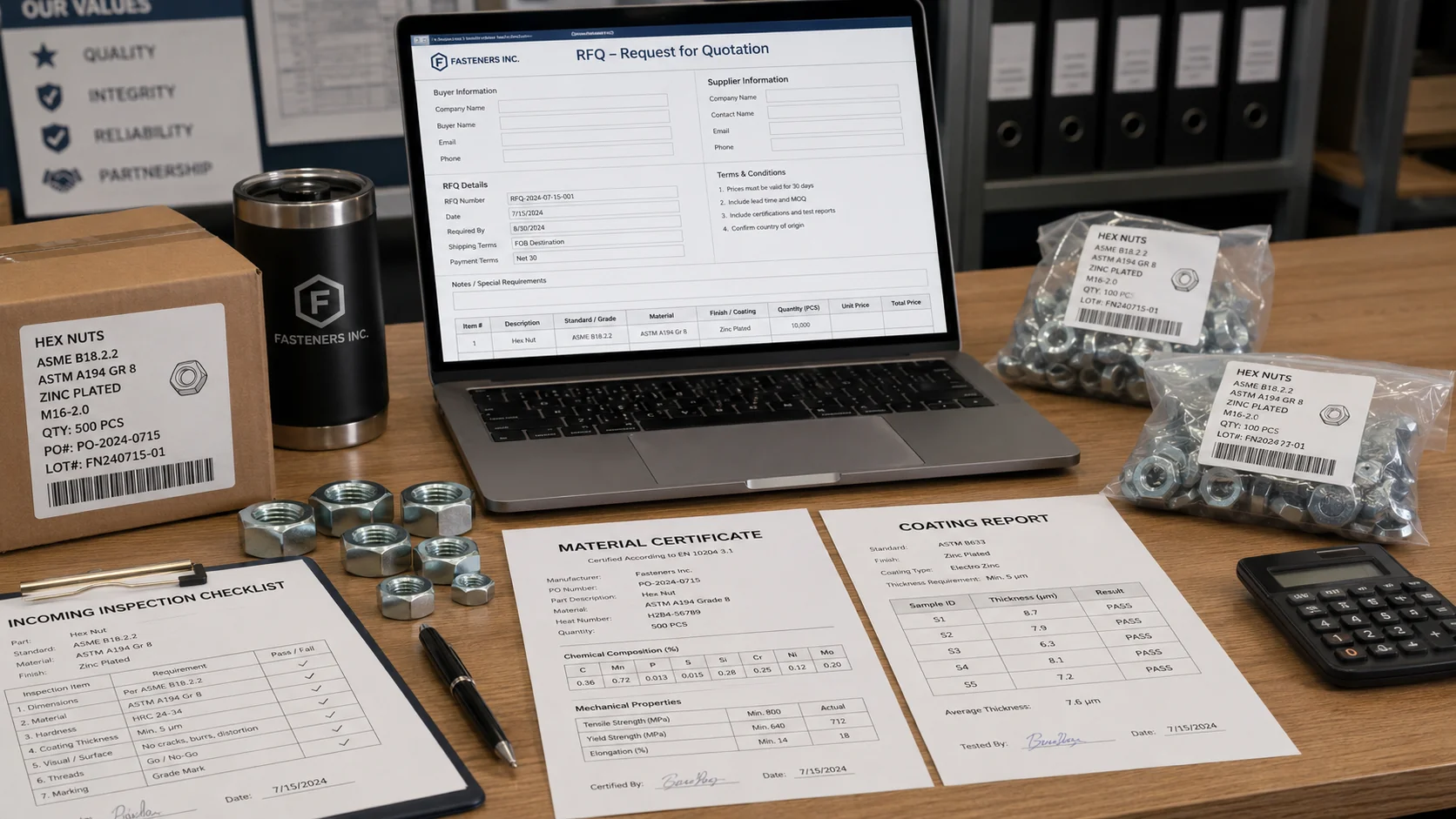
Before sending a hex nut RFQ, provide enough information for the supplier to quote correctly. A clear RFQ reduces wrong quotations, sample delays, coating disputes, and batch rejection.
RFQ Checklist
| Item | Example |
|---|---|
| Standard | ISO 4032 / DIN 934 / ASME B18.2.2 / ASTM A563 |
| Size | M12 / 1/2-13 |
| Thread pitch | Coarse / fine / specified pitch |
| Material | Carbon steel / 304 / 316 / alloy steel |
| Grade | Class 8 / Class 10 / ASTM A563 DH |
| Coating | Zinc plated / HDG / zinc flake / black oxide / PTFE |
| Quantity | 50,000 pcs |
| Certificate | MTC / RoHS / REACH / coating report |
| Inspection | Thread gauge / proof load / hardness / salt spray |
| Packaging | Bulk carton / small box / pallet / label |
| Application | Machinery / construction / marine / automotive |
| Mating bolt | Grade 8.8 / 10.9 / ASTM bolt grade |
| Special note | Lubrication, K factor, salt spray hours, marking |
Common RFQ Mistakes
Avoid these vague requests:
- “Need M12 nuts”
- “Quote stainless nuts”
- “Need high-strength hex nuts”
- “Same as DIN nut”
- “Outdoor use, normal zinc is OK?”
Better RFQ wording:
Please quote ISO 4032 M12-1.75 Class 8 hex nuts, carbon steel, zinc plated Cr3+, thread tolerance 6H, RoHS compliant, with material certificate and thread gauge inspection report.
Supplier Evaluation Checklist
A reliable hex nut supplier should be able to provide:
- Standard confirmation
- Material certificate
- Heat treatment record if applicable
- Coating report
- Thread gauge inspection
- Salt spray report when required
- Batch traceability
- Packaging photos
- Engineering support for grade and coating selection
CTA: Need help matching hex nuts with bolt grade, coating, and working environment? Send your drawing, sample, or RFQ through our contact page for engineering review before bulk ordering.
Hex Nuts vs Heavy Hex Nuts, Jam Nuts and Lock Nuts
Hex nuts are not the only nut type. Choosing the wrong nut type can create assembly clearance problems, insufficient bearing area, poor locking performance, or unsafe preload.
Hex Nuts vs Heavy Hex Nuts
Heavy hex nuts have larger width across flats and more bearing area. They are common in structural bolting, anchor rods, and heavy-duty joints.
Use heavy hex nuts when:
- Structural specification requires them
- Higher load distribution is needed
- Anchor bolt assemblies require large bearing area
- ASTM structural bolting is involved
Hex Nuts vs Jam Nuts
Jam nuts are thinner than standard hex nuts. They are often used for locking or adjustment, not as the main load-bearing nut in a high-strength joint unless specified by design.
Use jam nuts for:
- Position locking
- Adjustment mechanisms
- Double-nut locking arrangements
- Low-height assemblies
Hex Nuts vs Nylon Insert Lock Nuts
Nylon insert lock nuts resist loosening through prevailing torque. They are useful in vibration applications but have temperature limits because the nylon insert can soften.
Use them for:
- Light machinery
- Automotive accessories
- Equipment covers
- Vibration-sensitive non-high-temperature assemblies
Hex Nuts vs All-Metal Lock Nuts
All-metal lock nuts are better for high-temperature or harsher environments where nylon is not suitable. They resist loosening by thread deformation or prevailing torque design.
Use them for:
- Higher temperature assemblies
- Machinery vibration
- Automotive and industrial equipment
- Applications where nylon is not allowed
FAQ About Hex Nuts
What is the difference between DIN 934 and ISO 4032 hex nuts?
DIN 934 is an older German standard still common in legacy drawings and spare parts. ISO 4032 is a current international standard for metric hexagon regular nuts. They may look similar, but buyers should check nut height, wrench size, thread tolerance, property class, and drawing requirements before substitution.
What grade hex nut should I use with 8.8 bolts?
For most metric steel assemblies, an 8.8 bolt is commonly paired with a Class 8 nut. Critical applications should confirm proof load, washer hardness, coating, lubrication, and tightening method before final approval.
Why do stainless steel hex nuts seize?
Stainless steel hex nuts seize because stainless threads can gall under pressure and sliding friction. Dry stainless-to-stainless tightening, high installation speed, damaged threads, and lack of anti-seize compound increase the risk.
Are zinc plated hex nuts suitable for outdoor use?
Zinc plated hex nuts are usually better for indoor or light corrosion environments. For long-term outdoor steel structures, hot-dip galvanized, zinc flake, zinc-nickel, or stainless steel options are usually more appropriate, depending on load and environment.
How do I choose between 304 and 316 stainless steel hex nuts?
Choose 304 / A2 stainless steel for general corrosion resistance in mild environments. Choose 316 / A4 stainless steel for coastal, marine, chloride, chemical, or humid industrial environments. For stainless assemblies, always evaluate galling risk and installation lubrication.
Author Note: This guide is written from a fastener application engineering perspective, with focus on bolt-nut compatibility, standards, material selection, coating risk, torque-preload behavior, and B2B purchasing control. For project-specific hex nut selection, confirm the drawing, bolt grade, coating, lubrication, working load, and inspection requirement before bulk order.