








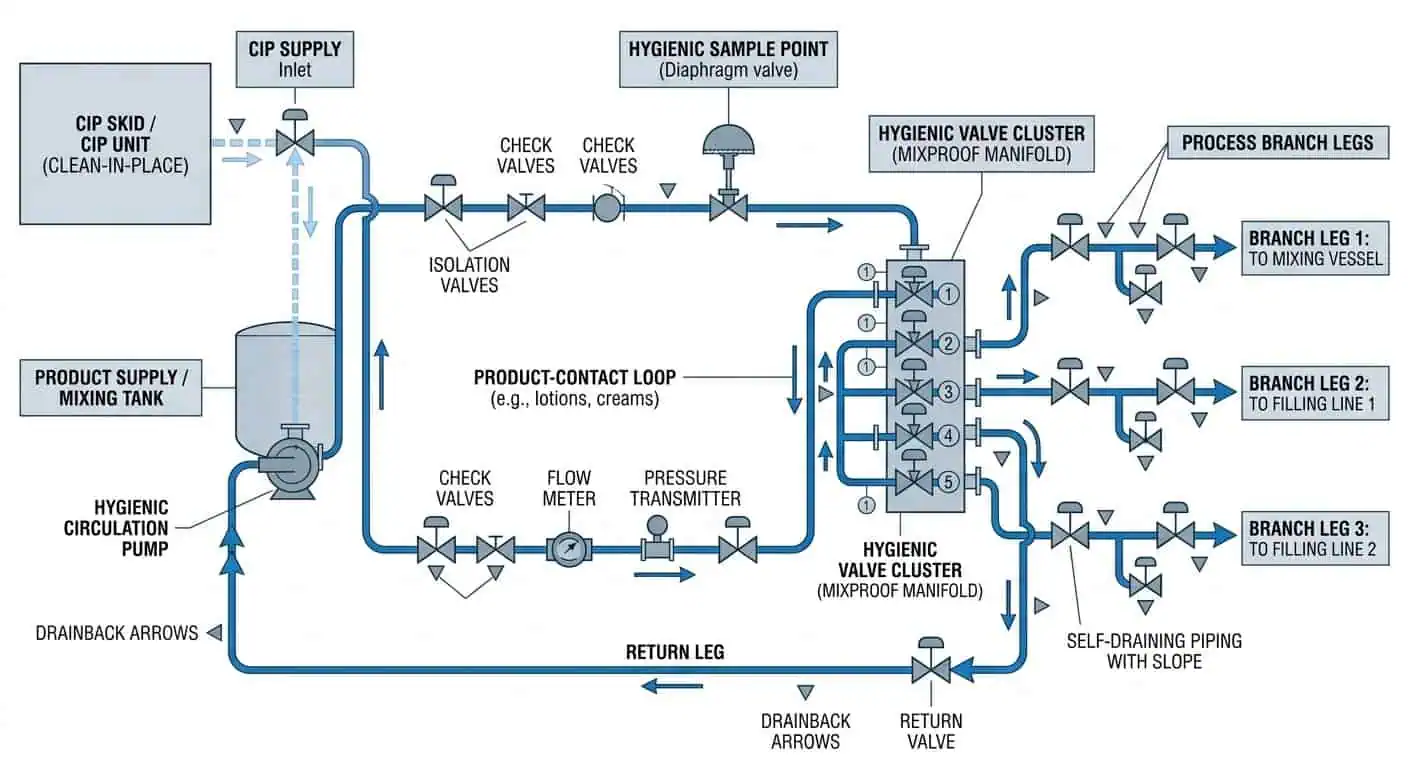
Cleaning performance in a hygienic process system is rarely limited by cleaning chemistry alone. In real production, cleaning succeeds only when the system allows cleaning solution to reach the right product-contact surfaces, remain there under useful flow and temperature conditions, remove residue, and then drain or rinse away without creating new pockets of retained liquid. That is why engineers review hygienic cleaning as a system issue shaped by layout, dead legs, branch exposure, drainability, joint detail, weld condition, and shutdown behavior—not simply by whether a CIP skid is installed.
Expert Insight:
When a hygienic line repeatedly “needs more cleaning time,” the root cause is often not weak detergent selection. It is usually a local geometry problem that prevents effective contact, rinse recovery, or drainback where product actually remains.
For cosmetic and personal care production, this matters even more because lotions, creams, gels, surfactant systems, and fragrance-containing products do not all release from surfaces the same way. Some retain film, some foam, some slow down rinse recovery, and some expose small design weaknesses that a lower-viscosity liquid would not reveal as quickly. A cleaning-focused review should therefore connect process layout, branch design, low-point control, connection selection, material condition, and startup verification as one engineering problem. FDA’s cosmetics GMP guidance and FDA’s later draft GMP guidance both support this broader process-control view, and FDA explicitly stated that it considered ISO 22716 when revising current practice.
What “Cleanability” Really Means in Hygienic Process Systems
Cleaning Is Not Just Chemical Compatibility
In hygienic systems, cleanability means more than whether the material can tolerate detergent or sanitizer. It means residue can be exposed to the cleaning solution, displaced from the surface, transported away from the local area, and removed without becoming trapped again elsewhere in the system. In practice, that depends on contact, circulation, drainability, surface condition, and whether the line creates blind pockets or weak-flow zones that cleaning fluid does not reach effectively.
Why a Line Can Look “Sanitary” and Still Clean Poorly
A line can use sanitary fittings and hygienic materials yet still show weak cleaning performance. The failure mode is usually local rather than global: a poorly exposed branch, a slow-rinsing valve pocket, an uneven gasket land, a rewelded spool with rougher internal finish, or a low point that was not obvious in the original design model. These details often dominate real cleaning behavior long before the main pipe run becomes the issue.
That is also why this topic should be read together with Sanitary Piping Design for Cosmetic Manufacturing. Layout and drainability are often the first reasons a hygienic system cleans well—or fails to do so.
One useful misconception to remove early is this: equipment or fittings described as “sanitary” are not automatically equivalent to “fully CIP-cleanable” in every service condition. In actual projects, the proposed cleaning method, branch exposure, and product behavior still have to be checked against the real geometry and operating pattern.
Why Cleaning Problems Usually Start at Local Geometry, Not in the Main Pipe Run
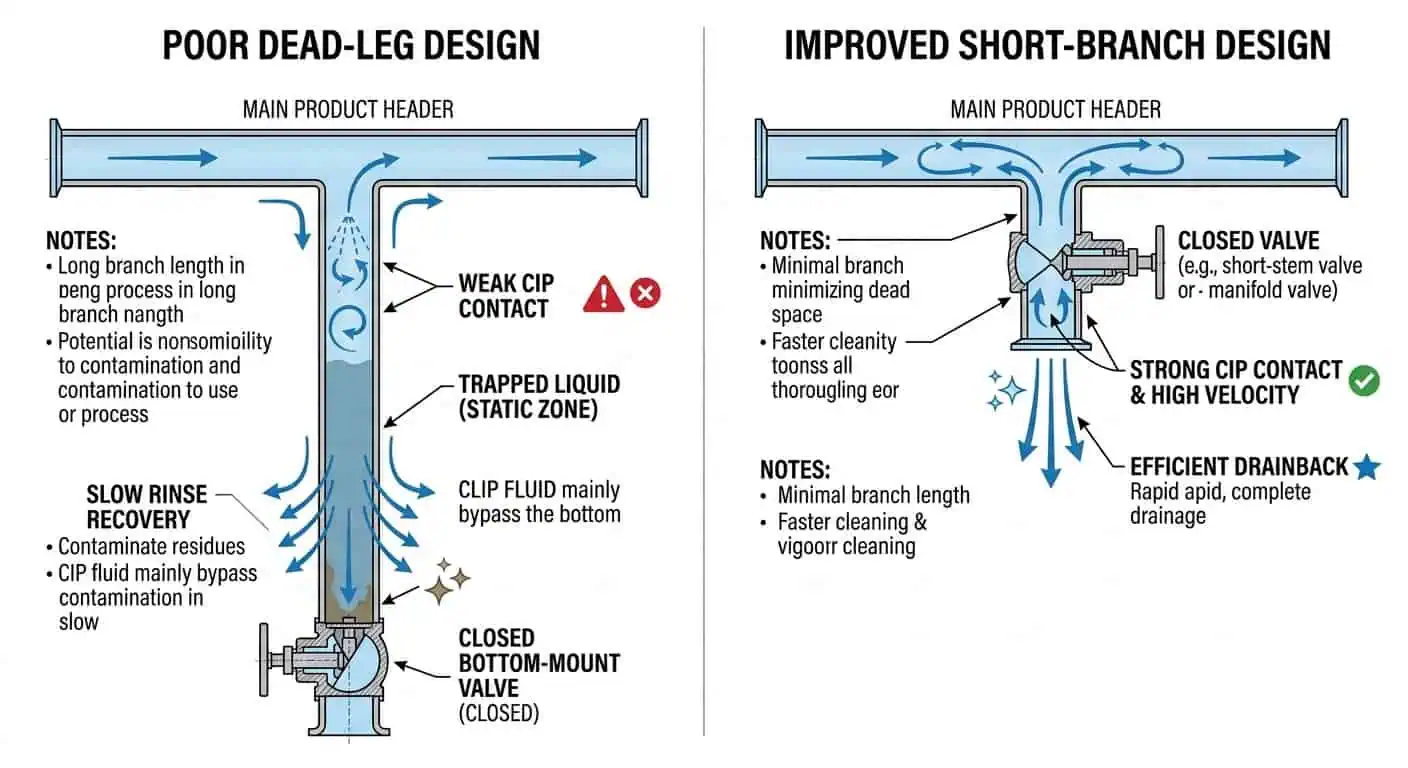
Dead Legs, Branches, and Entrapment Zones
Most repeat cleaning problems begin at local geometry. Dead legs, branch legs, short side pockets, and poorly drained take-offs create entrapment zones where product can remain, where air can block cleaning-solution contact, or where rinse recovery lags behind the rest of the line. In a cosmetic process system, this becomes especially visible when products are viscous, when changeovers are frequent, or when recovery time after cleaning is tightly controlled.
Why Sample Points, Instrument Tees, and Valve Clusters Deserve Extra Review
Small connections are often the first places where a line reveals its true cleanability. Sample points, instrument tees, upper branches, sight-glass transitions, and compact valve clusters all create local flow behavior that differs from the main run. If these points are added late in the project or reviewed only as mechanical details, they can become the recurring sanitation concern that slows the entire system.
One lotion filling line made this clear. The main transfer line cleaned acceptably, but rinse recovery was repeatedly delayed after product changeover. The cause was not the whole line. It was a small branch near a sample take-off that had enough retained volume and weak exposure to keep one section slower than the rest. Shortening the branch and improving its drainback solved more than increasing total cleaning time ever did.
A second field case involved a compact valve block on a cream transfer skid. Operators first blamed detergent concentration because one section stayed visually suspect longer than the rest of the line. The actual cause turned out to be a small retained pocket at a local transition immediately upstream of the valve cluster. Reworking that local detail reduced the repeat sanitation concern without increasing cycle time.
Connection geometry is also why this article should link to Sanitary vs Industrial Pipe Fittings. Even where the material is acceptable, the wrong local fitting geometry can still reduce cleanability.
Expert Insight:
In field troubleshooting, the most useful question is often not “Why is the CIP skid underperforming?” but “Which local detail is preventing contact, rinse recovery, or drainback?”
CIP Contact, Flow Path, and Rinse Recovery: What Actually Determines Cleaning Performance
Why Having a CIP Loop Does Not Guarantee Effective Cleaning
A CIP loop is only a delivery method. It does not guarantee that cleaning solution actually reaches every product-contact surface in a useful way. Real cleaning depends on how the flow path is arranged, how branches are exposed, whether trapped air is displaced, how the return path behaves, and whether solution can contact the areas where soil actually remains.
Rinse Recovery Is Often the More Useful Operating Signal
Plants often notice rinse recovery problems before they identify a formal cleaning failure. Conductivity may stabilize slowly, rinse-water appearance may clear unevenly, or the first product after restart may show greater uncertainty than the rest of the batch. These are practical operating signals that a local section is slower to recover than the rest of the line.
How Product Type Changes Cleaning Difficulty
Different cosmetic products create different cleaning burdens. Lotions and creams often create more persistent product film and hold-up. Surfactant-rich systems can alter rinse behavior. Gels may resist simple flushing. Fragrance-containing systems may create lingering odor or low-level carryover concern even when visible residue is minimal. That is why cleaning performance must be reviewed against the actual product family, not just against the base line design.
| Cleaning Factor | What Engineers Should Review | Why It Matters |
|---|---|---|
| CIP contact | Whether cleaning solution reaches the real residue zones | No contact means no effective cleaning at that location |
| Flow path simplicity | Whether the route is easy to expose and rinse consistently | Complex return paths often create uneven recovery |
| Branch exposure | Whether side legs see useful cleaning and rinsing | Weakly exposed branches become repeat sanitation concerns |
| Product behavior | Film formation, foam, viscosity, rinse release, residue tendency | Different products reveal different weaknesses in the same line |
One multi-SKU lotion system illustrated this clearly. The production team first assumed detergent strength or cleaning time was the issue. The actual problem was a return path with one branch that consistently recovered more slowly than the rest of the system. Simplifying the loop and changing the branch classification from minor to cleaning-critical improved recovery more than adding chemical exposure time.
Another example came from a gel line where operators reported that the system “cleaned,” but restart confirmation was still slow. The review found that the return leg layout forced one section to lag behind the rest of the system during rinse recovery. The corrective action was a flow-path change, not a chemistry change.
How Drainability and Shutdown Behavior Affect Cleaning Results
Cleaning Does Not End When Circulation Stops
Many hygiene problems appear after the cleaning cycle, not during it. If cleaning solution, rinse water, or diluted product remains in a local low point after circulation ends, the line may restart under less predictable conditions. In real plant operation, weekend wet hold, partial drainback, and valve position during shutdown all influence whether the system actually returns to a clean and stable state.
Why Shutdown Position Matters in Real Plants
The true cleaning condition of a line depends on how it sits between cycles. A branch that looks harmless during circulation may become a retained-liquid pocket during shutdown. A valve cluster may hold more solution than expected once flow stops. A support-induced sag may create a local low point that never existed in the model. Engineers should therefore evaluate not only dynamic cleaning behavior, but also static post-cleaning condition.
Small Low Points Can Dominate Real Hygiene Risk
A seemingly minor low point can dominate rinse delay, first-batch instability, and repeat sanitation attention. This was seen on one shampoo recirculation skid where recurring discoloration and delayed rinse recovery were traced to a local low point near a valve block. The fix was not a full-system redesign. It was targeted drainback improvement at the real retention location.
This is why drainability should always be reviewed together with Sanitary Piping Design for Cosmetic Manufacturing. Poor shutdown behavior is often the operating face of a layout problem.
A fourth field case came from a serum transfer skid that looked acceptable on the piping model but showed inconsistent first-batch behavior after weekend shutdowns. The issue was traced to retained rinse water at an understated low point created after support installation. Once the support condition and local spool elevation were corrected, restart became more stable.
Gaskets, Joints, and Surface Condition: Small Details That Control Big Cleaning Outcomes
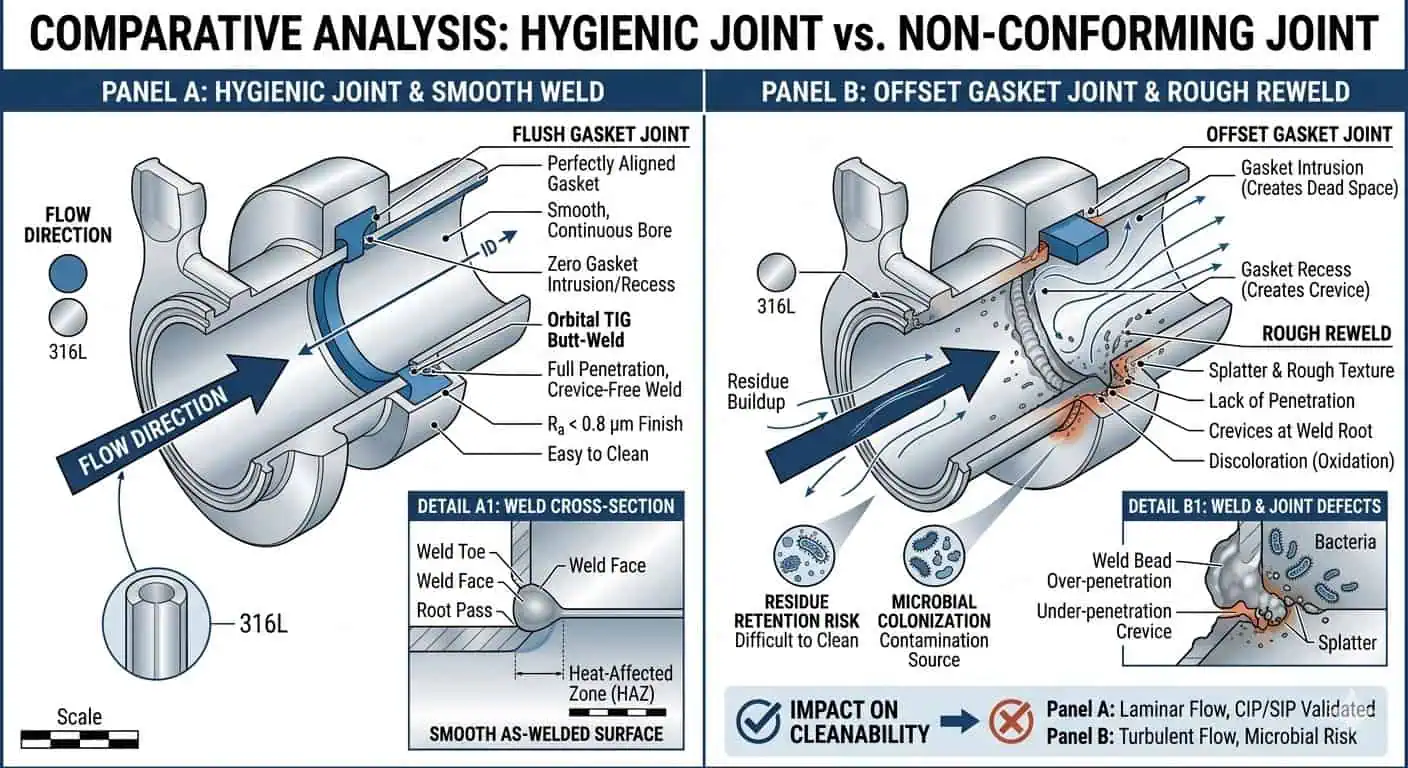
Why Gasket Lands and Joint Flushness Matter
Joint detail is often underestimated because it looks minor compared with line routing or material selection. In reality, gasket offset, poor flushness at a joint, or a local land that retains film can create a repeat cleaning burden far out of proportion to its size. This matters most where product is residue-prone and where visual or rinse confirmation is sensitive to small retained volumes.
Weld Condition and Surface Finish Affect More Than Appearance
Surface condition changes how easily soils release and how clearly the surface can be inspected after cleaning. Rougher local finish, heat tint, misalignment, or uneven weld profile can increase residue persistence and make repeat cleaning performance less stable. These issues are especially visible after field repairs or late project modifications that were not controlled to the same standard as the original hygienic fabrication.
Why “Sanitary” Hardware Still Needs Cleaning-Focused Review
Sanitary hardware is not automatically equivalent to optimal cleanability in every location. One recurring valve-cluster sanitation issue was ultimately traced not to the bulk material but to the combination of a gasket land detail and a rewelded spool section that changed local cleanability. The lesson was simple: local joint geometry and surface condition can outweigh the theoretical advantages of the base component specification.
That is also why flat gasket joints in CIP service deserve attention during design review. Where product-contact faces are not substantially flush, the joint itself can become a retention feature. This is a practical engineering issue, not only a maintenance detail.
This is also the point where 316L Stainless Steel for Personal Care Production Lines becomes relevant. A stronger alloy can improve corrosion margin, but it does not automatically improve local cleanability if geometry and finish remain weak.
Cleaning Chemistry, Passivation, and Material Condition—Where They Matter, and Where They Do Not Solve the Real Problem
Cleaning Chemistry Matters, but It Cannot Fix Weak Geometry
Detergent choice, temperature, concentration, and exposure time matter—but they are not substitutes for cleanability. If the line creates retained liquid, poor contact, or slow-rinsing pockets, stronger chemistry often only masks the real weakness for a while. Engineering teams should be cautious when “more cleaning time” becomes the default answer to a geometry-driven problem.
Passivation and Post-Fabrication Cleaning Should Be Treated as Controlled Steps
Post-fabrication cleaning and passivation are part of hygienic readiness, not decorative finishing. New or modified stainless surfaces may carry contamination, discoloration, or condition changes that affect corrosion behavior and inspection clarity. These steps should be defined as controlled requirements, especially where product-contact welds or repairs are involved.
When Material Upgrades Help—and When They Only Hide the Real Weak Point
Material upgrades can be useful, but only when they address a real material-driven risk. If the true problem is a dead leg, branch hold-up, poor drainback, or joint detail, upgrading the metal grade will not create a more cleanable system by itself. That is why cleaning review and material review should stay connected, not run as separate decisions.
Expert Insight:
When a team jumps from “we have a cleaning problem” directly to “we need a better material,” they often skip the more important question: where exactly is residue or slow recovery being created?
Designing for Faster Product Changeover in Cosmetic and Personal Care Lines
Why Changeover Is the Best Real-World Test of Hygienic Cleaning Performance
Changeover is where theoretical cleanability becomes an operating cost. A system that performs acceptably in a long single-product campaign may still become inefficient or unpredictable when products change frequently. The true test is whether the line can return to a stable, verifiable condition without excessive rinse time, product loss, or repeated attention to the same local section.
Where Product Hold-Up Becomes an Operating Cost
Retained product is not only a hygiene issue; it is also a throughput and yield issue. Hold-up increases product loss, slows restart, extends rinse confirmation, and can create uncertainty for the first material back into the line. This is why cleaning-critical sections deserve early prioritization in cosmetic and personal care projects.
How Engineers Should Prioritize Cleaning-Critical Sections
- Filler manifolds: multiple short legs can create uneven recovery.
- Sample branches: easy to underestimate, often slow to recover.
- Return legs: frequently control how quickly the loop stabilizes.
- Valve blocks: compact geometry can create localized cleaning burden.
- Equipment nozzles and transition spools: often where drainability changes suddenly.
If one line section is consistently slower than the rest during changeover, treat that as a local design signal rather than a whole-system mystery. In practice, a single poorly reviewed branch or joint detail can set the pace for the entire recovery process.
A Practical Cleaning-Focused Review Checklist for Hygienic Process Systems
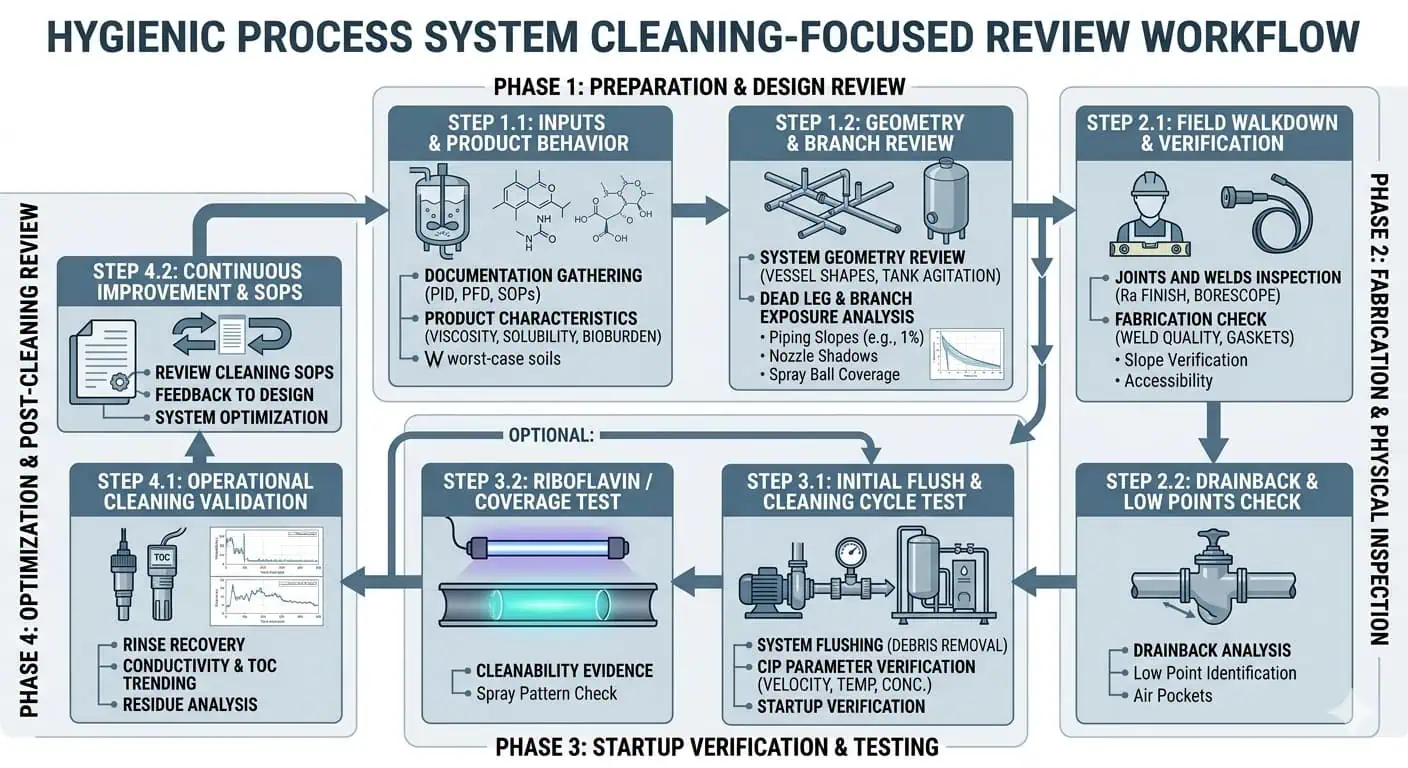
Questions to Ask Before Approving the Layout
- Does every product-contact branch actually see useful cleaning-solution contact?
- Where can residue remain after shutdown or partial drainback?
- Which low points are real after supports and installation, not only in the model?
- Are any joints or gasket lands likely to create local retention or inspection difficulty?
- Are there any late-added details that were never reviewed from a cleaning perspective?
Questions to Ask Before Releasing RFQs
| RFQ Topic | What Should Be Defined |
|---|---|
| Surface condition | State hygienic finish expectations for product-contact areas |
| Weld repair handling | Define how field rewelds must be treated and accepted |
| Post-fabrication cleaning | Include cleaning / passivation scope where required |
| Connection detail | Reduce nonstandard sample, instrument, and branch geometry |
| Cleaning-critical review | Identify which branches, manifolds, and return legs require special attention |
Questions to Ask Before Cleaning Validation or Startup
Startup review should check the real system, not just the intended one. Confirm actual drainback, observe rinse recovery behavior, identify slow sections, verify that late-added branches were reviewed as hygienic changes, and make sure local joints or repairs are not dominating the result. Visual confirmation also remains useful because a line cannot be considered cleanable if the areas that need to be assessed cannot be seen or reasonably evaluated after cleaning.
Common Reasons Hygienic Process Systems Still Fail Cleaning
Assuming More Cleaning Time Will Compensate for Poor Geometry
More exposure time does not reliably solve an entrapment problem. If solution contact is weak, the system may remain slow and inconsistent no matter how long the cycle runs.
Ignoring Branches Because the Main Pipe Looks Acceptable
Main-run appearance can be misleading. The section that controls recovery is often a small local feature the team did not initially classify as cleaning-critical.
Treating Gasket and Joint Details as Minor Mechanical Issues
Joint geometry directly affects product retention and local cleanability. If a joint detail is poor, the line may keep returning to the same sanitation concern.
Confusing Corrosion Resistance With Cleanability
A more corrosion-resistant surface is not automatically easier to clean. Cleanability still depends on contact, geometry, finish, and drainback.
Skipping Startup Verification of Real Drainback and Rinse Recovery
The installed system decides the outcome. If the plant never verifies true shutdown condition and rinse behavior, design weaknesses may remain hidden until production pressure exposes them.
Frequently Asked Questions About Cleaning in Hygienic Process Systems
What is the most important cleaning consideration in a hygienic process system?
The most important consideration is whether cleaning solution can actually contact and remove residue from all relevant product-contact areas. Without useful contact, time and chemistry alone will not create reliable cleaning.
Why do dead legs affect cleaning so much?
Because dead legs create entrapment zones where solution contact, air displacement, rinse recovery, and drainback are weaker than in the main run. These local areas often control the overall cleaning result.
Does 316L make a hygienic system easier to clean?
Not by itself. 316L can support hygienic service and corrosion margin, but it does not correct dead legs, poor drainability, weak joint detail, or rough local fabrication.
What usually slows rinse recovery in sanitary piping?
Slow rinse recovery is often caused by retained liquid, weakly exposed branches, local low points, joint details, or complex return paths. It is usually a local design or shutdown-behavior problem, not only a cleaning-chemistry problem.
Why can a sanitary line still fail cleaning even when CIP is installed?
Because a CIP system only provides the cleaning medium. If the line geometry prevents useful contact, rinse recovery, or drainback, the presence of CIP hardware alone will not make the system fully cleanable.
Are gasket joints a real cleaning risk in hygienic systems?
Yes. Gasket lands, local flushness, and joint detail can become real cleaning risks when they create retention, poor inspection access, or repeat residue at the same location.
What should engineers check before cleaning validation?
Engineers should confirm actual drainback, observe rinse recovery behavior, identify slow local sections, and verify that late-added branches, field rewelds, joints, and shutdown positions were reviewed as cleaning-critical details. Validation should reflect the installed line, not only the design intent.
Final Engineering Takeaway
Cleaning in a hygienic process system is a design-and-operation problem before it becomes a chemistry problem. Systems that clean predictably usually have short and rational product paths, limited dead-leg exposure, controlled branches, reliable drainback, disciplined joint and weld quality, and a realistic understanding of how the line behaves during shutdown and changeover. When these conditions are built into the system early, cleaning becomes easier to validate, faster to recover, and less dependent on trial-and-error adjustments later.
Expert Insight:
In the field, the most useful cleaning improvement is often not a stronger detergent or a longer cycle. It is a better understanding of where the system is preventing contact, retention, or drainback in the first place.
If your team is reviewing a cosmetic or personal care process line, start by identifying which product-contact sections repeatedly slow rinse recovery, retain residue, or attract repeated sanitation attention. Those locations usually define the real cleaning problem more clearly than the cleaning recipe itself.
Related Reading
- Sanitary Piping Design for Cosmetic Manufacturing
- 316L Stainless Steel for Personal Care Production Lines
- Sanitary vs Industrial Pipe Fittings
- Cosmetics & Personal Care Industry Solutions
- FDA Cosmetics GMP Guidelines / Inspection Checklist
- FDA Draft Guidance for Cosmetic Good Manufacturing Practices
- ISO 22716 Cosmetic GMP Guidelines
- ASME Branch Leg Study for Bioprocessing Equipment
- 3-A Cleanability of Equipment Resource Paper
- 3-A Primer for Standards and Practices
- 3-A General Requirements 00-02 Update
- ASTM A380 Cleaning, Descaling, Pickling, and Passivation Guidance
- ASTM A967 Chemical Passivation Treatments for Stainless Steel