
Specialty Fastening Solutions · OEM Serrated & Flange Nut Manufacturer
Specialty Serrated Flange Nuts: Engineered Serrations & Custom Flange Profiles for Critical Assemblies
Standard off-the-shelf flange nuts often fail to meet the unique vibration and load-distribution demands of advanced OEM assemblies. As a 30-year direct manufacturer of special nuts, we engineer customized Serrated Flange Lock Nuts and Plain Face Hex Flange Nuts. Whether you need aggressively angled teeth to bite into high-strength steel, an oversized plain flange to protect proprietary soft-metal coatings, or modified hex heights for restricted clearances, our cold-forging factory delivers precision-tailored fastening solutions that guarantee absolute joint integrity.
Configurations: Serrated Base (Flange Lock Nut), Plain Face (Smooth Base), Custom Oversized Flanges.
Specialty Customization: Modified tooth geometry (depth/angle), non-standard flange diameters, and custom thread pitches
Materials: Carbon Steel (Grade 8, 10, 12), 304/316 Stainless Steel, Alloy Steels.
Readiness: EN 10204 3.1 Certification, PPAP Level 3, and Custom Torque-Tension Testing.
Types of Serrated Flange Nuts
 Special Nuts
Weld Nuts Series
Inserts & Rivet Series
Furniture & Specialty

Serrated Flange Nut

Flange Lock Nut
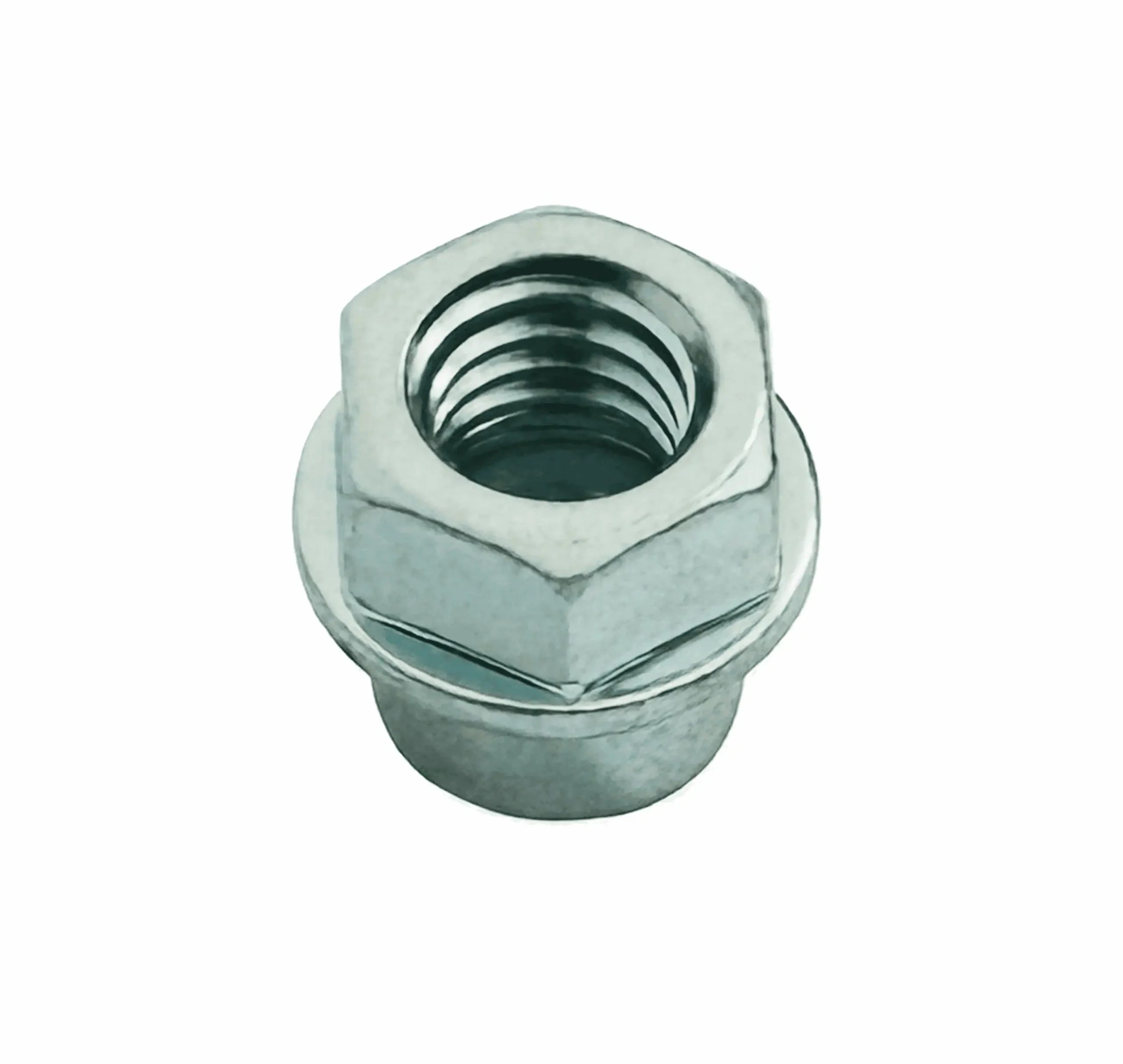
Hex Flange Nut
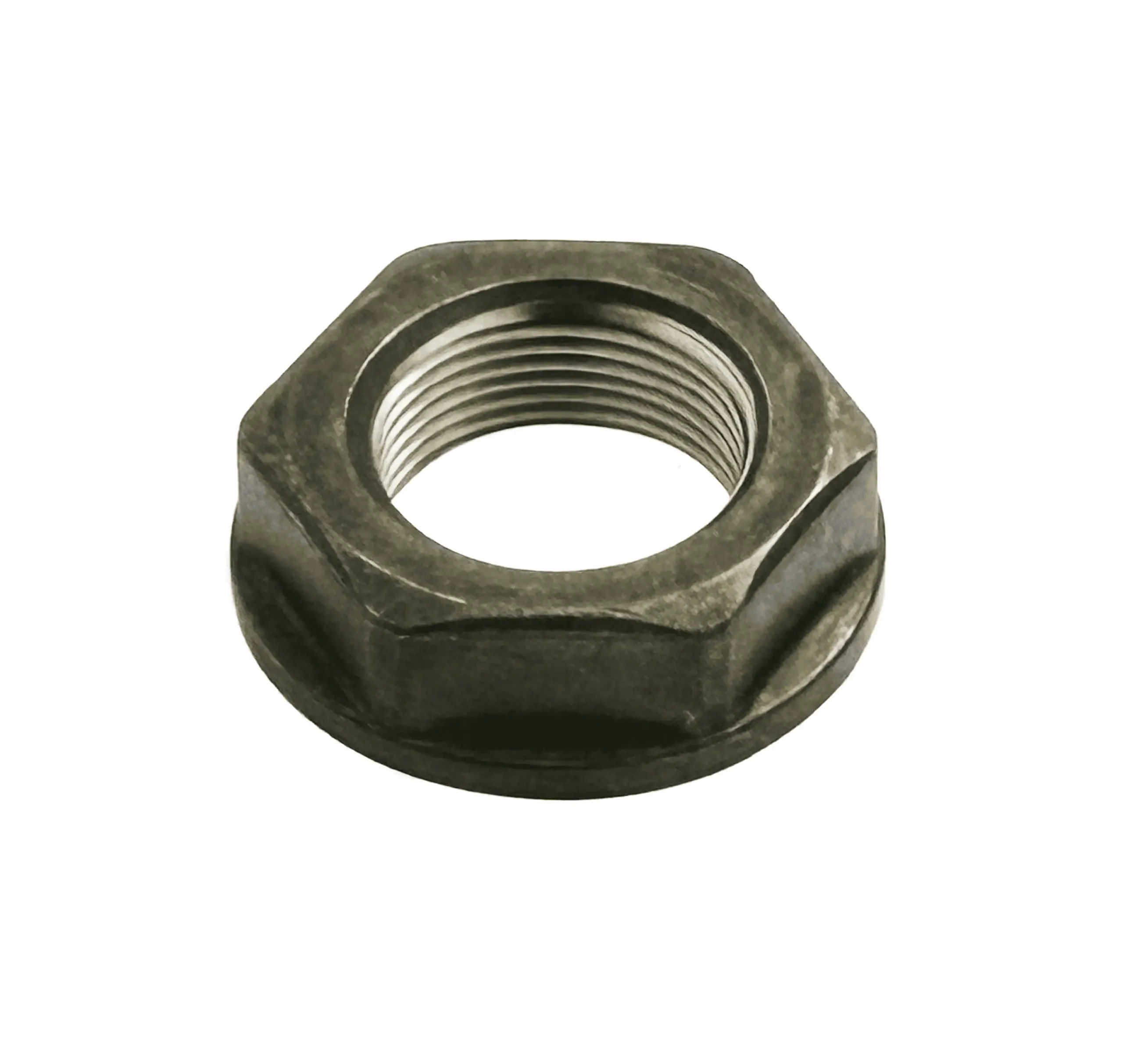
Hex Flange Nut (Plain Face)
The Engineering Advantage: Customizing the "Built-In Washer"
The fundamental physics of a flange nut is simple: the integrated wide base distributes the clamping load (measured in MPa) over a larger surface area, preventing the nut from pulling through the material. However, in the realm of Special Nuts, geometry is everything. If an OEM is using a proprietary ultra-thin composite metal, a standard DIN 6923 flange isn’t wide enough. We engineer Specialty Oversized Flange Nuts that act as massive snowshoes, safely dispersing kinetic loads across fragile materials without requiring secondary, clumsy flat washers on the assembly line.
What Is A Serrated Flange Nut?
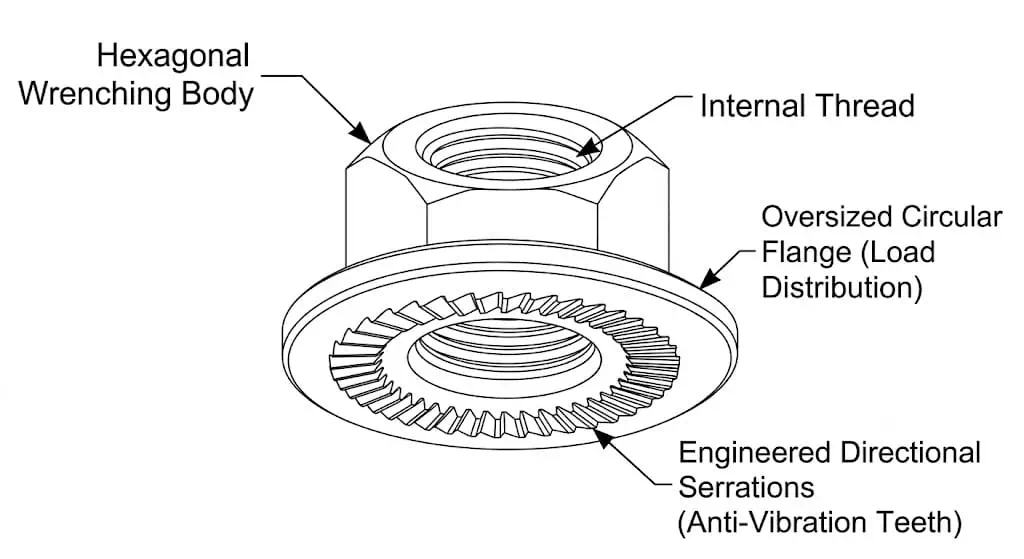
A serrated flange nut is a specialized cold-formed locking fastener that combines a hexagonal wrenching body with an integrated, oversized circular base (flange). Designed specifically to prevent loosening in high-vibration environments without the need for separate washers, the underside of the wide flange features aggressive, directional serrations (teeth). During torque-down, these teeth physically bite into the host material, creating a mechanical ratchet effect that resists counter-rotation and secures the joint.
Key Anatomy & Characteristics:
Engineered Directional Serrations (Anti-Vibration Teeth): Specialized teeth forged onto the bottom bearing surface. They allow the nut to turn easily in the tightening direction but dig into the mating surface to prevent backing off under dynamic loads.
Oversized Circular Flange (Load Distribution): A wide, flat base extending significantly beyond the hex body. It acts as a built-in washer, distributing the clamping load over a wider surface area to reduce surface pressure on thin or soft metals.
Hexagonal Wrenching Body: Provides a standard, high-strength surface for applying final torque with standard wrenches or automated tooling.
Internal Thread: The precision-tapped core that provides a permanent, high-torque fastening point.
Dimensional Reference: Base DIN 6923 Specifications
(Note: As a Special Nuts manufacturer, we use these dimensions merely as a baseline. We specialize in modifying flange diameters, hex heights, and serration depths to match your exact CAD blueprints.)
| Thread Size | Pitch (mm) | Width Across Flats (Max) | Standard Flange Dia. | Custom Flange Dia. |
| M5 | 0.80 | 8.00 mm | 11.80 mm | Engineered to Order |
| M6 | 1.00 | 10.00 mm | 14.20 mm | Engineered to Order |
| M8 | 1.25 | 13.00 mm | 17.90 mm | Engineered to Order |
| M10 | 1.50 | 15.00 mm | 21.80 mm | Engineered to Order |
| M12 | 1.75 | 18.00 mm | 26.00 mm | Engineered to Order |
Factory Engineering: Solving OEM Assembly Failures
Pain Point 1: Standard Serrations Failing on Hardened Steel
The Cause: When OEMs use standard serrated nuts on high-strength, heat-treated steel panels, the blunt standard teeth simply crush flat against the hard surface instead of biting into it, offering zero locking torque.
Our Solution: We engineer custom cold-heading dies to forge high-angle, extreme-depth serrations, and heat-treat the nut to a superior hardness grade. Our teeth bite into the hardest OEM chassis materials without deforming.
Pain Point 2: Flange Warpage (Non-Flat Bearing Surface)
The Cause: Poor material flow during standard cold-heading can cause the flange to cup or warp, meaning only the outer edge of the flange actually touches the panel, throwing off all torque-tension calculations.
Our Solution: We utilize multi-station cold formers that perfectly control the volumetric flow of the steel alloy. We guarantee a bearing surface that achieves 100% flush contact, ensuring the engineered clamp load is accurate and evenly distributed.
Industry Application Case Study
Sector: Commercial Solar Tracker Systems
The Challenge: An OEM of heavy-duty solar tracking mounts was using standard serrated flange nuts. However, the constant daily rotation and wind buffeting caused the standard shallow teeth to slip against their proprietary hardened steel brackets, leading to catastrophic structural loosening in the field.
Our Solution: Our engineering team analyzed their bracket hardness and vibration frequency. We manufactured a Custom Serrated Flange Nut featuring an aggressively modified tooth profile—30% deeper and angled specifically to resist the tracker’s reverse-rotational forces.
The Result: The customized serrations acted as an unbreakable mechanical ratchet against the hardened brackets. The field loosening rate dropped to 0 PPM, and the OEM successfully extended their structural warranty from 10 to 15 years.
FAQ
Can I use a Serrated Flange Nut on a painted or powder-coated surface?
No. The entire engineering purpose of a serrated nut is to aggressively bite into the mating material. If you use it on a painted or coated surface, the teeth will strip the paint down to the bare metal during torque-down. This immediately exposes the joint to rust and galvanic corrosion. For coated surfaces, you must specify our Plain Face Flange Nut.
Do I need to use a flat washer with your custom Flange Nuts?
No. Adding a washer underneath a flange nut completely defeats its engineering purpose. If you put a washer under a serrated flange nut, the teeth will bite into the washer instead of the host material, rendering the anti-vibration locking mechanism useless. Flange nuts are strictly designed to mate directly with the host panel.
Are Serrated Flange Nuts reusable?
For critical OEM joints, we advise against it. Every time a serrated nut is tightened and loosened, it carves away a microscopic layer of the host material. Repeated use will eventually create a smooth, galled groove in your panel, drastically reducing the friction and mechanical bite needed to keep the nut securely locked.