








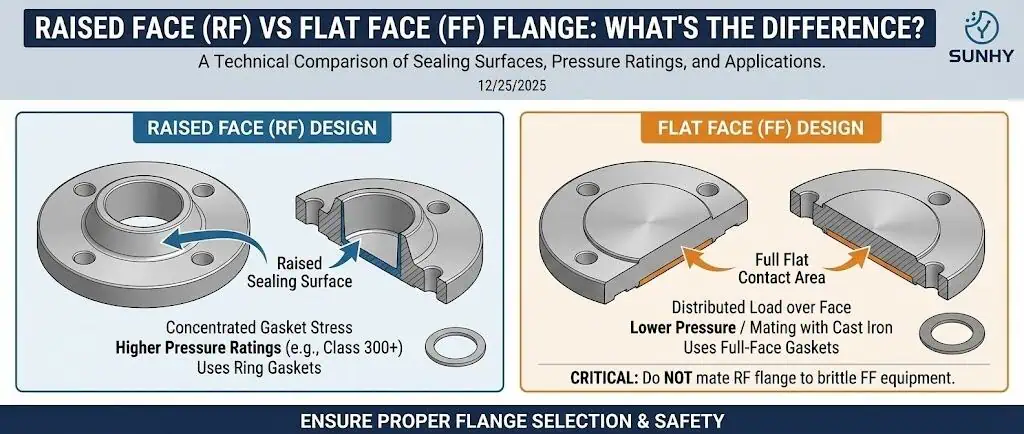
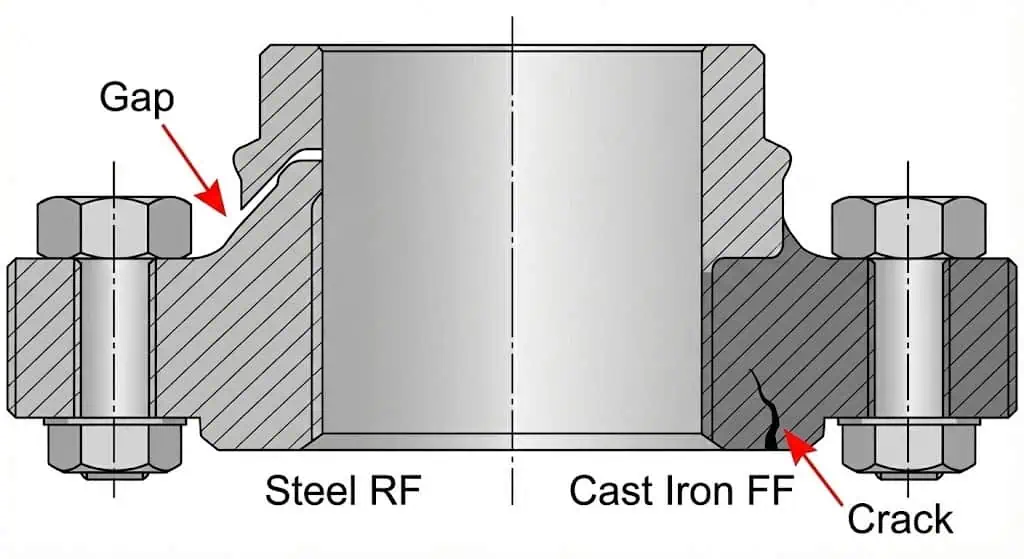
The critical engineering difference between raised face vs flat face flanges is the facing geometry (contact area), which strictly dictates gasket selection, bolt-load calculations, and mating compatibility. A frequent and costly field failure is mating a steel Raised Face (RF) flange to a cast iron Flat Face (FF) flange without mitigation; the resulting outer-edge gap introduces a “bending moment” that can snap the brittle cast iron flange during tightening.
- Raised Face (RF): The standard for steel process piping. Its reduced contact area concentrates bolt load to achieve high gasket seating stress, essential for sealing high-pressure fluids.
- Flat Face (FF): Mandatory when mating to brittle or low-ductility equipment (Cast Iron valves, FRP tanks, Bronze pumps) to distribute load evenly and prevent flange rotation.
Sunhy’s expertise in manufacturing stainless steel flanges ensures that every RF and FF facing meets the strict dimensional and roughness (Ra) requirements of ASME B16.5 and EN 1092-1. When specifying, treat “RF vs FF” not as a choice, but as an interface requirement dictated by your equipment.
Definitions and Features
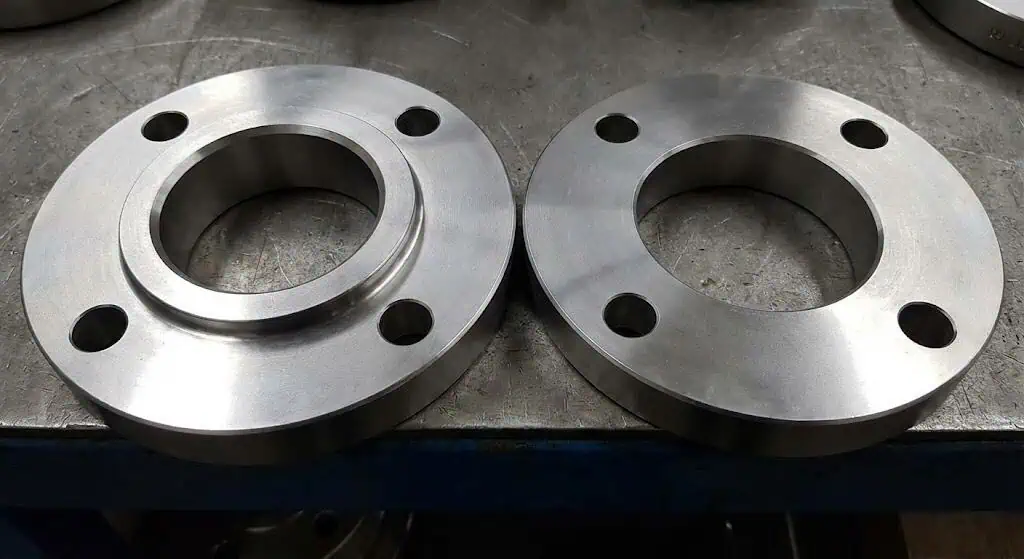
Raised face flange overview
A Raised Face (RF) flange features a sealing surface machined to a specific height above the bolting circle, designed to concentrate clamping force.
In the Oil & Gas and Chemical industries, RF is the default because this concentrated load allows the flange to “bite” into hard, semi-metallic gaskets (like Spiral Wound Gaskets). This creates a high-integrity seal capable of withstanding pressure fluctuations and thermal cycling.
Per ASME B16.5, the height of the raised face depends on the pressure class:
| Pressure Class | Raised Face Height | Surface Finish (Standard) |
|---|---|---|
| Class 150 & 300 | 1.6 mm (1/16 inch) | 125 to 250 µin Ra (Serrated) |
| Class 400 – 2500 | 6.4 mm (1/4 inch) | 125 to 250 µin Ra (Serrated) |
| Engineering Function | Concentrates Sealing Pressure | Increases friction to prevent gasket blowout |
RF flanges are typically forged from Carbon Steel (ASTM A105) or Stainless Steel (ASTM A182 F304/F316). The standard “phonographic” (concentric groove) finish is critical—it creates friction that holds the gasket in place. Using a smooth finish with a standard gasket can lead to hydraulic blowout.
Field Case #1 (The “Weeping” Steam Line): A client reported leakage on a Class 300 RF steam line. Investigation revealed they used a smooth-finish flange intended for a metal RTJ gasket but installed a graphite gasket. The lack of serrations meant zero friction grip. Fix: We supplied flanges with the correct 125-250 µin Ra serrated finish to grip the gasket.
Flat face flange overview
A Flat Face (FF) flange has a sealing surface that is flush with the bolting circle, providing full-face contact from bore to OD.
Engineers specify FF facings primarily to protect mating equipment made from brittle materials like Cast Iron (ASTM A126), Bronze, or Plastic. By supporting the full face of the flange, the design eliminates the “overhang” that causes bending stress.
Here are the defining engineering characteristics:
| Characteristic | Engineering Reason |
|---|---|
| Surface Design | Flush plane (No gap) reduces flange rotation and prevents cracking of brittle ears. |
| Mandatory Gasket | Full Face Gasket (with bolt holes) is required to support the outer bolt circle. |
Field Case #2 (The Cracked Pump Flange): A maintenance team bolted a steel RF flange to a cast iron FF pump. As they tightened the bolts, the raised face acted as a fulcrum. The outer edge of the cast iron flange had no support and snapped off. Prevention: Always use FF flanges or machine the RF off when connecting to cast iron.
Key design features
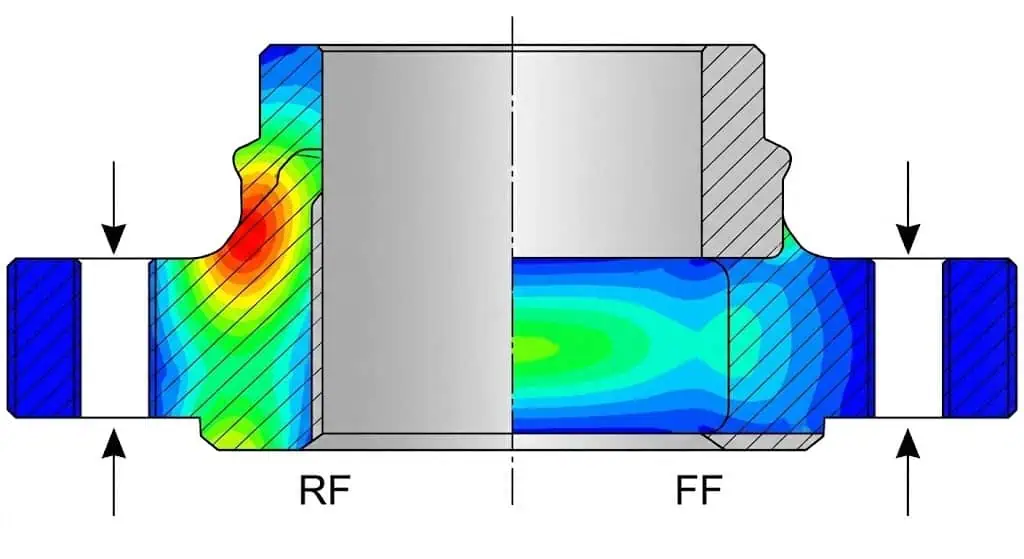
The structural difference dictates the mechanics of the joint: Concentration vs. Distribution.
An RF flange focuses energy to seal against high pressure. An FF flange distributes energy to protect the hardware. The correct choice is dictated by the mating component’s material properties.
| Feature | Raised Face (RF) | Flat Face (FF) |
|---|---|---|
| Geometry | Step change at gasket surface | Single continuous plane |
| Bolt Load Efficiency | High (Force ÷ Small Area = High Stress) | Lower (Force ÷ Large Area = Distributed Stress) |
| Typical Mating Material | Forged Steel, Stainless Steel | Cast Iron, Bronze, PVC, FRP |
| Compatible Gaskets | Spiral Wound, Ring Joint, Camprofile | Full Face Rubber/Fiber/PTFE only |
Field Rule: If you can slide a feeler gauge between the outer edges of two tightened flanges, it is likely a Raised Face joint. If the outer edges are touching tight, it is a Flat Face joint. (Always verify with spec sheets, as visual checks can be deceiving on insulated lines.)
Quality Assurance: Sunhy ensures all flanges meet ISO 9001 standards. For critical alloy projects, we provide Positive Material Identification (PMI) to verify that your 316L flange is actually 316L, preventing corrosion failures.
Flat face flange vs raised face flange: Main Differences
Engineering Insight: RF flanges are designed for sealing stress; FF flanges are designed for structural protection.
Sealing surface and construction
The main difference lies in Gasket Seating Stress vs. Flange Rotation Risk.
In an RF joint, the smaller facing area means you need less bolt torque to achieve a tight seal. In an FF joint, the large contact area means the seating stress is lower, which is why FF is typically used for lower pressure utility services (Water, Air).
| Flange Type | Sealing Mechanism Description |
|---|---|
| Raised Face Flange | Concentrates bolt load on the ring area (IBC – Inside Bolt Circle). Ideal for semi-metallic gaskets. |
| Flat Face Flange | Distributes bolt load across the full face. Required for soft gaskets on brittle equipment. |
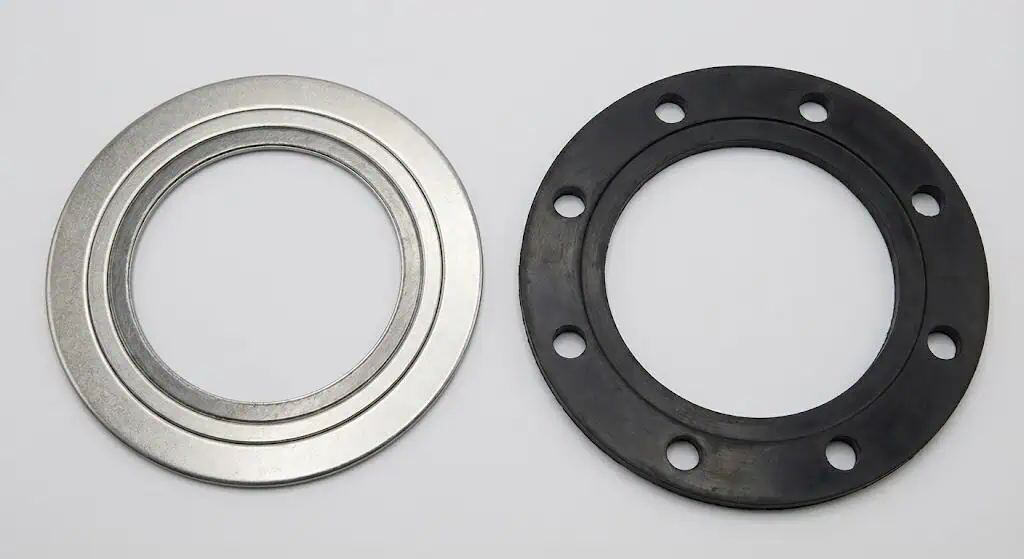
Gasket selection is non-negotiable here. You must use Full-Face gaskets on Flat Face joints. Using a ring gasket (IBC) on a Flat Face flange leaves the outer edge unsupported. When bolts are tightened, the flange rotates into this gap, causing leaks or breakage.
| Flange Type | Gasket Type | Installation Note |
|---|---|---|
| Raised Face | Ring-Type (IBC) | Compatible with Spiral Wound, Camprofile, and Graphite gaskets. |
| Raised Face | Full-Face | Rarely used. Can be used but requires higher torque to seal. |
| Flat Face | Full-Face | Mandatory for Cast Iron/FRP mates to prevent bending moments. |
Warning: Never use a Spiral Wound Gasket on a Flat Face Cast Iron flange. The metal winding is harder than the iron and will dig into the face, ruining the flange.
Pressure and temperature suitability
Raised Face flanges are the workhorse for high-pressure/temp applications (ASME B16.5). Flat Face flanges are limited by the brittle material they usually mate with (ASME B16.1).
Always verify the pressure-temperature rating of the weakest component in the system.
| Flange Type | Max Pressure Rating | Temp Limit (Typical) | Typical Service |
|---|---|---|---|
| Flat Face (Cast Iron) | Class 125 / 250 (per ASME B16.1) | Low (limited by iron ductility and gasket) | Water, Fire Mains, HVAC |
| Raised Face (Steel) | Class 150 – 2500 (per ASME B16.5) | High (up to 1000°F+ depending on alloy) | Steam, Hydrocarbons, Chemical |
Confusion Alert: Class 125 (Iron) and Class 150 (Steel) have the same bolt pattern. They will physically bolt together, but mixing their facings (RF to FF) is dangerous. Always check the material tag.
Manufacturing process
Sunhy employs precision CNC machining to ensure the surface finish (Ra) aligns with gasket requirements.
For RF flanges, we machine a precise 125–250 µin Ra serration. For Flat Face flanges, flatness is the critical parameter to ensure full support across the bolt holes.
| Certification | Why it matters for Flanges |
|---|---|
| ISO 9001 | Ensures traceability of heat numbers from billet to finished flange. |
| PED 2014/68/EU | Essential for pressure equipment compliance in the European market. |
| PMI Testing | Positive Material Identification guarantees chemical composition (e.g., Mo > 2.0% for 316L). |
Even small deviations in raised face height or flatness can lead to leaks. Sunhy performs 100% dimensional inspection before shipment to ensure fit-up at the site is seamless.
Comparison of the advantages and disadvantages of Raised Face vs Flat Face Flange
I. Raised Face Flanges (RF): Pros and Cons
The Raised Face (RF) is the industry workhorse for a reason, but it is not without limitations.
Advantages
- High Sealing Integrity: The concentrated load creates a tighter seal, essential for volatile or toxic fluids.
- Gasket Versatility: Can use almost any gasket type (Spiral Wound, RTJ, Graphite, Rubber).
- Ease of Installation: Ring gaskets (IBC) are self-centering inside the bolts, making installation faster.
Disadvantages
- Brittle Material Risk: Cannot be bolted directly to Cast Iron without risk of cracking the mating flange.
- Alignment Sensitivity: Because the contact area is small, angular misalignment can cause localized crushing of the gasket.
II. Flat Face Flanges (FF): Pros and Cons
The Flat Face (FF) is a protective design, prioritizing equipment safety over high-pressure sealing.
Advantages
- Equipment Protection: The only safe option for mating with Cast Iron, Glass-Lined, or Plastic equipment.
- Rigidity: Full-face contact reduces vibration and flange rotation.
- Visual Check: Easy to verify tightness—if there is no gap at the OD, the flange is likely seated (though torque check is still required).
Disadvantages
- Limited Pressure: Due to distributed load, it is difficult to achieve the high seating stress needed for Class 600+ pressures.
- Strict Gasket Rules: Must use Full-Face gaskets. Cannot use high-performance Spiral Wound gaskets.
- Surface Area Penalty: Requires higher total bolt load to achieve the same seal tightness as an RF flange.
| Feature | Raised Face (RF) | Flat Face (FF) |
| Sealing Ability | High (Concentrated stress) | Moderate (Distributed stress) |
| Primary Use | Steel Piping (Process lines) | Cast Iron/FRP/Utility |
| Risk Factor | Can crack brittle mates | Can leak if wrong gasket used |
| Gasket Types | Versatile (SWG, RTJ, IBC) | Restricted to Full-Face Soft Gaskets |
Applications and Use Cases
Raised face flange in the industry
RF flanges are the standard wherever leak containment is critical.
Engineers specify RF for systems that experience thermal expansion, pressure surges, or contain hazardous media.
- Oil & Gas: High-pressure transport lines where Spiral Wound Gaskets are mandatory for fire safety.
- Chemical Processing: Corrosive acid/alkali lines using exotic alloys (Hastelloy/Duplex) with RF facings.
- Steam Systems: Power plant steam lines use RF flanges because thermal cycling would loosen a Flat Face joint.
Flat face flange in the industry
FF flanges are the standard for Utility and Low-Pressure services involving cast/ductile iron components.
They are ubiquitous in municipal and general industrial support systems.
- Water Treatment: Connections to large Cast Iron Gate Valves and Check Valves (AWWA C207 or ASME B16.1).
- Fire Protection: Hydrants and sprinkler mains typically use Class 125 FF interfaces.
- Marine/HVAC: Seawater cooling loops using Bronze or Copper-Nickel pumps often require FF to prevent cracking the pump body.
Compatibility and installation
The Golden Rule of Piping: Never bolt a Steel RF flange directly to a Cast Iron FF flange without mitigation.
This is a “hard fail” scenario. The gap created by the raised face acts as a lever, and the cast iron flange will snap.
| Scenario | Correct Solution |
|---|---|
| Connecting Steel Pipe to Cast Iron Valve | Option 1: Buy a Flat Face steel flange. Option 2: Machine the Raised Face off your steel flange to make it flat. |
| Gasket Selection | Use a Full Face Gasket (Rubber/Fiber) to fill the entire gap and distribute load. |
| Torque Control | Use the torque values for Cast Iron, not Steel. Over-torquing will strip the iron threads or crack the body. |
Tip: If you cannot machine the flange, some sites use a “Spacer Ring” to fill the gap, but machining or buying the correct FF flange is always the safer, leak-proof engineering solution.
Choosing the Right Flange
Key selection factors
Flange selection is usually determined by the “Weakest Link” in your system—typically the valve or pump connection.
Use this engineering decision checklist:
| Factor | Decision Rule |
|---|---|
| Mating Equipment | Is the pump/valve Cast Iron, Plastic, or Bronze? Use Flat Face. Is it Steel? Use Raised Face. |
| System Pressure | Class 150/300/600+ usually defaults to RF. Class 125 (Iron) strictly defaults to FF. |
| Gasket Type | Do you need a fire-safe Spiral Wound Gasket? You need Raised Face flanges to seat it properly. |
| Fluid Service | Hazardous/Toxic service generally requires the superior containment of an RF joint with a semi-metallic gasket. |
Sunhy’s technical team can cross-reference your pump and valve cut-sheets to help confirm facing and gasket selection before fabrication, ensuring you don’t face delays during site assembly.
Industry standards and codes
Your flanges must meet the governing codes to ensure safety and interchangeability.
Sunhy supports projects aligned to these major global standards:
| Standard/Code | Description |
|---|---|
| ANSI/ASME B16.5 | The “Bible” for Steel Pipe Flanges. Defines RF heights and pressure classes. |
| ASME B16.1 | The standard for Gray Iron Pipe Flanges (commonly FF in Classes 125/250). |
| AWWA C207 | Waterworks flanges (Steel Ring Flanges). Often Flat Face for low pressure. |
| DIN EN 1092-1 | European metric standard (Type 11 = RF Weld Neck; Type 01 = FF Plate). |
Ensure your purchase order specifies the standard explicitly (e.g., “ASME B16.5, Class 150, RF, A182 F316L, NPS 4, 125-250 AARH Finish”).
Common mistakes to avoid
Avoid these costly field failures by following proper specification and assembly discipline:
- The “Gap” Error: Leaving a visible gap between the outer edges of an RF-to-FF connection. This indicates bending stress on the flange.
- The “Wrong Gasket” Error: Using a hard Spiral Wound gasket on a soft Flat Face flange. The metal winding will crush the face or crack the flange.
- Over-Torquing: Applying “Steel” torque values to “Cast Iron” flanges. Iron is brittle; respect the lower torque limits of ASME B16.1 equipment.
- Reusing Gaskets: Once compressed, gaskets lose their recovery properties. Always install new gaskets when reassembling a joint.
Note: Contact Sunhy’s experts if you are unsure about a connection. We can machine custom flanges to solve RF/FF mismatch problems.
FAQ
What is the main difference between raised face and flat face flanges?
The sealing surface geometry and load distribution. Raised Face (RF) flanges have a raised step (1/16″ or 1/4″) to concentrate pressure for high-performance sealing. Flat Face (FF) flanges are flush to the OD to distribute load evenly, preventing damage to brittle materials like Cast Iron.
Can you connect a raised face flange to a flat face flange?
Not directly to brittle equipment. If connecting Steel RF to Cast Iron FF, you must machine the raised face flat and use a full-face gasket. Failure to do so creates a bending moment that will snap the cast iron flange. If connecting Steel to Steel, it is generally safe but not ideal.
Which industries use raised face flanges most often?
Process industries (Oil & Gas, Chemical). RF is the standard for steel piping because it supports high-pressure Spiral Wound Gaskets and provides the tightest seal for hazardous fluids.
What gasket should you use with each flange type?
RF: Spiral Wound, Ring Joint (RTJ), or Camprofile gaskets (Inside Bolt Circle).
FF: Full-Face gaskets (with bolt holes) made of Rubber, Fiber, or PTFE. Never use a hard metal gasket on a Flat Face.
How do you choose the right flange for your system?
Check the mating equipment first. If your valve is Cast Iron (Class 125), you need a Flat Face flange. If your valve is Steel (Class 150/300), you need a Raised Face flange. Always match the facing to the equipment’s material limits.
| Factor | Raised Face Flange | Flat Face Flange |
|---|---|---|
| Pressure | Common across ASME B16.5 classes (material dependent) | Often tied to cast iron/utility standards (service dependent) |
| Material | Steel / Stainless | Cast Iron / FRP / Plastic / Lined equipment |
Tip: Consult Sunhy’s engineering team for torque strategy, gasket compatibility, and facing verification—especially for dissimilar joints and brittle equipment interfaces.
For a full overview of flange types and standards, see our complete guide