








Quick Answer: DIN 934, ISO 4032 or ASME B18.2.2 — Which One Should You Use?
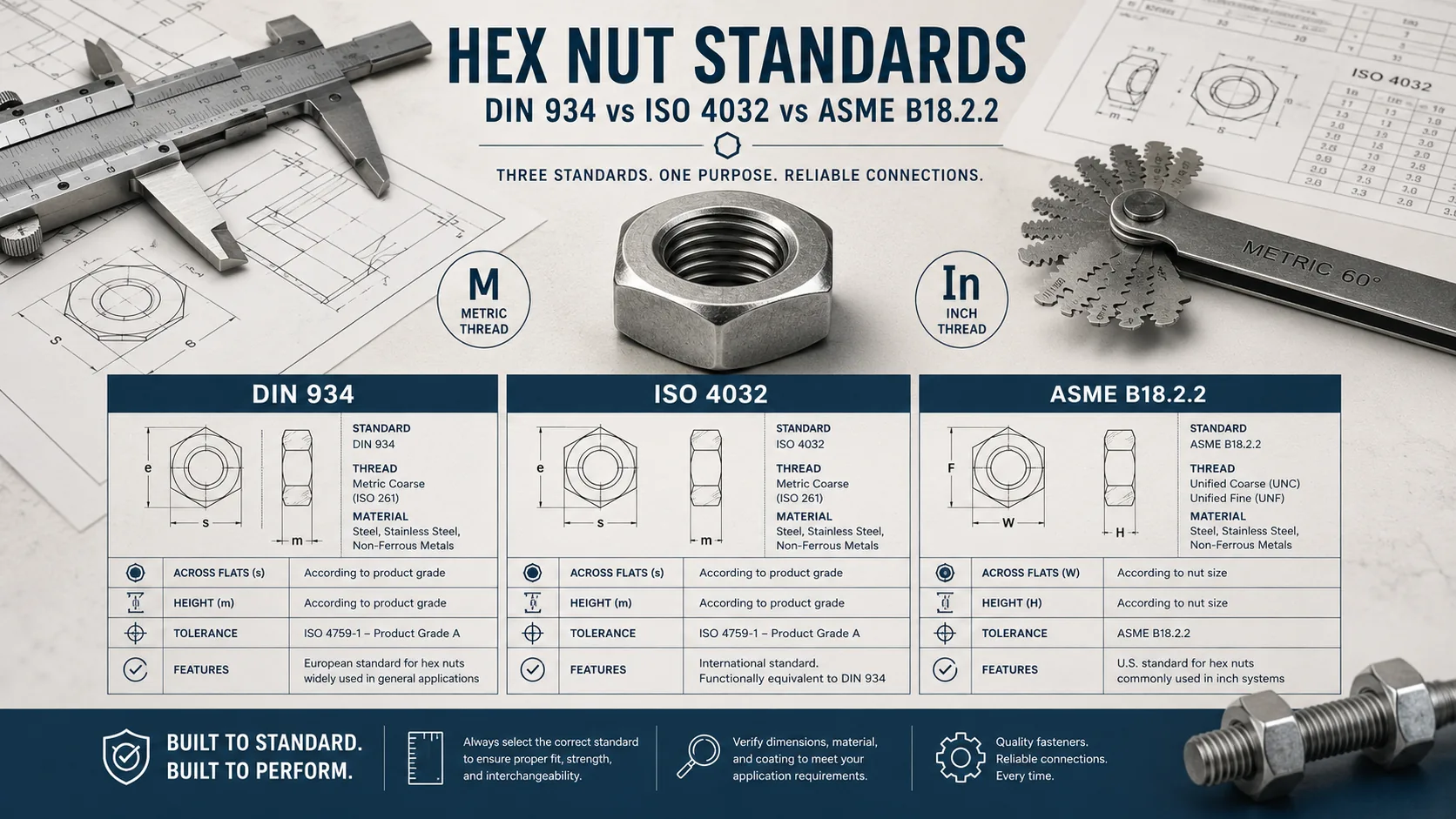
Use DIN 934 when an old metric drawing or spare-part list still requires the legacy DIN hex nut reference. Use ISO 4032 for current metric hexagon regular nuts in new machinery or export projects. Use ASME B18.2.2 when the drawing uses inch-series UNC or UNF threads. Do not substitute one standard by name only; confirm thread system, pitch, nut height, width across flats, property class, material, coating and drawing approval first.
For a new metric project, ISO 4032 is normally the cleaner specification. For an old European machine, follow the DIN 934 drawing unless engineering approves a substitute. For U.S. inch bolts, use ASME B18.2.2 dimensions and confirm the required ASTM material or grade separately. ISO 4032:2023 covers hexagon regular nuts, style 1, in steel and stainless steel, with metric coarse pitch threads from M5 to M39 and product grades A and B.
Engineering summary: DIN 934 and ISO 4032 are metric hex nut references, but they should not be substituted by name only. ASME B18.2.2 belongs to inch-series nuts. Always confirm thread system, dimensions, grade, material, coating, lubrication condition and drawing approval before bulk ordering.
In the workshop, the mistake usually appears late: a nut starts by hand but locks after two turns, a socket cannot reach the flats, the torque wrench clicks but preload does not build, or a coated nut fails the go/no-go thread gauge. That is why standard comparison is not a catalog exercise; it is a joint reliability check.
What Are DIN 934, ISO 4032 and ASME B18.2.2 Hex Nuts?
DIN 934, ISO 4032 and ASME B18.2.2 are hex nut standards used in different drawing systems and markets. They do not all define the same thread system, strength grade, material or coating condition. For B2B purchasing, the standard number must be combined with size, pitch, property class, material, surface treatment and inspection requirements.
Hex nut standards do not all answer the same question. Some mainly define dimensions. Some support mechanical property selection through related standards. Some are used because an old drawing still says so. A buyer who treats every “standard hex nut” as the same part can easily buy a nut that fits the thread by hand but fails the assembly by height, wrench clearance, coating allowance or strength grade.
DIN 934 Hex Nuts: Legacy Metric Standard for Older Drawings
DIN 934 hex nuts are still common in old European machinery drawings, spare parts lists, repair manuals and distributor catalogs. Many maintenance buyers continue to request DIN 934 because the equipment documentation was created before the buyer updated its internal fastener standards.
DIN 934 should be treated as a drawing requirement, not just a product name. When a drawing calls for DIN 934, the supplier should confirm whether the buyer accepts an ISO equivalent or requires strict DIN replacement. This matters for maintenance because a small difference in nut height, width across flats, chamfer or bearing face can affect socket access, exposed thread length, washer stack height and assembly clearance.
Engineering note: if the equipment is old, modified or repaired many times, do not rely on the catalog name alone. Ask for the drawing, sample, bolt size, thread pitch and assembly photo before confirming substitution. Old machines often contain mixed DIN, ISO, JIS and inch fasteners from previous repairs.
ISO 4032 Hexagon Regular Nuts: Current Metric Standard
ISO 4032 is widely used for current metric hexagon regular nuts. ISO 4032:2023 specifies the characteristics of hexagon regular nuts, style 1, in steel and stainless steel, with metric coarse pitch thread from M5 to M39 and product grades A and B. If property classes or stainless steel grades are requested, they should be selected from ISO 898-2 or ISO 3506-2.
Use ISO 4032 when the project is a new metric design, an export machinery project, or a standard industrial assembly where the customer accepts current ISO metric fasteners.
A complete ISO 4032 RFQ should not stop at the standard number. It should also include:
- Size and pitch, such as M12 × 1.75
- Property class, such as Class 8 or Class 10
- Material, such as carbon steel, 304 stainless steel or 316 stainless steel
- Surface treatment, such as zinc plated, hot-dip galvanized, zinc flake or plain
- Inspection requirement, such as thread gauge, hardness or proof load
- Packaging and batch traceability requirement
Why it matters: ISO 4032 tells the buyer the dimensional family, but it does not remove the need to specify property class, material and coating. A Class 5 nut and a Class 10 nut may both be quoted as metric hex nuts, but they do not carry the same proof load in a high-preload joint.
ASME B18.2.2 Hex Nuts: Inch-Series Standard for U.S. Drawings
ASME B18.2.2 is used for inch-series nuts. ASME identifies B18.2.2-2022 as covering nuts for general applications, including machine screw nuts, hex nuts, square nuts, hex flange nuts and coupling nuts in inch series.
Use ASME B18.2.2 when the drawing uses inch thread callouts such as:
- 1/4-20 UNC
- 5/16-18 UNC
- 3/8-16 UNC
- 1/2-13 UNC
- 1/2-20 UNF
- 5/8-11 UNC
- 3/4-10 UNC
ASME B18.2.2 should not be treated as a substitute for ISO 4032. It uses a different thread language, different dimensional system and different purchasing context. For structural or mechanical carbon steel inch nuts, the material and mechanical requirements may need to be specified through ASTM A563/A563M or another project-required ASTM standard.
Why the Standard Name Alone Is Not Enough for Purchasing
A standard name tells only part of the story. It may define dimensional characteristics, but it may not fully define strength, material, coating, lubrication or assembly behavior. In a bolted joint, the nut must support preload without thread stripping, galling, proof load failure or vibration loosening.
A weak RFQ says:
Hex nut, M12, zinc plated.
A better RFQ says:
ISO 4032 hex nut, M12 × 1.75, Class 8, carbon steel, zinc plated Cr3+, thread tolerance 6H, with material certificate and go/no-go thread gauge inspection.
For inch nuts, a better RFQ says:
ASME B18.2.2 finished hex nut, 1/2-13 UNC, carbon steel, zinc plated, ASTM grade requirement to be confirmed by application.
If torque is specified, add coating and lubrication condition. A dry zinc-plated nut, a hot-dip galvanized nut and a PTFE-coated nut can produce different preload at the same torque because the K factor changes.
DIN 934 vs ISO 4032: Are They Interchangeable?
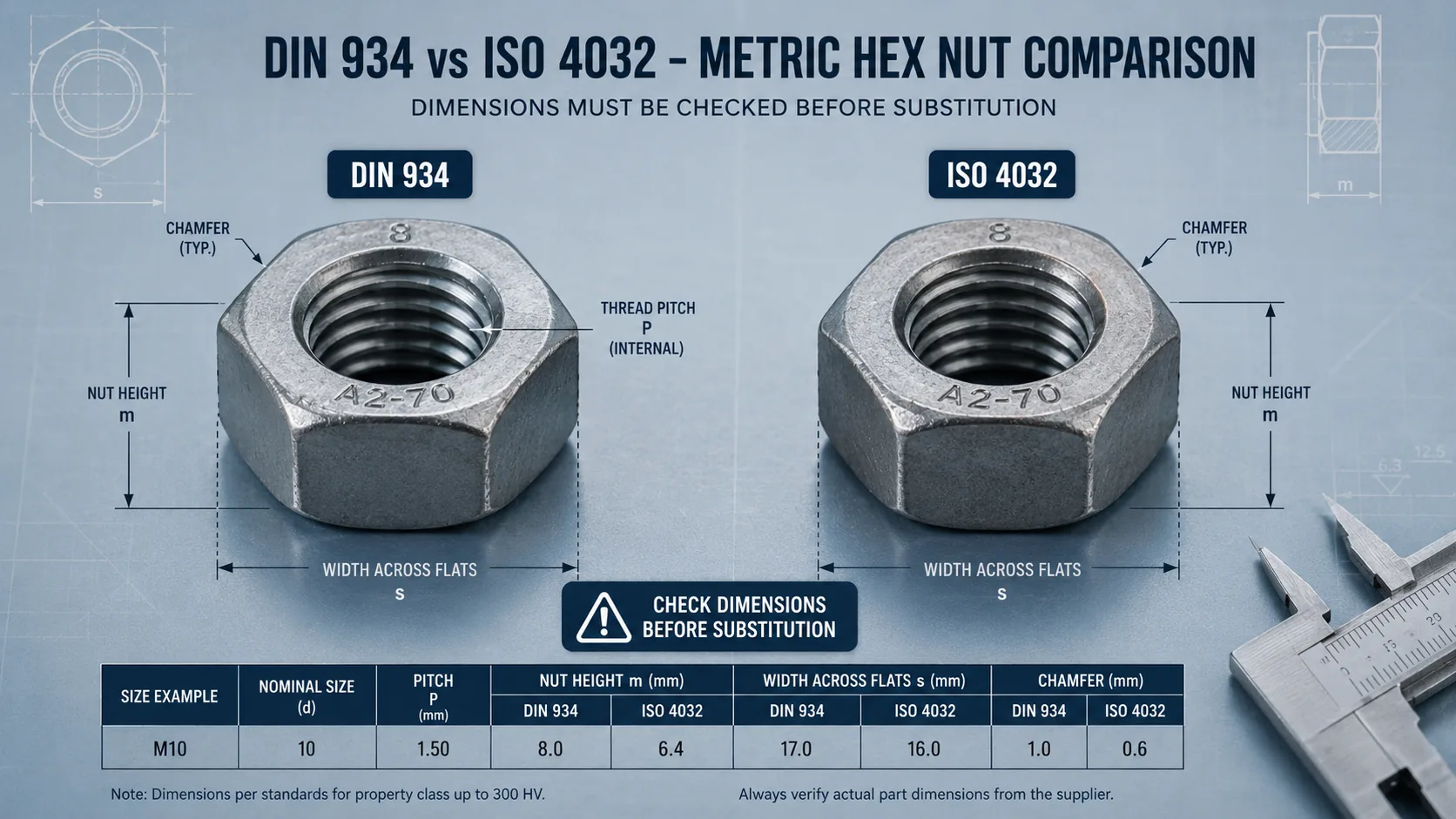
DIN 934 and ISO 4032 may be practically substitutable in some metric hex nut orders, but they are not automatically identical for controlled assemblies. Before substitution, check pitch, width across flats, nut height, chamfer, thread tolerance, property class, coating thickness and drawing approval.
Practical substitution is most risky on old machines, recessed joints, narrow wrench-access areas, and assemblies where exposed thread length is controlled. In one maintenance project, an old European machine still called for DIN 934 nuts. The supplier shipped ISO 4032 equivalents because the thread size matched. The nuts ran onto the bolts, but the socket could not reach the flats inside a recessed pocket. The fix was not a stronger nut; it was dimensional confirmation against the original drawing, including nut height, width across flats and washer stack clearance.
Why Buyers Still Specify DIN 934
Buyers still ask for DIN 934 because many old drawings, spare parts manuals and ERP systems have not been updated. This is common in:
- European equipment repair
- Industrial machinery maintenance
- Old OEM spare parts lists
- Distributor stock descriptions
- Mixed-standard workshops
- Export markets where customers still use DIN names
For a supplier, the phrase “DIN 934 hex nut” often means: “Please match the old drawing or old stock.” It does not always mean the buyer understands the latest ISO replacement relationship.
Key Dimensional Checks Before Substitution
Before replacing DIN 934 with ISO 4032, check:
| Check Item | Why It Matters |
|---|---|
| Thread diameter | Must match the bolt and thread gauge |
| Thread pitch | Prevents cross-threading, false torque and preload loss |
| Width across flats | Affects wrench, socket and automated tool fit |
| Nut height | Affects thread engagement, proof load and exposed thread length |
| Chamfer | Affects starting, assembly feel and edge damage |
| Bearing surface | Affects friction, washer contact and clamp load transfer |
| Product grade | Affects dimensional tolerance level |
| Property class | Affects proof load, hardness and stripping resistance |
| Coating thickness | Affects thread fit, torque scatter and gauge acceptance |
| Drawing revision | Determines whether substitution is allowed |
A nut may thread onto the bolt but still fail a production assembly because the socket cannot reach it, the nut height changes the clamp stack, or the coating causes tight running on the bolt. For high-volume assembly, even a small wrench-clearance difference can become a line-stop issue.
Coarse Thread, Fine Thread and ISO Replacement Risk
For metric nuts, coarse thread and fine thread must be specified clearly. A common purchasing problem is that a buyer says “DIN 934 M12” without stating whether the application uses standard coarse pitch or a fine pitch variant. If the bolt is M12 × 1.25 and the nut supplied is M12 × 1.75, the threads are not compatible.
For current ISO metric nuts, ISO 4032 is the key reference for hexagon regular nuts with metric coarse pitch thread M5 to M39. If the project uses fine pitch metric threads, the buyer should confirm the correct ISO fine-thread nut standard and not assume ISO 4032 covers every metric thread case.
Field check: when the thread is uncertain, use a pitch gauge before quoting. Do not identify M12 coarse and M12 fine thread by eye, especially on used bolts with damaged crests.
Engineering Warning: Thread Fit Does Not Mean Full Interchangeability
If the old drawing says DIN 934 and the supplier ships ISO 4032 without dimensional confirmation, the nut may fit the thread but still fail the assembly. The common failure points are not always dramatic. They may show up as:
- Socket clearance failure
- Insufficient thread projection
- Washer stack mismatch
- Coating-related tight fit
- Unexpected torque scatter
- Inspection rejection because the drawing still calls for DIN 934
For maintenance parts, the safest approach is to confirm the drawing requirement, sample dimensions and buyer approval before substitution. For safety-related joints, do not approve substitution without engineering sign-off.
ISO 4032 vs ASME B18.2.2: Metric vs Inch Hex Nut Systems
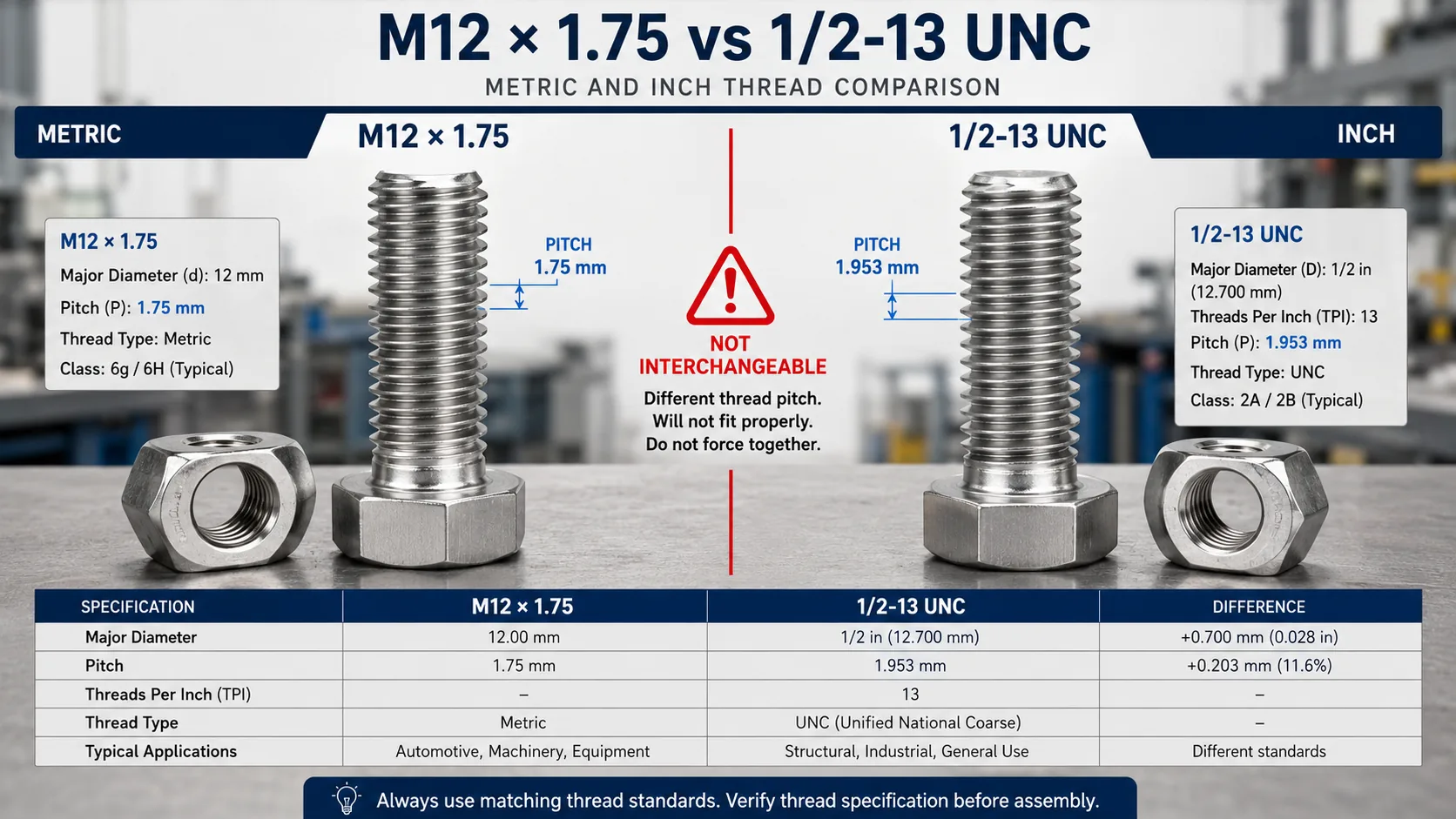
ISO 4032 is a metric hex nut standard using millimeter-based thread callouts such as M12 × 1.75. ASME B18.2.2 is an inch-series nut standard using UNC or UNF callouts such as 1/2-13 UNC. These systems are not interchangeable and require different gauges, drawings and inventory control.
This is not a small naming difference. A maintenance team once ordered 1/2-13 UNC nuts for an assembly that actually used M12 × 1.75 bolts. The nuts started by hand and then locked. After the installer used a wrench, the bolt threads were damaged and the torque reading no longer represented preload. The real cause was mixed metric/inch inventory and a missing pitch callout in the RFQ.
Metric Thread vs UNC / UNF Thread
Metric threads are described by nominal diameter and pitch in millimeters.
Example:
M12 × 1.75
This means:
- M12 = nominal thread diameter
- 1.75 = thread pitch in millimeters
Inch threads are commonly described by nominal diameter and threads per inch.
Example:
1/2-13 UNC
This means:
- 1/2 inch = nominal thread diameter
- 13 = threads per inch
- UNC = Unified National Coarse thread
These two systems must not be mixed. The nut may start on the bolt, but the flank contact will be wrong and the thread can tear before any useful preload is created.
Pitch in Millimeters vs Threads Per Inch
Metric pitch and inch TPI are different ways of describing thread spacing. A maintenance buyer may see that M12 and 1/2 inch look close in physical size, but the thread forms and pitch are different.
What can go wrong: the nut may start by hand for one or two turns, then bind. If the installer uses a wrench or impact tool, the threads can cross-thread, tear, or lock. The torque reading becomes meaningless because torque is being consumed by thread damage, not preload.
For critical joints, the wrong thread system can also create hidden risk. A damaged thread may pass casual visual inspection but fail under vibration, shear stress or cyclic loading after the machine enters service.
Why M12 × 1.75 and 1/2-13 UNC Must Not Be Mixed
M12 × 1.75 and 1/2-13 UNC are a common field mistake because their outside sizes appear visually close. They are not interchangeable.
Mixing them can cause:
- Cross-threading
- Damaged bolts
- Damaged internal nut threads
- False torque readings
- Low or unstable clamp load
- Assembly rework
- Field service delay
For B2B procurement, separate metric and inch fastener bins, labels and RFQ templates are worth the effort. A wrong bin label can cost more than the nut itself.
When ASME B18.2.2 Is the Correct Standard
Use ASME B18.2.2 when:
- The drawing uses inch dimensions
- The bolt thread is UNC or UNF
- The equipment is from a U.S. or North American design
- The customer specifically requests ASME inch-series nuts
- The maintenance part is for inch fastener inventory
- The mating bolt is not metric
For mechanical properties, ASME B18.2.2 should be paired with the correct material or grade specification. ASTM A563, for example, covers chemical and mechanical requirements for carbon and alloy steel nuts used for structural and mechanical applications.
Standard Comparison Table: DIN 934 vs ISO 4032 vs ASME B18.2.2
The fastest way to compare DIN 934, ISO 4032 and ASME B18.2.2 is to separate three issues: thread system, dimensional standard and mechanical requirement. DIN 934 and ISO 4032 are metric references. ASME B18.2.2 is an inch-series dimensional standard. Grade and material must still be specified separately.
| Item | DIN 934 | ISO 4032 | ASME B18.2.2 |
|---|---|---|---|
| Thread system | Metric | Metric | Inch |
| Common thread language | M size and pitch | M size and pitch | UNC / UNF |
| Main use | Legacy metric drawings and spare parts | Current metric hexagon regular nuts | U.S. inch-series nuts |
| Common market | Europe, legacy equipment, distributor stock | Global metric projects | U.S. / North America |
| Typical buyer | Maintenance buyer, distributor, OEM replacement | OEM buyer, machinery manufacturer, exporter | U.S. OEM, MRO, distributor |
| Substitution risk | Medium | Low when correctly specified | High if mixed with metric |
| Mechanical grade included? | Must be specified separately | Property class selected separately | Grade/material specified separately |
| Main risk | Assuming it equals ISO without checking | Forgetting property class or material | Mixing inch nuts with metric bolts |
| Buyer must confirm | Old drawing dimensions and substitute approval | Property class, material, coating, inspection | UNC/UNF, nut type, ASTM grade if required |
Buyer Confirmation Checklist
Before approving substitution or quotation, confirm:
- Same thread system?
- Same thread pitch?
- Same width across flats?
- Same nut height?
- Same thread tolerance?
- Same property class or grade?
- Same material?
- Same coating?
- Same thread gauge requirement?
- Same drawing approval?
- Same packaging and traceability requirement?
This checklist is especially important for distributors quoting replacement parts. The customer may not know whether the old drawing is still technically valid, but they will still reject the shipment if the part does not fit.
Mechanical Grades and Property Classes: What the Standard Does Not Solve
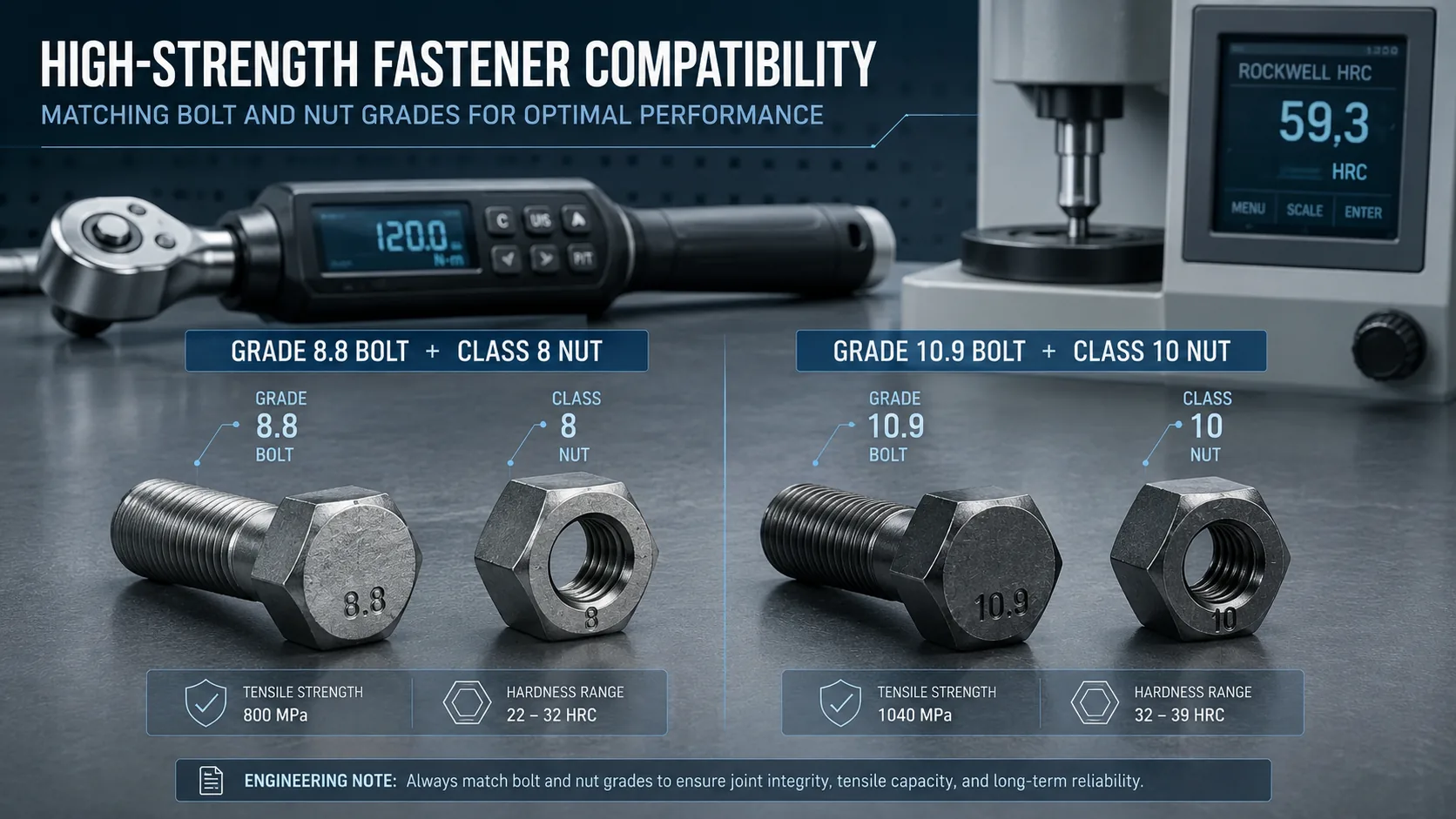
A nut standard does not automatically define strength. ISO 4032 defines metric hexagon regular nut characteristics, while ASME B18.2.2 defines inch-series nut dimensions. The buyer must still specify property class, ASTM grade, proof load requirement, hardness, material, coating and mating bolt grade.
This point has a direct failure consequence. In one equipment frame assembly, the drawing listed ISO 4032 nuts, but the purchasing line did not include Class 10. The bolts were 10.9. During tightening, several nuts stripped before the joint reached target preload. The torque wrench was not the problem. The missing property class was the problem. The corrective action was to revise the BOM to show ISO 4032 + size + pitch + Class 10 + material + coating + inspection.
Standard Is Not the Same as Strength Grade
A common mistake is writing:
ISO 4032 M16 hex nut.
This does not fully define the nut for most industrial orders. The RFQ still needs the property class, such as Class 8 or Class 10, and the material and finish.
For high-preload joints, missing the property class can create serious problems. A low-strength nut may assemble onto a high-strength bolt, but the internal threads can strip before the bolt reaches the desired preload. On a Class 10.9 bolt joint, a low-grade nut may become the weak link even when the bolt has enough yield strength.
Metric Nut Classes for DIN / ISO Hex Nuts
Metric steel nuts are commonly selected by property classes such as:
- Class 5
- Class 6
- Class 8
- Class 10
- Class 12
ISO 898-2:2022 specifies mechanical and physical properties of nuts made of non-alloy steel or alloy steel. It applies to ISO metric threads, coarse pitch M5 to M39 and fine pitch M8×1 to M39×3, and includes property classes such as 04, 05, 5, 6, 8, 10 and 12, including proof load.
Engineering warning: do not use a low-property-class nut on a high-strength bolt only because the thread fits. Thread fit confirms geometry. It does not confirm proof load, hardness or bolt-nut compatibility.
Inch Nut Grades for ASME-Dimension Nuts
For inch nuts, ASME B18.2.2 gives the inch dimensional framework. It does not replace a material or grade specification. If the application requires carbon or alloy steel nuts for structural or mechanical use, ASTM A563 may be relevant because it covers chemical and mechanical requirements, hardness and proof load for carbon and alloy steel nuts.
For high-temperature pressure service, stainless inch nuts, or special service conditions, other ASTM specifications may be required. Do not assume one ASME dimensional standard answers every mechanical property requirement.
Bolt-Nut Compatibility Table
| Mating Bolt / Stud | Recommended Standard Direction | Grade / Property Check |
|---|---|---|
| Metric 8.8 bolt | ISO 4032 or DIN legacy if drawing requires | Usually Class 8 nut |
| Metric 10.9 bolt | ISO 4032 where applicable | Usually Class 10 nut |
| Metric 12.9 bolt | Engineering review required | Class 12 or specified design requirement |
| Stainless A2-70 bolt | ISO metric stainless nut | A2 nut, check galling risk |
| Stainless A4-80 bolt | ISO metric stainless nut | A4 nut, check lubrication |
| UNC / UNF inch bolt | ASME B18.2.2 dimensions | ASTM grade as required by application |
| Structural bolt / anchor rod | Often heavy hex nut direction | ASTM grade and project specification |
For fatigue-sensitive assemblies, also check washer hardness, bearing surface condition, torque method and lubrication. A correct nut grade cannot save a joint that loses preload because the bearing surface embeds or the K factor was not controlled.
Material and Coating Considerations When Comparing Hex Nut Standards
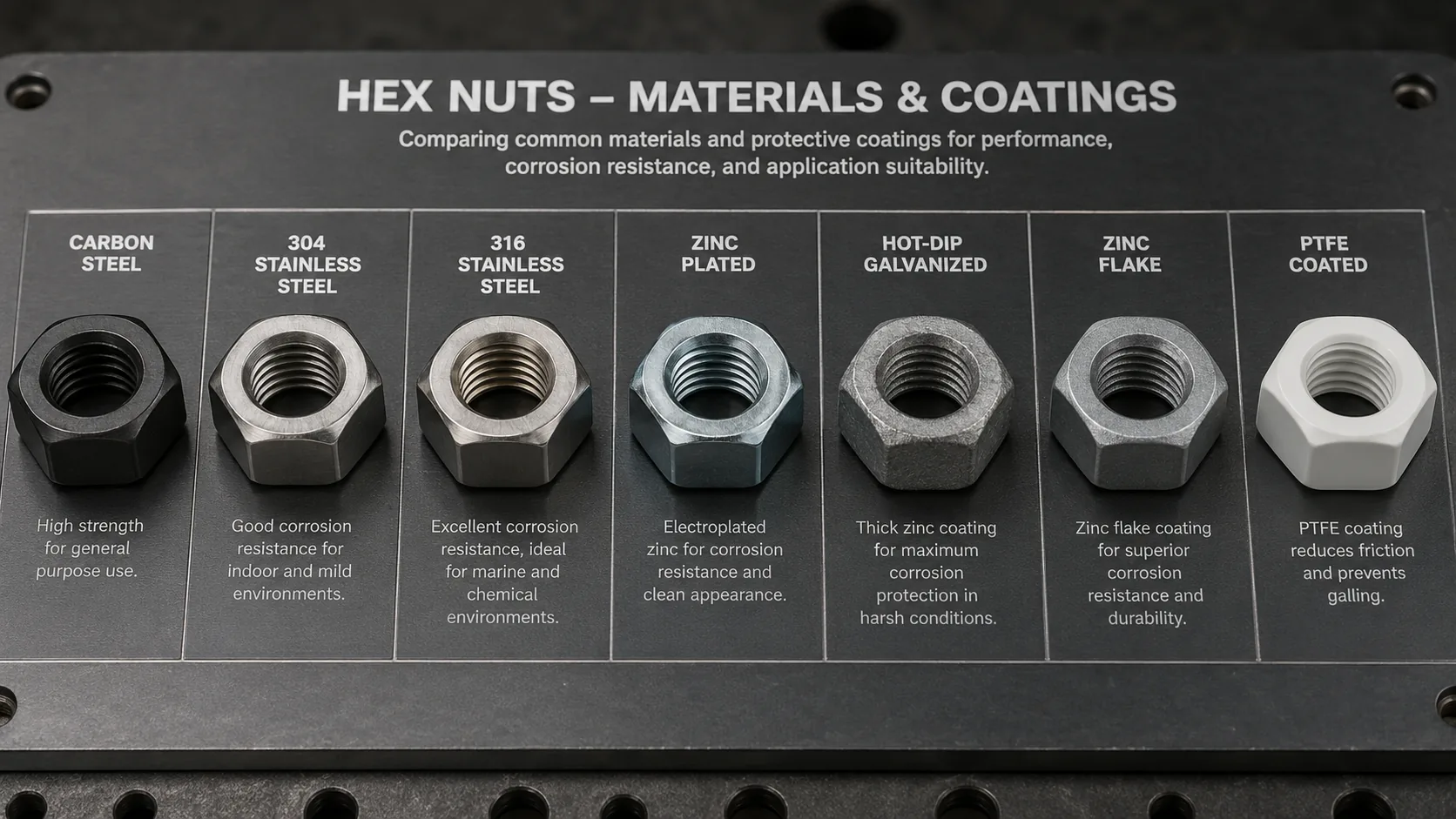
Material and coating must be specified in addition to the standard. Carbon steel is common for cost-sensitive machinery. 304/A2 and 316/A4 stainless steel improve corrosion resistance but increase galling risk. Zinc plating, hot-dip galvanizing, zinc flake and PTFE coatings change corrosion performance, thread fit and torque-preload behavior.
One steel structure project ordered hot-dip galvanized bolts and nuts by size only. The coating requirement was clear, but the thread allowance was not. On site, some nuts could not run freely onto the galvanized bolts. The corrective action was to replace them with properly tapped and gauge-inspected hot-dip galvanized nuts. The lesson is simple: coating is not only a surface appearance issue. It changes thread fit.
Carbon Steel Hex Nuts
Carbon steel is common for general industrial hex nuts. It is cost-effective and suitable for many machinery, construction and maintenance assemblies when paired with the correct grade and coating.
Common finishes include:
- Plain / oiled
- Zinc plated
- Black oxide
- Phosphate
- Hot-dip galvanized
- Zinc flake
For indoor dry environments, zinc plated or black oxide may be acceptable. For outdoor structures, hot-dip galvanized or higher corrosion-resistant coatings are usually considered. Typical commercial electro-zinc plating is often specified around 5–12 μm, but the exact thickness and salt spray target must be written into the RFQ.
Stainless Steel Hex Nuts: A2 / A4 and Galling Risk
Stainless steel hex nuts are selected when corrosion resistance matters more than low cost. Common choices include:
- 304 / A2 for general stainless use
- 316 / A4 for marine, coastal or chloride environments
The main installation risk is galling. Stainless-to-stainless thread contact can cold weld under pressure and sliding friction. A nut can seize before reaching final torque, especially when installed dry with a power tool.
Engineering warning: for stainless steel bolts and nuts, consider anti-seize compound, slower installation speed, clean threads and controlled final tightening. A2-70 or A4-80 stainless assemblies should not be run down dry at high speed with an impact tool unless the process has been validated.
Hot-Dip Galvanized Nuts and Oversize Thread Fit
Hot-dip galvanizing gives stronger outdoor corrosion protection than light zinc plating, but it changes thread fit. ISO 10684 specifies hot-dip galvanized coatings for coarse threaded steel fasteners from M8 up to M64 and notes that hot-dip galvanizing is not recommended for threaded fasteners smaller than M8 or pitches below 1.25 mm.
For galvanized nuts, thread allowance matters. If the nut is not correctly tapped or checked after coating, it may not run freely on the mating bolt. In construction or field installation, that means delayed crews, damaged zinc coating and rejected lots.
Coating, K Factor and Torque-Preload Variation
Coating changes friction. Friction changes preload. Preload determines whether the joint stays clamped.
A zinc plated nut, hot-dip galvanized nut, zinc flake nut and PTFE-coated nut may all produce different clamp loads at the same torque. ASTM F1941/F1941M covers electrodeposited coatings on threaded fasteners and includes coating thickness, corrosion resistance and precautions for managing hydrogen embrittlement risk in high-strength or surface-hardened fasteners.
For preliminary torque discussions, common nut factor ranges may be roughly:
| Assembly Condition | Approximate K Factor Range | Procurement Note |
|---|---|---|
| Dry plain steel | 0.20–0.30 | High scatter; surface condition matters |
| Dry zinc plated | 0.18–0.25 | Depends on plating and passivation |
| Lightly lubricated | 0.12–0.18 | Same torque gives higher preload |
| PTFE / low-friction coating | Often lower than dry zinc values | Confirm by test or coating supplier data |
For torque-controlled joints, the RFQ should confirm:
- Dry or lubricated assembly
- Coating system
- K factor or friction condition if available
- Thread gauge inspection
- Hydrogen embrittlement relief if required
- Whether the torque table is project-specific or generic
CTA: If you are not sure about the friction coefficient under your coating and lubrication condition, ask a fastener engineer for a project-specific torque table before mass assembly.
Common Procurement Mistakes When Comparing DIN, ISO and ASME Hex Nuts
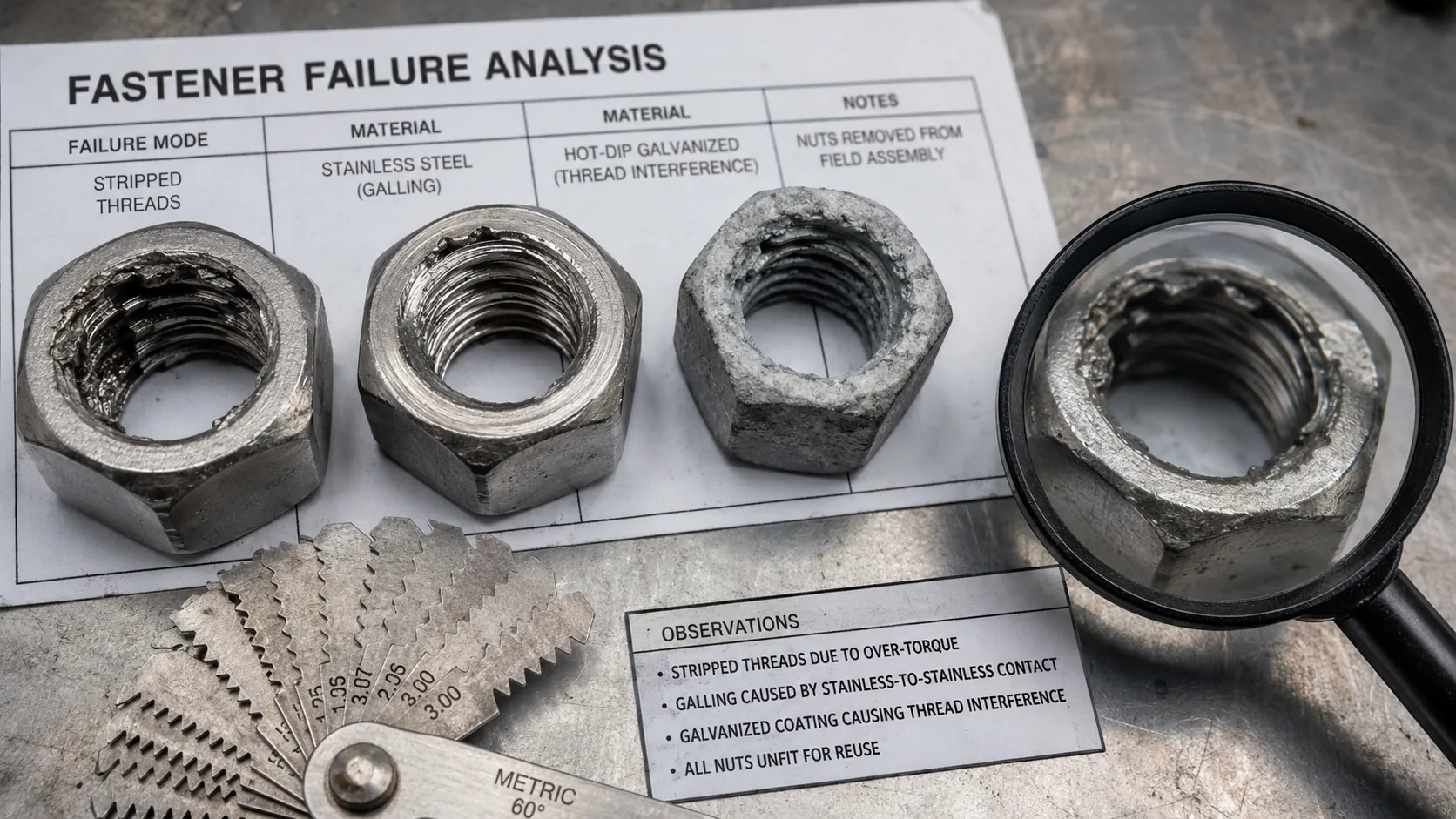
Most wrong hex nut purchases come from incomplete RFQs, not from bad intent. The common mistakes are treating DIN 934 and ISO 4032 as always identical, mixing metric and inch threads, specifying a standard without a grade, ignoring coating thickness, and following catalog names instead of the drawing.
Mistake 1 — Treating DIN 934 and ISO 4032 as Always Identical
DIN 934 and ISO 4032 are close enough in many buyers’ minds that they are often used casually. That is risky for controlled assemblies. Always confirm dimensions, drawing approval and application requirements before substitution.
Mistake 2 — Mixing Metric Nuts with Inch Bolts
M12 and 1/2 inch parts can look close in a bin. They are not interchangeable. Mixing metric and inch threads can cause cross-threading, damaged parts, false torque readings and field failure.
Mistake 3 — Specifying Standard but Not Grade
A standard without property class is incomplete for many orders.
Bad RFQ:
ISO 4032 M16 zinc plated nut.
Better RFQ:
ISO 4032 M16 × 2.0 Class 10 carbon steel hex nut, zinc plated Cr3+, thread tolerance 6H, with material certificate and thread gauge inspection.
Mistake 4 — Ignoring Coating Thickness and Thread Fit
Coating affects thread fit. This is especially important for hot-dip galvanized nuts and high-build coatings. A coating that improves corrosion resistance can create assembly problems if thread allowance is not controlled.
For electroplated high-strength nuts, the risk is not only tight fit. Acid cleaning and electroplating can introduce hydrogen embrittlement risk when the material hardness and process control are not managed. For hot-dip galvanized nuts, thread oversize and gauge inspection are just as important as corrosion protection.
Mistake 5 — Following Supplier Catalog Names Instead of the Drawing
Distributor catalogs may use “DIN 934,” “ISO 4032,” “metric hex nut,” and “standard hex nut” in overlapping ways. The drawing should control the order. If the drawing is old, ask the customer whether ISO substitution is allowed.
A good purchasing team does not wait for these problems to appear on the line. They separate metric and inch bins, add property class to the BOM, define coating and inspection requirements, and ask the supplier to confirm any DIN-to-ISO substitution in writing.
How to Write a Correct RFQ for DIN 934, ISO 4032 or ASME B18.2.2 Hex Nuts
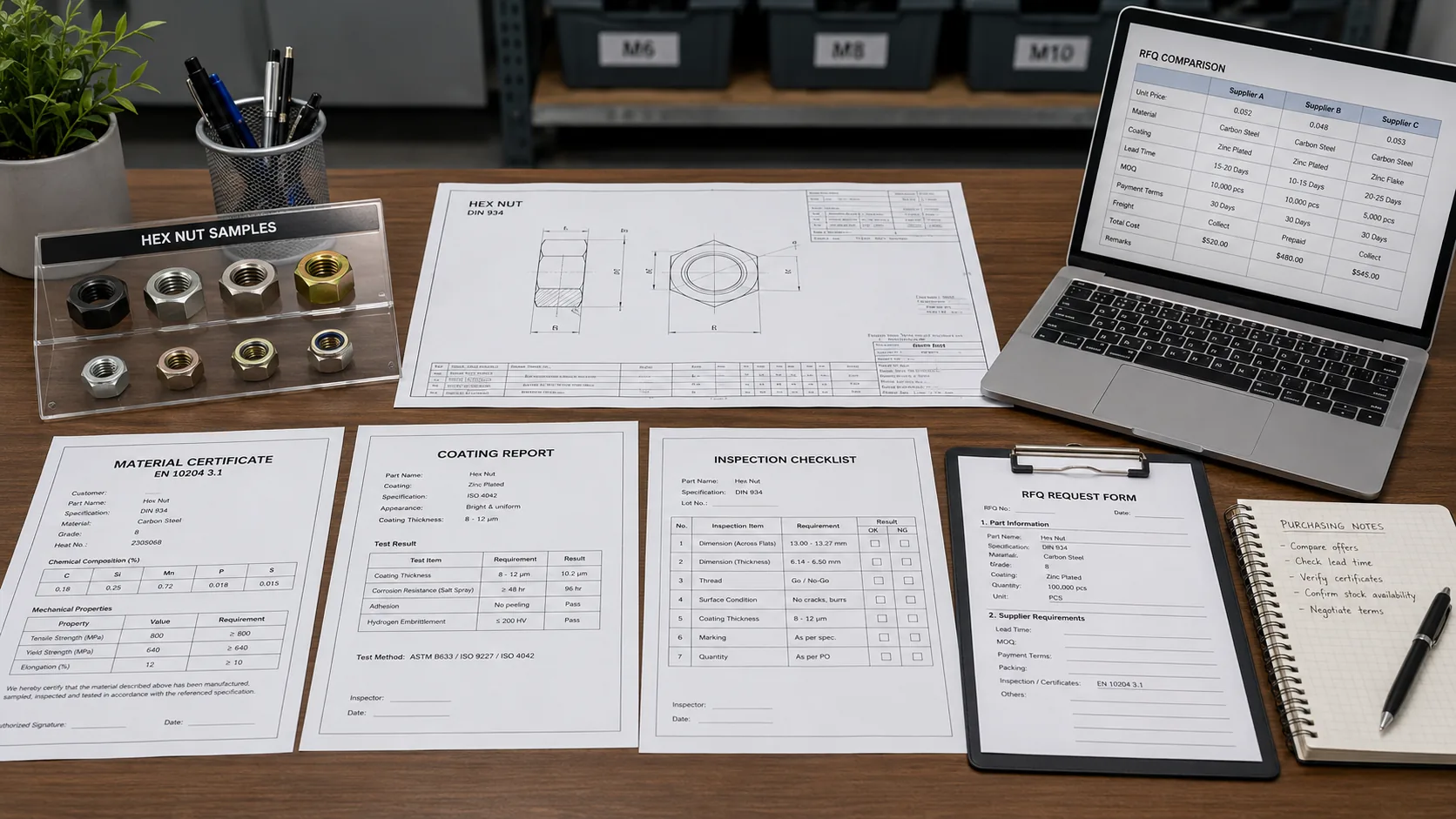
A correct RFQ should define the standard, thread system, size, pitch, nut type, grade, material, coating, inspection, certificate, packaging and application. “M12 nut” or “standard hex nut” is not enough for controlled B2B orders because it leaves grade, pitch, coating and compatibility open to interpretation.
A correct RFQ saves time for both buyer and supplier. It also reduces wrong quotations, sample delays and quality disputes.
RFQ Template for ISO 4032 Hex Nuts
ISO 4032 hex nut, M12 × 1.75, Class 8, carbon steel, zinc plated Cr3+, thread tolerance 6H, with material certificate, coating report and go/no-go thread gauge inspection.
RFQ Template for DIN 934 Replacement Nuts
DIN 934 hex nut replacement for legacy equipment, M16 coarse thread, Class 8, zinc plated, please confirm dimensional equivalence with original drawing before shipment.
RFQ Template for ASME B18.2.2 Hex Nuts
ASME B18.2.2 finished hex nut, 1/2-13 UNC, carbon steel, zinc plated, ASTM grade requirement to be confirmed by application, with thread gauge inspection and packaging label.
RFQ Checklist for B2B Hex Nut Orders
| RFQ Item | Required Information |
|---|---|
| Standard | DIN 934 / ISO 4032 / ASME B18.2.2 |
| Thread system | Metric / UNC / UNF |
| Size | M12 × 1.75 / 1/2-13 UNC |
| Nut type | Finished hex / heavy hex / jam nut / lock nut |
| Grade | Class 8 / Class 10 / ASTM grade |
| Material | Carbon steel / 304 / 316 / alloy steel |
| Coating | Zinc plated / HDG / black oxide / zinc flake / PTFE |
| Inspection | Thread gauge / hardness / coating report / proof load |
| Application | Machinery / construction / maintenance / OEM |
| Mating bolt | 8.8 / 10.9 / A2-70 / A4-80 / ASTM bolt grade |
| Packaging | Bulk carton / small box / pallet / custom label |
| Traceability | Batch number / MTC / test report if required |
If torque is part of the assembly process, add lubrication condition, washer type, coating system and target K factor if available. If the project involves stainless steel, add anti-galling requirements. If the order involves hot-dip galvanizing, add thread fit inspection after coating.
Which Standard Should You Choose for Your Project?
Choose DIN 934 for legacy metric drawings, ISO 4032 for current metric hexagon regular nuts, and ASME B18.2.2 for inch-series UNC/UNF systems. For export orders, the drawing controls the choice. For substitutions, confirm thread system, dimensions, grade, coating, inspection and customer approval before quoting.
For New Metric Equipment
Use ISO 4032 when the project is a new metric design and the customer accepts current ISO metric fastener standards. Confirm property class, material, coating and inspection requirement separately.
Recommended RFQ direction:
ISO 4032 + size + pitch + property class + material + coating + inspection.
For Legacy European Equipment
Use DIN 934 when the drawing still requires DIN 934 and no substitution approval is given. If the supplier proposes ISO 4032, check dimensions and obtain buyer approval before shipping.
Recommended RFQ direction:
DIN 934 replacement + drawing revision + sample check + dimensional confirmation.
For U.S. Inch Fastener Systems
Use ASME B18.2.2 when the drawing uses UNC or UNF inch threads. Confirm the required ASTM material or grade separately.
Recommended RFQ direction:
ASME B18.2.2 + inch thread size + nut type + material/ASTM grade + coating.
For Export Orders and Mixed-Market Supply Chains
Ask the customer which standard controls the order. Do not assume the supplier catalog name is acceptable. In export orders, the safest route is to quote exactly against the drawing and list any proposed substitution clearly.
For mixed factories that handle both metric and inch fasteners, separate inventory labels are essential:
- M12 × 1.75 is not 1/2-13 UNC.
- M10 × 1.5 is not 3/8-16 UNC.
- Fine thread must be marked clearly.
- Stainless grade and nut property class should be visible on the BOM.
Project Review CTA
Have an old DIN 934 drawing, an ISO 4032 RFQ, or a U.S. ASME B18.2.2 inch nut requirement? Send us the drawing, thread callout, bolt grade, material and coating requirement. Our fastener engineering team can help check standard compatibility, metric/inch thread risk, property class, coating fit and inspection requirements before quotation or bulk production.
Need a fast check before ordering? Contact us through the request a quote page and include the drawing, mating bolt grade, thread callout, coating requirement and application environment. If you are unsure about the friction coefficient for a coated or lubricated assembly, ask for an engineer-reviewed torque recommendation before placing the order.
FAQ About DIN 934, ISO 4032 and ASME B18.2.2 Hex Nuts
Is DIN 934 the same as ISO 4032?
No. DIN 934 and ISO 4032 are both associated with metric hex nuts, but they should not be treated as automatically identical. Before substitution, check nut height, width across flats, thread pitch, property class, coating and drawing approval.
Can I replace DIN 934 with ISO 4032?
Sometimes, but only after dimensional and functional confirmation. For non-critical assemblies, substitution may be accepted by the buyer. For legacy equipment, maintenance parts or controlled OEM drawings, approval should be confirmed before shipment.
Is ASME B18.2.2 metric or inch?
ASME B18.2.2 is an inch-series nut standard. It is used for U.S. inch fastener systems such as UNC and UNF. It should not be mixed with ISO or DIN metric nuts.
What standard should I use for M12 hex nuts?
For a current metric project, ISO 4032 is usually the cleaner standard direction for hexagon regular nuts, if the nut type matches the design. The RFQ should also specify M12 pitch, property class, material, coating and inspection requirement.
What standard should I use for 1/2-13 UNC hex nuts?
For 1/2-13 UNC hex nuts, use an inch-series standard such as ASME B18.2.2 for dimensions. Then confirm the material and mechanical grade separately, such as an ASTM grade if required by the application.
Does ISO 4032 define nut strength grade?
ISO 4032 defines dimensional characteristics for hexagon regular nuts. If property classes are required, they should be selected from ISO 898-2 for steel nuts or ISO 3506-2 for stainless steel nuts, depending on the material and application.
Is ASME B18.2.2 the same as ASTM A563?
No. ASME B18.2.2 is a dimensional standard for inch-series nuts. ASTM A563 covers chemical and mechanical requirements for carbon and alloy steel nuts used in structural and mechanical applications.
Author Note: This article is written from a fastener application engineering perspective for engineers, purchasing managers, distributors, OEM buyers and maintenance teams. It focuses on DIN 934, ISO 4032 and ASME B18.2.2 hex nut selection, metric vs inch thread risk, standard substitution, property class specification, coating-related thread fit and RFQ quality control. For safety-related, structural, high-preload or corrosion-critical assemblies, confirm the final specification against the project drawing and latest purchased standard before production.
Standards / Technical References Note: Relevant references for final technical review include ISO 4032, ISO 898-2, ISO 3506-2, ASME B18.2.2, ASTM A563, ISO 10684 and ASTM F1941/F1941M. Always verify production-critical dimensions, tolerances, grades and testing requirements against the latest purchased standard before final order approval.