








Tri-clamp fittings are widely used in brewing systems because they support hygienic assembly, fast maintenance access, modular line changes, and cleaner product-contact connections than threaded joints. In breweries, that matters in fermenters, bright beer tanks, sample points, cellar piping, transfer loops, and packaging connections where brewers need both cleanability and practical serviceability. A tri-clamp connection is not automatically hygienic just because it looks sanitary, though. The real outcome still depends on ferrule alignment, gasket choice, weld quality, branch geometry, drainability, and how the assembly is actually cleaned and inspected.
This guide explains how brewery engineers and brewers should select tri-clamp fittings by process area, size, gasket material, CIP cleanability, and real failure risk. It also shows where tri-clamp systems work exceptionally well, where they get misused, and how they connect to broader hygienic piping decisions across brewing operations.
What Tri-Clamp Fittings Actually Do in Brewing Systems
How a Tri-Clamp Connection Works
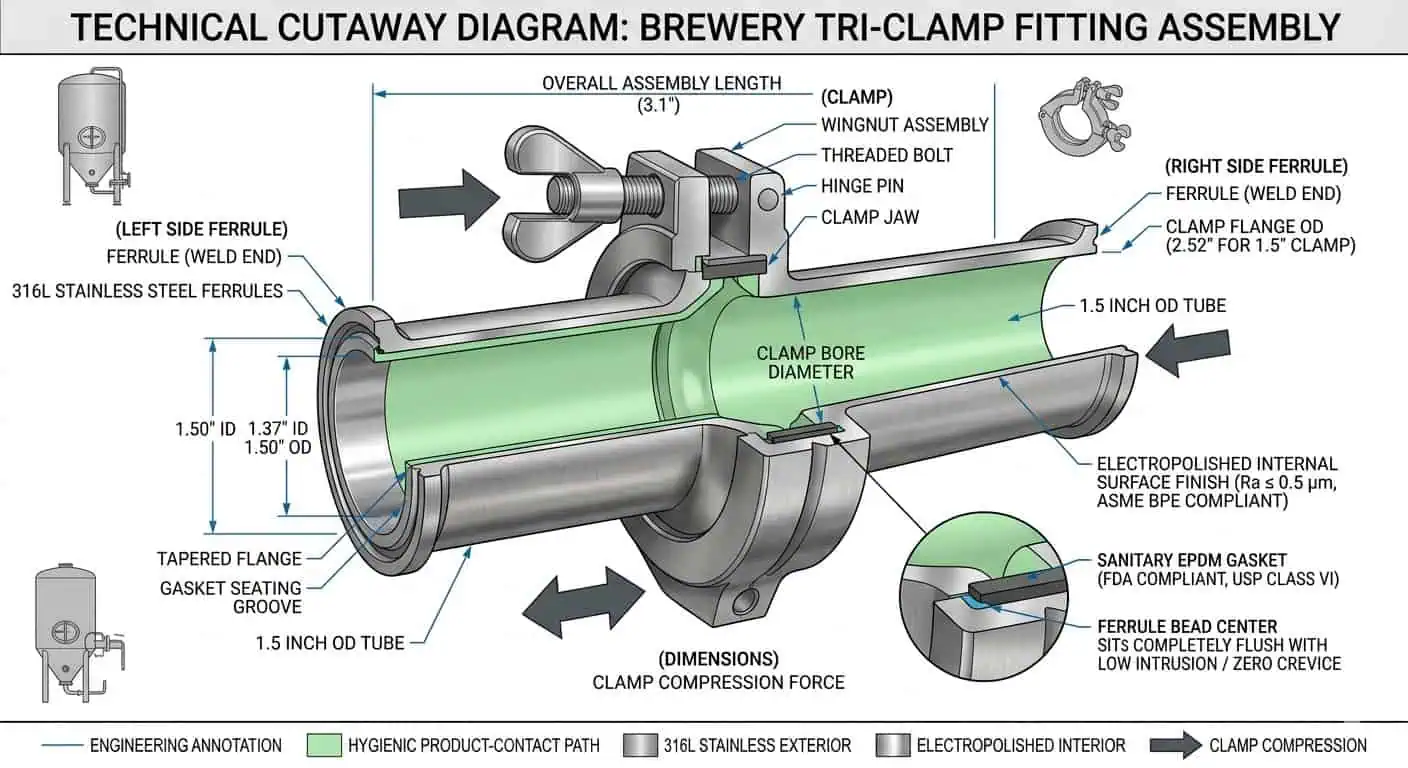
A tri-clamp connection joins two ferrules with a gasket between them and a clamp that compresses the assembly evenly. The value is not just fast assembly. The real advantage is that the connection can be opened for inspection, gasket replacement, line changes, or component swaps without cutting tube or disturbing a threaded product-contact joint. In brewery service, that modularity is especially useful when one line has to support tank transfers, sample assemblies, hose drops, valves, sight glasses, or future expansion.
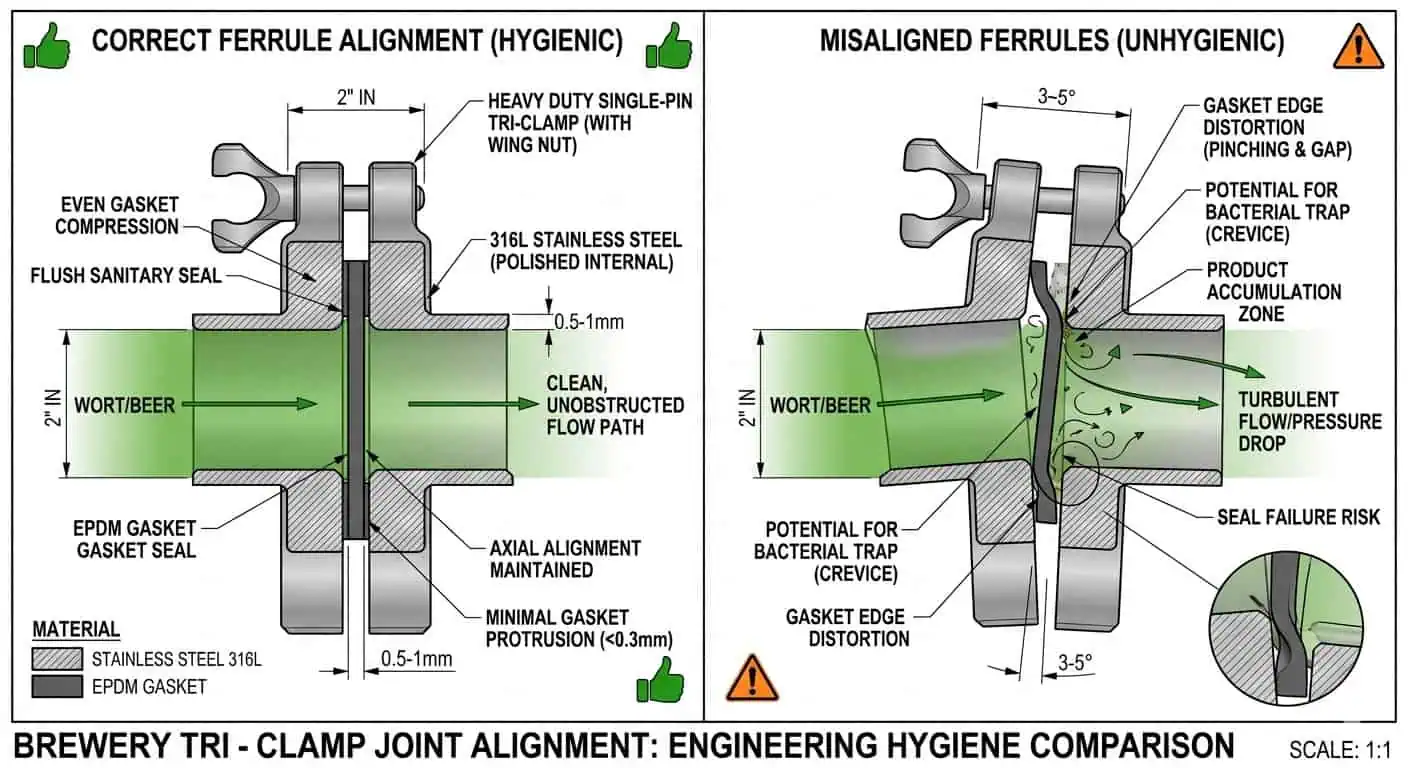
From an engineering standpoint, the fitting only works as intended when the ferrule faces are aligned, the gasket is correctly seated, and the clamp is used to seal a correct joint rather than force a poor fit-up into place. In repeated brewery maintenance work, that distinction matters more than the clamp style itself.
Why Brewers Prefer Tri-Clamp Over Threaded Connections in Product-Contact Areas
Brewers usually prefer tri-clamp fittings in product-contact areas because they are easier to inspect, easier to disassemble, and less crevice-prone than threaded connections. This does not mean tri-clamp is automatically correct everywhere. It means the connection style is better suited to hygienic product-contact service when the full assembly is specified and installed correctly. If you need the broader logic behind that distinction, read sanitary vs industrial pipe fittings.
That preference also aligns with food-contact equipment rules. FDA 21 CFR 117.40 requires food-contact surfaces to be adequately cleanable, corrosion-resistant, and suitable for the intended food and cleaning environment. A threaded product-contact joint can meet service needs in some noncritical locations, but in brewery hygienic zones tri-clamp usually gives brewers better inspection and maintenance control.
Where Tri-Clamp Is Commonly Used in Breweries
In breweries, tri-clamp fittings are common anywhere product-contact cleanliness and flexible maintenance both matter. Typical locations include brewhouse transfer lines, cellar piping, fermenters, bright beer tanks, sample points, carbonation loops, hose adapters, valve manifolds, sight glasses, and packaging-related assemblies. On pressure-rated brewery vessels, the Brewers Association notes that secondary non-mechanical pressure relief devices such as rupture or burst disks are commonly mounted to a tri-clamp ferrule or similar fitting on the tank dome. That detail matters because it shows how tri-clamp hardware is used not only for process piping, but also for critical brewery tank accessories.
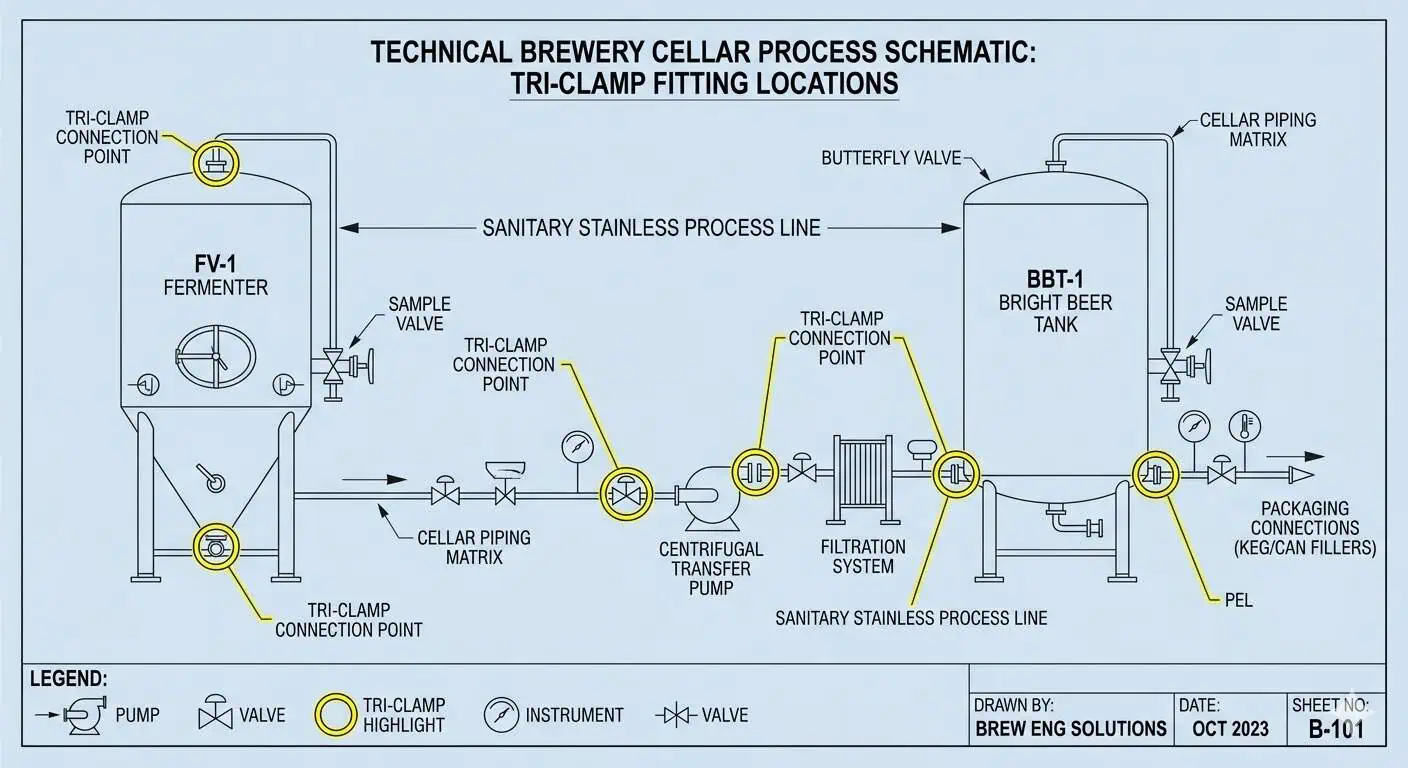
| Typical Brewery Area | Why Tri-Clamp Is Common | Main Engineering Check |
|---|---|---|
| Fermenters and bright beer tanks | Easy removal of valves, sample points, and accessories | Ferrule alignment, gasket compatibility, hygienic branch geometry |
| Cellar transfer lines | Modular routing and frequent cleaning | Drainability, hose connection discipline, standard size control |
| Sampling and racking points | Fast access and inspection | Low-flow cleanability, residue retention, repeat leak risk |
| Packaging-related connections | Flexible maintenance and changeover | Gasket handling, odor retention, frequent reassembly control |
Why Tri-Clamp Fittings Make Sense in Brewing—And Where They Do Not
The Real Brewing Advantages
The real brewing advantage of tri-clamp fittings is not speed alone. It is control. Brewers can open, inspect, clean, replace, and reconfigure assemblies more easily than with many fixed or threaded alternatives. That is especially useful in pilot breweries, growing production breweries, and mixed-use cellar layouts where hose connections, temporary changes, and modular equipment expansion are part of normal operations.
In practical brewery work, tri-clamp becomes most valuable when one assembly has to support multiple realities at once: sanitary product contact, frequent access, limited downtime, and the possibility that the process layout will change after startup. That is a more realistic design basis than simply calling tri-clamp “easy to use.”
Where Tri-Clamp Can Still Become a Hygiene Problem
A tri-clamp connection can still become a hygiene problem if the full assembly is wrong. Common causes include ferrule misalignment, damaged gasket edges, poor weld transitions, incorrect gasket material, repeated over-tightening, poor drainability, and branch geometry that traps liquid after CIP. This is exactly why FDA equipment rules focus on whether food-contact surfaces are adequately cleanable, corrosion-resistant, and able to withstand their intended environment, including cleaning compounds and cleaning procedures. A sanitary-looking connection is not enough if the installed assembly cannot actually be cleaned and maintained correctly.
A repeated field pattern in breweries is that the joint looks correct from the outside, the leak is small or intermittent, and operators assume the issue is minor. Later review shows the actual weak point was a damaged gasket lip, a slight ferrule offset, or a short branch that never drained fully after CIP. In other words, the problem was hidden inside a joint that looked “sanitary enough.”
A Tri-Clamp Joint Is Only as Hygienic as the Full Assembly
The hygienic result depends on the full joint, not the clamp by itself. That means the ferrule faces, the gasket land, the gasket material, the compression condition, the surrounding weld quality, and the drainability of the connected branch all matter together. In brewery practice, one of the most common mistakes is to blame the clamp when the real problem is a poor fit-up or an assembly that should never have been treated as fully CIP-cleanable in the first place.
EHEDG hygienic design principles make the same point from a design perspective: entities with poor hygienic design are difficult to clean. In brewery terms, that means a tri-clamp fitting cannot rescue a badly oriented sample branch, a rough ferrule weld, or a low point that keeps holding rinse water.
How Brewers Should Choose Tri-Clamp Fittings by Process Area
Hot Side Applications
On the hot side, brewers should evaluate tri-clamp fittings by temperature exposure, cleaning access, and service practicality rather than by appearance alone. Wort transfer, brewhouse circulation, and hot-side hose changes often involve repeated assembly, washdown, and thermal cycling. In these zones, the important questions are whether the gasket material is appropriate, whether the assembly is opened frequently, and whether the connection can be cleaned and reassembled reliably during normal brewery operations.
Hot-side tri-clamp hardware often gets judged too casually because the microbial consequence is perceived as lower than cold-side service. That is only partly true. Poor gasket choice, repeated assembly stress, and unreliable fit-up still create maintenance burden, delay restarts, and reduce operator confidence in the connection.
Cold Side and Cellar Applications
Cold-side tri-clamp decisions usually carry higher hygienic consequence than hot-side ones. In fermentation, bright beer transfer, carbonation loops, and final beer-contact assemblies, the penalty for retained residue, gasket odor pickup, poor drainback, or hidden contamination is higher. This is where brewers should pay closer attention to branch geometry, gasket condition, local cleanability, and whether the same assembly keeps needing intervention after cleaning or changeover.
A good engineering rule is simple: when the product is closer to finished beer, the tolerance for joint imperfection gets smaller. On cold-side assemblies, what looks like a minor connection detail can become a flavor, sanitation, or shelf-life problem faster than expected.
Packaging, Racking, and Sampling Points
The most underestimated brewery tri-clamp problems are often not in the main transfer line, but at sample points, racking assemblies, and packaging-related branches. These are the places where local flow is weaker, liquid can linger longer, and manual handling is more frequent. The Brewers Association’s keg performance guideline is useful here because it notes that after a CIP sequence, beer process mains, bright beer tank or sterile beer tank connections, and racker connection heads can be swabbed and checked for visual cleanliness to verify cleaning effectiveness. That is a practical reminder that brewery cleaning verification often matters most at connection details rather than on the easiest straight-run sections of pipe.
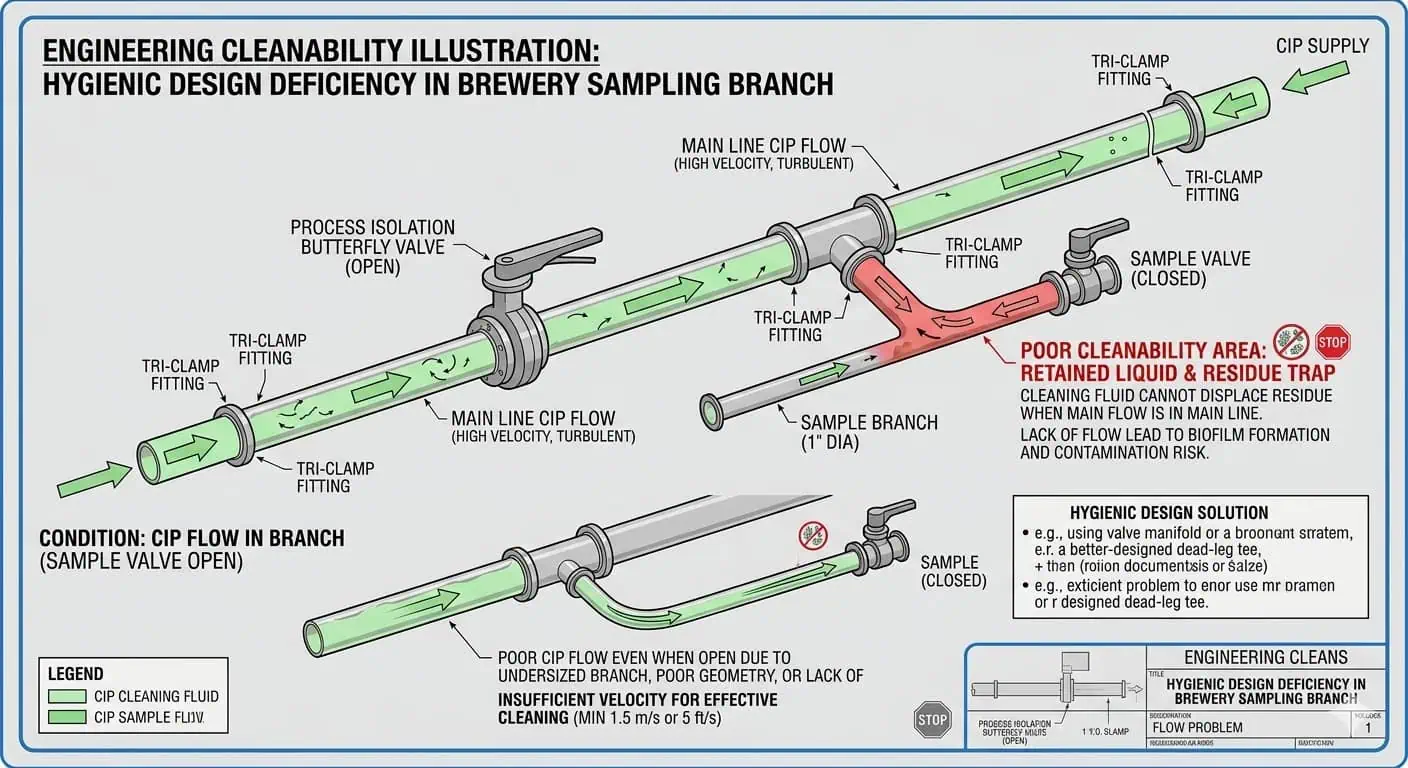
One realistic brewery example is a sample branch that passes casual visual review but keeps failing odor or residue checks after cleaning. The root cause is often not the clamp itself. It is the local geometry around the assembly and the false assumption that the branch receives the same effective CIP action as the main line.
Sizing and Connection Logic: What Actually Matters
Tube Size vs Clamp Size
Brewers should choose tri-clamp fittings by process line size and ferrule standard, not by clamp appearance alone. In real brewery projects, one of the most common purchasing mistakes is treating the clamp size as the primary decision point. The better approach is to start with the tubing and ferrule standard already used in the brewery, then confirm the matching clamp and gasket format so that the connection stays consistent with the existing hygienic hardware strategy.
This matters because maintenance errors often start at the storeroom shelf, not on the process line. If the brewery cannot distinguish clearly between line standard, ferrule format, and gasket compatibility, the wrong “almost correct” part gets installed during downtime pressure.
Flow, Velocity, and Changeover Practicality
Bigger is not automatically better in brewery tri-clamp sizing. Oversized product-contact assemblies can increase hold-up volume, reduce cleaning efficiency in certain branches, and make routine changes less practical. Undersized fittings can restrict transfer speed, complicate CIP targets, or create bottlenecks at tank and cellar connections. The right size is the one that matches the actual brewery duty, not the one that simply looks more robust.
From an engineering perspective, sizing affects more than transfer rate. It affects drainback behavior, hose handling, cleaning response, and the amount of beer or rinse liquid that can remain trapped in local assemblies during changeover.
Standardization Across the Brewery
Breweries that standardize tri-clamp sizing early usually reduce downtime later. Standardization simplifies hose sets, spare parts, gasket inventory, operator training, and reassembly speed. In growing breweries, mixed clamp and ferrule strategies often create more maintenance confusion than brewers expect. One practical field pattern is that the brewery does not feel the pain during installation; it feels it six months later when the wrong spare is grabbed during a leak or cleaning issue.
Engineering note: standardization is not only a purchasing convenience. In expanding breweries, it is one of the simplest ways to reduce wrong-part installation and shorten maintenance recovery time.
Gasket Selection for Brewing Systems
Why the Gasket Often Decides Whether the Joint Is Reliable
In brewery tri-clamp service, the gasket is often the first true weak point. Joint performance depends on gasket material, chemical resistance, temperature tolerance, elastic recovery, odor retention behavior, and how the assembly is handled during maintenance. When brewers have a recurring connection problem, the clamp itself is often blamed first, but the gasket is more often where the real reliability loss begins.
This is especially true in brewery operations with repeated cleaning, frequent opening, and mixed service conditions between hot side and cold side. The same gasket compound that performs acceptably in one zone may become a repeat problem in another because the real issue is chemistry plus handling plus compression history, not material name alone.
EPDM, Silicone, PTFE, and Other Common Options
Gasket choice should follow brewery service conditions, not habit. EPDM is often selected where good general resistance and sealing recovery are needed. Silicone is frequently chosen where flexibility and handling convenience matter, but brewers need to think carefully about odor and service fit. PTFE-based options are often considered where chemical resistance is the stronger requirement. The correct choice depends on cleaning chemistry, service temperature, product-contact expectations, and how often the joint is opened and reassembled.
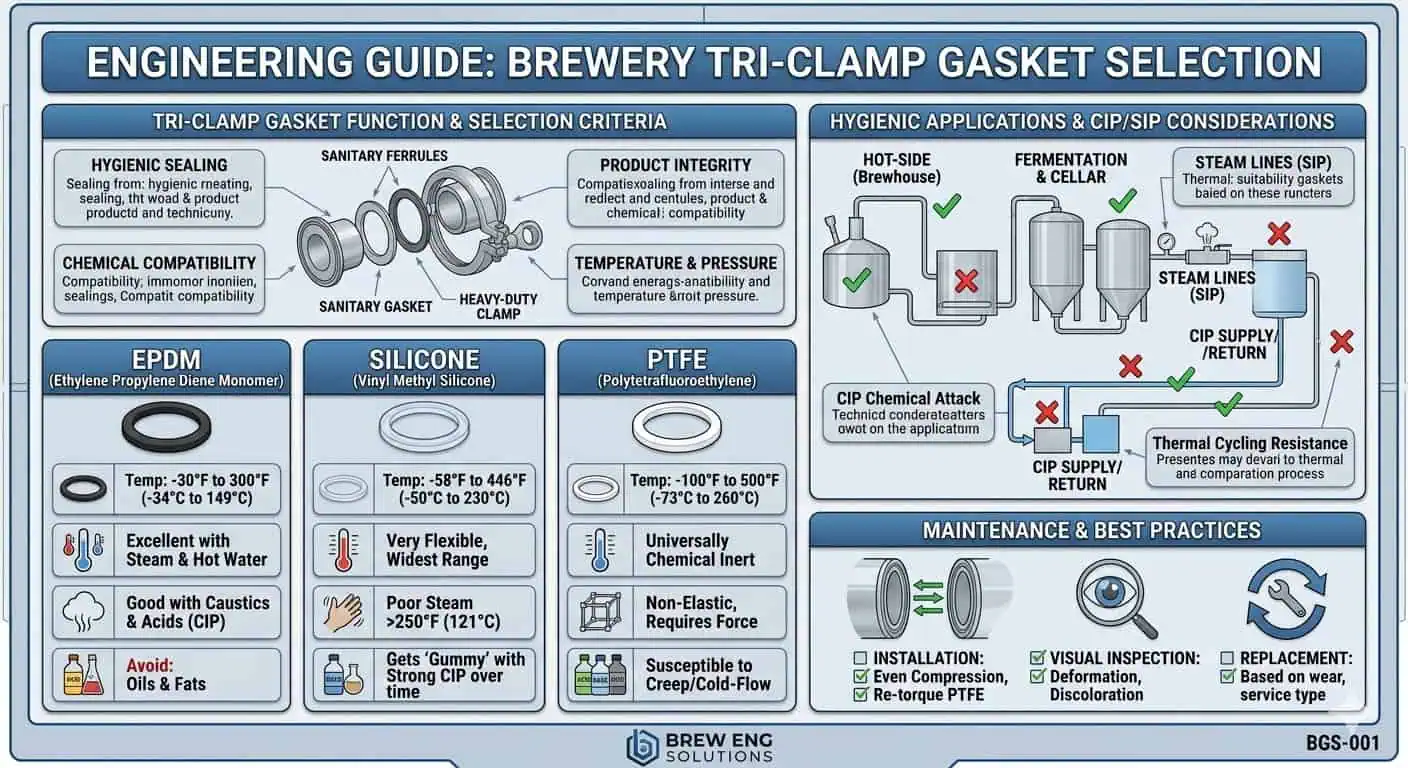
| Gasket Option | Where Brewers Often Use It | Main Caution |
|---|---|---|
| EPDM | General brewery hygienic service with repeated assembly and cleaning | Confirm actual chemical compatibility with the brewery’s CIP program |
| Silicone | Applications where handling flexibility is valued | Review odor retention and true service fit before standardizing |
| PTFE / PTFE-faced | More chemically demanding service | Do not ignore sealing behavior and assembly practicality |
| Other specialty compounds | Selected brewery-specific duties | Use only when service conditions justify the added complexity |
Good practice is to control gasket materials as approved components, not cheap consumables. When gasket discipline is weak, brewery connection problems become harder to trace and harder to correct permanently.
A Common Brewery Failure Pattern: The Joint Stops Leaking but Becomes Harder to Keep Hygienic
One repeated brewery failure pattern is a joint that stops leaking externally but becomes less reliable hygienically. The usual sequence is familiar: the same connection leaks, an operator tightens it further, the visible drip stops, but the ferrules were slightly out of alignment and the gasket edge is now unevenly loaded or damaged. From the outside, the joint looks improved. Internally, it may now be more prone to product retention or harder to clean consistently. A dry joint is not automatically a good joint.
This is a useful troubleshooting clue in breweries because it explains why a connection may stop leaking yet still keep becoming a sanitation nuisance. The leak symptom is gone, but the cleanability of the joint has become less reliable than before.
Tri-Clamp Fittings and CIP Design in Breweries
Why Tri-Clamp Helps CIP—but Does Not Guarantee It
Tri-clamp fittings help CIP because they support hygienic assembly and easy inspection, but they do not guarantee that an installed system is fully cleanable in place. That boundary matters. 3-A’s cleanability guidance directly addresses the common misconception that all sanitary-looking equipment is automatically suitable for full CIP. In brewery terms, that means a clamp connection may be correct while the connected branch, sample assembly, or valve detail is still difficult to clean effectively without inspection or disassembly.
If you want the broader line-design side of that question, link this article to CIP Design Considerations for Hygienic Piping.
Branches, Valves, and Sample Points Are the Real Test
The real test of a brewery tri-clamp system is not whether the main line looks clean after CIP. It is whether the hardest local assembly stays cleanable and drainable. This becomes obvious at sample ports, short side branches, valve clusters, and low-drain accessory connections. On more than one brewery or brewery-adjacent hygienic line, the main return data looked acceptable while the same local branch kept showing retained residue or repeat verification issues. The real cause was local geometry and weak effective flow, not a lack of detergent strength.
That distinction matters because operators often respond by extending the cycle or increasing chemistry, when the more durable correction is to shorten, reorient, or redesign the troublesome local assembly.
What Brewers Should Verify After CIP
Brewers should verify the assemblies that are easiest to overlook, not only the easiest to access. Useful post-CIP checks include drainback, retained liquid, unusual smell, visible residue, and targeted swab or ATP verification where justified. In brewery practice, sample assemblies, bright beer tank-related connections, and racking points often deserve more attention than the straight main because that is where hidden cleanability problems surface first.
Materials and Surface Considerations for Brewery Tri-Clamp Assemblies
304 vs 316L in Brewery Service
Material choice for brewery tri-clamp assemblies should follow product chemistry, cleaning intensity, and hygienic consequence. Many brewery systems operate successfully with 304-based hygienic hardware, but some service conditions justify a stronger corrosion margin. If the application involves more aggressive cleaning, higher hygienic consequence, or more demanding chemistry, review the decision against 316L Stainless Steel for Dairy and Brewery Applications.
That does not mean brewers should specify 316L everywhere by reflex. The better question is where extra corrosion margin really changes hygienic reliability and where 304-based hardware remains fully reasonable.
Why Weld Quality Matters More Than Many Buyers Think
A tri-clamp fitting can only perform as well as the weld transition feeding into it. If the ferrule-to-tube weld is poorly contoured, oxidized, or difficult to clean, the connection can remain hygienically weak even when the clamp, gasket, and ferrule dimensions are correct. In practice, brewers often notice the symptom later as repeat odor retention, slow cleaning response, or unexplained trouble at the same local assembly.
This is one of the clearest examples of why hardware specification and fabrication quality cannot be separated. A correctly chosen fitting does not erase a poor weld root or a rough internal transition.
Surface Finish, Product Film, and Cleanability
Surface finish is not a premium feature for brewery tri-clamp assemblies. It is a cleanability factor. Rougher or less controlled product-contact surfaces make product film harder to remove and inspection less reliable. That matters even more in cold-side and final beer-contact zones where sensory quality and microbiological consequence are tighter.
Common Failure Points in Brewery Tri-Clamp Systems
Recurring Clamp Leaks
Recurring clamp leaks usually point to alignment, gasket, or ferrule-face problems rather than clamp failure by itself. If the same joint keeps leaking, do not start by assuming more force is the answer. First confirm fit-up, gasket condition, ferrule face condition, and whether the joint is being used in a way that creates repeated assembly stress.
Residue Around Sample Branches or Valve Clusters
Residue problems are more likely to begin at branches and assemblies than in the main line. Sample connections, valve clusters, and low-flow side branches are where brewers should expect local cleanability issues first. That is why those locations deserve inspection logic that goes beyond “the CIP return looked good.”
False Confidence from Sanitary-Looking Hardware
One of the most common brewery mistakes is assuming that sanitary-looking hardware is automatically hygienic in service. A polished clamp and ferrule do not compensate for poor branch geometry, difficult drainback, weak weld profile, or the wrong gasket material. This is also why the broader hygienic logic still matters more than hardware appearance alone.
Inventory and Standardization Problems
As breweries grow, mixed tri-clamp formats and uncontrolled spare-part choices create avoidable downtime. When different sizes, gasket materials, and assembly styles are mixed without a controlled standard, maintenance slows down and troubleshooting gets less reliable. Standardization is not only a purchasing issue. It is a brewery uptime issue.
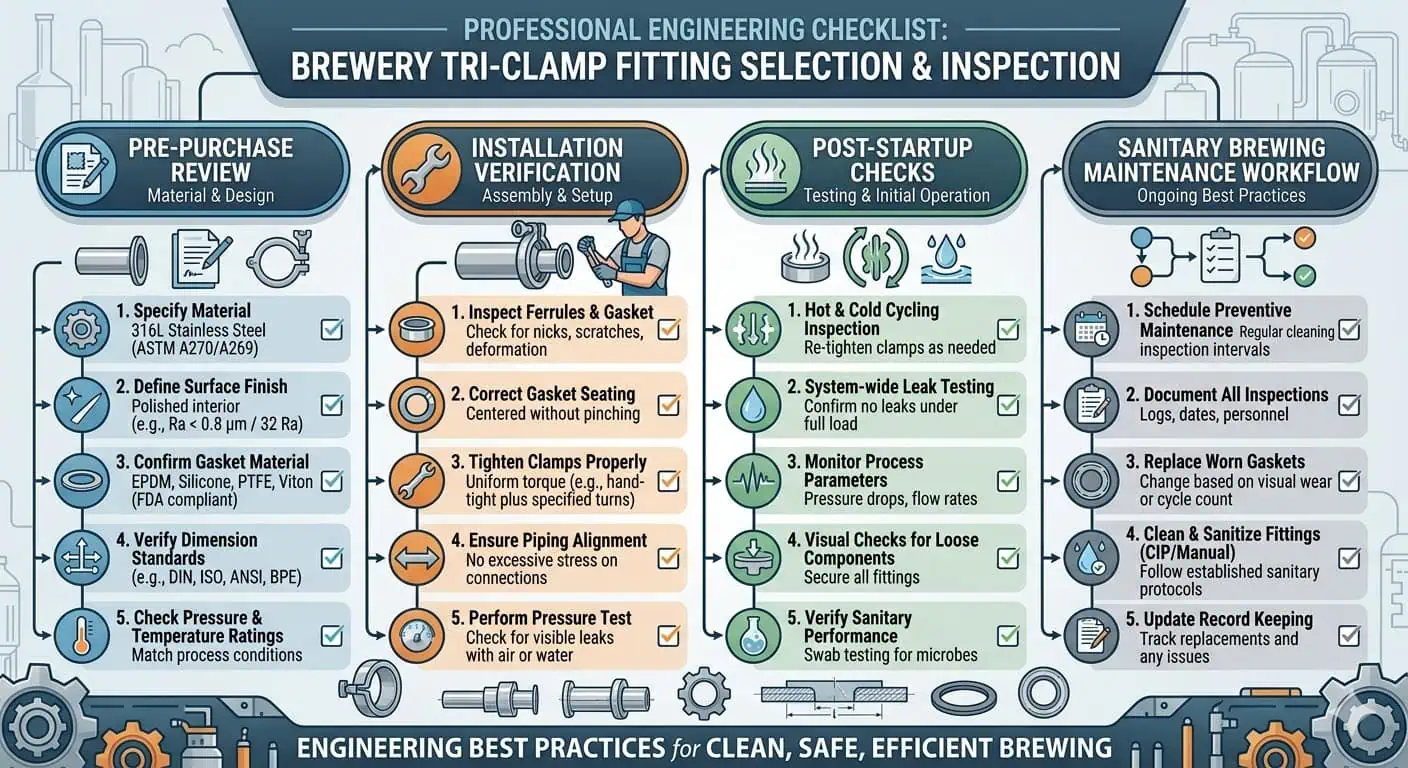
Practical Buying Checklist for Tri-Clamp Fittings in Brewing Systems
Questions to Answer Before Purchase
- Where will the fitting be used: hot side, cold side, cellar, packaging, or sampling?
- What cleaning method will it actually see?
- What gasket material is approved for this service?
- Is the connection likely to be opened frequently?
- Is the assembly truly drainable after cleaning?
- Will this size and style match the brewery’s existing standard?
What to Verify Before Installation
- Ferrule alignment
- Ferrule face condition
- Correct gasket material and size
- Clamp condition
- Correct orientation for inspection and drainage
- Access for opening and cleaning verification
What to Review After Startup
- Leak recurrence at the same joint
- Odor retention after cleaning
- Residue after CIP at sample and racking points
- Repeated reassembly problems at the same fitting
- Whether a standardization issue is emerging as the brewery expands
Conclusion: Tri-Clamp Fittings Work Best in Breweries When the Whole Assembly Is Designed for Hygiene, Not Just Convenience
Tri-clamp fittings work exceptionally well in brewing systems when they are specified as part of a hygienic assembly strategy rather than purchased as convenience hardware alone. Their real value is cleaner product-contact geometry, easier maintenance access, modular process flexibility, and better inspection potential for brewery service. But those advantages only hold when the gasket is right, the ferrules are aligned, the weld transition is cleanable, the branch is drainable, and the cleaning logic matches the real geometry.
For a complete brewery hygienic connection path, connect this article with Sanitary vs Industrial Pipe Fittings, 316L Stainless Steel for Dairy and Brewery Applications, and CIP Design Considerations for Hygienic Piping.
FAQ
Are Tri-Clamp fittings better than threaded fittings in brewing systems?
In most brewery product-contact areas, yes. Tri-clamp fittings are usually easier to inspect, easier to disassemble, and less crevice-prone than threaded product-contact joints. The advantage depends on the full assembly being specified and installed correctly, and it becomes more important as hygienic consequence rises.
What gasket material is best for brewery Tri-Clamp connections?
There is no single best gasket for every brewery application. The correct choice depends on cleaning chemistry, service temperature, product-contact expectations, opening frequency, and whether odor retention or compression recovery is a bigger concern in that service zone.
Can Tri-Clamp fittings always be cleaned in place?
No. A tri-clamp connection may support good hygienic design, but it does not guarantee that the installed assembly is truly cleanable in place. Branch geometry, valve details, drainability, and inspection access still determine the real result, which is why some brewery assemblies still need targeted inspection or breakdown.
Why does the same brewery Tri-Clamp joint keep leaking?
The most common causes are not the clamp alone. Repeated leaks usually come from ferrule misalignment, wrong gasket material, damaged gasket edges, uneven compression, poor ferrule face condition, or a joint that is being used to compensate for poor line fit-up.
Should breweries use 304 or 316L for Tri-Clamp fittings?
That depends on service conditions. Many brewery applications use 304-based hygienic hardware successfully, but more demanding chemical, cleaning, or corrosion-risk environments may justify 316L in selected zones, especially where hygienic consequence and cleaning severity are both higher.
What Tri-Clamp size is most common in breweries?
The most common brewery sizes depend on the process line and existing standard. The correct decision should follow tubing and ferrule standards, actual brewery duty, and how the system is standardized across the plant rather than appearance alone.