






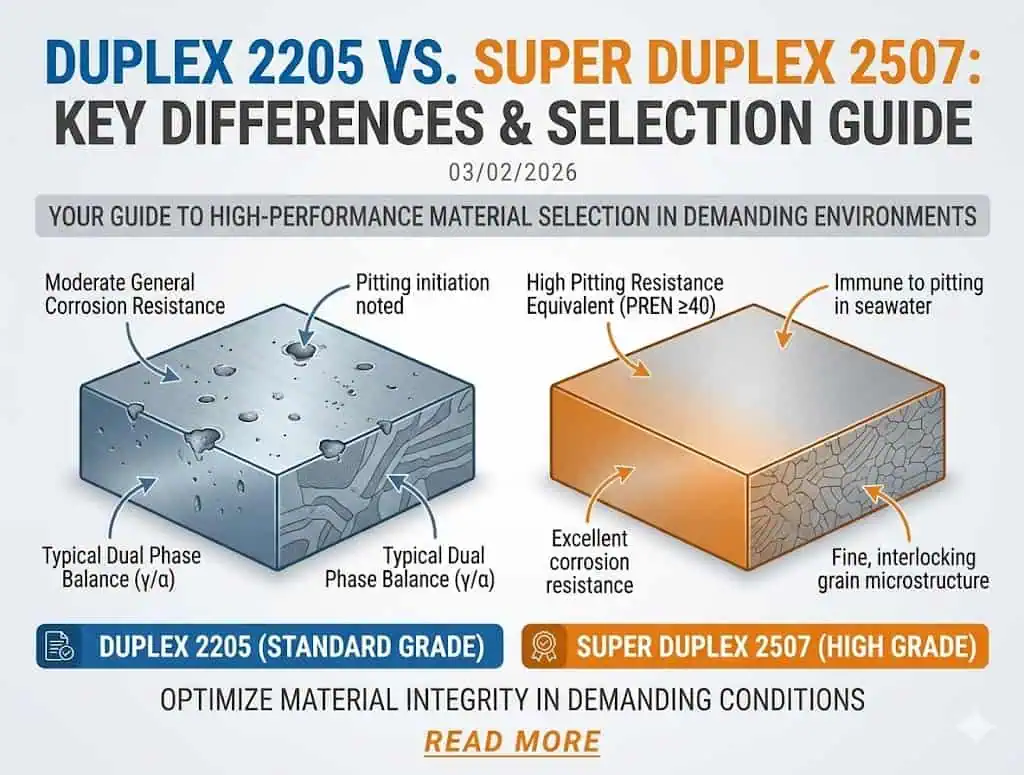
Duplex 2205 vs Super Duplex 2507 is not just a chemistry comparison. It is a material selection decision that affects corrosion margin, fabrication risk, inspection requirements, and long-term maintenance cost. In most moderate chloride environments, duplex 2205 is the practical and cost-effective choice. In direct seawater, desalination, offshore splash or immersion zones, and other high-crevice-risk service, super duplex 2507 is usually preferred because it offers a higher PREN, stronger resistance to pitting and crevice corrosion, and a wider safety margin in aggressive chloride exposure.
Quick answer: choose 2205 when chloride exposure is moderate and budget, availability, and easier fabrication matter. Choose 2507 when failure consequences are high and the service includes seawater, concentrated brine, deposits, stagnant zones, or more demanding offshore and chemical conditions. Nickel Institute guidance identifies 2205 as the workhorse duplex grade and also notes that 2205 does not have enough crevice-corrosion resistance for critical seawater applications where deposits or crevices exist, while more highly alloyed duplex grades are used when the chloride risk becomes more severe. Nickel Institute duplex guide
That is why engineers comparing duplex 2205 vs super duplex 2507 should not stop at tensile strength or purchase price. The real question is this: what environment is the part actually going into, how much crevice risk exists, how difficult is fabrication, and what is the cost of being wrong?
Duplex 2205 vs Super Duplex 2507: Quick Comparison
Duplex 2205 and Super Duplex 2507 are both duplex stainless steels with mixed ferrite-austenite microstructures, but 2507 is a higher-alloy super duplex grade designed for more aggressive chloride service. In practical project work, this means 2205 is often the default choice for process piping, tanks, fittings, and flanges in moderate corrosive service, while 2507 is selected when the design needs higher corrosion resistance and higher mechanical strength in one package.
| Comparison Point | Duplex 2205 | Super Duplex 2507 |
|---|---|---|
| Common UNS designation | S32205 / S31803 | S32750 |
| Typical use case | Moderate chloride service, process piping, general offshore topside, chemical equipment | Seawater, desalination, subsea, offshore splash zone, aggressive chloride service |
| PREN range | Typically about 35 to 36 for S32205 | Typically 40 to 43, with minimum PRE 41 in SAF 2507 |
| Strength level | High | Higher |
| Welding difficulty | More forgiving | Requires tighter heat-input and interpass control |
| Material cost | Lower | Higher |
| Best selection logic | Use when chloride severity is moderate and total cost matters | Use when the corrosion margin must be higher and downtime risk is expensive |
Field example: a plant may specify 2507 for every chloride service line “to be safe,” but that often drives unnecessary cost and longer lead time on parts that would perform well in 2205. The opposite mistake is worse: using 2205 on a seawater line with stagnant crevices, scale, or deposits, then discovering later that the material itself was never the right fit for that specific exposure condition.
Chemical Composition and PREN: 2205 vs 2507
Nominal Chemistry Differences
The main chemical difference between 2205 and 2507 is that 2507 contains more chromium, more nickel, more molybdenum, and more nitrogen. Those additions are exactly why 2507 performs better in high-chloride service, but they also explain why it costs more and why fabrication control becomes more sensitive.
According to Alleima datasheets, SAF 2205 is nominally about 22% Cr, 5% Ni, 3.2% Mo, and 0.18% N, while SAF 2507 is nominally about 25% Cr, 7% Ni, 4% Mo, and 0.3% N. SAF 2205 datasheet SAF 2507 datasheet
| Grade | Cr | Ni | Mo | N | What it means in practice |
|---|---|---|---|---|---|
| 2205 | About 22% | About 5% | About 3.2% | About 0.18% | Strong general-purpose duplex balance for corrosion resistance, strength, and availability |
| 2507 | About 25% | About 7% | About 4% | About 0.3% | Higher pitting and crevice-corrosion resistance, better fit for severe chloride environments |
Engineering note: many projects now prefer UNS S32205 rather than only S31803 because Nickel Institute notes that the tighter S32205 chemistry was introduced to improve corrosion and toughness response in welded fabrication. Nickel Institute duplex guide
PREN Comparison
PREN is one of the fastest ways to understand why 2507 outperforms 2205 in chloride service. The usual formula is:
PREN = Cr + 3.3(Mo + 0.5W) + 16NIMOA lists a typical PREN range of 35–36 for S32205 and 40–43 for S32750. Alleima’s published data gives SAF 2205 a PRE value above 35 and states that SAF 2507 has a minimum PRE value of 41. IMOA duplex fabrication guide SAF 2205 datasheet SAF 2507 datasheet
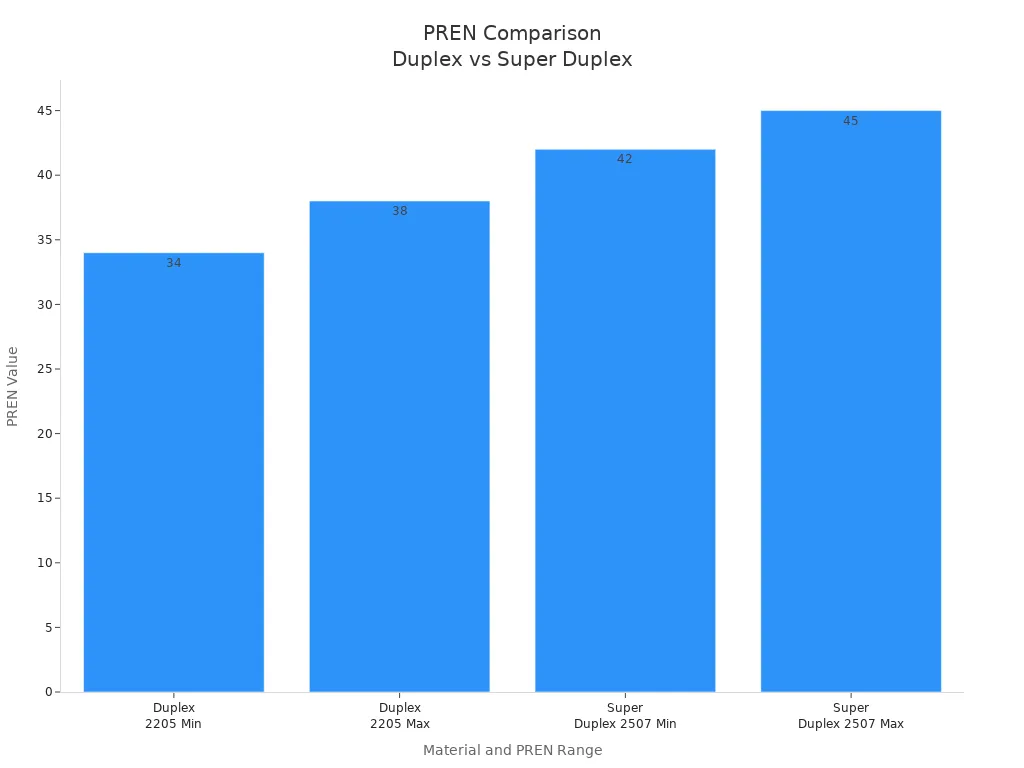
Important limitation: PREN is a useful screening tool, but it is not the whole decision. It does not replace service-specific checks for crevices, deposits, stagnant flow, temperature, weld quality, or fabrication defects. In real projects, the material with the higher PREN still fails if the service geometry creates a more severe crevice environment than the design assumed.
Corrosion Resistance: 2205 vs 2507 in Chloride Service
Pitting and Crevice Corrosion
The biggest real-world difference between duplex 2205 and super duplex 2507 shows up in pitting and crevice corrosion, especially when chloride concentration, deposits, or stagnant seawater are present. IMOA notes that 2205 can handle many brackish waters and deaerated brines, and it has been used successfully in deaerated seawater where the surface is kept free of deposits through high flow rates or other means. The same guide also states that 2205 does not have enough crevice-corrosion resistance for critical seawater applications such as thin-wall heat exchanger tubes or conditions where deposits or crevices exist. IMOA duplex fabrication guide
| Service condition | 2205 | 2507 |
|---|---|---|
| Moderate chlorides, good flow, low crevice risk | Usually suitable | Usually suitable but may be over-specified |
| Direct seawater with deposits or crevices | Often not enough margin | Preferred choice |
| Desalination brine and severe chloride service | Often limited | Much stronger candidate |
| Offshore splash, immersion, subsea hardware | Application-specific and often borderline | Commonly preferred |
Field example: 2205 may perform well in a chloride-bearing utility line that sees continuous flow and clean surfaces. The same grade can become a bad choice if the service later changes to a stagnant dead-leg spool or a crevice-prone flange region where deposits build up. That is why good material selection always includes geometry and operating condition, not chemistry alone.
Stress Corrosion Cracking Resistance
Both 2205 and 2507 offer much better chloride stress-corrosion-cracking resistance than standard 300-series austenitic grades, but 2507 still gives a higher corrosion margin when the chloride severity rises. Alleima reports that SAF 2205 has much higher SCC resistance than 304L and 316L in chloride-bearing solutions. IMOA likewise notes that duplex stainless steels in general have significantly better chloride SCC resistance than 300-series stainless steels. SAF 2205 datasheet IMOA duplex fabrication guide
That said, the right engineering question is not “does duplex resist SCC better than 316L?” The more useful question is “does 2205 provide enough margin here, or does this seawater, temperature, and crevice geometry justify 2507?”
Seawater, Offshore, and Desalination Use
If your project involves continuous seawater, offshore exposure, or desalination, 2507 is usually the safer answer. Nickel Institute notes that super duplex stainless steel welds will not pit in seawater up to about 40°C in the referenced seawater cooling guidance, while also emphasizing that crevice conditions remain critical and that actual service behavior depends on design and operation. Nickel Institute seawater guidance
Typical selection rule:
- Choose 2205 for moderate chloride service, process equipment, many chemical lines, and offshore topside duty where the chloride severity is not extreme and crevices are controlled.
- Choose 2507 for direct seawater, desalination, subsea, splash zones, and higher-risk crevice or deposit conditions where the cost of corrosion failure is too high.
Mechanical Properties: 2205 vs 2507
Strength Comparison
Super Duplex 2507 is stronger than Duplex 2205, and that strength advantage can matter when wall thickness, weight, or pressure design margins are important. In producer data, 2205 commonly sits around a minimum yield strength in the 450 MPa class, while 2507 is typically in the 550 MPa class or higher, depending on product form and standard. SAF 2205 datasheet SAF 2507 datasheet
| Property | 2205 | 2507 |
|---|---|---|
| Typical minimum yield strength | About 450 MPa | About 550 MPa |
| Typical minimum tensile strength | About 620 MPa | About 800 MPa |
| Practical implication | Strong enough for many pressure and structural duties | Higher design margin or potential wall-thickness reduction in severe service |
Engineering caution: higher strength is useful only when the corrosion environment also justifies the grade. Over-specifying 2507 in a mild process line may increase cost and fabrication sensitivity without creating meaningful lifecycle value.
Toughness, Hardness, and Fabrication Balance
2205 is often easier to fabricate and weld consistently across a wide range of shops, while 2507 rewards better discipline but punishes poor control more quickly. Duplex stainless steels already require more controlled fabrication practice than common austenitic grades. IMOA notes that their high alloy content and strength require changes in fabrication practice, and that correct composition and process control matter for successful welding and heat treatment. IMOA duplex fabrication guide
Field example: on a fabricated spool project, a team may select 2507 for extra corrosion margin but then use welding controls suitable for 2205. The result is not immediate visible failure. The result is often a weld zone with reduced corrosion performance because heat input, purge quality, or interpass control were not kept tight enough.
Welding and Fabrication Differences
When comparing duplex 2205 vs super duplex 2507, welding is one of the most overlooked differences. Both grades are weldable, but 2507 generally needs tighter discipline to protect the phase balance and corrosion resistance of the weld area.
Alleima states that SAF 2507 can be welded without preheat or post-weld heat treatment in normal practice, but recommends a heat input of 0.2–1.5 kJ/mm and an interpass temperature below 150°C. That is exactly the kind of control detail buyers should ask about when sourcing fabricated super duplex components. SAF 2507 welding guidance
| Fabrication issue | 2205 | 2507 |
|---|---|---|
| General weldability | Good | Good, but less forgiving |
| Heat input sensitivity | Moderate | Higher |
| Need for disciplined purge and weld control | Important | More critical |
| Procurement implication | Verify standard fabrication capability | Verify qualified procedures, filler selection, and welding records more carefully |
Practical buying rule: if you are purchasing finished flanges, fittings, or fabricated spools rather than raw material, do not compare 2205 and 2507 only by MTC chemistry. Compare them by fabrication competence. Ask for EN 10204 3.1 certificates, welding procedure qualification records where relevant, and project-specific inspection details.
Cost, Availability, and Procurement
2205 is usually easier to buy, faster to source, and more affordable than 2507. Nickel Institute describes 2205 as the workhorse second-generation duplex grade and notes that it is readily available in almost all product forms. That matters in real projects because the correct material is not just the one with the best datasheet. It is the one that can be sourced consistently, fabricated correctly, and delivered on time. Nickel Institute duplex guide
2507 costs more because its alloy content is higher, supply is narrower, and fabrication demands are tighter. The cost difference is often justified in seawater and offshore service, but not always in moderate chloride duty.
| Procurement factor | 2205 | 2507 |
|---|---|---|
| Material price | Lower | Higher |
| Availability across product forms | Usually broader | Usually narrower |
| Lead time risk | Lower | Higher |
| Best value case | Moderate corrosive service with cost control needs | High-risk chloride service where failure or downtime is expensive |
Field example: a buyer may reject 2507 because the initial quote is much higher, then spend more later on maintenance, replacement, shutdowns, and inspection if the service really needed super duplex from the start. The reverse also happens: 2507 gets specified everywhere, material cost rises sharply, and the project gains little because 2205 would have been enough for most of the system.
When to Choose 2205 vs 2507
Choose Duplex 2205 When
- The chloride environment is moderate rather than severe.
- The service is not direct seawater with heavy crevice or deposit risk.
- You want a better corrosion-and-strength package than 316L without moving into super duplex cost.
- Availability, fabrication ease, and shorter lead times matter.
- The application includes general process piping, many chemical services, and moderate marine or offshore duty where the exposure conditions are controlled.
Choose Super Duplex 2507 When
- The service includes direct seawater, desalination brine, offshore splash or immersion zones, or high chloride exposure.
- Crevice corrosion is a realistic risk because of deposits, stagnant zones, gasketed joints, or low-flow conditions.
- The failure consequence is high and you need a larger corrosion margin.
- You need higher strength and are prepared to control welding and fabrication more tightly.
- The lifecycle cost of corrosion failure is much higher than the additional purchase price.
| If your question is… | Usually the better answer is… |
|---|---|
| Which grade is enough for moderate chloride process service? | 2205 |
| Which grade is safer for seawater, desalination, and offshore immersion? | 2507 |
| Which grade is easier to buy and fabricate? | 2205 |
| Which grade gives the higher corrosion margin in aggressive chloride service? | 2507 |
Direct answer: if you are choosing between duplex 2205 vs super duplex 2507 for seawater, desalination, or highly aggressive chloride conditions, 2507 is usually the better engineering choice. If the environment is moderate and the corrosion risk is not extreme, 2205 often delivers the best balance of performance, availability, and cost.
SUNHY Support for Duplex and Super Duplex Projects
For duplex and super duplex flanges, fittings, and related piping components, the safest procurement approach is to combine the correct material grade with verifiable documentation. SUNHY can support projects that require corrosive-service material selection, certified material traceability, and document review for RFQs and purchase orders.
- Material support for Duplex 2205 and Super Duplex 2507
- Traceable documentation and MTC interpretation support
- Selection guidance for flanges, fittings, and piping components in chloride-bearing service
The key is not simply buying “duplex” or “super duplex.” The key is matching the right grade to the real service condition and then making sure the supplied material, fabrication route, and paperwork actually support that choice.
FAQ
What is the difference between Duplex 2205 and Super Duplex 2507?
The biggest difference is corrosion margin in chloride service. Duplex 2205 is the widely used workhorse grade for moderate corrosive environments, while Super Duplex 2507 contains more chromium, molybdenum, nickel, and nitrogen, giving it higher PREN, higher strength, and better resistance to pitting and crevice corrosion in seawater and other severe chloride conditions.
Is 2205 good enough for seawater service?
Sometimes, but not always. 2205 can work in certain seawater-related applications when the surface remains clean and crevice risk is controlled. It is usually not the safest choice for critical seawater service where deposits, stagnant flow, or crevices exist. In those cases, 2507 is often preferred.
Why is Super Duplex 2507 used in desalination plants?
Because desalination service combines chlorides, brine concentration, and crevice risk. 2507 provides a higher corrosion margin than 2205, which is why engineers often select it for more demanding desalination components and other severe chloride environments.
Is Super Duplex 2507 harder to weld than Duplex 2205?
Yes, it generally requires tighter welding control. Both grades are weldable, but 2507 is less forgiving. Heat input, purge quality, filler selection, and interpass temperature matter more because poor welding practice can reduce the corrosion performance of the weld zone.
How do engineers verify whether supplied 2205 or 2507 is correct?
They verify the grade through traceable documentation and project-required inspection. That typically includes EN 10204 3.1 certificates, heat-lot traceability, chemistry checks against the specified standard, and additional fabrication or weld records where relevant.