
Fastening Efficiency Solutions · OEM K-Lock (Keps) Nut Manufacturer
K-Lock (Keps) Nuts: Integrated Captive Washers for High-Speed, Anti-Vibration Assembly
Stop wasting assembly time fumbling with separate nuts and tiny lock washers. Leveraging decades of cold-forging expertise, we engineer K-Lock Nuts (also known as Keps Nuts) featuring a pre-assembled, free-spinning external tooth lock washer permanently staked to a precision hex body. Designed for high-volume automated and manual assembly lines, our integrated K-Nuts eliminate dropped parts, guarantee that a lock washer is present on every single joint, and provide aggressive bite-down resistance against vibration.
Configurations: External Tooth Washer (Standard), Conical/Belleville Washer variants.
Standard Compliance: ASME B18.6.3, DIN variants, and Custom OEM Prints.
Size Range: M3 to M12 / #4-40 to 1/2-13 (Optimized for small-to-medium enclosures).
Readiness: EN 10204 3.1 Certification, PPAP Level 3, and Precision Staking Verification.
Types of K-Lock (Keps) Nuts
 Special Nuts
Weld Nuts Series
Inserts & Rivet Series
Furniture & Specialty
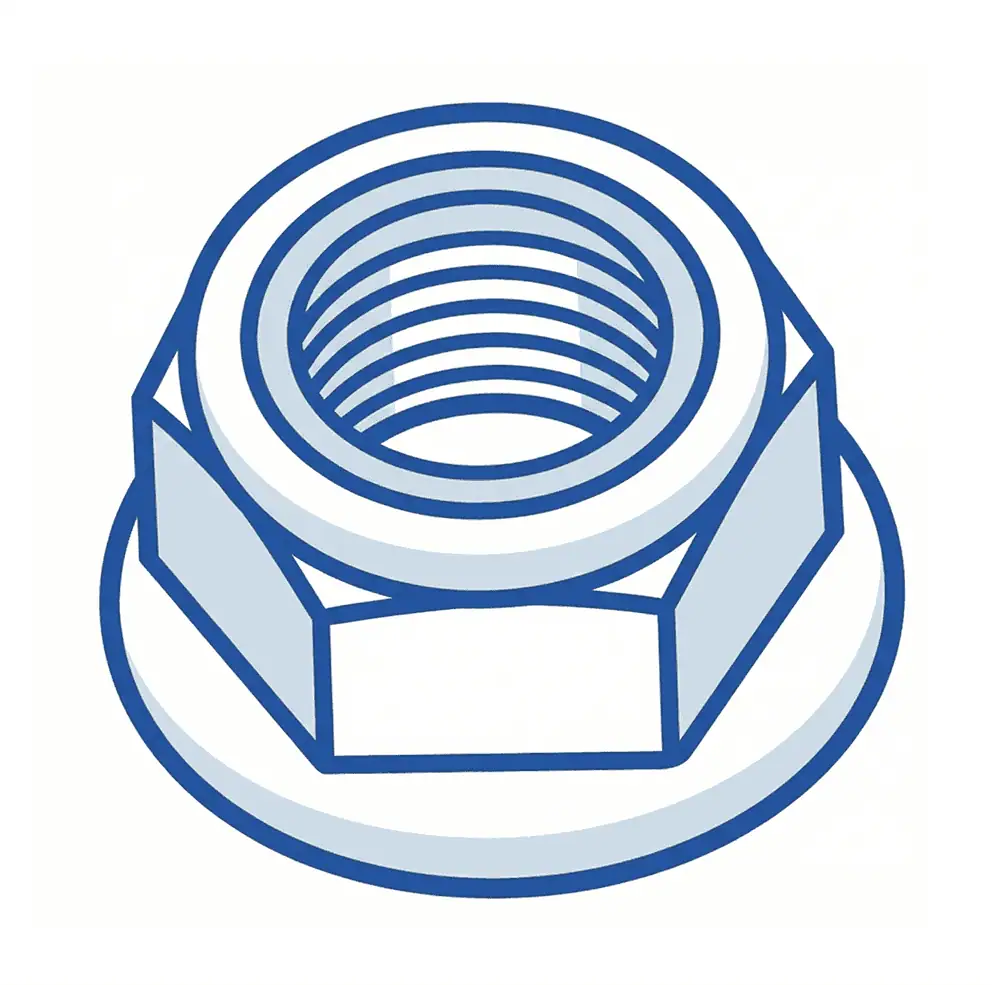
Standard K-Lock Nut (External Tooth Washer)
Conical Washer K-Nut (Belleville Type)
The Engineering Advantage: Captive Assembly Physics
Why specify a Keps Nut over a standard nut and separate washer? It is an investment in assembly line economics. Handling two separate, small components (a nut and a washer) requires fine motor skills, drastically slowing down manual operators. Dropped washers fall into machinery, causing severe electrical shorts or mechanical jams. By utilizing a Captive Staking Process, our factory tooling flares the bottom collar of the nut over the inner diameter of the washer. The washer remains completely free-spinning (to prevent scoring the mating surface prematurely during run-down) but physically cannot fall off. You halve your parts inventory and double your assembly speed.
What Is A K-Lock (Keps) Nut?
A K-Lock nut, universally known as a Keps nut, is a specialized industrial fastener consisting of a standard hex nut with a pre-assembled, free-spinning lock washer permanently attached to its base. This integrated design eliminates the need for manual pairing of small components, drastically speeding up assembly processes.
Key Anatomy & Characteristics:
Captive Lock Washer: Typically an external-tooth star washer (though conical styles exist). It is retained by a flared collar on the nut but is free to spin independently.
Anti-Vibration Teeth: Angled serrations on the washer that bite into the mating surface during final torque, creating a mechanical lock against vibration and establishing electrical continuity.
Flared Retaining Collar: A small, precision-crimped lip at the bottom of the hex body that permanently traps the inner diameter of the washer, preventing detachment.
Hexagonal Wrenching Body: The standard upper portion used for applying torque with automated drivers or hand tools.

Dimensional Reference: Metric K-Lock (Keps) Nuts
(Note: K-Lock nuts are predominantly used in smaller electronics and HVAC applications. We specialize in both metric and unified thread standards.)
| Thread Size | Pitch (mm) | Width Across Flats (Max) | Nut Height w/ Washer (Max) | Washer Outer Dia. (Max) |
| M3 | 0.50 | 5.50 mm | 3.20 mm | 7.20 mm |
| M4 | 0.70 | 7.00 mm | 4.20 mm | 9.20 mm |
| M5 | 0.80 | 8.00 mm | 5.20 mm | 10.50 mm |
| M6 | 1.00 | 10.00 mm | 6.20 mm | 12.50 mm |
| M8 | 1.25 | 13.00 mm | 8.20 mm | 15.50 mm |
Factory Engineering: Solving OEM Assembly Failures
Pain Point 1: Washers Detaching in Transit or Feeders
The Cause: Cheap K-nuts suffer from inconsistent staking/crimping. The collar isn’t flared enough, causing the washers to fall off during shipping or inside vibratory bowl feeders, halting automated lines.
Our Solution: Our automated assembly machines utilize precision-calibrated pressure dies to flare the retaining collar. Every batch undergoes a rigorous “pull-off” destructive test to ensure the captive washer remains permanently attached under high mechanical stress.
Pain Point 2: Hydrogen Embrittlement of the Lock Washer
The Cause: External tooth lock washers must be hardened (heat-treated) to bite into the metal. When these hardened washers are zinc-plated, they absorb hydrogen, causing them to shatter like glass when torqued.
Our Solution: We strictly enforce a post-plating baking protocol. All high-strength Keps nuts and their captive washers are baked within 4 hours of electroplating to safely outgas trapped hydrogen, completely preventing brittle fractures in the field.
Industry Application Case Study
Sector: Telecommunications & Server Rack Manufacturing
The Challenge: A manufacturer of 5G telecom enclosures was struggling with their manual assembly line. Operators were using separate M4 hex nuts and M4 external tooth washers to mount grounding plates. Operators frequently dropped the tiny washers, which would fall deep into the server chassis. If not found, these loose washers caused catastrophic electrical shorts during final power-testing, ruining $10,000 servers.
Our Solution: We transitioned their entire bill of materials to M4 K-Lock (Keps) Nuts.
The Result: The captive design meant zero dropped washers. The line operators no longer had to manually pair two tiny components. Assembly throughput increased by 35%, and electrical short defects caused by loose hardware dropped to absolute zero.
FAQ
Will a K-Lock Nut damage my painted surface?
Yes, if you use the External Tooth variant. The teeth are designed to aggressively bite through paint, powder coatings, and oxidation down to the bare metal. This is highly desired for electrical grounding applications. If you need to protect a coated surface, you must specify our Plain Flange Nut or a Conical Washer K-Nut instead.
Are K-Lock Nuts reusable?
No. The anti-vibration locking mechanism relies on the sharp teeth of the lock washer biting into the mating material and plastically deforming. Once the nut is removed, the teeth are flattened and the spring tension is permanently lost. Reusing a Keps nut guarantees a severe drop in vibration resistance.
Why does the washer need to be "free-spinning"?
If the washer were rigidly welded to the nut, the teeth would act like a milling cutter, violently grinding and tearing the host metal as you torque the nut down. A free-spinning washer remains stationary against the panel while the hex nut turns above it, only biting in at the very final stage of compression.