
Threaded Tees | Equal & Reducing Threaded Pipe Tees (NPT/BSPT)
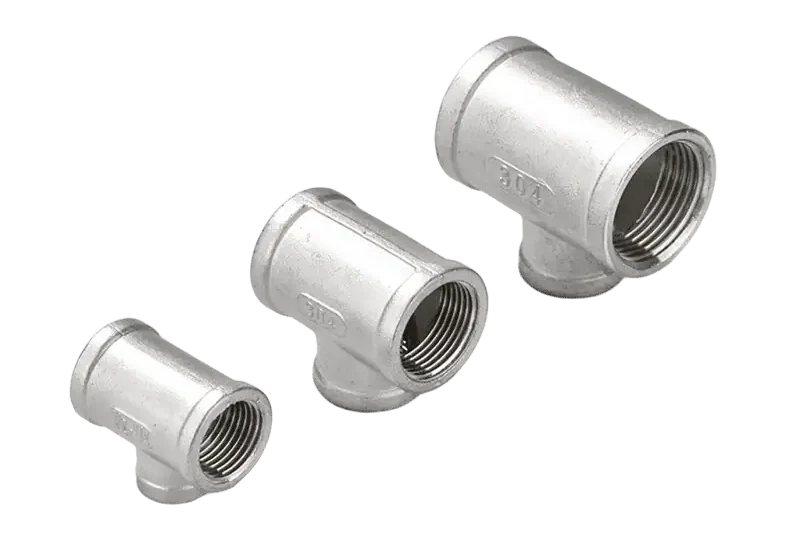
SUNHY supplies threaded tees for branch connections in serviceable piping systems. These fittings are commonly selected when projects need fast assembly, simplified site work, and easier maintenance access during commissioning or future line modifications.
Our offering covers equal tee and reducing tee configurations with NPT/BSPT options, focusing on stainless steel threaded tee requirements in SS304 / SS316L for corrosion-prone utility and process lines. Documentation and inspection levels can be provided per project specification.
- Clean branching, simple layout
- Fast assembly, no hot work
- Equal/reducing options, BOM match
- Stable make-up, reliable sealing
- Clear traceability, heat ID
- Docs available, per project spec
Specification & Standard
Nominal Size (NPS/DN)
Commonly 1/8″ – 4″ (larger sizes on request)
Type
Equal Tee / Reducing Tee (as specified)
Radius
Long Radius (LR) / Short Radius (SR) / Reducing Options
Standards
Thread requirement per ASME B1.20.1 (NPT) / ISO 7-1 (BSPT); product standard per project spec
Product
Threaded Tee / Threaded Reducing Tee
Thread Standard
NPT (ASME B1.20.1) / BSPT (ISO 7-1) (per BOM)
Materials
SS304 / SS316L common (other grades on request)
Documentation & Inspection
MTC (EN 10204 3.1), dimensional inspection, PMI for stainless upon request; NDT as specified
Threaded Tees for Clean Branch Connections
A threaded pipe tee creates a branch connection without welding, making it practical for serviceable piping where installation speed and future access matter. Typical selections include equal tees (same run/branch size) and reducing tees (different branch size).
Types You Can Specify
- Threaded Tee / Threaded Pipe Tee — standard branch connection for general routing.
- Threaded Reducing Tee — used when branch size differs from the run size on the BOM.
Why Buyers Choose Threaded Tees
- Fast assembly — minimizes site work and supports flexible routing changes.
- Maintenance access — easier disassembly for flushing, replacement, and line modifications.
- Thread compatibility — NPT/BSPT selection aligned to regional practice and mating pipe.
- Corrosion control — focus on SS304 / SS316L stainless steel threaded tees for humid/coastal and utility environments.
Dimension & Ordering Table (Equal vs Reducing Tee)
For procurement and site fit, threaded tees should be ordered by run size, branch size, thread standard, and material grade. Use the table below as a BOM checklist.
| Item | Equal Tee | Reducing Tee |
|---|---|---|
| Run size | Same as branch size | Main line size (as specified) |
| Branch size | Same as run size | Smaller or different size (as specified) |
| Thread | NPT or BSPT (match mating pipe and regional spec) | |
| Material | SS304 / SS316L common (other grades on request) | |
| Inspection scope | Dimensional check / thread gauging / PMI / NDT (as specified) | |
| Documents | MTC (EN 10204 3.1) + marking/traceability support (as required) | |
Selection tip: choose equal vs reducing by run/branch sizes shown on your BOM to avoid adapters and rework on site.
Product Assembly | How to Install a Threaded Tee
Threaded tees are assembled by engaging tapered threads to mating pipe threads. Final procedures should follow the project specification and be performed by qualified personnel.
Recommended Assembly Steps
- Verify the tee type — confirm equal vs reducing tee by run/branch sizes on the BOM.
- Confirm thread standard — NPT vs BSPT must match the mating pipe to avoid leakage and rework.
- Seal per spec — use approved PTFE tape or thread sealant compatible with service fluid and temperature.
- Align and tighten — avoid cross-threading; keep alignment to reduce stress on connected lines.
- Test and inspect — perform leak testing and inspection per project requirement after assembly.
Related Products
Butt Weld Tee (Equal / Reducing)
For branch connections in welded piping spools.
Concentric Reducer
Smooth centerline transition for vertical lines and pumps.
Eccentric Reducer
Flat side design to reduce air pockets in horizontal piping.
Butt Weld End Cap
Clean closure for pipe ends—ideal for test spools and headers.
Stub End (Lap Joint)
Common with lap joint flanges for frequent disassembly service.
FAQ
What is a threaded tee used for?
A Threaded Tee is a forged pipe fitting manufactured to ASME B16.11 standards, used to divide or combine fluid flow at a 90-degree angle. It features three internal thread connections (female) and is designed for high-pressure systems (Class 2000, 3000, 6000) where a reliable, leak-tight seal is required without on-site welding.
Key Applications:
Branching: diverting flow from a main header to a sub-line.
Instrumentation: installing pressure gauges or sensors via a reducing outlet.
Mixing: combining two fluid streams into one common line.
What is the difference between an equal tee and a reducing tee?
The primary difference is the outlet size configuration. An Equal Tee has three openings of the exact same nominal pipe size (e.g., 2″ x 2″ x 2″). A Reducing Tee has a branch outlet smaller than the main run, designated by the sequence: Largest Run × Opposite Run × Branch (e.g., 2″ x 2″ x 1″).
Equal Tee: Used when the branch line diameter matches the header.
Reducing Tee: Used to feed smaller equipment or instruments without needing an extra bushing.
When should l specify NPT vs BSPT for threaded tees?
Specify NPT (National Pipe Taper) for projects in North America or oil & gas systems using ANSI standards; it uses a 60° thread angle. Specify BSPT (British Standard Pipe Taper) for European, Asian, or ISO-standard projects; it uses a 55° thread angle.
Warning: Never mix these threads. Although a 1/2″ NPT male may physically screw into a 1/2″ BSPT female, the 5° angular mismatch creates a spiral leak path that cannot be sealed, leading to failure under pressure.
Why choose SS 304/SS316L stainless steel threaded tees?
Choose SS 316L for marine, chemical, or chloride-rich environments. It contains 2-3% Molybdenum, which provides superior resistance to pitting corrosion, and has Low Carbon (L) content to prevent weld decay. Choose SS 304 only for general-purpose, indoor, or non-aggressive fluid applications where cost is the primary factor.
Selection Guide:
SS 304/304L: Standard use, fresh water, air lines.
SS 316/316L: Sour gas, seawater, sulfuric acid traces.
What documents can you provide for site acceptance?
For site acceptance (SAT), the mandatory document is an EN 10204 Type 3.1 Material Test Certificate (MTC), which verifies the chemical composition and mechanical properties of the specific heat number.
Critical Add-ons for High-Integrity Systems:
NACE MR0175 Statement: Confirms hardness is ≤ 22 HRC for sour service defense.
PMI Report (Positive Material Identification): Verifies alloy grade on-site (e.g., confirming Mo content in 316L).
Hydrotest Report: Proof of pressure containment capability.