Ein weiterer Unterschied ist bei der Bestellung entscheidend: Ein allgemeiner schwerer Sechskantbolzen und ein schwerer Sechskant-Strukturbolzen sind nicht zwangsläufig nach derselben Norm dimensioniert. Für Verbindungselemente der US-Zoll-Serie deckt ASME B18.2.1 allgemeine Sechskant- und Schwerlast-Sechskantprodukte ab, während ASME B18.2.6 festgelegte Strukturverbindungselemente behandelt. Auch die anwendbare Produktgüte und die Verbindungsspezifikation müssen angegeben werden.
Ein korrekter Vergleich erfordert daher mehr als die Entscheidung, welcher Kopf größer aussieht. Der Käufer muss die tatsächlichen Kopfabmessungen, die maßgebliche Maßnorm, die geforderte Produktgüte und die Frage prüfen, ob ein anderer Bolzen in die Baugruppe passt und dort wie vorgesehen funktioniert.
Unterschiede bei den Kopfabmessungen von Schwerlast-Sechskantschrauben und Standard-Sechskantschrauben
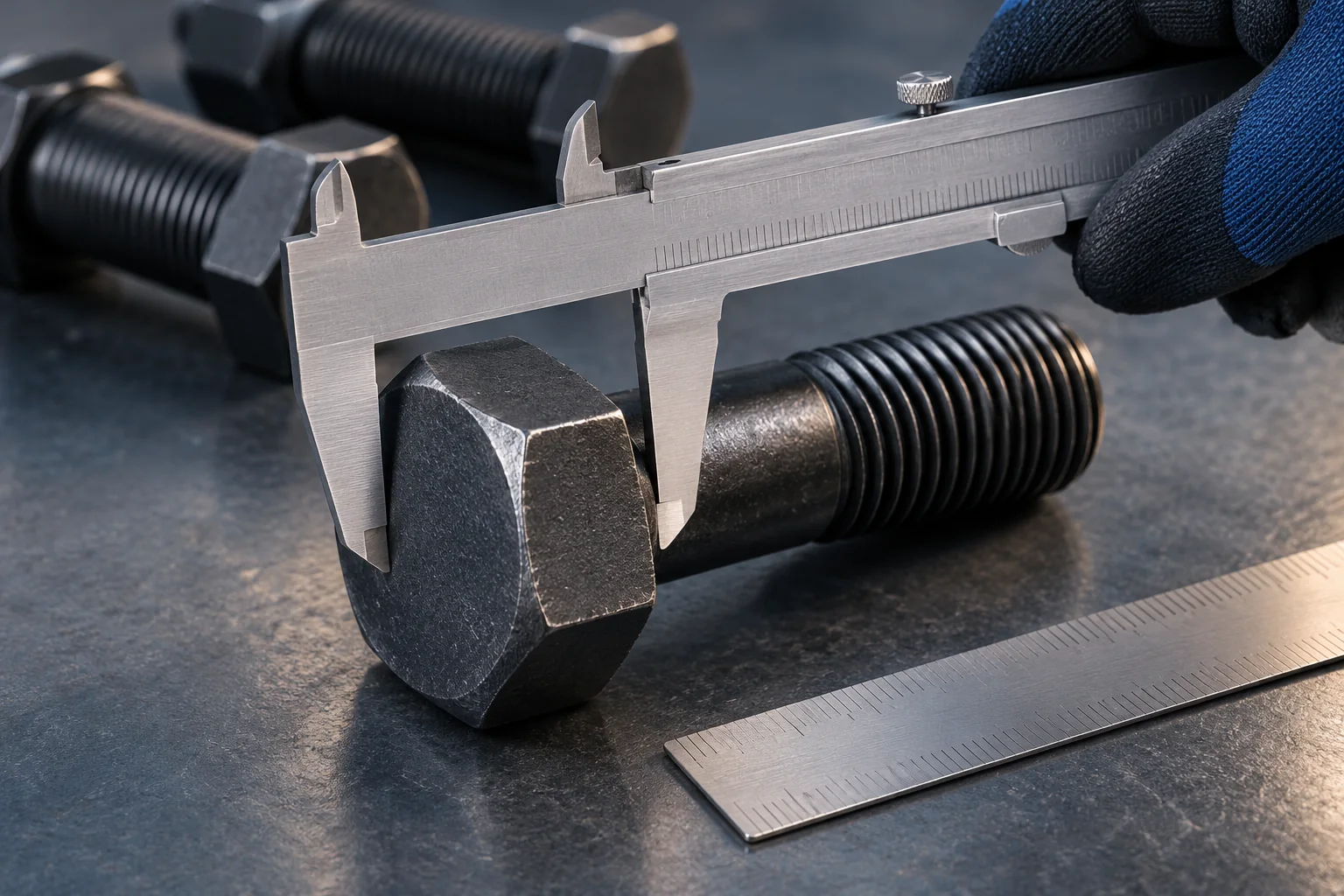
Der auffälligste Unterschied ist die Schlüsselweite des Kopfes, oft mit AF abgekürzt. Sie ist der Abstand zwischen zwei gegenüberliegenden ebenen Flächen des Sechskants und die Abmessung, mit der die entsprechende Schlüsselöffnung bestimmt wird.
Bei mehreren gängigen Nenndurchmessern der Zollreihe ist die Schlüsselweite eines schweren Sechskantkopfs um 1/8 inch (0.125 in) größer als die eines Standard-Sechskantkopfs. Der Nenndurchmesser bezieht sich weiterhin auf den Gewindeschaft der Schraube, nicht auf den Kopf.
Die folgenden Werte veranschaulichen den Unterschied.
| Nenndurchmesser der Schraube | Standard-Sechskant Schlüsselweite (in) | Allgemeiner Schwerlast-Sechskant Schlüsselweite (in) | Schwerlast-Sechskant Struktur Schlüsselweite (in) |
|---|---|---|---|
| 1/2 in | 0.750 | 0.875 | 0.875 |
| 3/4 in | 1.125 | 1.250 | 1.250 |
| 1 in | 1.500 | 1.625 | 1.625 |
Dimensionsgrundlage: veröffentlichte ASME B18.2.1-Referenzmaße für allgemeine Sechskantprodukte, abgeglichen mit Struktur-Schwerlast-Sechskant-Referenzmaßen gemäß ASME B18.2.6-2019. Die Werte sind Grund-/Referenz-Schlüsselweiten, keine vollständigen Fertigungstoleranzgrenzen oder eine Wareneingangsprüftabelle. Die gültige Standardausgabe und die Produktzeichnung sind maßgebend für die Abnahme.
Für eine 3/4-Zoll-Schraube beträgt die Standard-Sechskant-Referenzweite 1.125 Zoll, während die Schwerlast-Sechskant-Weite 1.250 Zoll beträgt. Dieser Unterschied erfordert eine andere Schlüsselöffnung, obwohl beide Schrauben denselben Nenndurchmesser des Schafts haben können.
Der Unterschied wird wichtig, wenn die Schraube nahe an einem Gehäuse, einem Strukturelement, einer Rohrhalterung oder einem anderen Verbindungselement liegt. Ein Schwerlast-Sechskantkopf kann in den verfügbaren Raum passen, lässt aber zu wenig Platz für das Montagewerkzeug.
Drei Maße erfordern besondere Beachtung:
Schlüsselweite bestimmt die nominale Schlüsselöffnung. Ein Standard-Sechskantwerkzeug passt möglicherweise nicht auf den breiteren Schwerlast-Sechskantkopf, selbst wenn Schraubendurchmesser und Gewinde übereinstimmen.
Breite über Ecken ist die maximale diagonale Hüllkurve des Sechskants. Sie ist wichtig bei der Prüfung des Freiraums neben benachbarten Komponenten oder beim Einführen einer Stecknuss in einen engen Raum. Der Außendurchmesser der Stecknuss kann deutlich mehr Platz erfordern als der Schraubenkopf selbst.
Kopfhöhe bestimmt den axialen Bauraum des Kopfes und beeinflusst den Zugang für ein geeignetes Werkzeug. Sie sollte nicht allein aus dem Wort schwer.
Ein schwerer Sechskantkopf ist nicht immer höher
Die größere Schlüsselweite bedeutet nicht, dass jeder schwere Sechskantkopf eine größere Höhe aufweist.
For example, published reference dimensions for 3/4-inch standard hex and general heavy hex products both give a head-height range of 0.455–0.524 inches. A corresponding ASME B18.2.6-2019 heavy hex structural reference gives 0.455–0.483 inches.
Diese Werte veranschaulichen einen wichtigen Unterschied: Allgemeine schwere Sechskantschrauben und schwere Sechskant-Strukturverschraubungen können dieselbe Schlüsselweite aufweisen, aber unterschiedliche Kopfhöhen-Grenzwerte haben.
Die Bereiche sind Referenzdaten für die angegebenen Produktkategorien und Ausgaben, keine universellen Toleranzen für jedes Sechskant-Verbindungselement.
Deshalb sollte eine Einkaufsspezifikation die genaue Kopfform und das Maßstandard angeben, anstatt einen “großen Sechskantkopf” anzufordern oder anzunehmen, dass jede schwere Sechskantschraube Strukturmaße erfüllt.
ASME B18.2.1 vs. B18.2.6: Welche Norm gilt?
Die beiden Normen decken unterschiedliche Produktbereiche ab, und diese Unterscheidung wirkt sich sowohl auf die Fertigungsanforderungen als auch auf die Beschaffung aus.
ASME B18.2.1: Allgemeine Sechskantprodukte der Zollreihe
ASME B18.2.1-2012 (R2021) legt die Maße für verschiedene Arten von Vierkant- und Sechskantschrauben und -bolzen fest, einschließlich allgemeiner Sechskant- und Schwerlast-Sechskantausführungen.
Sie bietet einen Maßrahmen zur Identifizierung relevanter Produkttypen sowie ihrer Kopf-, Schaft- und zugehörigen Maßanforderungen.
Die Spezifikation muss jedoch weiterhin die vorgesehene Produktform angeben. Ein Sechskantbolzen und eine Sechskant-Zylinderschraube sollten nicht automatisch als identisch behandelt werden, nur weil beide einen sechskantigen Kopf haben.
Ein allgemeiner Schwerlast-Sechskantbolzen, der nach B18.2.1 bemessen ist, sollte nicht als Erfüllung sämtlicher Maßanforderungen eines schweren Sechskant-Strukturbolzens nach B18.2.6 vorausgesetzt werden.
ASME B18.2.6: Schwere Sechskant-Strukturbolzen
ASME B18.2.6-2019 umfasst die festgelegten strukturellen Verbindungselemente, einschließlich schwerer Sechskant-Strukturbolzen und zugehöriger struktureller Befestigungskomponenten im angegebenen Geltungsbereich.
Die Anforderungen an Strukturbolzen müssen auf die korrekte Produktkategorie angewendet werden. Kopfhöhe, Bolzenkonfiguration und Gewindelängenregelungen können von den entsprechenden allgemeinen schweren Sechskantprodukten abweichen.
For an engineer reviewing replacement hardware, this matters beyond the visible head width. A replacement may accept the correct wrench but have a different threaded portion or other dimensional feature that affects the specified assembly.
The dimensional standard is only one part of the product identity. It does not establish the material’s tensile strength, the specified bolt grade, or the installed joint’s required pretension.
ASTM F3125 and RCSC have different responsibilities
For applicable high-strength structural bolts, ASTM F3125/F3125M addresses product requirements, including the relevant grade, type, style, and mechanical or material characteristics within its scope.
The ASTM F3125/F3125M-26 standard catalog identifies structural bolt product categories including Grade A325 and Grade A490. Where that edition is applicable, the precise product classification still matters. A head described as heavy hex does not independently establish its ASTM grade or type.
RCSC’s 2025 Spezifikation für strukturelle Verbindungen mit hochfesten Schrauben addresses the design, installation, and inspection of qualifying structural bolted joints.
These documents should not be substituted for one another:
- The ASME dimensional standard establishes the relevant bolt geometry.
- The ASTM product specification establishes applicable requirements for the specified fastener product.
- The RCSC specification governs qualifying structural connections, including relevant installation and inspection provisions.
A purchase order may need all three levels of identification, depending on the application. Passing a head-dimension check alone is not proof that a bolt meets the required ASTM product specification or that its installation satisfies the joint design.
The applicable editions should come from the governing project documents. The latest published edition is not automatically the edition incorporated into an existing contract.
Macht ein Schwerlast-Sechskantkopf eine Schraube fester?
Not necessarily. A larger hex head does not establish a higher tensile-strength grade or greater allowable bolt load.
Bolt tensile behavior is associated with properties such as the specified material and mechanical grade, the effective tensile-stress area, and the requirements of the applicable product specification. The width of the wrenching head is not a substitute for those properties.
A wider head can change the geometry of the bearing interface. Depending on the actual under-head bearing surface, washer arrangement, and mating material, this may affect how compressive contact forces are distributed.
But a larger head does not guarantee lower bearing stress throughout the entire joint. The effective contact area depends on the actual surfaces in contact, not simply the hexagon’s overall width.
The same limitation applies to bolt pretension.
Pretension is produced by the specified installation process and the resulting bolt elongation. It is affected by the fastener assembly, joint conditions, and installation method. Increasing the head width alone does not establish a higher pretension.
For a structural connection requiring pretension, the installation and verification method must follow the applicable project and RCSC requirements. A wider head or a larger wrench cannot replace those requirements.
Consider two bolts with matching nominal diameters but different head styles. If their product grades, material requirements, or specified assembly conditions differ, their suitability cannot be established by comparing head dimensions. Conversely, two bolts with similar mechanical-strength designations are not necessarily interchangeable if their geometric or assembly requirements differ.
The useful engineering distinction is that head geometry affects tool engagement and local fit, while product grade and the complete connection design determine whether the bolt is acceptable for the intended service.
A hypothetical buyer selects a wider head to obtain a stronger bolt while leaving the product grade unspecified. Head geometry cannot establish material or mechanical conformity. Define the required grade separately, confirm the dimensional product standard and review the mating parts. The bolt-grade guide is background for the grade terminology, not approval of the proposed joint.
Wann Schwerlast-Sechskantschrauben oder Standard-Sechskantschrauben verwenden
The correct selection begins with the assembly specification, not the assumption that one head style is universally better.
For general mechanical equipment, a standard hex bolt or hex cap screw may be suitable when it satisfies the specified product requirements and provides the required installation access. Its smaller head envelope can be useful where fasteners are close to surrounding equipment, guards, brackets, or other components.
This does not mean a standard hex bolt is appropriate for every mechanical connection, or that it is inherently weaker than a heavy hex bolt. The specified grade, dimensions, and service requirements remain decisive.
Heavy hex bolts are relevant where the equipment specification, original design, or mating hardware calls for that geometry. Their wider heads require a corresponding wrench or socket, and the surrounding structure must provide adequate installation clearance.
For structural steel connections requiring heavy hex structural bolts, selection is more restrictive. The engineer and buyer must confirm the specified structural bolt product, applicable grade and style, dimensional requirements, and compatible assembly components.
It is not sufficient to replace a specified structural bolt with a general-purpose heavy hex bolt solely because both use the same nominal diameter and wrench size.
Example: A 3/4-inch replacement bolt in a confined assembly
Illustrative hypothetical example — not a SUNHY customer installation or test result.
Suppose a machine assembly originally uses a 3/4-inch standard hex bolt with a 1.125-inch basic across-flats head width. A replacement supplier proposes a 3/4-inch heavy hex bolt with a 1.250-inch basic across-flats width.
The nominal diameter remains 3/4 inch, but the head is 0.125 inch wider across flats.
That creates an immediate tooling difference. The original 1-1/8-inch nominal wrench opening is not appropriate for the proposed 1-1/4-inch heavy hex head.
If the bolt is recessed or near another component, the installer must also check the outside diameter of the larger socket and the space needed to position and operate it. The 0.125-inch difference between basic across-flats dimensions is not itself the total additional installation clearance required.
There is a second, less visible question: does the proposed replacement satisfy the original bolt’s product and dimensional requirements?
The buyer would need to compare the material or product grade, thread series and class, required threaded length, applicable dimensions, and any relevant washer or nut requirements. If the original bolt belongs to a structural connection, the governing structural design and substitution approval requirements also apply.
The example demonstrates why a replacement can appear dimensionally similar at the threaded shank while still being unsuitable for the original installation.
The same reasoning works in reverse. Replacing a specified heavy hex structural bolt with a smaller standard hex bolt should not be approved merely because it passes through the same bolt hole.
Was vor einem Austausch oder Kauf zu prüfen ist
An RFQ that requests only “3/4-inch hex bolts” leaves the supplier to infer several important specifications.
The order should establish the required fastener identity before price or availability is compared.
For a general hex or heavy hex fastener, the essential information includes the nominal diameter, thread series and class, bolt length, head style, governing dimensional standard and edition, and applicable material or mechanical grade.
Where the head geometry is important to installation, the buyer should identify the required across-flats dimension or provide the applicable controlled drawing. A drawing becomes particularly useful for restricted-access assemblies or replacements involving older equipment.
For heavy hex structural bolts, the specification should also identify the relevant ASTM F3125 grade, type and style as applicable, together with the project-governing structural bolting requirements.
Nuts and washers must be considered as part of the specified assembly, not selected only because their nominal threads appear to match. Coating, thread fit, and lubrication requirements may also affect whether the supplied components form an acceptable assembly.
These considerations become especially important for coated structural fasteners, where the governing product and installation requirements may address compatible nuts, washers, and preparation conditions.
What should the buyer request for inspection?
The inspection requirements should follow the purchase specification rather than an arbitrary list of documents.
Relevant evidence may include dimensional inspection records, material or mechanical-test documentation, manufacturer identification, product marking verification, and records supporting the required batch or lot traceability.
A certificate of conformity, material test report, dimensional inspection record, and installed-joint inspection report serve different purposes. None automatically replaces the others.
For example, a report identifying a steel heat does not by itself establish that finished bolt heads comply with the specified dimensional tolerances. Similarly, a compliant finished product does not prove that the installed structural joint received the required pretension.
Before accepting a proposed substitute, the engineer or buyer should be able to answer a few concrete questions: Does the new bolt comply with the specified dimensional standard? Does its product grade meet the governing requirements? Is the head and thread configuration correct? Can the existing tools and mating components accommodate it? If the assembly is structurally controlled, has the substitution been reviewed under the applicable design and project requirements?
If any of these questions remain unresolved, matching nominal diameter alone is not an adequate basis for approval.
For buyers preparing a structural-bolt RFQ, SUNHY’s Structural Bolts product category provides the relevant commercial starting point. Supply scope, required grades, actual dimensions, and supporting documentation should be confirmed against the specific inquiry rather than inferred from a general technical article.
When requesting a dimensional or purchasing review, provide the governing specification, required head style, bolt size and length, product grade, coating, quantity, and any available assembly drawing. This gives the supplier enough information to identify potential dimensional or specification conflicts before an order is placed.
Häufig gestellte Fragen
Bedeutet ein schwerer Sechskantkopf eine höhere Festigkeit?
Die Kopfgröße ist ein Maß. Werkstoff und mechanische Güteklasse, die anzuwendende Produktspezifikation sowie zugehörige Nachweise legen separate Anforderungen fest.
Ist ein schwerer Sechskantkopf immer höher?
Gehen Sie nicht davon aus. Vergleichen Sie die zutreffenden Maßgrenzen für das exakte Produkt, die Größe und die Norm; Breite und Höhe ändern sich nicht in gleicher Weise.
Können Standard-Sechskantschrauben und schwere Sechskantschrauben dieselbe Schlüsselweite haben?
Prüfen Sie die tatsächlichen Schlüsselweiten. Ein gleicher Nenndurchmesser des Gewindes garantiert weder die gleiche Schlüsselweite noch ausreichenden Montagefreiraum.