Il existe une autre distinction importante lors de la commande : un boulon à tête hexagonale lourde général et un boulon structurel à tête hexagonale lourde ne sont pas nécessairement dimensionnés selon la même norme. Pour les éléments de fixation en série pouces américaine, l'ASME B18.2.1 couvre les produits hexagonaux et hexagonaux lourds généraux, tandis que l'ASME B18.2.6 traite des éléments de fixation structurels désignés. La nuance de produit applicable et la spécification d'assemblage doivent également être identifiées.
Une comparaison correcte implique donc plus que de décider quelle tête semble la plus grande. L'acheteur doit vérifier les dimensions réelles de la tête, la norme dimensionnelle applicable, la nuance de produit requise, et si un boulon différent s'adaptera et se comportera comme prévu dans l'assemblage.
En quoi les dimensions des têtes hexagonales lourdes et standard diffèrent
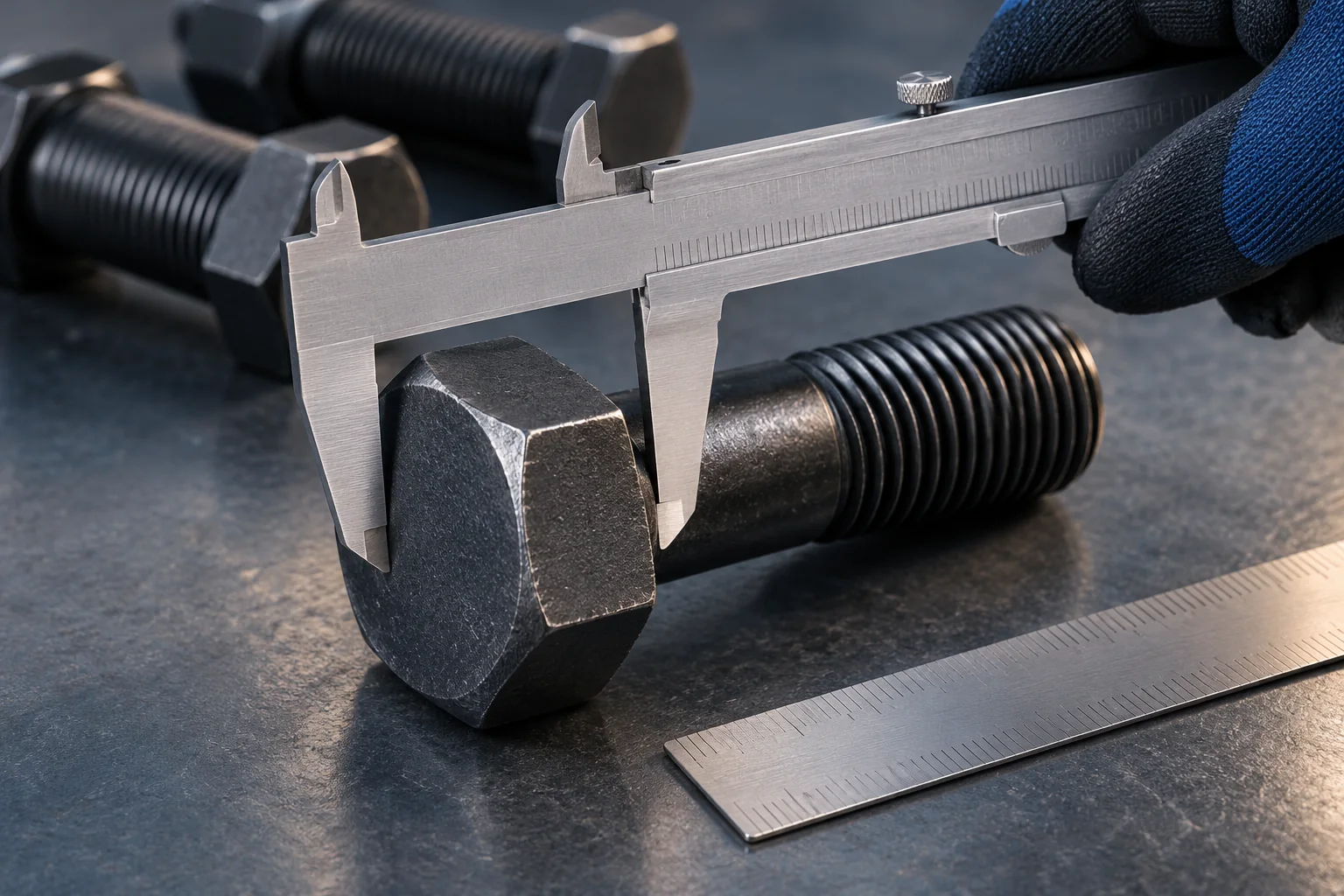
La différence la plus reconnaissable est la largeur sur plats de la tête, souvent abrégée AF. Il s'agit de la distance entre deux faces plates opposées de l'hexagone, et c'est la dimension utilisée pour identifier l'ouverture de clé correspondante.
Pour plusieurs diamètres nominaux courants de la série pouces, une tête hexagonale lourde présente une largeur sur plats de base supérieure de 1/8 inch (0.125 in) à celle d'une tête hexagonale standard. Le diamètre nominal se réfère toujours à la tige filetée du boulon, et non à sa tête.
Les valeurs suivantes illustrent la différence.
| Diamètre nominal du boulon | Méplat standard (in) | Méplat hexagonal série lourde standard (in) | Méplat hexagonal série lourde de construction (in) |
|---|---|---|---|
| 1/2 in | 0.750 | 0.875 | 0.875 |
| 3/4 in | 1.125 | 1.250 | 1.250 |
| 1 in | 1.500 | 1.625 | 1.625 |
Base dimensionnelle : dimensions de référence publiées dans ASME B18.2.1 pour les vis à tête hexagonale standard, recoupées avec les dimensions de référence des vis à tête hexagonale série lourde de construction identifiées dans ASME B18.2.6-2019. Les valeurs correspondent aux dimensions sur plats de base/référence, et non aux limites complètes de tolérance de fabrication ni à un tableau de réception. L'édition applicable de la norme et le plan du produit font foi pour l'acceptation.
Pour une vis de 3/4 de pouce, la largeur de référence de la tête hexagonale standard est de 1.125 pouces, tandis que celle de la tête hexagonale série lourde est de 1.250 pouces. Cet écart impose une ouverture de clé différente, bien que les deux vis puissent avoir le même diamètre nominal de tige.
Cette distinction devient importante lorsque la vis se trouve à proximité d'un carter, d'un élément de structure, d'un support de tuyauterie ou d'un autre élément de fixation. Une tête hexagonale série lourde peut tenir dans l'espace disponible tout en laissant trop peu de place à l'outil de pose.
Trois dimensions doivent être examinées séparément :
Largeur sur plats détermine l'ouverture nominale de la clé. Un outil pour tête hexagonale standard peut ne pas convenir à la tête hexagonale série lourde plus large, même lorsque le diamètre de la vis et le filetage correspondent.
Largeur entre coins correspond à l'encombrement diagonal maximal de l'hexagone. Elle intervient lors du contrôle du dégagement à proximité de composants adjacents ou pour permettre le passage d'une douille dans un espace confiné. Le diamètre extérieur de la douille peut nécessiter nettement plus de place que la tête de vis elle-même.
Hauteur de tête détermine l'encombrement axial de la tête et influence l'accès pour un outil adapté. Elle ne doit pas être déduite simplement du mot lourde.
Une tête hexagonale lourde n'est pas toujours plus haute
Une dimension sur plats plus grande ne signifie pas que chaque tête hexagonale lourde présente une hauteur supérieure.
For example, published reference dimensions for 3/4-inch standard hex and general heavy hex products both give a head-height range of 0.455–0.524 inches. A corresponding ASME B18.2.6-2019 heavy hex structural reference gives 0.455–0.483 inches.
Ces valeurs illustrent une distinction importante : les boulons hexagonaux lourds standard et les boulons hexagonaux lourds de structure peuvent partager la même largeur sur plats tout en ayant des limites de hauteur de tête différentes.
Les plages indiquées sont des données de référence pour les catégories de produits et les éditions spécifiées, et non des tolérances universelles pour tous les éléments de fixation à tête hexagonale.
C'est pourquoi une spécification d'achat doit identifier le style de tête et la norme dimensionnelle exacts plutôt que de demander une “ grande tête hexagonale ” ou de supposer qu'un boulon hexagonal lourd quelconque respecte les dimensions de structure.
ASME B18.2.1 vs B18.2.6 : quelle norme s'applique ?
Les deux normes couvrent des périmètres produits différents, et cette distinction influe à la fois sur les exigences de fabrication et sur l'approvisionnement.
ASME B18.2.1 : produits hexagonaux généraux de la série pouces
ASME B18.2.1-2012 (R2021) couvre les dimensions de plusieurs types de vis et boulons carrés et hexagonaux, y compris les configurations hexagonales générales et hexagonales lourdes.
Elle fournit un cadre dimensionnel permettant d'identifier les types de produits concernés ainsi que leurs exigences dimensionnelles relatives à la tête, au corps et aux éléments associés.
Toutefois, la spécification doit toujours préciser la forme de produit visée. Un boulon hexagonal et une vis à tête hexagonale ne doivent pas être automatiquement considérés comme identiques au seul motif que tous deux possèdent une tête à six pans.
Un boulon hexagonal lourd général dimensionné selon la B18.2.1 ne doit pas être présumé satisfaire à toutes les exigences dimensionnelles d'un boulon hexagonal lourd de structure selon la B18.2.6.
ASME B18.2.6 : boulons hexagonaux lourds de structure
ASME B18.2.6-2019 couvre les éléments de fixation structurels désignés, y compris les boulons structurels à tête hexagonale lourde et les composants de fixation structurels associés dans le périmètre indiqué.
Ses exigences relatives aux boulons structurels doivent être appliquées à la bonne catégorie de produit. La hauteur de tête, la configuration du boulon et les dispositions relatives à la longueur filetée peuvent différer des produits généraux à tête hexagonale lourde correspondants.
For an engineer reviewing replacement hardware, this matters beyond the visible head width. A replacement may accept the correct wrench but have a different threaded portion or other dimensional feature that affects the specified assembly.
The dimensional standard is only one part of the product identity. It does not establish the material’s tensile strength, the specified bolt grade, or the installed joint’s required pretension.
ASTM F3125 and RCSC have different responsibilities
For applicable high-strength structural bolts, ASTM F3125/F3125M addresses product requirements, including the relevant grade, type, style, and mechanical or material characteristics within its scope.
The ASTM F3125/F3125M-26 standard catalog identifies structural bolt product categories including Grade A325 and Grade A490. Where that edition is applicable, the precise product classification still matters. A head described as heavy hex does not independently establish its ASTM grade or type.
RCSC’s 2025 Spécification pour les assemblages structuraux utilisant des boulons à haute résistance addresses the design, installation, and inspection of qualifying structural bolted joints.
These documents should not be substituted for one another:
- The ASME dimensional standard establishes the relevant bolt geometry.
- The ASTM product specification establishes applicable requirements for the specified fastener product.
- The RCSC specification governs qualifying structural connections, including relevant installation and inspection provisions.
A purchase order may need all three levels of identification, depending on the application. Passing a head-dimension check alone is not proof that a bolt meets the required ASTM product specification or that its installation satisfies the joint design.
The applicable editions should come from the governing project documents. The latest published edition is not automatically the edition incorporated into an existing contract.
Une tête hexagonale lourde rend-elle un boulon plus résistant ?
Not necessarily. A larger hex head does not establish a higher tensile-strength grade or greater allowable bolt load.
Bolt tensile behavior is associated with properties such as the specified material and mechanical grade, the effective tensile-stress area, and the requirements of the applicable product specification. The width of the wrenching head is not a substitute for those properties.
A wider head can change the geometry of the bearing interface. Depending on the actual under-head bearing surface, washer arrangement, and mating material, this may affect how compressive contact forces are distributed.
But a larger head does not guarantee lower bearing stress throughout the entire joint. The effective contact area depends on the actual surfaces in contact, not simply the hexagon’s overall width.
The same limitation applies to bolt pretension.
Pretension is produced by the specified installation process and the resulting bolt elongation. It is affected by the fastener assembly, joint conditions, and installation method. Increasing the head width alone does not establish a higher pretension.
For a structural connection requiring pretension, the installation and verification method must follow the applicable project and RCSC requirements. A wider head or a larger wrench cannot replace those requirements.
Consider two bolts with matching nominal diameters but different head styles. If their product grades, material requirements, or specified assembly conditions differ, their suitability cannot be established by comparing head dimensions. Conversely, two bolts with similar mechanical-strength designations are not necessarily interchangeable if their geometric or assembly requirements differ.
The useful engineering distinction is that head geometry affects tool engagement and local fit, while product grade and the complete connection design determine whether the bolt is acceptable for the intended service.
A hypothetical buyer selects a wider head to obtain a stronger bolt while leaving the product grade unspecified. Head geometry cannot establish material or mechanical conformity. Define the required grade separately, confirm the dimensional product standard and review the mating parts. The bolt-grade guide is background for the grade terminology, not approval of the proposed joint.
Quand utiliser des boulons à tête hexagonale lourde ou standard
The correct selection begins with the assembly specification, not the assumption that one head style is universally better.
For general mechanical equipment, a standard hex bolt or hex cap screw may be suitable when it satisfies the specified product requirements and provides the required installation access. Its smaller head envelope can be useful where fasteners are close to surrounding equipment, guards, brackets, or other components.
This does not mean a standard hex bolt is appropriate for every mechanical connection, or that it is inherently weaker than a heavy hex bolt. The specified grade, dimensions, and service requirements remain decisive.
Heavy hex bolts are relevant where the equipment specification, original design, or mating hardware calls for that geometry. Their wider heads require a corresponding wrench or socket, and the surrounding structure must provide adequate installation clearance.
For structural steel connections requiring heavy hex structural bolts, selection is more restrictive. The engineer and buyer must confirm the specified structural bolt product, applicable grade and style, dimensional requirements, and compatible assembly components.
It is not sufficient to replace a specified structural bolt with a general-purpose heavy hex bolt solely because both use the same nominal diameter and wrench size.
Example: A 3/4-inch replacement bolt in a confined assembly
Illustrative hypothetical example — not a SUNHY customer installation or test result.
Suppose a machine assembly originally uses a 3/4-inch standard hex bolt with a 1.125-inch basic across-flats head width. A replacement supplier proposes a 3/4-inch heavy hex bolt with a 1.250-inch basic across-flats width.
The nominal diameter remains 3/4 inch, but the head is 0.125 inch wider across flats.
That creates an immediate tooling difference. The original 1-1/8-inch nominal wrench opening is not appropriate for the proposed 1-1/4-inch heavy hex head.
If the bolt is recessed or near another component, the installer must also check the outside diameter of the larger socket and the space needed to position and operate it. The 0.125-inch difference between basic across-flats dimensions is not itself the total additional installation clearance required.
There is a second, less visible question: does the proposed replacement satisfy the original bolt’s product and dimensional requirements?
The buyer would need to compare the material or product grade, thread series and class, required threaded length, applicable dimensions, and any relevant washer or nut requirements. If the original bolt belongs to a structural connection, the governing structural design and substitution approval requirements also apply.
The example demonstrates why a replacement can appear dimensionally similar at the threaded shank while still being unsuitable for the original installation.
The same reasoning works in reverse. Replacing a specified heavy hex structural bolt with a smaller standard hex bolt should not be approved merely because it passes through the same bolt hole.
Ce qu'il faut vérifier avant substitution ou achat
An RFQ that requests only “3/4-inch hex bolts” leaves the supplier to infer several important specifications.
The order should establish the required fastener identity before price or availability is compared.
For a general hex or heavy hex fastener, the essential information includes the nominal diameter, thread series and class, bolt length, head style, governing dimensional standard and edition, and applicable material or mechanical grade.
Where the head geometry is important to installation, the buyer should identify the required across-flats dimension or provide the applicable controlled drawing. A drawing becomes particularly useful for restricted-access assemblies or replacements involving older equipment.
For heavy hex structural bolts, the specification should also identify the relevant ASTM F3125 grade, type and style as applicable, together with the project-governing structural bolting requirements.
Nuts and washers must be considered as part of the specified assembly, not selected only because their nominal threads appear to match. Coating, thread fit, and lubrication requirements may also affect whether the supplied components form an acceptable assembly.
These considerations become especially important for coated structural fasteners, where the governing product and installation requirements may address compatible nuts, washers, and preparation conditions.
What should the buyer request for inspection?
The inspection requirements should follow the purchase specification rather than an arbitrary list of documents.
Relevant evidence may include dimensional inspection records, material or mechanical-test documentation, manufacturer identification, product marking verification, and records supporting the required batch or lot traceability.
A certificate of conformity, material test report, dimensional inspection record, and installed-joint inspection report serve different purposes. None automatically replaces the others.
For example, a report identifying a steel heat does not by itself establish that finished bolt heads comply with the specified dimensional tolerances. Similarly, a compliant finished product does not prove that the installed structural joint received the required pretension.
Before accepting a proposed substitute, the engineer or buyer should be able to answer a few concrete questions: Does the new bolt comply with the specified dimensional standard? Does its product grade meet the governing requirements? Is the head and thread configuration correct? Can the existing tools and mating components accommodate it? If the assembly is structurally controlled, has the substitution been reviewed under the applicable design and project requirements?
If any of these questions remain unresolved, matching nominal diameter alone is not an adequate basis for approval.
For buyers preparing a structural-bolt RFQ, SUNHY’s Structural Bolts product category provides the relevant commercial starting point. Supply scope, required grades, actual dimensions, and supporting documentation should be confirmed against the specific inquiry rather than inferred from a general technical article.
When requesting a dimensional or purchasing review, provide the governing specification, required head style, bolt size and length, product grade, coating, quantity, and any available assembly drawing. This gives the supplier enough information to identify potential dimensional or specification conflicts before an order is placed.
Questions fréquemment posées
Une tête hexagonale lourde signifie-t-elle une résistance plus élevée ?
La taille de tête n'est qu'une donnée dimensionnelle. La nuance de matériau et de mécanique, la spécification produit applicable et les enregistrements justificatifs constituent des exigences distinctes.
Une tête hexagonale lourde est-elle toujours plus haute ?
Ne le présumez pas. Comparez les limites dimensionnelles applicables pour le produit, la taille et la norme exacts ; la largeur et la hauteur ne varient pas de manière identique.
Les boulons hexagonaux standard et les boulons hexagonaux à tête épaisse peuvent-ils utiliser la même douille ?
Vérifiez les dimensions réelles sur plats. Un diamètre nominal de filetage identique ne garantit pas une taille de clé identique ni un dégagement de montage disponible.