Há outra distinção importante na hora de fazer o pedido: um parafuso sextavado pesado comum e um parafuso sextavado estrutural pesado não são necessariamente dimensionados conforme o mesmo padrão. Para elementos de fixação da série em polegadas dos EUA, a ASME B18.2.1 abrange produtos sextavados comuns e sextavados pesados, enquanto a ASME B18.2.6 trata dos elementos de fixação estruturais designados. O grau de produto aplicável e a especificação da conexão também devem ser identificados.
Portanto, uma comparação correta envolve mais do que decidir qual cabeça parece maior. O comprador precisa verificar as dimensões reais da cabeça, o padrão dimensional aplicável, o grau de produto exigido e se um parafuso diferente se encaixará e terá o desempenho esperado na montagem.
Como as dimensões das cabeças sextavadas pesada e padrão diferem
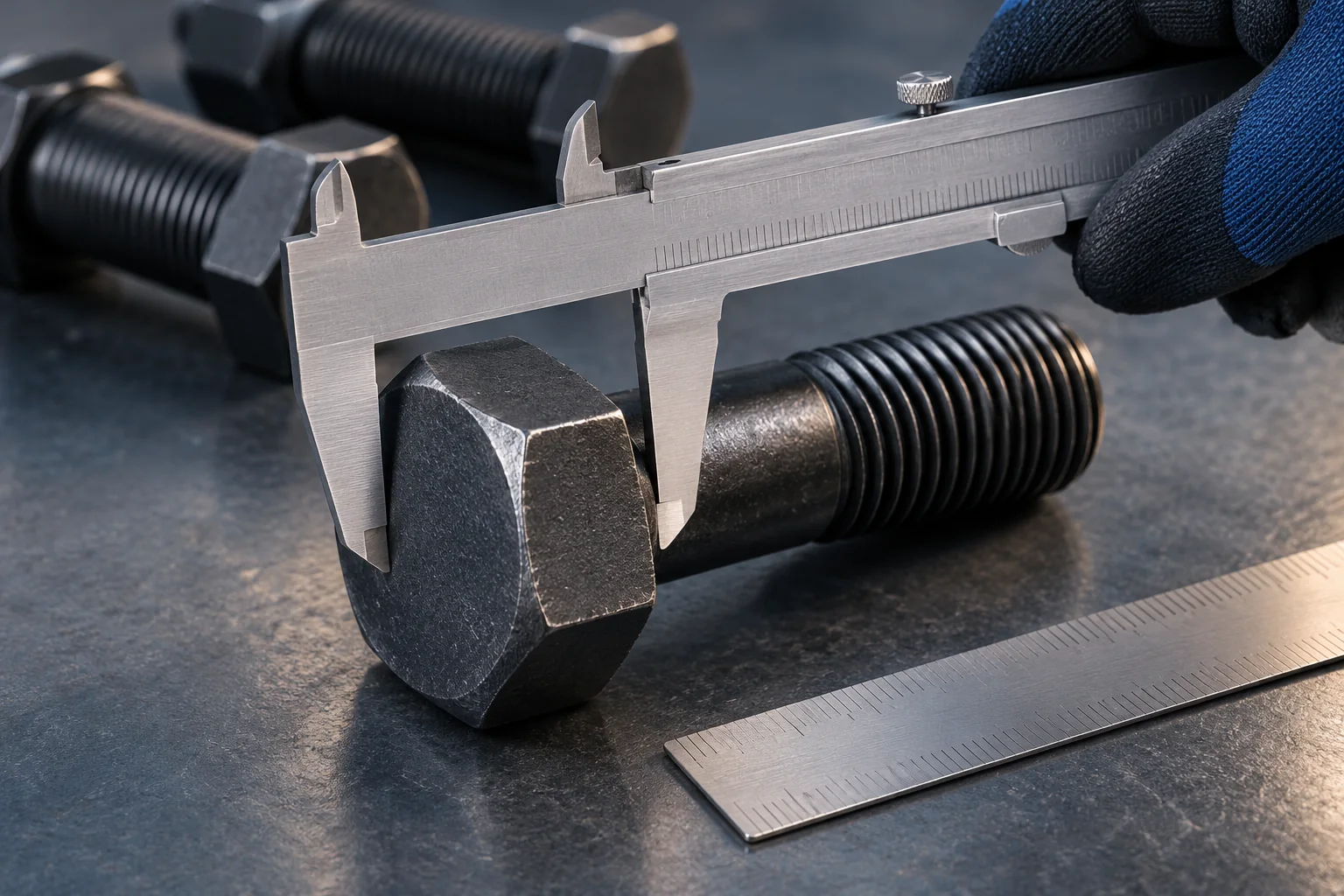
A diferença mais reconhecível é a largura da cabeça entre faces planas, frequentemente abreviada como AF. Essa é a distância entre duas faces planas opostas do sextavado e é a dimensão usada para identificar a abertura de chave correspondente.
For several common inch-series nominal diameters, a heavy hex head has a basic across-flats width 1/8 inch (0.125 in) greater than a standard hex head. The nominal diameter still refers to the bolt’s threaded shank, not its head.
Os valores a seguir ilustram a diferença.
| Diâmetro nominal do parafuso | AF padrão sextavado (in) | AF sextavado pesado geral (in) | AF sextavado pesado estrutural (in) |
|---|---|---|---|
| 1/2 in | 0.750 | 0.875 | 0.875 |
| 3/4 in | 1.125 | 1.250 | 1.250 |
| 1 in | 1.500 | 1.625 | 1.625 |
Base dimensional: dimensões de referência publicadas na ASME B18.2.1 para produtos sextavados gerais, verificadas em relação às dimensões de referência de sextavado pesado estrutural identificadas na ASME B18.2.6-2019. Os valores são dimensões entre faces (AF) básicas/de referência, não limites completos de tolerância de fabricação nem uma tabela de inspeção de recebimento. A edição aplicável da norma e o desenho do produto prevalecem para a aceitação.
Para um parafuso de 3/4 de polegada, a largura de referência do sextavado padrão é 1.125 polegadas, enquanto a largura do sextavado pesado é 1.250 polegadas. Essa diferença exige uma abertura de chave diferente, embora ambos os parafusos possam ter o mesmo diâmetro nominal de haste.
A distinção torna-se importante quando o parafuso está próximo de uma carcaça, um elemento estrutural, um suporte de tubulação ou outro elemento de fixação. Uma cabeça sextavada pesada pode caber no espaço disponível, deixando, porém, pouco espaço para a ferramenta de instalação.
Três dimensões exigem atenção separada:
Largura entre faces determina a abertura nominal da chave. Uma ferramenta para sextavado padrão pode não caber na cabeça sextavada pesada mais larga, mesmo quando o diâmetro do parafuso e a rosca coincidem.
Largura entre cantos é o envelope diagonal máximo do hexágono. É relevante ao verificar a folga junto a componentes adjacentes ou ao permitir que um soquete passe para um espaço confinado. O diâmetro externo do soquete pode exigir substancialmente mais espaço do que a própria cabeça do parafuso.
Altura da cabeça determina o espaço axial ocupado pela cabeça e influencia o acesso para uma ferramenta adequada. Não deve ser inferida simplesmente a partir da palavra pesada.
Uma cabeça sextavada pesada nem sempre é mais alta
A maior dimensão entre faces não significa que toda cabeça sextavada pesada tenha maior altura.
For example, published reference dimensions for 3/4-inch standard hex and general heavy hex products both give a head-height range of 0.455–0.524 inches. A corresponding ASME B18.2.6-2019 heavy hex structural reference gives 0.455–0.483 inches.
Esses valores ilustram uma distinção importante: parafusos sextavados pesados comuns e parafusos estruturais sextavados pesados podem compartilhar a mesma largura entre faces, embora tenham limites diferentes de altura da cabeça.
As faixas são dados de referência para as categorias de produto e edições especificadas, não tolerâncias universais para todo elemento de fixação com cabeça sextavada.
Por isso, uma especificação de compra deve identificar o estilo exato da cabeça e a norma dimensional, em vez de solicitar uma “cabeça sextavada grande” ou presumir que qualquer parafuso sextavado pesado atende às dimensões estruturais.
ASME B18.2.1 vs B18.2.6: qual norma se aplica?
As duas normas atendem a escopos de produto diferentes, e essa distinção afeta tanto os requisitos de fabricação quanto a compra.
ASME B18.2.1: produtos hexagonais gerais da série em polegadas
ASME B18.2.1-2012 (R2021) abrange as dimensões de vários tipos de parafusos e pinos quadrados e hexagonais, incluindo as configurações hexagonais gerais e hexagonais pesadas.
Ela fornece uma estrutura dimensional para identificar os tipos de produto relevantes e seus requisitos dimensionais de cabeça, corpo e correlatos.
No entanto, a especificação ainda deve identificar a forma de produto pretendida. Um parafuso hexagonal e um parafuso de cabeça hexagonal não devem ser automaticamente tratados como idênticos apenas porque ambos têm cabeças de seis lados.
Um parafuso hexagonal pesado geral dimensionado conforme a B18.2.1 não deve ser presumido como atendendo a todos os requisitos dimensionais de um parafuso estrutural hexagonal pesado conforme a B18.2.6.
ASME B18.2.6: parafusos estruturais hexagonais pesados
ASME B18.2.6-2019 abrange elementos de fixação estruturais designados, incluindo parafusos estruturais sextavados pesados e componentes de fixação estrutural relacionados dentro do seu escopo declarado.
Seus requisitos para parafusos estruturais devem ser aplicados à categoria de produto correta. A altura da cabeça, a configuração do parafuso e as disposições de comprimento de rosca podem diferir dos produtos sextavados pesados gerais correspondentes.
For an engineer reviewing replacement hardware, this matters beyond the visible head width. A replacement may accept the correct wrench but have a different threaded portion or other dimensional feature that affects the specified assembly.
The dimensional standard is only one part of the product identity. It does not establish the material’s tensile strength, the specified bolt grade, or the installed joint’s required pretension.
ASTM F3125 and RCSC have different responsibilities
For applicable high-strength structural bolts, ASTM F3125/F3125M addresses product requirements, including the relevant grade, type, style, and mechanical or material characteristics within its scope.
The ASTM F3125/F3125M-26 standard catalog identifies structural bolt product categories including Grade A325 and Grade A490. Where that edition is applicable, the precise product classification still matters. A head described as heavy hex does not independently establish its ASTM grade or type.
RCSC’s 2025 Especificação para Juntas Estruturais com Parafusos de Alta Resistência addresses the design, installation, and inspection of qualifying structural bolted joints.
These documents should not be substituted for one another:
- The ASME dimensional standard establishes the relevant bolt geometry.
- The ASTM product specification establishes applicable requirements for the specified fastener product.
- The RCSC specification governs qualifying structural connections, including relevant installation and inspection provisions.
A purchase order may need all three levels of identification, depending on the application. Passing a head-dimension check alone is not proof that a bolt meets the required ASTM product specification or that its installation satisfies the joint design.
The applicable editions should come from the governing project documents. The latest published edition is not automatically the edition incorporated into an existing contract.
Uma cabeça sextavada pesada torna o parafuso mais resistente?
Not necessarily. A larger hex head does not establish a higher tensile-strength grade or greater allowable bolt load.
Bolt tensile behavior is associated with properties such as the specified material and mechanical grade, the effective tensile-stress area, and the requirements of the applicable product specification. The width of the wrenching head is not a substitute for those properties.
A wider head can change the geometry of the bearing interface. Depending on the actual under-head bearing surface, washer arrangement, and mating material, this may affect how compressive contact forces are distributed.
But a larger head does not guarantee lower bearing stress throughout the entire joint. The effective contact area depends on the actual surfaces in contact, not simply the hexagon’s overall width.
The same limitation applies to bolt pretension.
Pretension is produced by the specified installation process and the resulting bolt elongation. It is affected by the fastener assembly, joint conditions, and installation method. Increasing the head width alone does not establish a higher pretension.
For a structural connection requiring pretension, the installation and verification method must follow the applicable project and RCSC requirements. A wider head or a larger wrench cannot replace those requirements.
Consider two bolts with matching nominal diameters but different head styles. If their product grades, material requirements, or specified assembly conditions differ, their suitability cannot be established by comparing head dimensions. Conversely, two bolts with similar mechanical-strength designations are not necessarily interchangeable if their geometric or assembly requirements differ.
The useful engineering distinction is that head geometry affects tool engagement and local fit, while product grade and the complete connection design determine whether the bolt is acceptable for the intended service.
A hypothetical buyer selects a wider head to obtain a stronger bolt while leaving the product grade unspecified. Head geometry cannot establish material or mechanical conformity. Define the required grade separately, confirm the dimensional product standard and review the mating parts. The bolt-grade guide is background for the grade terminology, not approval of the proposed joint.
Quando usar parafusos sextavados pesados ou padrão
The correct selection begins with the assembly specification, not the assumption that one head style is universally better.
For general mechanical equipment, a standard hex bolt or hex cap screw may be suitable when it satisfies the specified product requirements and provides the required installation access. Its smaller head envelope can be useful where fasteners are close to surrounding equipment, guards, brackets, or other components.
This does not mean a standard hex bolt is appropriate for every mechanical connection, or that it is inherently weaker than a heavy hex bolt. The specified grade, dimensions, and service requirements remain decisive.
Heavy hex bolts are relevant where the equipment specification, original design, or mating hardware calls for that geometry. Their wider heads require a corresponding wrench or socket, and the surrounding structure must provide adequate installation clearance.
For structural steel connections requiring heavy hex structural bolts, selection is more restrictive. The engineer and buyer must confirm the specified structural bolt product, applicable grade and style, dimensional requirements, and compatible assembly components.
It is not sufficient to replace a specified structural bolt with a general-purpose heavy hex bolt solely because both use the same nominal diameter and wrench size.
Example: A 3/4-inch replacement bolt in a confined assembly
Illustrative hypothetical example — not a SUNHY customer installation or test result.
Suppose a machine assembly originally uses a 3/4-inch standard hex bolt with a 1.125-inch basic across-flats head width. A replacement supplier proposes a 3/4-inch heavy hex bolt with a 1.250-inch basic across-flats width.
The nominal diameter remains 3/4 inch, but the head is 0.125 inch wider across flats.
That creates an immediate tooling difference. The original 1-1/8-inch nominal wrench opening is not appropriate for the proposed 1-1/4-inch heavy hex head.
If the bolt is recessed or near another component, the installer must also check the outside diameter of the larger socket and the space needed to position and operate it. The 0.125-inch difference between basic across-flats dimensions is not itself the total additional installation clearance required.
There is a second, less visible question: does the proposed replacement satisfy the original bolt’s product and dimensional requirements?
The buyer would need to compare the material or product grade, thread series and class, required threaded length, applicable dimensions, and any relevant washer or nut requirements. If the original bolt belongs to a structural connection, the governing structural design and substitution approval requirements also apply.
The example demonstrates why a replacement can appear dimensionally similar at the threaded shank while still being unsuitable for the original installation.
The same reasoning works in reverse. Replacing a specified heavy hex structural bolt with a smaller standard hex bolt should not be approved merely because it passes through the same bolt hole.
O que verificar antes da substituição ou compra
An RFQ that requests only “3/4-inch hex bolts” leaves the supplier to infer several important specifications.
The order should establish the required fastener identity before price or availability is compared.
For a general hex or heavy hex fastener, the essential information includes the nominal diameter, thread series and class, bolt length, head style, governing dimensional standard and edition, and applicable material or mechanical grade.
Where the head geometry is important to installation, the buyer should identify the required across-flats dimension or provide the applicable controlled drawing. A drawing becomes particularly useful for restricted-access assemblies or replacements involving older equipment.
For heavy hex structural bolts, the specification should also identify the relevant ASTM F3125 grade, type and style as applicable, together with the project-governing structural bolting requirements.
Nuts and washers must be considered as part of the specified assembly, not selected only because their nominal threads appear to match. Coating, thread fit, and lubrication requirements may also affect whether the supplied components form an acceptable assembly.
These considerations become especially important for coated structural fasteners, where the governing product and installation requirements may address compatible nuts, washers, and preparation conditions.
What should the buyer request for inspection?
The inspection requirements should follow the purchase specification rather than an arbitrary list of documents.
Relevant evidence may include dimensional inspection records, material or mechanical-test documentation, manufacturer identification, product marking verification, and records supporting the required batch or lot traceability.
A certificate of conformity, material test report, dimensional inspection record, and installed-joint inspection report serve different purposes. None automatically replaces the others.
For example, a report identifying a steel heat does not by itself establish that finished bolt heads comply with the specified dimensional tolerances. Similarly, a compliant finished product does not prove that the installed structural joint received the required pretension.
Before accepting a proposed substitute, the engineer or buyer should be able to answer a few concrete questions: Does the new bolt comply with the specified dimensional standard? Does its product grade meet the governing requirements? Is the head and thread configuration correct? Can the existing tools and mating components accommodate it? If the assembly is structurally controlled, has the substitution been reviewed under the applicable design and project requirements?
If any of these questions remain unresolved, matching nominal diameter alone is not an adequate basis for approval.
For buyers preparing a structural-bolt RFQ, SUNHY’s Structural Bolts product category provides the relevant commercial starting point. Supply scope, required grades, actual dimensions, and supporting documentation should be confirmed against the specific inquiry rather than inferred from a general technical article.
When requesting a dimensional or purchasing review, provide the governing specification, required head style, bolt size and length, product grade, coating, quantity, and any available assembly drawing. This gives the supplier enough information to identify potential dimensional or specification conflicts before an order is placed.
Perguntas frequentes
Uma cabeça sextavada pesada significa maior resistência?
Não. O tamanho da cabeça é dimensional. O grau do material e mecânico, a especificação de produto aplicável e os registros de suporte estabelecem requisitos separados.
Um parafuso sextavado pesado é sempre mais alto?
Não presuma isso. Compare os limites dimensionais aplicáveis para o produto, tamanho e norma exatos; largura e altura não variam de forma idêntica.
Parafusos sextavados padrão e pesados podem usar o mesmo soquete?
Verifique as dimensões reais entre faces (abertura de chave). Diâmetro nominal de rosca igual não garante o mesmo tamanho de chave nem folga de instalação disponível.