Surface finish and cleanliness in process gas systems are related, but they are not the same thing. Surface finish describes the condition of the wetted surface, including roughness and finish quality. Cleanliness describes whether that same surface is free from fabrication residue, shop contamination, weld discoloration, trapped particles, free iron, or handling damage that can later affect gas purity, leak integrity, purge time, and startup stability. In real projects, many failures happen because teams specify a low roughness value but do not control cleaning, passivation, weld quality, packaging, or field handling to the same standard. If the system carries high-purity or contamination-sensitive gas, the right question is not “Is the surface smooth?” but “Is this component finished, cleaned, documented, received, installed, and released in a way that matches the actual gas service?”
That distinction matters for facility engineers, process engineers, QA inspectors, EPC teams, and procurement managers because a polished appearance alone does not prevent particle excursions, corrosion concerns, delayed purge recovery, or repeated rework after installation. A useful engineering review should connect surface finish, cleanliness, welding practice, packaging integrity, inspection records, and service-specific acceptance criteria instead of treating them as separate topics.
The most expensive mistake is not buying a rough part. It is buying a part that looks acceptable, passes a quick dimensional check, and still introduces contamination or startup risk because finish, cleanliness, and release control were never tied together.
What Surface Finish and Cleanliness Actually Mean in Process Gas Systems

Surface Finish Is Not the Same as Cleanliness
Surface finish helps describe the wetted surface. Cleanliness tells you whether that surface is actually suitable for gas service.
In process gas systems, people often use these terms as if they mean the same thing. They do not. Surface finish is usually discussed in terms of roughness, manufacturing finish, or the treated condition of the metal surface. Cleanliness is a broader control issue. It includes residual oils, shop dust, polishing media residue, cutting compounds, weld oxidation, poor post-fabrication cleaning, damaged packaging, and even contamination introduced after the component left the factory.
This is why a component can show an acceptable roughness value and still be a poor fit for a contamination-sensitive line. A common field issue is a part that looks smooth and bright when unpacked, but the line later shows particles or slow purge recovery because the actual contamination source came from fabrication residue, poor weld purge, or packaging damage rather than roughness alone.
| Term | What It Tells You | What It Does Not Prove | Why It Matters |
|---|---|---|---|
| Surface finish | Texture and condition of the wetted surface | That the component is clean, passivated, or contamination-free | Affects cleanability, particle hold-up tendency, and some corrosion behavior |
| Cleanliness | Whether contamination sources have been removed or controlled | That the surface geometry is optimal or the weld quality is acceptable | Directly affects gas purity, startup stability, and release confidence |
| Passivation | That the stainless surface has been chemically treated to support corrosion resistance | That the part was properly cleaned, packaged, and protected afterward | Important where fabrication residue or free iron concerns exist |
| Visual brightness | The part looks polished or clean to the eye | Any controlled acceptance basis | Often misused as a substitute for actual QA evidence |
For related connection categories and fabrication context, you can review industrial pipe fittings, butt weld fittings, and socket weld fittings when you need to compare how different component families influence the final wetted path.
Practical rule: A low Ra number can support a specification, but it should never be treated as proof that the component is ready for process gas service.
Which Parts of the System Usually Drive the Most Risk
Not every part of a process gas system carries the same cleanliness risk.
Tubing, fittings, valves, regulators, welds, manifolds, and dead-leg-prone branches each create different contamination and release concerns. Straight tubing may be easy to characterize, but fittings and valves often introduce more complex internal geometry. Welded joints can add heat tint, purge-related residue, or localized surface changes. Maintainable joints can be clean in design but still become repeat problem points if sealing faces are scratched, handled poorly, or reopened without controlled practice.
A typical receiving or installation mistake happens when the team focuses on the visible external surface of the component but does not review the internal wetted path, weld area, or packaging condition with the same care.
| Component | Main Surface / Cleanliness Risk | What Inspectors Often Miss |
|---|---|---|
| Tubing | Surface condition, fabrication residue, end protection | Tube ends exposed during storage or handling |
| Weld fittings | Internal geometry, weld prep condition, post-fabrication cleaning | Assuming supplied fittings are clean because they are capped |
| Valves | Complex wetted path, trapped residue, seal-related contamination | Focusing on body finish but not internal cleanliness documentation |
| Welds | Heat tint, purge quality, weld acceptance, local surface condition | Treating weld completion as proof of cleanliness |
| Maintainable joints | Sealing-face damage, handling contamination, reassembly variation | Assuming the joint stays clean after repeated opening |
| Packaging | Broken caps, open bags, mixed lots, wrong service segregation | Passing a part because dimensions match even though packaging does not |
In high-purity or semiconductor-style gas systems, the system should be viewed as a contamination path, not just a collection of parts.
Why Surface Finish and Cleanliness Affect Process Gas System Performance
Surface finish and cleanliness affect more than appearance. They influence contamination, purge stability, weld release risk, and confidence during startup.
A rough or poorly controlled surface can trap particles or make post-fabrication cleaning less reliable. A visually smooth component can still carry residue or contamination if cleaning, passivation, packaging, or handling were weak. In welded stainless systems, local heat effects and poor internal purge practice can create a surface condition that looks acceptable from the outside but behaves poorly in service.
In one fabrication case, a stainless gas branch met dimensional and material requirements but still caused problems after startup because the project team accepted the branch on weld completion and paperwork timing, not on weld cleanliness and release readiness. The visible problem was particles. The deeper cause was that surface condition and cleanliness were treated as separate teams’ responsibilities instead of one shared release criterion.
In gas systems, contamination problems often appear late. That is exactly why finish and cleanliness controls must be written into procurement, fabrication, receiving, and release rather than checked only after startup trouble appears.
How to Evaluate Surface Finish and Cleanliness Before Release
You should evaluate process gas system surface finish and cleanliness through a combination of material basis, surface condition, fabrication controls, weld acceptance, and receiving evidence.
In practice, engineers usually make mistakes by over-focusing on one variable. Some only look at roughness. Some only look at cleaning certificates. Some only look at weld appearance. A more reliable approach is to connect service chemistry, contamination sensitivity, component type, fabrication method, and the actual release criteria that the line must satisfy.
If the package includes small-bore components and mixed connection styles, it also helps to separate tube fitting types from code-style pipe fittings early, then compare butt weld, socket weld, and threaded fitting strategies before freezing the specification. This prevents a common engineering mistake where the connection style is selected for layout convenience, even though it changes contamination risk, inspection difficulty, and long-term maintenance behavior.
| Selection Factor | What to Check | Why It Matters |
|---|---|---|
| Gas service | Bulk gas, specialty gas, high-purity service, contamination sensitivity | Changes how aggressive the finish and cleanliness controls must be |
| Base material | Material grade, metallurgical cleanliness, traceability | Supports corrosion resistance and contamination control logic |
| Surface condition | Specified finish basis, acceptance method, relevant documentation | Defines what the supplier is actually obligated to deliver |
| Cleaning / passivation | What treatment was done, when, and how it is documented | Prevents “looks clean” from replacing verifiable processing |
| Weld quality | Weld procedure, purge practice, visual acceptance, release readiness | Welds can become the dirtiest part of an otherwise good system |
| Packaging and receiving | Caps, bags, labels, lot integrity, document match | A good component can be made unusable by poor packaging or handling |
A useful internal reference such as this material grades guide can help buyers and reviewers keep the discussion tied to actual ordered material, not just generic stainless language.

What matters most is not whether a component sounds “clean” or “smooth,” but whether it can be specified, fabricated, delivered, inspected, and released without introducing contamination or repeat failures.
Note: A lower roughness target may support easier cleanability, but it does not remove the need to control weld purge, passivation, packaging, and field handling.
Which Standards Are Actually Relevant
The most useful standards for this topic are the ones that directly affect piping, wetted surface condition, metallurgical cleanliness, welding practice, and weld acceptance.
For general piping framework, ASME B31.3 matters because it covers process piping found in semiconductor and related plants and addresses materials, components, design, fabrication, examination, inspection, and testing. For semiconductor or high-purity stainless gas systems, SEMI F19 matters because it is specifically about the wetted surface condition of stainless steel components. SEMI F20 matters because it ties 316L material forms to general-purpose, high-purity, and ultra-high-purity semiconductor applications rather than leaving the conversation at a generic alloy label. For fabrication quality, SEMI F78 and SEMI F81 matter because weld quality in high-purity gas systems affects more than strength. It affects purity, local surface condition, internal cleanliness risk, and whether the system can be released with confidence.
| Standard | Why It Matters in This Topic |
|---|---|
| ASME B31.3 | Provides the process piping framework for materials, components, fabrication, inspection, and testing |
| SEMI F19 | Supports decisions about the wetted surface condition of stainless steel components |
| SEMI F20 | Supports material basis decisions for 316L in HP and UHP semiconductor applications |
| SEMI F78 | Supports welding practice decisions where GTA weld quality affects cleanliness and purity |
| SEMI F81 | Supports visual acceptance of GTA welds in semiconductor fluid distribution systems |
You should not turn the article into a standards list. The standard only becomes useful when it changes what the buyer writes, what the inspector checks, and what the field team accepts or rejects.

Practical takeaway: If the specification names a piping code but says nothing about wetted surface condition, weld cleanliness, packaging, or receiving criteria, the cleanliness requirement is still underdefined.
What to Specify in Procurement and Receiving Inspection
Most disputes about finish and cleanliness begin with vague purchase wording.
Terms such as “clean finish,” “high purity quality,” or “polished stainless” sound technical, but they do not define what the supplier must actually deliver. A better purchase package states the service, material grade, wetted surface basis, required cleaning or passivation status, weld-related requirements where applicable, packaging expectations, traceability, and document package.
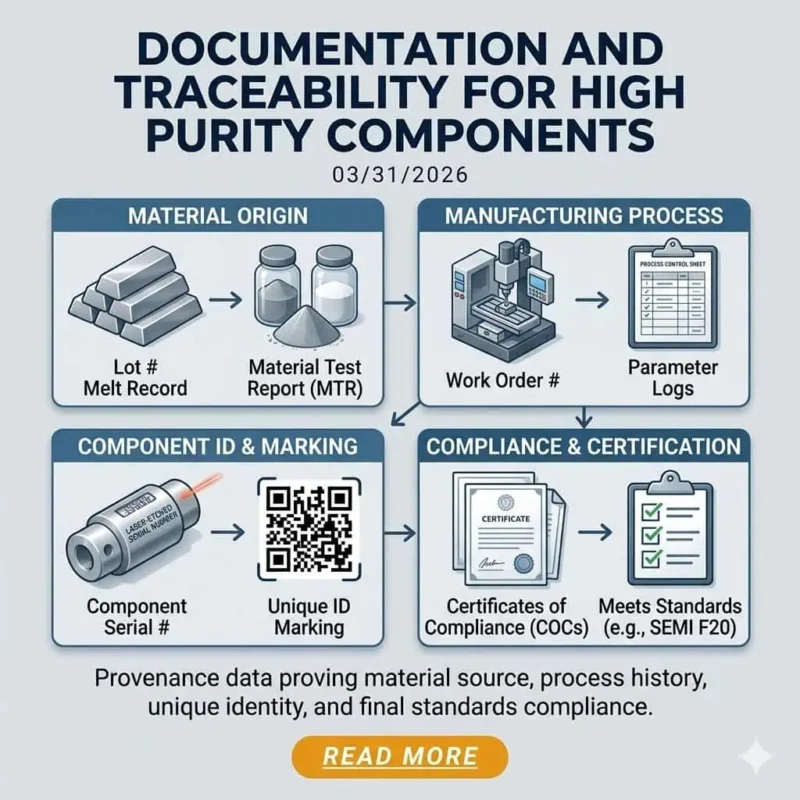
A typical receiving mistake happens when the supplier ships the correct size and pressure class, but the certificate package does not clearly tie the part to the ordered heat, lot, or cleanliness basis. If your team needs a practical reference for document review, a guide on how to interpret a material certificate helps buyers and inspectors cross-check material statements against what was actually ordered.
| Item to Specify | Why It Matters | Risk If Omitted |
|---|---|---|
| Service and gas class | Defines contamination sensitivity and finish logic | Wrong component family is accepted as equivalent |
| Material grade and traceability | Supports corrosion and cleanliness decisions | Generic stainless substitution becomes harder to catch |
| Surface basis | Defines what “finish” actually means | Supplier and buyer interpret finish differently |
| Cleaning / passivation status | Clarifies whether post-fabrication treatment is required | Visual appearance is used as a substitute for evidence |
| Packaging and end protection | Keeps the delivered surface in usable condition | Clean parts arrive exposed or mixed with wrong lots |
| Required documents | Supports receiving inspection and later root-cause work | Inspection becomes subjective and hard to defend |
As a practical procurement rule, write the PO so a receiving inspector can determine whether the part is acceptable without guessing what “clean” was supposed to mean.
Receiving Inspection and Pre-Installation Checks
Receiving inspection for process gas components is a contamination-control step, not just a warehouse step.
Before installation, verify packaging condition, caps, bags, part identification, lot traceability, certificates, and whether the delivered items match the service class and finish basis that were ordered. If the system is contamination-sensitive, critical sealing faces, tube ends, and internal cleanliness should not be left to a quick visual glance. For teams that depend on clear lot identification during warehouse turnover, reading markings and traceability is a useful support topic for keeping receiving checks consistent.
- Check packaging condition before opening any clean cap, bag, or protective cover.
- Verify part number, size, material, lot identification, and service designation.
- Confirm CoC, MTR where required, cleaning status, and traceability records.
- Inspect tube ends, sealing faces, and visible wetted areas for contamination or damage.
- Segregate parts by gas service class if the site handles multiple contamination levels.
- Hold any part with missing documents, damaged protection, or inconsistent identification.
If the receiving process cannot distinguish between a dimensionally correct part and a release-ready part, the QA system is still too weak for contamination-sensitive gas service.
Common Failure Modes and Composite Field Scenarios
Most finish and cleanliness failures in process gas systems are not mysterious. They come from the wrong control point being trusted too much.
Some teams trust roughness too much. Some trust a cleaning certificate too much. Some trust weld appearance too much. In the field, the failures usually come from weak handoffs between procurement, fabrication, receiving, and installation.
| Observed Problem | Immediate Cause | Real System Cause | Corrective Action |
|---|---|---|---|
| Particle excursion after startup | Residual contamination in wetted surfaces or weld areas | Finish requirement was checked, but cleanliness release was not | Isolate suspect branches, inspect, re-clean, and requalify before restart |
| Unexpected discoloration or local corrosion concern | Weak post-fabrication surface control or free-iron concern | Visual brightness was accepted as proof of surface readiness | Review treatment records, inspect suspect lots, and reprocess if needed |
| Repeat leak or contamination after maintenance | Handling damage or poor reassembly at a maintainable joint | The joint was clean in design but not controlled in service | Replace affected interfaces and tighten maintenance procedure |
| Good material, but poor startup behavior | Weld purge and weld release quality were weak | Weld completion was treated as the milestone instead of cleanliness release | Review weld acceptance, inspect internal condition, and repeat recovery work |
Composite field scenario for engineering training: A new gas branch showed particle problems even though the supplied tubing and fittings met the specified material grade and roughness basis. The immediate problem appeared during startup. The deeper cause was that the project controlled roughness but did not control welding purge quality, post-fabrication cleanliness, or release after field handling. The correction was to isolate the branch, inspect suspect joints, re-clean affected sections, and requalify before release. The prevention was to connect finish, welding, packaging, and release requirements in one acceptance plan.
Composite field scenario for engineering training: A delivered batch passed dimensional receiving checks but was later quarantined because the packaging was damaged and the service-class traceability was unclear. The visible problem was not size or material. The real issue was that the purchase description was too loose on packaging, identification, and cleanliness basis. The correction was to hold the batch and resolve the document gap. The prevention was to write packaging and traceability criteria into the PO and receiving checklist rather than relying on supplier habit.
How to Reduce Surface Finish and Cleanliness Risk
You reduce risk by treating surface finish and cleanliness as one managed decision path from procurement to release.
The most effective improvement is not a more polished sentence in the specification. It is a clearer control loop. Define the service, define the finish basis, define the cleanliness expectation, define the fabrication and weld controls, define the packaging and document requirements, and define how receiving and installation teams will accept or reject the part.
Key Actions That Actually Reduce Rework
- Separate finish from cleanliness in the specification. Do not assume one requirement proves the other.
- Use a controlled material basis. Do not let “316L” become the entire material discussion.
- Treat welds as purity and cleanliness features. Do not leave them in a fabrication-only bucket.
- Define packaging and end protection clearly. A clean component can be made unusable before installation.
- Make receiving inspection service-specific. What is acceptable for general utility service may be too weak for high-purity gas.
- Release the line on records plus condition. Do not accept paperwork without confirming that the physical condition still matches it.
Tip: The part that is easiest to buy is not always the part that is easiest to release. In process gas systems, release confidence comes from controlled condition, controlled documents, and controlled handling together.

Surface finish and cleanliness in process gas systems should be specified, inspected, and released together. That is the practical way to reduce contamination, startup delays, field rework, and arguments between procurement, QA, and installation teams. The engineering value comes from linking finish, material basis, weld quality, packaging, and traceability into one service-specific acceptance path.
| Key Findings | Description |
|---|---|
| Finish is not cleanliness | Surface texture alone does not prove that the wetted path is clean or release-ready |
| Welds matter | Weld quality and purge quality can control the dirtiest part of a stainless gas system |
| Receiving matters | Packaging, traceability, and document match are part of cleanliness control |
| Release must be connected | Procurement, fabrication, receiving, and installation should not be treated as isolated quality steps |
Good engineering judgment keeps the system reliable long after handover. A smooth-looking part is useful only when it also arrives clean, traceable, protected, and truly suitable for the process gas service it will see.
FAQ
What is the difference between surface finish and cleanliness in process gas systems?
Surface finish describes the wetted surface condition. Cleanliness describes whether contamination sources have actually been removed or controlled.
A component can meet a finish target and still be unsuitable for gas service if residue, weld oxidation, poor packaging, or handling contamination are still present.
Does a lower roughness value always mean a cleaner process gas system?
No.
A lower roughness value may support easier cleanability, but it does not prove the surface is clean, passivated, properly welded, or protected during delivery and installation.
Which standards are most relevant for surface finish and cleanliness in process gas systems?
ASME B31.3 is the process piping framework, while SEMI F19, F20, F78, and F81 are especially relevant where stainless wetted surfaces and high-purity semiconductor-style gas systems are involved.
You should use the standard that changes the actual decision, not just the one that sounds familiar.
What should you check during receiving inspection?
Check packaging, end protection, part identification, lot traceability, certificate match, and whether the delivered part still meets the ordered surface and cleanliness basis.
If the part is dimensionally correct but packaging is broken or traceability is unclear, it should be held for review.
Why do welds matter so much in a cleanliness discussion?
Because weld quality changes the local wetted surface condition and can introduce one of the most contamination-sensitive points in the entire gas system.
A structurally complete weld is not automatically a clean, release-ready weld.
| Situation | Recommendation |
|---|---|
| Low Ra but weak packaging | Hold for review before installation |
| Good material but unclear weld release basis | Review fabrication and inspection records before acceptance |
| Correct dimensions but missing lot traceability | Do not release to field until resolved |