Metric thread tolerances define the permitted variation of major diameter, minor diameter, and pitch diameter so a bolt actually seats, develops preload, and survives vibration without stripping, seizing, or excessive play. In practice, tolerance is how engineers control fit, friction scatter, and assembly repeatability. The global baseline is the ISO M-profile system, built around ISO 68-1, ISO 261, ISO 262, and ISO 724, with tolerances defined in ISO 965-1. On North American drawings, you will also see ASME B1.13M referenced for M-profile threads.
| Specification Aspect | Description |
|---|---|
| Basic Profile | Defines the 60° flank angle, crest/root truncation, and where thread-root stress concentration starts to matter for fatigue life. |
| Tolerance Classes | Combine a tolerance grade (number) and a fundamental deviation (letter) to control clearance or interference mainly at the pitch diameter. |
| Major / Minor / Pitch Diameters | Major and minor affect engagement, but pitch diameter is the make-or-break size for fit, preload repeatability, and stripping resistance. |
| 6H / 6g Pairing | The most common general-purpose fit: internal 6H with external 6g for dependable assembly and practical running clearance. |
| Why It Matters in Production | Prevents cross-threading, reduces scrap, and protects interchangeability across suppliers, coatings, and machining routes. |
Sunhy’s industrial fasteners are built around controlled metric thread tolerances and inspection discipline that match real shop-floor risks: pitch diameter drift, flank damage, burrs at the lead thread, and coating build that turns a nominal 6g fit into a forced fit. For production lots, the most reliable inspection sequence is GO/NO-GO functional gaging first, then pitch diameter measurement when you need root-cause answers instead of guesswork.
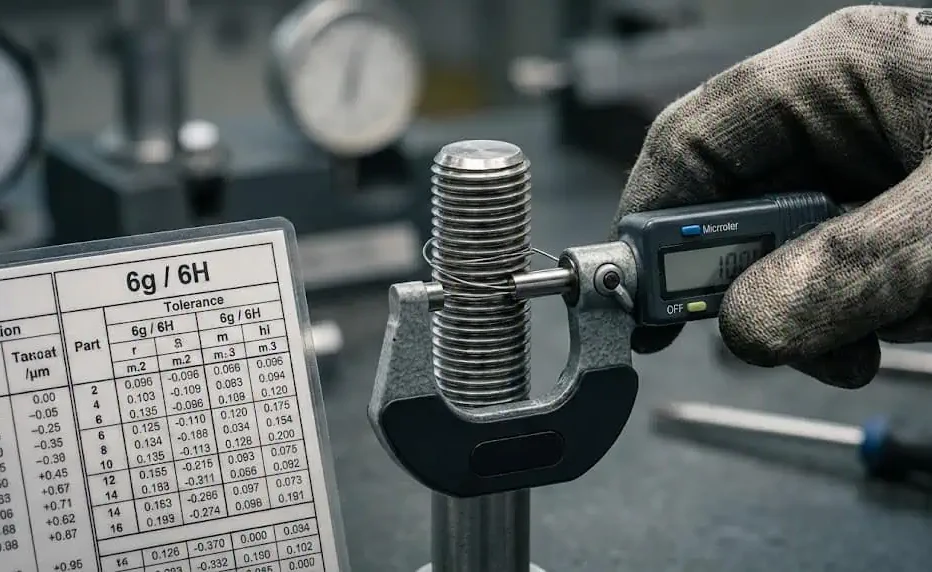
What Are Metric Thread Tolerances? (ISO 965 Fit Limits Explained)
Metric thread tolerances are the allowable dimensional limits for an ISO M-profile thread so an internal thread and an external thread assemble to a predictable fit and carry preload reliably. In ISO notation, the number controls tolerance width, the letter sets the deviation from basic size, and uppercase versus lowercase separates internal from external threads.
Definition and Purpose
Metric thread tolerances define the allowable limits for thread dimensions so assemblies go together without forced fit, develop stable preload, and remain serviceable after vibration, coating, and maintenance cycles. Engineers use tolerances to prevent two expensive failures that often get misdiagnosed on the line: loose fit that loses clamp load under vibration, and tight fit that damages flanks, spikes friction, and causes galling or stripping. ISO tolerances are specified in ISO 965-1 for ISO general-purpose metric screw threads conforming to ISO 261, while the basic profile comes from ISO 68-1 and the basic dimensions from ISO 724.
| Aspect | Description |
|---|---|
| Tolerance System | Applies to ISO M-series threads selected by ISO 261 and ISO 262, with tolerance principles defined in ISO 965-1. |
| Major Diameter | Controls crest-to-crest entry size and influences initial engagement feel. |
| Pitch Diameter | Primary functional diameter; governs flank clearance and strongly affects preload scatter through friction changes. |
| Coarse Thread Limits | Best for field assembly and dirty environments; more tolerant of minor flank damage and debris. |
| Fine Thread Limits | Better adjustment resolution and higher tensile stress area, but more sensitive to coating build, damage, and galling if dry. |
Engineering warning: if you plate or coat threads, you are changing fit. Common zinc systems can add roughly 5–12 μm per side in many commercial cases. If you do not specify coated-thread allowance or validate the coated class, the first symptom is often a failed GO gage or a bolt that feels gritty and starts chewing flanks during assembly.
Key Terms in Metric Thread Tolerances
If the team can talk in pitch diameter, deviation, tolerance grade, and chamfer quality, thread failures stop looking mysterious. The table below shows the key terms that actually help engineers specify, inspect, and troubleshoot metric thread tolerances on real production parts.
| Key Term | Definition |
|---|---|
| Thread Series | ISO metric series identified by “M”; diameter/pitch combinations are selected in ISO 261 and ISO 262. |
| Nominal Diameter | The basic major diameter in millimetres used to designate size, for example M10. |
| Thread Pitch | The axial distance between adjacent thread flanks. Pitch changes thread depth, engagement behaviour, and sensitivity to coating. |
| Tolerance Grade | The number in the class, such as 4, 5, 6, 7, or 8. Smaller numbers mean tighter limits and higher manufacturing cost. |
| Fundamental Deviation | The letter, such as H, G, h, or g. This sets where the tolerance zone sits relative to basic size. |
| Internal vs. External | Uppercase letters apply to internal threads. Lowercase letters apply to external threads. |
When a joint fails, the root cause is usually one of these: pitch diameter out of limit, damaged chamfer causing cross-threading, coating build pushing a running fit toward interference, or friction scatter shifting the torque-to-preload relationship. Thread problems rarely start with the major diameter alone.
Metric Thread Standards and Designations (ISO vs ASME)
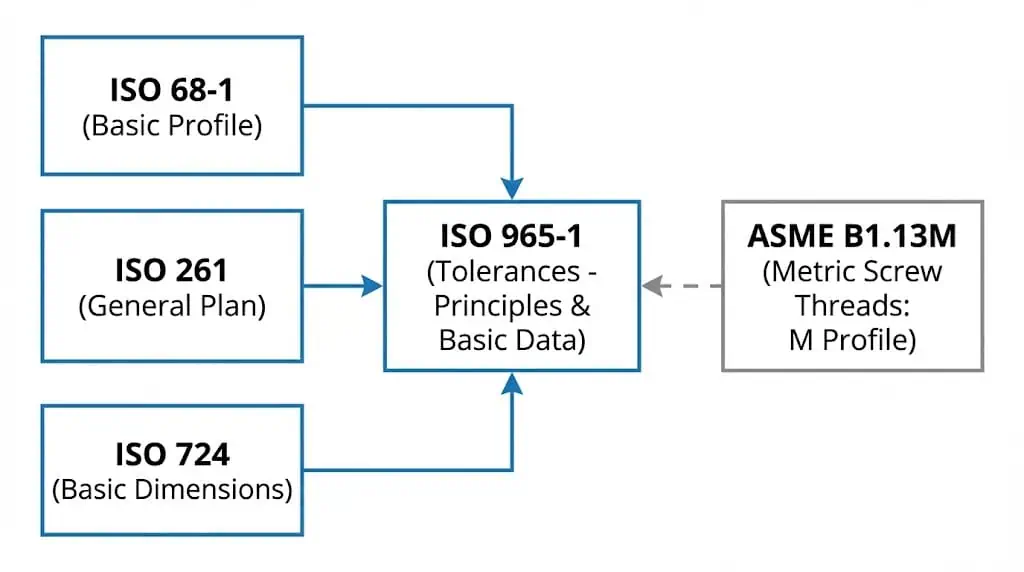
ISO 965-1 Overview
ISO 965-1 sets the tolerance system for ISO general-purpose metric screw threads conforming to ISO 261. It defines the principles behind tolerance grades and fundamental deviations so parts assemble across suppliers without selective fitting. On drawings, these tolerances usually sit on top of the basic profile from ISO 68-1 and the basic dimensions from ISO 724. For North American documentation, ASME B1.13M is commonly referenced for M-profile threads.
- ISO 965-1 covers tolerance principles for both coarse and fine pitch metric threads.
- It uses tolerance grades and fundamental deviations to control fit and running clearance.
- It works with ISO 261, ISO 262, and ISO 724 to support thread selection and basic dimensions.
Note: if you are building an inspection plan, do not stop at ISO 965-1. Functional gaging practice lives in ISO 1502 or ASME B1.16M, and that is what the shop actually uses to pass or fail parts.
Understanding Metric Thread Designations
Metric thread designations tell the assembler exactly what fit they are getting. The designation starts with “M,” gives the nominal diameter and pitch if not the standard coarse series, and then adds the tolerance class. Example: M10 × 1-6g for an external thread mating with M10 × 1-6H for an internal thread. If tolerances are omitted, the shop usually defaults to common general-purpose classes, which is where friction surprises start when coatings or automation are introduced.
| Thread Type | Tolerance Class | Description |
|---|---|---|
| Internal Thread | G | Positive fundamental deviation for internal threads, adding clearance for easier assembly or allowance. |
| Internal Thread | H | Zero fundamental deviation; the most common baseline class for nuts and tapped holes. |
| External Thread | h | Zero fundamental deviation for external threads, used when you want the tolerance zone at basic size. |
| External Thread | g | Negative fundamental deviation; the common general-purpose external class that provides practical running clearance. |
- Uppercase letters identify internal threads.
- Lowercase letters identify external threads.
- The grade number and deviation letter together define the fit, not either one by itself.
Metric designations keep engineering, purchasing, machining, and quality aligned. When a supplier changes coating, tool wear, or process route, the tolerance callout is what stops a part from becoming a bench-fit success and a line-fit failure.
Tolerance Classes in Metric Threads (6H/6g and When to Change)
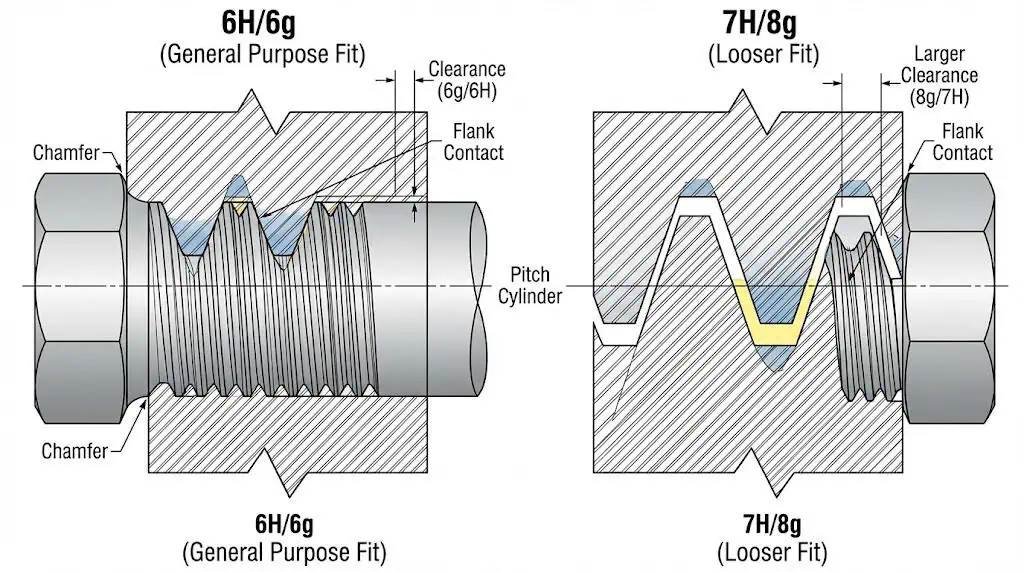
Common Classes (6H, 6g, etc.)
The most common tolerance classes for metric threads are 6H for internal threads and 6g for external threads because they balance assembly ease with stable clamp load. These classes are widely used for bolts, screws, and nuts in equipment, automotive, and general manufacturing. They are common defaults, but they are not automatic answers when coatings, high preload, automation, or dirt tolerance become important.
The table below shows common classes and how they are used in practice:
| Tolerance Class | Description |
|---|---|
| 6H / 6g | General-purpose running fit. Good balance of assembly ease and preload stability for most production work. |
| 6H / 5g6g | Closer external fit control. Useful when reduced play or better positional repeatability is required. |
| 7H / 8g | Looser fit for faster assembly or more tolerance to dirt, paint, and rough field conditions. |
Looser classes speed up assembly and tolerate contamination, but you trade off alignment control and can increase movement under cyclic load. Tighter classes reduce play, but after coating build or thermal expansion they can behave like an interference fit. That is when you see seized threads, damaged flanks, and stainless galling.
How Tolerance Classes Affect Fit
Tolerance classes control flank clearance, so they directly influence assembly feel, preload repeatability, and failure modes such as stripping and vibration loosening. A smaller grade number means tighter limits. The deviation letter decides where those limits sit relative to the basic size. Engineers choose the class based on alignment needs, assembly method, coating or lubrication, and the risk of galling.
- 6H / 6g: standard fit for most metric thread applications and a good balance of ease of assembly and holding strength.
- 6H / 5g6g: reduced play and better positional repeatability when micro-movement needs to be controlled.
- 7H / 8g: faster assembly and more tolerance for dirt or paint, but less positional control.
Tip: if torque-to-preload scatter is high, tolerance alone will not fix it. The friction factor changes with coating and lubricant. If you do not know the real K factor in your process, ask for a torque/preload table validated on your actual joint stack instead of guessing from a generic chart.
Metric thread tolerances keep fit under control. They do not replace good surface condition, correct chamfer, sound coating practice, or consistent lubrication. Those are what stop galling and stripping on the line.
Metric Thread Dimensions and Profiles (What Actually Matters)
Basic Thread Profile
The basic metric thread profile is a symmetric 60° V-form. That geometry is why thread roots become fatigue hot spots and why chamfer quality matters during assembly. ISO 68-1 defines the M-profile shape, and ISO 724 provides the basic dimensions. When a joint strips or cracks at the first engaged thread, you are looking at some combination of pitch diameter error, flank loading, root stress concentration, and entry damage.
| Feature | Description |
|---|---|
| Thread Profile | Symmetric V-shape with a 60° flank angle per ISO 68-1. |
| Thread Depth | Approximately 0.6134 × pitch for the basic ISO profile. |
| Fundamental Triangle Height | H = 0.8660 × pitch. |
| Major Diameter | Basic crest diameter affecting entry and crest clearance. |
| Minor Diameter | Root diameter influencing stress area and stripping resistance. |
| Root Quality | Poor root form accelerates fatigue cracking and local stress concentration. |
| Crest / Chamfer Condition | Rounding, burrs, and coating build change effective fit and entry behaviour. |
Note: the profile gives you the geometry. The tolerance class gives you the fit. The process route—rolled vs cut thread, coating, lubrication, and tool wear—decides whether the joint repeats preload or damages itself in assembly.
Major, Minor, and Pitch Diameters
Major, minor, and pitch diameters define whether a thread will assemble, carry preload, and resist stripping. In inspection, pitch diameter is the functional control point. Major and minor diameter checks confirm that you are not drifting toward poor flank engagement or weak root section.
| Diameter Type | Definition | Measurement Method |
|---|---|---|
| Major Diameter | Largest diameter of the thread and the easiest dimension to see | Measured crest-to-crest on external threads; useful but not sufficient alone |
| Minor Diameter | Smallest diameter of the thread | Important for stress area, stripping resistance, and root condition |
| Pitch Diameter | Diameter where thread thickness equals the groove width | Best checked by three-wire method, thread micrometer, or functional gaging |
- Major diameter influences entry feel but does not guarantee correct flank fit.
- Minor diameter relates to stress area and stripping risk, especially in soft tapped materials.
- Pitch diameter usually explains cross-threading, seized assembly, or excessive play.
Coarse vs. Fine Pitch Tolerances
Coarse and fine pitch threads behave differently because pitch changes thread depth, flank contact length, and sensitivity to damage and coating build. On real assemblies that difference shows up fast:
- Coarse pitch series is more tolerant of dirt, minor nicking, and fast assembly. It is the practical default for field work.
- Fine pitch improves adjustment resolution and can help clamp-load control, but it is more sensitive to dry stainless galling and more likely to bind if coating thickness is ignored.
- If you are pushing high clamp load, fine pitch can help only when chamfers are clean, flank finish is controlled, and lubrication is consistent.
Tip: fine pitch + stainless + dry assembly is a classic galling recipe. If you are using A2 or A4 fasteners, specify anti-seize and control assembly speed before blaming the tolerance class.
Tolerance Charts for Metric Threads (Letters + Grades)
External Thread Tolerances
External thread tolerances define the permitted size variation for bolts and screws, mainly through pitch diameter limits, and they determine assembly clearance, torque scatter, and stripping risk. In the ISO system, external deviation letters run from a to h. The tolerance grade number controls how wide the zone is.
| Thread Type | Tolerance Letters | Description |
|---|---|---|
| External Threads | a, b, c, d, e, f, g, h | h is zero deviation. g is the common general-purpose external class providing practical running clearance. Earlier letters such as a–f increase the clearance below basic size. Grades like 6g vs 8g change the width of the limits. |
- Letters and grades are selected to match bolts with nuts without forcing fit.
- 6g is a common balance. 8g increases clearance for speed and contamination tolerance.
- If you coat the bolt, you may need coated-thread allowance or a different callout to avoid binding.
Tip: always check pitch diameter, not just the major diameter, when an external thread feels tight. Tightness is usually flank interference, burrs, or coating build—not an oversized outside diameter by itself.
Internal Thread Tolerances
Internal thread tolerances control the size limits for nuts and tapped holes so bolts assemble without cross-threading and still develop preload. In ISO notation, internal deviation letters are typically H or G. Grades such as 6H or 7H define the zone width.
| Thread Type | Tolerance Letters | Description |
|---|---|---|
| Internal Threads | G, H | H is zero deviation and is the most common nut/tap class. G adds clearance for smoother assembly, coating allowance, or easier running fit. Larger grade numbers widen the tolerance zone. |
- H is the most common internal class for nuts and tapped holes.
- G adds clearance when smoother assembly or extra allowance is needed.
- Looser internal classes speed assembly but reduce positional control.
Note: if you are tapping aluminium or cast iron, stripping is often driven by engagement length and pitch diameter control. A passing gage does not guarantee enough thread shear area. Check the design, not just the inspection record.
Measuring Metric Thread Tolerances (Shop Tools That Catch Real Problems)
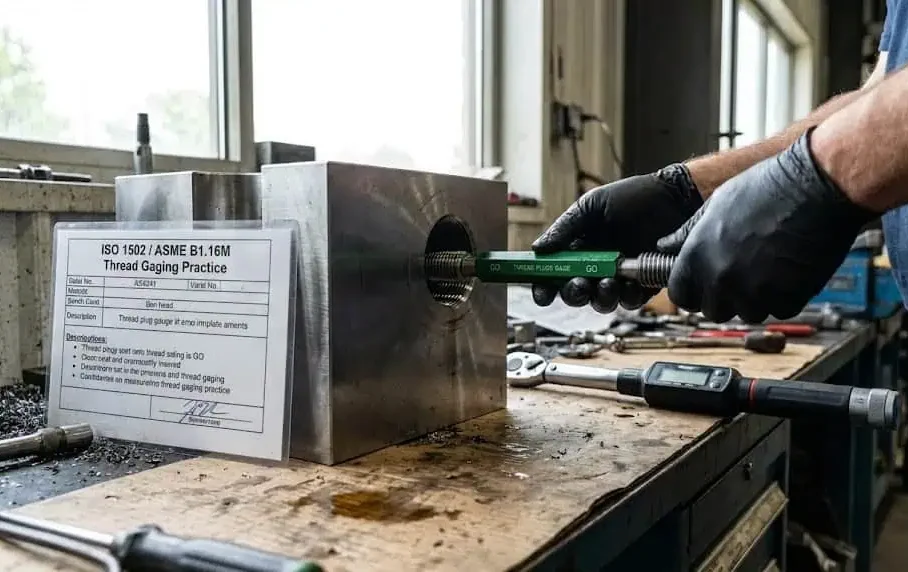
Tools and Methods
The most reliable way to measure metric thread tolerances combines functional gaging with pitch diameter measurement when diagnosis is needed. Calipers on the OD miss most real failures. A good plan checks pitch, lead, pitch diameter, and entry chamfer condition, because those are what drive assembly torque, preload repeatability, and cross-threading risk.
- ISO 1502 Thread Gauges: manufacture and use of gauges for checking ISO general-purpose metric screw threads.
- ASME B1.16M Gaging Practice: practical gaging rules for M-series metric threads.
- Three-Wire Method: accurate pitch diameter measurement for external threads when you need diagnosis.
- Thread Pitch Gauges: quick verification of pitch and series before assembly damage happens.
- Plug and Ring Gauges: fast pass/fail check of functional fit at the controlled limits.
The fastest troubleshooting path is usually this: verify pitch, run GO/NO-GO, then measure pitch diameter. That sequence tells you whether the problem is wrong pitch, tool wear, coating build, or damaged chamfer and flanks.
Interpreting Results
Interpret thread results against the specified standard and tolerance class—not against what usually works on the bench. A part that “almost goes” on the line is usually already out of control in one of the three places that matter most: pitch diameter, lead-in geometry, or surface condition at the flanks.
| Thread Type | Measurement Tools | Purpose |
|---|---|---|
| External (Male) | Thread micrometers, three-wire method, thread ring gauges | Verify pitch, pitch diameter, and functional fit; separate coating build from machining drift. |
| Internal (Female) | Thread plug gauges, bore gages, optical inspection of chamfer | Confirm functional fit and entry condition; catch partial threads and damaged lead-in. |
| Advanced Checks | CMM, optical systems, form analysis | Quantify lead error, flank angle, and form deviation when fatigue or stripping repeats. |
Judge results against the referenced standard and the specified tolerance class. If a value is out of the allowed zone, do not “make it work” on the line. You will pay later with seized assembly, stripped threads, or joint relaxation.
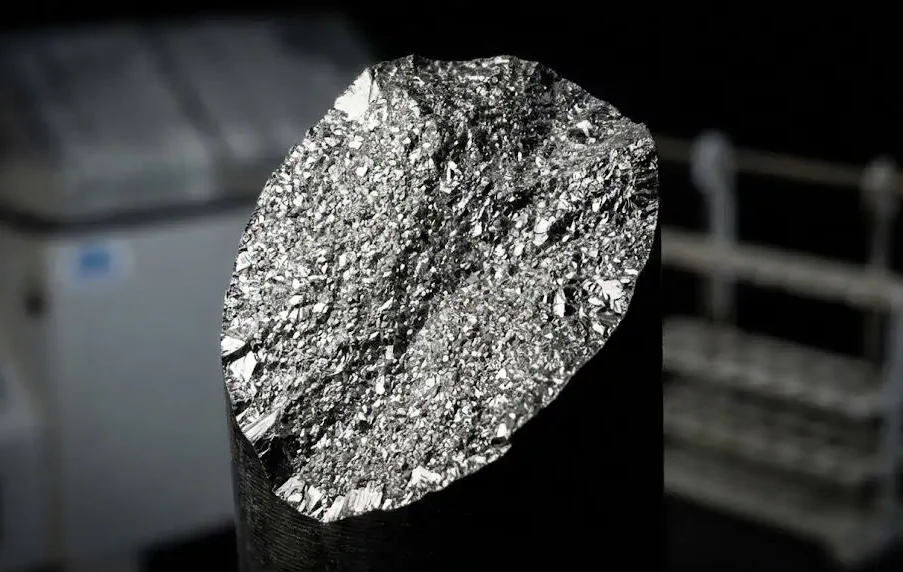
Case study 1 (Problem → Analysis → Fix):
Problem: Wind-turbine flange studs (property class 10.9) snapped with brittle fracture within days of installation even though torque records looked acceptable.
Analysis: Investigation found electroplated coating plus delayed cracking consistent with hydrogen embrittlement risk on high-strength steel. The threads also ran tighter after coating, suggesting coated fit drift. Standards such as ISO 4042 and ISO/TR 20491 exist because coating control and thread fit cannot be separated on high-strength fasteners.
Fix: specify the coating standard, define hydrogen-relief requirements where applicable, and validate coated thread class with GO/NO-GO inspection plus sample pitch diameter checks after coating.
Case study 2 (Problem → Analysis → Fix):
Problem: Stainless fasteners in marine equipment seized mid-assembly. Nuts locked at about 60–70% of target torque and the first engaged threads showed smeared flanks.
Analysis: Tight fit, dry assembly, and high flank pressure drove adhesion and galling. Tolerance was only part of the story. Friction condition and assembly speed mattered more than the nominal class on paper.
Fix: specify anti-seize for stainless assemblies, control installation speed, and verify that coatings or lubricants do not push fit toward interference. If automation is used, validate torque-to-preload on the real joint stack, not on a bench coupon.
Tip: calibrate measuring tools and monitor wear. A worn GO gage turns acceptable threads into future scrap, and a worn NO-GO gage turns scrap into field failures.
Importance of Metric Thread Tolerances in Manufacturing (Quality, Safety, Cost)
Interchangeability and Functionality
Metric thread tolerances guarantee that parts from different sources assemble to a known fit so preload does not become a lottery. Factories rely on standard thread systems so bolts and nuts from different suppliers still mate within functional limits. That prevents cross-threading, reduces assembly rework, and stabilizes clamp load in safety-critical joints such as flanges, housings, and structural brackets.
| Key Aspect | Explanation |
|---|---|
| Standardized Thread Systems | ISO and ASME rules make manufacturing scalable without selective assembly. |
| Interchangeability | A bolt from one supplier fits a nut from another because pitch diameter limits are controlled. |
| Stronger Connections | Correct flank fit spreads load across engaged threads and reduces peak shear stress at the first thread. |
| Global Compatibility | ISO M threads support global sourcing without rewriting drawings region by region. |
Metric thread tolerances protect the interface. Ignore them and the failure modes show up as vibration loosening, stripping in soft materials, seized stainless assembly, or unpredictable torque-to-preload results. None of those failures care that the outside diameter looked fine.
Quality Control and Cost Efficiency
Choosing the right tolerance level is a cost decision as much as a quality decision. Tight tolerances demand better tooling, better temperature control, and more inspection. Loose tolerances assemble faster, but they can increase positional play and joint movement under cyclic loads. The right class matches the load path, the coating, the assembly method, and the real service risk.
- Tighter fits improve alignment and reduce micro-movement, but they increase sensitivity to coating build and can raise galling risk if lubrication control is weak.
- Modern CNC, rolling, and gaging can hold tighter limits, but only if tool wear is managed.
- Looser but consistent tolerances often beat “tight on paper” tolerances that drift in real production.
| Tolerance Type | Impact on Quality | Impact on Cost |
|---|---|---|
| Tighter | Better positional repeatability and reduced play, but more sensitive to coating and contamination | Higher machining and inspection cost; more scrap if process control is weak |
| Looser | Faster assembly and more forgiveness for dirt or paint, but greater risk of movement under vibration | Lower machining cost, but possible increase in rework and warranty cost if joint function is critical |
Factories reduce thread-related scrap by combining process control, stable coating thickness, and the right inspection strategy. If you are coating threads, define the coating standard and confirm the coated fit class. Otherwise the same nominal “6g” can behave differently from lot to lot.
Tip: if you are dealing with coated fasteners, do not guess. Use standards that explicitly discuss coating thickness, corrosion testing, and hydrogen embrittlement risk management, such as ASTM F1941/F1941M or ISO 4042, and verify fit after coating.
Industry Applications (Where Tolerances Save You)
Automotive
Metric thread tolerances protect safety and serviceability in automotive assemblies where mixed materials and high cycle loads are normal. Engine blocks and housings often involve aluminium or cast iron tapped holes. Strip risk depends on pitch diameter plus engagement length, not on tightening harder. Battery enclosures and structural joints also rely on predictable clamp load, and tolerance drift shows up as loosening under vibration and thermal cycling.
| Feature | Benefit |
|---|---|
| Standardized ISO metric thread selection | Parts from different suppliers fit together with controlled assembly clearance |
| ISO profile and dimension rules | Consistent geometry across designs and suppliers |
| Controlled tolerances | Reduced cross-threading, binding, and excessive play |
Tip: in mixed-material joints, tolerance and lubrication are coupled. Aluminium threads plus high preload demand stable pitch diameter and clean chamfers, or stripping appears long before the bolt actually reaches the intended clamp load.
Aerospace
Aerospace applications demand precise thread tolerances because vibration, temperature variation, and high-value materials amplify small fit errors. Titanium and nickel alloys punish poor surface finish and inconsistent fit with galling, unpredictable preload, and accelerated fatigue. Tight tolerances only help when gaging, lubrication, and surface condition are controlled end to end.
- Predictable pitch diameter limits reduce assembly variability and preload scatter.
- High-strength materials raise the cost of thread damage, so chamfers and flank finish must be treated as critical features.
- Strong quality systems reduce rework and protect traceability on high-risk hardware.
Machinery and Equipment
Metric thread tolerances simplify maintenance and protect uptime in heavy machinery where field assembly and contamination are real conditions, not exceptions. Correct tolerance selection and realistic coating allowance prevent seized bolts, reduce re-tapping, and keep joints stable under vibration and repeated service cycles.
- Controlled fit reduces cross-threading and flank damage during maintenance.
- Appropriate clearance helps prevent seizure when debris, coating, or paint is present.
- Standard threads improve spare-parts interchangeability and repair speed.
Note: if you specify coated fasteners for outdoor machinery, define both the corrosion test method and the coating system standard. “Zinc plated” without the standard is how mismatched fit and premature corrosion get built into the job.
Metric thread tolerances are the backbone of reliable threaded connections. When you understand standards, tolerance classes, and inspection methods, you prevent assembly failures and reduce lifetime cost.
- They make sure parts match globally through standardized selection and dimensional control.
- They keep thread cutting, rolling, coating, and gaging aligned so clamp load stays repeatable.
- They prevent silent interface mismatches when suppliers, processes, or finishes change.
Sunhy’s engineering approach supports fastener reliability beyond the datasheet:
- Design review and tolerance selection aligned with ISO and ASME thread systems to reduce assembly risk early.
- Inspection planning that prioritizes pitch diameter and functional gaging, not cosmetic OD checks.
- Coating and fit verification on samples before release to prevent binding, galling, and gage failures.
- Engineering support: if your application needs a validated torque/preload table because friction conditions are uncertain, request a joint-specific recommendation instead of relying on a generic chart.
FAQ
What does the tolerance class mean in metric threads?
The tolerance class is the grade-plus-letter system that defines the size zone and deviation from basic size, mainly controlling pitch diameter fit. Example: 6H for internal and 6g for external is a common general-purpose pairing.
| Class | Fit Type |
|---|---|
| 6H / 6g | General-purpose running fit; common default pairing |
| 6H / 5g6g | Closer external fit control; reduced play |
| 7H / 8g | Looser fit for fast assembly and contamination tolerance |
How do engineers measure metric thread tolerances?
Engineers use functional gaging first, then pitch diameter measurement when troubleshooting is needed. GO/NO-GO plug and ring gauges quickly verify functional limits. Three-wire measurement or a thread micrometer then explains why a part failed.
- Thread plug and ring gauges verify functional fit quickly.
- Three-wire or thread micrometers quantify pitch diameter for diagnosis.
- Pitch gauges confirm pitch and series before assembly damage occurs.
Why are metric thread tolerances important in manufacturing?
They prevent cross-threading, binding, stripping, and vibration loosening by controlling pitch diameter fit and flank engagement. In production, tolerance control is also supply-chain control: it keeps parts interchangeable when suppliers, coatings, or machining routes change.
Good tolerances reduce line stoppage and rework. Bad tolerances create hidden cost: stripped taps, seized stainless joints, and clamp-load scatter that later shows up as leaks or fatigue cracks.
Which standards control metric thread tolerances?
The core tolerance standard is ISO 965-1, supported by ISO 68-1, ISO 261, ISO 262, and ISO 724. For gaging practice, ISO 1502 is commonly used. In North America, ASME B1.13M is often referenced for M-profile threads.
| Standard | Purpose |
|---|---|
| ISO 965-1 | Metric thread tolerance system |
| ISO 68-1 | Basic metric thread profile |
| ISO 261 | General plan for ISO metric threads |
| ISO 262 | Selected sizes for bolts, screws, studs, and nuts |
| ISO 724 | Basic dimensions |
What is the safest default pairing for general-purpose metric thread fit?
For most uncoated or normally controlled general-purpose assemblies, internal 6H with external 6g is the practical default pairing. If coatings, automation, contamination, or unusually high preload are involved, validate the fit instead of assuming the default will still behave the same after process changes.
References
| Reference Source | Description |
|---|---|
| ISO 965-1 | Metric thread tolerance system |
| ISO 68-1 | Basic metric screw thread profile |
| ISO 261 | General plan for ISO metric threads |
| ISO 262 | Selected sizes for bolts, screws, studs, and nuts |
| ISO 724 | Basic metric thread dimensions |
| ISO 1502 | Gauges and gauging for ISO general-purpose metric screw threads |
| ASME B1.13M | M-profile metric screw threads in North American documentation |
| ASME B1.16M | Gages and gaging for metric M screw threads |
| ISO 4042 | Electroplated coating systems for fasteners |
| ISO/TR 20491 | Fundamentals of hydrogen embrittlement in steel fasteners |
| ASTM F1941/F1941M | Electrodeposited coatings on mechanical fasteners, inch and metric |
| ISO 9227 | Salt spray test method |
| ASTM B117 | Operating salt spray apparatus |
| Sunhy | Industrial fastener products and engineering support |