For the most severe corrosive flange environments, Inconel is usually the safer material choice. That is especially true when chlorides, mixed chemicals, wet shutdown exposure, or elevated temperatures make stainless steel less predictable. Stainless steel is still the right answer for many moderate services, and in real projects it often delivers the better value. The key question is not which alloy sounds more advanced. The real question is which material gives the flange enough corrosion margin, enough mechanical stability, and enough service life for the duty it will actually see.
That distinction matters because flanges rarely fail the same way plain pipe does. Leakage often starts at the gasket contact area, the flange face, the bolt load zone, or a crevice where fluid sits after shutdown. A material that looks acceptable in the line specification can still become the weak point once the joint is assembled and exposed to real plant conditions.
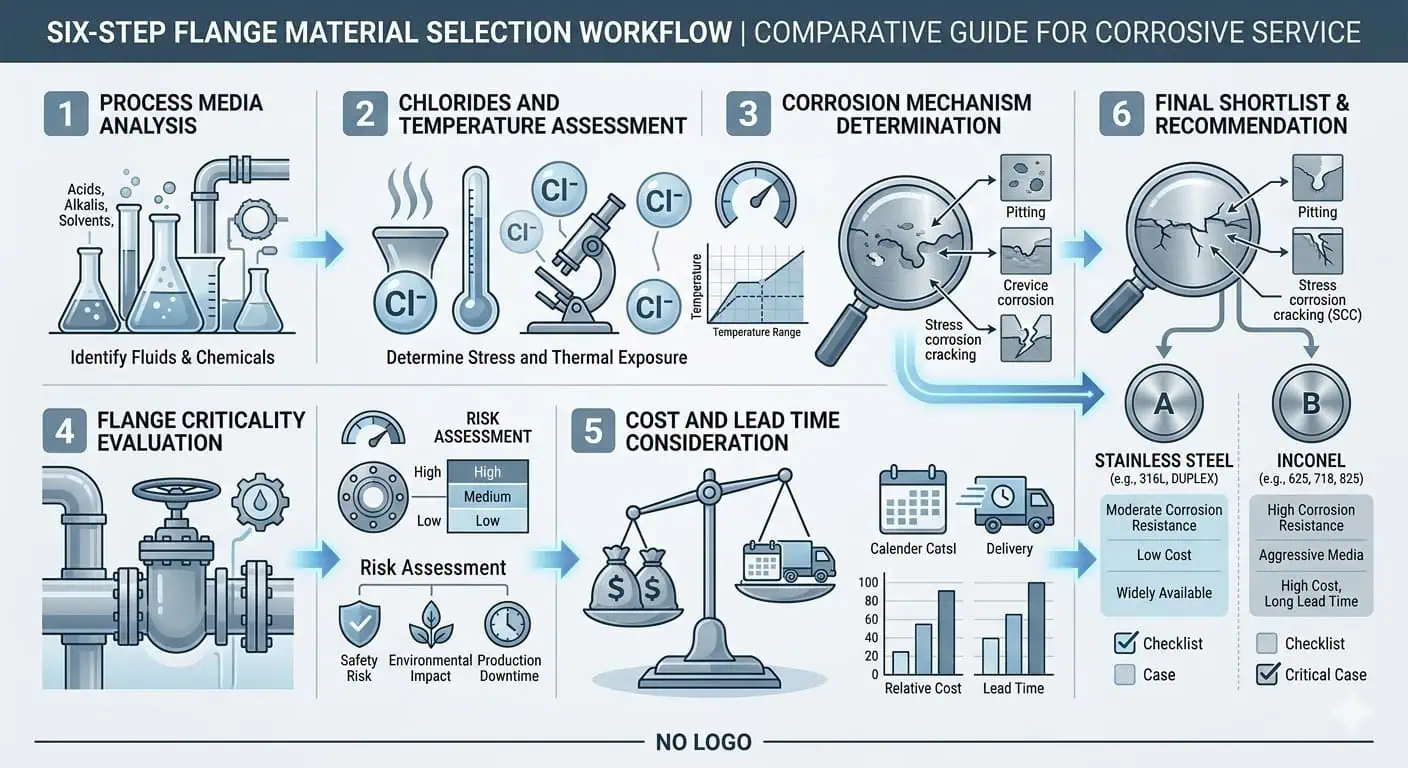
For flange selection, buyers should compare corrosion behavior, temperature capability, joint integrity, cost, and supply risk together — not just the alloy name.
| Material Family | Where It Usually Wins | Where It Reaches Limits |
|---|---|---|
| Inconel | Severe corrosive service, high-consequence flange locations, combined heat and chemical exposure | Higher cost, longer lead time, more difficult machining and sourcing |
| Stainless Steel | Moderate corrosive service, clean process lines, better availability and easier fabrication | Hot chlorides, crevice-prone joints, mixed chemicals, and some SCC-prone environments |
SUNHY supports demanding flange projects with certified materials, traceability, inspection records, and application-based recommendations. For engineers and buyers, the most useful comparison is not a generic material comparison. It is a flange-focused one: corrosion resistance, pressure-temperature suitability, joint integrity, manufacturability, lifecycle value, and the real consequence of a leak.
Material Overview
What Inconel Really Means in Flange Applications
Inconel is a nickel-based alloy family, not a single material
In flange applications, “Inconel” is often used as shorthand for a group of nickel-chromium alloys chosen when corrosion resistance, elevated-temperature performance, or both are beyond the comfortable range of standard stainless steel. That is a useful starting point, but it can also be misleading. Different grades are designed for different priorities, so the alloy should be selected for the failure mechanism you are trying to avoid, not just for the family name.
For corrosive flange service, INCONEL alloy 625 is the more typical reference point because it is widely associated with strong resistance to pitting, crevice corrosion, and chloride-related cracking. INCONEL alloy 718 is also corrosion resistant, but it is usually selected where very high strength, temperature capability, and cyclic duty matter as much as corrosion performance.
| Inconel Grade | Typical Flange-Relevant Strength | Typical Use Logic |
|---|---|---|
| Inconel 625 | Very strong corrosion resistance, especially against localized attack and chloride-related risk | Chosen when corrosion is the main reason to upgrade beyond stainless steel |
| Inconel 718 | Very high strength with good corrosion resistance and strong performance under elevated temperature and cyclic duty | Chosen where strength retention and thermal-mechanical performance matter as much as corrosion resistance |
For most users, that distinction is practical. If the service is mainly a corrosion problem, 625 is usually the more meaningful comparison point. If the service combines heat, stress, and load cycling, 718 becomes more relevant.
Stainless Steel Grades Commonly Used for Flanges
Stainless steel is a wide material family, not a single baseline
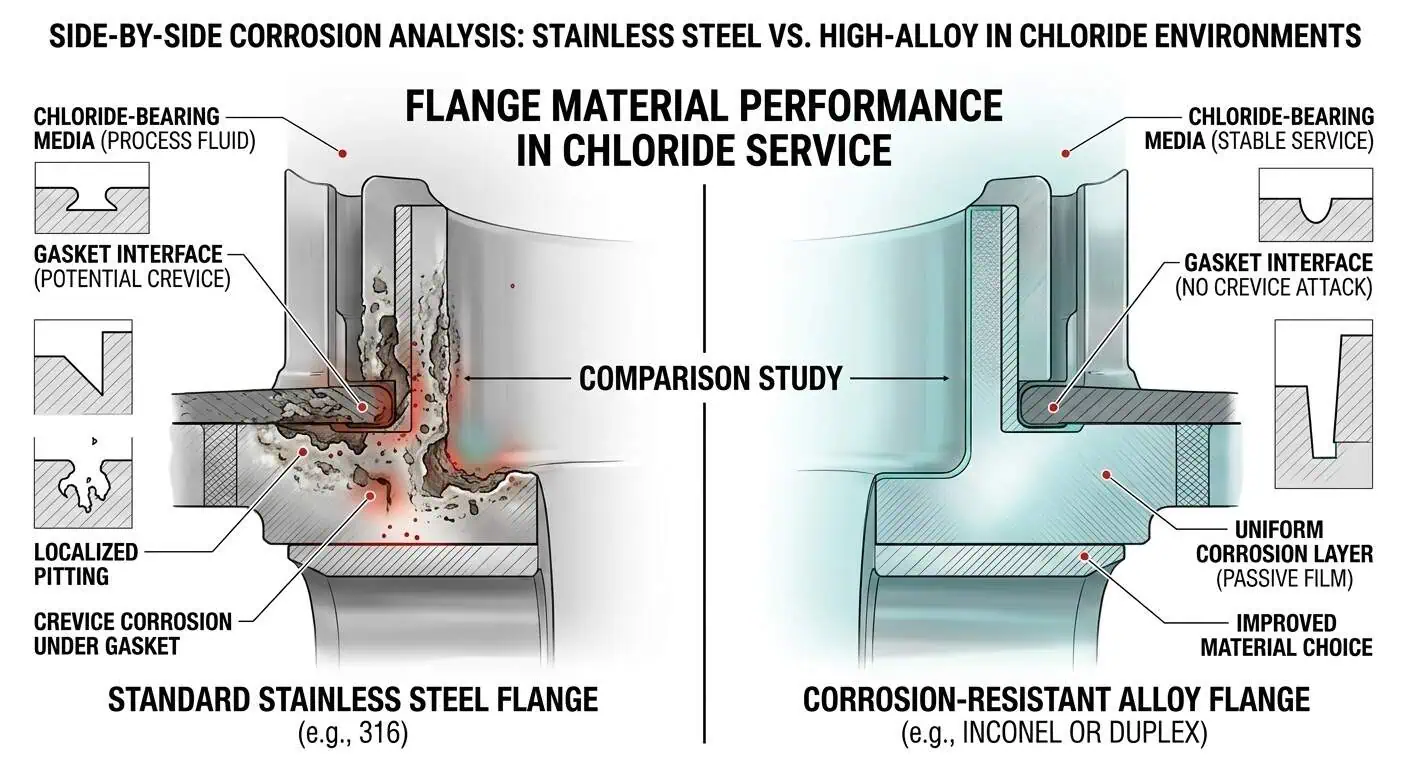
Many discussions reduce stainless steel to “304 vs 316,” but flange selection in corrosive service is broader than that. In practice, common flange choices include 304/304L, 316/316L, duplex 2205, and super duplex 2507, depending on service severity. This matters because “Inconel vs stainless steel” is often too simple. In real projects, the better comparison may be Inconel vs 316L, or Inconel vs duplex, depending on what the line is actually seeing.
| Stainless Grade | General Position | Typical Flange Use Logic |
|---|---|---|
| 304 / 304L | General corrosion resistance, cost-effective, widely available | Suitable for less aggressive services where chloride risk is low |
| 316 / 316L | Better resistance than 304 in many chloride-related and process environments | Common first upgrade for process flanges, but still not universal for aggressive chemical duty |
| Duplex 2205 | Higher strength with better resistance to localized corrosion than common austenitic grades | Often the practical middle step before moving to nickel alloys |
| Super Duplex 2507 | Higher resistance in severe chloride-bearing service | Useful where 316L is no longer comfortable and full Inconel upgrade may not be necessary |
If your current comparison is only “316L or Inconel,” there is a good chance you are skipping an intermediate option that may offer a better cost-performance balance. These two internal comparisons can help frame that step more clearly: ASTM A182 F316 vs F304 flange and 304 vs 316 vs duplex in corrosive service.
Why the Material Choice Is So Important for Flanges
Flanges are more vulnerable than plain pipe in many corrosive services
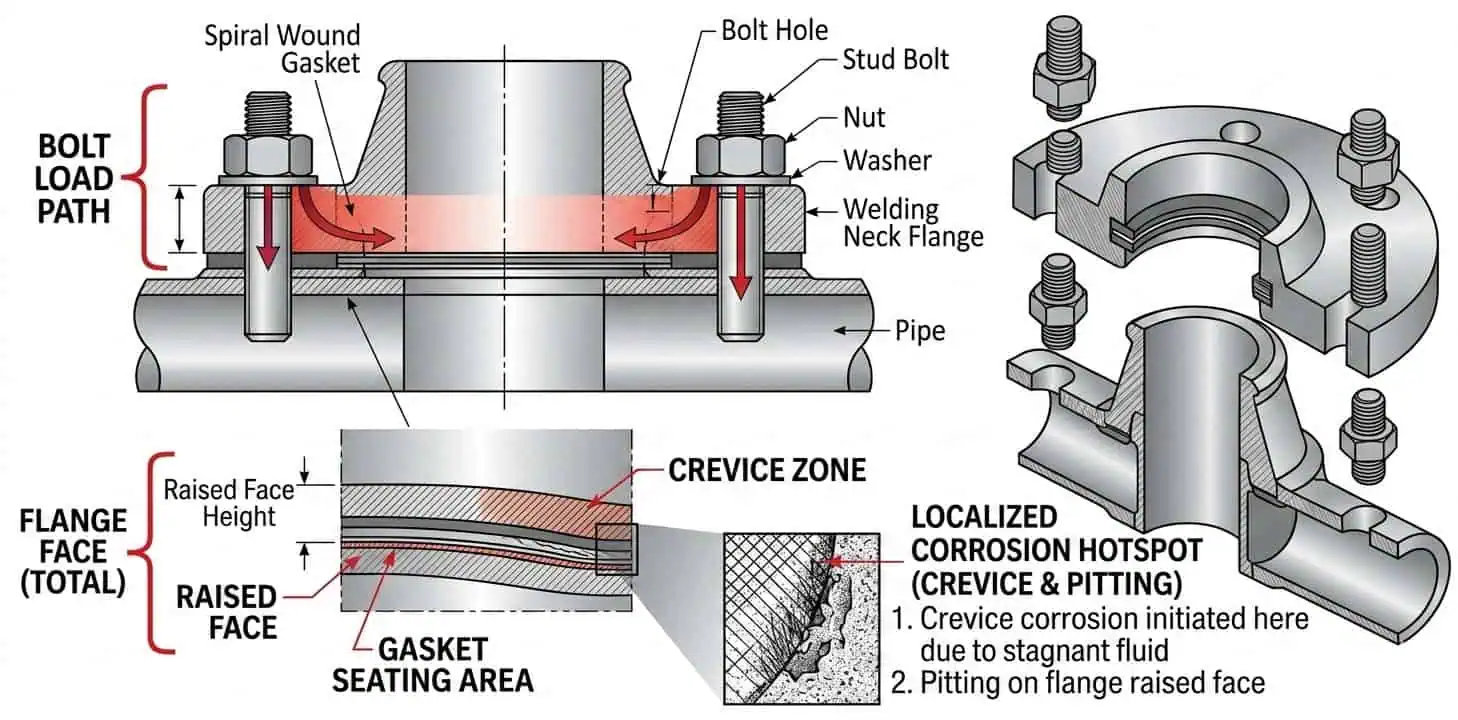
Flanges have gasket seating surfaces, bolt loads, crevice geometry, and repeated assembly-disassembly cycles. Those features make them more exposed to localized corrosion and sealing failure than straight pipe. A line can appear healthy while the flange face is already degrading under the gasket or around the bolt circle.
The most important corrosion risks at flanges usually include:
- Pitting corrosion, especially where chlorides are present
- Crevice corrosion under gaskets, deposits, and narrow stagnant zones
- Galvanic corrosion when incompatible metals are combined in the joint
- Stress-corrosion cracking in the wrong alloy-environment-stress combination
A flange material therefore needs to do more than resist the fluid. It has to hold its face condition, keep sealing stress, and survive the mechanical reality of a bolted joint. That is why flange material selection often needs a more conservative review than the line material itself.
If sealing performance is part of your failure history, these related guides usually belong in the same review: flange gasket selection guide, flange assembly for zero-leakage joint integrity, and different types of flanges for piping.
Corrosion Resistance: When Inconel Outperforms Stainless Steel Flanges
Why Inconel Usually Performs Better in Severe Corrosive Environments
When the environment is severe, mixed, or difficult to control, Inconel usually gives the flange more reliable corrosion margin than stainless steel. That is the real reason buyers move into nickel-based alloys. They are not paying only for a higher alloy name. They are paying for a joint that is less likely to pit, crack, or leak when the service becomes more aggressive than expected.
In corrosive flange service, that advantage shows up most clearly in chloride-bearing environments, media that create crevice attack, and applications where heat and chemistry work together against the joint. This is also why Inconel is often chosen for critical nozzles, splash-prone points, shutdown-sensitive locations, and flanges where any leak would create a major safety or production problem.
| Comparison Point | Inconel | Stainless Steel | Engineering Reading |
|---|---|---|---|
| Localized corrosion resistance | Usually stronger margin in severe chloride and mixed-corrosive service | Can be adequate in moderate service, but more sensitive to service details | Inconel gives more forgiveness when service data is harsh or uncertain |
| Crevice-prone flange service | Usually more forgiving where the gasket area becomes the critical zone | Can perform well, but the service window must be more tightly controlled | Flange geometry often amplifies localized attack risk |
| Service unpredictability | Better choice where chemistry, temperature, or shutdown exposure can shift | Better when the environment is stable and well understood | Uncertainty usually pushes selection toward more corrosion margin |
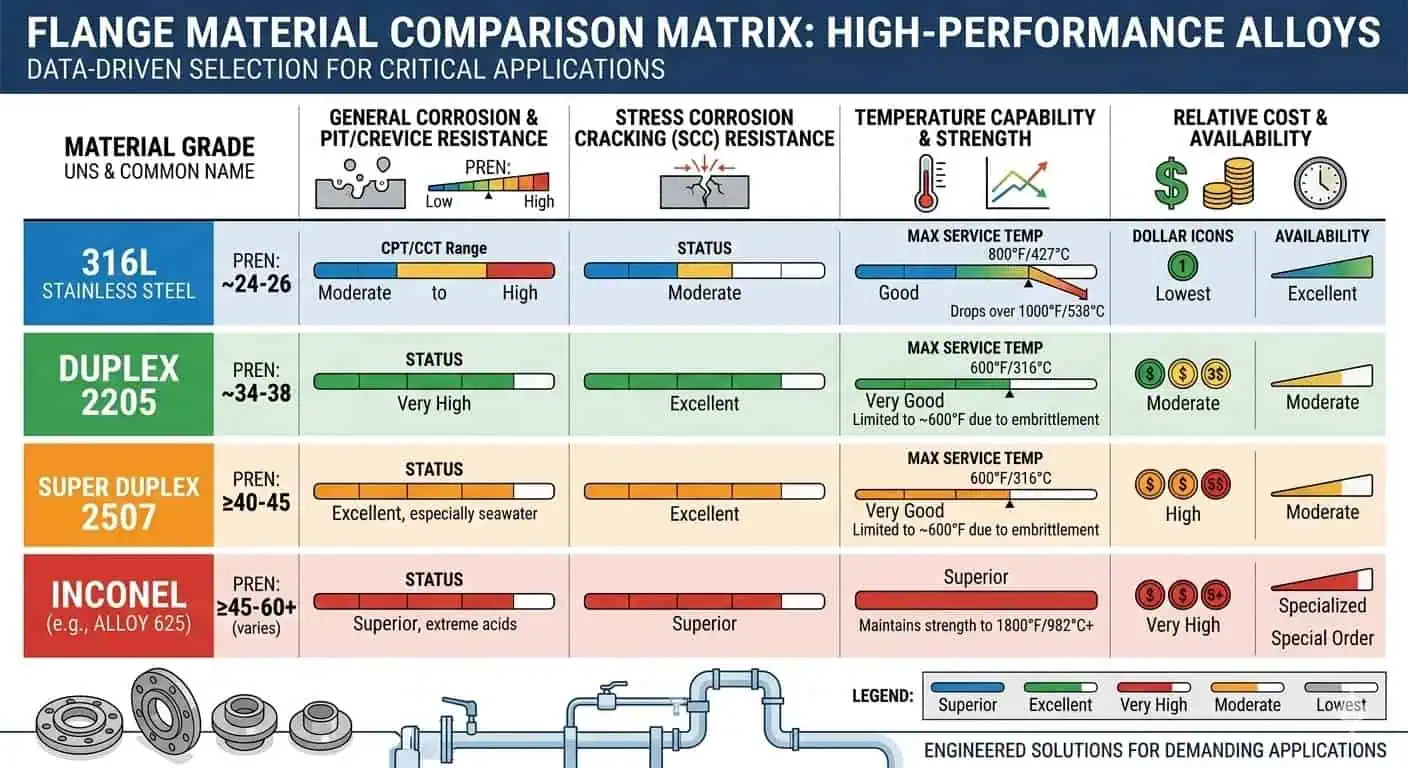
Engineering example: a chloride-bearing branch line may run acceptably in bulk flow, then begin leaking after shutdown because moisture and residual chemicals concentrate under the gasket. In that kind of service, the problem is not average corrosion. It is localized attack in a crevice. That is exactly where Inconel-class materials often justify themselves.
Where Stainless Steel Performs Well — and Where It Reaches Its Limits
Stainless steel performs very well in many plant services, but only within a defined service window. That is why it remains one of the most common flange materials in chemical and utility systems. It is available, familiar, easier to machine, and often entirely sufficient when chemistry is controlled and localized corrosion risk is low.
Its limits become more obvious in hot chlorides, stagnant crevices, mixed chemicals, and environments where stress-corrosion cracking becomes possible. The passive film that gives stainless steel its corrosion resistance can break down when chlorides concentrate or when the flange face creates a restricted wet zone. That is one reason why gasket-area damage is often the first visible sign of trouble.
If you want to compare stainless options in more detail, these internal guides are useful: ASTM A182 F316 vs F304 flange and 304 vs 316 vs duplex in corrosive service. For the chloride cracking mechanism itself, it is also worth reviewing chloride stress corrosion cracking guidance.
Engineering example: in one common field pattern, 316L performs well on the main process line but shows recurring face damage and seepage at low-flow instrument tie-ins. The root cause is usually not that 316L is “bad.” It is that the local crevice condition is harsher than the main line environment used for the original material decision.
Media Suitability by Service Type
The right comparison depends on the actual media, not only on the alloy family name.
- Chloride-bearing service: Inconel or other higher alloys usually become more attractive when temperature rises, crevices are unavoidable, or past leakage has already shown stainless steel to be borderline.
- Mixed chemical service: Nickel-based alloys are often chosen when chemistry changes during operation, shutdown, or cleaning and the risk is no longer easy to define with one compatibility table.
- High-purity and moderate clean service: Stainless steel often remains the better choice because it provides adequate corrosion resistance with easier procurement and lower cost.
- Wet shutdown and cleaning cycles: These transient conditions often decide the material choice because they create the kind of concentrated, stagnant attack that flanges are vulnerable to.
That last point matters more than many buyers expect. A flange may survive normal operation but start degrading during shutdown because moisture, residual chemicals, or cleaning fluid sit right where the gasket creates a crevice. When that happens, the problem is not always the main process fluid. It is the transition condition.
Mechanical Properties and Flange Joint Integrity
Strength Comparison
Strength matters for flanges, but only in the form the joint can actually use
Published tensile numbers can be useful, but flange performance depends on more than a mechanical property table. The practical question is whether the material keeps bolt load, resists distortion, and supports stable gasket seating under the actual combination of pressure, temperature, and corrosion. High strength is useful only if the alloy also fits the fabrication route and the corrosion mechanism.
| Material | General Strength Position | What It Means for Flanges |
|---|---|---|
| Inconel 625 | Higher than common austenitic stainless steels | Useful where corrosion resistance and strength retention are both needed |
| Inconel 718 | Very high | Useful where cyclic duty, load, and temperature make strength retention critical |
| 304 / 316L | Moderate | Often fully adequate in moderate service |
| Duplex / Super Duplex | High | Often a strong intermediate solution before nickel-alloy upgrade |
That is why Inconel is not automatically selected for strength alone. In many services, duplex or super duplex already provides enough structural advantage without moving into the full cost of a nickel alloy.
High-Temperature Performance
Heat is where Inconel’s advantage becomes much clearer
When the flange sees both corrosive media and elevated temperature, Inconel becomes more compelling. The key issue is not the catalog maximum temperature. It is the way the alloy retains strength, resists oxidation, and maintains joint stability when heat, pressure, and chemistry are all active together.
Stainless steel can still perform well in many moderate-temperature services, but once the environment adds oxidation, thermal cycling, chloride concentration, or repeated startup-shutdown exposure, the margin becomes narrower. That is where nickel-based alloys usually justify themselves.
What These Properties Mean for Flange Integrity
Joint integrity is always a system question
Flange reliability depends on face condition, preload retention, thermal stability, gasket compression, and corrosion behavior acting together. A stronger alloy does not automatically create a better joint if the gasket selection is wrong, the bolting is mismatched, or the assembly practice is poor.
That is why flange materials should be reviewed together with the gasket and bolting system, not in isolation. These internal references help complete that picture: flange gasket selection guide and flange assembly for zero-leakage joint integrity.
Engineering example: one of the most common field mistakes is upgrading the flange alloy while leaving the gasket selection and bolt-up practice unchanged. The result is a more expensive joint that still leaks for the same mechanical reason as before.
Cost & Value
Material and Production Costs
Inconel costs more for reasons that go well beyond raw metal price
Inconel flanges are usually more expensive because nickel-based alloys cost more, are harder to machine, and often require tighter process control. Tool wear is higher, cycle times are longer, and qualified forging availability is more limited. Stainless steel flanges, by comparison, are easier to source and easier for most shops to machine and deliver.
| Cost Driver | Inconel Flanges | Stainless Steel Flanges |
|---|---|---|
| Raw material cost | High | Moderate |
| Machining difficulty | High | Lower |
| Supplier availability | More limited | Broad |
| Lead time sensitivity | Higher | Lower |
That does not make Inconel uneconomic. It means the upgrade should be tied to a real engineering reason, not used as a default shortcut.
Long-Term Value
The higher-cost flange is not always the higher-cost decision
Where corrosion is severe, Inconel’s upfront cost can be offset by longer service life, fewer shutdowns, and lower leak risk. That becomes especially important at difficult-to-access flange locations, safety-critical joints, or services where a small leak quickly becomes a plant event. In less aggressive duty, stainless steel often remains the better-value solution because the service is not severe enough to justify the alloy upgrade.
The correct comparison is therefore lifecycle value, not price per flange. Inspection intervals, expected maintenance, downtime consequence, and replacement frequency all belong in the decision.
Supply and Lead Times
Procurement risk can change the material decision
Inconel flanges often involve longer lead times, tighter sourcing, and more limited forging capacity. Stainless steel benefits from far stronger global availability and faster replenishment. That difference matters during shutdown work, urgent replacement, or projects where a long material lead time would delay a critical milestone.
Engineering example: in outage-driven projects, Inconel may be technically attractive but commercially risky if the forging lead time does not fit the shutdown window. In those cases, duplex or super duplex may become the smarter project choice even if nickel alloy remains the theoretical top performer.
Application Guide
When to Choose Inconel
Severe chloride service with high temperature or high leakage consequence
Choose Inconel when chlorides, heat, and crevice geometry come together in a way that makes stainless steel difficult to trust over time. This is especially true for flange joints in chemical plants, marine-related systems, and splash-prone service where a leak would be hard to tolerate.
Mixed chemical service where stainless steel performance is uncertain or historically poor
Inconel is often justified when chemistry changes over time, when shutdown or cleaning conditions are aggressive, or when past experience has already shown stainless steel to be unreliable. In those cases, the alloy upgrade is not theoretical. It is a response to a proven failure pattern.
Corrosive environments combined with high thermal stress, cyclic operation, or extended service-life requirements
If the flange must stay stable through repeated heating and cooling, long inspection intervals, or demanding temperature swings, Inconel becomes more attractive because it brings both corrosion margin and better retention of joint stability under thermal stress.
Critical flange locations where failure would create major safety, environmental, or production losses
The more serious the consequence of leakage, the easier it is to justify Inconel. That can include toxic service, hard-to-isolate flanges, environmental exposure points, or high-value production lines where even a minor leak is unacceptable.
When Stainless Steel Is Suitable
Mild-to-moderate corrosive service with controlled chemistry and lower localized corrosion risk
Use stainless steel where chemistry is stable, chloride severity is controlled, and the flange is not operating on the edge of localized corrosion risk. In these cases, stainless steel often delivers the best balance of reliability, cost, and supply.
Clean process lines, treated water systems, and many services where 316L or duplex has already proven reliable
Where service history already shows that 316L or duplex performs well, there is usually no benefit in forcing a nickel-alloy upgrade without a new technical reason. Proven field performance is valuable evidence in flange material selection.
Applications where inspection access is good and lifecycle economics favor stainless steel
If the flange is easy to inspect, easy to isolate, and the consequence of repair is manageable, stainless steel often remains the more rational choice. Material selection should be conservative, but it should not become expensive without a clear service driver.
Practical Intermediate Options Users Should Not Ignore
Duplex or super duplex may be the smarter bridge between 316L and Inconel
Many users compare 316L directly with Inconel because those are the names they hear most often. In practice, duplex or super duplex may be the better answer when you need more resistance than 316L can comfortably give, but the full cost and lead time of Inconel are not yet justified.
Some services fit Alloy 20, 904L, or other corrosion-resistant materials better than a simple binary choice
Acid service is a good example. In some sulfuric or mixed-acid applications, materials such as Alloy 20 or 904L may fit the chemistry better than a simple “stainless vs Inconel” comparison suggests. The best answer is often not binary. It is the material that best matches the actual corrosion mechanism at the right project cost.
Engineering takeaway: the best material choice is often not the most expensive one. It is the material that matches the real damage mechanism with the lowest total project risk.
Industry Examples
| Example | Situation | What Failed or Became Risky | More Reliable Decision |
|---|---|---|---|
| 1 | Chloride-bearing chemical line | 316L showed gasket-area attack and recurring leakage concern | Upgrade to duplex or Inconel-class material restored corrosion margin |
| 2 | High-temperature corrosive flange duty | Stainless steel lost reliability once heat and chemistry acted together | Inconel provided safer long-term flange performance |
| 3 | Moderate process service | Higher alloy added cost without clear lifecycle benefit | Stainless steel remained the better-value choice |
| 4 | Shutdown-critical replacement project | Inconel was technically attractive but lead time was too long | Duplex or stainless solution chosen to meet outage schedule |
These examples reflect a common pattern: material selection should follow service severity, failure consequence, and project constraints together. Flange type also matters in the final decision, especially where sealing geometry changes the risk profile. For face-type context, this comparison of RF vs FF vs RTJ flanges is a useful companion reference.
Selection Checklist
Key Criteria Before Choosing Inconel or Stainless Steel
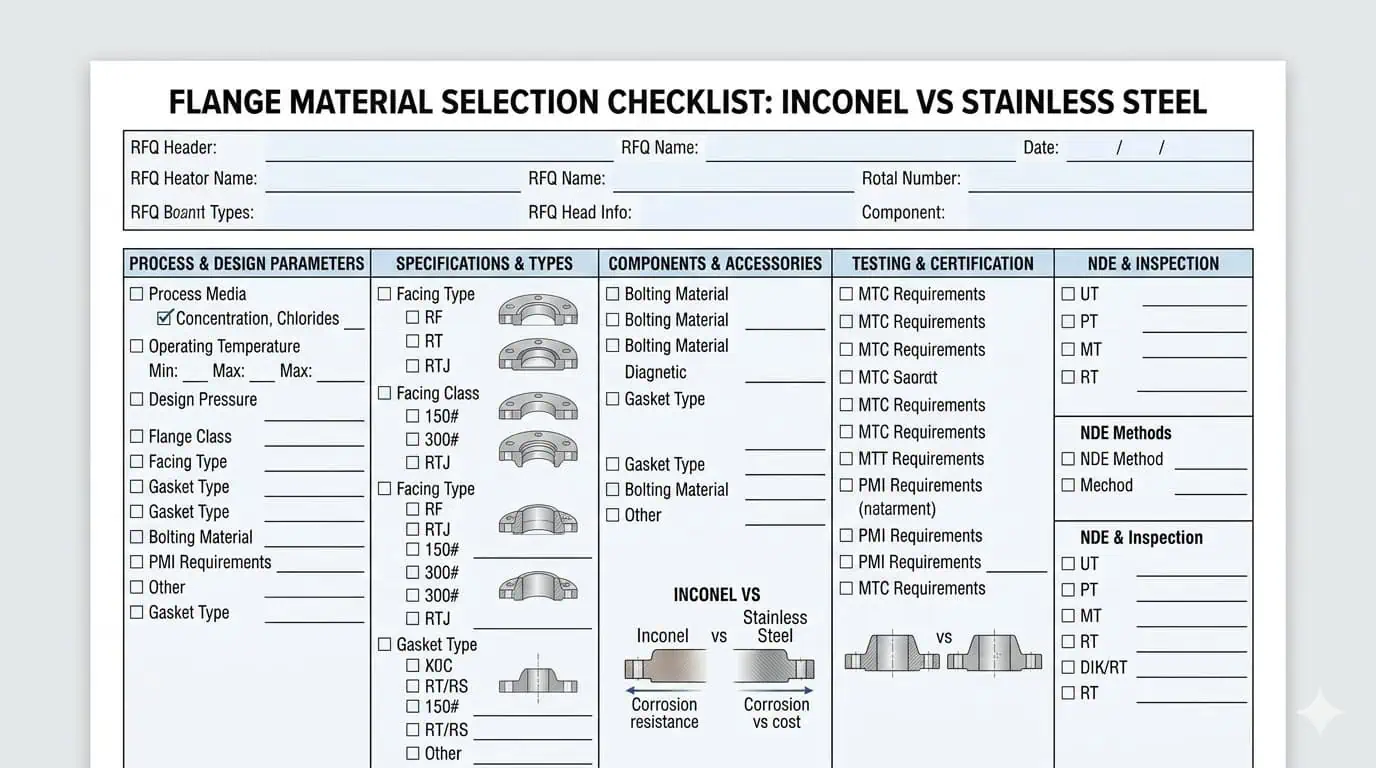
Process media, concentration, impurities, and whether the service is wet, dry, oxidizing, or reducing
Start with the actual media, not the simplified process name. Chemical identity, concentration, impurities, solids, and whether the service becomes wet during shutdown often decide the material more than the line label does.
Operating and upset pressure-temperature range
Review normal operation, upset, startup, shutdown, and cleaning exposure. Also confirm the required flange class and standard basis through the applicable flange and material standards. The most common references are ASME B16.5 for dimensional and rating requirements and ASTM A182 for forged stainless and alloy steel flange materials.
Likely corrosion mechanism: general corrosion, pitting, crevice attack, SCC, or erosion-corrosion
The material should be selected against the dominant failure mode, not only against a general corrosion rate. For austenitic stainless steels, chloride-related SCC deserves real attention in the right environment, which is why nickel-alloy upgrades or duplex alternatives are sometimes necessary.
Flange location criticality and consequence of leakage
A flange on an easy-to-access utility line is not the same decision as a flange in toxic, high-value, or environmentally sensitive service. The higher the consequence of leakage, the easier it is to justify a material with more corrosion margin.
Gasket and bolting compatibility
Always review the flange together with gasket style, facing type, bolting material, and assembly method. A premium alloy cannot rescue a badly matched joint design. These two pages help complete that review: gasket material and service compatibility and joint assembly for zero leakage.
Required standards, testing, traceability, and documentation
Traceability, MTCs, testing requirements, and inspection records are not paperwork after the fact. They are part of the material decision itself, especially in critical service or multi-alloy projects.
Budget, fabrication complexity, and lead time risk
Lifecycle cost and supply risk belong in the same conversation as corrosion resistance. A technically strong material recommendation is incomplete if it ignores outage schedule, machining difficulty, or delivery risk.
Tip: the best flange material is the one that fits the actual environment, protects the whole joint, and can be delivered with the required documentation when the project needs it.
Comparison Table
The table below is useful for fast screening, especially early in RFQ or concept selection. It is not a substitute for a full engineering review, but it helps organize the decision quickly.
| Property | Inconel | Stainless Steel | Duplex / Intermediate Alloy |
|---|---|---|---|
| Corrosion resistance | Excellent in severe, mixed, or chloride-rich service | Good in mild-to-moderate service | Often stronger than 316L in aggressive chloride-bearing duty |
| High-temperature performance | Usually the strongest option in this comparison | Adequate in many moderate-temperature services | Good, but depends strongly on grade and service details |
| Strength retention | High | Moderate to high depending on grade | High |
| Fabrication difficulty | Higher | Lower | Moderate |
| Cost | High | Moderate | Between stainless and Inconel in many cases |
| Supply / lead time | More limited | Broad availability | Usually more available than Inconel, less universal than stainless |
| Best-fit use | Severe, critical, or combined heat-plus-corrosion service | General, clean, or moderate corrosive service | Aggressive service that does not yet justify nickel-alloy upgrade |
Inconel vs stainless steel comes down to service severity and consequence of failure. Inconel is generally preferred where corrosion is severe, heat is involved, or the cost of leakage is high. Stainless steel remains the better-value answer for many moderate services where corrosion resistance is sufficient and supply is easier. The best decision follows a simple path: define the media, identify the main corrosion threat, confirm pressure-temperature and code requirements, review the full flange joint, and then compare lifecycle value and procurement risk.
- Define the actual media, including shutdown and cleaning exposure.
- Check temperature, pressure class, and flange standard requirements.
- Evaluate localized corrosion risk at the flange joint, not just the line.
- Compare lifecycle cost, supply risk, and leakage consequence before final approval.
SUNHY provides certified, traceable flange solutions in both standard and high-alloy materials. For difficult services, it is always worth consulting material specialists or experienced flange manufacturers before the RFQ is finalized.
FAQ
What is the main difference between Inconel and stainless steel flanges?
Inconel generally provides more corrosion margin and better high-temperature reliability.
Stainless steel works very well in many moderate services, but Inconel is usually the safer choice when chlorides, severe crevice conditions, mixed chemicals, or elevated temperatures make stainless steel less predictable.
When should someone choose duplex stainless steel instead of Inconel or 316L?
Choose duplex when 316L looks borderline but a full nickel-alloy upgrade still feels unnecessary.
Duplex often gives a better balance of strength and localized corrosion resistance than 316L, which is why it is a common intermediate step in corrosive flange service. See also super duplex 2507 material overview.
Are Inconel flanges much more expensive than stainless steel flanges?
Yes, usually by a wide margin.
The difference comes from raw material cost, machining difficulty, forging availability, and longer procurement cycles. That is why Inconel should be selected for a clear engineering reason, not by default.
Can stainless steel flanges handle seawater service?
Standard stainless steel is often not the most comfortable choice for seawater-related flange service.
Seawater and splash zones create chloride exposure, and flanges add crevices at exactly the points where localized corrosion tends to start. Duplex, super duplex, or nickel-based alloys are often more reliable depending on severity.
What certifications should users look for when buying flanges?
Look for the standard, the material traceability, and the inspection package together.
That usually includes the correct dimensional and material standard, traceable mill test certification, and any project-required inspection records. This guide on questions to ask a flange supplier before RFQ is a good checklist before issuing the purchase inquiry.