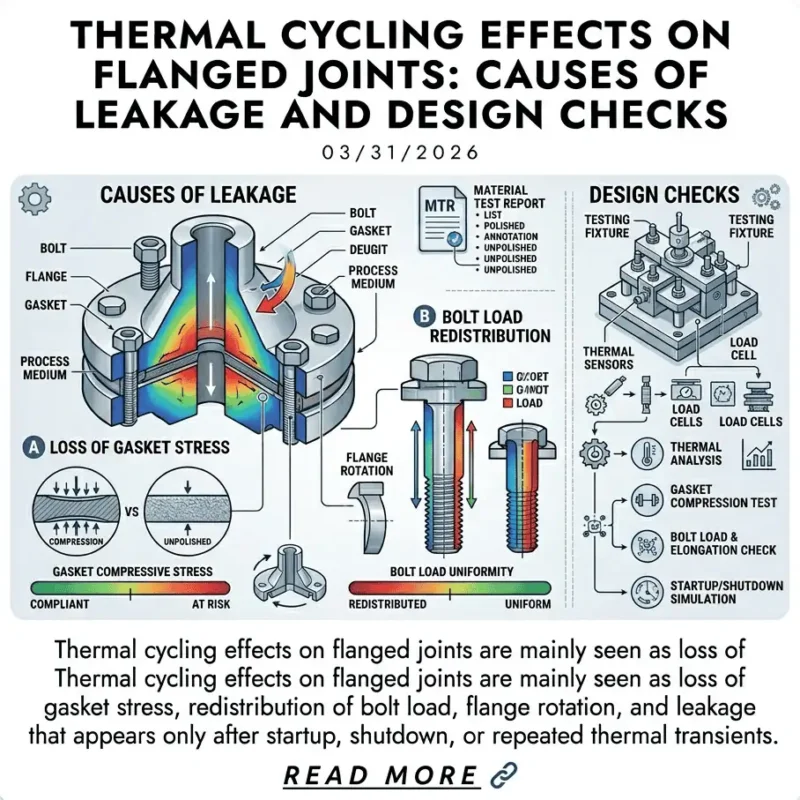
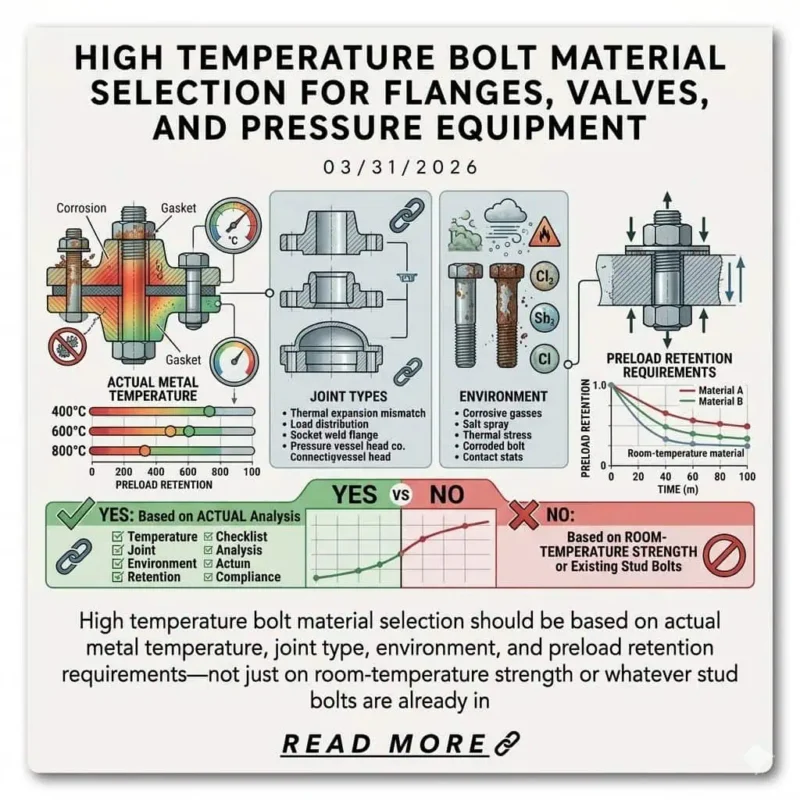
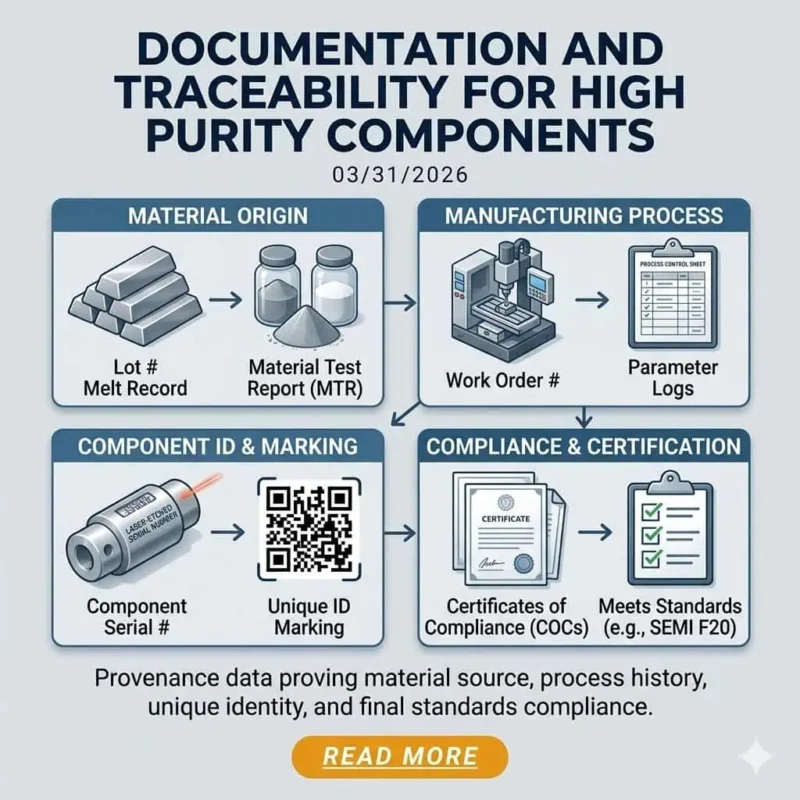
Flanged joint reliability in power generation systems depends on whether the joint can stay leak-tight through steam service, load changes, startup-shutdown cycles, vibration, and repeated maintenance—not just whether it passed cold assembly or hydrotest. In power plants, a flange joint is rarely operating under mild and stable conditions. Main steam lines, hot reheat systems, HRSG headers, valve bonnets, exchanger nozzles, and boiler external piping all subject the joint to thermal cycling, bolt load redistribution, gasket stress loss, and external piping loads. That is why many plant leaks do not appear during initial tightening. They appear after restart, after load swings, or after a shutdown when the same connection is assembled again with small but important differences. A reliable joint in power generation is not simply a flange with the correct pressure class. It is a controlled system of flange geometry, gasket choice, bolting materials, assembly method, and inspection discipline that still performs when the unit is hot, cycling, and under operational stress.
If you are reviewing the full joint rather than the flange alone, see our related pages on zero-leakage flange assembly, common flange leakage causes, and ASME B16.5 flange dimensions and ratings.
What Flanged Joint Reliability Means in Power Generation Systems
Why power plant flange reliability is different from general utility piping
Power generation flange joints are less forgiving because their operating profile is harsher and more variable. Steam temperature, pressure fluctuation, thermal gradients, vibration, startup ramp rates, and shutdown maintenance all place demands on the same joint. A general low-pressure utility flange may only need to hold pressure. A power plant flange joint may need to remain stable through heat-up, high sustained temperature, cooldown, and reassembly during outage work.
This is why a joint that seems acceptable in static service can still be unreliable in power service. Reliability here means leak tightness over time, repeatability after outage work, and resistance to restart-related failure. In practice, the plant does not care whether the joint looked good on paper. It cares whether the joint stays dry at load and stays predictable after the next outage.
Why steam, startup, shutdown, and cycling make joints less forgiving
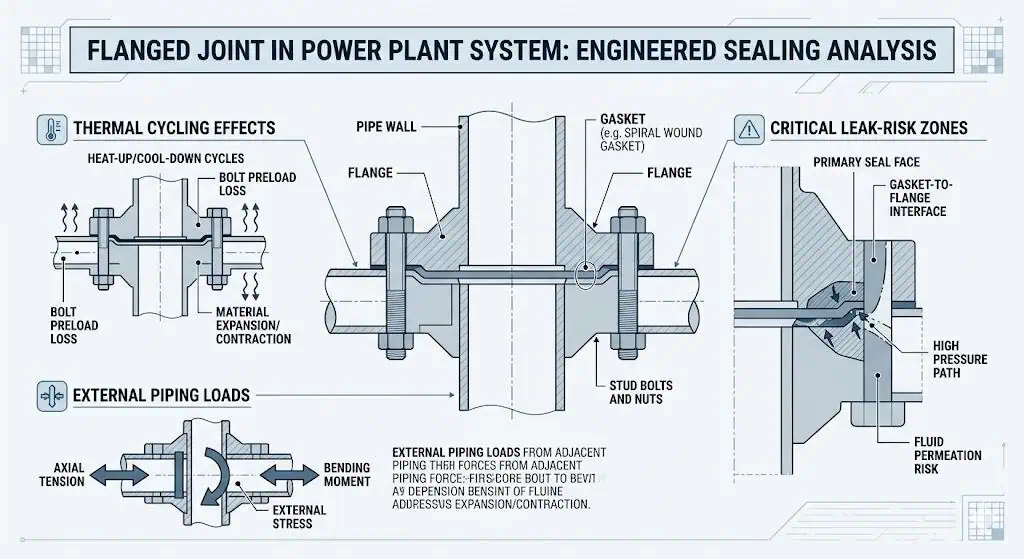
Steam and cyclic duty do not just raise temperature. They disturb joint load balance. During startup and shutdown, flanges, bolts, and gaskets do not heat or cool at the same rate. That changes gasket stress, bolt elongation, flange rotation, and sometimes pipe-to-equipment alignment. Combined-cycle and cycling plants are especially sensitive to this because the number of thermal transients is often higher than in older base-load operation.
A common field issue is a joint that survives one startup but begins to seep earlier with each later restart. That pattern usually means the joint is losing usable load margin cycle by cycle rather than suffering from one single assembly mistake.
What “reliable” really means in plant service
A reliable flanged joint is one that remains sealed, survives restart, and can be maintained without becoming a repeated leak location. In practical plant terms, that means the joint must have enough gasket stress retention, controlled bolt load, acceptable face condition, and manageable external loading to stay stable between outages—not just on the day it was assembled.
Where Flange Reliability Problems Happen Most Often in Power Plants
| Plant Location | Why Reliability Is Challenging | Typical Failure Pattern | What to Review First |
|---|---|---|---|
| Main steam and hot reheat lines | High temperature, sustained stress, startup-shutdown cycling | Leak after hot run or restart | Bolting stability, gasket stress retention, assembly records |
| HRSG headers and associated flanged connections | Frequent cycling, transient thermal gradients, variable operating duty | Repeated restart leakage | Thermal-cycling sensitivity and flange distortion response |
| Valve bonnet and valve body flanges | Local temperature concentration, mass imbalance, maintenance reopening | Localized leakage after reassembly | Assembly discipline and seating uniformity |
| Heat exchanger and condenser-related flanges | Temperature difference across connected components and frequent intervention | Leakage after outage work | Gasket suitability, flange face condition, bolt load consistency |
| Equipment tie-ins and nozzle-side flanges | External piping loads and thermal growth | One-sided leak pattern | Support condition, piping flexibility, flange rotation |
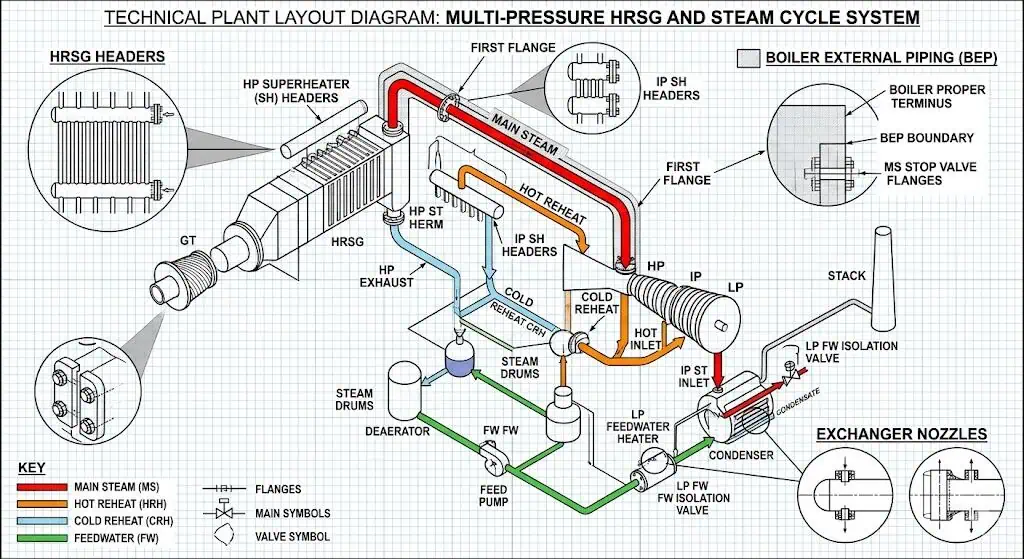
If recurring leakage is concentrated on exchanger channels or nozzle-side flanges, our heat exchanger flange leakage guide is the most relevant follow-up page because restart-sensitive joints often fail there before they fail in simpler pipe runs.
What Actually Controls Flanged Joint Reliability
Gasket stress retention
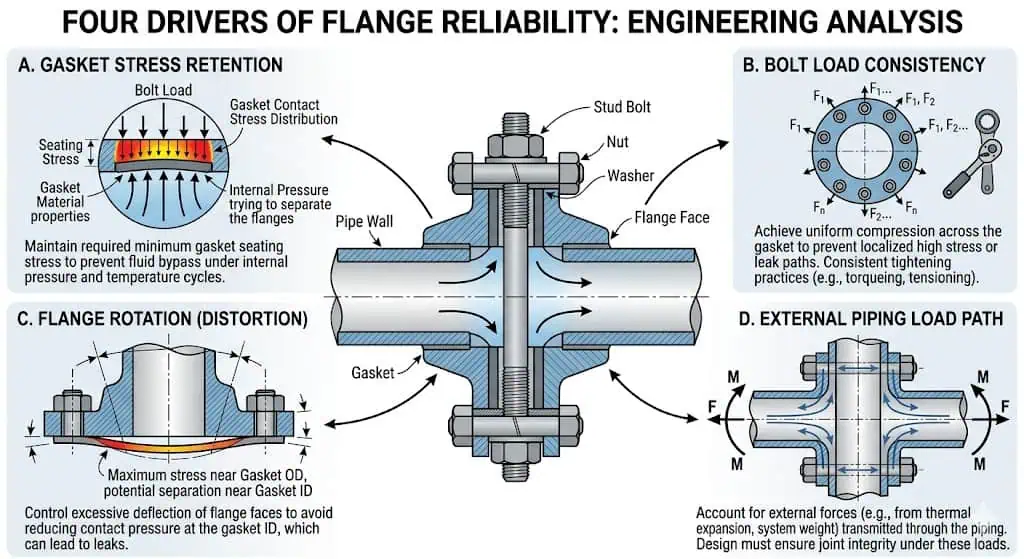
Gasket stress retention is one of the clearest indicators of whether a power generation flange joint will remain reliable. A gasket can seal well during initial assembly and still lose too much effective seating stress once the joint sees temperature, pressure, relaxation, and time. When that happens, the joint becomes progressively more sensitive to restart conditions, vibration, and pressure variation.
A common field issue is a steam flange that stays dry during cold checks but begins to weep after the first full operating cycle. In those cases, the gasket often did not “fail” on its own. The joint failed to maintain enough usable load on it.
Bolt load consistency and bolting material choice
Reliable power plant flange joints need not only adequate bolt strength, but also repeatable and stable bolt load. That is why bolting should be reviewed as a system: stud material, nut grade, bolt length, lubrication condition, thread quality, and tightening method. ASTM A193 and ASTM A194 matter here because the plant joint is not just a flange problem. It is a bolting-system problem as well.
If bolting selection or replacement is part of the job, see our related pages on industrial studs, hex nuts and heavy hex nuts, and ASME flange bolt length guide.
Flange rotation, alignment, and face condition
Flange reliability is strongly affected by how evenly load is delivered across the gasket face. If the faces are not parallel enough, if the flange rotates under thermal or external load, or if the sealing surface condition is poor, the gasket will not be compressed uniformly. One side then loses sealing margin before the other, and the leak pattern becomes directional rather than random.
For users checking surface and seating details, our flange surface finish guide is the most relevant next page when face condition becomes part of the root-cause review.
External piping loads, support condition, and thermal growth
Some of the worst flange reliability problems in power generation are not created inside the flange. They are imposed from outside. Thermal growth, support drift, nozzle loading, or poor piping flexibility can introduce bending and misalignment into the joint. When the same flange leaks at the same clock position after every restart, the problem is often in the system movement path rather than in the gasket alone.
That is why repeated one-sided leakage should trigger a piping-load review, not just a gasket replacement. A joint that is mechanically forced out of balance will rarely become reliable through consumable changes alone.
How to Select the Right Bolting, Gasket, and Flange Details for Power Service
When standard stock choices are acceptable
Not every power plant flange requires a special solution. Standard flange classes, common bolting grades, and familiar gasket types may be acceptable when the service is stable, the joint is not exposed to severe cycling, external loads are controlled, and the assembly procedure is disciplined. The mistake is to assume that because a standard choice worked on one utility flange, it will be reliable everywhere in the plant.
When steam and cycling duty require a stricter review
Main steam, hot reheat, HRSG, and repeatedly cycled joints deserve stricter review than ordinary service. These locations are more sensitive to transient distortion, load loss, and repeated assembly variation. A common outage mistake is to treat them like routine flange jobs and use the same gasket, bolt handling, and tightening approach as on general plant piping.
Why stronger bolts alone do not solve reliability problems
Higher-strength bolting does not fix a joint that is unreliable because of poor load distribution, cycling-induced distortion, or external piping strain. In one typical plant maintenance case, the site upgraded the bolting after repeated leakage but saw the same failure during the next startup. The real problem was not bolt strength. It was uneven gasket compression combined with thermal movement and inconsistent assembly friction.
Why nut grade, lubrication, and bolt length still matter
Power plant flange reliability is often lost through small assembly details that never show up in the line class. Wrong nut substitution, damaged threads, dry tightening, or poorly chosen bolt length can all reduce the actual load delivered to the gasket. That is why “material correct” does not always mean “joint reliable.”
Which Standards Actually Matter in Power Generation Flange Reliability
| Standard | What It Covers | Why It Changes Decisions |
|---|---|---|
| ASME B31.1 | Power piping scope including flanges, bolting, gaskets, valves, supports, inspection, operation, and maintenance | Defines the industry boundary for power piping reliability review |
| ASME B16.5 | Flange dimensions, ratings, facing types, and pressure-temperature limits | Gives the geometric and rating framework but does not by itself guarantee leak-tight reliability |
| ASME PCC-1 | Pressure-boundary bolted flange joint assembly guidance | Supports repeatable assembly and load control for leak prevention |
| ASTM A193 / ASTM A194 | Bolting and nut materials for high-temperature or high-pressure service | Controls whether the bolting system is suitable for plant duty, not just whether the flange fits |
Why these standards matter in practice
These standards should be used as decision tools, not as decoration. ASME B31.1 matters because power generation systems are not generic plant piping. ASME B16.5 matters because the flange geometry and rating boundary still define what the joint can physically and pressure-wise be expected to do. ASME PCC-1 matters because assembly discipline directly affects leak risk. ASTM A193 and A194 matter because reliable sealing depends on the bolting system as much as on the flange itself. For pressure-boundary assembly method and documentation, engineers commonly work from ASME PCC-1; for power piping scope, material and operating context, the governing background remains ASME B31.1.
Installation, Inspection, and Shutdown Practices That Improve Reliability
| Stage | What to Control | Why It Matters | Common Site Error |
|---|---|---|---|
| Assembly | Lubrication, tightening sequence, multiple passes, alignment, flange parallelism | Creates uniform initial gasket stress | Assuming final torque number alone is enough |
| Initial hot run | Leak observation, support movement, bolt condition trend, directional seepage pattern | Shows how the joint behaves under real service | Checking only for gross leakage |
| Shutdown inspection | Thread damage, corrosion, gasket extrusion signs, flange face condition, support drift | Reveals what operating cycles are doing to the joint | Replacing the gasket without reviewing joint mechanics |
| Restart preparation | Repeatability of assembly method, alignment, support condition, recorded issues from last run | Prevents repeat failure on the next startup | Treating each restart leak as an isolated event |
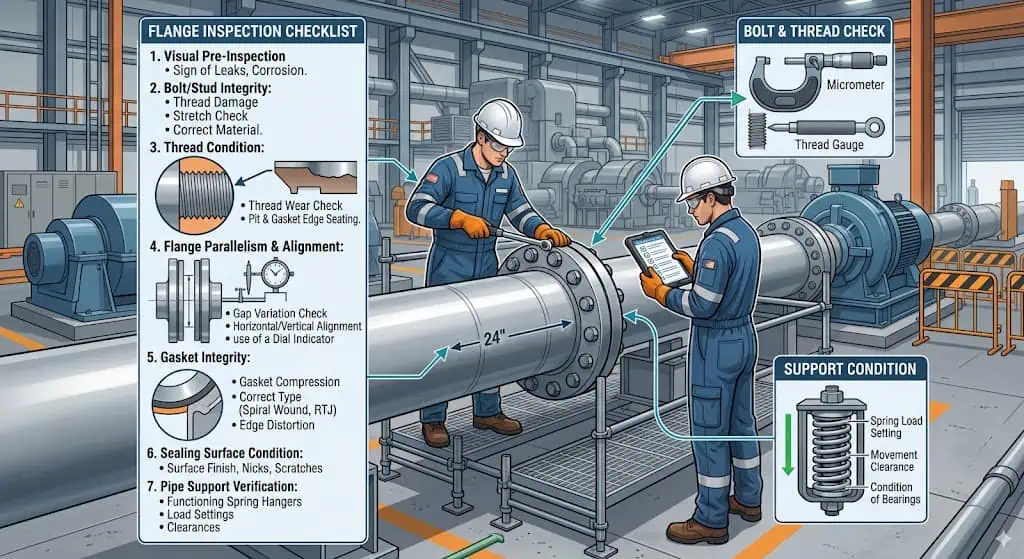
For a more assembly-focused workflow, see our 4-step flange assembly guide and installation and maintenance support page.
Common Failure Modes in Power Generation Flange Joints
| Observed Failure | Likely Root Cause | Corrective Action | How to Prevent Recurrence |
|---|---|---|---|
| Leakage after startup | Loss of gasket stress during heat-up or early operating transition | Review gasket type, bolt load stability, lubrication, and assembly uniformity | Classify the joint as startup-sensitive before the next outage |
| Repeated leakage after every outage | Cyclic distortion, inconsistent reassembly, or unresolved external loads | Review restart conditions, face condition, flange rotation, and support behavior | Treat the joint as a repeated-failure location with a defined inspection plan |
| Leak concentrated on one side | External piping load or non-uniform flange compression | Check support condition, piping growth path, and local joint geometry | Add piping-load review to the root-cause process |
| No lasting improvement after retorque | Underlying reliability problem not corrected | Stop treating the issue as torque-only and review the full joint system | Link design, assembly, and maintenance records instead of reacting symptom by symptom |
| Bolt damage or corrosion discovered during outage | Wrong bolting choice, thread damage, poor handling, or shutdown exposure | Review material, storage, inspection findings, and reuse suitability | Define receiving, storage, and shutdown inspection requirements |
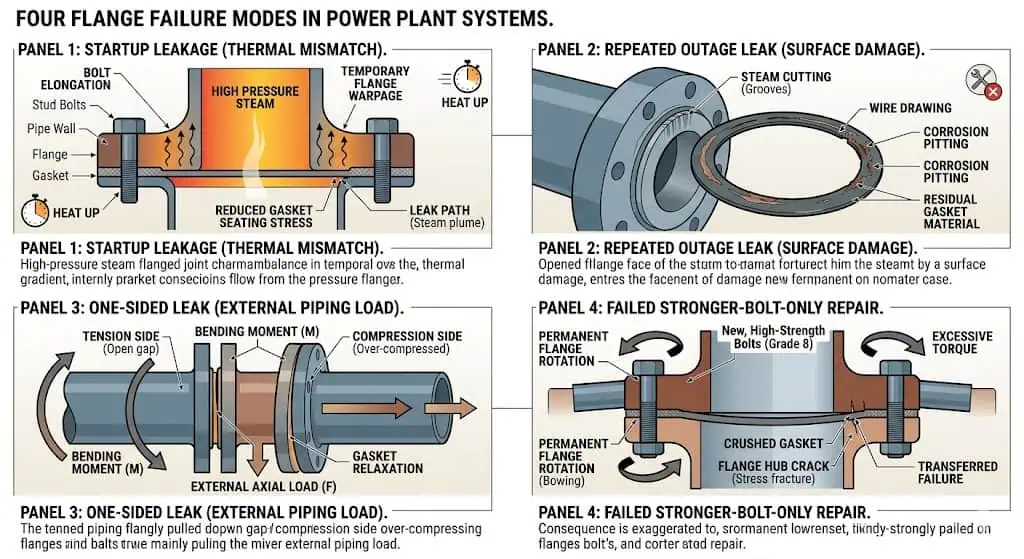
If the symptom has already become a working leak rather than a design concern, our flange gasket leakage troubleshooting page and heat exchanger flange leakage guide are the best next steps.
Composite Field Scenarios for Engineering Training
Scenario 1: Main steam flange leaks after hot startup
What happened: A main steam flange passed cold assembly checks and hydrotest, but began to weep after the unit reached operating temperature.
Why it happened: The remaining gasket stress during hot operation was lower than expected, even though assembly records looked acceptable.
The real system cause: The joint was treated as a cold-static flange rather than a startup-sensitive power-service flange.
How it was corrected: The team reviewed gasket type, bolting condition, lubrication control, and assembly uniformity together instead of retorquing blindly.
How to prevent recurrence: Flag startup-sensitive steam joints in the work pack and inspect them after first hot exposure.
Scenario 2: HRSG flange leaks after every restart
What happened: A flanged connection in an HRSG-related system stayed dry in steady operation but leaked again after each outage and restart.
Why it happened: Repeated thermal gradients and cycling duty were disturbing the joint more than a standard reassembly method could tolerate.
The real system cause: The joint was sensitive to cyclic operating conditions, not just to gasket replacement quality.
How it was corrected: The connection was reviewed for thermal-cycling sensitivity, flange distortion response, and repeatability of assembly load.
How to prevent recurrence: Treat frequent restart duty as a design and maintenance condition rather than a routine piping detail.
Scenario 3: Equipment nozzle flange leaks on one side only
What happened: A nozzle-side flange repeatedly leaked at the same clock position after startup.
Why it happened: Thermal growth in the connected pipe introduced an external bending load into the flange.
The real system cause: The flange was reacting to system movement rather than to internal pressure alone.
How it was corrected: Support condition, alignment, and the external load path were reviewed and corrected.
How to prevent recurrence: Include piping flexibility and thermal movement review whenever leakage repeats in a consistent location.
Scenario 4: Stronger bolting did not improve reliability
What happened: The plant upgraded bolting after repeated leakage, but the joint still failed during later service.
Why it happened: The modification addressed material strength but not the actual mechanism of load loss.
The real system cause: The joint was losing sealing integrity through distortion, uneven gasket compression, and cycling-related movement.
How it was corrected: The team reviewed the full flange-gasket-bolting-assembly system instead of focusing on bolting alone.
How to prevent recurrence: Do not approve a bolt-only change without reviewing gasket behavior and external load condition.
FAQ
Why do flange joints leak in steam service?
Because steam service often combines high temperature, startup-shutdown cycling, and load redistribution inside the joint. A flange can be tight when cold and still lose useful gasket stress after heating, especially if the joint is sensitive to thermal gradients, flange rotation, or external piping loads.
What is the most common cause of flange leakage after startup?
One of the most common causes is loss of gasket stress during heat-up. In plant service, the connection may look correct during cold assembly but become less stable once the joint sees real operating temperature and movement.
Can retorque alone improve reliability?
Not reliably. Retorque may help in some cases, but if the real problem is flange distortion, external piping load, gasket stress loss, or poor assembly repeatability, the leak often returns on the next cycle.
Which standards matter most for power piping flange joints?
ASME B31.1, ASME B16.5, ASME PCC-1, and ASTM A193/A194 are the most relevant standard anchors for this topic. They cover the power piping scope, flange geometry and ratings, assembly discipline, and bolting materials that directly affect joint reliability.
What should be inspected before restart?
Review bolt condition, thread damage, corrosion, flange alignment, support condition, and signs of uneven gasket compression or extrusion. Restart-sensitive joints should be treated as repeatability-critical assemblies, not as routine reassembly points.