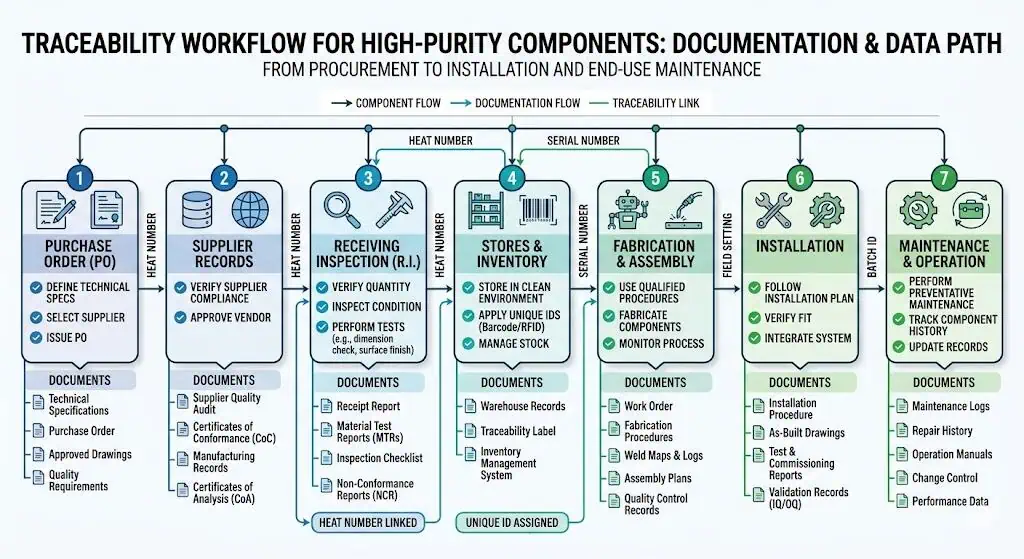
Documentation and traceability for high purity components are the records and identification controls that let you prove what the component is, what material or lot it came from, how it was processed, how it was inspected, and whether it is acceptable for the specific service where it will be installed. In high purity work, this is not paperwork for its own sake. It is how engineering approves a component, how QA decides whether it can be released, and how maintenance later determines what was installed, what can be reused, and what must be quarantined after a failure or changeout. If a project cannot link the installed part back to its material basis, surface or cleanliness basis, inspection records, and delivery condition, it does not really control contamination risk. In practice, the real question is not “Do we have a certificate?” but “Can we still match this exact part to the right records at receiving, after storage, after fabrication, and later during maintenance?”
The most expensive traceability mistake is not a missing signature on a form. It is accepting a component that looks correct on size and alloy but cannot be tied back to the right heat, lot, surface basis, passivation status, polymer qualification, weld history, or receiving condition. That is when engineering approval becomes subjective, QA release becomes weak, and later maintenance work turns into guesswork.
In high purity systems, a component is not fully controlled when the certificate exists somewhere in a folder. It is controlled when the physical part in hand can still be matched to the right records without guessing.
What Documentation and Traceability Actually Mean for High Purity Components
Documentation Is Not Only the Material Certificate
In high purity work, the document package usually has to do more than prove the nominal material grade.
For metallic components, inspection documents help define what the supplier is actually certifying and what the purchaser is entitled to review. In real projects, that changes what procurement should request and what QA should accept. A material certificate may confirm the basic material callout, but it does not automatically prove the delivered component still has the correct identity, the correct surface basis, or the correct delivery condition after packaging, storage, repacking, or fabrication.
For high purity components, the practical document package often includes material identity, order conformance, surface or cleanliness basis, cleaning or passivation records where applicable, weld records for welded subassemblies, and receiving records that confirm the item still matched the requirement when it arrived. A common field issue is a component with the right certificate on paper but a weak link between the certificate and the actual part in stores or at installation.
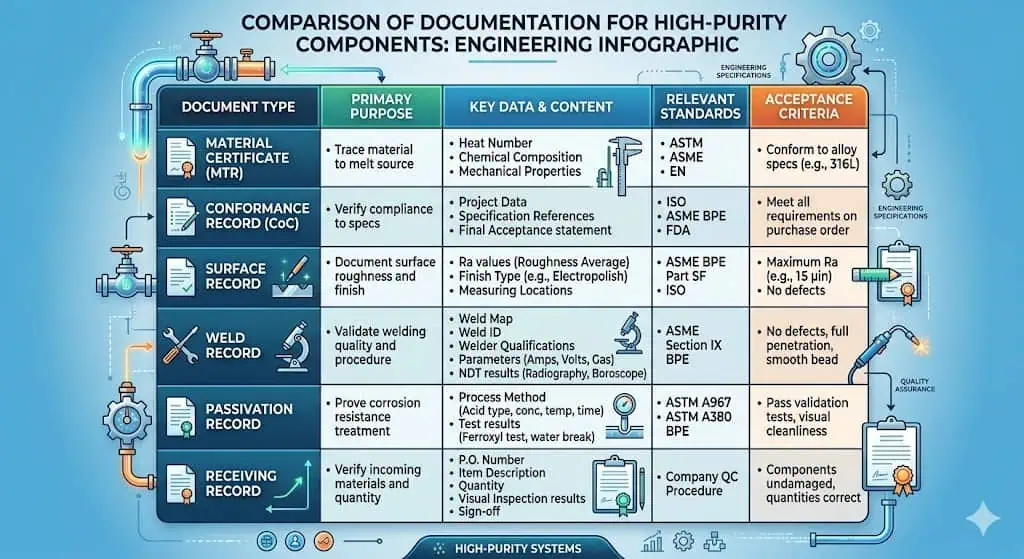
| Document Group | What It Proves | Why Engineering and QA Care |
|---|---|---|
| Material certificate / inspection document | Grade, heat or lot, ordered material basis | Confirms the component starts from the correct material family |
| CoC or order conformance record | Delivered item matches the PO or approved requirement | Supports release against project-specific acceptance rules |
| Surface / finish / cleanliness record | How wetted condition was specified or processed | Important where contamination-sensitive service is involved |
| Cleaning / passivation record | What post-fabrication treatment was done | Important for stainless components in critical service |
| Weld record / weld acceptance record | How welded joints were made and accepted | Critical where purity and weld quality are linked |
| Packaging / receiving record | Delivered condition at arrival | Prevents a correct component from being released in damaged condition |
Practical rule: A good certificate is useful only when the component identity is still intact enough to prove that the certificate belongs to that exact part.
Traceability Means You Can Follow the Component Backward and Forward
A traceable high purity component should be identifiable in both directions.
Backward traceability means you can connect the installed or received part to its material, lot, process history, and inspection records. Forward traceability means you can identify where that same lot, spool, or component family was installed if a later problem appears. This is why physical marking, lot identity, and issue records matter. A typical receiving or stores mistake happens when the component enters the warehouse with the right marking and records, but that identity link is lost after repackaging, kit breakdown, cut-length issue, or spare handling. After that, engineering approval becomes much weaker even if the original certificate still exists.
| Traceability Direction | What It Should Allow You to Do | Main Failure If Weak |
|---|---|---|
| Backward traceability | Connect the part to its heat, lot, process route, and records | The installed item cannot be proven against the approved material basis |
| Forward traceability | Identify where the same batch or lot was used later | A problem lot cannot be isolated efficiently |
| Stores traceability | Keep identity intact during receiving, warehousing, and issue | Correct records exist, but not for the part actually installed |
| Maintenance traceability | Track replacement part identity and revision status | Spare substitution creates hidden risk later |
Which Records Matter Most Before a High Purity Component Is Approved
The required records change by component type, service, and fabrication route.
Straight stainless tubing, machined valve bodies, face seal fittings, polymer UPW fittings, and welded subassemblies do not all carry the same documentation risk. A line that includes stainless components, polymer components, and field welds should not be approved using one generic “material certificate received” rule. In semiconductor-style stainless service, a material-basis document and a wetted-surface basis are separate decisions. In polymer UPW and liquid chemical service, generic plastic naming is not enough if the line depends on a qualified polymer family and controlled lot history.
| Component Type | Documentation That Usually Matters Most | Main Risk If Weak |
|---|---|---|
| Stainless tubing and fittings | Material document, heat or lot traceability, surface basis, delivery condition | Wrong material form, weak surface basis, mixed lots |
| Machined stainless components | Material basis, machining route, surface condition, cleaning or passivation evidence | Residue, wrong incoming stock, unclear wetted condition |
| Welded subassemblies | Component traceability, weld records, weld acceptance, release logic | Good components assembled into a weak high purity joint |
| Polymer UHP / UPW components | Lot identity, polymer qualification basis, service-specific evidence | Wrong polymer family or wrong qualification basis |
| Maintenance replacement parts | Spare identity, revision status, tie-back to approved item | Correct size but wrong service class |
A useful internal support path is to keep related topics connected. For example, traceability review works better when buyers and inspectors can also cross-check how to interpret a material certificate, how to read markings and traceability, and broader material grades guidance without leaving the actual decision path.
Which Standards Actually Matter
The useful standards are the ones that change what the engineer writes, what the supplier delivers, and what QA accepts.
ASME B31.3 matters because it is the process piping framework and its scope covers materials, components, design, fabrication, examination, inspection, and testing for process piping, including semiconductor plants. It helps define the overall quality environment, but it does not replace service-specific documentation rules.
EN 10204 matters because it defines inspection document types for metallic products. In real procurement work, this is what turns “send the mill cert” into a defined document requirement and traceability expectation.
MSS SP-25 matters because it standardizes marking for valves, fittings, flanges, and unions used in piping connections. Without a reliable marking-to-document link, the certificate becomes much weaker at receiving and almost useless later in maintenance planning or failure review.
SEMI F20 and SEMI F19 matter for stainless high purity and ultra high purity semiconductor-style service because they separate the material basis from the wetted surface basis. SEMI F57 matters for polymer UPW and liquid chemical components because traceability in that service cannot stop at a generic plastic callout.
SEMI F81 matters where welded stainless high purity systems are involved because weld acceptance and weld records affect both purity and release confidence. ASTM A380 and ASTM A967 matter where cleaning, descaling, or passivation records are part of the acceptance basis for stainless components.
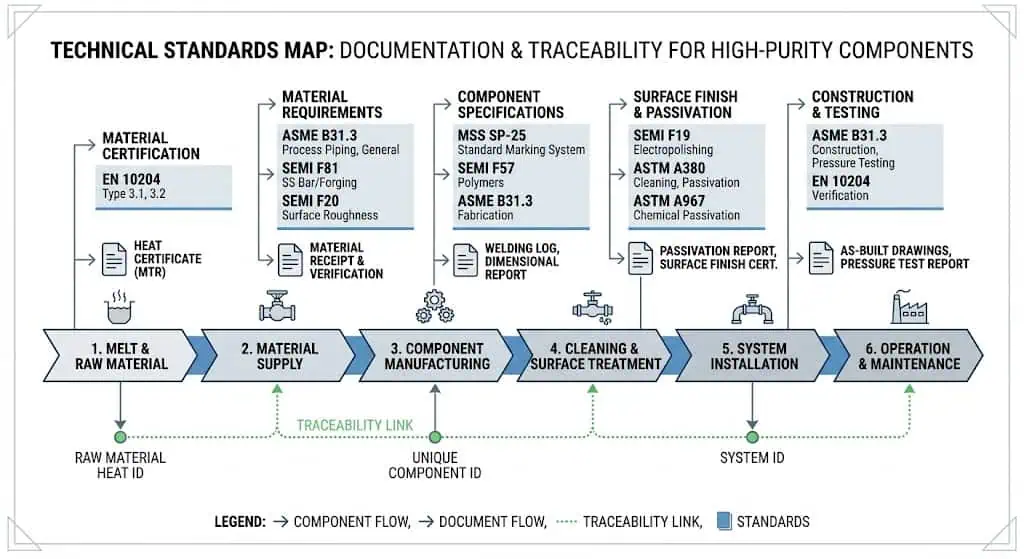
| Standard | Why It Matters in This Topic |
|---|---|
| ASME B31.3 | Provides the process piping framework for material, fabrication, examination, inspection, and testing |
| EN 10204 | Defines inspection document types supplied to the purchaser for metallic products |
| MSS SP-25 | Supports the marking system that keeps physical identity tied to records |
| SEMI F20 / F19 | Support material basis and wetted surface basis for stainless HP and UHP components |
| SEMI F57 | Supports qualification logic for polymer UPW and liquid chemical components |
| SEMI F81 | Supports GTA weld inspection and acceptance in high purity semiconductor fluid systems |
| ASTM A380 / A967 | Support cleaning, descaling, and passivation records where stainless post-fabrication condition matters |
Practical takeaway: If the PO says “high purity component” but says nothing about document type, physical identity, surface basis, weld acceptance where applicable, or delivery condition, the traceability requirement is still underdefined.
Procurement and Receiving Checklist for High Purity Components
What Should Be Written Into the PO
Most documentation disputes start because the PO is too vague.
A strong purchase description for high purity components should state the service and contamination sensitivity, the component type and material or polymer basis, the required inspection document type, the surface or cleanliness basis where applicable, the cleaning or passivation basis where applicable, the marking or lot identification expectation, packaging and end protection requirements, and weld record requirements for welded assemblies.
| Item to Specify | Why It Matters |
|---|---|
| Service and contamination sensitivity | Changes how strong the documentation and traceability requirements must be |
| Component type and material or polymer basis | Prevents non-equivalent substitutions |
| Required document type | Avoids arguments over whether a generic CoC is enough |
| Surface / finish / cleanliness basis | Stops visual appearance from replacing a defined requirement |
| Cleaning / passivation basis | Makes post-fabrication condition reviewable |
| Marking / lot / heat identity | Keeps physical identity tied to records |
| Packaging and end protection | Protects the delivered condition through receiving and storage |
| Weld record and acceptance basis | Needed for welded subassemblies and critical field joints |
As a practical procurement rule, write the PO so that a receiving inspector can decide whether the delivered item is acceptable without having to guess what “high purity documentation” was supposed to mean.
Receiving Inspection Checklist
Receiving inspection should verify both records and physical identity.
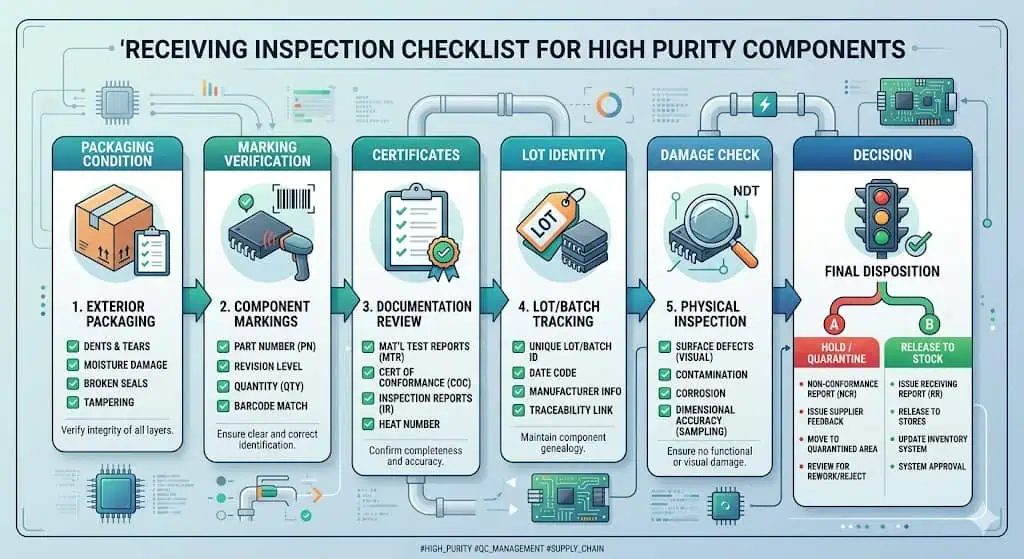
- Check package condition before opening clean bags or end caps.
- Verify heat, lot, part number, or service identity against the supplied records.
- Confirm that the document type matches the PO or project requirement.
- Inspect visible wetted openings, tube ends, and sealing areas for delivery damage or contamination.
- Keep service classes segregated in stores, especially for HP and UHP spares.
- Hold anything with mismatched identity, weak protection, or incomplete records.
If the receiving process can confirm size and material name but cannot confidently confirm identity, the traceability process is still too weak for high purity work.
Common Failure Modes and Composite Field Scenarios
Most documentation and traceability failures are not mysterious. They happen when the link between the physical component and the record chain is lost.
| Observed Problem | Immediate Cause | Real System Cause | Corrective Action |
|---|---|---|---|
| Correct material on paper, QA hold at receiving | Marking and certificate do not match cleanly | PO allowed weak traceability language | Quarantine the batch and reconcile identity before release |
| Repeat contamination after maintenance | Wrong spare was used | Spare parts were controlled by size, not by service class and lot identity | Rebuild with approved parts and tighten spare segregation |
| Welded assembly passes dimensional check but not release review | Missing weld acceptance evidence | Project treated weld completion as enough | Review or repeat weld inspection and document release |
| “Passivated” part is disputed later | No reliable treatment record | Passivation was treated as a vendor claim, not a controlled requirement | Re-establish process basis and reprocess if needed |
Composite field scenario for engineering training: A stainless high purity gas branch was received with the correct alloy statement and dimensions, but QA later held the batch because the physical marking and the supplied inspection certificate could not be matched with confidence after repacking. The immediate problem looked administrative. The real system cause was that receiving treated documentation and identity as separate tasks. The correction was to quarantine the branch and rebuild the identity link before issue. The prevention was to require mark-to-document verification as part of the receiving checklist, not as a later audit item.
Composite field scenario for engineering training: A maintenance team replaced a critical face-seal component with a spare that matched size and connection type. After restart, the branch was questioned because the part could not be tied back to the approved lot and surface basis. The immediate cause was spare substitution. The real system cause was weak traceability discipline in stores. The correction was to remove the part and reinstall an approved traceable component. The prevention was to segregate spares by service class and keep issue records tied to part identity, not only to description.
How to Reduce Risk and Rework
The practical way to reduce documentation and traceability failures is to treat them as part of component control from PO to release.
- Define the required document type at ordering stage.
- Require physical marking or controlled lot identity that can be matched at receiving.
- Do not separate surface, cleaning, passivation, and weld records from the base material record.
- Keep incoming identity intact through warehousing, repacking, fabrication, and installation.
- Treat maintenance replacement as a traceability event, not only a spare issue event.
- Quarantine anything that cannot be tied back cleanly to the approved requirement.
A high purity component is not really traceable when the document exists somewhere. It becomes traceable when engineering, QA, stores, fabrication, and maintenance can all follow the same identity chain without reinterpreting it.
| Key Findings | Description |
|---|---|
| Documentation is broader than the mill cert | High purity approval often needs material, surface, weld, cleaning, and receiving records together |
| Traceability depends on physical identity | If the mark or lot link is lost, the document package becomes much weaker |
| Receiving is a control point | Many failures start when identity and delivery condition are not checked together |
| Maintenance can break traceability | Correct-looking spares create hidden risk if issue control is weak |
Good engineering judgment keeps the component record chain useful long after handover. That is what turns documentation and traceability from paperwork into a real quality control tool for high purity components.
FAQ
What does traceability mean for high purity components?
It means you can connect the physical component back to its material or lot, inspection documents, processing history, and delivery condition, and also identify where that same lot or part family was installed later.
Is a material certificate alone enough?
Usually not.
In high purity service, you often also need matching identification, surface or cleanliness basis where applicable, weld records for welded items, cleaning or passivation records for stainless parts where required, and receiving evidence that the delivered condition still matched the requirement.
Why does EN 10204 matter?
Because it defines the types of inspection documents supplied to the purchaser for metallic products, including specific inspection certificates such as 3.1 and 3.2.
That changes what procurement should request and what QA should verify.
Why does marking matter if the certificate is correct?
Because a correct certificate is weak if it cannot be matched back to the physical part.
MSS SP-25 exists precisely because marking on valves, fittings, flanges, and unions is part of component identification.
What is the most common traceability mistake?
Accepting a component because the size and alloy look right even though the lot identity, document type, or delivered condition cannot be matched confidently at receiving or after maintenance.
| Situation | Recommendation |
|---|---|
| Certificate exists but part identity is weak | Hold the part for reconciliation before release |
| Spare matches size but not approved lot or service basis | Do not install until identity is confirmed |
| Welded assembly lacks release-ready weld records | Review or repeat weld acceptance before issue |