Proper bolt tightening for storage terminal flanges is not just about reaching a torque number. It is about creating and retaining the right gasket seating stress across the whole joint. In real terminal service, repeat leaks usually come from uneven preload, poor bolt condition, poor lubrication control, flange face problems, misalignment, wrong tightening sequence, or weak assembly discipline rather than from “bad bolts” alone.
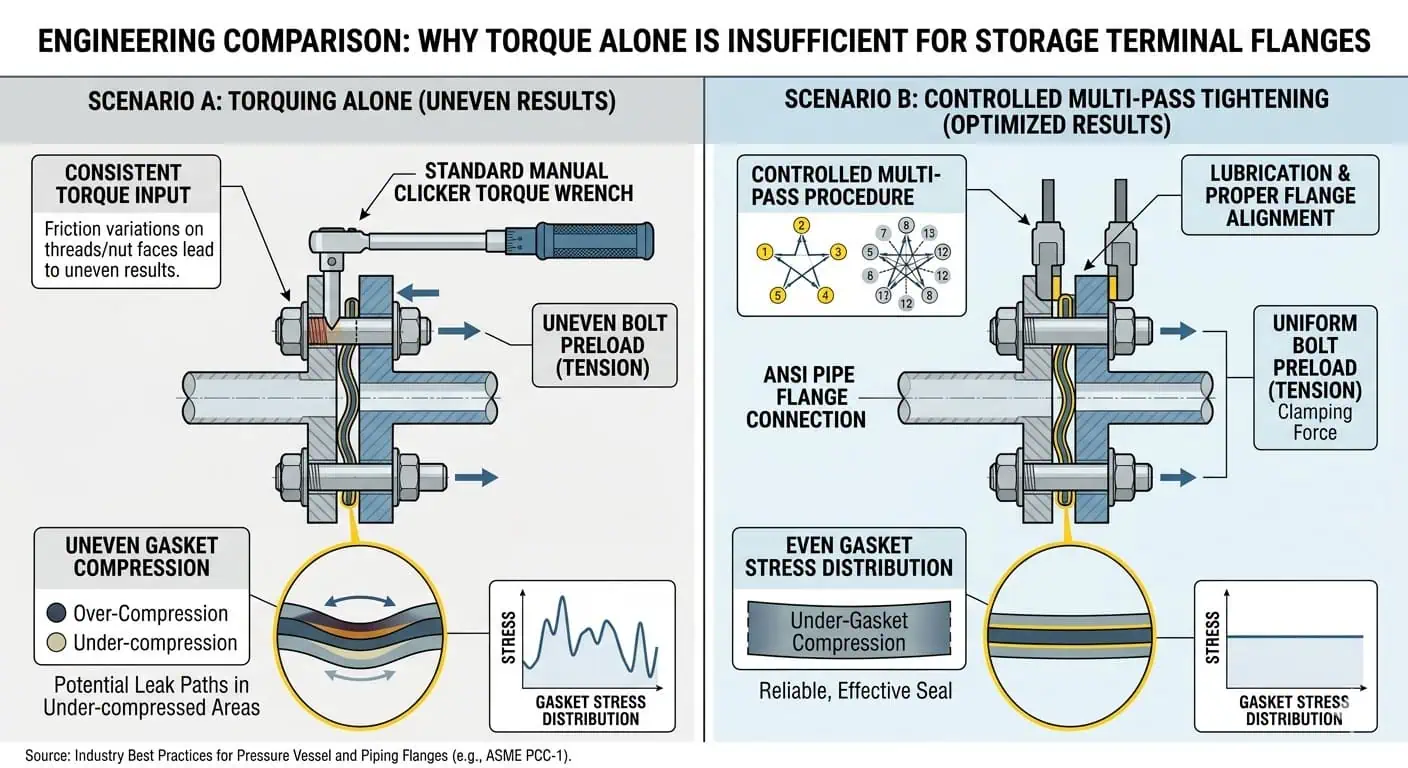
That is why bolt tightening in terminals should be treated as a joint integrity task, not as a wrench task. A flange can be tightened to the specified torque and still leak if the preload is not uniform, if the gasket is seated unevenly, or if the flange is being forced out of alignment by pipe strain. In practice, the goal is not to hit a torque figure. The goal is to build a stable, even, retained bolt load that allows the gasket to do its job through startup, shutdown, temperature change, vibration, and maintenance history. This is also why ASME PCC-1 matters in practice: its bolted flange joint assembly guidance is intended to help users develop effective assembly procedures across a broad range of flange sizes and service conditions.
Field rule: In storage terminals, a flange that is “tightened to spec” is not automatically a good joint. A good joint is one that builds uniform gasket stress, retains load in service, and does not become a repeat seepage point after the next operating cycle.
| Tightening Variable | Why It Matters |
|---|---|
| Bolt preload uniformity | Controls whether the gasket is compressed evenly around the flange circumference. |
| Lubrication consistency | Changes the relationship between applied torque and actual bolt load. |
| Flange face condition | Determines whether the gasket can seat correctly and hold stress. |
| Alignment before tightening | Prevents the bolts from being used to pull the joint into position. |
| Tightening sequence and passes | Reduces preload scatter, especially on larger flange sizes. |
| Hardware condition | Affects friction, repeatability, and retained load after assembly. |
| Service movement | Vibration, thermal movement, and piping strain can reduce retained load after startup. |
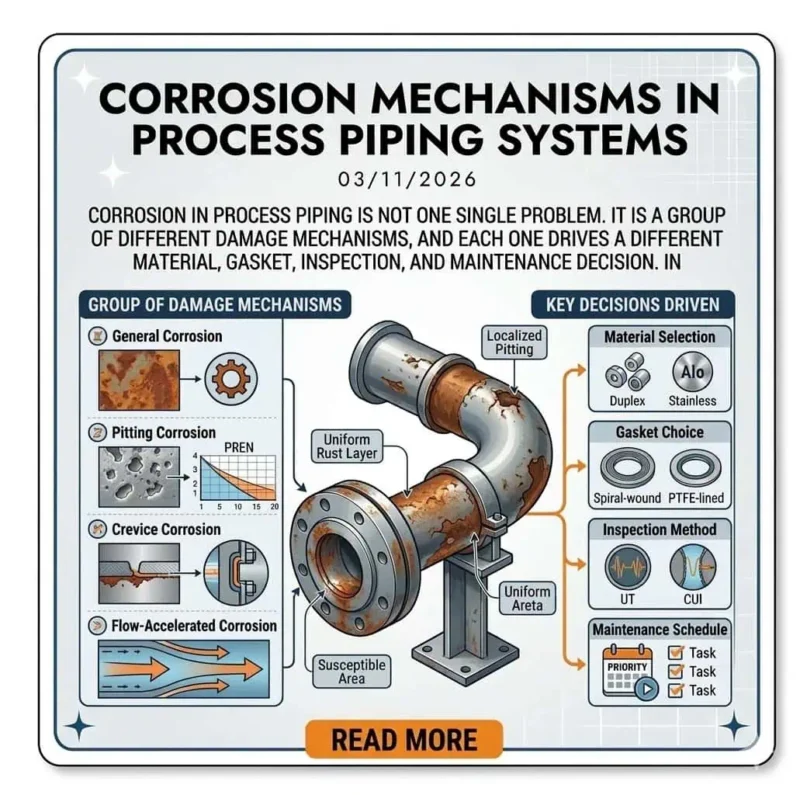
If you are reviewing this topic as part of a wider flange reliability path, it also helps to read Flange Assembly: 4 Steps to Zero-Leakage Joint Integrity, Flange Gasket and Sealing Considerations for Chemical Plants, Tank Farm Piping Connection Best Practices for Flanges and Manifolds, and Corrosion Mechanisms in Process Piping Systems. Those pages explain the connection design, sealing, and operating factors that sit behind successful bolt tightening in storage terminals.
Why Bolt Tightening Is a Bigger Issue in Storage Terminals Than Many Users Expect
Storage Terminal Flanges Often Operate at Modest Pressure, but Leak Consequence Is Still High
Storage terminal flanges are often underestimated because they do not always sit in the highest-pressure or highest-temperature service. That is misleading. Even when the service conditions look moderate, the consequence of poor tightening can still be significant: chronic hydrocarbon seepage, visible product leakage, emissions, repeat maintenance, cleanup cost, and reduced operator confidence in the system. EPA guidance on equipment leaks treats connectors and other component leak points as real fugitive-emission sources, which is exactly why terminal flange tightening should never be treated as a minor workshop task.
Repeat Terminal Leaks Are Usually Assembly Problems, Not Just Material Problems
In terminal work, the same flange may be opened and closed many times during its life. The hardware may be reused, the threads may not be in the same condition, the lubrication may vary from crew to crew, and the flange face may slowly lose quality after repeated maintenance. In that environment, repeat leakage is often an assembly-control problem long before it becomes a material-limit problem.
What Users Actually Need From a Tightening Article
From a practical standpoint, users need this article to do four things:
- Identify which terminal flanges need stricter tightening control
- Understand why torque alone is not enough
- Recognize the most common root causes behind repeat seepage
- Build a repeatable tightening and QA method that different crews can follow consistently
Practical takeaway: Good terminal tightening practice is not defined by how hard someone pulls a wrench. It is defined by whether different people can produce the same leak-tight result on the same class of joint.
Which Storage Terminal Flanges Need the Tightest Control
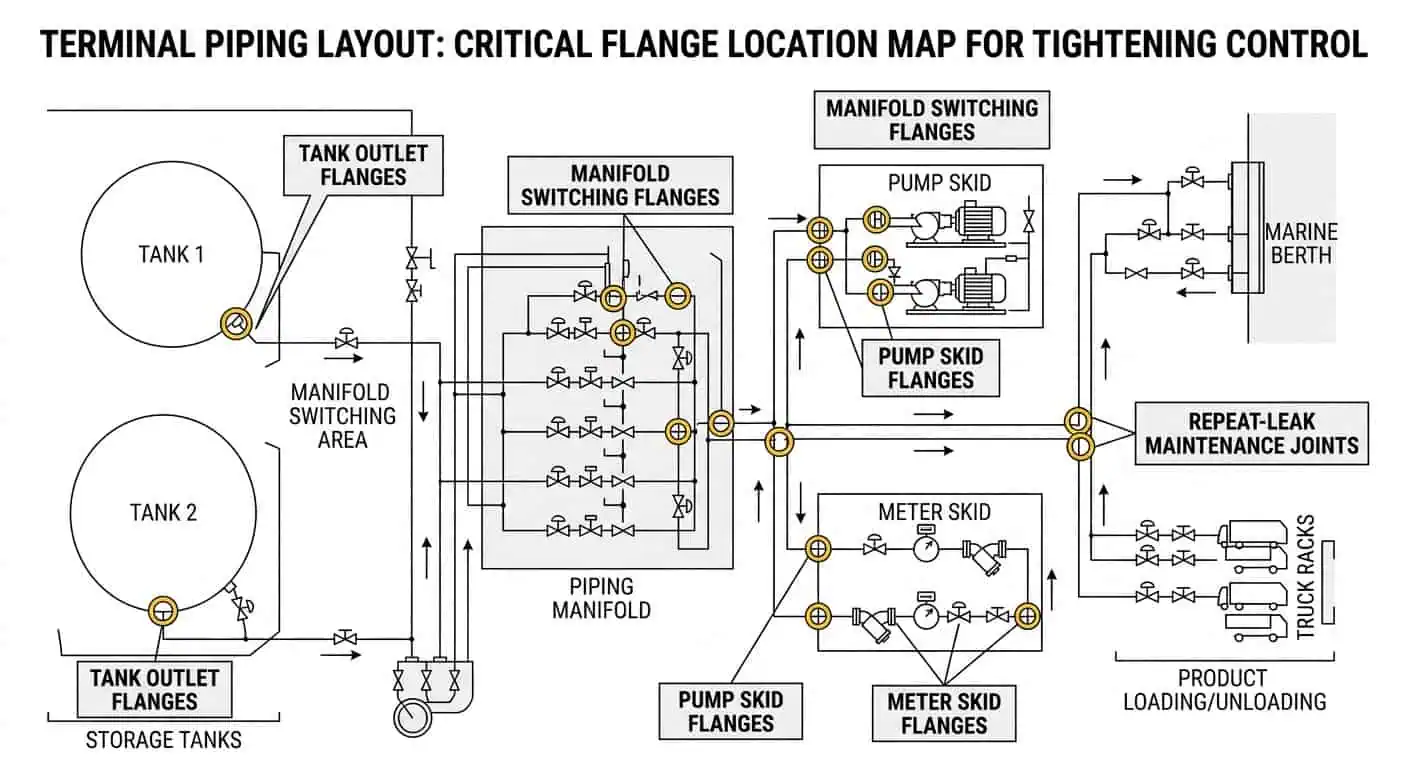
Tank Outlet and First Isolation Flanges
Flanges near tank outlets and first isolation points usually deserve tighter bolt-up control than routine straight-run connections. They are high-consequence joints because they sit at practical isolation boundaries, are often visible to operators, and can create immediate cleanup and operating problems if they seep after a maintenance return.
Manifold Switching Points and Valve Clusters
Manifold flanges and valve cluster joints are common tightening trouble points because they are frequently opened, often congested, and not always easy to align perfectly. They also tend to see repeated operator activity, which means the joint history can become just as important as the original flange specification.
Pump Suction, Discharge, and Metering Skid Connections
These locations often combine tightening difficulty with movement. Even if the initial bolt-up is correct, vibration, alignment shift, pump maintenance, or adjacent piping movement may reduce retained load after startup. A connection that is fine at cold assembly may become a leak point once the system begins to move in service.
Reopened Maintenance Flanges
Any reopened flange deserves more tightening discipline than a never-opened joint. Repeated disassembly changes hardware condition, thread friction, flange face quality, and crew handling consistency. If a terminal wants to reduce repeat seepage, reopened flanges should be one of the first categories placed under a written tightening procedure.
| Terminal Flange Type | Why Tightening Control Should Be Higher |
|---|---|
| Tank outlet flange | High-consequence release boundary with visible leak impact |
| Manifold switching flange | Frequent operation, repeated opening, congestion, and operability risk |
| Pump tie-in flange | Movement, vibration, and alignment sensitivity |
| Metering skid flange | Maintenance access and repeated disturbance |
| Reopened maintenance joint | Higher variability in hardware condition and assembly quality |
The Most Common Root Causes of Poor Bolt Tightening Results
Torque Reached, but Preload Not Controlled
This is one of the most common causes of repeat flange leaks in storage terminals. The torque value may be correct on paper, but the actual bolt load may still vary too much from stud to stud. If preload is not uniform, gasket compression is not uniform. Once that happens, the joint may appear acceptable at handover and still become a seepage point after it sees service movement or thermal change.
Lubrication Variation and Friction Scatter
Two bolts tightened to the same torque do not automatically carry the same load. Thread condition, nut condition, washer condition, lubrication amount, and lubricant type all affect friction. In practical terms, this means that uncontrolled lubrication can create major preload scatter even when the crew believes it is following the same tightening value.
Poor Tightening Sequence and Weak Multi-Pass Discipline
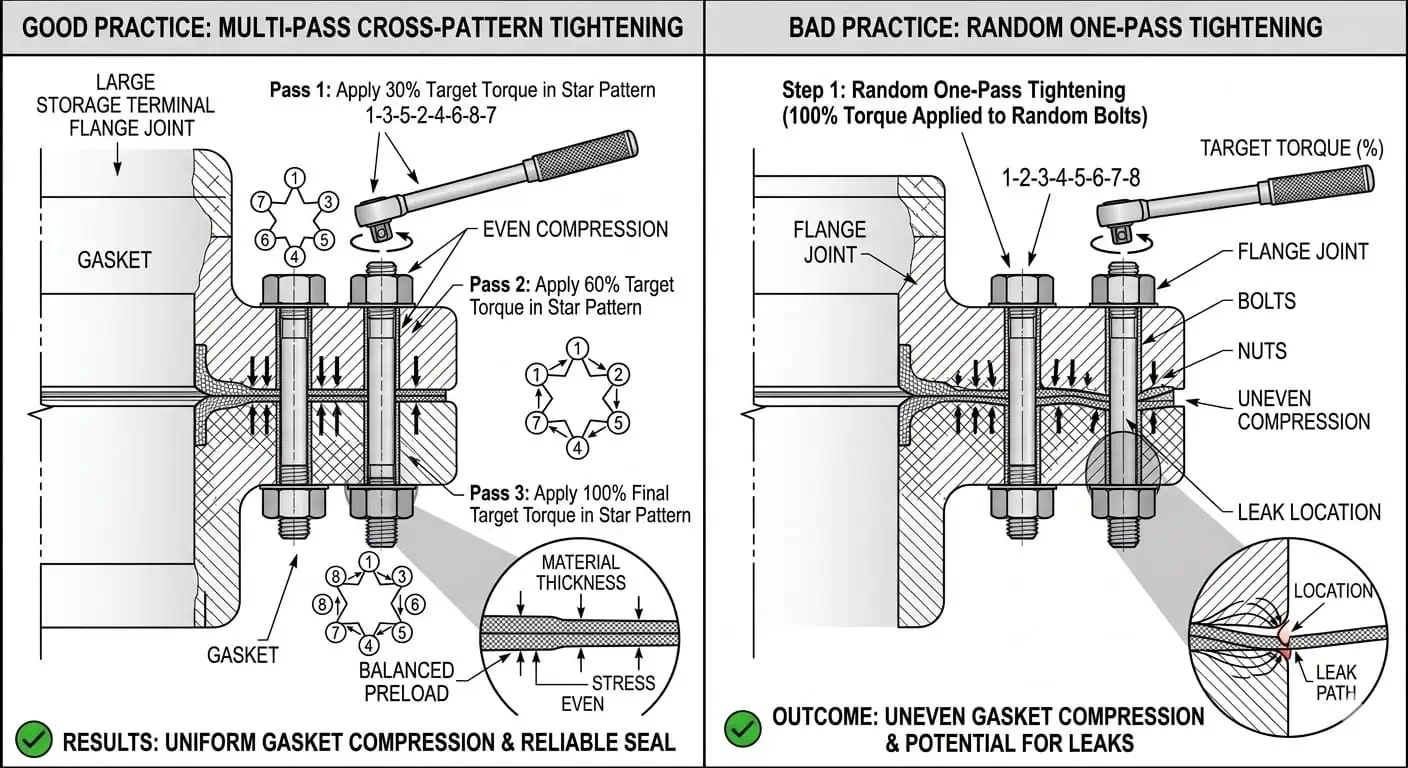
Large-diameter storage terminal flanges are especially sensitive to the way load is built into the joint. Random tightening, one-pass tightening, incomplete cross-pattern tightening, or skipping the final verification pass can all produce non-uniform gasket stress. The larger the flange and the greater the bolt count, the more damaging poor sequence control becomes.
Bolt, Nut, and Washer Condition Not Standardized
Mixed hardware, corroded threads, reused damaged fasteners, galling, and inconsistent washer practice all reduce tightening repeatability. Terminal crews often discover this only after the fact, when one flange in a group performs differently from the others even though the same torque value was used.
Flange Face Damage, Misalignment, and Pipe Strain
Some tightening failures are not really tightening failures. They are joint-condition failures. If the flange face is scratched, contaminated, distorted, or out of alignment, the tightening process starts from a bad condition and cannot deliver a stable result. Bolts should not be used to pull the flange into position. When that happens, part of the bolt load is spent on forced alignment instead of gasket seating.
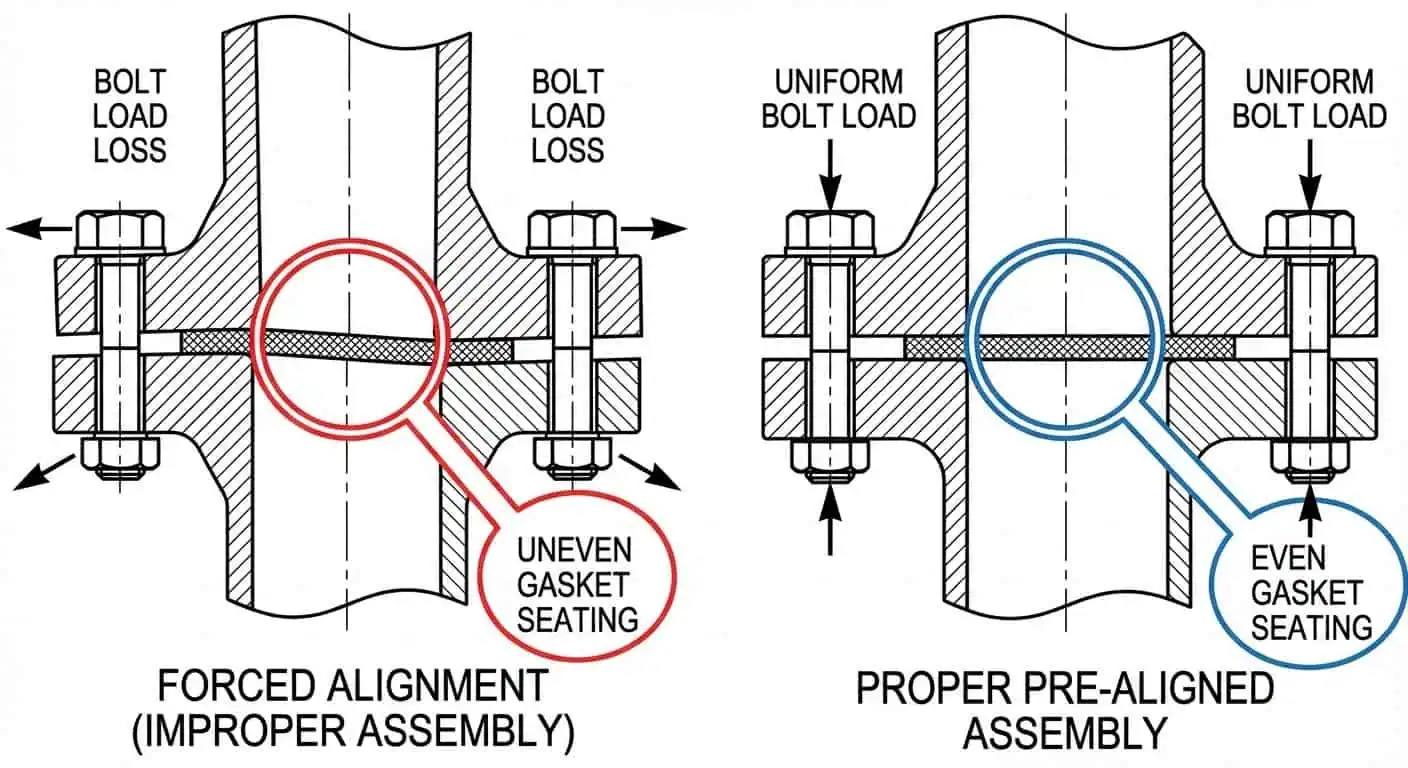
Practical takeaway: If the same flange location leaks repeatedly after multiple gasket replacements, stop blaming the gasket first. Review preload scatter, lubrication control, flange face condition, and alignment before repeating the same repair again.
Why Torque Alone Is Not a Complete Tightening Strategy
Torque Is a Control Method, Not the Goal
Torque is useful because it gives the assembler a controllable way to load the joint. But torque itself is not the sealing target. The real goal is adequate and uniform gasket seating stress, followed by acceptable retained load in service. A terminal tightening procedure that treats torque as the final objective usually ends up missing the real reason the joint leaked.
Large-Diameter Terminal Flanges Are Especially Sensitive to Scatter
Storage terminals commonly use larger flanges on transfer lines, manifolds, pump tie-ins, and tank connections. These joints are less forgiving of uneven loading because the load has to be developed and balanced around a larger circumference with more bolts. The physical size of the flange increases the need for discipline, not just the need for a higher tightening number.
Think in Terms of Joint Integrity, Not Wrench Output
Wrench output is a process variable. Joint integrity is the result. This is why ASME PCC-1 is useful in practice: it treats bolted flange assembly as a controlled procedure, not as a one-step tightening action. In the same way, ASME B16.5 remains relevant because it covers flange pressure-temperature ratings, materials, dimensions, tolerances, marking, and testing, which define the boundary conditions that tightening must work within. If the question at your site is also about sealing-face choice, it is worth reviewing RF vs FF vs RTJ flanges before standardizing one tightening habit across different joint designs.
If the real question at your site is no longer “what torque should we use?” but “why is this joint still not behaving consistently?”, then the problem is already larger than torque alone.
Pre-Assembly Best Practices Before Any Tightening Starts
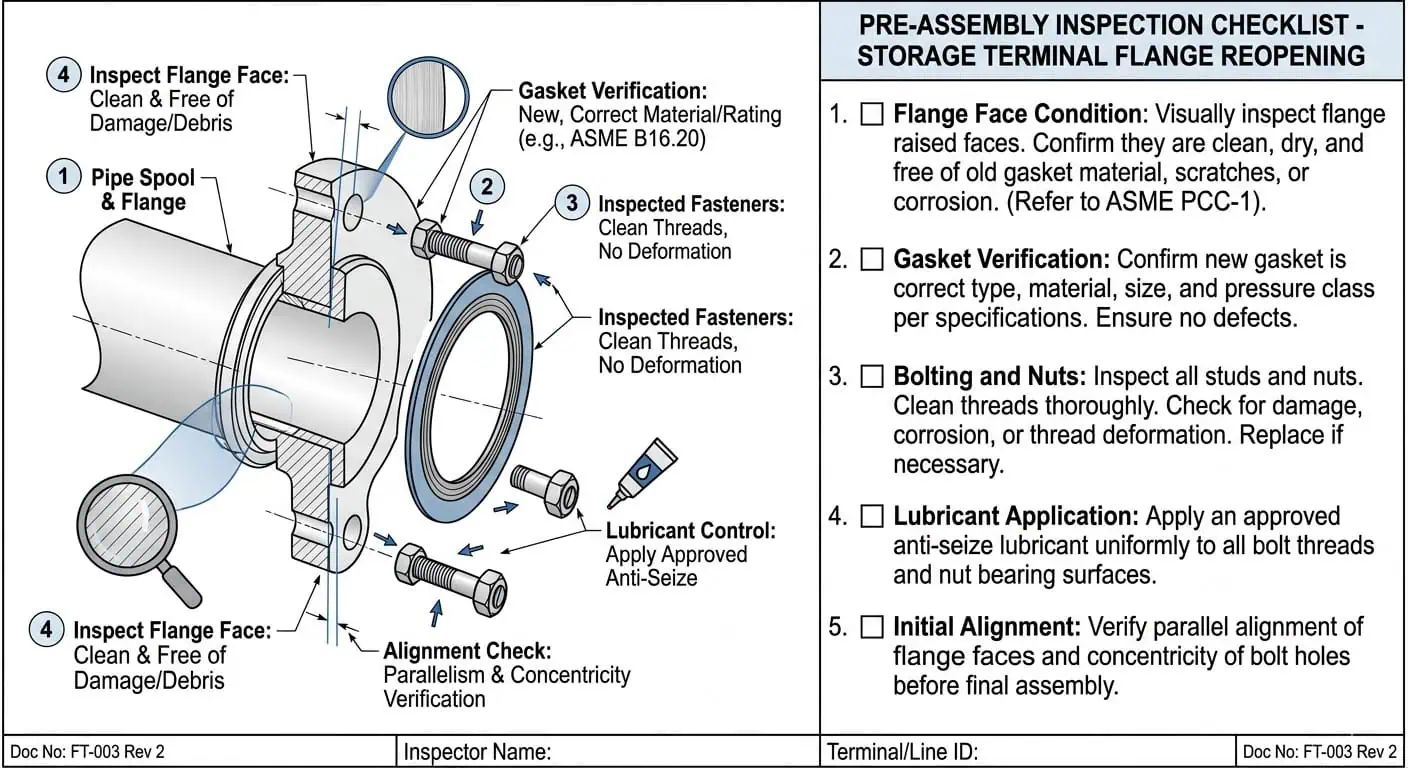
Confirm the Correct Flange, Gasket, and Fastener Combination
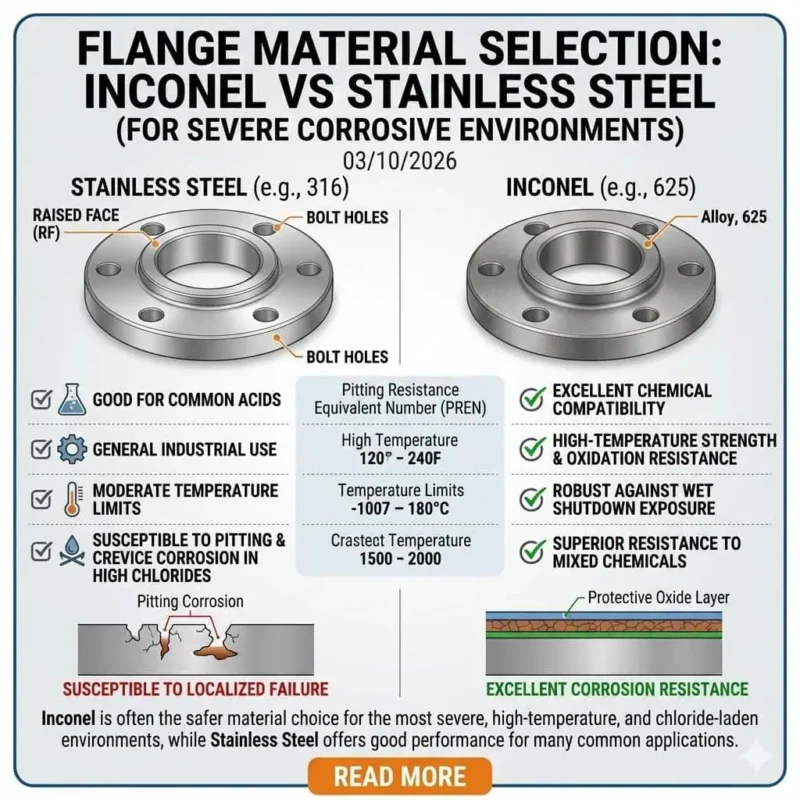
Before any tightening begins, confirm that the flange class, facing, gasket, bolt grade, dimensions, and washer practice all match the intended joint design. A terminal should not rely on “close enough” hardware substitution at the point of assembly. If the flange class or facing is wrong, tightening quality cannot rescue the joint later. If the hardware and service basis still need review, the next upstream reference is usually How to Select Flange Materials for Chemical Processing.
Cleanliness, Face Inspection, and Surface Condition
Flange faces should be clean and free of debris, loose corrosion scale, paint intrusion into the sealing area, embedded material, or visible damage that would affect gasket seating. In practice, poor cleanliness and poor inspection cause more trouble in reopened terminal joints than many teams expect.
Alignment and Gap Check Before Loading the Joint
Do not use bolts to pull a badly aligned joint into place. If the flanges are not reasonably aligned before tightening, part of the bolt load is lost to forced positioning and part of the gasket is over-compressed while another part remains under-loaded. That is a classic setup for repeat seepage.
Verify Bolt and Nut Condition and Control Lubrication
Thread condition, nut condition, washer use, and lubricant type should be checked before bolt-up begins. Terminals that do not standardize this step often end up with one crew producing different bolt loads from another crew even though both claim to use the same tightening value.
Step-by-Step Tightening Best Practices for Terminal Flanges
Use a Controlled Multi-Pass Tightening Sequence
Terminal flange tightening should follow a documented multi-pass method rather than a one-pass approach. The normal logic is a snug pass, one or more intermediate passes, a final pass, and a verification or rotational pass where the written procedure requires it. The purpose is to bring the joint into load gradually and uniformly.
Follow a Cross Pattern, but Do Not Stop There
A cross pattern is a basic requirement, not a complete tightening strategy. The final result also depends on pass count, increment control, flange size, bolt count, and whether the crew follows through with the last verification stage instead of stopping early.
Large Flanges Need More Discipline, Not Just More Force
When crews struggle with larger terminal flanges, the instinct is often to think about higher torque first. That is usually the wrong starting point. Larger flanges need more discipline in sequence, better hardware control, cleaner alignment, and better documentation. More force does not solve poor loading practice.
Record What Matters on Critical Terminal Joints
On critical storage terminal flanges, record more than the final tightening value. Useful records include joint location, flange class and facing, gasket type, fastener grade and size, lubricant used, tightening method, crew or verifier, and whether the joint has a repeat leak history. That turns bolt-up from a memory-based task into a repeatable reliability process.
Storage Terminal Scenarios That Commonly Cause Tightening Failure
Reassembly After Product Changeover or Maintenance
Storage terminal joints are often reopened during changeover, outage work, valve replacement, or skid maintenance. These are exactly the situations where crews work quickly, hardware condition varies, and face damage is missed. The result is a flange that appears properly assembled but fails to remain tight after the system is returned to service.
Outdoor Corrosion and Long Idle Periods
Threads that sat exposed for a long period, nuts that look usable but no longer behave consistently, and joints that were idle through weather exposure can all produce poor tightening repeatability. What matters here is not just visible corrosion. It is the change in friction behavior and retained load behavior when the joint is finally reassembled.
Vibration or Pipe Movement Near Pumps and Valve Clusters
Not every leak that appears after startup is a tightening-only problem. Some joints are assembled correctly but lose retained load because vibration, support issues, or pipe movement disturb the joint after return to service. Tightening quality and retained load stability must be considered together.
Large-Bore Low-Pressure Flanges That Get Underestimated
One of the biggest terminal mistakes is to underestimate large, low-pressure flanges because they are not part of a severe process unit. In reality, large bore, repeated maintenance, hydrocarbon service, and outdoor exposure can create a chronic leak environment if tightening discipline is weak.
Real Engineering Cases and Industry-Type Examples
Case 1 — Repeated Seepage After a Shutdown Return
What the user saw: a terminal flange began to seep lightly after a shutdown return even though the gasket had just been replaced.
What the real cause was: preload scatter was too large because the hardware condition varied, lubrication was inconsistent, and the face inspection had been rushed.
What changed after correction: the joint was rebuilt using a controlled multi-pass procedure, standardized hardware condition review, and better face inspection discipline.
What rule to keep next time: if a leak appears right after return to service, first suspect assembly consistency before suspecting gasket quality alone.
Case 2 — Large Manifold Flange Tightened to Spec, Still Leaked
What the user saw: a large manifold flange leaked even though the tightening value was achieved across the joint.
What the real cause was: the flanges were not well aligned before loading, so bolt load was spent pulling the joint into position and gasket seating became uneven.
What changed after correction: the alignment problem was corrected first, then the flange was reassembled with a controlled sequence.
What rule to keep next time: never use bolts as alignment tools and then expect even gasket stress.
Case 3 — Pump Skid Flange Lost Tightness After Start-Up
What the user saw: the flange held during cold assembly but began leaking after the skid was put back into service.
What the real cause was: the joint lost retained load because movement and vibration near the skid were not considered in the assembly review.
What changed after correction: support condition, alignment, and the flange’s criticality classification were reviewed together instead of treating it as a simple retightening problem.
What rule to keep next time: a joint can be assembled correctly and still fail if service movement is not controlled.
Case 4 — Chronic Leak Point Solved Only After Tightening Became Procedural
What the user saw: the same flange location leaked repeatedly over multiple maintenance cycles.
What the real cause was: different crews used different tightening habits, different lubrication practice, and different decisions about reusing hardware.
What changed after correction: the terminal classified the joint as critical, created a written bolt-up method, and added QA records for future work.
What rule to keep next time: repeat leak points should be treated as process problems in the maintenance system, not as one-off bad-luck events.
How to Build a Terminal-Ready Bolt Tightening Procedure
Define Which Flanges Are Critical
Not all storage terminal flanges need the same level of tightening control. Start by classifying the joints that matter most: tank outlet flanges, first isolation points, manifold switching flanges, pump skid connections, repeat leak history joints, and environmental exposure-sensitive locations. A critical joint list helps terminals apply discipline where it matters most instead of trying to treat every flange the same way.
Standardize Hardware, Lubrication, and Tightening Method
Repeatability comes from standardization. Critical terminal joints should not depend on whichever bolts, nuts, lubricant, and tightening style happen to be available on that shift. Standardize the hardware set, lubrication practice, pass sequence, and acceptance logic if you want different crews to produce the same result.
Add Pre-, In-Process, and Post-Assembly Checks
Terminal tightening procedures should include three stages:
- Pre-assembly: face inspection, alignment check, hardware verification, gasket confirmation, lubrication control
- In-process: sequence control, pass control, crew consistency, abnormal movement observation
- Post-assembly: verification pass, record completion, critical joint tagging, and follow-up inspection logic where required
Train Assemblers, Not Just Supervisors
A written method only works if the people doing the work understand why the method exists. ASME’s PCC-1 bolting assembler learning path explicitly includes inspection and assembly fundamentals, manual tightening concepts, and pre-, in-process, and post-assembly quality assurance. Terminals that want fewer repeat leaks should treat bolting skill as a trainable and auditable competence, not as an informal craft habit.
Practical Checklist for Storage Terminal Flange Tightening
Before Tightening
- Correct flange class and facing confirmed?
- Correct gasket verified?
- Correct bolt, nut, and washer set confirmed?
- Threads clean and condition acceptable?
- Lubrication controlled and consistent?
- Faces clean and inspected?
- Alignment acceptable before loading?
During Tightening
- Multi-pass sequence followed?
- Cross pattern applied correctly?
- Target increments controlled?
- Crew using one method instead of mixed methods?
- Any sign of flange rotation or forced alignment during loading?
After Tightening
- Final pass verified?
- Any abnormal gap or uneven compression?
- Critical joint record completed?
- Reopen history or leak history noted?
- Should this location be flagged for follow-up inspection?
| What the User Sees | Most Likely Root Cause | Best First Review |
|---|---|---|
| Leak after maintenance return | Preload scatter, poor face inspection, inconsistent hardware or lubrication | Review assembly discipline before changing gasket again |
| Large flange leaks even though torque was achieved | Misalignment or uneven gasket seating | Check alignment and joint condition first |
| Pump skid flange loosens after startup | Retained load loss from movement or vibration | Review support, alignment, and service movement |
| Same flange leaks every turnaround | No written critical-joint procedure or no history control | Classify the joint and standardize the bolt-up method |
| One flange behaves differently from similar nearby flanges | Hardware condition or lubrication inconsistency | Check bolt, nut, washer, and lubricant standardization |
| Project Situation | What Good Practice Looks Like | What Usually Goes Wrong | Best First Action |
|---|---|---|---|
| Routine terminal maintenance return | Written bolt-up method, controlled hardware, face inspection, documented passes | Rushed assembly and mixed field habits | Rebuild the joint with one controlled method |
| Large manifold flange | Alignment checked first, disciplined multi-pass tightening, verification pass | Bolts used to force alignment | Correct alignment before retightening |
| Pump skid or moving piping connection | Assembly reviewed together with support and movement | Treating the leak as a torque-only problem | Review retained load risk and support condition |
| Chronic repeat leak location | Critical-joint classification, history tracking, repeatable QA records | Same repair repeated without changing the cause | Escalate the joint into a written reliability procedure |
Bolt tightening best practice for storage terminal flanges is not about torque alone. It is about building uniform, retained gasket seating stress through controlled assembly. Most repeat terminal flange leaks are not random and not purely gasket-related. They usually come from preload scatter, weak assembly discipline, poor hardware control, or unresolved alignment and movement problems.
The practical path is straightforward: identify which terminal flanges are critical, standardize the assembly steps, control hardware and lubrication, and document the tightening method on repeat-risk joints. If your site wants fewer repeat seepage points, treat tightening as a reliability program, not as a wrench task. If the next question is about why a terminal flange keeps leaking even after correct tightening, the most useful next pages are Flange Gasket and Sealing Considerations for Chemical Plants, Tank Farm Piping Connection Best Practices for Flanges and Manifolds, and questions to ask a flange supplier before RFQ.
FAQ
Is reaching the specified torque enough to guarantee a leak-free flange?
No.
Torque is only a control method. The real goal is uniform gasket seating stress and adequate retained load. A flange can reach the target torque and still leak if preload is uneven, friction varies too much, or the joint is misaligned.
Why do storage terminal flanges often leak after maintenance even with a new gasket?
Because many post-maintenance leaks are assembly consistency problems, not simple gasket problems.
Hardware condition, lubrication variation, face damage, preload scatter, and poor alignment can all cause the new gasket to perform poorly even when it is the correct type.
Should reopened flanges be treated differently from never-opened flanges?
Yes.
Reopened flanges have higher variability in thread condition, face condition, gasket handling, and alignment. They should receive more controlled inspection and tighter bolt-up discipline than untouched joints.
What is the most common tightening mistake on large storage terminal flanges?
One of the most common mistakes is assuming that a correct torque value automatically means a correct joint.
Large flanges are especially sensitive to preload scatter, sequence quality, lubrication differences, and alignment problems.
When should a terminal create a written tightening procedure for a flange?
Any flange with high consequence, repeat leak history, large diameter, frequent reopening, or sensitivity to vibration or movement should be treated as a candidate for a written tightening procedure.
Written procedures are especially useful when different crews work on the same joints over time.