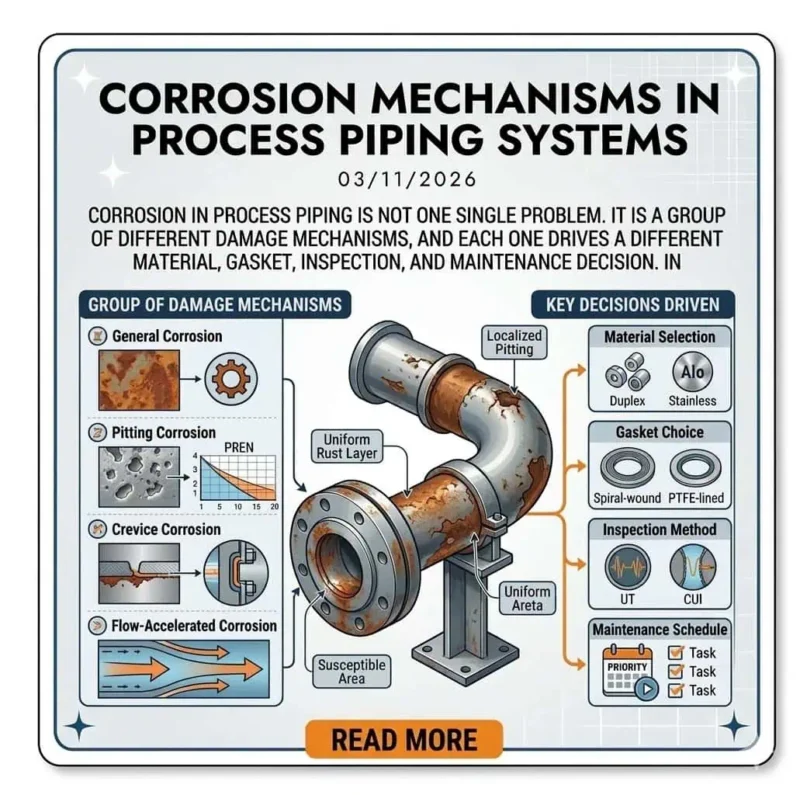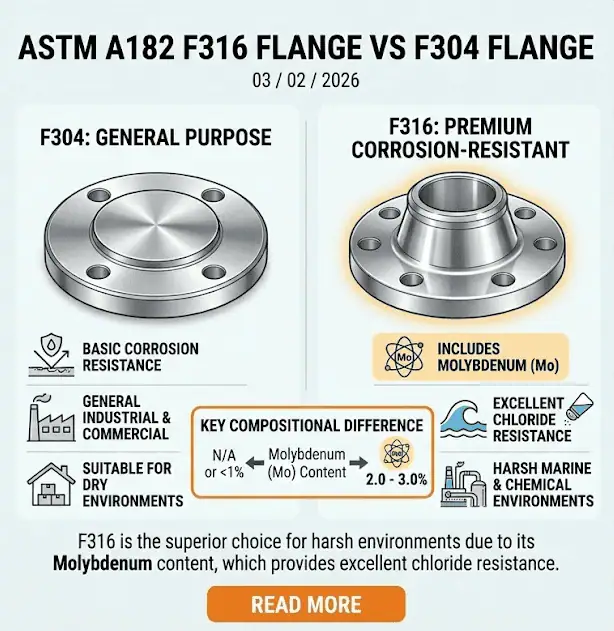
The main difference between ASTM A182 F316 and F304 flanges is that F316 is molybdenum-bearing, which improves pitting and crevice corrosion resistance in chloride-containing service. In practical piping work, the “right” grade depends on the corrosion mechanism (pitting/crevice vs. SCC), chloride level and temperature, surface condition, and whether you have crevices under gaskets/insulation. F316 is widely treated as a marine-grade starting point, but it is not fully resistant to seawater in all conditions—especially where crevices and warm chlorides exist.
What this means for selection: Choose F304 for low-chloride, controlled indoor environments where cost and availability matter. Choose F316 when chlorides, washdown chemicals, coastal exposure, or corrosive process media raise localized corrosion risk. If the service is warm chloride, stagnant seawater, or high-consequence leakage, it can be more realistic to evaluate duplex/super duplex (project-dependent) rather than expecting 316 to be “maintenance-free.”
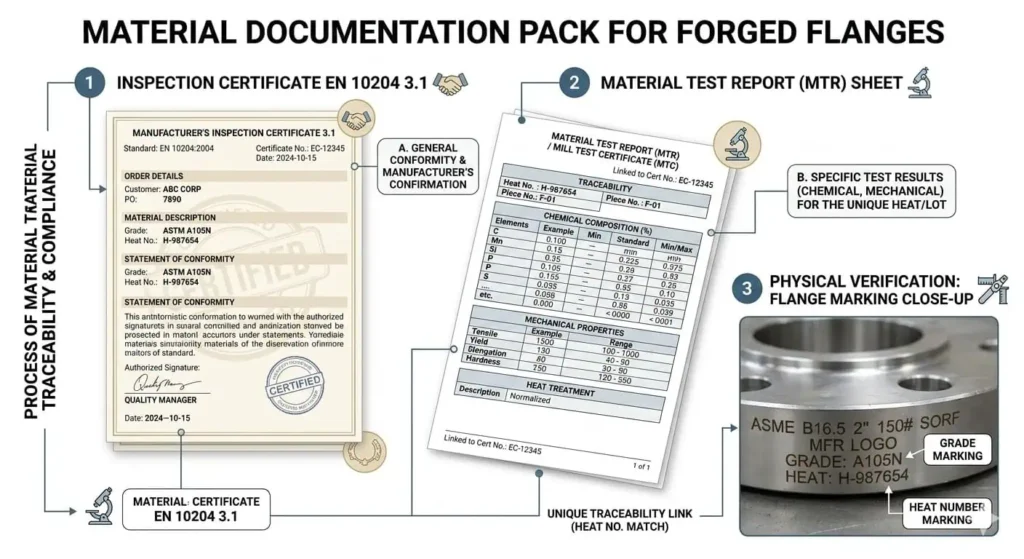
Procurement note (engineering-accurate wording): quality and compliance are proven by documentation and controls, not marketing claims. Common buyer requirements include ISO 9001-certified quality management (supplier system), PED conformity assessment where EU pressure equipment rules apply, and EN 10204 inspection documents such as Type 3.1 for traceability (when specified). Manufacturers and suppliers (including SUNHY where applicable) should support audit-ready packages: clear markings, heat-number traceability, and complete MTR/MTC documentation.
Authoritative references used in engineering practice include ISO 9001 (QMS standard), EU Pressure Equipment Directive (PED 2014/68/EU) scope/requirements, and EN 10204 definitions for inspection documents: ISO 9001 (ISO overview), PED 2014/68/EU (European Commission), EN 10204:2004 (inspection document definitions).
| Documentation / Requirement (Typical) | What It Proves (Engineering Meaning) |
|---|---|
| ISO 9001:2015 (supplier QMS) | Supplier quality system and process controls (not a material grade “certificate”) |
| PED 2014/68/EU (where applicable) | EU conformity assessment framework for pressure equipment & assemblies |
| EN 10204 Type 3.1 (when specified) | Specific inspection results + validation by authorized representative independent of manufacturing |
| Third-party inspection (project-dependent) | Client/witness inspection scope (e.g., ABS/DNV/TÜV or other bodies as contract requires) |
ASTM A182 Flange Differences
Quick Comparison Table
| Property | ASTM A182 F304 | ASTM A182 F316 |
|---|---|---|
| Typical Corrosion Focus | General corrosion resistance in many services; more limited margin in warm chlorides | Improved pitting/crevice resistance in chlorides due to Mo; still not “immune” to seawater crevices |
| Chemistry Key Point | Cr-Ni “18/8” family (Mo-free) | Cr-Ni-Mo family; Mo typically 2–3% in 316-type alloys (project/spec dependent) |
| PRE / Pitting Resistance Indicator (engineering shortcut) | Lower PRE range (often ~18–22 class for 304-type) | Higher PRE range (often ~24–26 class for 316-type) |
| Minimum Yield Strength (room temp, per common A182 summaries) | Typically 30 ksi class (verify by latest A182 + project requirements) | Typically 30 ksi class (verify by latest A182 + project requirements) |
| Chloride Service Reality | More prone to pitting/crevice in warm chloride environments; SCC risk increases with temperature | Better pitting/crevice resistance than 304; SCC can still occur in chloride environments above ~60°C (service-dependent) |
| Typical Applications | Food processing, indoor process piping, general industrial service | Marine/coastal exposure, chemical processing, outdoor installations with chlorides |
Direct Answer: ASTM A182 F316 flanges are molybdenum-bearing, which improves resistance to chloride-driven pitting and crevice corrosion. ASTM A182 F304 flanges are a cost-effective choice when chloride severity is low and the environment is controlled.
Main Distinctions
- F316’s advantage is localized-corrosion margin in chloride-containing service (pitting/crevice), especially where gasket crevices, deposits, or intermittent wetting exist.
- F304 is often chosen for cost and availability when chloride severity is low and cleaning chemicals are controlled.
- Mechanical minimums are often similar at room temperature (selection is usually corrosion-driven, not strength-driven, unless temperature/allowables drive you to H grades or different materials).
- SCC reality matters: austenitic stainless steels (including 304/316 families) can be susceptible to chloride SCC when tensile stress + chlorides + elevated temperature coexist. Grade choice alone does not “remove” SCC risk.
Expert Insight (engineering buyer view):
A procurement mistake that shows up repeatedly in field failure reviews is treating “316 = safe for any marine service.” In real offshore/coastal piping, leaks often originate at crevices under gaskets, insulation, deposits, or poor surface finish. A 30-year buyer/inspector perspective is to (1) define the chloride + temperature envelope, (2) confirm whether crevices/stagnation exist, (3) require EN 10204 3.1 documents (when specified), and (4) evaluate whether duplex (F51/F53) should be considered for severe cases rather than repeatedly repairing 316 joints.
Tip: If you cannot control crevices or warm chlorides, “upgrade” decisions should be based on failure mode (pitting/crevice vs SCC) and lifecycle risk—not on grade popularity.
Stainless Steel Flanges: Chemical Composition
F316 Composition
ASTM A182 F316 corresponds to the molybdenum-bearing 316 stainless family. In engineering guidance, Type 316 is commonly described as having slightly higher nickel than Type 304 and about 2–3% molybdenum, which improves corrosion resistance in chloride environments that tend to cause pitting. For a practical material-selection discussion, use composition as a mechanism indicator: Mo increases pitting/crevice resistance margin.
| Grade (Typical Range) | Chromium (Cr) | Nickel (Ni) | Molybdenum (Mo) |
|---|---|---|---|
| F316 | ~16.0–18.0% | ~10.0–14.0% | ~2.0–3.0% |
Why Mo matters: a common engineering shortcut is PRE (Pitting Resistance Equivalent). PRE increases with Cr and especially Mo; higher PRE usually correlates to higher resistance to pitting in chlorides. Reference formula: PRE = %Cr + 3.3×%Mo + 16×%N (Outokumpu).
F304 Composition
F304 is the standard “18/8” austenitic stainless family and does not contain molybdenum. It performs well in many general industrial environments and is widely used when chloride severity is low and surfaces are clean and well maintained.
| Grade (Typical Range) | Chromium (Cr) | Nickel (Ni) | Molybdenum (Mo) |
|---|---|---|---|
| F304 | ~18.0–20.0% | ~8.0–10.5% | N/A |
Role of Molybdenum
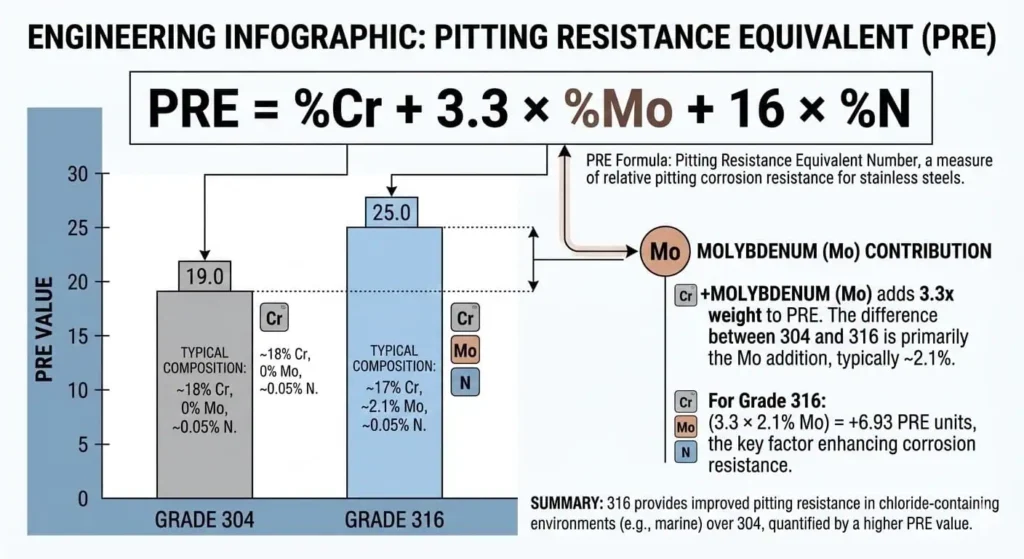
Molybdenum increases resistance to pitting and crevice corrosion in chloride-containing environments. That is why 316-type materials are often selected for coastal exposure, washdown systems, and chemical processing piping where chloride-driven localized corrosion is a realistic failure mode.
Direct Answer: Molybdenum in F316 improves pitting/crevice resistance in chloride-rich service, but it does not eliminate stress corrosion cracking risk when stress + chlorides + elevated temperature are present.
Mechanical Properties of Stainless Flanges
Strength and Hardness
For most buyers comparing F304 vs F316, mechanical properties are usually not the deciding factor. Under many procurement scenarios, minimum room-temperature mechanical requirements for 304/316 families in A182 summaries appear similar (for example, 75 ksi tensile and 30 ksi yield class are commonly cited). The real design control is the governing code allowable stress at design temperature and the pressure-temperature rating of the flange standard used (e.g., ASME B16.5/B16.47), which the piping stress engineer must verify.
- Use MTR/MTC values (heat-specific) for verification, not generic web tables.
- For elevated-temperature pressure-containing applications, projects may specify H grades (e.g., 304H/316H) or different materials depending on allowable stress needs.
Direct Answer: Strength minimums are often similar; selection is commonly corrosion-driven. Final acceptance must follow project specifications, code allowables, and heat-specific test results.
Ductility and Temperature Resistance
Ductility helps flanged joints tolerate vibration and installation loads without brittle failure. Temperature resistance, however, must be framed correctly: oxidation resistance (how the surface scales in hot air) is not the same as pressure-containing capability (code allowables and flange ratings).
Engineering guidance often notes that 304/316 families have good oxidation resistance to high temperatures, but both grades can be susceptible to chloride SCC above about 60°C when stress and chlorides are present. For higher-temperature service where subsequent aqueous corrosion matters, low-carbon “L” grades reduce sensitization risk in weldments, while “H” grades may be used where higher elevated-temperature strength is required (project-dependent).
| Grade Family | Practical Temperature Note (Engineering Context) |
|---|---|
| 304 / 304L / 304H | Good oxidation resistance at high temperature; SCC and pitting risks still depend on chlorides + temperature; 304H may be used for elevated-temperature strength when specified |
| 316 / 316L / 316H | Better pitting/crevice resistance vs 304; still not fully seawater-proof; SCC risk can exist above ~60°C in chloride environments; 316H sometimes used for elevated-temperature strength (project-dependent) |
Tip: If your service includes warm chlorides or frequent washdown with chloride cleaners, treat SCC/pitting as a design input—not an afterthought at commissioning.
Corrosion Resistance in Stainless Flanges
General Corrosion
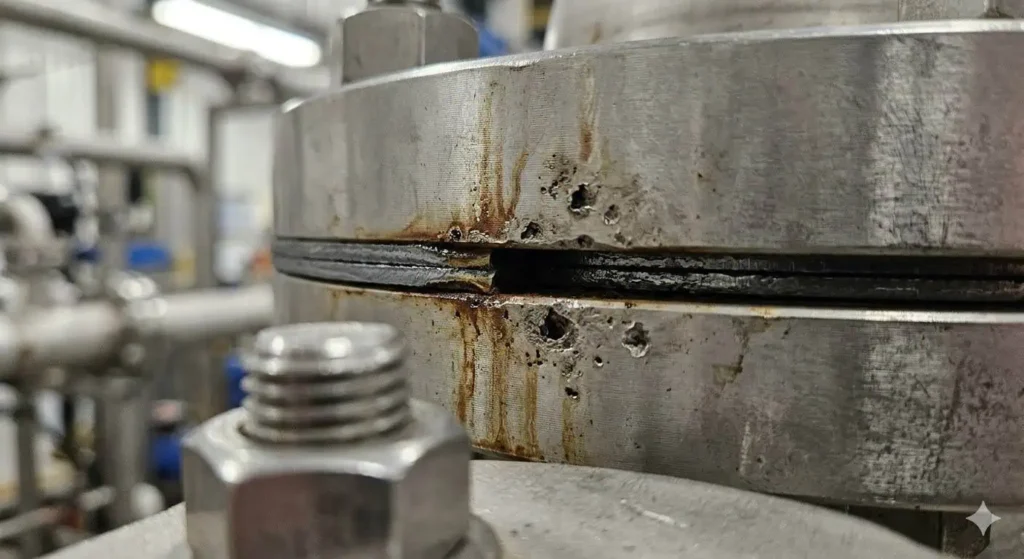
Both F304 and F316 offer strong general corrosion resistance in many industrial environments. The practical separation happens when localized corrosion becomes the governing mechanism: chlorides, deposits, gasket crevices, stagnant zones, or intermittent wetting.
Direct Answer: F316 generally provides better localized-corrosion resistance than F304 in chloride-containing environments because it is Mo-bearing.
The following table gives a field-useable way to think about chloride exposure. These are typical engineering guidance values and are highly dependent on temperature, oxygen content, flow, crevices, and surface finish. Always verify with your corrosion engineer and project specification.
| Material | Typical Pitting/SCC Guidance (Service-Dependent) |
|---|---|
| 304 family | Often cited as resistant to pitting in potable water up to ~200 mg/L chlorides at ambient temperatures, dropping as temperature rises; chloride SCC risk increases above ~60°C when stress + chlorides coexist |
| 316 family | Often cited as resistant to pitting in potable water up to ~1000 mg/L chlorides at ambient temperatures (lower at higher temperature); still not fully resistant to seawater; crevices and warm chlorides can produce staining/pitting and leak recurrence |
Engineering takeaway: If you have gasket crevices + warm chlorides, your flange grade choice is only part of the control plan. You also need surface finish control, crevice management, gasket selection, and inspection strategy.
Chloride and Marine Environments
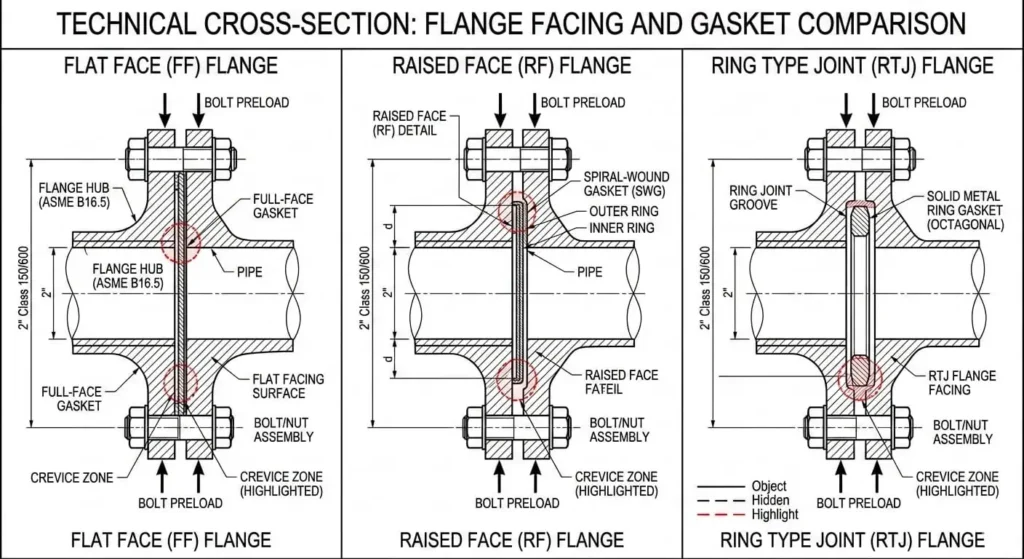
Chloride-rich and marine environments drive many real flange failures because they combine deposits, intermittent wetting, crevices, and temperature variation. F316 improves pitting and crevice resistance versus F304, but 316 can still show corrosion/staining in many marine environments, particularly at crevices or rough surfaces. If the line is warm, stagnant, or high consequence, evaluate higher-alloy options under project rules (often duplex/super duplex in offshore practice).
Direct Answer: F316 is usually the first upgrade choice for coastal and chloride exposure, but it is not a “guarantee.” In harsh marine service, selection should be based on the governing mechanism and lifecycle risk, not grade label.
The table below highlights performance drivers and selection risks:
| Material | What It Improves | What Can Still Fail (Common) | Where It’s Commonly Used |
|---|---|---|---|
| F316 | Higher resistance to pitting/crevice corrosion in chloride environments (Mo-bearing) | Crevice corrosion under gaskets/deposits; staining in marine exposure; SCC risk above ~60°C under stress + chlorides | Coastal, outdoor piping, chemical processing, offshore topsides (project-dependent) |
| F304 | Good general corrosion resistance; economical and widely available | Pitting/crevice in warm chlorides; SCC risk above ~60°C under stress + chlorides | Indoor/controlled environments, food & beverage (low chloride), general industrial |
- Use F316 when your credible failure mode is pitting/crevice in chlorides.
- Do not assume “316 = seawater-proof.” For severe marine service, confirm corrosion mechanism and consider duplex/super duplex where specified.
Field note: Many “316 marine” leaks start at crevices (gasket interfaces, deposits, under insulation), not on open, well-flushed surfaces.
Stainless Flange Applications
F304 Typical Uses
F304 stainless flanges serve a wide range of industries. Engineers select this grade for its balance of performance, fabrication ease, and cost. F304 is typically appropriate for general industrial applications where chloride severity is low and the environment is controlled. Common uses include:
- Indoor process piping with controlled water chemistry
- Food & beverage lines where chloride cleaners are controlled and passivation practices are maintained
- General chemical handling where chlorides are not the governing risk driver
- Utility and HVAC service where corrosion exposure is moderate
This grade offers reliable performance when the service envelope is understood and crevices/deposits are controlled.
F316 Typical Uses
F316 stainless flanges provide improved localized-corrosion resistance. F316 is commonly selected for environments exposed to chlorides, aggressive chemicals, or outdoor marine/coastal conditions. Typical industries and reasons include:
| Industry | Common Driver |
|---|---|
| Chemical Processing | Pitting/crevice resistance margin in chloride-containing or chemical environments |
| Marine / Coastal | Improved chloride resistance vs 304 (still verify seawater/crevice severity) |
| Food-Grade (washdown) | Better margin under frequent wetting/cleaning where chlorides may be present |
| Pharmaceutical / High cleanliness | Corrosion resistance and cleanability under defined cleaning regimes |
| Offshore topsides | Outdoor exposure + maintenance access constraints (project-dependent) |
F316 supports integrity in demanding settings when selection is aligned to the governing corrosion mechanism and joint design details.
Industry Examples
Below are field-style examples written in an RCA-friendly format. They reflect common failure modes seen in piping work; exact outcomes depend on temperature, chloride level, flow, surface finish, gasket crevices, and maintenance practices.
| Case | What Happened | Likely Root Cause | Corrective / Preventive Action |
|---|---|---|---|
| Coastal utility water line | Recurring brown staining and seepage at flange after rain/sea spray periods | Crevice corrosion at gasket interface + deposits + insufficient surface finish control | Upgrade 304→316, improve surface finish + cleaning, select gasket to reduce crevice/deposit retention, add inspection triggers |
| Washdown food plant | Pitting under gasket after repeated CIP/cleaning cycles | Chloride cleaners + warm environment + crevice under gasket; passivation not maintained | Upgrade to 316 for chloride margin, control cleaning chemistry, restore/passivate surfaces, tighten gasket material/installation control |
| Warm chloride process service | Leak recurrence despite “316 marine grade” flanges | Warm chlorides + crevices + possibly SCC risk under residual/assembly stress | Evaluate duplex option (project-dependent), reduce crevices, control stress, verify environment and inspection plan |
Tip: If a leak repeats after “material upgrade,” do not assume the metal grade was the only variable. Check crevice geometry, surface finish, gasket selection, bolt preload, deposits, and temperature-chloride synergy.
Selection Guidance for ASTM A182 Flanges
When to Choose F304
Engineers often select ASTM A182 F304 flanges for general industrial systems where chloride severity is low and exposure conditions are controlled. F304 can be a solid choice for indoor process piping, sanitary systems with controlled cleaners, and many general industrial services.
Choose F304 when:
- The environment has low chloride exposure and limited deposit/crevice risk.
- Cost efficiency and broad availability matter (large projects, standard service).
- Inspection access is good and maintenance practices control deposits and surface condition.
Common flange types and their recommended uses include:
| Flange Type | Recommended Application Areas |
|---|---|
| Weld Neck Flange | Higher-pressure / higher-temperature piping where fatigue and integrity matter |
| Slip-On Flange | Lower-pressure utilities where alignment and cost are priorities (project-dependent) |
| Socket Weld Flange | Small-bore lines where leak-tightness is critical and welding quality is controlled |
| Threaded Flange | Limited use; avoid vibration/cyclic service where loosening risk exists |
| Blind Flange | Isolation, hydrotest, and maintenance access points |
| Lap Joint Flange | Frequent dismantling/cleaning service (selected with stub-end strategy) |
Direct Answer: Select ASTM A182 F304 flanges for reliable, cost-effective performance when chloride-driven localized corrosion is not the governing risk.
When to Choose F316
ASTM A182 F316 flanges provide enhanced localized corrosion resistance in chloride-rich or chemically aggressive environments because the grade is molybdenum-bearing. F316 is commonly used for outdoor/coastal exposure, chemical processing piping, and washdown systems where pitting and crevice corrosion risk is credible.
Choose F316 when:
- The system faces high chloride exposure (coastal/marine, washdown, brackish water, chloride-bearing process media).
- The application includes frequent wetting, deposits, or gasket crevices that can concentrate chlorides.
- Long-term durability and reduced leak recurrence justify the higher material cost.
With proper joint design and maintenance, 316-family flanges can perform for long periods in demanding environments—but they are not “set-and-forget” in warm seawater or severe crevice service.
Direct Answer: Use ASTM A182 F316 flanges when chloride-driven pitting/crevice corrosion is a credible failure mode and lifecycle risk is higher than the incremental material cost.
Cost and Compliance Factors
Cost and compliance are real constraints in B2B procurement, but they should be managed with engineering controls. The most practical approach is to set a service envelope (chlorides + temperature + crevice risk + consequence), then specify the grade and documentation package that fits the risk.
| Flange Grade | Cost | Corrosion Resistance Margin | Suitable Applications (Typical) |
|---|---|---|---|
| F316 | Higher | Higher margin in chlorides (pitting/crevice) | Chemical processing, coastal/outdoor, washdown, offshore topsides (project-dependent) |
| F304 | Lower | Good general resistance; lower margin in warm chlorides | General industrial, indoor controlled environments, low-chloride service |
Tip: Avoid treating ISO/PED/EN10204 as “marketing checkboxes.” Define what documents you need (MTR/MTC, EN 10204 type, traceability scope, third-party inspection) and tie them to acceptance criteria and project audits.
Key engineering criteria for selection:
- Pressure and temperature ratings (verify by design code and flange rating standard)
- Material compatibility with process fluids and cleaning chemistry
- Chloride level + temperature + crevice/deposit risk (governing corrosion mechanism)
What buyers should add (high-value checklist):
| Buyer Check | Why It Prevents Failure |
|---|---|
| Confirm grade on PO + flange markings | Prevents wrong-grade substitution and mixed heats |
| Require EN 10204 3.1 (when specified) | Ensures heat-specific test results and traceability validation |
| Define surface finish and cleaning/passivation expectations | Reduces crevice/pitting initiation at gasket interfaces |
| Specify gasket strategy for chloride service | Controls crevice/deposit retention and leak recurrence |
F304 flanges suit general, low-chloride environments. F316 flanges improve chloride pitting/crevice resistance for coastal/marine and aggressive chemical conditions, but 316 is not fully seawater-proof and SCC can still occur depending on temperature and stress state.
- F316 provides better localized corrosion resistance margin in chlorides than F304, primarily due to molybdenum.
- If the service is warm chloride or high consequence and crevices cannot be controlled, consider evaluating duplex/super duplex under project specifications.
| Documentation Type (Typical) | Example Scope |
|---|---|
| Certificate / Traceability Package | EN 10204 3.1 inspection certificate, heat number traceability, MTR/MTC, dimensional inspection records, third-party witness (as required), PED file (where applicable) |
For project-specific selection, consult SUNHY or qualified engineers. In critical service, the most reliable approach is specification-driven selection + traceable documentation + disciplined installation and inspection.
FAQ
What is the main difference between ASTM A182 F316 and F304 flanges?
F316 is molybdenum-bearing, which improves pitting and crevice corrosion resistance in chloride-containing service. F304 is a cost-effective choice for general industrial environments when chlorides are not the governing risk driver.
Which flange grade should engineers select for marine applications?
F316 is often the minimum starting point for coastal and marine exposure, because it provides better localized corrosion resistance than F304. However, 316 is not fully resistant to seawater in all conditions—crevices, deposits, and warm chlorides can still cause corrosion. For severe service, evaluate duplex/super duplex under project specifications.
Are both F304 and F316 flanges compliant with international standards?
Compliance depends on what standard you mean and what the supplier documents. The material can be supplied to ASTM A182 (grade F304/F316), the flange dimensions/ratings may follow ASME/EN standards per the project, and quality/traceability is proven through MTR/MTC and EN 10204 inspection documents (when specified). PED conformity applies only where EU rules are in scope and a conformity assessment is required.
How do buyers verify the quality of stainless steel flanges?
- Request EN 10204 Type 3.1 inspection certificate (when specified) and confirm heat-number traceability
- Confirm material grade and test results on the MTR/MTC match the purchase order and project specification
- Verify markings, dimensional inspection records, and any required third-party witness/inspection scope
What factors influence the cost of F316 and F304 flanges?
| Flange Grade | Cost | Corrosion Resistance |
|---|---|---|
| F304 | Lower | Good general resistance; lower margin in warm chlorides |
| F316 | Higher | Better pitting/crevice resistance in chlorides; still service-dependent |
Material chemistry (Mo-bearing vs Mo-free), corrosion risk, documentation scope (EN 10204 type), inspection requirements, and project compliance obligations are the primary cost drivers—not just the flange grade name.
References
- ASTM International: ASTM A182 Standard Specification for forged or rolled alloy and stainless steel flanges (project verification should follow the latest applicable edition).
- ISO: ISO 9001 overview (ISO).
- European Commission: Pressure Equipment Directive (PED) 2014/68/EU.
- EN 10204 definitions: EN 10204:2004 inspection documents (Type 3.1 / 3.2 definitions).
- Materials guidance (chlorides, SCC, heat resistance): World Stainless / Atlas grade sheets (304/316 practical guidance).
- Selection guidance (316 vs 304, Mo effect): Nickel Institute — Design Guidelines for Selection and Use of Stainless Steels.