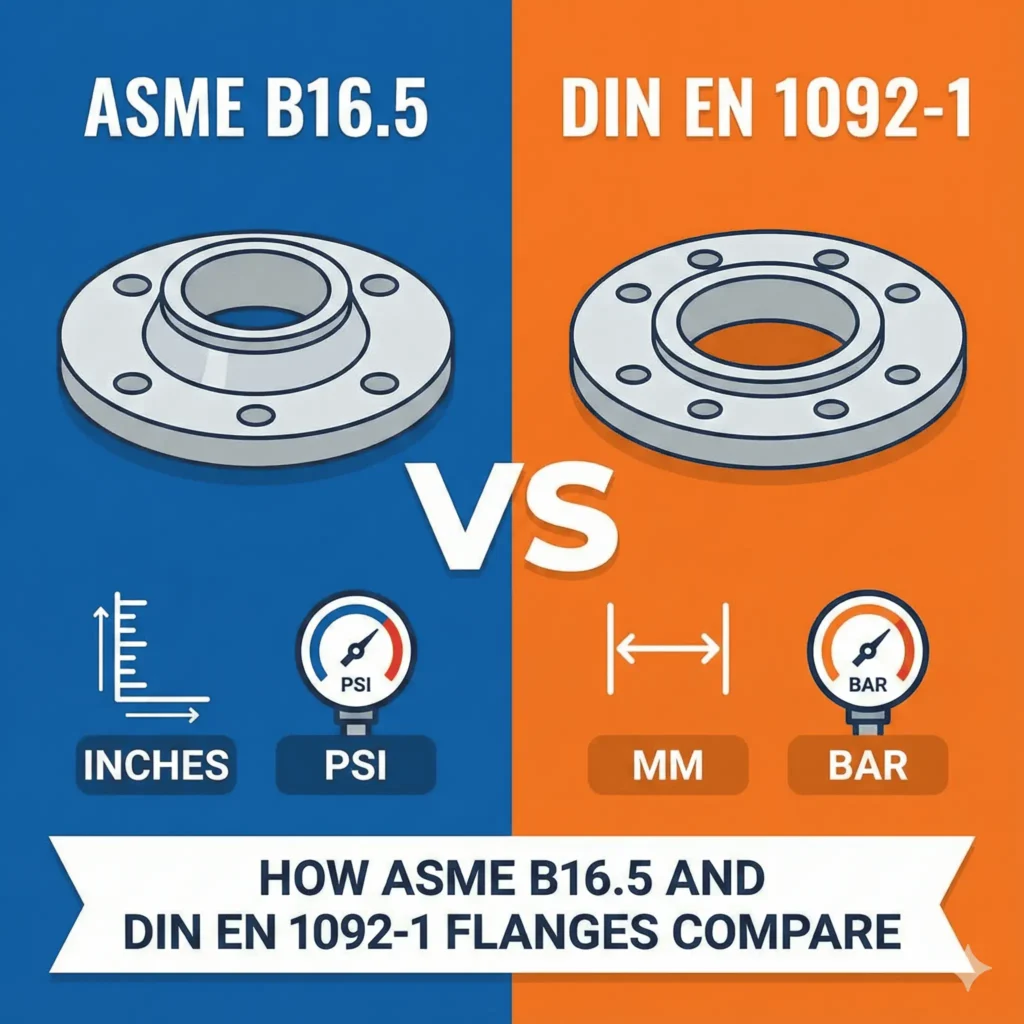
In industrial piping, mixing ASME B16.5 with DIN EN 1092-1 is not a “small typo”—it is a bolt-up risk that can stop commissioning. Both standards define flange dimensions, facing, drilling, and pressure-temperature limits, but they follow different engineering systems: ASME (NPS / Class / inch-based) vs. EN (DN / PN / metric-based). Choosing correctly protects safety, schedule, and total lifecycle cost.
- Procurement reality: “DN100” and “4-inch” are not interchangeable purchase specs unless you also lock the standard + drilling pattern.
- Common failure mode: Bolt circle mismatch causes field rework, wrong studs, and repeated gasket damage during attempted assembly.
- Best practice: Always specify Standard + Size + Rating + Facing/Form + Material + Bore on the PO and drawing.
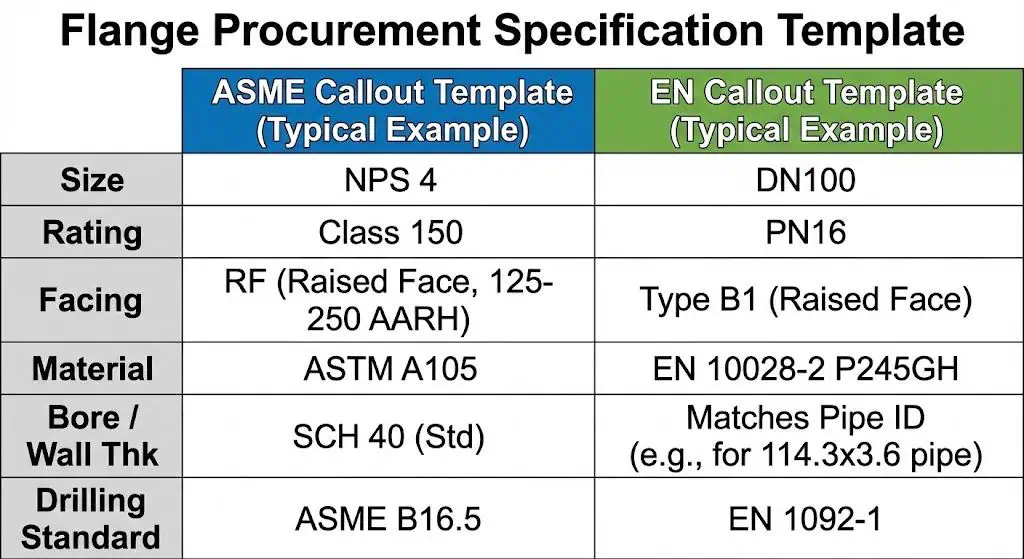
Sunhy manufactures stainless steel flanges to both systems on request. The key is to keep the project specification “unambiguous” so the shop machines the correct drilling, facing, and thickness for your standard family.
| Standard | Core Definition |
|---|---|
| ASME B16.5 | Pipe flanges and flanged fittings using NPS sizing, Class pressure ratings, and defined facings/drilling (commonly used up to NPS 24). |
| DIN EN 1092-1 | Circular steel flanges using DN sizing and PN designations, with EN face “Forms” and metric drilling (covers a wider DN range than B16.5). |
ASME B16.5 vs DIN EN 1092-1: Detailed Overview
Key Technical Differences
The real differences are the rating system, the drilling pattern, and the dimensional “philosophy.”
You will notice that ASME B16.5 is typically specified in inches and uses Class ratings, while EN 1092-1 is specified in millimetres and uses PN designations. The safest way to compare is to check: (1) bolt circle, (2) number/size of bolt holes, (3) facing type, (4) pressure-temperature table for the actual material.
| Aspect | ASME B16.5 (USA) | DIN EN 1092-1 (Europe) |
|---|---|---|
| Pressure Rating System | Class (e.g., Class 150, 300, 600) with pressure-temperature ratings by material group. | PN (e.g., PN10, PN16, PN40) with limits depending on material and temperature. |
| Size System | NPS (nominal, inch-based naming; dimensions are standardized, not “free”). | DN (nominal, metric naming; drilling and dimensions standardized by PN series). |
| Flange Face Types | RF (Raised Face), RTJ (Ring Type Joint), FF (Flat Face), plus other ASME facings. | Form A (Flat), Form B (Raised), plus tongue/groove and male/female style forms. |
| Drilling / Bolt Pattern | ASME bolt circles and bolt holes are defined per NPS + Class. Many sizes use inch-based bolt circles. | EN bolt circles and bolt holes are defined per DN + PN. Metric bolt circles commonly differ from ASME. |
| Material Specification System | ASTM / ASME material grades (e.g., A105, A182 F316L). | EN material numbers (e.g., 1.4307, 1.4404) and EN product standards. |
| Interchangeability | Not directly interchangeable with EN drilling/facing in most cases; adapters may be required. | Interchangeable within EN/DIN flange families when the same DN/PN and form are specified. |
- Pressure ratings are not “simple conversions”: Class and PN may look similar at room temperature, but both standards require pressure-temperature checks for the actual material.
- Threads are different: EN threaded flanges commonly use ISO metric threads, while many ASME threaded systems use NPT conventions.
- Fastener planning changes: bolt quantity, bolt diameter, and stud length choices change with drilling patterns and facing heights.
Expert Tip:
Never order “4-inch flanges” without adding the standard and rating. Write it like: “ASME B16.5 NPS 4 Class 150 RF” or “EN 1092-1 DN100 PN16 Form B1”. This one line prevents most cross-standard bolt-up failures.
Main Similarities
Despite dimensional differences, both standards aim for safe, repeatable, leak-tight joints.
- Common flange types exist in both systems: Weld neck, slip-on/plate style, blind, threaded, lap joint/loose styles.
- Both require pressure-temperature discipline: rating depends on material and operating temperature, not “nameplate only.”
- Traceability mindset: projects typically expect heat numbers, MTC/MTR documentation, and dimensional inspection records.
Deep Dive: ASME B16.5
Scope and Use
ASME B16.5 is widely used in North American process industries and many global EPC specifications. It standardises dimensions, tolerances, facings, drilling, and pressure-temperature ratings by material group. For larger sizes above the B16.5 range, projects typically move to ASME B16.47.
ASME B16.5 Flange Types
ASME defines flanges primarily by how they connect to pipe and how they manage stress. Here is the full breakdown of common types you will encounter:
| Flange Type | Description & Best Use |
|---|---|
| Welding Neck (WN) | Butt-welded hub flange; preferred for high-pressure/high-temperature and cyclic loading. |
| Slip On (SO) | Easy alignment, welded fillets; common in utilities where fatigue is not critical. |
| Blind (BL) | Closes a line or nozzle; useful for pressure testing and future expansion. |
| Threaded (THD) | Easy alignment, welded fillets are common in utilities where fatigue is not critical. |
| Socket Welding (SW) | Small-bore, high-pressure services; sensitive to fit-up and weld quality. |
| Lap Joint (LJ) | Used with stub ends; allows rotation for easier bolt alignment and frequent dismantling. |
| Long Weld Neck (LWN) | Used when welding is restricted; thread standard must be specified to avoid a mismatch. |
Note:
Assembly quality matters as much as flange type. Many projects reference bolted-joint assembly guidance (torque, tightening pattern, gasket handling) such as ASME PCC-1.
Deep Dive: DIN EN 1092-1
Scope and Use
DIN EN 1092-1 is the European flange standard for circular steel flanges. It is built around DN (nominal diameter) and PN (pressure designation) with metric drilling and EN face forms. In EU projects, flange choice is often tied to regulatory compliance, such as the Pressure Equipment Directive (PED) and the project’s harmonised standards list.
DIN EN 1092-1 Flange Types (The “Type” System)
EN uses a numerical “Type” system rather than English names. This reduces language ambiguity across suppliers. Common types include:
- Type 01: Plate flange for welding (flat/plate style).
- Type 02: Loose plate flange with weld-on collar.
- Type 04: Loose plate flange with weld-neck collar.
- Type 05: Blind flange.
- Type 11: Welding neck flange (process piping workhorse).
- Type 12: Hubbed slip-on flange for welding.
- Type 13: Threaded hub flange (thread standard must be specified).
- Type 21: Integral flange (application-specific).
| EN Type | ASME Equivalent (Functional) | Key Reminder |
|---|---|---|
| Type 01 | Plate / slip-on family | Function may match, but drilling and thickness usually differ by standard. |
| Type 05 | Blind Flange | Same function; dimensions/bolt pattern differ. |
| Type 11 | Weld Neck | Do not assume “DN100 = NPS 4” bolt-up; verify bolt circle and bore. |
| Type 13 | Threaded | Metric vs NPT conventions can cause fit failures if unspecified. |
Pressure Ratings: Class vs. PN
ASME B16.5 Pressure Classes (Temperature Dependent)
ASME uses “Classes”, and the allowable pressure drops as temperature rises. Below is a commonly referenced pressure-temperature example table for carbon steel (illustrative values):
| Pressure Class | Ambient (100°F / 38°C) | 400°F (200°C) | 600°F (315°C) | 800°F (425°C) |
|---|---|---|---|---|
| Class 150 | 285 psig | 200 psig | 140 psig | 80 psig |
| Class 300 | 740 psig | 635 psig | 550 psig | 410 psig |
| Class 400 | 990 psig | 845 psig | 730 psig | 550 psig |
| Class 600 | 1480 psig | 1270 psig | 1095 psig | 825 psig |
| Class 900 | 2220 psig | 1900 psig | 1640 psig | 1235 psig |
| Class 1500 | 3705 psig | 3170 psig | 2735 psig | 2055 psig |
| Class 2500 | 6170 psig | 5280 psig | 4560 psig | 3430 psig |
Expert Note:
Temperature is a “silent derating factor.” If you compare Class vs PN, compare them at the same operating temperature and for the same material group.
EN 1092-1 PN Ratings
EN 1092-1 uses PN (Pressure Nominal) as a designation system, not a universal “guaranteed working pressure” for all temperatures. The allowable pressure depends on flange material and operating temperature, so you must verify against the EN pressure-temperature tables for the selected steel grade.
| PN Rating | Reference Pressure at 20°C (Bar) | Equivalent PSI (Approx) |
|---|---|---|
| PN 2.5 | 2.5 | 36 psi |
| PN 6 | 6 | 87 psi |
| PN 10 | 10 | 145 psi |
| PN 16 | 16 | 232 psi |
| PN 25 | 25 | 362 psi |
| PN 40 | 40 | 580 psi |
| PN 63 | 63 | 913 psi |
| PN 100 | 100 | 1450 psi |
| PN 160 | 160 | 2320 psi |
| PN 250 | 250 | 3625 psi |
| PN 400 | 400 | 5800 psi |
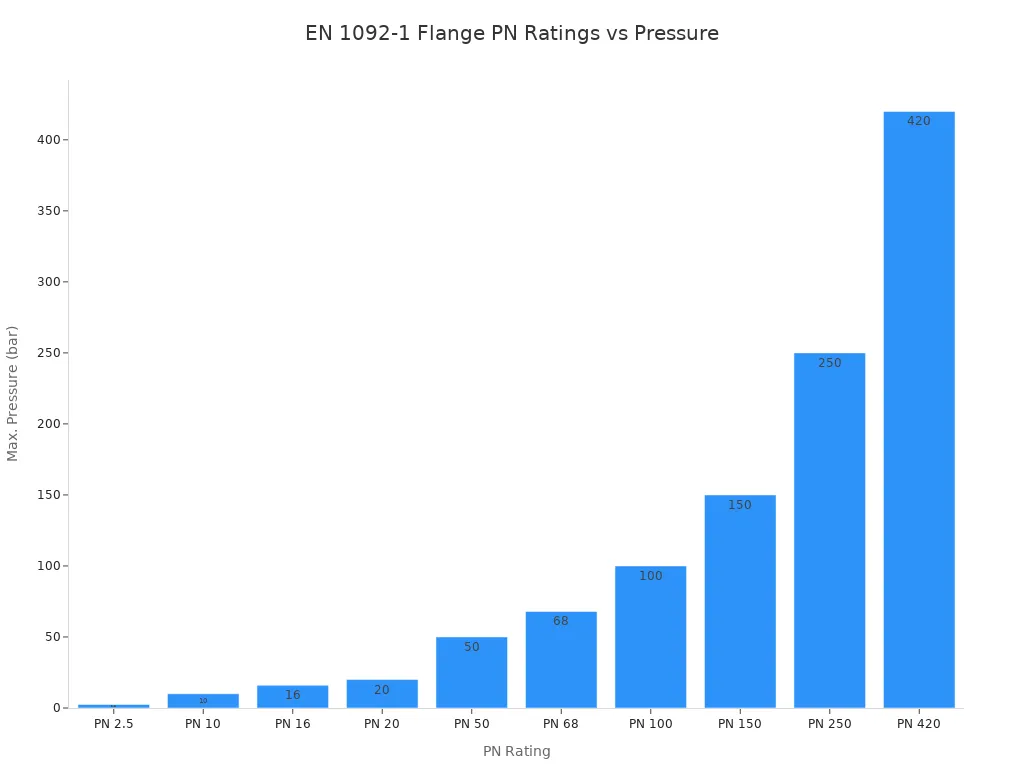
Practical Comparison (Rule-of-Thumb Only):
- PN 16 is often compared to Class 150 at ambient conditions (verify at temperature).
- PN 40 is often compared to Class 300 at ambient conditions (verify at temperature).
- PN 100 is often compared to Class 600 at ambient conditions (verify at temperature).
Flange Face Types and Sealing
ASME B16.5 Face Types
The face type dictates the gasket style, seating stress, and assembly sensitivity. Common face types include:
| Face Type | Sealing Principle | Advantages | Limitations | Applications |
|---|---|---|---|---|
| RF (Raised Face) | Concentrates bolt force on a smaller gasket area. | Widely available gaskets; easy sourcing. | More sensitive to surface finish and bolt load control. | Oil, gas, chemical, utilities (typical Class 150–600). |
| RTJ (Ring Type Joint) | Metal ring seats into a machined groove (metal-to-metal). | Handles very high pressure/vibration when assembled correctly. | Higher machining cost; requires controlled tightening; the ring is often single-use. | High-pressure offshore, steam, critical services. |
| FF (Flat Face) | Higher machining cost; requires controlled tightening; ring is often single-use. | Helps protect brittle mating flanges (e.g., cast iron). | Lower sealing stress; not for high-pressure services. | Water treatment, cast iron equipment, FRP systems. |
| TG (Tongue and Groove) | Enclosed gasket; tongue locates into the groove. | Good alignment; gasket protected from blowout/erosion. | Requires matched pairs; tighter machining control. | Toxic/flammable media, special services. |
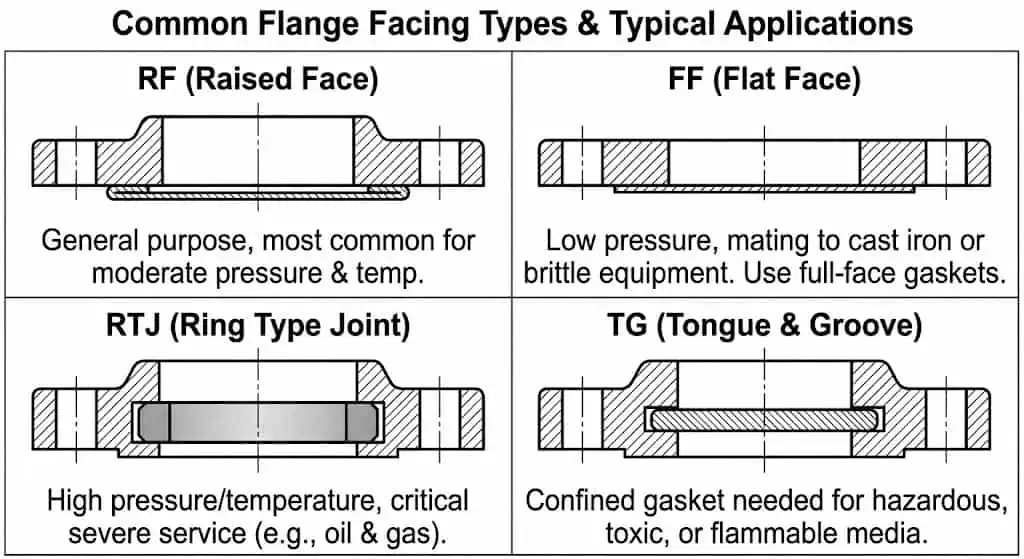
EN 1092-1 Face Types
EN uses a “Form” system for faces:
- Form A: Flat Face (comparable to ASME FF).
- Form B: Raised Face (comparable to ASME RF). Note: Form B1 vs B2 may differ by finish/requirements depending on project spec.
- Form C/D: Tongue and Groove.
- Form E/F: Spigot and Recess (Male/Female style).
Dimensions and Tolerances
B16.5 Dimensional Standards (Imperial)
ASME B16.5 covers standard flange dimensions for many projects. For larger diameters, engineering specs typically reference ASME B16.47 instead of “guessing” a B16.5 pattern.
- NPS (Nominal Pipe Size): A standardised naming system—do not treat it as a measured OD.
- Bolt circle & holes: Defined by NPS + Class; do not assume EN drilling will match.
- Field lesson: if bolt circle differs, assembly fails even when “DN and NPS look equivalent.”
EN 1092-1 Dimensions (Metric)
EN 1092-1 is based on the DN and PN series with metric drilling. It is common in EU industrial plants, water, marine, and many international EPC packages that adopt EN standards.
| Feature | ASME B16.5 | EN Flange |
|---|---|---|
| Nominal Diameter | NPS ½ – NPS 24 | DN 10 – DN 2000+ (project dependent) |
| Pressure Rating | Class 150 – Class 2500 | PN 2.5 – PN 400 |
| Units | Inches | Millimeters |

Critical Warning:
Mixing ASME and EN flanges often leads to bolt circle misalignment. Example: DN100 PN16 commonly uses a 180 mm bolt circle, while NPS 4 Class 150 commonly uses a 190.5 mm bolt circle. They will not bolt up without an adapter or redesign.
Material Specifications
ASME B16.5 Materials
ASME projects commonly specify ASTM/ASME forging grades and require MTC/MTR traceability for audits and turnaround work.
- Forgings: ASTM A105 (carbon steel), ASTM A182 F304L/F316L (stainless steel).
- Engineering reminder: “Similar performance” is not the same as “equivalent chemistry.” Match the project material spec and verify by MTC and PMI where required.
EN 1092-1 Materials
EN projects commonly specify EN material numbers and require documentation aligned to PED where applicable.
| Material | ASME Standard (Common) | EN Equivalent (Common Reference) |
|---|---|---|
| Carbon Steel | ASTM A105 | P245GH (1.0352) (verify by project spec) |
| Stainless 304L | ASTM A182 F304L | 1.4307 |
| Stainless 316L | ASTM A182 F316L | 1.4404 |
Sunhy supports full traceability (heat number linkage) and can provide PMI/spectrometer verification when the project QA plan calls for it. For buyers, the fastest risk-reducer is to request the MTC format you need before mass production.
Selection Guide: Which One Do I Need?
Decision Matrix
Use this guide to select the correct standard family for your project—then lock the full callout on the PO.
| Scenario | Go with ASME B16.5 | Go with DIN EN 1092-1 |
|---|---|---|
| Region / Spec Owner | North America EPC specs, many oil & gas/process specs using ASME families | EU-based plants, EN standard packages, many water/marine and PED-driven projects |
| Rating System | Class-based pressure-temperature checks by ASME material groups | PN designation with EN pressure-temperature checks by EN steel grade |
| Supplier / QA | ASTM/ASME MTC + dimensional inspection to ASME drilling/facing | EN material numbers + PED/EN documentation when required |
Regional and Compliance Factors
Compliance often drives the final decision more than “preference.” If the equipment is placed on the EU market, PED obligations may apply depending on fluid group, pressure, and volume.
- ASME route: Often selected when the piping class and project standard are written around ASME B16 / ASTM grades.
- EN route: Common when the project documentation package is built around EN standards and PED compliance expectations.
Expert Advice:
Don’t guess. Check the P&ID and the piping class/spec sheet. The standard family (ASME vs EN) and the facing/drilling will be defined there.
FAQ
What is the main difference between ASME B16.5 and DIN EN 1092-1 flanges?
ASME B16.5 uses NPS + Class (inch-based naming), while DIN EN 1092-1 uses DN + PN (metric naming). Their drilling and dimensions are often different, so they are generally not bolt-up compatible.
Can you use ASME and EN flanges together?
Usually no. Even if the “pressure level” seems similar, bolt circle diameter, hole count, and facing form often differ. If you must connect systems, you typically need an adapter flange or a designed transition spool.
What happens above 24 inches for ASME flanges?
Many projects use ASME B16.5 patterns up to NPS 24. For larger sizes, specifications typically switch to ASME B16.47 (large diameter steel flanges) rather than forcing non-standard drilling.
What is the difference between ASME B16.47 Series A and Series B?
Series A is generally heavier and follows a different drilling philosophy, while Series B is generally lighter. They are not interchangeable unless the project specifically designs them to match.
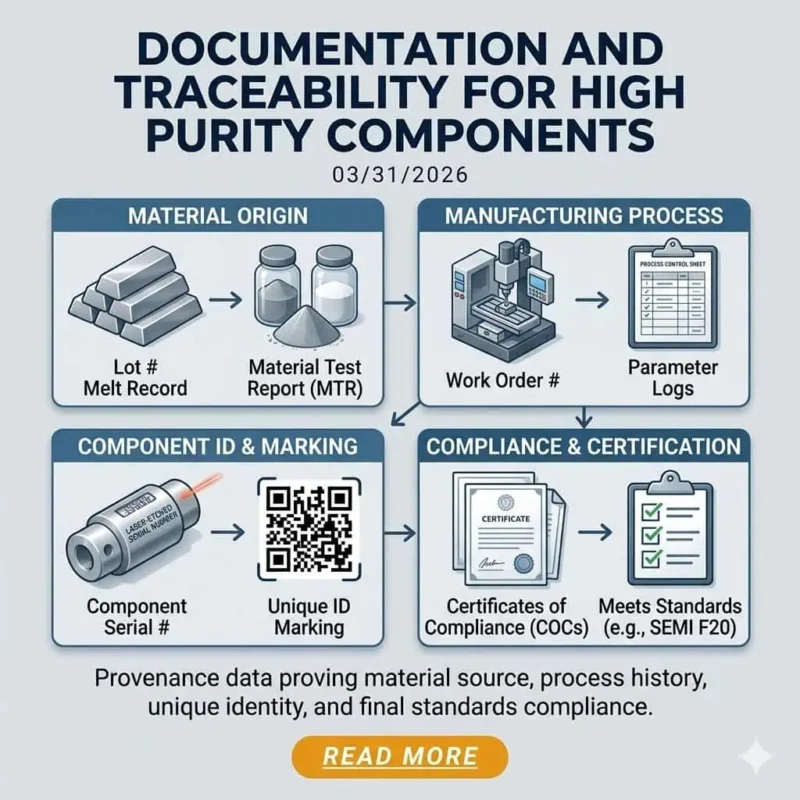
Why does material traceability matter for flanges?
Material traceability links the flange to the heat number and MTC requirements, supporting safety audits and ensuring it meets the chemical and mechanical requirements of the specified ASME or EN grade.