316L stainless steel for ultra high purity applications is usually selected because it offers a workable balance of corrosion resistance, weldability, availability in tubing, plate, bar, and forgings, and a long qualification history in high purity fluid distribution systems. But in real UHP service, the alloy name alone is never the full answer. A correct 316L callout does not automatically prove suitable metallurgy, acceptable wetted surface condition, reliable GTA weld performance, low particle risk, or proper post-fabrication cleaning and passivation. If the system is truly contamination-sensitive, the engineering decision has to connect material form, surface basis, weld method, passivation status, packaging, traceability, receiving inspection, and release criteria. That is why experienced teams do not buy “316L SS” as a vague material label. They specify 316L in the context of the actual service, the component form, the finish requirement, the fabrication route, and the acceptance rules that will decide whether the part can enter a UHP line without creating contamination, rework, or startup delay.
The most common failure is not choosing the wrong alloy family. It is assuming that “316L” already covers everything that matters. In actual projects, the problems usually start later: mixed heats, weak metallurgical cleanliness, underdefined finish requirements, poor weld purge, incomplete cleaning records, damaged end caps, or receiving teams that verify dimensions and paperwork but not the actual delivery condition of the wetted surfaces.
For UHP work, 316L is usually the starting point, not the release decision.
Why 316L Stainless Steel Is Used in Ultra High Purity Applications
316L Offers a Proven Base Material for Welded UHP Systems
316L remains common in ultra high purity applications because it supports welded stainless distribution systems with a long engineering track record.
For many UHP gas and liquid systems, 316L is practical because it is widely available in tubing and component forms, supports GTA autogenous butt welding, and fits project teams that need a stainless wetted path with known fabrication and inspection methods. In semiconductor-style systems, this is one reason SEMI F20 matters: it does not treat 316L as a casual alloy label. Its scope directly covers 316L bar, forgings, extruded shapes, plate, and tubing used in general purpose, high purity, and ultra high purity semiconductor manufacturing applications.
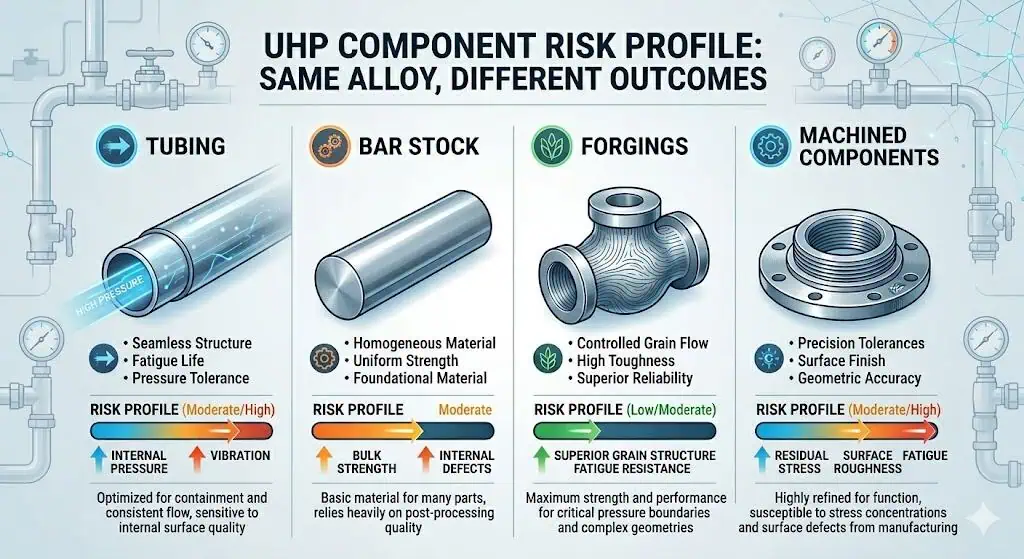
That matters to buyers and QA teams because a tubing decision is not the same as a bar or forging decision. The metallurgy discussion changes when the component is machined from bar stock, formed from plate, or welded from tubing. If the PO only says “316L stainless steel,” the supplier may still meet the alloy callout while leaving too much uncertainty about product form, cleanliness basis, and release suitability.
| Why 316L Is Common in UHP Systems | What It Helps With | What It Does Not Prove by Itself |
|---|---|---|
| Good weldability | Supports GTA autogenous butt welds and permanent stainless runs | That weld purge, heat tint control, and weld acceptance are adequate |
| Wide product availability | Available in tubing, plate, bar, and forgings | That every product form has equal metallurgical cleanliness |
| Established qualification history | Fits many semiconductor and high purity fluid systems | That the delivered part is clean, passivated, and ready for UHP release |
| Corrosion resistance | Supports many clean gas and liquid services | That the alloy is automatically correct for every chemistry or maintenance condition |
For related mechanical connection categories, you can review industrial pipe fittings, butt weld fittings, and socket weld fittings when comparing how connection family and fabrication route affect the final wetted path.
Practical rule: In UHP service, “316L” should be read as a controlled material system decision, not a shorthand for purity.
316L Is Useful Only When the Product Form and Surface Basis Are Also Controlled
The reason 316L works in UHP systems is not only chemistry. It is chemistry plus product form, wetted surface condition, weld quality, and post-fabrication control.
A common engineering mistake is assuming that any 316L component is equally appropriate for ultra high purity service. That is not how real project risk behaves. Straight tubing, machined valve bodies, forged fittings, manifolds, and complex internal components create different contamination and release concerns. SEMI F19 matters here because it exists specifically to address the surface condition of wetted stainless surfaces rather than leaving the conversation at generic material naming.
A typical field issue occurs when the delivered component has the correct alloy and size, but the internal wetted condition, handling history, or cleanliness basis is not strong enough for the line where it will be installed.
| Component Form | Main UHP Concern | What Buyers Often Miss |
|---|---|---|
| Tubing | Weldability, end protection, surface basis, traceability | Assuming capped tube ends guarantee acceptable delivery condition |
| Bar stock for machined parts | Material basis, machinability-related residue, wetted finish control | Assuming machined 316L automatically matches tube-based UHP expectations |
| Forgings | Material cleanliness, internal quality, machining and passivation after forming | Accepting the alloy callout without matching finish and cleaning requirements |
| Weld fittings | Internal geometry, prep condition, weld compatibility, packaging | Focusing on OD/ID and ignoring post-fabrication wetted condition |
When 316L Stainless Steel Is the Right Choice and When It Is Not Enough
316L is often the right material direction for ultra high purity applications, but it is not enough by itself when the service is highly contamination-sensitive.
Use 316L when the system needs a proven stainless wetted path, strong weldability, and a material family that fits existing UHP fabrication practice. This usually applies to permanent stainless distribution runs, high purity gas panel work, UHP tubing systems, and components that will be qualified through semiconductor-style material, surface, and weld control logic.
Do not stop at “316L” when the application demands tighter control of surface condition, passivation, packaging, or weld release. A low roughness target does not prove good metallurgical cleanliness. A correct heat number does not prove the part was cleaned well after fabrication. A completed weld does not prove the local wetted surface is acceptable for release.

| Situation | Recommended Direction | Reason |
|---|---|---|
| Permanent UHP stainless tubing run | 316L with controlled surface basis and GTA weld procedure | Material plus weld and finish control support repeatable release |
| Machined UHP component from bar or forging | 316L only if product form and post-machining cleanliness are defined | Bar or forging quality is not identical to finished tubing quality |
| PO only states “316L SS for UHP” | Not enough | Too vague for QA, receiving, and supplier accountability |
| System is hard to clean after installation | Tighten surface, weld, cleaning, and packaging requirements | Recovery cost is higher after the line is built |
| Buyer compares suppliers on alloy name only | Avoid | Surface, welding, passivation, and documents decide real performance |
If the line is truly UHP, the real approval question is not “Is it 316L?” but “Is this 316L component controlled strongly enough for this service?”
What to Check Before Approving 316L Stainless Steel for Ultra High Purity Use
You should approve 316L for ultra high purity applications only after checking product form, metallurgical basis, wetted surface condition, cleaning or passivation status, weld route, packaging, and traceability.
In practice, engineers and buyers often over-focus on one variable. Some only verify alloy chemistry. Some only verify roughness. Some only verify the supplier certificate. A stronger review connects the actual UHP service to the delivered part, the fabrication process, and the release method.
If the package mixes tubing systems and smaller forged connections, it helps to separate tube fitting types from code-style fittings early, then compare butt weld, socket weld, and threaded fitting strategies before freezing the class. That prevents a common mistake where the connection family is chosen for layout convenience even though it changes dead volume, inspection difficulty, contamination risk, and maintenance behavior.
| Approval Factor | What to Confirm | Why It Matters |
|---|---|---|
| Product form | Tubing, plate, bar, forging, or machined component | Product form changes the material and fabrication risk discussion |
| Material basis | Defined 316L basis, traceability, and supporting documents | Prevents generic alloy substitutions and weak receiving control |
| Wetted surface condition | Specified finish basis and acceptance method | Prevents “polished appearance” from replacing controlled acceptance |
| Cleaning / passivation | What was done, when, and how it is documented | Post-fabrication surface condition can control corrosion and contamination behavior |
| Weld route | GTA procedure, purge method, weld acceptance basis | Welds often become the highest-risk local surface in a UHP run |
| Packaging and delivery condition | End protection, bagging, lot separation, visible condition | A good component can become unacceptable before installation |
A useful internal reference such as this material grades guide can help reviewers keep the discussion tied to actual ordered forms and documentation instead of generic stainless terminology.
Note: In UHP systems, the delivered condition of the 316L part matters just as much as the base alloy statement on the certificate.
Which Standards Actually Matter for 316L Stainless Steel in UHP Applications
The most useful standards are the ones that change what the engineer writes, what the supplier delivers, and what QA accepts.
For general piping framework, ASME B31.3 matters because it covers process piping in semiconductor plants and related facilities and addresses materials, components, design, fabrication, examination, inspection, and testing. It is the base piping framework, but it does not replace UHP-specific material, surface, and weld controls.
For the 316L material basis itself, SEMI F20 matters because it directly covers 316L bar, forgings, extruded shapes, plate, and tubing for general purpose, high purity, and ultra high purity semiconductor manufacturing applications. For wetted surface condition, SEMI F19 matters because it gives the buyer and QA team a real surface-condition basis instead of vague finish wording.
For cleaning and passivation logic, ASTM A380 and ASTM A967 matter because UHP performance depends on more than alloy and finish. A380 covers cleaning, descaling, pickling, and passivation of new stainless parts, equipment, and systems, while A967 covers chemical passivation treatments for stainless steel parts and includes alternative tests with acceptance criteria to confirm effectiveness. For GTA fabrication, SEMI F78 and SEMI F81 matter because weld quality in UHP service affects purity and local surface condition, not only mechanical completion.

| Standard | Why It Matters Here |
|---|---|
| ASME B31.3 | Provides the process piping framework for material, fabrication, inspection, and testing |
| SEMI F20 | Supports 316L material basis decisions for general purpose, HP, and UHP semiconductor applications |
| SEMI F19 | Supports wetted surface condition decisions for stainless UHP components |
| ASTM A380 / A967 | Support cleaning, descaling, passivation, and related acceptance logic |
| SEMI F78 / F81 | Support GTA welding practice and visual weld acceptance where weld quality affects purity |
You should not turn this page into a standard list. The standard matters only when it changes specification, purchasing, fabrication, or release decisions.
Practical takeaway: If the PO says 316L for UHP service but says nothing about product form, surface basis, passivation, weld acceptance, packaging, or traceability, the UHP requirement is still underdefined.
Procurement and Receiving Checklist for 316L Stainless Steel in UHP Systems
What to Specify Before You Buy
Most procurement problems start with the phrase “316L SS for UHP” being treated as a complete specification.
That wording is too weak. A stronger purchase package states the service, the 316L product form, the wetted surface basis, cleaning or passivation status where required, weld-related requirements where applicable, packaging and end protection, traceability, and the required document set. If your team needs a practical cross-check for document review, a guide on how to interpret a material certificate helps buyers and inspectors match the material statement to what was actually ordered.
| Item to Specify | Why It Matters |
|---|---|
| Service and contamination sensitivity | Defines how strict the UHP controls must be |
| 316L product form | Bar, forging, plate, and tubing are not interchangeable quality discussions |
| Wetted surface basis | Prevents “smooth finish” from replacing a controlled acceptance basis |
| Cleaning / passivation status | Clarifies whether post-fabrication treatment is required and documented |
| Weld basis where applicable | Stops field welding from becoming an uncontrolled release point |
| Packaging and end protection | Protects the delivered surface from avoidable damage and contamination |
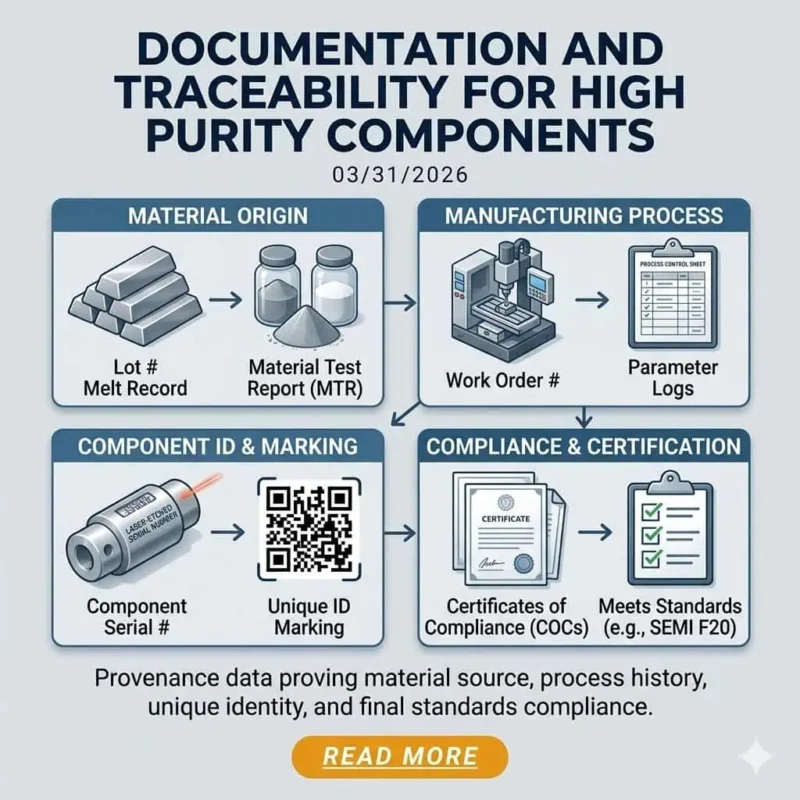
| Traceability and documents | Supports receiving inspection and later root-cause work |
As a practical procurement rule, write the PO so a receiving inspector can decide whether the delivered part is acceptable without guessing what “UHP-grade 316L” was supposed to mean.
Receiving Inspection and Release Checks
Receiving inspection for 316L UHP components is not only a warehouse step. It is a contamination-control step.
Before installation, verify packaging condition, end protection, part identification, lot traceability, certificate match, and whether the delivered part still meets the ordered material and surface basis. A typical receiving mistake happens when the alloy and size look correct, but the bag is torn, the tube ends are exposed, or the heat / lot traceability is incomplete. For teams that depend on fast incoming identification, reading markings and traceability is a useful support page.

- Check caps, bags, and visible delivery condition before opening protection.
- Verify heat number, lot number, part number, and product form.
- Confirm CoC, MTR where required, and any ordered finish or passivation basis.
- Inspect visible wetted openings, tube ends, and sealing areas for damage or contamination.
- Hold any part with inconsistent identification, broken protection, or unclear documents.
- Do not release a part to field use only because the alloy statement appears correct.
If the receiving process cannot distinguish between a correct 316L material statement and a release-ready UHP component, the QA process is still too weak.
Common Failure Modes and Composite Field Scenarios for 316L in UHP Applications
Most failures do not come from 316L being the wrong stainless family. They come from the project treating the alloy name as the main control point.
| Observed Problem | Immediate Cause | Real System Cause | Corrective Action |
|---|---|---|---|
| Particle excursion after startup | Residual contamination in wetted surfaces or weld areas | Team controlled alloy and roughness, but not weld cleanliness or release readiness | Isolate suspect sections, inspect, re-clean, and requalify before restart |
| Passivated on paper, questioned in QA review | Weak or unclear process records | Passivation was specified loosely instead of as a controlled process | Review records, reprocess if needed, tighten procurement wording |
| Repeat issues after maintenance | Handling damage or poor reassembly | UHP discipline stopped at factory delivery and did not continue into field practice | Replace affected interfaces and strengthen maintenance handling controls |
| Correct 316L on paper, but receiving hold | Packaging damage or mixed traceability | Procurement language was too weak on delivery condition | Quarantine batch and resolve packaging / document gap |
Composite field scenario for engineering training: A UHP gas branch was built from approved 316L tubing and fittings, and the material paperwork looked correct. After startup, particle counts increased. The immediate problem was contamination inside the new branch. The deeper cause was that the project treated 316L material approval as the main milestone and did not connect weld purge quality, post-fabrication cleanliness, and field release into one acceptance package. The correction was to isolate the branch, inspect suspect welds, re-clean the affected line, and requalify before release. The prevention was to write material, wetted surface basis, weld acceptance, packaging, and release criteria into one controlled QA path.
Composite field scenario for engineering training: A batch of 316L UHP components passed dimensional receiving checks but was later held because traceability and packaging condition were inconsistent. The immediate issue was not alloy or size. The real system cause was weak procurement wording that specified 316L but did not clearly define delivery condition, identification, and incoming acceptance logic. The correction was to quarantine the batch and reconcile the documents. The prevention was to make packaging integrity, lot traceability, and document match part of the standard receiving checklist.
How to Reduce Risk When Using 316L Stainless Steel in UHP Applications
You reduce UHP risk by managing 316L as a controlled system decision from procurement to release, not as a generic material shortcut.
Key Actions That Actually Reduce Rework
- Specify the 316L product form clearly. Do not let tubing, bar, plate, and forging discussions blur together.
- Separate alloy approval from wetted surface approval. The correct material does not prove the correct delivered surface condition.
- Treat welds as purity features. Do not leave GTA weld acceptance in a fabrication-only bucket.
- Control cleaning and passivation explicitly. Do not use “cleaned” or “passivated” as vague supplier adjectives.
- Define packaging and end protection as part of quality. A good UHP component can be made unusable before installation.
- Release the system on documents plus condition. Paperwork should support, not replace, physical acceptance.
Tip: The easiest 316L part to buy is not always the easiest 316L part to release into a UHP line.
| Key Findings | Description |
|---|---|
| 316L is a starting point | The alloy family is useful, but it does not define the whole UHP decision |
| Product form matters | Tubing, bar, plate, and forgings change the procurement and QA discussion |
| Welds matter | Weld quality and purge quality can control the dirtiest local surface in a UHP line |
| Receiving matters | Packaging, traceability, and delivery condition are part of UHP control |
| Release must be connected | Procurement, fabrication, receiving, and installation should not be treated as isolated quality steps |
Good engineering judgment keeps the system stable after handover. A correct 316L callout is valuable only when the delivered part is also traceable, properly finished, correctly cleaned, and truly suitable for the ultra high purity service it will see.
FAQ
Is 316L stainless steel enough by itself for ultra high purity applications?
No.
316L is often the right material direction, but UHP performance also depends on product form, wetted surface condition, cleaning, passivation, weld quality, packaging, and receiving control.
Why is SEMI F20 important for 316L UHP applications?
Because SEMI F20 does not treat 316L as a generic alloy label.
It covers 316L bar, forgings, extruded shapes, plate, and tubing used in general purpose, high purity, and ultra high purity semiconductor manufacturing applications, which makes it useful for procurement and QA decisions.
Does electropolishing or a low roughness value automatically make 316L UHP-ready?
No.
A lower roughness target may help, but it does not prove the part is clean, passivated, or weld-acceptable. Wetted surface condition, cleanliness, and fabrication control still need their own acceptance basis.
Which standards matter most when buying 316L for UHP use?
ASME B31.3 matters as the piping framework. SEMI F20 matters for the 316L material basis, SEMI F19 for wetted surface condition, SEMI F78 and F81 for GTA weld practice and acceptance, and ASTM A380 and A967 for cleaning and passivation logic.
What is the most common buyer mistake?
Writing “316L SS for UHP service” as if that alone defines what will be delivered.
Without product form, surface basis, cleaning or passivation status, packaging, and traceability requirements, incoming inspection becomes subjective.
| Situation | Recommendation |
|---|---|
| Correct 316L chemistry but weak delivery protection | Hold for review before installation |
| Good paperwork but unclear wetted surface basis | Clarify acceptance basis before release |
| UHP weld completed but not clearly accepted | Review weld inspection and release records before startup |