






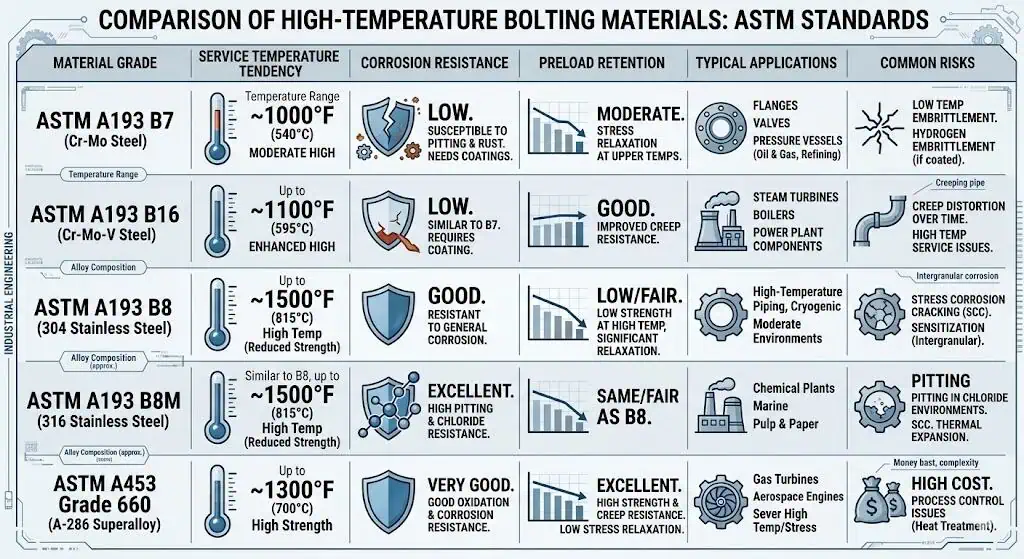
High temperature bolt material selection should be based on actual metal temperature, joint type, environment, and preload retention requirements—not just on room-temperature strength or whatever stud bolts are already in the warehouse. For flanges, valves, and pressure vessels, the right bolting material has to do more than meet a tensile number on paper. It has to keep clamp load after heating, stay compatible with the matching nut grade, resist the real operating and shutdown environment, and support a controlled assembly method that can be repeated in the field. That is why experienced engineers do not treat ASTM A193 B7, B16, B8, B8M, and ASTM A453 Grade 660 as interchangeable. The practical question is not “Which stud is strongest?” It is “Which bolting system will still seal after thermal cycling, maintenance handling, and real plant exposure?” This page compares the common materials, shows where each one fits, and highlights the purchasing, QA, and field mistakes that lead to leakage, galling, or avoidable hot rework.
If you are reviewing the full joint rather than the stud alone, see our related pages on stainless steel flanges, flange standards, and ASME B16.5 dimensions and ratings.
Quick Selection Snapshot
| Service Condition | Typical Starting Point | What Usually Controls the Decision | What Commonly Goes Wrong |
|---|---|---|---|
| General hot pressure-boundary service on steel flanges and valves | ASTM A193 B7 | Availability, familiarity, adequate performance in many standard hot services | Used by default even when long-term hot preload retention becomes the real issue |
| Higher sustained temperature or more demanding hot flange service | ASTM A193 B16 | Better elevated-temperature review than routine B7 practice | Specified too late, after purchasing has already bought B7 kits |
| Corrosive hot service where stainless bolting is required | ASTM A193 B8 or B8M | Corrosion resistance, cleanliness, and material compatibility with equipment | Stainless selected for corrosion only, without checking galling, hot strength behavior, or shutdown corrosion risk |
| High temperature service near austenitic stainless equipment where expansion behavior matters | ASTM A453 Grade 660 | High-temperature bolting with expansion characteristics comparable to austenitic stainless steels | Used as a drop-in substitute without checking project specification, nut compatibility, or availability |
| Low-temperature stock left over from another project | Do not assume suitability | ASTM A320 is a low-temperature bolting specification, not a default hot-service replacement | Wrong stock substituted because the diameter and thread fit physically |
What Controls High Temperature Bolt Material Selection
Start with design metal temperature, not ambient temperature
The first engineering mistake is to select bolting by line description instead of by the actual temperature seen by the stud, nut, and flange hub. A steam line, heater nozzle, hot oil flange, valve bonnet, or turbine-related joint can expose the bolting to temperatures very different from the bulk fluid temperature. Insulation gaps, radiant heat, startup upset conditions, and cyclic operation all change what the bolting really sees. A common field problem is that a joint passes hydrotest and cold alignment checks, then begins to relax or seep only after the metal has stayed hot for a full operating cycle. That is usually not a “torque problem.” It is a service-definition problem that started before the bolting grade was ordered.
Good selection starts with these questions:
- What is the normal operating metal temperature at the joint?
- What upset, startup, and shutdown temperatures can the bolting see?
- Is the service steady, cyclic, or frequently retightened?
- Is the joint sealing a pressure boundary or only supporting equipment?
Check environment during operation and during shutdown
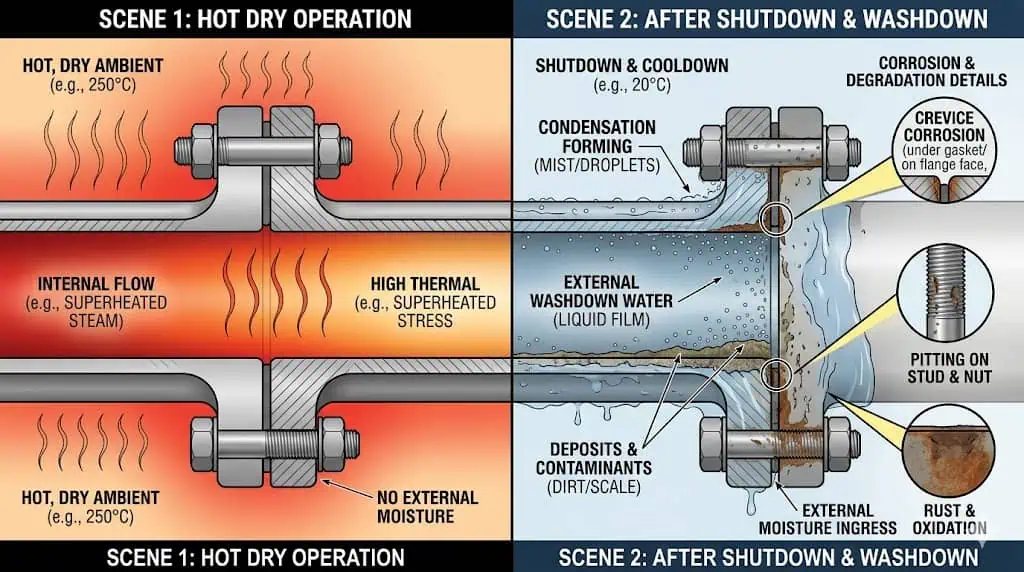
Many bolting failures are driven by the shutdown environment, not the running condition. During operation, a hot dry service may look easy. After shutdown, the same joint may see condensate, washdown water, chlorides, sulfur compounds, cleaning chemicals, or trapped deposits. A typical maintenance mistake happens when stainless studs are selected to “solve corrosion,” but no one reviews what happens after cooldown. The joint then survives the hot run but develops seizure, staining, or corrosion damage during shutdown exposure because the real environment was never defined properly.
In corrosive or mixed-service systems, selection should consider both of these windows:
| Assessment Window | What to Review | Why It Matters |
|---|---|---|
| Operating condition | Temperature, pressure, hot strength, oxidation, thermal cycling | Determines preload retention and elevated-temperature behavior |
| Shutdown / standby / washdown | Condensation, chlorides, acidic residues, cleaning chemicals, atmospheric exposure | Often controls corrosion, seizure, and post-maintenance failures |
Bolt material selection is incomplete without nut grade and assembly method
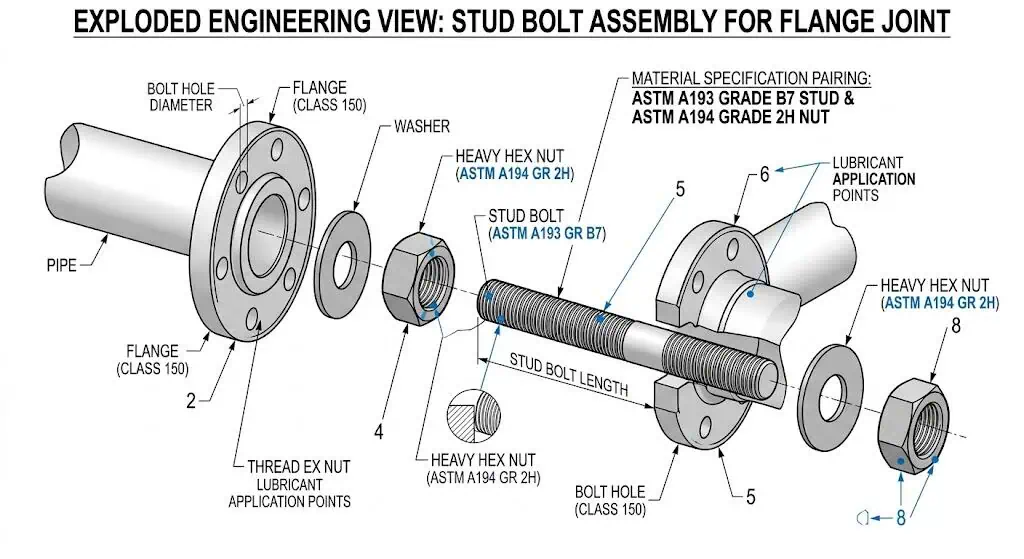
A correct stud grade can still produce a bad joint if the nut grade, lubrication, thread fit, or tightening procedure is wrong. High temperature service is unforgiving because any loss in initial preload shows up later as leakage, relaxation, or repeated hot rework. On flanged joints using ring-type gaskets inside the bolt circle, assembly quality is not a side issue. It is part of the material decision. If your team is also standardising mating hardware, review the related hex nut and heavy hex nut options together with the stud specification instead of treating them as separate purchases.
Field rule: Never specify “stud bolt material” as a single line item without also fixing the nut grade, lubrication condition, and tightening method. A bolt grade is only one part of the sealing system.
Which High Temperature Bolt Materials Are Actually Used
ASTM A193 B7: the common starting point, not the automatic answer
ASTM A193 B7 remains the common starting point for many steel flanges, valves, and fittings in hot pressure-boundary service because it is widely available, familiar to maintenance teams, and accepted in many project standards. In practice, B7 is often the default stud material for general refinery, utility, and plant piping work. The problem is not that B7 is wrong. The problem is that many teams stop the review as soon as B7 appears on the requisition. If the real issue is sustained high metal temperature, long thermal exposure, or hot preload loss, the engineering question changes from “Does B7 fit the flange?” to “Will this bolting system still hold the required clamp load after the unit has been hot for months?”
For users comparing general stud formats, our threaded rods and stud solutions page is the right downstream product path, but the grade decision still has to be made from service conditions first.
ASTM A193 B16: reviewed when elevated-temperature performance matters more
ASTM A193 B16 is commonly reviewed when service temperature and hot preload retention become more demanding than routine B7 applications. This is why engineers often compare B16 against B7 for heater nozzles, hotter steam-related joints, and other services where long-term elevated-temperature performance matters more than warehouse convenience. A common project issue is that the engineering team identifies B16 early, but purchasing still orders B7 because that grade is already approved elsewhere in the line class. Once the wrong bolting kit reaches site, the team usually tries to rescue the decision with torque changes, which rarely addresses the real temperature-driven limitation.
ASTM A193 B8 and B8M: used when corrosion drives the choice
ASTM A193 B8 and B8M are stainless bolting grades that enter the discussion when corrosion resistance, cleanliness, or material compatibility becomes the controlling requirement. B8 is associated with 304-type stainless, and B8M with 316-type stainless. These grades are common in chemical service, selected clean utility systems, and applications where carbon or low-alloy steel bolting would create unacceptable corrosion risk. They are also often reviewed when the bolting must align better with stainless equipment materials.
However, stainless bolting is not automatically the safest answer in hot service. In real maintenance work, stainless studs can introduce three different problems:
- Galling risk during tightening, especially when thread condition and lubrication are poorly controlled.
- Different hot strength behavior than the alloy-steel bolting that the original joint design assumed.
- Shutdown corrosion exposure, especially if the joint later sees moisture, chlorides, or washdown chemistry.
That is why “corrosive service = stainless studs” is too shallow as a selection rule. The better question is whether corrosion, temperature, preload retention, and assembly risk all point in the same direction.
ASTM A453 Grade 660: when high temperature capability and thermal expansion behavior matter
ASTM A453 Grade 660 belongs in the review whenever the project needs high-temperature bolting and wants expansion behavior comparable to austenitic stainless steels. This makes it relevant for selected high-temperature equipment and joints where thermal expansion mismatch can complicate preload stability. It is not a universal replacement for A193 grades, and it should not be introduced casually during maintenance substitution. Availability, nut compatibility, project specification, and lead time all need to be checked early instead of being left for purchasing to resolve after the engineering decision has already been made.
| Bolt Material | Why Engineers Choose It | Typical Strength of the Choice | Where the Choice Can Fail |
|---|---|---|---|
| ASTM A193 B7 | Common, familiar, widely stocked | Solid starting point for many steel hot-service joints | Overused by default without checking hot preload retention |
| ASTM A193 B16 | Reviewed for more demanding elevated-temperature service | Useful when service is hotter and sustained preload matters more | Specified too late or treated as interchangeable with B7 |
| ASTM A193 B8 | Corrosion resistance, cleanliness, stainless compatibility | Useful where 304-type stainless bolting is appropriate | Can be selected for corrosion only, without reviewing galling or hot joint behavior |
| ASTM A193 B8M | Higher corrosion resistance than B8 in many wet or chloride-prone environments | Useful where 316-type stainless bolting is justified | Can still suffer galling and poor assembly control |
| ASTM A453 Grade 660 | High-temperature bolting with austenitic-type expansion behavior | Useful in selected high-temperature equipment and stainless-associated service | Misapplied as a generic substitute without full specification review |
Standards That Actually Affect the Decision
Good bolt material selection depends on using the right standards for the right question. Do not stack standard names just to make the page look technical. Each standard matters for a specific decision, and each one should help the reader make a clearer choice.
| Standard | What It Covers | Why It Changes User Decisions |
|---|---|---|
| ASTM A193 / A193M | Alloy-steel and stainless steel bolting for high temperature or high pressure service and other special purpose applications | This is the main starting point for stud and bolt grades used on pressure-boundary equipment |
| ASTM A194 / A194M | Carbon steel, alloy steel, and stainless steel nuts for bolts for high pressure or high temperature service, or both | It prevents the common mistake of specifying a bolt grade but leaving nut selection vague |
| ASTM A453 / A453M | High-temperature bolting with expansion coefficients comparable to austenitic stainless steels | It matters when high-temperature service and thermal expansion behavior must both be considered |
| ASTM A320 / A320M | Bolting for low-temperature service | It matters because engineers sometimes substitute it incorrectly into hot service just because the size is available |
| ASTM A962 / A962M | Common requirements for bolting specifications | It affects quality requirements, traceability, and common specification controls across bolting materials |
| ASME PCC-1 | Pressure-boundary bolted flange joint assembly guidance | It affects tightening, inspection, and QA, which directly influence leakage risk even when the material grade is correct |
If the joint is part of a flange assembly built to ASME B16.5 dimensional and rating rules, do not assume the flange standard answers the bolting-material question by itself. Flange standard, gasket type, and bolting standard work together, but they do not replace each other.
Do not use ASTM A320 as a hot-service shortcut. A320 is a low-temperature bolting specification. Physical fit and familiar markings do not make it a valid high-temperature replacement.
How to Select the Right High Temperature Bolt Material
Step 1: Define the real service, not the tag description
- Confirm the actual metal temperature at the bolting location.
- Review continuous service, startup, shutdown, and upset conditions.
- Check whether the joint is sealing a flange, a valve bonnet, a pressure vessel closure, or an equipment support point.
- Identify whether the system sees corrosive media only in operation, only in shutdown, or in both.
Step 2: Decide what is really driving the choice
| Selection Driver | What It Usually Pushes You To Review | Common Error |
|---|---|---|
| Sustained elevated temperature | B7 vs B16 vs A453 review | Choosing from room-temperature strength alone |
| Corrosive service | B8 or B8M review, plus shutdown corrosion exposure | Assuming stainless fixes everything |
| Austenitic stainless equipment | A453 review for expansion behavior, plus compatibility review | Ignoring thermal expansion mismatch |
| Critical pressure-boundary sealing | Material plus ASME PCC-1-style assembly control | Treating assembly as a field-only issue |
| Project QA or traceability requirements | A962-linked requirements and receiving control | Selecting only from a generic bolting table |
Step 3: Lock the bolt and nut system together
Do not let purchasing buy “equivalent” nuts after engineering has specified the studs. Common field practice often pairs A193 B7 with A194 2H, A193 B8 with A194 8, and A193 B8M with A194 8M, but the correct combination must still follow your project specification, valve standard, equipment drawing, and service requirements. The engineering point is simple: bolt selection without defined nut selection is incomplete. This is also where teams should confirm whether the joint needs standard hex nuts, heavy hex nuts, or a project-specific assembly kit.
| Common Bolting Example | Typical Nut Example | Use This Table For | Do Not Assume |
|---|---|---|---|
| A193 B7 | A194 2H | Routine project review and purchasing cross-check | That every high-strength nut is equivalent |
| A193 B8 | A194 8 | Stainless bolting review | That thread galling risk disappears because the grade “matches” |
| A193 B8M | A194 8M | 316-type stainless bolting review | That corrosion resistance alone decides the assembly |
| B16 or A453 assemblies | Project-specific review required | Detailed engineering and procurement alignment | That a warehouse substitute is acceptable without approval |
Step 4: Review assembly risk before release
The selected material should be reviewed together with lubrication, thread condition, tightening method, and reuse rules. This matters most for stainless bolting and hot flange joints, where galling, inconsistent friction, or reused nuts can destroy the preload assumptions behind the original design. In one fabrication case, the bolting grade itself was acceptable, but thread damage from poor storage and mixed lubrication produced large torque scatter across the same flange. The leak that followed looked like a material problem, but the actual cause was uncontrolled assembly friction.
When Not to Use a Common Substitute
- Do not use A320 stock in hot service just because the diameter and thread match.
- Do not upgrade to stainless automatically just because corrosion has appeared somewhere on the joint.
- Do not keep B7 by habit when elevated-temperature preload retention is the real design issue.
- Do not change only the studs while leaving nut grade, lubrication, and tightening procedure undefined.
- Do not treat shutdown exposure as irrelevant in hot systems that later see moisture or cleaning chemicals.
Engineering boundary: A material that survives hot dry service may still be the wrong choice for a unit that is frequently steamed out, water washed, or exposed to chloride-bearing deposits after shutdown.
Procurement Specification Checklist
Most high temperature bolting mistakes start in the purchase order, not in the field. If the PO only states size and material loosely, the supplier has too much freedom to interpret the order. If you also need to confirm stud length against flange stack-up, see our practical guide on how to calculate bolt length for ASME flanges before releasing the final kit.
| PO Item | What to State Clearly | Why It Matters |
|---|---|---|
| Stud bolt specification | Exact ASTM grade, size, thread, length, and class if applicable | Prevents material and dimensional substitution |
| Nut specification | Exact ASTM A194 grade and quantity per stud | Stops incomplete or mismatched bolting kits |
| Quantity basis | Per joint set or loose pieces, with washers if required by project | Avoids incomplete site deliveries |
| Material traceability | Heat number traceability and MTR requirements | Supports QA, audits, and failure investigation |
| Heat treatment / testing | Project-specific hardness, tensile, or supplementary requirements | Reduces the risk of buying the right grade name with the wrong processing history |
| Surface condition | Plain, coated, or other approved finish; thread condition and lubrication requirements | Directly affects torque-tension behavior and galling risk |
| Prohibited substitutions | No substitution without written engineering approval | Prevents “equivalent” field replacements |
Example PO wording: “Stud bolts to ASTM A193 Grade B16, nuts to approved matching ASTM A194 grade per project specification, full traceability required, MTRs required, no substitution without written approval.”
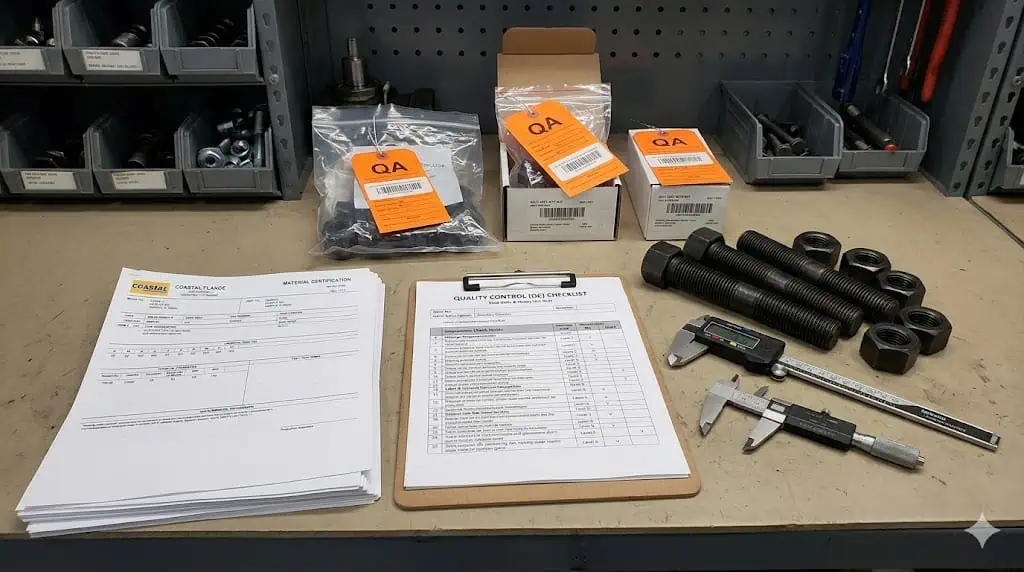
Incoming Inspection Checklist
| Inspection Item | What QC Should Check | Typical Failure Found |
|---|---|---|
| Markings | Grade, manufacturer markings, heat / lot identification where applicable | Mixed batches or unmarked replacements |
| MTR review | Chemistry, mechanical test records, traceability consistency | Correct label with incomplete supporting documents |
| Dimensions | Diameter, length, thread form, thread fit, nut engagement | Wrong length or thread mismatch causing poor engagement |
| Surface condition | Thread damage, rust, contamination, burrs, plating or coating status | Galling risk or torque scatter from damaged threads |
| Kit completeness | Correct number of studs, nuts, washers, and tagged sets | Field mixing from different lots |
| Project restrictions | No unauthorized substitute grades | Warehouse issue of “close enough” material |
Common Failure Modes in High Temperature Bolting
If the joint is already leaking, material review should be done together with flange condition, gasket type, and assembly records rather than in isolation. Our heat exchanger flange leakage guide is a useful troubleshooting follow-up when the question has moved from “what should we specify?” to “why did this joint fail in service?”
| Failure Mode | Likely Cause | Corrective Action | How to Prevent Repeat |
|---|---|---|---|
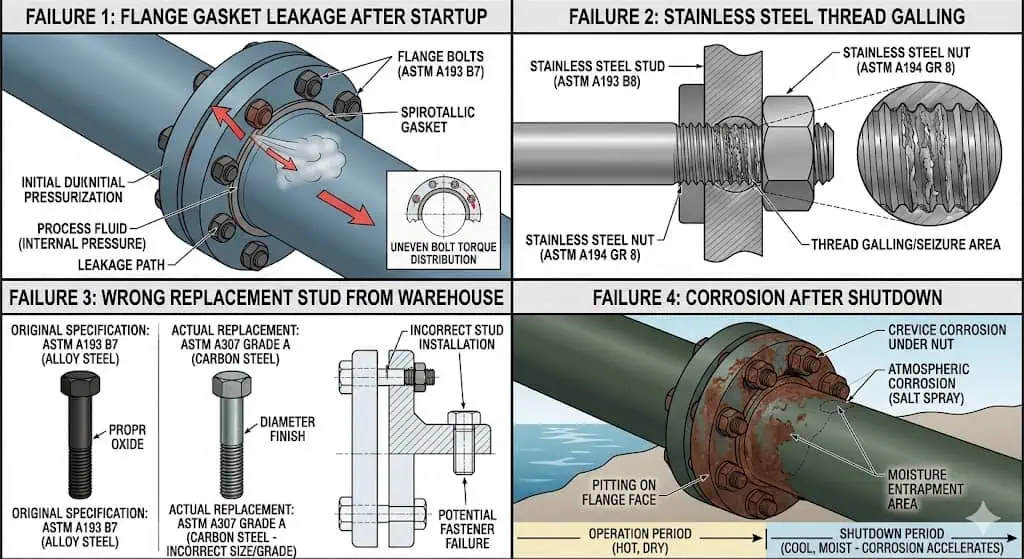
| Leakage after startup | Hot preload loss, poor assembly control, or wrong material for sustained temperature | Re-evaluate stud grade, nut grade, lubrication, and tightening procedure | Specify bolting and assembly method together |
| Repeated hot retightening | Original selection based on stock availability, not service review | Review actual metal temperature and material suitability | Move from stock-based to service-based selection |
| Thread galling during assembly | Stainless bolting with poor lubrication or damaged threads | Replace damaged parts, control lubrication, reject mixed or rough threads | Write assembly controls into the work pack |
| Corrosion after shutdown | Material chosen for operating condition only, not standby environment | Review shutdown chemistry, cleaning sequence, and alternative material choice | Assess operating and shutdown exposure separately |
| Wrong parts installed from stores | Grade substitution or incomplete PO language | Quarantine stock and verify MTR / markings | Ban substitutions without written approval |
Composite Field Scenarios for Engineering Training
Scenario 1: Steam flange starts weeping after a hot run
What happened: A bolted flange on a hot steam line passed hydrotest and cold commissioning but began weeping after the unit reached steady operating temperature.
Why it happened: The site used a familiar stud grade from general maintenance stock and assumed the original torque value was enough.
The real system cause: The selection and assembly were both treated like a room-temperature joint. The real issue was hot preload retention, not whether the stud physically fit.
How it was corrected: The joint was reviewed as a complete bolting system, including stud grade, nut grade, lubrication condition, and tightening sequence.
How to prevent recurrence: Put actual metal temperature and assembly controls into the job package before procurement.
Scenario 2: Stainless bolting solved corrosion but created assembly trouble
What happened: A maintenance team changed from alloy-steel studs to stainless studs after visible external corrosion was found during inspection.
Why it happened: The decision was made from a corrosion snapshot, not from a full joint review.
The real system cause: The team improved corrosion resistance but ignored thread condition, lubrication, and galling risk. Assembly consistency became worse, and some nuts seized before full preload was reached.
How it was corrected: Damaged components were replaced, assembly controls were rewritten, and the shutdown environment was reviewed together with the operating condition.
How to prevent recurrence: Never change only the material line on the BOM. Review the whole bolting system.
Scenario 3: Shutdown washdown caused unexpected corrosion
What happened: Bolting that looked acceptable during hot service showed corrosion and removal difficulty during the next outage.
Why it happened: The service was reviewed as a hot dry process line, but no one considered what happened during washdown and cooldown.
The real system cause: The material was selected for operating condition only. The real corrosion driver appeared after shutdown, when moisture and cleaning chemicals stayed in the joint area.
How it was corrected: The joint environment was reclassified and the material review expanded to include shutdown exposure and maintenance practice.
How to prevent recurrence: Add a second service check for shutdown, standby, and cleaning chemistry in every bolting selection review.
Scenario 4: B7 was kept because it was already on the shelf
What happened: A project team used stocked B7 stud kits on a hotter service because delivery of the originally reviewed material would delay startup.
Why it happened: Procurement pressure overrode the original engineering concern.
The real system cause: Material selection was treated as a supply problem, not a service problem. The team substituted a stocked grade before closing the engineering review.
How it was corrected: The bolting material was brought back in line with the approved project requirement and future substitutions were moved under written engineering approval only.
How to prevent recurrence: State “no substitution without written approval” in the PO and receiving checklist.
Related Flange and Joint Checks Engineers Usually Review Next
After reading a high temperature bolting guide, most engineers and buyers move to one of these follow-up decisions:
- What flange material and facing is this bolting connecting?
- What gasket type is assumed by the joint design?
- Which flange standard controls the joint dimensions and rating?
- What material test and traceability documents should QA ask for?
That is why this page should sit close to your related pages on flange standards, flange types and uses, and your main stainless steel flange product range. That internal path gives readers a clear move from bolting material choice to full joint selection, instead of forcing them back to site search.
FAQ
What is the best bolt material for high temperature service?
There is no single “best” material for every hot joint. The correct choice depends on actual metal temperature, how long the joint stays hot, whether corrosion or thermal expansion matters, and whether the joint is a pressure boundary that must retain preload after heating. ASTM A193 B7 is a common starting point, but it is not automatically correct for every higher-temperature application.
When should B16 be reviewed instead of B7?
Review B16 when elevated-temperature performance and hot preload retention are more important than general stock convenience. This often comes up in hotter or more demanding service where teams do not want to rely on a default B7 assumption. If the joint sees sustained hot operation rather than only brief temperature spikes, B16 should be reviewed early instead of being treated as a late project change.
Are stainless bolts better for hot service?
Not automatically. Stainless bolting can be the right answer when corrosion resistance or cleanliness drives the decision, but it can also create galling risk, different hot-joint behavior, and shutdown corrosion issues if it is selected without a full service review.
Can ASTM A320 be used for high temperature bolting?
Do not assume so. ASTM A320 is a low-temperature bolting specification. It should not be used as a hot-service substitute just because the size and thread fit the joint.
Why do high temperature flange bolts loosen after startup?
The usual reasons are preload loss, poor assembly control, wrong material choice for sustained hot service, or uncontrolled friction during tightening. In many cases, the root cause is not one bad bolt. It is a bolting system that was never reviewed as a system.
What should purchasing and QC always verify?
They should verify the exact ASTM stud grade, matching nut grade, dimensions, markings, MTR traceability, thread condition, and any project-specific testing or substitution restrictions. Many field failures begin with incomplete purchasing language or mixed incoming stock.