








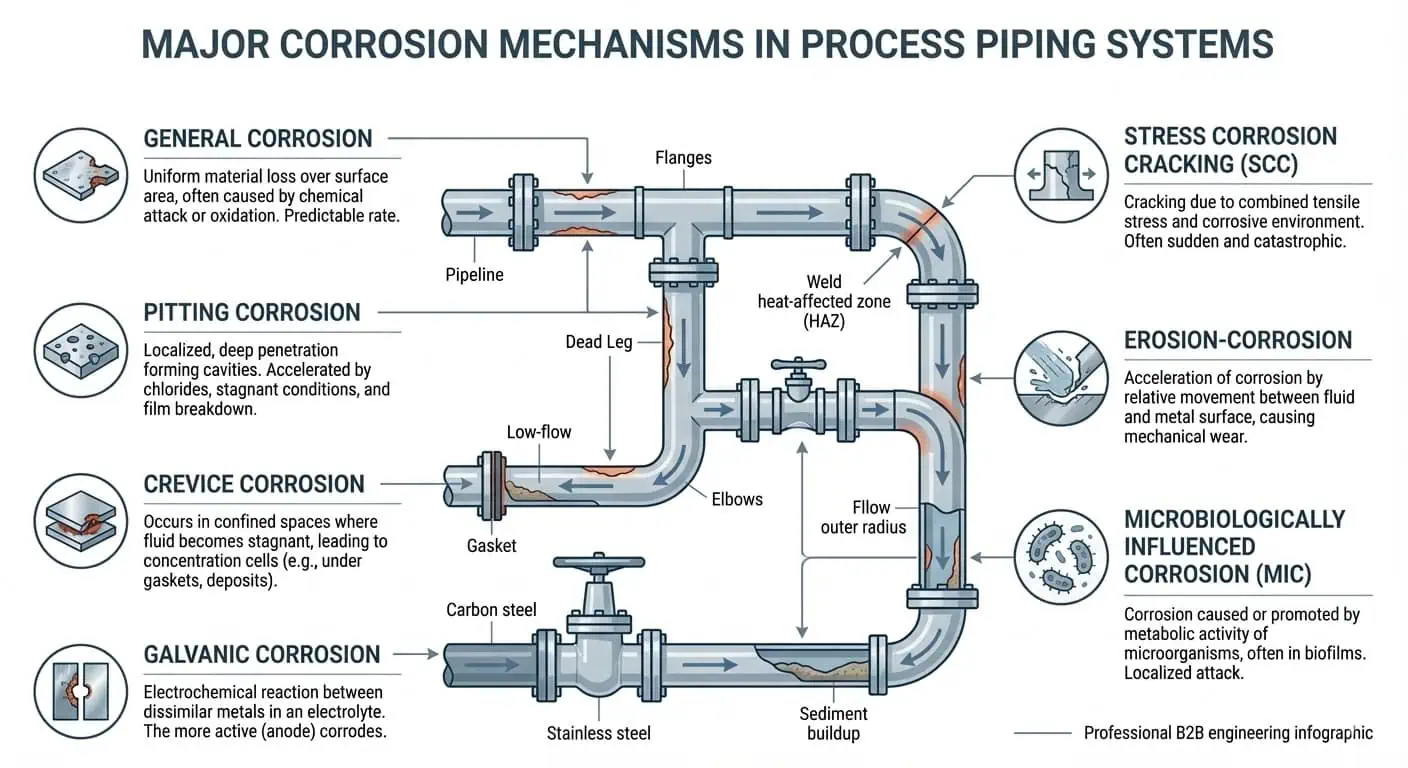
Corrosion in process piping is not one single problem. It is a group of different damage mechanisms, and each one drives a different material, gasket, inspection, and maintenance decision. In plant work, the first question should not be “is this line corrosion resistant?” The first question should be “what corrosion mechanism is actually active here?” General wall loss, pitting, crevice corrosion, galvanic attack, stress corrosion cracking, erosion-corrosion, and under-deposit damage do not behave the same way, and they do not fail at the same speed.
That is why corrosion review should come before any repair decision, alloy upgrade, or flange replacement. A line that is thinning uniformly can often be managed with corrosion allowance and inspection intervals. A line suffering from pitting or chloride stress corrosion cracking can fail with very little warning. In process piping, the correct response depends on the mechanism, the location, the operating condition, and the consequence of leakage. ASME B31.3 provides the process piping framework, but code compliance does not replace corrosion-mechanism identification.
Field rule: Do not fix pitting with average corrosion-rate thinking. Do not fix gasket-area crevice corrosion by changing gasket brand alone. Do not treat cracking like uniform wall loss.
| Corrosion Mechanism | What Makes It Dangerous |
|---|---|
| General corrosion | Usually predictable, but still serious if thickness loss is ignored. |
| Pitting corrosion | Can perforate quickly with very little overall metal loss. |
| Crevice corrosion | Often starts under gaskets, deposits, and stagnant zones where inspection is poor. |
| Galvanic corrosion | Can accelerate attack after material changes or mixed-metal repairs. |
| Stress corrosion cracking | Can crack without major wall thinning and often gives limited warning. |
| Erosion-corrosion | Flow, solids, and geometry can destroy protective films in specific locations. |
| MIC / under-deposit corrosion | Often hidden, localized, and easy to misdiagnose. |
If you are reviewing this topic as part of a wider materials and leakage-control strategy, it also helps to read How to Select Flange Materials for Chemical Processing, Inconel vs Stainless Steel for Corrosive Environments, and Flange Gasket and Sealing Considerations for Chemical Plants. Those three topics explain how corrosion mechanism review connects directly to material selection, alloy upgrades, and flange leakage control.
Why Corrosion Mechanism Identification Comes Before Material Selection
Corrosion Rate Alone Does Not Tell the Whole Story
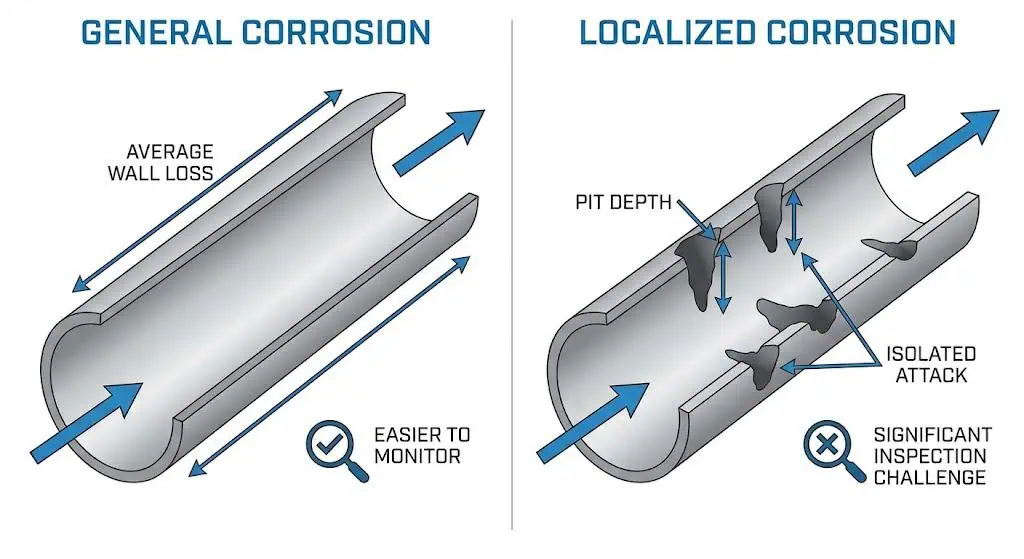
Users often start by asking whether the corrosion rate is high or low. That is useful for general corrosion, but it is not enough for real plant decisions. A low average corrosion rate does not mean low failure risk if the active mechanism is pitting, crevice corrosion, or cracking. A line can look acceptable on paper and still fail early if the damage is localized.
This distinction is one of the most important engineering differences between predictable wall loss and high-risk localized attack. Uniform thinning can usually be managed through corrosion allowance, UT trending, and inspection planning. Localized corrosion and cracking require different logic because they do not consume metal evenly across the wall.
Why the Same Fluid Can Produce Different Damage in Different Locations
In process piping, the same chemistry does not produce the same damage everywhere. Straight runs, dead legs, branch connections, flanges, elbows, reducers, low-flow lines, and weld heat-affected zones do not experience the same environment even when they belong to the same system. Flow pattern, crevice geometry, deposits, shutdown drainage, and thermal condition can change the local corrosion mechanism completely.
Engineering example: a chloride-bearing process line may show no serious damage in the main run, while a small branch connection starts leaking at the flange or threaded area. The reason is usually not that the branch “has worse material.” It is that the branch sees lower flow, more stagnation, more trapped chemistry, or more crevice conditions.
What Users Actually Need From a Corrosion Review
From a practical standpoint, corrosion review should help the user do four things:
- Identify the likely damage mechanism
- Know where to inspect first
- Understand what process condition is driving the damage
- Choose the right corrective action instead of the most obvious one
Practical takeaway: A corrosion article is only useful if it helps the reader decide where to look, what to ask, and what to change.
General Corrosion — Predictable, but Not Always Harmless
What General Corrosion Looks Like in Process Piping
General corrosion is the most familiar form of metal loss. The wall becomes thinner across a broad area rather than at one isolated point. In plant work, this is often seen in carbon steel lines carrying wet corrosive media, certain acids, untreated water, and services where the chemistry attacks the exposed surface in a relatively even way.
This form of damage is easier to measure and trend than localized corrosion. Ultrasonic thickness data can usually be turned into a remaining-life estimate if the corrosion pattern is reasonably uniform and the inspection locations are representative.
When General Corrosion Can Be Managed with Corrosion Allowance
General corrosion is not always a reason to jump immediately to a high-alloy material. In many systems, it can be managed with corrosion allowance, inspection intervals, chemistry control, or internal coatings, provided the thinning remains predictable and the consequence of failure is acceptable.
The important point is that corrosion allowance only works when the damage is truly distributed and inspectable. It is a poor answer when the active mechanism is pitting, crevice corrosion, or cracking.
Where Users Misread General Corrosion
- Assuming all wall loss is uniform because UT readings were taken only on easy-to-reach locations
- Using average thickness loss to justify continued service when local geometry is more severe
- Ignoring external corrosion, splash zones, or insulation-related moisture exposure
Engineering example: a carbon steel chemical transfer line may remain acceptable for years if wall loss is even and the inspection program is disciplined. The mistake is not allowing wall loss to exist. The mistake is assuming the same logic also applies to branch connections, flange interfaces, and stagnant low points without checking them directly.
If the next question is whether a material upgrade is justified or whether the service can remain on carbon steel or standard stainless, How to Select Flange Materials for Chemical Processing is the right follow-on page.
Pitting Corrosion — Small Surface, Big Failure Risk
Why Pitting Is More Dangerous Than It Looks
Pitting corrosion is one of the most dangerous mechanisms in process piping because the damage is highly localized. The outside surface may look acceptable, but the deepest pit can already be close to perforation. This is why pitting cannot be managed the same way as average wall thinning. A line can fail with very little overall metal loss. AMPP notes that pitting is more dangerous than uniform corrosion because it is harder to detect, predict, and design against.
Pitting is especially important in stainless steel systems, chloride-bearing services, deposit-prone lines, and intermittent wet environments where the passive film can break down locally.
Typical Triggers for Pitting in Process Systems
- Chloride-containing media
- Deposits and poor drainage
- Passive film breakdown
- Surface damage and stagnant liquid zones
- Low-flow areas that concentrate corrosive species
In plant practice, pitting often starts where the service is less open, less flushed, or less inspectable than the main line.
Where Pitting Often Starts
High-risk locations commonly include:
- Branch connections
- Instrument take-offs
- Low-flow bypasses
- Flange edges and gasket interfaces
- Under deposits and residual solids
- Splash zones and chloride-contaminated external surfaces
Engineering example: a stainless utility line in chloride-bearing service may run for years in the main header while a small bypass branch develops localized attack and leaks first. The difference is usually local service severity, not the nominal material grade alone.
When that happens, the next engineering question is often whether standard stainless still provides enough margin or whether duplex or nickel alloy is justified. That decision connects directly to Inconel vs Stainless Steel for Corrosive Environments.
Crevice Corrosion — The Flange and Dead-Leg Problem
Why Crevice Corrosion Is So Common in Real Plants
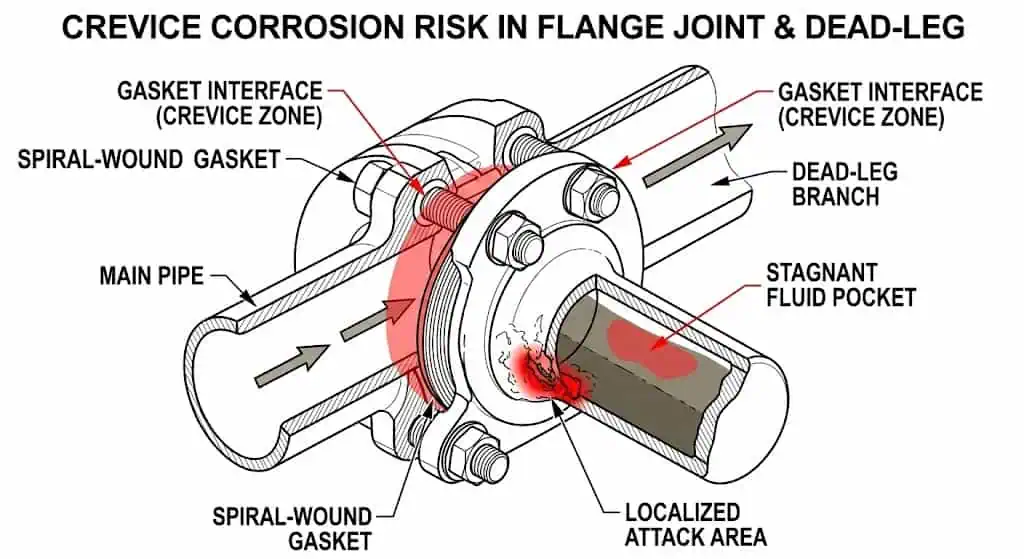
Crevice corrosion is common because real piping systems contain crevices everywhere. Flange gasket interfaces, threaded transitions, lap joints, support contact points, dead legs, deposits, and trapped low points all create restricted zones where the local environment differs from the bulk fluid. In these places, the chemistry can become much more aggressive than the process description suggests.
This is why a material that appears stable in the open line can become unreliable at the gasket line, the flange bore edge, or a stagnant branch pocket.
Why Flanges, Gaskets, and Dead Legs Are High-Risk Locations
Flanges and dead legs combine geometry, reduced flow, trapped chemistry, and surface discontinuity. That makes them natural crevice-corrosion locations. In many systems, what appears to be a recurring gasket leak is actually a crevice-corrosion problem at the sealing interface.
This is where corrosion review overlaps directly with sealing design. If the leakage pattern points to the gasket area, the right next step is usually not just another gasket change. It is a combined review of flange face condition, crevice geometry, gasket choice, shutdown drainage, and local material resistance. That is exactly the topic covered in Flange Gasket and Sealing Considerations for Chemical Plants. For flange face geometry, it also helps to review RF vs FF vs RTJ flanges.
Shutdown Wetting and Trapped Chemistry
Crevice corrosion is often driven more by shutdown condition than by normal operation. Residual liquid, condensate, cleaning solution, or process concentrate can remain in restricted areas after the bulk line is drained. When the system cools and flow stops, the local chemistry can shift sharply inside the crevice.
Engineering example: a flange joint may stay dry throughout production but begin to leak after outage because fluid is trapped at the gasket interface and the crevice chemistry becomes more aggressive than the flowing service ever was.
Galvanic Corrosion — When the Metal Combination Creates the Problem
What Galvanic Corrosion Really Means in Piping Assemblies
Galvanic corrosion happens when dissimilar metals are electrically connected in the presence of an electrolyte and one metal becomes the anodic partner. In plant work, this often appears after modifications, small-bore additions, emergency repairs, or mixed-metal bolting and component changes.
The problem is not that mixed metals are always forbidden. The problem is that the metal combination, environment, and area ratio were not reviewed together before the change was made.
Where It Commonly Appears in Process Piping
- Dissimilar flange and fastener combinations
- Stainless additions in wet carbon steel systems
- Instrument fittings and threaded adaptors
- Marine or splash-prone wet services
- Temporary repairs and retrofit components
Why Small Area / Large Area Ratio Matters
One of the most important engineering details in galvanic corrosion is area ratio. A small anodic area connected to a large cathodic area can corrode much faster than expected. This is why a seemingly minor component change, such as a fastener or fitting, can create a disproportionately severe local problem.
Engineering example: after a field modification, a stainless component added to a wet carbon steel assembly may appear to improve the system. Instead, the local galvanic relationship accelerates attack on the more active metal near the connection.
Stress Corrosion Cracking — Low Warning, High Consequence
Why SCC Is One of the Most Dangerous Failure Modes
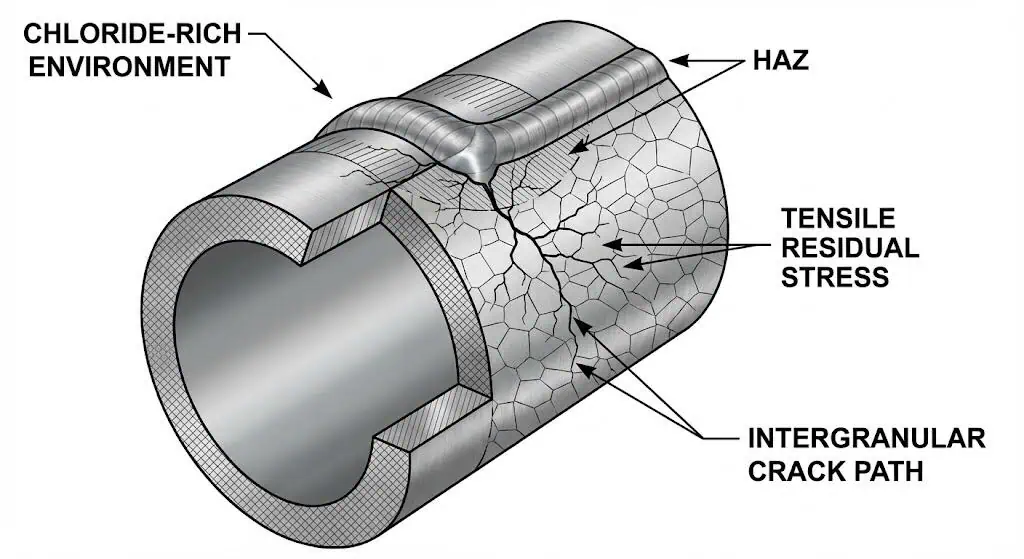
Stress corrosion cracking is dangerous because it does not behave like general corrosion. The metal may not show major uniform wall loss before failure. Instead, cracks develop under the combined effect of tensile stress and a susceptible environment. When SCC is active, a line can look much healthier than it really is.
In process piping, SCC demands a different mindset. Average corrosion rate does not protect you from cracking.
Chloride SCC in Austenitic Stainless Steel
Chloride stress corrosion cracking is one of the most important examples in plant service. Austenitic stainless steels can perform well in many environments, but when chlorides, temperature, and tensile stress combine in the wrong way, cracking risk rises sharply. Residual welding stress, cold work, assembly stress, and hot chloride conditions all matter. Nickel Institute guidance on austenitic stainless steels in chemical plants is a useful reference point for this failure mode.
This is why some stainless lines fail without major wall thinning. The damage mechanism is not average corrosion. It is cracking under stress in a susceptible environment. When that pattern appears, alloy comparison becomes critical, and the relevant companion page is Inconel vs Stainless Steel for Corrosive Environments.
Where SCC Often Hides
- Weld heat-affected zones
- Hot chloride service
- External splash and contamination areas
- Residual stress regions
- Supports, attachments, and cold-worked locations
Engineering example: an austenitic stainless line can crack in service even when thickness readings do not suggest major metal loss. In that situation, material review, chloride control, stress reduction, and fabrication quality all become part of the corrective action.
Erosion-Corrosion and Flow-Accelerated Damage
Why Flow Can Destroy Protective Films
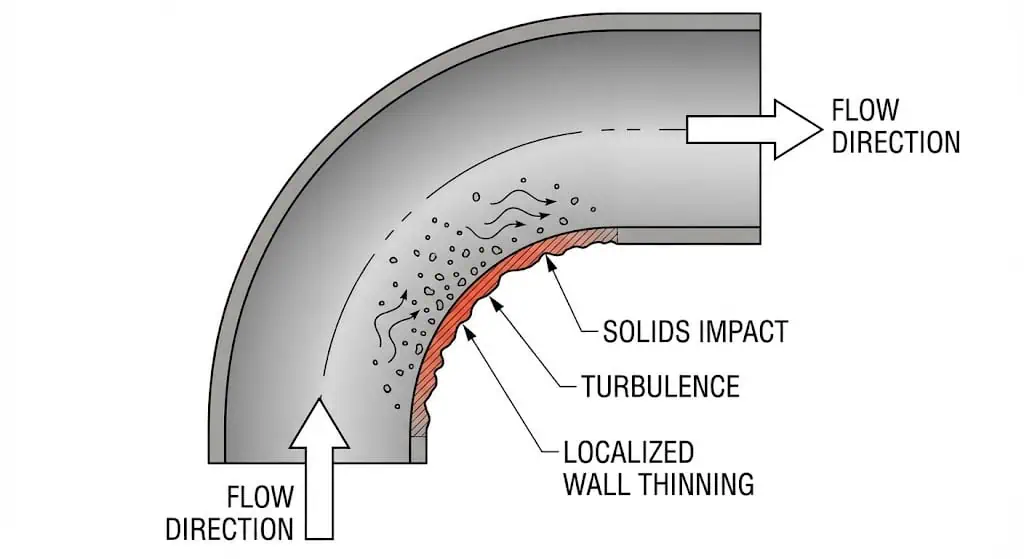
Some piping damage is driven as much by flow as by chemistry. High velocity, flashing, solids, turbulence, and abrupt geometry change can strip or damage the protective surface film. Once that film is repeatedly broken, corrosion accelerates in the affected region.
This is why material selection based only on static chemical compatibility can be misleading in high-velocity service.
High-Risk Locations in Process Piping
- Elbows
- Reducers
- Pump discharge lines
- Valve outlets
- Flashing zones
- Slurry and solids-bearing service
How to Tell Erosion-Corrosion from Pure Chemical Attack
Erosion-corrosion usually leaves location-specific evidence. The damage often appears where flow changes direction, where turbulence is high, or where solids impact the wall. The pattern is often directional rather than random. If elbows are failing well before straight runs, geometry and velocity should be part of the diagnosis.
Engineering example: when an elbow in solids-bearing or high-velocity service loses wall thickness much faster than the adjacent straight pipe, the mechanism is often flow-assisted rather than purely chemistry-driven.
MIC and Under-Deposit Corrosion — Hidden Damage Users Often Miss
Why MIC Is Often Misdiagnosed
MIC and under-deposit corrosion are often misdiagnosed because the visible damage may look like ordinary pitting or random local attack. In reality, the problem is tied to stagnant conditions, deposits, low flow, intermittent water service, or biofilm development. The damage is usually localized and often hidden until it becomes serious.
Where MIC and Under-Deposit Corrosion Often Appear
- Cooling water systems
- Standby or intermittent lines
- Low-flow branch sections
- Dead legs
- Under sludge, scale, or deposits
- Lines that are wet but not continuously flushed
Engineering example: a low-use water line may show very little obvious system-wide corrosion, yet a stagnant pocket under deposits can perforate unexpectedly. In those cases, cleaning frequency, drainage, and usage pattern are just as important as material grade.
How to Identify the Active Corrosion Mechanism in the Field
Start with Damage Morphology, Not Assumptions
The first field step is to look at the damage shape. Is it uniform thinning, isolated pits, crack-like indications, directional wash-out, or damage concentrated under deposits or at gasket interfaces? The damage pattern usually tells you more than the system name does.
Ask the Right Service Questions
- Are chlorides present?
- Does the line experience wet shutdown?
- Is there thermal cycling?
- Is flow low or intermittent?
- Are there dissimilar metals in contact?
- Is velocity high or are solids present?
- Was there a recent process or cleaning change?
Why Inspection Location Matters
Do not inspect only the easiest place to reach. Inspect the most likely place for the mechanism to be active. Flanges, gasket interfaces, branch connections, dead legs, elbows, weld HAZ, and low points often tell the real story before the rest of the system does.
What to Document Before Choosing a Fix
- Media and concentration
- Temperature and pressure
- Flow regime
- Location type: flange, elbow, weld, dead leg, branch
- Maintenance and shutdown history
- Previous leakage or repair pattern
From Corrosion Mechanism to Correct Action
When the Right Fix Is a Material Upgrade
Material upgrade is usually the right answer when the existing alloy no longer has adequate margin against the active mechanism. That may include localized chloride attack, repeated crevice failures, SCC risk, or a service severity increase that moves the system out of its comfortable range. If the decision is moving toward higher-alloy stainless, duplex, or nickel-based materials, start with How to Select Flange Materials for Chemical Processing and then compare higher-corrosion-resistance options through Inconel vs Stainless Steel for Corrosive Environments.
When the Right Fix Is a Sealing or Geometry Change
If the active problem is crevice damage, gasket-area attack, trapped residual fluid, or repeated flange leakage, the right fix may be in joint design, drainability, dead-leg elimination, or flange sealing strategy rather than the main pipe body material. That is when Flange Gasket and Sealing Considerations for Chemical Plants becomes the more useful next step. Assembly quality can also be part of the answer, especially at repeated leak points, so Flange Assembly: 4 Steps to Zero-Leakage Joint Integrity is often relevant at the same time.
When the Right Fix Is Operating Discipline
Not every corrosion problem is solved by hardware. Some require better shutdown drainage, deposit control, cleaning control, chloride management, flow adjustment, or more realistic inspection intervals. If the wrong operating habit keeps recreating the same corrosive condition, material upgrades alone will not solve the repeat failure pattern.
Decision Rule
Do not fix pitting with corrosion-allowance logic. Do not fix SCC with a general corrosion table. Do not fix gasket-area crevice attack by changing gasket brand alone.
| Commercial Symptom | Most Likely Mechanism | Best First Action | When to Escalate to Material Upgrade |
|---|---|---|---|
| Even wall loss found during routine UT | General corrosion | Check remaining life, corrosion allowance, and inspection interval | When corrosion rate, remaining life, or consequence no longer fits the operating window |
| Pinhole leak with limited visible damage | Pitting or under-deposit attack | Perform localized inspection and review chloride or deposit control | When localized attack repeats or standard stainless no longer has enough margin |
| Leakage recurring at flange after shutdown | Crevice corrosion / gasket-area attack | Review flange face, gasket choice, drainability, and assembly method | When gasket-area corrosion continues after sealing and geometry corrections |
| Cracking with little overall metal loss | Stress corrosion cracking | Review stress source, environment, and fabrication history immediately | When chloride or service temperature keeps the current alloy in a crack-prone regime |
| Elbow losing thickness faster than straight pipe | Erosion-corrosion | Review flow velocity, solids, and local geometry | When geometry or velocity cannot be reduced enough for the current material to survive |
Practical Corrosion Review Checklist for Process Piping
Questions to Answer Before Selecting Material or Repair Method
- What is the likely corrosion mechanism?
- Is the damage uniform, localized, or crack-like?
- Where did it start?
- Did it appear after a process change, cleaning cycle, or shutdown?
- Is the real service worse locally than the design basis suggests?
High-Risk Locations to Review First
- Flanges and gasket interfaces
- Branch connections
- Dead legs
- Weld heat-affected zones
- Elbows and reducers
- Low-flow and intermittent service points
What to Change First Based on Mechanism
| Mechanism | What to Change First |
|---|---|
| General corrosion | Corrosion allowance, inspection interval, material economics, chemistry control |
| Pitting | Localized inspection, chloride control, material upgrade where needed |
| Crevice corrosion | Geometry, sealing design, drainage, local material review |
| Galvanic corrosion | Metal pairing, electrical isolation, wet-environment review |
| Stress corrosion cracking | Stress reduction, environment review, alloy suitability |
| Erosion-corrosion | Flow regime, geometry, velocity, wear-resistant design |
| MIC / under-deposit | Cleaning, drainage, deposit control, intermittent-service review |
Corrosion in process piping is not a single failure mode, and the right engineering response depends on identifying the active mechanism correctly. Average corrosion thinking is not enough for pitting, crevice corrosion, SCC, or erosion-corrosion. The practical path is straightforward: identify the damage morphology, review the real local service, inspect the highest-risk geometry first, and then choose the fix that matches the mechanism rather than the most visible symptom.
That corrosion review should connect directly to your material selection, flange sealing strategy, and maintenance plan. In the four-article topic path, this page explains why the damage happens. How to Select Flange Materials for Chemical Processing explains how to choose the base material. Inconel vs Stainless Steel for Corrosive Environments explains when higher-alloy upgrades are justified. Flange Gasket and Sealing Considerations for Chemical Plants explains how the same mechanism shows up at the flange joint and sealing interface. If the next step is supplier evaluation rather than in-house repair, it is also worth reviewing questions to ask a flange supplier before RFQ.
FAQ
What is the most dangerous corrosion mechanism in process piping?
There is no single answer for every system, but pitting, crevice corrosion, and stress corrosion cracking are often more dangerous than uniform wall loss because they can cause failure with limited warning.
Uniform corrosion is usually easier to inspect and trend. Localized attack and cracking are harder to manage with average thickness logic.
Why does the same process fluid cause different corrosion in different parts of the system?
Because the local environment is not the same everywhere.
Flow, deposits, crevice geometry, weld condition, branch configuration, shutdown drainage, and temperature differences can change the active corrosion mechanism even within the same system.
Can average corrosion rate be used to manage pitting or stress corrosion cracking?
No.
Average corrosion rate is useful for general wall loss, but it does not describe the real risk from pitting or SCC. Those mechanisms are localized or crack-driven and can fail earlier than average thickness data suggests.
Why do flanges and branch connections corrode earlier than straight pipe?
Because they create local geometry that is more severe than the main run.
Flanges add gasket interfaces and crevices. Branches often have lower flow and more stagnation. These locations are more likely to trap fluid, concentrate chemicals, and develop localized attack.
When should corrosion review lead to a material upgrade instead of a repair only?
When the active mechanism shows that the current material no longer has enough margin.
That includes repeated pitting, chloride-related failures, SCC risk, recurring gasket-area corrosion, or service changes that move the system outside the safe range of the original material choice.