






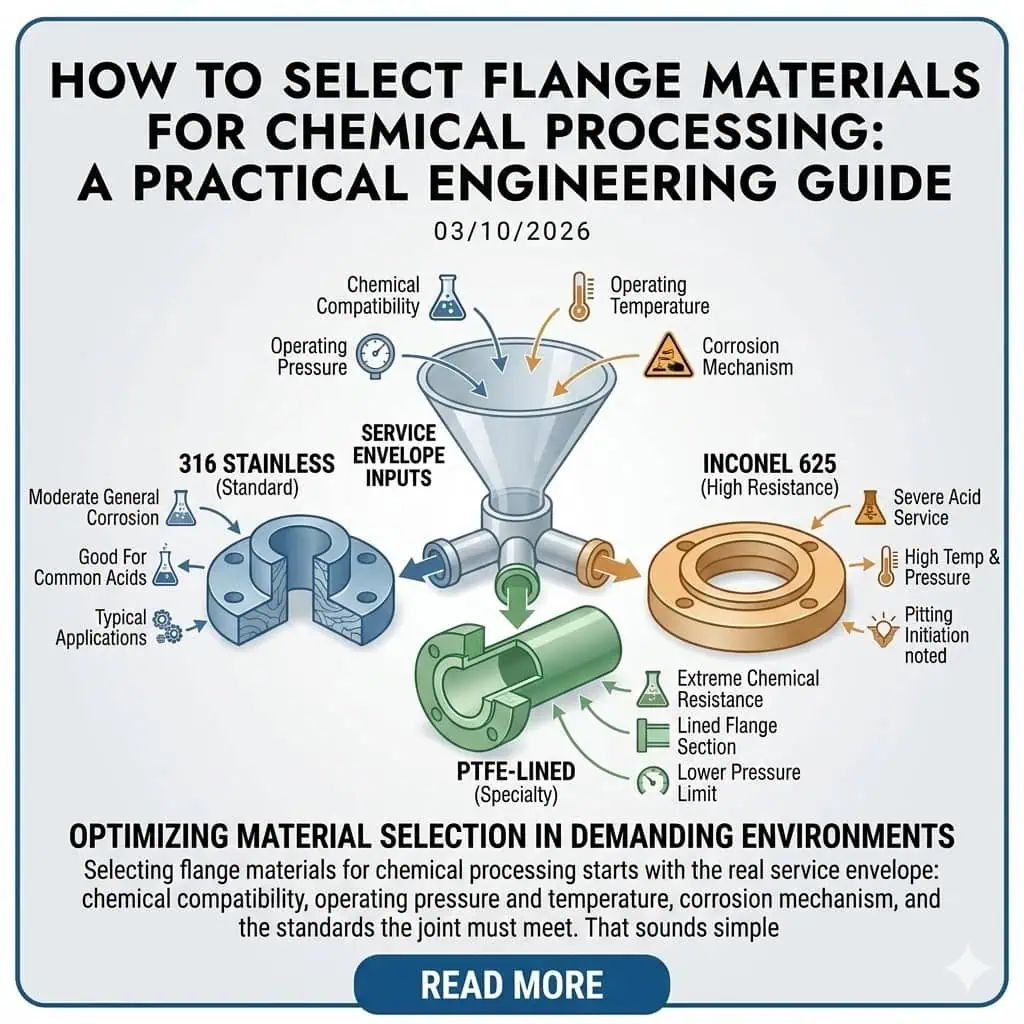
Selecting flange materials for chemical processing starts with the real service envelope: chemical compatibility, operating pressure and temperature, corrosion mechanism, and the standards the joint must meet. That sounds simple until the details show up. A flange that works in clean, steady service can fail early once the line sees chlorides, startup temperature swings, cleaning chemicals, or wet shutdown conditions. In most plants, wrong material selection is not a dramatic single error. It is usually a chain of small assumptions: the media sheet is incomplete, 316L is treated as a universal answer, the gasket area is ignored, or the purchase decision is driven by price before the service is fully understood.
| What to Check First | Why It Matters |
|---|---|
| Real process media | The chemical name alone is not enough. Concentration, impurities, moisture, solids, and chlorides can change corrosion behavior completely. |
| Pressure-temperature envelope | The flange must meet both corrosion and mechanical requirements under normal, upset, and shutdown conditions. |
| Corrosion mechanism | General corrosion, pitting, crevice corrosion, SCC, and erosion-corrosion do not push selection in the same direction. |
| Joint design and standards | Flange material, gasket, bolting, facing type, and code compliance must work together as one sealing system. |
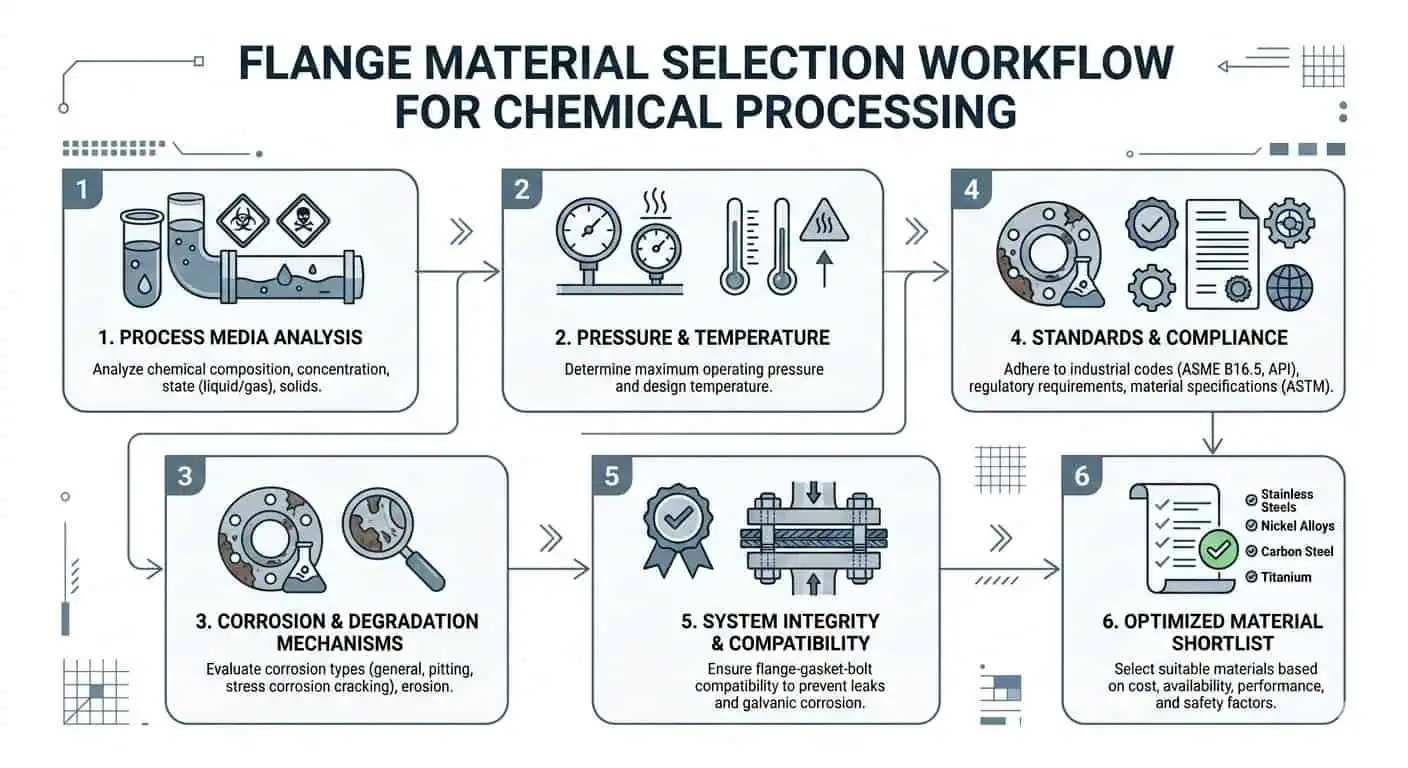
Engineers and buyers rarely need the “best” alloy in the abstract. They need the right flange material for the actual service. That means matching corrosion resistance with pressure-temperature rating, joint integrity, fabrication quality, documentation, and realistic procurement lead time. For critical applications, manufacturers such as SUNHY can support that process with traceable materials, machining quality, inspection records, and application-based recommendations.
Flange Selection Factors
Chemical Compatibility
Why chemical compatibility is the first screening factor
Chemical compatibility comes first because no pressure class can compensate for the wrong corrosion response. If the flange material is not compatible with the media, the joint may begin leaking at the bore, under deposits, or at the gasket seating area long before anyone sees major wall loss. That is why experienced engineers start with the fluid, not the alloy catalog.
How concentration, impurities, moisture, and oxidation level can change material performance
Small process changes often matter more than buyers expect. A material that performs well in a clean, dry stream may behave very differently once moisture enters during shutdown, once chloride contamination appears, or once concentration shifts during cleaning and dilution. The same chemical name can hide very different corrosion risks depending on oxidation level, solids content, flow condition, and trace impurities.
Why the same chemical can require different flange materials at different temperatures or process stages
Material selection has to follow the whole process, not just steady-state operation. Feed, circulation, sampling, standby, shutdown, and CIP cleaning can expose the same flange to different chemical and thermal conditions. This is one reason why plants sometimes see failures at branch lines, instrument connections, or low-flow nozzles even when the main line looks acceptable on paper.
Common corrosion mechanisms to review: general corrosion, pitting, crevice corrosion, stress corrosion cracking, and erosion-corrosion
Before narrowing down the material list, it helps to ask a more useful question than “Is this alloy corrosion resistant?” The real question is what kind of corrosion is most likely to cause the leak. In chemical processing, that usually comes down to five failure modes:
- General corrosion that produces broad, measurable wall loss
- Pitting that can perforate a flange much faster than average corrosion rate suggests
- Crevice corrosion under gaskets, deposits, lap joints, and sealing surfaces
- Stress corrosion cracking in the wrong alloy-environment-stress combination
- Erosion-corrosion where velocity, flashing, or solids strip away protective films
For stainless steel flanges, crevice attack and chloride-related cracking deserve special attention because the gasket area creates exactly the kind of restricted environment that can hide early localized damage.
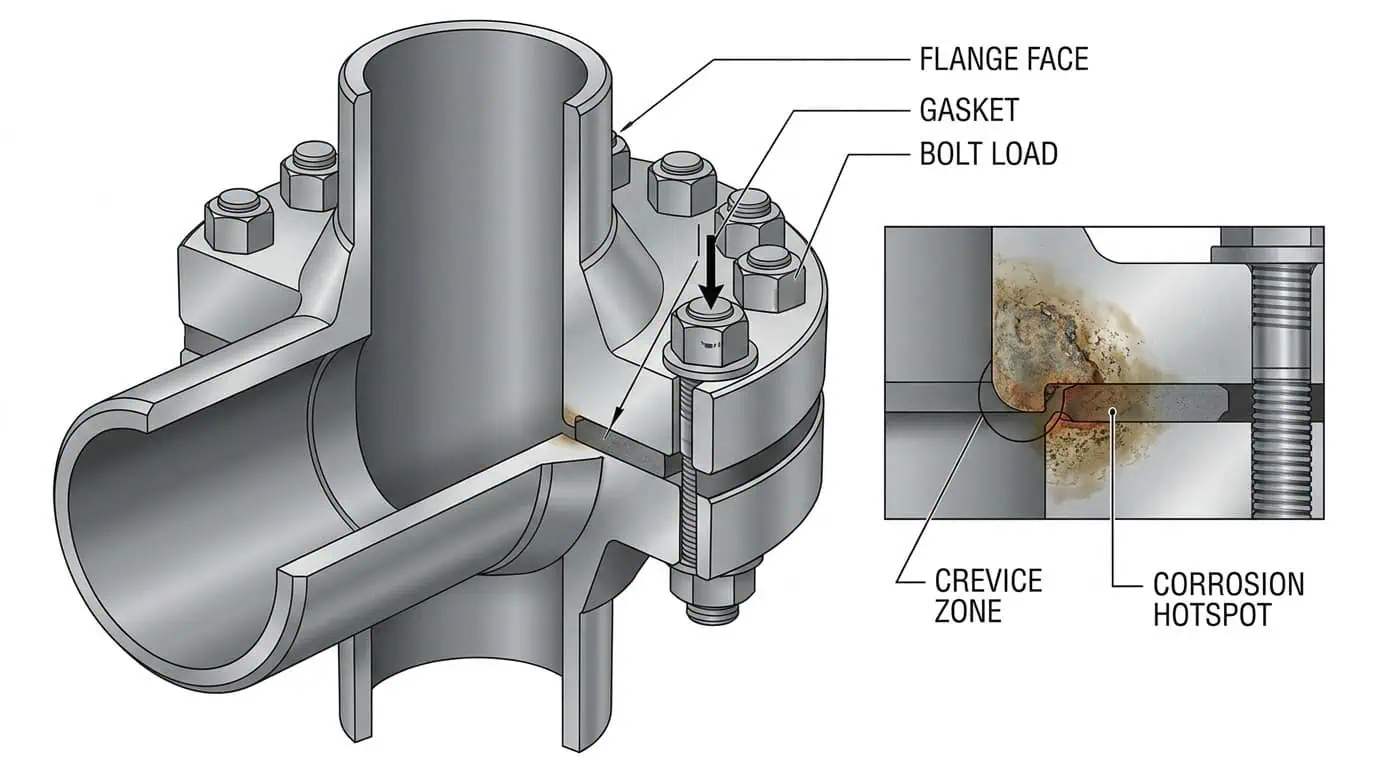
Practical tip: always review real process media, not just the chemical name on the P&ID
Engineering tip: “Sulfuric acid,” “caustic,” or “chloride water” is not enough information for a safe material call. Ask for concentration range, impurities, solids, operating temperature, cleaning chemicals, and whether the line sees wet shutdown conditions.
Pressure and Temperature
How pressure-temperature conditions affect flange class and material suitability
A chemically suitable alloy is still the wrong choice if the flange cannot carry the required pressure-temperature rating. In practice, the corrosion review and the mechanical review have to run together. Standards such as ASME B16.5 define the rating framework for common pipe flanges and flanged fittings, while the selected material standard determines what the forging is actually allowed to be.
| Check Item | Why It Matters |
|---|---|
| Design pressure and temperature | Sets the flange class, rating window, and mechanical basis for the joint. |
| Operating cycle | Thermal expansion and relaxation can reduce gasket stress even when average conditions look acceptable. |
| Upset and cleaning exposure | Short-term conditions can be more aggressive than normal service. |
| Assembly load path | Flange, gasket, and bolting have to maintain sealing integrity together. |
Why elevated temperature can accelerate corrosion and reduce allowable strength
Temperature makes material selection harder in two ways at once. It can increase the corrosion rate and reduce the strength margin of the joint. That combination is exactly why room-temperature compatibility charts should be treated as a starting point, not a final approval.
The difference between normal operating conditions, upset conditions, startup/shutdown, and cleaning cycles
Real process lines do not live at one stable design point. Startup can bring thermal shock. Shutdown can leave concentrated residue at the gasket line. Cleaning cycles may introduce oxidizing or alkaline chemicals that never appear in production service. Many early flange leaks show up after these transitions, not during smooth operation.
Why flange material must be checked together with gasket and bolting for the full joint integrity
A flange is one part of a sealing system, not a standalone component. The flange alloy may be correct and the joint can still leak if the gasket chemistry is wrong, if bolting loses preload, or if the facing type does not match the gasket style. This is why gasket and bolting review should begin alongside material selection, not after it. For a more detailed sealing review, see this flange gasket selection guide.
Practical tip: never select material only from ambient-condition corrosion tables
Engineering tip: If the compatibility table assumes room temperature and pure media, it does not yet represent the actual flange service. Temperature, stress, crevice geometry, and impurities can change the correct material choice.
Standards and Certifications
Why ASME, ASTM, EN, DIN, and project specifications matter in flange material selection
Standards do more than tell you the flange size. They establish dimensions, pressure-temperature ratings, tolerances, marking, testing, and the material framework behind the finished part. In chemical projects, the material call is often split between the flange dimensional standard and the material standard. For example, ASTM A105/A105M is commonly used for forged carbon steel piping components, while ASTM A182/A182M covers forged or rolled alloy and stainless steel flanges and related parts for pressure systems and high-temperature service.
How material standards help verify chemistry, mechanical properties, traceability, and testing
Material standards give the buyer something verifiable. They help confirm chemistry, heat treatment condition, tensile properties, hardness, marking, and supplementary testing requirements. That matters because a flange marking alone does not prove how the forging was produced or what condition it is actually in.
Why MTCs, PMI, heat treatment records, and third-party inspection may be required in chemical projects
Critical services usually need more than the finished part. They need the document trail behind it. MTCs, PMI, heat treatment records, and third-party inspection are often the difference between a smooth approval and an expensive field hold. The risk becomes higher when carbon steel, stainless, duplex, and nickel alloys are all being machined in the same workshop.
How certified suppliers reduce compliance risk for EPCs, contractors, and end users
Certified suppliers reduce risk because they control both the hardware and the paperwork. In many projects, delays are caused less by machining problems than by missing traceability, unclear substitutions, or incomplete inspection packages. For a buyer, that is not a small issue. It can stop installation.
Practical tip: confirm both material grade and manufacturing standard before ordering
Engineering tip: “316 flange” is not a complete specification. Confirm the flange standard, material standard, pressure class, flange type, facing, testing, and documentation requirements before releasing the RFQ.
Flange Materials Overview
In real projects, flange selection usually narrows to a practical shortlist rather than an unlimited search. Most engineers compare carbon steel, stainless steel, duplex stainless steel, higher alloys, and lined or non-metallic options. The right answer depends on service conditions, not on which material sounds the most sophisticated.
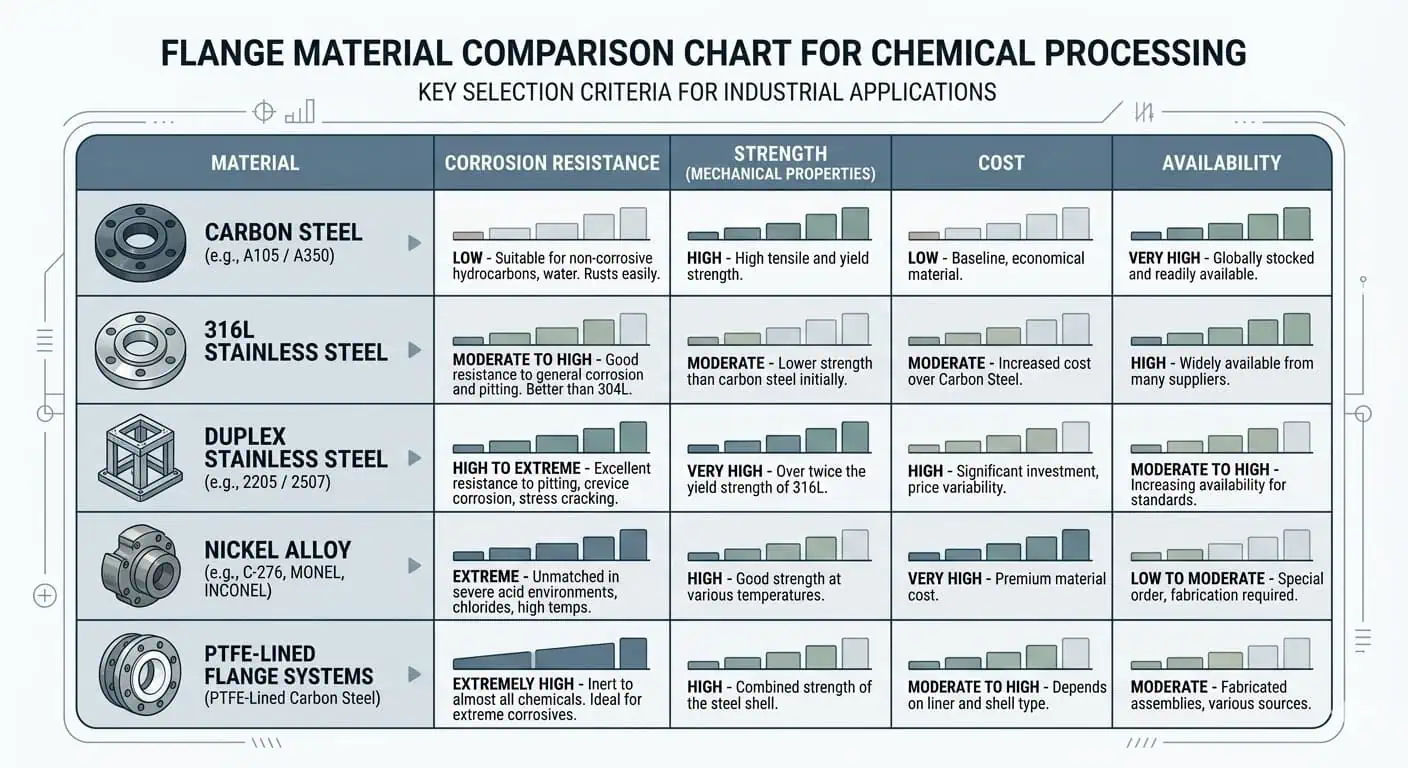
Carbon Steel Flanges
Where carbon steel is cost-effective and widely used
Carbon steel remains the default choice where corrosion is limited and strength, availability, and price are the main drivers. It still makes sense in utility lines, inert gas service, steam systems, and many non-corrosive or mildly corrosive duties where the process environment is well controlled.
Its main limitations in corrosive chemical service
Its weakness is equally clear. Unprotected carbon steel can deteriorate quickly in wet, acidic, oxygenated, or chloride-bearing environments. External exposure can be just as important as internal media if insulation damage, washdown, or coastal contamination are part of the plant environment.
When coatings, linings, or corrosion allowance may be considered
Carbon steel can still be a rational answer if the protection strategy is part of the design basis. Internal lining, external coating, corrosion allowance, and process control may make it workable. What should be avoided is treating those protections as an afterthought once the flange has already been selected on cost alone.
Best suited applications: non-corrosive or mildly corrosive utility and process service
Use carbon steel where chemistry is manageable, inspection access is good, and the penalty for periodic maintenance is acceptable.
Stainless Steel Flanges
Why stainless steel is often the first upgrade from carbon steel
Stainless steel is usually the first practical upgrade because it gives a good balance of corrosion resistance, cleanliness, fabrication familiarity, and supply availability. It is common in process lines, clean utility systems, water treatment, pharmaceutical support service, and many general chemical plant duties.
Differences between common grades such as 304, 304L, 316, and 316L
304 and 304L are general-purpose choices, while 316 and 316L add molybdenum and are usually preferred when chloride resistance needs to improve. Low-carbon grades are often selected when welding is part of the fabrication route. Even so, 316L should be seen as a starting point for review, not a universal answer for chemical service.
Where stainless steel performs well in chemical plants
Stainless steel performs well when the environment stays within its practical limits and process cleanliness matters. Typical examples include treated water systems, many mild chemicals, instrument tie-ins, and services that do not combine hot chlorides, tight crevices, and sustained tensile stress.
Its limitations in chloride-bearing, reducing acid, or crevice-prone environments
The most common mistake is assuming “stainless” automatically means chemically safe. In the wrong service, especially with chlorides, crevices, and stress, stainless steel can fail in a way that gives little visible warning first. AMPP’s explanation of stress corrosion cracking is directly relevant here because chloride SCC in austenitic stainless steels is one of the classic failure modes that can be underestimated during selection.
Common user question: why 316L is common, but not a universal answer
316L is common because it often makes economic sense, not because it works everywhere. Once chloride level, temperature, crevice severity, or consequence of leakage increases, duplex, super duplex, higher alloys, titanium-based solutions, or lined systems may be the better fit.
Alloy Steel Flanges
How alloy steels are typically selected for elevated temperature and strength requirements
Alloy steel flanges are normally chosen for mechanical and thermal performance, not for broad chemical resistance. They appear where elevated temperature strength and pressure capability matter more than exposure to aggressive media.
The difference between strength-driven selection and corrosion-driven selection
This distinction matters because buyers often blur the two. A material can be strong at temperature and still be a poor corrosion choice. In chemical service, strength-driven selection and corrosion-driven selection should be reviewed separately before the final material is approved.
Where alloy steels may appear in refinery, thermal, or high-temperature service connected to chemical plants
Typical locations include hot utility lines, heaters, connected refinery service, and process sections where temperature is the dominant engineering concern.
Why users should not confuse alloy steel with high-corrosion-resistance alloys
“Alloy steel” does not automatically mean “acid resistant.” The grade still has to match the environment. In corrosive duty, the chemical mechanism remains the deciding factor.
Duplex and Super Duplex Flanges
Why duplex stainless steels are often considered for chloride-containing environments
Duplex and super duplex flanges are often evaluated when the service pushes beyond what standard austenitic stainless steels can comfortably handle. They are especially useful where chloride resistance and mechanical strength both matter.
Their advantages in strength and resistance to localized corrosion compared with austenitic stainless steels
Compared with common austenitic grades, duplex materials often provide a stronger balance of pitting resistance, crevice resistance, and structural strength. That can delay or avoid a jump straight into much more expensive nickel alloys.
Typical applications where duplex materials offer a strong cost-performance balance
Typical candidates include chloride-bearing process streams, coastal or offshore-related systems, and plant sections where 316L is judged borderline but a full high-alloy upgrade is not yet justified. For a more direct comparison, see 304 vs 316 vs duplex in corrosive service.
Limitations related to fabrication control, welding, and temperature window
Duplex materials are not forgiving of poor fabrication control. Welding procedure, heat input, post-fabrication handling, and shop cleanliness all matter. If that control is weak, the theoretical alloy advantage can disappear in service.
Specialty Alloy Flanges
When Alloy 20, 904L, Hastelloy, Monel, Inconel, or titanium may be justified
Higher alloys are justified when common stainless or duplex grades no longer provide reliable margin. Typical drivers include mixed acids, severe chloride attack, wet chlorine, highly localized corrosion, or services where leakage consequence is simply too high to tolerate a trial-and-error approach.
Why these materials are often chosen for severe acids, mixed chemicals, chlorides, or highly critical service
These materials are selected because they are matched to a defined failure risk, not because they are just “premium” grades. In practice, many plants use them selectively at the most exposed nozzles, branch connections, sampling points, or dead-leg-prone sections rather than specifying them across the entire system.
The trade-off between corrosion resistance, cost, and procurement lead time
The trade-off is straightforward: better corrosion margin often means higher cost, longer lead time, and tighter sourcing. That does not make the upgrade wrong. It simply means the selection should be based on lifecycle value, not only first price.
Why specialty alloys should be selected based on a defined corrosion mechanism, not just “better material” thinking
Without a clear corrosion mechanism, buyers often overspend in the wrong place. The better method is to define the dominant threat first, then select the alloy family that directly addresses it.
Non-Metallic Flanges
When FRP, PTFE-lined, or other non-metallic solutions may be suitable
FRP, PTFE-lined, and other non-metallic solutions can be excellent when chemical resistance is the main driver and mechanical loading is moderate. They are often attractive in dosing lines, corrosive utility service, and lower-pressure applications where a full-metal exotic alloy solution would add cost without real benefit.
Their advantages in specific corrosive, lower-pressure applications
In the right operating window, these systems can outperform metal economically. That is exactly why they remain a serious option for selected chemical lines.
Mechanical and sealing limitations users need to understand
Their limitation is usually mechanical rather than chemical. Bolt load, creep, compression behavior, flange flatness, thermal stability, and installation discipline all have to be reviewed carefully. Copying a steel-flange bolt-up method directly onto a lined or non-metallic joint is a common field mistake.
Why non-metallic flange solutions require careful review of temperature, bolt load, and long-term maintenance
Non-metallic options should never be chosen on chemical compatibility alone. They work best when the full joint design and installation method are controlled from the start.
How to Select Flange Materials for Your Application
Step 1: Define the Real Process Media
Start with the actual media, not the simplified line description. This is the foundation of good flange selection.
- Record the exact chemical name, concentration range, impurities, solids content, and water content.
- Confirm whether the service is oxidizing, reducing, dry, wet, stagnant, flowing, or solids-bearing.
- Include cleaning chemicals, flushing media, inerting gas, and shutdown exposure in the review.
This step also helps prevent mismatches between the flange, gasket, bolting, and adjacent piping. If you are reviewing sealing at the same time, this guide on zero-leakage flange assembly is a useful companion piece.
Practical takeaway: Many wrong material selections begin with incomplete media data. If the process sheet does not show impurities and shutdown conditions, the review is not finished.
Step 2: Establish the Full Operating Envelope
Once the media is clear, define the full operating envelope. That includes normal service, design condition, upset, startup, shutdown, steaming-out, and cleaning cycles.
- Confirm normal and design pressure-temperature range.
- Include upset, thermal cycling, startup, shutdown, and cleaning exposure.
- Verify the required flange class, facing type, and code basis.
At this stage, the question is no longer only “Can the alloy resist the media?” It becomes “Can the entire flange joint keep its sealing integrity under real plant conditions?”
Practical takeaway: Transient conditions often drive leaks faster than steady operation. Short exposure can still determine the right material choice.
Step 3: Identify the Likely Corrosion Threat
Pinpoint the most likely failure mechanism before comparing materials.
- Is the main threat uniform corrosion, pitting, crevice corrosion, SCC, or erosion-corrosion?
- Are chlorides, sulfur compounds, acidic condensate, or oxidizers present?
- Will dead legs, low-flow branches, deposits, or gasket seating areas create hidden local attack?
This step prevents a common error in chemical plants: choosing a material with decent general corrosion resistance but poor localized performance in the actual flange geometry.
Practical takeaway: Select against the failure mode most likely to cause a leak first. A flange rarely fails because the average corrosion rate looked high on paper. It fails where real damage concentrates.
Step 4: Build a Shortlist of Candidate Materials
Now reduce the options to a practical shortlist.
- Compare materials that satisfy both corrosion and mechanical requirements.
- Remove grades that fail code, fabrication, availability, or lifecycle cost checks.
- Keep the shortlist focused, usually 2 to 4 realistic options.
This is where many projects compare carbon steel plus lining, 316L, duplex stainless steel, and one higher-alloy fallback instead of jumping immediately to an expensive all-purpose answer.
Practical takeaway: A short, evidence-based shortlist is more useful than a long catalog of theoretical possibilities.
Step 5: Evaluate the Full Flanged Joint
Review the flange, gasket, bolting, and assembly method as one joint.
| Joint Element | What to Confirm |
|---|---|
| Flange | Material, pressure class, facing type, dimensions, and corrosion margin |
| Gasket | Chemical compatibility, temperature capability, compression behavior, and facing match |
| Bolting | Strength level, preload retention, and corrosion risk in the plant environment |
| Assembly | Surface condition, alignment, bolt tightening method, and inspection discipline |
Many field leaks are sealing failures rather than base-metal failures. For a broader background on flange styles and applications, see different types of flanges for piping.
Practical takeaway: If gasket and bolting are not reviewed together with the flange material, the selection is only half done.
Process Media Considerations
Some services repeatedly cause poor material calls because the chemistry sounds simpler than it really is. Acid service, chloride-bearing streams, wet versus dry exposure, and solids-bearing flow all deserve extra caution.
- Acid service: sulfuric, hydrochloric, nitric, phosphoric, and mixed acids should never be treated as one material category.
- Chloride service: hot chlorides and stagnant crevices are classic risk conditions for many stainless steels.
- Wet vs dry service: moisture can completely change corrosion behavior.
- Solids-bearing flow: erosion-corrosion may control the decision more than chemical compatibility alone.
Engineering example: a line that runs safely in dry service may begin leaking after maintenance because trapped condensate creates a wet crevice beneath the gasket. The root cause is not the alloy name by itself. It is the change in service condition at the joint.
Environmental and Maintenance Needs
The plant environment affects flange life just as much as the process side in many cases. Outdoor exposure, coastal air, damaged insulation, repeated washdown, and poor inspection access can shift the material decision. Carbon steel flanges under wet insulation are a familiar example because corrosion can progress unnoticed until the next shutdown.
Engineering example: a flange material may be acceptable for the process media and still fail early because insulation traps moisture on the external surface. Internal compatibility was checked correctly, but external service conditions were left out of the review.
Practical takeaway: If the flange location is difficult to inspect, expensive to isolate, or close to personnel exposure areas, reliability should weigh more than first cost.
Fabrication and Supply Chain Considerations
The best technical material is not always the best project choice if fabrication and supply are poorly controlled. Before approving a specialty alloy, check forging availability, machining capability, welding requirements, shop cleanliness, PMI controls, and actual lead time.
Engineering example: a project upgrades a corrosive service flange from 316L to a higher alloy, but the supplier cannot provide the correct forging size or full traceability package on schedule. The technically correct material then becomes a procurement problem. A better approach is to lock those requirements into the RFQ and shortlist realistic options earlier.
Practical takeaway: Good selection balances chemistry, joint integrity, fabrication quality, traceability, and supply certainty.
Budget and Availability
Lowest purchase price is not the same as lowest lifecycle cost. The real cost of a flange material includes inspection frequency, replacement labor, scaffold access, downtime, cleanup, and production loss if the joint leaks. That is why many plants upgrade only the highest-risk flange sets rather than changing the entire system.
| Cost View | Typical Decision Impact |
|---|---|
| Lowest unit price | Useful only for low-risk, easy-access, non-critical service |
| Total installed value | Better for most plant projects because it includes reliability and maintenance |
| Failure consequence | Often drives upgrades in toxic, corrosive, or difficult-to-isolate systems |
Practical takeaway: Upgrade material where leakage consequence is high, where crevice attack is likely, or where access for maintenance is poor. That is where better alloy usually pays back fastest.
Typical Chemical Processing Selection Scenarios
Scenario 1: Sulfuric Acid Service
Why concentration and temperature are decisive
Sulfuric acid service is one of the clearest examples of why the chemical name alone is not enough. Concentration, temperature, flow condition, impurities, and whether the acid sits stagnant or keeps moving can all change the preferred flange material.
Why one sulfuric acid system may require different materials in different sections
Pump discharge, tank nozzle, branch line, and instrument tie-in do not always see the same conditions. Many plants use one material in the main line, a different approach at dead-leg-prone or splash-prone points, and a higher alloy only where localized attack is most likely. That is usually better engineering than overspecifying the whole system.
Key lesson: never generalize material suitability from acid name alone
Field lesson: a flange that survives on the main sulfuric acid line can still fail early at an instrument branch because dilution, temperature drift, or stagnant crevice conditions are different there. Review each critical location, not only the process title on the datasheet.
Scenario 2: Chloride-Containing Process Streams
Why 316L may be acceptable in some conditions but risky in others
316L can work well in many plant services, but chloride-bearing duty is where discipline matters. Temperature, oxygen, crevice severity, and tensile stress all influence the outcome. What looks like a mild line in the bulk fluid can still create aggressive local attack right at the gasket seating area.
When duplex stainless steel may provide a better balance of performance and cost
Duplex stainless steel is often the more practical step when 316L starts to look borderline but a full high-alloy upgrade still feels unnecessary. That makes duplex a valuable middle ground in many chloride-containing services. If you are comparing material families, this article on 304 vs 316 vs duplex in corrosive service is a useful follow-on read.
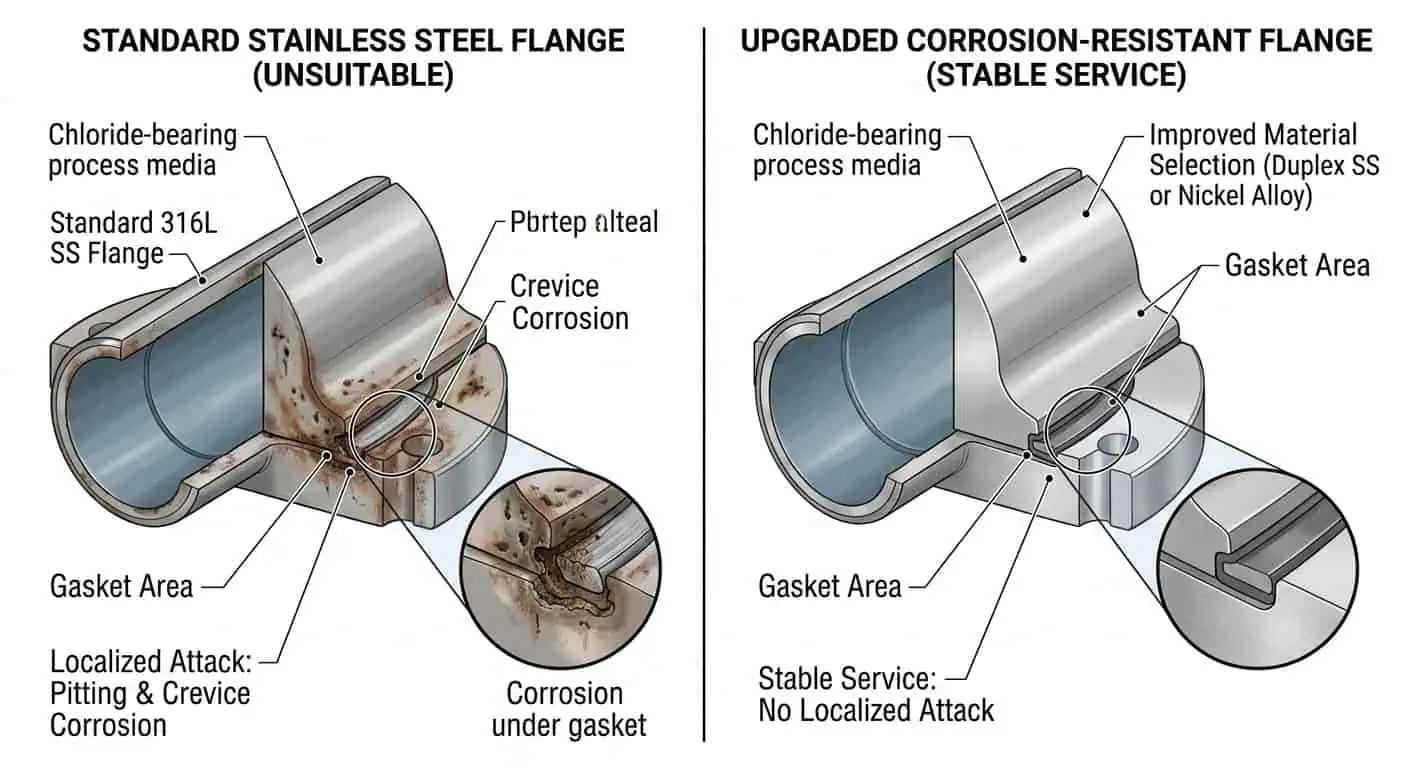
Key lesson: chloride content, temperature, and crevice conditions must be reviewed together
Do not approve 316L in chloride service only because similar lines have run before. Review thermal history, maintenance experience, gasket compression pattern, and stagnant areas. That is where real flange trouble usually starts.
Scenario 3: Wet Chlorine or Mixed Corrosive Service
Why severe service may require specialty alloys or titanium-based solutions
Wet chlorine and mixed corrosive services are high-consequence duties where trial-and-error selection is poor practice. In these environments, the correct answer often moves beyond standard stainless steel and into specialty alloys, titanium-based options, or lined systems depending on the exact combination of media and mechanical requirements.
Why failure consequences are usually too high for trial-and-error material selection
The cost of being wrong is almost always higher than the cost of doing a disciplined review first. A flange leak here can affect safety, emissions, unplanned downtime, and cleanup. That is why these services should be validated with proven application history, test data where available, and supplier input that goes beyond a generic catalog recommendation.
Key lesson: critical corrosive services should be validated with supplier expertise and data
If the service is severe, document the basis for selection. Ask for similar-service references, material compliance records, fabrication controls, and the reasoning behind the recommended flange-gasket-bolting combination.
Scenario 4: Utility or Lower-Pressure Corrosive Chemical Lines
When lined or non-metallic flange systems may be more economical
For lower-pressure corrosive lines, lined or non-metallic flange systems can be the most economical and reliable option. This is especially true where chemical resistance drives the design more than high pressure or high external loading.
What users must verify regarding temperature, mechanical loading, and sealing design
The decision only works if temperature limits, creep behavior, flange flatness, and installation load are controlled tightly. Many non-metallic failures come from steel-flange assembly habits being copied directly into a different joint design.
Key lesson: non-metallic solutions can be excellent, but only within their real operating limits
Use them where they truly fit the duty, not where they merely survive the chemistry on paper.
Practical Flange Material Selection Checklist
Information to Gather Before Requesting a Quote
Before asking a supplier to recommend or quote a flange material, prepare the service basis properly. The better the RFQ data, the more useful the supplier response will be.
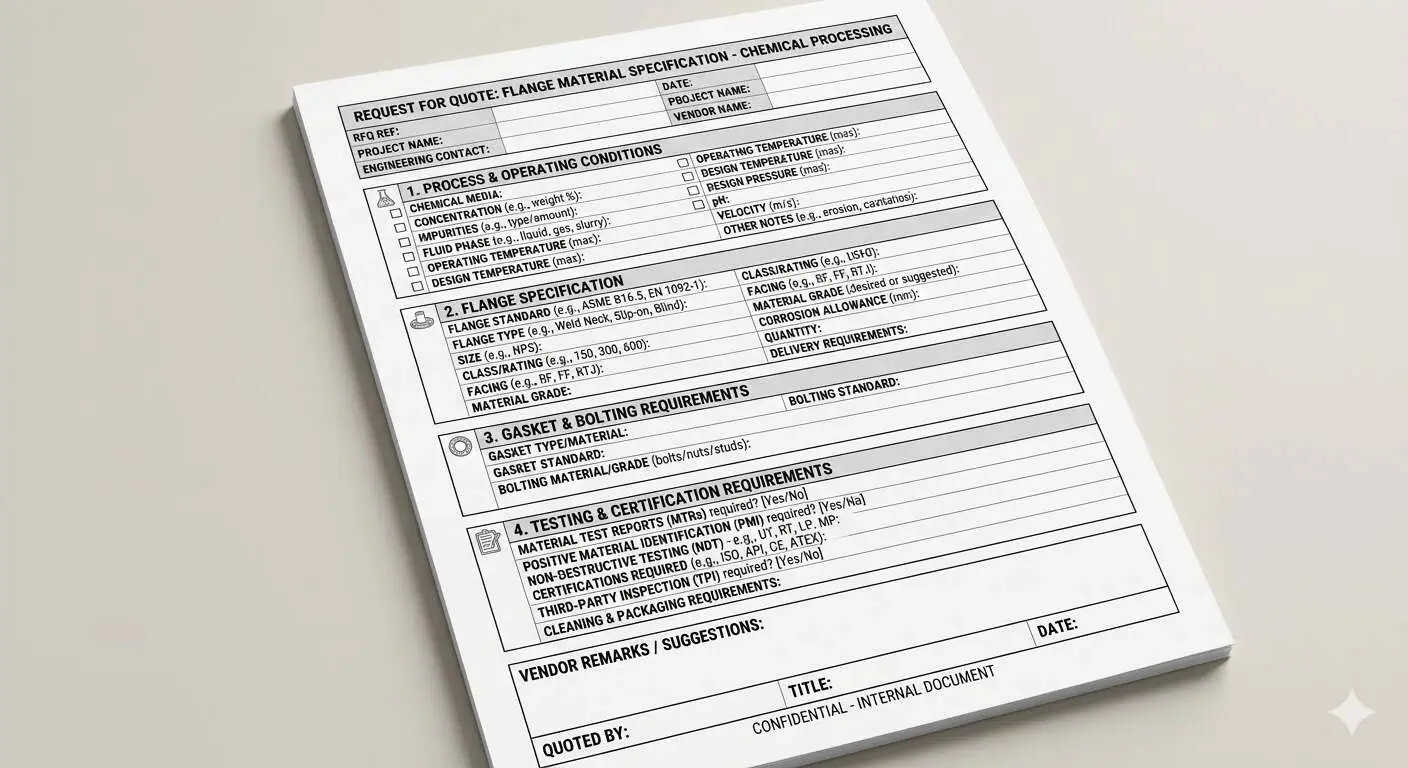
- Process media and concentration
State the exact chemical composition, concentration range, impurities, solids, and whether the service is wet, dry, oxidizing, or reducing. - Operating and design pressure-temperature range
Include normal, design, upset, startup, shutdown, and cleaning conditions. - Applicable flange standard and pressure class
Specify ASME, EN, DIN, or project standard, plus the required class or PN rating. - Corrosion concerns and expected service life
Identify the likely damage mode and whether the flange is in a critical or easy-access location. - Gasket and bolting requirements
Review gasket type, bolt material, assembly method, and any sealing history from similar service. - Documentation, testing, and certification needs
List MTC, PMI, hardness, NDE, coating, third-party inspection, and traceability requirements before RFQ.
Tip: A good RFQ makes material selection faster and safer because it removes hidden assumptions before manufacturing starts.
Questions to Ask Your Flange Supplier
These questions quickly show whether a supplier is giving you an engineering recommendation or just a price.
- Has this material been used successfully in similar service?
Ask for comparable media, temperature range, and installation type. - Can you provide compliance documents and traceability?
Request MTC, heat number traceability, PMI support, and final inspection records. - Are there lead time or forging limitations for this alloy?
This matters for larger sizes, heavy sections, and specialty grades. - Can you support application-based recommendations for the flange, gasket, and bolting set?
This is critical for leakage control in chemical service. - What quality controls are in place for machining, PMI, testing, and final inspection?
Good suppliers should explain their controls clearly, not just say “standard inspection.”
| Supplier Question | What a Good Answer Should Show |
|---|---|
| Similar service experience | Practical understanding of the media, not just a generic catalog answer |
| Compliance and traceability | Clear document package and heat traceability path |
| Forging and lead time limits | Realistic planning and no hidden substitution risk |
| Joint-level recommendation | Ability to review flange, gasket, and bolting together |
| Quality control process | Confidence that the delivered flange matches the approved technical basis |
Note: If the supplier cannot explain why a material is suitable for your service, the quote is probably built around price rather than reliability. For procurement-stage review, this article on questions to ask a flange supplier before RFQ is also worth keeping in your shortlist.
The most reliable material selection method is systematic: define the actual media, verify the full pressure-temperature envelope, identify the dominant corrosion risk, confirm the governing standards, and evaluate the full flange-gasket-bolting joint. No single material works for every chemical process, and no corrosion table replaces engineering judgment.
- Use carbon steel where chemistry is controlled and maintenance access is good.
- Use stainless steel where general corrosion resistance is needed but the service remains within the alloy’s real limits.
- Move to duplex or higher alloys when chloride attack, localized corrosion, or leakage consequence increases.
- Consider lined or non-metallic systems where chemical resistance matters more than high mechanical loading.
Informed material selection lowers leakage risk, reduces unplanned maintenance, and supports safer long-term plant performance. For critical projects, work with suppliers that can support material compliance, joint-level recommendations, and traceable manufacturing from RFQ through final inspection.
FAQ
What is the most important factor when selecting flange materials?
The first and most important factor is chemical compatibility under the real service condition.
This includes the actual media, concentration, impurities, temperature, moisture, velocity, and whether crevice or stagnant conditions exist at the flange joint.
Can one flange material work for all chemicals?
No.
Even commonly used grades such as 316L have practical limits. Material selection must match the specific corrosion mechanism, pressure-temperature range, joint design, and maintenance environment.
Why do standards like ASME or ASTM matter for flange selection?
They provide the technical basis for dimensions, ratings, materials, testing, and traceability.
Using the right standards helps ensure the flange is chemically suitable, mechanically compliant, and properly documented. For installation quality, this guide on joint integrity and flange assembly is also relevant.
When should specialty alloys be considered?
Consider specialty alloys when common stainless steel is borderline or already unreliable in service.
Typical triggers include mixed acids, wet chlorine, aggressive chlorides, repeated crevice failures, high failure consequence, or shutdown leakage risk.
What information should buyers give suppliers for a flange quote?
Provide the full service basis, not only the nominal size and pressure class.
At minimum, include the chemical name, concentration, impurities, design and operating pressure-temperature range, applicable standards, flange type, facing, gasket requirements, bolting requirements, and documentation needs.
| Information | Example |
|---|---|
| Chemical Name | Sulfuric acid |
| Concentration | 70% nominal, occasional dilution during cleaning |
| Pressure | 10 bar design |
| Temperature | 120°C operating, ambient shutdown |
| Standard | ASME B16.5, ASTM A182 |