






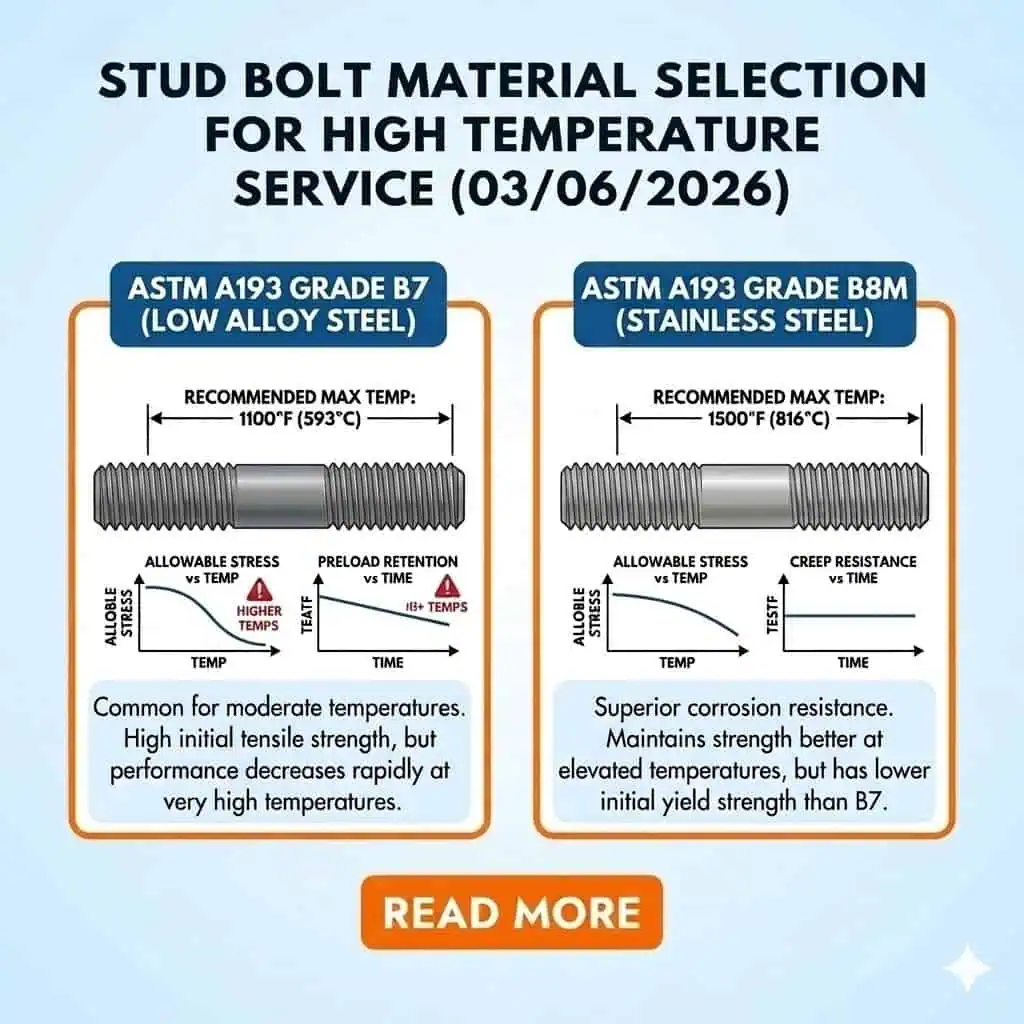
What is the best stud bolt material for high temperature service? In most industrial flange joints, the answer is not one material. The right stud bolt material depends on metal temperature, preload retention, time at temperature, cycling severity, corrosion mechanism, and the governing code allowable stress. For many refinery and power plant joints, engineers start with ASTM A193 bolting grades such as B7 or B16, then move to stainless or higher-performance alloys only when the environment or clamp-load retention requirement justifies the upgrade.
The short version: ASTM A193 B7 is often the first evaluation grade for many medium-to-high temperature refinery and process joints. ASTM A193 B16 is commonly selected when hotter service demands better elevated-temperature strength retention. ASTM A193 B8 or B8M may be chosen where corrosion resistance drives the selection, while ASTM A453 Grade 660 is often evaluated when engineers need both corrosion resistance and stronger preload retention at temperature. Nickel-based alloys are usually reserved for severe hot-corrosive service where standard bolting grades cannot meet the service envelope.
In real plants, hot-service bolting failures usually come from one of four mistakes: selecting by headline temperature only, copying an old spec without checking the actual medium, specifying the stud without controlling the nut and lubricant, or ignoring preload loss after startup. This guide explains how to avoid those mistakes and how to choose the right stud bolt material for high temperature service with a more practical engineering workflow.
Best Stud Bolt Material for High Temperature Service: Quick Answer
If you need a direct answer fast, use the service scenario first and the material name second. Engineers should filter by service condition before comparing prices or defaulting to a familiar grade.
| Application Scenario | Typical First Evaluation Grade | Why It Is Chosen |
|---|---|---|
| Hot process flange joint with controlled corrosion exposure | ASTM A193 B7 | Widely used, strong, available, and familiar in refinery and process plant bolting programs |
| Hotter service where better strength retention is needed | ASTM A193 B16 | Often chosen when B7 is not sufficient for the actual metal temperature and preload retention target |
| Hot service where corrosion resistance is a primary driver | ASTM A193 B8 / B8M | Austenitic stainless bolting is considered when the environment is too aggressive for standard alloy steel |
| Hot and corrosive service where clamp load retention matters more | ASTM A453 Grade 660 | Higher-performance bolting often evaluated when common stainless grades do not provide enough hot-strength margin |
| Severe heat plus severe oxidation or aggressive chemical exposure | Project-specified nickel alloy | Used only when lifecycle risk justifies a premium alloy solution |
Important: The correct choice is the grade that keeps the flange joint sealed after heat-up, cycling, and time at temperature, not the grade that simply survives the peak temperature on paper.
Common Stud Bolt Materials Used in High Temperature Service
ASTM A193 B7 for General High Temperature Service
ASTM A193 B7 is one of the most common stud bolt materials for high temperature service in refineries, piping systems, valves, and flanged joints. It is widely used because it offers strong mechanical performance, broad availability, and familiar inspection and replacement practice. In many plants, B7 is the standard starting point for hot-service bolting where the environment is not highly corrosive.
B7 works well when the joint needs strength, availability, and predictable procurement, but it is not a universal answer. If the service includes strong external corrosion, steam condensate issues, chloride contamination, or long-term clamp-load loss under repeated cycling, engineers often move beyond B7 and evaluate whether the service really needs B16, stainless, or a higher-performance alloy.
- Common refinery and petrochemical bolting grade
- Good balance of strength, cost, and availability
- Best suited where corrosion exposure is controlled
- Should be selected by actual code allowables, not copied by habit
ASTM A193 B16 for Hotter Service
ASTM A193 B16 is commonly evaluated when the service is hotter and the joint needs better elevated-temperature strength retention than B7. This is why engineers often compare A193 B7 vs B16 when reviewing hot hydrocarbon, steam, exchanger, furnace-adjacent, and high-consequence flange joints.
The key difference is not just “B16 is hotter.” The practical difference is that B16 is often selected where the joint needs more margin against preload loss under time at temperature. In hot-service flange engineering, that extra margin can mean fewer startup leaks, fewer retightening events, and less repeat maintenance on the same joint.
| Grade | Where Engineers Commonly Start Using It | Main Decision Driver |
|---|---|---|
| A193 B7 | General refinery and process hot service with controlled environment | Strength, availability, cost balance |
| A193 B16 | Hotter joints where better high-temperature strength retention is needed | More margin for hot-service preload retention |
Illustrative field pattern: a refinery exchanger channel leak may not come from the gasket alone. In many recurring cases, the joint passes initial assembly checks but loses sealing margin after cycling because the bolting grade and procedure were not chosen for long-term clamp-load retention. That is exactly the type of case where teams revisit B7 versus B16 rather than changing gaskets again and again.
ASTM A193 B8 and B8M for Corrosion-Driven Service
ASTM A193 B8 and B8M are commonly considered when corrosion resistance is a major part of the bolting selection. These grades are used in chemical processing, offshore exposure, humid environments, and services where standard alloy steel bolting would need excessive corrosion management.
But this is where buyers often make a mistake. Stainless is not automatically the best stud bolt material for high temperature service. A stainless stud may solve one problem, such as surface corrosion, while creating another problem, such as lower strength margin, different relaxation behavior at temperature, or galling risk during assembly. That is why stainless hot-service bolting must be evaluated as a system, not just a material label.
- B8 is commonly associated with 304-based stainless bolting
- B8M is commonly associated with 316-based stainless bolting
- Used when corrosion exposure is important
- Must still be checked for hot-strength adequacy and preload retention
- Sour-service use is conditional and must be verified to project requirements where MR0175 / ISO 15156 applies
ASTM A453 Grade 660 for High Temperature Bolting
ASTM A453 Grade 660 is one of the most important answers when engineers ask what stud bolt material is best for high temperature service with both heat and corrosion resistance demands. In practice, Grade 660 is often evaluated when common stainless bolting is not enough and the joint needs stronger hot-service preload retention.
That is why searches such as A453 Grade 660 stud bolt, best stud bolt material for heat exchanger service, and high temperature stud bolt material are usually coming from buyers or engineers dealing with repeat leakage, hot-service relaxation, or corrosion-driven fastener upgrades.
| Material | Main Strength | Typical Reason to Upgrade |
|---|---|---|
| A193 B8 / B8M | Corrosion resistance | Corrosion exposure justifies stainless bolting |
| A453 Grade 660 | Better hot-strength plus corrosion resistance | Joint needs stronger clamp-load retention at elevated temperature |
Practical decision rule: if the joint is hot, cycling, critical, and corrosive, A453 Grade 660 usually deserves evaluation long before a plant jumps straight to an expensive nickel alloy.
Nickel Alloy Stud Bolts for Severe Service
Nickel alloy stud bolts are usually selected only when the service envelope is severe enough that standard alloy steel, stainless, or Grade 660 will not provide a reliable lifecycle solution. These upgrades are typically driven by high consequence of leakage, difficult access, severe oxidation, strong chemical attack, or repeated failures in existing service.
In other words, nickel alloy bolting is not where most hot-service selections should begin. It is where many high-consequence selections end after the real service envelope has been reviewed and the cost of downtime is compared with the cost of upgraded hardware.
What High Temperature Does to Stud Bolts
Strength Loss and Preload Loss
High temperature reduces the effective mechanical margin of a bolted flange joint over time. This is the point many non-specialist articles miss. Hot-service bolting is not only about whether the stud can survive the temperature. It is about whether the stud can hold clamp load long enough for the gasket to remain sealed.
At elevated temperature, stud bolts can lose effective load through:
- Reduced strength at metal temperature
- Relaxation under time at temperature
- Creep-related load loss in long-duration service
- Embedment and gasket settling after startup
- Repeated thermal cycling
Field pattern: a flange that passes hydrotest and even initial hot commissioning can still begin leaking after a few cycles. The usual reason is not “mystery gasket failure.” It is clamp-load loss that the joint was never designed or assembled to resist.
Oxidation, Corrosion, and Thread Damage
Hot-service stud bolts do not fail only from temperature. They often fail from the combination of heat and environment. Steam, sulfur compounds, chlorides, condensate, and chemical vapors can degrade threads, reduce effective cross-section, and change assembly friction behavior over time.
| Service Condition | Bolting Risk |
|---|---|
| High temperature dry process service | Preload loss and oxidation |
| Hot service with wet chemical exposure | Corrosion plus preload loss |
| Hot service with chlorides | Material-specific corrosion and cracking concerns |
| Hot service with maintenance substitutions | Wrong-grade replacement and traceability gaps |
This is why a bolting selection that works well on a dry fired heater access flange may fail early on a hot exchanger channel or a corrosive process nozzle. The temperature may look similar, but the environment is not.
Thermal Expansion and Joint Movement
Thermal expansion mismatch between flanges, studs, nuts, and the connected equipment can change clamp load during operation. If the joint also sees vibration, external piping loads, or repeated startup and shutdown, the sealing margin becomes even smaller.
That is why hot-service bolting cannot be selected independently from the rest of the joint. Engineers should treat the flange, gasket, stud, nut, lubricant, and tightening method as one package.
Rule of thumb: if the joint is hot and cycling, the real failure mode is usually not bolt breakage. It is clamp-load drift.
How to Select Stud Bolt Material for High Temperature Service
1. Start With the Actual Metal Temperature
Do not select the stud bolt grade from fluid temperature alone. The selection should be based on the expected metal temperature of the joint, including startup, upset, and cycling conditions where those are relevant to the design basis.
- Check normal operating temperature
- Check upset and transient temperature
- Check cycle frequency and dwell time at temperature
- Check code allowable stresses for the selected grade
2. Check the Real Service Environment
After temperature, the next filter is the actual environment. Is the joint seeing dry heat, steam, wet chlorides, sulfur compounds, hot hydrocarbon vapors, offshore exposure, or sour-service conditions? Each one changes the material ranking.
This is where many procurement mistakes happen. Teams copy “B7” from an old datasheet, but the current joint is in a different area of the plant with a different corrosion mechanism. The hardware looks familiar, but the service is not.
3. Check Preload Retention, Not Only Material Name
The correct stud bolt material is the one that holds the required clamp load for the required service life. If the joint is critical, hot, cycling, and expensive to rework, preload retention deserves more attention than simple material familiarity.
This is the point where engineers often compare:
- A193 B7 vs B16
- B8M vs A453 Grade 660
- Standard hot-service alloy steel vs premium alloy upgrade
Illustrative field pattern: a repeated exchanger leak is often fixed more effectively by correcting the bolting package and assembly method than by installing the same stud grade one more time with a new gasket.
4. Specify the Bolt, Nut, Lubricant, and Procedure as One Package
One of the biggest hidden reasons for hot-service leakage is incomplete bolting specification. A purchase order or drawing may define the stud grade but leave the nut grade, lubricant, and assembly method vague. That creates large variation in actual preload.
| Item to Control | Why It Matters |
|---|---|
| Stud grade | Sets strength and hot-service capability |
| Nut grade | Must be compatible with the stud and service condition |
| Lubricant | Changes friction and actual preload for the same torque value |
| Tightening method | Controls preload consistency and leak-tightness |
| Verification record | Supports repeatability and troubleshooting after startup |
For hot-service flanged joints, that package matters more than many buyers realize. A “correct” stud can still underperform if the nut substitution is wrong, the lubricant changes, or the tightening method is uncontrolled.
5. Confirm Certification and Traceability
Traceability is part of stud bolt material selection, not an admin extra. High-temperature bolting should be linked to the correct documentation before installation, especially in refinery, chemical, offshore, and high-consequence plant service.
- Verify MTR / MTC documents
- Check heat or lot traceability
- Check hardness and any project-required inspection records
- Confirm bolt and nut grade compatibility
- Control substitutions during shutdown work
Clear traceability and marking review reduce the risk of wrong-grade substitution during maintenance, and they make later troubleshooting much faster if the joint leaks after restart.
Common Mistakes in Hot-Service Stud Bolt Selection
Choosing by Temperature Alone
Temperature alone is not enough. A bolting grade that survives a peak temperature may still fail to keep preload in a cycling joint. Always evaluate the combined effect of temperature, time, and load retention.
Copying Old Project Specs Without Reviewing the Current Service
Spec reuse is one of the easiest ways to create repeat leakage. The old project may have used the same flange size, but a different corrosion mechanism, cycle pattern, or maintenance access condition can change the correct material ranking completely.
Specifying the Stud but Not the Nut and Lubricant
Stud bolt material selection is incomplete unless the nut grade and assembly friction condition are also defined. In hot-service bolted joints, uncontrolled friction means uncontrolled preload, and uncontrolled preload means unreliable sealing.
Upgrading Everything When Only a Few Joints Need It
Premium alloys are not automatically better engineering. Over-specification increases cost without improving reliability if the service envelope does not justify it. Smart plants usually upgrade the high-risk joints first and keep standard alloy steel in lower-risk hot-service locations where it is still appropriate.
Best practice: right-size the bolting grade to the actual service envelope, and spend the real engineering effort on critical joints where preload retention and downtime risk matter most.
Engineering Checklist for Buyers and Engineers
Use this simple checklist before releasing a PO or approving a hot-service bolting package.
| Checklist Question | What You Need to Confirm |
|---|---|
| What is the actual metal temperature? | Normal, upset, and cycling condition |
| What environment is the stud seeing? | Dry heat, steam, chlorides, sulfur compounds, corrosive vapors, sour service |
| Does the joint need stronger preload retention? | Check criticality, cycling severity, and leak consequence |
| Is alloy steel enough, or is stainless / 660 / nickel alloy justified? | Select by lifecycle risk, not only purchase price |
| Are the nut grade and lubricant defined? | Control the real preload, not just the torque number |
| Are the documents complete? | MTR, heat traceability, hardness and project-required records |
Where procurement quality matters, working with suppliers who can provide controlled manufacturing, clear marking, and complete documentation helps reduce avoidable risk. For related joint-integrity topics, you can also connect this article internally to flange assembly for zero leakage and understanding bolt grades.
FAQ
What is the most common stud bolt material for high temperature service?
ASTM A193 B7 is one of the most common starting grades for high temperature stud bolts. It is widely used in refineries, power plants, valves, and flanged joints because it balances strength, availability, and cost. But for hotter service or more demanding preload retention, engineers often evaluate ASTM A193 B16 instead.
ASTM A193 B7 vs B16: which is better for high temperature service?
B16 is commonly selected when the joint needs better elevated-temperature strength retention than B7. B7 remains a widely used hot-service grade, but B16 is often preferred for hotter joints where long-term preload retention matters more. The final choice should always be checked against the governing code allowable stress and project requirements.
When should I choose B8M instead of A453 Grade 660?
Choose B8M when corrosion resistance is the main driver and the strength requirement is still satisfied. Choose A453 Grade 660 when the joint needs both corrosion resistance and stronger hot-service preload retention. This comparison matters most in corrosive hot-service joints where common stainless grades are not enough.
When are nickel alloy stud bolts necessary?
Nickel alloy stud bolts are usually justified only for severe combinations of temperature and aggressive media. They are selected where standard alloy steel, stainless, or Grade 660 cannot provide acceptable lifecycle reliability, or where downtime consequence is too high to accept repeat failure risk.
Can I choose stud bolt material by temperature alone?
No. Temperature is only one part of the decision. You also need to check preload retention, cycling severity, corrosion mechanism, code allowable stress, nut compatibility, and the assembly method.
What documents should I ask for when buying high temperature stud bolts?
At minimum, ask for MTR or MTC documents, heat traceability, and the correct grade identification for both stud and nut. For more critical service, also confirm hardness or project-required inspection records and control substitutions during maintenance shutdowns.
Do hot-service stainless stud bolts automatically qualify for sour service?
No. Sour-service use is conditional. If the project defines H2S-containing service, stainless or alloy bolting must be checked against the applicable MR0175 / ISO 15156 requirements and any project-specific hardness, environment, and qualification limits.