Grade 5 and Grade 8 bolts differ mainly in preload capacity, yield margin, and service risk, just as Class 8.8 and Class 10.9 do in the metric system. Grade 8 and Class 10.9 are chosen when the joint needs higher clamp load, better slip resistance, and more stability under shock or vibration. Grade 5 and Class 8.8 remain the practical choice for a large share of machinery, vehicle, and industrial assemblies where cost, toughness, and easier installation control matter more than maximum strength.
The key point is this: buyers should not treat SAE grades and ISO property classes as perfectly interchangeable just because the strength levels look similar. SAE J429 and ISO 898-1 are different systems with different thread forms, dimensions, markings, and qualification routes. In real projects, the right question is not only “Which bolt is stronger?” but “Which bolt grade gives the required preload without creating galling, hydrogen embrittlement, stripped threads, or fatigue loosening?”
| System | Grade / Class | Minimum Tensile Strength | Typical Use |
|---|---|---|---|
| SAE J429 | Grade 5 | 120 ksi | General machinery, medium-duty automotive, serviceable industrial joints |
| SAE J429 | Grade 8 | 150 ksi | Heavy equipment, suspension, critical clamp-load joints |
| ISO 898-1 | Class 8.8 | 800 MPa | Metric machinery assemblies, frames, industrial equipment |
| ISO 898-1 | Class 10.9 | 1,000 MPa class level | High-strength metric joints, powertrain, earthmoving equipment |
Engineering warning: a stronger bolt does not automatically make a safer joint. If the nut grade is too low, the washer is too soft, the thread engagement is too short, or the friction condition changes because of coating or lubricant, the joint can still fail long before the bolt reaches its headline tensile strength.
Engineering Fundamentals: What Defines a Bolt Grade?
A bolt grade is a mechanical classification defined by material, heat treatment, and standard-based performance limits. In practical engineering terms, bolt grade tells you how much preload a fastener can safely carry, how close it can run to yield strength, and how much safety margin remains before permanent deformation or fracture becomes a risk.
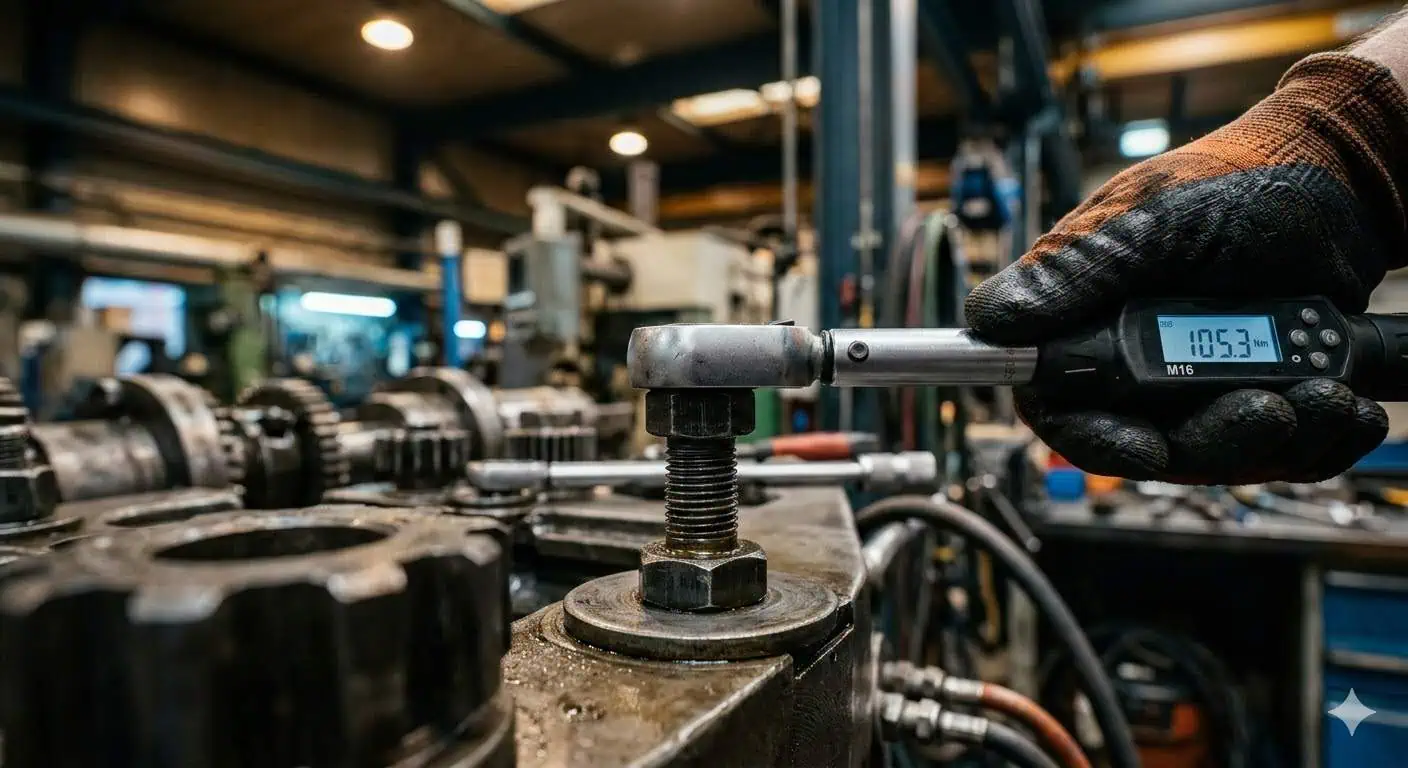
Understanding Key Metrics: Proof Load, Yield Strength, and Tensile Strength
These three values determine whether a bolted joint stays tight or turns into a leak, slip, or fatigue problem.
- Proof Load: the highest load a bolt can sustain without permanent set. This is critical when defining a safe preload target.
- Yield Strength: the stress level where permanent deformation starts. Once yield is crossed, clamp force becomes unstable and reuse is no longer good practice.
- Tensile Strength: the maximum stress before rupture. It is important for classification, but most field failures happen earlier through preload loss, stripping, joint embedding, or vibration loosening.
In the workshop, installers tighten to a torque value, but what the joint actually needs is repeatable preload. That preload depends on bolt grade, nut fit, washer hardness, surface roughness, thread pitch, and the friction factor K. For common industrial assemblies, the same nominal torque can produce very different clamp loads if one fastener is plain oil-finished and the other is zinc-plated or lubricated. In many joints, K can vary roughly from 0.10 to 0.22, which is enough to turn a “correct” torque into either under-tightening or over-stressing.
| Bolt Grade / Class | Minimum Yield Strength | Minimum Tensile Strength | Practical Engineering Note |
|---|---|---|---|
| Grade 5 | 92 ksi | 120 ksi | Balanced cost and strength for medium-duty inch-series joints |
| Grade 8 | 130 ksi | 150 ksi | Higher preload ceiling and better slip resistance in severe-duty service |
| Class 8.8 | 640 MPa | 800 MPa | Reliable metric workhorse for machinery and general industrial assemblies |
| Class 10.9 | 900 MPa | 1,000 MPa class level | Higher preload potential, but tighter control of coating and torque is needed |
The Role of SAE J429 (Imperial) vs. ISO 898-1 (Metric) Standards
SAE J429 governs inch-series fasteners, while ISO 898-1 governs carbon and alloy steel metric fasteners. Buyers often compare Grade 5 to Class 8.8 and Grade 8 to Class 10.9 because they occupy similar strength tiers, but those comparisons are for reference only. Substitution still requires checking thread system, dimensions, nut compatibility, washer hardness, and installation method. For broader fastener specifications and testing requirements, buyers can also review ASTM fastener standards. Inch-series bolt dimensions are commonly referenced against ASME B18.2.1, while metric mechanical properties are defined in ISO 898-1.
| Feature | SAE J429 | ISO 898-1 |
|---|---|---|
| Primary system | Imperial / inch-series | Metric |
| Identification | Radial head markings | Property class numbers stamped on the head |
| Typical examples | Grade 2, Grade 5, Grade 8 | 4.8, 8.8, 10.9, 12.9 |
| Selection focus | Strength level plus inch dimensions | Property class plus metric dimensions |
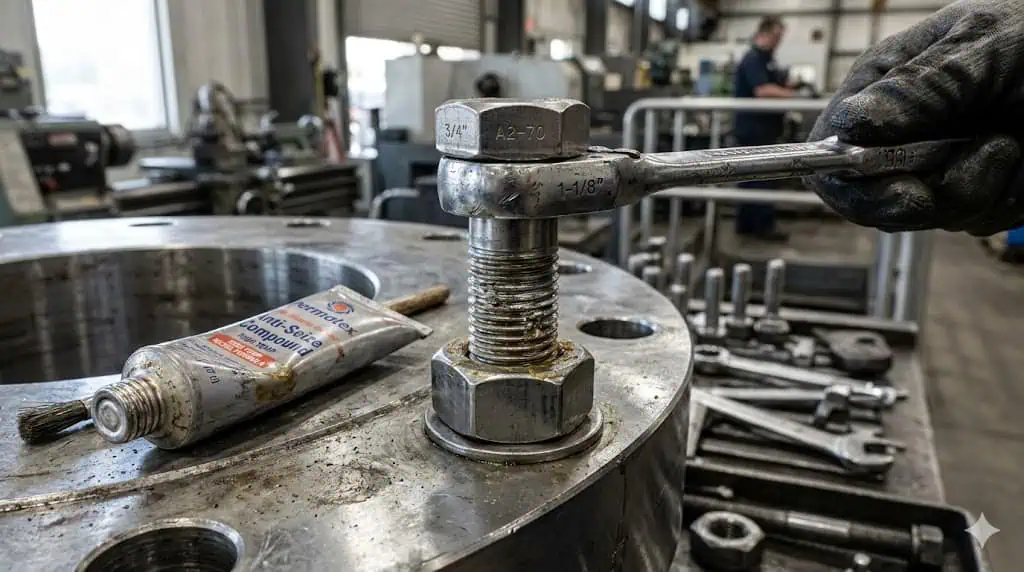
For corrosion-resistant fasteners such as A2-70 and A4-80, engineers usually refer to ISO 3506-1 rather than ISO 898-1. That matters because stainless steel fasteners behave differently from carbon steel or alloy steel bolts under torque, preload, and galling conditions.
SAE J429 Comparison: Grade 5 vs. Grade 8
Grade 5 and Grade 8 are both heat-treated bolts, but they serve different clamp-load targets. Grade 5 is the practical middle ground. Grade 8 is the higher-strength option when the joint must resist shock, joint separation, or micro-slip under load.
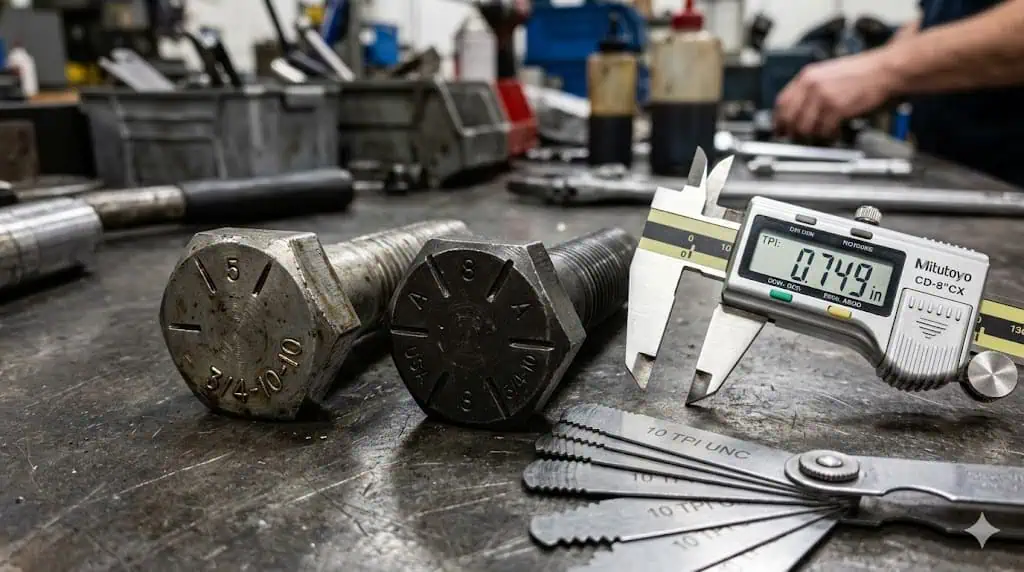
Mechanical Properties Breakdown (120 ksi vs. 150 ksi Tensile Strength)
Grade 8 bolts are roughly 25% higher in minimum tensile strength than Grade 5 bolts. That extra strength gives a higher clamp-load ceiling, which is why Grade 8 is common in suspension, heavy equipment, and other load-sensitive joints. Grade 5 remains the better fit where the joint does not need maximum preload and the buyer wants a more economical solution.
| Bolt Grade | Minimum Tensile Strength | Minimum Yield Strength | Typical Use |
|---|---|---|---|
| Grade 5 | 120 ksi | 92 ksi | General machinery, agricultural equipment, medium-duty assemblies |
| Grade 8 | 150 ksi | 130 ksi | Heavy equipment, truck suspension, high-stress industrial joints |
Material Composition: Medium Carbon Steel vs. Medium Carbon Alloy Steel
Material chemistry and heat treatment are what create the strength difference. Grade 5 is commonly produced from medium carbon steel and then quenched and tempered. Grade 8 usually relies on medium carbon alloy steel and similar heat treatment, which increases hardness and yield strength. The result is more preload potential, but also less tolerance for poor assembly practice.
For metric high-strength bolts, steels such as SCM435 or equivalent alloy routes are often used to achieve Class 10.9 and above. This is one reason why the buyer cannot judge a fastener only by surface appearance or color.
Identification: Reading the Radial Lines (3 Lines vs. 6 Lines)
Head markings allow quick field identification. Grade 5 bolts usually show 3 radial lines on the head. Grade 8 bolts usually show 6 radial lines. In real maintenance work, this matters because mixed bins, repainting, and undocumented field replacements are common causes of grade mismatch.
| Bolt Grade | Head Marking | Field Check Point |
|---|---|---|
| Grade 5 | 3 radial lines | Suitable for many standard-duty inch-series applications |
| Grade 8 | 6 radial lines | Preferred when clamp-load demand is higher |
Safety note: visual head marking is only the first screen. For critical service, also verify lot traceability, dimensional inspection, and mating hardware grade.
ISO 898-1 Comparison: Class 8.8 vs. Class 10.9
Class 8.8 and Class 10.9 are the most widely compared metric high-strength property classes in industrial procurement. The selection usually comes down to preload demand, service severity, and whether the buyer can control torque, coating, and friction conditions with enough consistency.
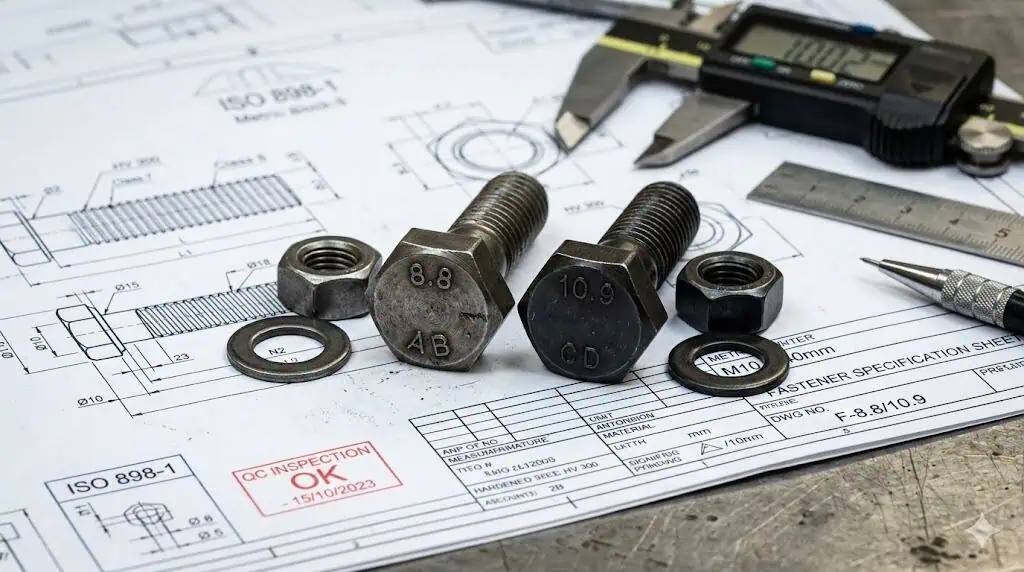
Decoding the Numbers: What “8.8” and “10.9” Actually Mean
The first number shows the tensile strength class level, and the second shows the yield ratio. For Class 8.8, the tensile class level is 800 MPa and the yield ratio is 0.8, giving a minimum yield strength of 640 MPa. For Class 10.9, the tensile class level is 1,000 MPa and the yield ratio is 0.9, giving a minimum yield strength of 900 MPa.
| Property Class | Tensile Strength Level | Yield Ratio | Minimum Yield Strength |
|---|---|---|---|
| 8.8 | 800 MPa | 0.8 | 640 MPa |
| 10.9 | 1,000 MPa class level | 0.9 | 900 MPa |
Strength Comparison (800 MPa vs. 1000 MPa Class Level)
Class 10.9 is chosen when the joint depends on higher preload rather than bolt shank shear alone. Class 8.8 is suitable for a broad range of machine frames, brackets, housings, and general industrial metric joints. Class 10.9 is preferred for powertrain joints, compact high-load assemblies, earthmoving equipment, and other applications where reduced joint slip matters.
- Use Class 8.8 where serviceability, cost control, and broad availability matter.
- Use Class 10.9 where the joint needs higher clamp load and better resistance to vibration-driven separation.
- Do not move to Class 10.9 just because “stronger sounds safer.” Review coating route, nut grade, and torque method first.
Identification: Head Markings and Manufacturer Symbols
Metric bolts identify their property class directly on the head. A Class 8.8 bolt is marked 8.8. A Class 10.9 bolt is marked 10.9. Manufacturer symbols matter too, because once a failure investigation starts, traceability is what separates a qualified lot from a risky one.
| Head Marking | Strength Tier | Practical Risk If Misused |
|---|---|---|
| 8.8 | Medium-high strength | Joint slip or preload loss in severe service |
| 10.9 | High strength | Hydrogen embrittlement and torque error if process control is poor |
| 12.9 | Very high strength | Higher brittleness sensitivity and tighter installation demands |
Application Scenarios: When to Use Which Grade?
The best bolt grade is the one that meets the load, environment, and maintenance conditions of the joint without over-specifying cost or creating avoidable installation risk.
Grade 5 / Class 8.8: Automotive General Use and Structural Assemblies
Grade 5 and Class 8.8 are the workhorse choices for general mechanical joints. They are commonly used in vehicle service parts, machinery housings, agricultural equipment, conveyor systems, and structural assemblies where moderate preload is sufficient.
- Vehicle chassis and service hardware
- Industrial machine frames and covers
- Agricultural and conveying equipment
- General structural assemblies with moderate clamp-load demand
Grade 8 / Class 10.9: Heavy Suspension, Earthmoving Equipment, and High-Stress Zones
Grade 8 and Class 10.9 belong in joints that must stay clamped under severe dynamic loading. These are common in heavy truck suspension, excavator structures, mining equipment, industrial presses, loader arms, and powertrain assemblies where joint separation and micro-slip cannot be tolerated for long.
- Heavy truck and trailer suspension systems
- Earthmoving and mining machinery
- Powertrain and gearbox connections
- High-load industrial brackets and critical mounting joints
Environmental Considerations: Zinc Plating vs. Plain Finish Risks
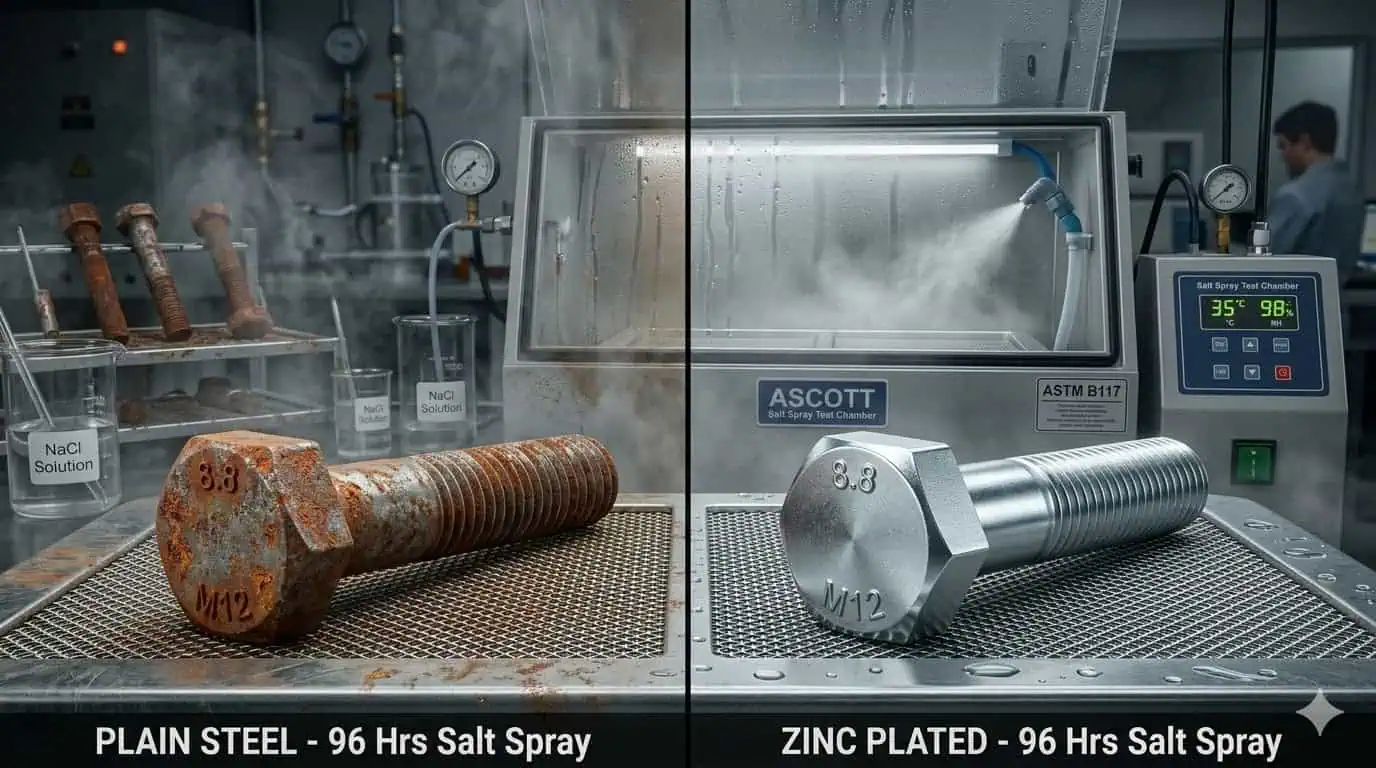
Surface finish changes both corrosion performance and installation behavior. Plain-finish fasteners are common in dry indoor service. Zinc-plated bolts provide better corrosion protection, but they also change friction and can increase hydrogen embrittlement risk on high-strength grades if the process is poorly controlled. Standard electro-zinc thickness in many industrial applications is often controlled in roughly the 5–12 μm range, but exact thickness must match the product specification and thread fit requirements. For plated mechanical fasteners, buyers should review coating requirements against ASTM F1941/F1941M.
| Finish / Material | Corrosion Resistance | Installation Impact | Typical Use |
|---|---|---|---|
| Plain finish carbon/alloy steel | Low | Stable fit, no coating buildup, minimal corrosion reserve | Dry indoor service, controlled maintenance environment |
| Zinc-plated steel | Moderate | Changes friction and may require revised torque assumptions | General industrial outdoor or humid conditions |
| 304 / A2 stainless steel | High | Good corrosion resistance, but galling risk if assembled dry | Outdoor, food equipment, general corrosive service |
| 316 / A4 stainless steel | Higher in chloride-prone service | Same galling caution applies; better for harsher environments | Marine, chemical, washdown, coastal applications |
Corrosion performance data should also be read carefully. Salt spray numbers are useful for comparing coating systems under controlled laboratory conditions, but they are not a direct guarantee of field service life. The salt spray test environment itself is defined by ASTM B117, which standardizes the apparatus and test conditions rather than promising a fixed real-world lifespan for any fastener finish.
Engineering warning: never copy a dry plain-finish torque value directly onto a lubricated or coated fastener. The preload can increase enough to strip internal threads or push the bolt too close to yield.
Material Science & Manufacturing Quality
Material science is where good-looking fasteners get separated from reliable fasteners. Chemistry, heat treatment, decarburization control, coating route, and dimensional discipline all affect how the joint performs once real load is applied.
Heat Treatment Processes: Quenching and Tempering Differences
Quenching gives hardness, while tempering makes that hardness usable. High-strength bolts depend on controlled heat treatment to balance strength and toughness. If heat treatment is unstable, the fastener may still pass a quick visual inspection and fail under load by brittle fracture, low ductility, or inconsistent hardness from lot to lot.
This is why experienced buyers check more than tensile numbers. They also look at hardness results, dimensional accuracy, thread finish, chamfer quality, and whether the manufacturer can tie each lot back to real inspection records.
The Risk of Hydrogen Embrittlement in High-Strength Bolts (Grade 8 / 10.9)
Hydrogen embrittlement is one of the most dangerous hidden failure modes in high-strength plated fasteners. Hydrogen can enter the steel during cleaning, pickling, or electroplating. The bolt may install normally, hold preload for a short period, and then crack or fracture later with very little warning. This risk becomes much more important once you move into Grade 8, Class 10.9, and above. For plated fasteners, ASTM F1941/F1941M is one of the key external references because it addresses coating requirements, corrosion performance, and hydrogen embrittlement precautions for mechanical fasteners.

- High-strength bolts are more sensitive to hydrogen than lower-strength bolts.
- Electroplated finishes need process control, post-plating baking where specified, and clear inspection records.
- For critical joints, buyers should review whether a non-electrolytic coating route or a stricter plating control plan is the safer choice.
Safety warning: if a Grade 8 or Class 10.9 bolt is plated, ask for the coating specification, hydrogen relief control, and traceability record. This is not paperwork for its own sake. It is fracture prevention.
Why Material Traceability (MTRs) Matters in B2B Procurement
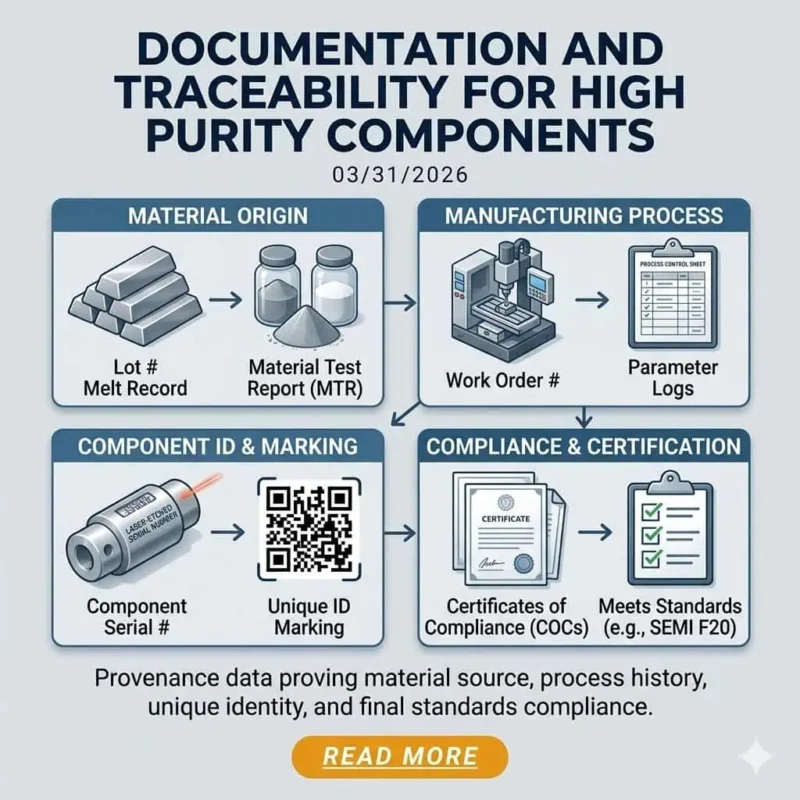
Traceability is what separates a catalog part from an auditable industrial fastener. For B2B buyers, the fastener should be traceable back to its raw material lot, heat treatment batch, dimensional inspection, and coating process. Without that trail, it becomes hard to confirm compliance or investigate a failure correctly.
| Traceability Item | Why It Matters |
|---|---|
| Heat / lot number | Links the product to raw material and manufacturing history |
| Mechanical test record | Confirms grade, yield, tensile strength, and hardness compliance |
| Coating process record | Important for corrosion consistency and hydrogen control |
| Dimensional inspection | Prevents pitch, thread fit, chamfer, and head dimension problems |
Critical Safety: Matching Bolts, Nuts, and Washers
A bolted joint is a system. The bolt, nut, washer, thread pitch, surface finish, and contact face all share the load. If one part is underspecified, the whole joint becomes unreliable.
The “Weakest Link” Rule: Matching Nut Grades to Bolt Grades
A high-strength bolt cannot perform correctly if the mating nut or washer is too weak. The joint may fail by thread stripping, surface embedding, loss of preload, or uneven bearing stress long before the bolt body is close to fracture.
- Match nut grade or property class to the bolt.
- Use hardened washers where bearing stress or paint compression is an issue.
- Check thread engagement length and pitch compatibility.
- Review bearing face condition, especially on coated, slotted, or uneven surfaces.
Danger of Counterfeit Bolts: How to Spot Low-Quality Fasteners
Counterfeit or downgraded fasteners usually fail in the most expensive joints. Warning signs include poor thread finish, unclear head marks, excessive plating buildup, inconsistent dimensions, missing lot records, and vague mechanical claims with no supporting inspection data.
- Inspect the head mark and manufacturer symbol.
- Check thread form and pitch with proper gauges.
- Look for coating buildup or thread interference.
- Review inspection records and traceability for critical lots.
- Use third-party testing where the service risk justifies it.
Torque Specifications: Why High-Grade Bolts Require Precise Installation
Torque is only a method. Preload is the real target. Higher-grade fasteners need tighter installation discipline because the margin between “not enough clamp load” and “too much stress” becomes smaller. The same torque value can create very different preload if lubrication, thread condition, washer hardness, or under-head friction changes.
| Bolt Grade / Class | Installation Sensitivity | Main Risk If Torque Is Wrong |
|---|---|---|
| Grade 5 / Class 8.8 | Moderate | Loosening, joint slip, preload loss |
| Grade 8 / Class 10.9 | High | Thread stripping, bolt stretch, fracture, or fatigue from poor clamp control |
If you are not sure about the actual friction factor in your joint, especially with plating, anti-seize, or coated washers, consult an engineer and use a verified torque-preload table instead of copying a generic chart. This is one of the simplest ways to prevent field failures in high-strength joints.
Workshop warning: stainless steel bolts should not be assembled dry in critical service. Galling can seize the threads before target preload is reached, especially with 304/A2 or 316/A4 mating combinations.
Engineering Cases: Why Fasteners Still Fail in the Field
Case 1: Upgrading from 8.8 to 10.9 Did Not Stop Joint Loosening
Problem: a heavy-equipment customer upgraded an M20 joint from Class 8.8 to Class 10.9 and expected the connection to become more reliable. The joint still loosened under vibration.
Analysis: the bolt grade was increased, but the assembly process stayed the same. The team reused the old torque value, kept the same washer arrangement, and did not account for the lower friction condition of the new coated fastener. The result was inconsistent preload and continued embedding at the contact face.
Solution: the joint was revalidated with hardened washers, controlled lubrication status, and a revised torque-preload window. Once clamp-load consistency improved, loosening stopped. The real fix was preload control, not just a higher number on the bolt head.
Case 2: Delayed Fracture of High-Strength Zinc-Plated Fasteners
Problem: a batch of plated high-strength fasteners passed incoming inspection and then fractured days after installation.
Analysis: fracture timing and appearance suggested hydrogen embrittlement. The plating route and post-process control were not strict enough for the strength level of the fastener.
Solution: the buyer tightened coating specifications, required clearer baking and traceability records, and reviewed alternative coating routes for the most critical joints. The lesson was simple: for high-strength bolts, corrosion protection and embrittlement control must be specified together.
Strategic Sourcing: Choosing the Right Supplier
The cheapest fastener is rarely the lowest-priced one. The best supplier is the one that delivers the required grade, stable dimensions, traceable lots, and technical support that prevents costly joint failures later.
Balancing Strength Requirements with Project Budget
Over-specifying wastes money, but under-specifying usually costs more in rework, downtime, leakage, and warranty claims. The buyer should evaluate fasteners not only by unit price, but by preload consistency, coating reliability, inspection discipline, and whether the supplier understands the actual service condition.
| Supplier Evaluation Point | Why It Matters |
|---|---|
| Mechanical compliance | Confirms the advertised grade or class is real |
| Traceability | Makes audits and failure investigations possible |
| Coating control | Reduces corrosion inconsistency and hidden embrittlement risk |
| Technical support | Helps buyers avoid substitution and torque mistakes |
| Delivery consistency | Prevents mixed lots and production interruptions |
The Importance of Manufacturer Certifications (Sunhy’s Quality Assurance)
Certifications matter because they show the supplier can repeat quality, not just advertise it. For OEM, energy, industrial machinery, and export projects, buyers need a supplier that can support lot traceability, inspection records, coating discussion, and fit-for-service fastener selection.
- Documented quality systems support repeatable production.
- Inspection records reduce the risk of mixed-grade shipments.
- Traceability helps verify compliance for critical industrial orders.
- Application support helps buyers match bolt grade, coating, and torque method more accurately.
Sunhy is strongest where the buyer needs a technical fastener partner rather than a simple box supplier: industrial fastener supply, material support, technical guidance, and custom discussions for OEM or project-based procurement.
For buyers who need to verify dimensions, property classes, coating controls, or corrosion test methods before ordering, the most useful external references are ASME B18.2.1, ISO 898-1, ISO 3506-1, ASTM F1941/F1941M, and ASTM B117.
FAQ
What is the main difference between Grade 5 and Grade 8 bolts?
Grade 8 bolts provide higher yield and tensile strength, which means they can deliver higher preload and better joint stability in severe-duty service. Grade 5 is usually the practical choice for medium-duty assemblies where the load and vibration level do not justify the extra strength and tighter installation control.
Can Class 10.9 replace Class 8.8 in any metric joint?
No. A Class 10.9 bolt can provide more clamp load, but the joint also needs a compatible nut, suitable washer hardness, correct thread engagement, and a verified torque-preload method. Upgrading the bolt alone can create stripping, embedding, or fatigue problems if the joint design is not reviewed.
Why do stainless steel bolts sometimes seize during installation?
Austenitic stainless fasteners such as 304 / A2 and 316 / A4 can gall under pressure and friction, especially when assembled dry. Use anti-seize, controlled lubrication, slower installation speed, and clean threads to reduce the risk of cold welding and seizure.
When should a Class 10.9 bolt be used?
Use Class 10.9 when the joint depends on higher preload, reduced slip, or better performance under heavy dynamic load. Typical examples include powertrain joints, earthmoving equipment, heavy suspension points, and compact high-load industrial assemblies.
What does material traceability mean for bolts?
Material traceability means the fastener can be linked back to its material heat, manufacturing lot, inspection results, and sometimes its coating process. This is essential for critical industrial projects, quality audits, and failure analysis.