
Spectacle Blinds, Line Spades, and Ring Spacers :ASME B16.48 Line Isolation Solutions for Critical Piping
At Sunhyings, we provide comprehensive solutions for positive pipeline isolation. Whether you need a standard Spectacle Blind Flange for quick maintenance or heavy-duty Line Spades and Ring Spacers for large-diameter pipes, our products guarantee safety and zero leakage. Manufactured in strict accordance with ASME B16.48 (API 590) standards, our isolation flanges are trusted globally in oil, gas, and chemical industries.
Types of Spectacle Blind & Spades We Supply
 Stainless Steel Flanges
By Design Type
By Standard & Class
Advanced Materials
Why Choose Sunhy?
- Certified Quality: Strictly manufactured to ASME B16.48 with full Mill Test Certificates (EN 10204 3.1) included.
100% Traceability: rigorous PMI (Positive Material Identification) testing on all Stainless & Carbon Steel grades.
Custom Solutions: We offer special dimensions, coatings, and Jack Screw integration for safer maintenance.
One-Stop Supply: We can package your blinds with matching gaskets and bolts to ensure a perfect fit.
Global Delivery: Expert packaging and logistics for heavy flanges, ensuring safe arrival worldwide.
What are Spectacle Blinds and Line Spades?
These are safety devices used to permanently isolate a section of pipe or equipment. Unlike a valve, they provide a physical, visible assurance that a line is closed (“blinded”) or open.
1. Spectacle Blind Flanges (Figure-8 Blinds) Ideal for pipe sizes from 1/2″ to 24″. The unit consists of a steel spade (blind) and a spacer (ring) connected by a web, resembling a pair of spectacles.
Function: To switch between open and closed positions, simply loosen the bolts (often using jack screw flanges to spread the joint) and rotate the blind.
Benefit: The “open” and “closed” parts are attached, preventing loss of parts and ensuring quick identification of the line status.
2. Line Spades (Paddle Blinds) & Ring Spacers For larger pipelines (e.g., spectacle blind flanges 36 inches and above) or high-pressure ratings (Class 900+), the weight of a single spectacle blind becomes too heavy to handle safely.
Solution: We use separate Line Spades (to block flow) and Ring Spacers (to allow flow).
Handle Design: Our spades feature distinct handles that protrude from the flange connection, providing a clear visual indicator of the line’s status even when insulated.
Standard & Material Compliance We prioritize safety and durability. Our flanges meet ASME B16.48 standards for dimensions and ASME B16.5 for mating flange compatibility.
Stainless Steel Spectacle Blinds: Manufactured from ASTM A182 F304/304L and F316/316L, ideal for corrosive chemical and offshore environments.
Carbon Steel: ASTM A105 and A350 LF2 for standard oil & gas applications.
| Feature | Specification Details |
| Product Names | Spectacle Blind, Figure-8 Blind, Line Spade (Paddle Blind), Ring Spacer (Paddle Spacer) |
| Design Standards | ASME B16.48, API 590 |
| Size Range | 1/2″ to 60″ (Spectacle type typically up to 24″) |
| Pressure Ratings | Class 150, 300, 600, 900, 1500, 2500 |
| Sealing Face | Raised Face (RF), Flat Face (FF), Ring Type Joint (RTJ) |
| Stainless Steel Materials | ASTM A182 F304/F304L, F316/F316L, F321, F347, F904L |
| Carbon & Alloy Materials | ASTM A105, A350 LF2, ASTM A182 F5, F9, F11, F22, F91 |
| Surface Finish | Anti-rust oil, Black painting, Galvanized, or Pickled (for Stainless) |
Spectacle Blind vs. Blind Flange vs. Slip Blinds
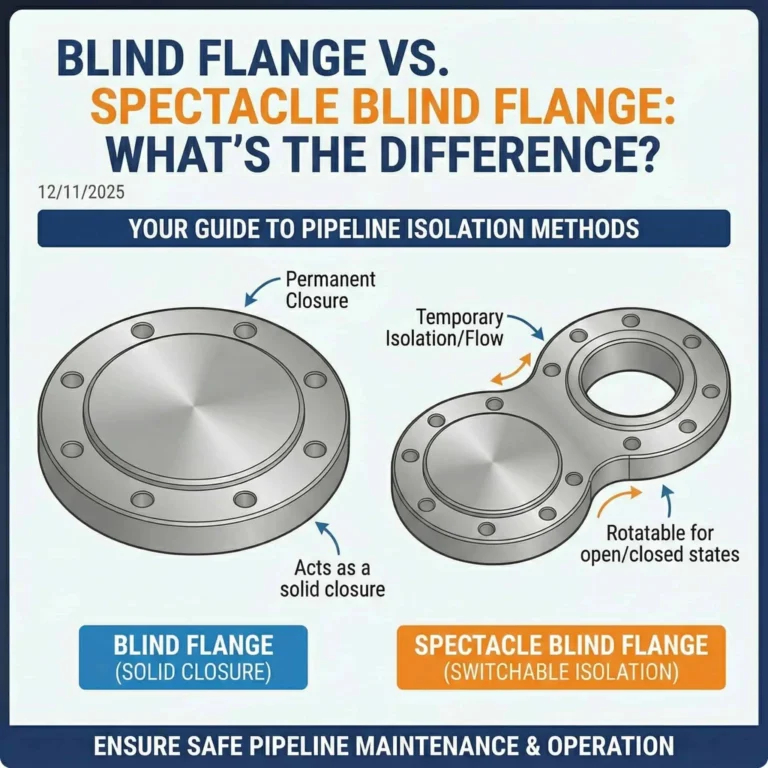
Spectacle Blind vs. Blind Flange. Customers often ask about the difference between these isolation methods:
Spectacle Blind: A single unit attached to the line. Pros: Immediate availability, no missing parts. Cons: Heavy for very large sizes.
Standard Blind Flange: Used to terminate the end of a pipe permanently or semi-permanently.
Spades and Ring Spacers (Paddle Blinds): Similar function to spectacle blinds but are two separate pieces. Preferred for large diameter pipes (e.g., above 24 inches) where the weight of a connected spectacle blind would be too heavy to rotate manually.
Dimensions & Weight Info
Engineers must account for spectacle blind flange dimensions and weight during piping design.
Thickness: The thickness of the blind plate increases with pressure class to withstand the line pressure.
Weight: A 12-inch Class 150 spectacle blind weighs approx. 17kg, while a Class 900 version can weigh over 80kg. For heavy blinds, we recommend using Line Spades to comply with lifting safety regulations.
Download our full PDF catalog for detailed dimensional charts.
Applications
Oil & Gas Refineries: Isolating standard process lines for maintenance.
Chemical & Petrochemical: Preventing cross-contamination in manifold systems.
Offshore Platforms: High-corrosion resistance using Duplex and Stainless Steel blinds.
Water Treatment: Large diameter isolation.
FAQ
What is the difference between a Spectacle Blind and a Blind Flange?
A Spectacle Blind (ASME B16.48) is a safety isolation device consisting of a solid disc and a hollow ring connected by a tie bar, installed between two flanges to allow for isolation without removing the component from the line. In contrast, a Blind Flange (ASME B16.5) is a solid disc bolted to the end of a pipe to terminate the line, requiring full removal to reopen the system.
| Feature | Spectacle Blind | Blind Flange |
| Standard | ASME B16.48 | ASME B16.5 |
| Structure | Figure-8 (Solid + Open ends) | Single Solid Disc |
| Installation | Sandwiched between flanges | Bolted to pipe end |
| Function | Reversible (Open/Close switching) | Permanent or End-of-Line Closure |
| Efficiency | High (Rotates in place) | Low (Must be removed) |
When should I use a Line Spade instead of a Spectacle Blind?
You should use a Line Spade (Paddle Blind) and Spacer instead of a Spectacle Blind for piping systems larger than NPS 10 to 12, or in high-pressure classes where weight becomes a safety issue.
While Spectacle Blinds are convenient for smaller pipes, they become impractical in the following scenarios :
Weight Constraints: In large diameters, a single-piece Spectacle Blind can weigh hundreds of pounds. Using a separate Spade and Spacer halves the weight maintenance crews must lift during changeovers.
Space Limitations: Spectacle Blinds require significant clearance to rotate the “figure-8” shape. In congested pipe racks, a Spade (which is inserted directly) saves vertical and lateral space.
Cost Efficiency: For very large or high-alloy applications, manufacturing two separate pieces (Spade and Spacer) is often more cost-effective than a massive, single-forged Spectacle Blind.
Do you offer Jack Screws?
Yes, we supply Jack Screws (also known as Flange Spreaders or Jack Bolts) as essential accessories for safe blind isolation.
In the context of ASME B16.48 isolation, Jack Screws are used to spread the mating flanges safely, breaking the gasket seal to allow for the rotation of a Spectacle Blind or the insertion of a Spade.
How to Use Jack Screws for Isolation:
Depressurize: Ensure the line is fully depressurized and drained.
Loosen: Loosen all flange bolts (do not remove them entirely).
Engage: Turn the Jack Screws to apply pressure against the flange faces.
Spread: Create a gap just wide enough to free the Spectacle Blind or Spacer.
Rotate: Rotate the blind to the desired position.
Retract: Retract the Jack Screws and retorque the flange bolts to specifications.