Eine Grade-8-Schraube kann einer ähnlichen Festigkeitsklasse entsprechen, jedoch eine andere Kopfform, Gewindelänge oder Prüfgrundlage als die spezifizierte A490-Schraube aufweisen. Diese Unterschiede können auch bei identischem Nenndurchmesser von Bedeutung sein.
Ähnliche Festigkeit macht aus Grade 8 keine A490-Strukturschraube
SAE J429 legt mechanische und werkstoffliche Anforderungen für außengewindete Verbindungselemente aus Stahl der Zollreihe fest, einschließlich Schrauben, Schrauben und Stehbolzen. Grade 8 bezeichnet eine mechanische Eigenschaftsklasse innerhalb dieser Spezifikation. Sie legt für sich genommen weder die Kopfdimensionen noch die Gewindelängenkonfiguration fest, die für eine strukturelle Grade-A490-Schraube erforderlich sind.
ASTM F3125/F3125M dient einem anderen Produktspezifikationszweck. Sie umfasst hochfeste Strukturschrauben und -baugruppen, einschließlich Grade-A490-Schwer-Sechskantschrauben für strukturelle Verbindungen. ASTM F3125 enthält Anforderungen an das Strukturverbindungselement, während die anwendbaren Maßnormen und die RCSC-Verbindungsspezifikation weitere Teile ihrer Verwendung abdecken.
Der aktuelle ASTM F3125/F3125M-26 identifiziert Grade A490 als eine Schwerlast-Sechskantschrauben-Festigkeitsklasse für den Strukturbau. Die 2025 RCSC Specification ordnet Grade A490 in ihre Group 150 classification ein.
AISC beschreibt SAE J429 Grade 8 als festigkeitsäquivalent zu Grade A490, weist jedoch auch auf Unterschiede bei Kopfform, Gewindelänge und Qualitätssicherungsanforderungen hin. Eine übereinstimmende Festigkeitsklassifizierung begründet daher nur eine begrenzte Ähnlichkeit, nicht die Konformität mit derselben Produktspezifikation für Strukturbauschrauben.
| Vergleich | SAE J429 Grade 8 | ASTM F3125 Grade A490 |
|---|---|---|
| Hauptsächliche spezifikationsbezogene Rolle | Mechanische und werkstoffbezogene Anforderungen an Schrauben mit Außengewinde | Produktanforderungen an hochfeste Strukturbauschrauben |
| Kopfform | Muss durch die Maßspezifikation des tatsächlichen Produkts festgelegt werden | Schwere Sechskant-Bauform |
| Gewinde- und Maßanforderungen | Abhängig von der festgelegten Verbindungselement-Konfiguration und dem relevanten Maßstandard | Vorbehaltlich der geltenden Maßanforderungen für Strukturbolzen |
| Produktverifizierung | Nachweis der Konformität mit den festgelegten SAE-Produktanforderungen | Nachweis der Konformität mit den festgelegten ASTM-Anforderungen für Strukturbolzen |
| Direkte Verwendung gemäß A490 | Nicht durch die Bezeichnung Grade 8 festgelegt | Das festgelegte Produkt, vorbehaltlich vollständiger Bestell- und Projektanforderungen |
Der Unterschied wird wichtig, wenn eine Einkaufsspezifikation ASTM F3125 Grade A490 angibt und ein Lieferant ein Verbindungselement nach SAE Grade 8 mit demselben Nenndurchmesser anbietet.
Der Lieferant beschreibt möglicherweise ein legitimes Grade-8-Produkt. Auch sein Bericht über die mechanischen Eigenschaften kann für dieses Produkt gültig sein. Keine dieser Tatsachen belegt, dass das gelieferte Verbindungselement die Einkaufsanforderung nach Grade A490 erfüllt.
Der Käufer muss unterscheiden ein Produkt, das seiner eigenen Norm entspricht und ein Produkt, das der für die konstruktive Verbindung festgelegten Norm entspricht.
In einem veranschaulichenden Engpassfall bietet ein Lieferant SAE-Grade-8-Sechskantschrauben anstelle der spezifizierten A490-Konstruktionsschrauben an. Eine ähnliche Festigkeitsangabe begründet nicht dieselbe Geometrie, dieselben Produktprüfungen oder dieselbe Montagegrundlage. Die Substitution ist zurückzuhalten, die vorgeschlagenen Abweichungen sind aufzulisten und eine technische Entscheidung ist einzuholen. Die Vergleich der Zoll-Schraubengüten stützt die Terminologie, nicht die Austauschbarkeit.
Kopfform und Gewindelänge verändern die physische Verbindung
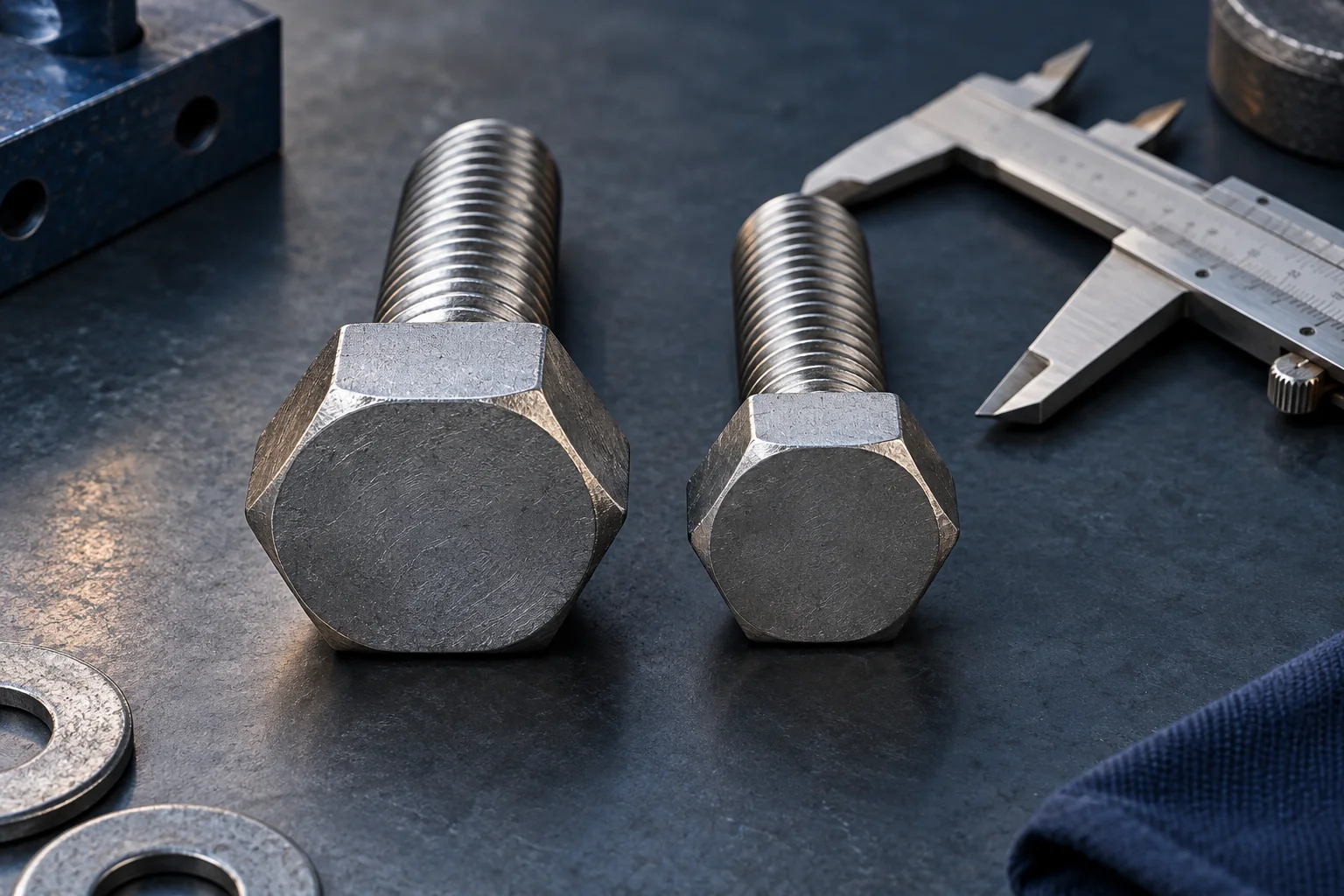
Zwei Verbindungselemente können einen gleichen Nenndurchmesser und eine ähnliche Werkstofffestigkeit aufweisen, ohne dem angeschlossenen Stahl dieselbe Geometrie zu bieten.
Bei konstruktiven Verbindungen können Kopf, Schraubenkörper, Gewindeabschnitt und Lage des Gewindes relativ zu den angeschlossenen Platten alle beeinflussen, ob das gelieferte Verbindungselement den Konstruktionsannahmen entspricht.
Die Kopfgeometrie ist Teil der konstruktiven Spezifikation
Schwere Sechskant-Konstruktionsschrauben der Güte A490 unterliegen den einschlägigen Maßanforderungen für Konstruktionsverbindungselemente, einschließlich der in ASME B18.2.6 behandelten. Übliche Sechskantschrauben der Güte 8 können stattdessen einer allgemeinen Maßspezifikation der Zollreihe wie ASME B18.2.1 folgen.
Dieser Vergleich muss anhand des tatsächlich vorgeschlagenen Produkts der Güte 8 erfolgen. SAE J429 verlangt nicht, dass jedes Verbindungselement der Güte 8 eine einheitliche Kopfkonfiguration aufweist.
Die Kopfabmessungen beeinflussen die Kontaktgeometrie unter dem Schraubenkopf. Die Auflagefläche beeinflusst, wie die Kraft in eine Unterlegscheibe oder den angeschlossenen Stahl eingeleitet wird, und ob das vorgeschlagene Verbindungselement die vom spezifizierten Schraubensystem geforderte Geometrie erfüllt.
Ein kleinerer oder anders geformter Kopf beweist für sich genommen nicht, dass eine Verbindung versagen wird. Er bedeutet jedoch, dass eine Anforderung an einen Strukturbolzen nicht allein deshalb als erfüllt angenommen werden darf, weil der Bolzen durch das Loch passt.
Diese Unterscheidung wird in RCSC 2025 Abschnitt 2.12.4 berücksichtigt. Bei Schraubverbindungselementen in alternativer Ausführung behandelt die Spezifikation den Durchmesser des Bolzenschafts und die Auflagefläche unter dem Kopf im Verhältnis zum entsprechenden spezifizierten Bolzen.
The practical purchasing consequence is straightforward: nominal diameter and tensile strength are insufficient for a head-geometry comparison. The actual bolt drawing and its dimensional standard are required.
The shear plane may intersect a different part of the bolt
Thread length can create a more consequential difference.
In a shear-loaded structural connection, the shear plane passes through the joint at the interface between connected parts. Depending on the bolt length, grip, and threaded configuration, that plane may intersect either the unthreaded body or the threaded portion.
These are not necessarily equivalent design conditions.
The threaded portion has a different cross-sectional geometry from the unthreaded body. The RCSC 2025 specification therefore distinguishes between threads included in and excluded from a shear plane when establishing the applicable nominal shear-strength provisions for the bolt groups it covers.
For a specified Grade A490 connection, the designer must use the appropriate provisions for its actual configuration. A Grade 8 substitution cannot simply inherit the Group 150 design values without establishing an approved alternative design basis.
Hypothetical example: Assume a structural connection drawing specifies Grade A490 bolts and its shear-strength calculation is based on the threads being excluded from the shear plane.
A supplier offers an SAE Grade 8 fastener with the same nominal diameter. However, its documented thread length would place part of the threaded section through one of the connection’s shear planes.
The proposed bolt no longer matches the original thread-position assumption.
Even if its minimum tensile-strength classification is comparable, the original shear-strength calculation cannot simply be carried over unchanged. The engineer would need to verify the alternative fastener’s actual geometry, establish an applicable design basis, and determine whether the proposed change can be accepted.
This is an illustrative procurement situation, not a reported failure or a calculation of actual connection capacity.
The reverse assumption also deserves attention. Not every A490 bolt should automatically be treated as having threads excluded from the shear plane. RCSC addresses short bolts and special configurations, including conditions in which the specified bolt is treated as fully threaded for shear-design purposes.
The relevant check is the actual installed configuration against the design drawing—not a general assumption that one bolt grade always has more favorable thread placement than another.
Werkstoffzertifikat ist keine Abnahme der Strukturverbindung
A second substitution problem arises when the supplier provides a mechanical test report for Grade 8 and considers the matter resolved.
A valid report demonstrating that a bolt satisfies its SAE mechanical requirements does not demonstrate that the bolt complies with ASTM F3125 Grade A490. Nor does it establish that the assembled structural joint satisfies the project requirements.
There are three separate verification questions.
First, does the bolt meet its specified product standard? For an A490 order, the relevant product conformity evidence must address the specified ASTM grade and applicable edition. Identification markings and manufacturing or test records are useful for establishing product identity, but a marking alone is not a complete conformity assessment.
Second, are the associated components compatible with the specified structural bolting system? Nuts, washers, finishes, and any required matched assemblies must be evaluated under the applicable product and structural-joint requirements. A high-strength bolt installed with an unsuitable component does not become an acceptable structural assembly simply because the bolt itself meets a strength requirement.
Third, was the structural joint installed and inspected as required? This is a separate responsibility governed by the connection type and the applicable RCSC and project provisions.
For example, snug-tightened, pretensioned, and slip-critical joints do not all have identical installation and verification requirements. Where pretensioning and pre-installation verification are required, product tensile-strength results cannot substitute for those activities. Similarly, an arbitrary tightening torque cannot establish the required installed bolt condition.
RCSC 2025 Section 2.9 requires applicable product-conformity test reports for bolting components and matched assemblies to be available to the Engineer of Record and inspector before structural steel assembly or erection. These records serve a different function from installation verification records.
The buyer should therefore avoid treating a material test report, certificate of conformity, head marking, and installation inspection report as interchangeable documents. Each is relevant to a different acceptance question.
Coating compatibility is another specification check
Coatings further illustrate why a strength comparison is incomplete.
Under the 2025 RCSC specification, Group 150 bolts and assemblies are not permitted to use hot-dip or mechanical galvanizing. The document nevertheless permits zinc-flake coating systems that meet its specified ASTM F3393 requirements and associated conditions.
It would therefore be inaccurate to state that every protective coating on an A490 bolt is prohibited.
For purchasing, the correct questions concern the specified coating process, compatibility with the bolt and mating components, and the relevant assembly requirements. A coating designation alone does not establish adequate corrosion protection for every environment or guarantee satisfactory installation behavior.
A proposed Grade 8 replacement with a different finish cannot be approved merely because both products are described as high-strength steel bolts. The coating and assembly requirements are part of the technical review.
Was ist zu tun, wenn ein Ingenieur Grade 8 als Alternative vorschlägt?
The AISC position against direct substitution and the existence of an engineering alternative-design process are not contradictory.
AISC’s FAQ addresses whether SAE Grade 8 can simply replace a specified Grade A490 bolt as an equivalent product. The answer is no.
RCSC 2025 Section 2.12 addresses a different situation: appropriately evaluated alternative-design bolting components, assemblies, or installation methods that have been approved by the Engineer of Record.
This route does not automatically qualify SAE J429 Grade 8. It requires assessment of the specific proposed alternative against the applicable requirements.
For alternative-design components, RCSC addresses manufacturing, material, and mechanical properties, along with relevant dimensions and assembly conditions. Among its geometric requirements, the bolt body diameter and under-head bearing area are controlled relative to the specified bolting components. Different thread lengths must be identified and communicated to the Engineer of Record.
Where pretensioned or slip-critical joints are involved, the applicable pretensioning, installation, and verification provisions must also be satisfied. Alternative installation and inspection procedures cannot be presumed equivalent merely because the same tools can engage the fastener.
The engineering review must therefore answer more than whether the proposed Grade 8 fastener reaches a particular tensile-strength level.
It must establish the proposed product’s actual dimensions, applicable manufacturing and mechanical-property basis, effect on the structural connection, mating-component compatibility, installation requirements, and the evidence supporting acceptance.
Only the appropriate engineering authority can determine whether the documented alternative is suitable for the particular project under its governing requirements.
That approval, if granted, would authorize a defined alternative. It would not convert SAE J429 Grade 8 into ASTM F3125 Grade A490 or make the grades generally interchangeable for other projects.
For a buyer, this distinction prevents a common purchasing error: accepting an alternative designation in the quotation without a corresponding approved deviation in the engineering documents.
Was vor der Bestellung von A490-Strukturschrauben zu prüfen ist
When the drawings or purchase documents specify ASTM F3125 Grade A490, the supplier should quote against that specification rather than substitute SAE Grade 8 based on a strength comparison.
A hypothetical receiving team checks the head mark and diameter but overlooks a different thread configuration and washer requirement. The fastener may fit while the scheduled assembly remains unresolved. Compare the actual product form, dimensions and matched components with the approved order. Record the product identity and supporting evidence before deciding release.
Before the purchase order is finalized, confirm the following:
- Product specification and edition. Identify ASTM F3125/F3125M, Grade A490, the required type and heavy-hex style, and the edition governing the project. The latest published edition is not automatically the contractual edition.
- Bolt dimensions and configuration. Specify nominal diameter, length, applicable dimensional standard, and relevant thread configuration. Check the actual bolt against the connection drawing where grip length or shear-plane position matters.
- Nuts, washers, and assembly requirements. Identify compatible components and whether the specified finish or installation system requires a matched assembly.
- Finish and coating. State the permitted coating specification and any project-specific requirements. Do not replace one coating method with another without checking the applicable structural-bolting provisions.
- Product acceptance records. Request the test reports and identification records needed to establish conformity with the specified product and assembly requirements. Distinguish product records from field installation records.
- Proposed deviations. If a supplier offers Grade 8 or another alternative, obtain the actual product specification, drawings, supporting evidence, and the required engineering disposition before treating the offer as acceptable.
This verification is especially important when a quotation describes a fastener only by nominal diameter, strength grade, or a broad term such as high-strength hex bolt. Such descriptions do not establish full conformity with a Grade A490 structural-bolt requirement.
The default purchasing decision is to retain the specified A490 product and its associated requirements. If an alternative is genuinely necessary, the correct next step is a documented engineering review—not an informal substitution based on tensile strength.
Häufig gestellte Fragen
Ist SAE Grade 8 dasselbe wie A490?
Nein. Sie gehören zu unterschiedlichen Produktspezifikationen. Vergleichbare Zugfestigkeitsangaben belegen keine strukturelle Austauschbarkeit.
Kann ein Ingenieur ein anderes Verbindungselement freigeben?
Jede vorgeschlagene Alternative erfordert die zutreffende Auslegungs-, Produkt-, Installations- und Projektgenehmigungsgrundlage. Eine Festigkeitskurve des Lieferanten allein ist nicht ausreichend.
Was muss ein Austauschantrag enthalten?
Die genaue vorgeschlagene Spezifikation, Werkstoffsorte, Geometrie, Gewinde, Oberflächenausführung, Gegenstücke, Produktnachweise und Abweichungen von der freigegebenen Strukturbaugruppe identifizieren.