Leitfaden zur Fertigungsroute für kundenspezifische Muttern
Kaltumformung vs. CNC-Bearbeitung für kundenspezifische Muttern: Kosten, Festigkeit, Toleranz und Stückzahl
Die Wahl zwischen Kaltumformung und CNC-Bearbeitung für eine kundenspezifische Mutter ist keine einfache Frage nach dem “besseren Verfahren”. Die richtige Route hängt von Geometrie, Material, Gewindeanforderung, kritischer Toleranz, Musterphase, Beschichtung, Wärmebehandlung, Jahresmenge und Freigaberisiko ab.
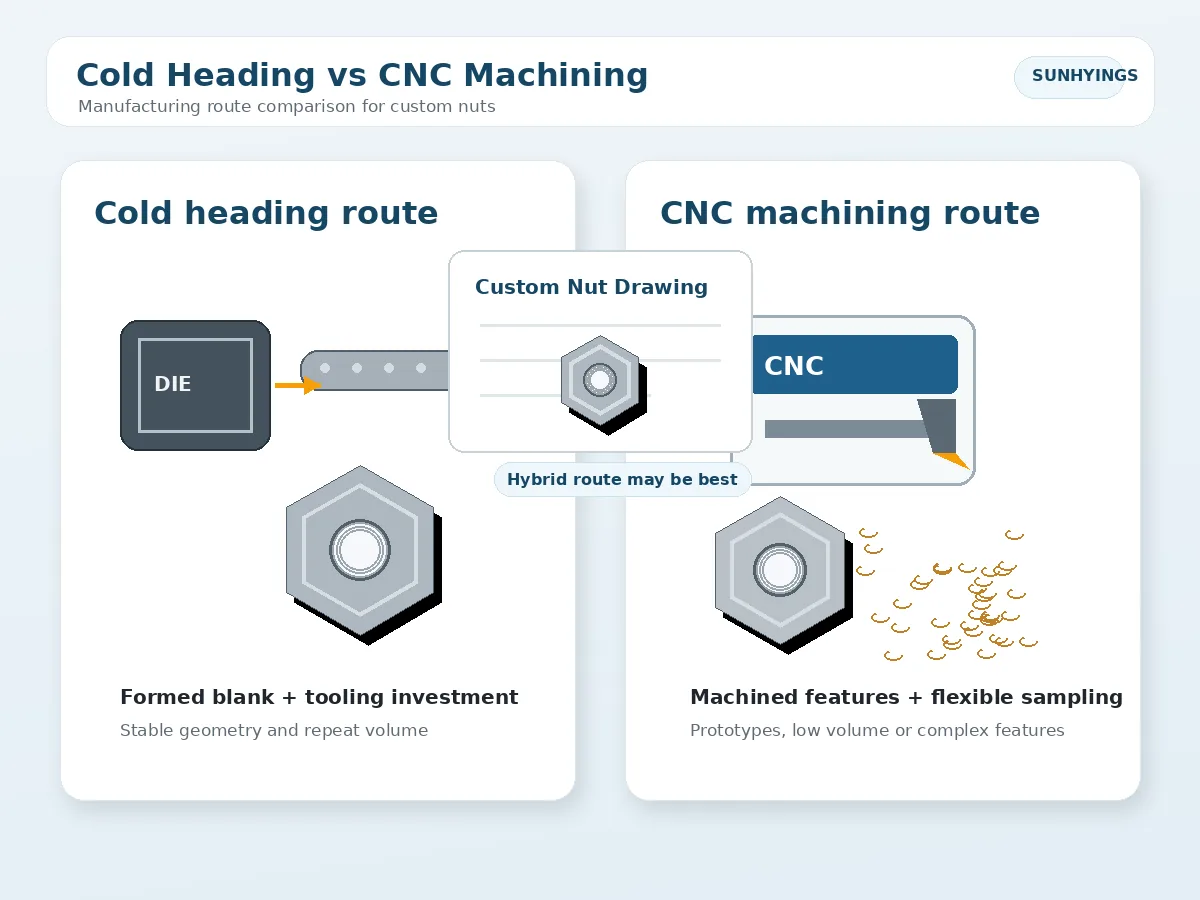
Die Kaltumformung ist in der Regel eine produktionsorientierte Route, wenn die Geometrie formbar ist und die Stückzahl das Werkzeug rechtfertigt. Die CNC-Bearbeitung ist in der Regel eine flexible Route für Prototypen, Kleinserien, sich ändernde Konstruktionen oder komplexe Merkmale. Viele kundenspezifische Muttern verwenden eine Hybridroute, die Kaltumformung mit sekundärer Bearbeitung, Gewindeschneiden, Wärmebehandlung, Beschichtung oder Prüfung kombiniert, falls erforderlich.
Kaltumformung, CNC-Bearbeitung und Hybridrouten sollten nach Geometrie, Toleranz, Stückzahl und Freigabestufe ausgewählt werden.
Nur konzeptionelles Bild der Fertigungsroute; kein Nachweis eines bestimmten Produktmodells oder einer Prozessfreigabe.
Kurze Antwort: Wann sollten kundenspezifische Muttern kaltgeformt oder CNC-bearbeitet werden?
Wählen Sie die Kaltumformung, wenn die kundenspezifische Mutter eine stabile Geometrie, umformbare Merkmale, wiederkehrende Nachfrage und ein Jahresvolumen aufweist, das die Werkzeugkosten rechtfertigt. Wählen Sie die CNC-Bearbeitung, wenn das Projekt Prototypen, Kleinserien, häufige Konstruktionsänderungen, komplexe Seitenmerkmale, enge lokale Bearbeitungsmerkmale oder eine schnelle Designvalidierung vor der Werkzeuginvestition erfordert. Wählen Sie einen Hybridansatz, wenn der Grundrohling geformt werden kann, aber kritische Merkmale dennoch eine Bearbeitung, Gewindeschneiden, Gewindewalzen oder eine Nachkontrolle erfordern.
Der Käufer sollte nicht nur fragen: “Welches Verfahren ist billiger?” Die bessere Frage ist: welcher Fertigungsweg der Zeichnung, Funktion, Toleranz, dem Material, der Beschichtung, dem Volumen und dem Freigabestatus entspricht? Eine CNC-Muster kann helfen, die Passform zu prüfen, ersetzt aber nicht automatisch ein kaltgeformtes Serienteil. Ein Angebot für Kaltumformung kann die Stückkosten bei großen Stückzahlen senken, jedoch nur, wenn Werkzeugkosten, Materialfluss, Nachbearbeitung und Prüfanforderungen machbar sind.
Warum der Fertigungsweg Kosten, Festigkeit, Toleranz und Lieferzeit beeinflusst
Zwei Lieferanten können dieselbe kundenspezifische Mutter unterschiedlich anbieten, da sie unterschiedliche Fertigungswege annehmen. Ein Lieferant bietet möglicherweise CNC-Bearbeitung für eine kleine Charge an. Ein anderer bietet möglicherweise Kaltumformung mit Werkzeug für die zukünftige Massenproduktion an. Ein dritter Lieferant bietet möglicherweise einen hybriden Weg an, der einen umgeformten Rohling mit sekundärer Bearbeitung kombiniert.
Wenn der Käufer nur den Stückpreis vergleicht, kann das Ergebnis irreführend sein. Ein niedriger CNC-Musterpreis sagt nicht immer die Massenproduktionskosten voraus. Ein Kaltumformungsangebot kann Werkzeug- und Einrichtungskosten enthalten, die die erste Charge teurer machen, aber später die Stückkosten senken. Ein hybrider Weg mag komplexer erscheinen, aber er könnte der realistischste Weg sein, um sowohl Kosten- als auch kritische Merkmalsanforderungen zu erfüllen.
Bei zeichnungsbasierten Teilen sollte der Fertigungsweg zusammen mit der aktuellen Zeichnungsrevision überprüft werden. Dies ist besonders wichtig für nach Zeichnung gefertigten Spezialmuttern, wo der angebotene Fertigungsweg mit der tatsächlichen Geometrie, den kritischen Maßen und den Genehmigungserwartungen übereinstimmen muss.
Kaltumformung, CNC-Bearbeitung und Sekundäroperationen müssen als vollständiger Prozessweg betrachtet werden.
Arbeitsablaufdiagramm für die Prozessplanung; der tatsächliche Weg hängt von Zeichnung, Material, Toleranz und Stückzahl ab.
Entscheidungsfaktor
Kaltumformung eignet sich, wenn…
CNC-Bearbeitung eignet sich, wenn…
Hybrider Weg eignet sich, wenn…
Geometrie
Die Außenform kann konsistent geformt werden
Das Teil hat komplexe oder nicht formbare Merkmale
Der Rohling ist formbar, aber einige Merkmale erfordern Bearbeitung
Volumen
Jahresbedarf kann Werkzeugbau rechtfertigen
Menge ist gering oder Nachfrage unsicher
Volumen ist signifikant, aber nicht alle Merkmale sind umformbar
Designreife
Zeichnung ist stabil und kritische Maße bestätigt
Design ändert sich noch oder befindet sich in Prototypenprüfung
Design ist weitgehend stabil, ausgewählte kritische Merkmale werden noch bearbeitet
Kostenstruktur
Werkzeugkosten können über wiederholte Produktion amortisiert werden
Spezielles Stauchwerkzeug ist nicht gerechtfertigt
Umformen reduziert Materialabfall, während die Bearbeitung Schlüsselmerkmale kontrolliert
Genehmigungsrisiko
Produktionsnaher Umformweg kann validiert werden
Prototypenweg ist für frühe Designprüfungen akzeptabel
Der Prozessweg muss umgeformte und bearbeitete Merkmale klar definieren
Konstruktionsregel
Der Prozessname reicht für die Freigabe nicht aus. Käufer sollten den vollständigen Fertigungsablauf anfordern: Rohlingvorbereitung, Umformen oder Zerspanen, Gewindeschneiden, Sekundäroperationen, Wärmebehandlung, Beschichtung, Prüfung und Verpackung, falls erforderlich.
Was ist Kaltumformung für kundenspezifische Muttern?
Kaltstauchen, auch als Kaltumformung in vielen Verbindungselementkontexten bezeichnet, formt Metall bei Raumtemperatur, indem Draht, Stange oder ein vorbereiteter Rohling in eine Matrize gepresst wird. Anstatt den Großteil des Materials abzutragen, verdrängt der Prozess das Material in die gewünschte Form. Dies kann für die Großserienproduktion von Verbindungselementen effizient sein, wenn die Geometrie, das Material und das Werkzeugdesign geeignet sind.
Bei kundenspezifischen Muttern kann das Kaltstauchen den Rohling der Mutter, die Flanschform, den Ansatz, das Vorsprungmerkmal oder andere geformte Geometrien erzeugen. Das Teil kann je nach Zeichnung noch Gewindeschneiden, Gewinderollen, Entgraten, spanende Nachbearbeitung, Wärmebehandlung, Beschichtung und Endprüfung erfordern.
Wie Kaltstauchen den Mutterrohling formt
Vereinfacht ausgedrückt verwendet das Kaltstauchen kontrollierte Kraft und Matrizen, um Material in Form zu bringen. Der Prozess hängt von der Umformbarkeit des Materials, der Rohlinggröße, dem Matrizendesign, der Teilegeometrie und der Prozessreihenfolge ab. Eine kundenspezifische Mutter mit einer einfachen Außenform und stabilem Volumen kann ein guter Kandidat sein. Ein Teil mit dünnen Wänden, tiefen Hinterschneidungen, schwierigen Seitenmerkmalen oder sehr geringer Stückzahl kann weniger geeignet sein.
Warum das Werkzeug wichtig ist
Das Werkzeug bestimmt die geformte Geometrie. Gute Werkzeuge können die Wiederholbarkeit unterstützen, verursachen jedoch zusätzliche Vorlaufkosten und Validierungsarbeiten. Wenn sich die Zeichnung nach der Herstellung des Werkzeugs ändert, können die Kosten- und Zeitauswirkungen erheblich sein. Käufer sollten die kritische Geometrie einfrieren und das erwartete Volumen bestätigen, bevor sie sich für das Kaltstauchen einer kundenspezifischen Mutter entscheiden.
Kaltstauch-DFM-Prüfungen
Vor der Auswahl des Kaltstauchens sollte der Lieferant prüfen, ob die Muttergeometrie geformt werden kann, ohne übermäßiges Materialflussrisiko, Dünnwandverformung, Matrizenfüllprobleme oder zusätzlichen Bearbeitungsaufwand zu verursachen. Die Überprüfung sollte die Umformbarkeit des Materials, die Rohlinggröße, die Wandstärke, die Flansch- oder Ansatzgeometrie, die Gewindevorbereitung, die erwartete Losgröße und die Endprüfmethode umfassen.
Kaltstauch-DFM-Artikel
Warum es wichtig ist
Bestätigung erforderlich
Umformbarkeit des Materials
Beeinflusst Stauchbarkeit und Rissrisiko
Materialgüte, Härte und Vorratsmaterial des Lieferanten
Rohteilgeometrie
Steuert Materialfluss und Gesenkfüllverhalten
Teilezeichnung, Rohteilgröße und Umformsequenz
Wanddicke
Dünne Bereiche können sich verformen oder eine Bearbeitung erfordern
Kritische Querschnittsabmessungen
Gewindevorbereitung
Das Gewindeverfahren beeinflusst Passung und Festigkeit
Gewindegröße, Steigung, Toleranz und Beschichtungszustand
Erfordernis einer Sekundäroperation
Besondere Merkmale lassen sich möglicherweise nicht wirtschaftlich formen
Nuten, Seitenbohrungen, Ansätze, Pilotmerkmale und Auflageflächen
Wenn noch Sekundärbearbeitungen erforderlich sind
Das Kaltstauchverfahren vervollständigt nicht automatisch jede kundenspezifische Mutter. Gewinde, kritische Planheit, Nuten, Seitenbohrungen, Auflageflächen, Pilotmerkmale oder Sonderflächen können Sekundärbearbeitungen erfordern. Wärmebehandlung oder Beschichtung können je nach Material, Funktion und Kundenspezifikation ebenfalls erforderlich sein.
Was ist CNC-Bearbeitung für kundenspezifische Muttern?
Die CNC-Bearbeitung erzeugt Merkmale durch Abtragen von Material mit gesteuerten Werkzeugen. Bei kundenspezifischen Muttern kann die CNC-Bearbeitung je nach Geometrie des Teils Drehen, Fräsen, Bohren, Reiben, Gewindebohren, Gewindeschneiden, Nuten oder Planfräsen umfassen.
Die CNC-Bearbeitung ist besonders nützlich, wenn der Käufer einen Prototypen, eine Kleinserie, Designflexibilität oder schwer formbare Merkmale benötigt. Sie kann auch als Sekundärbearbeitung nach dem Kaltstauchverfahren eingesetzt werden.
CNC-Bearbeitung für Prototypen und Kleinserien
Wenn sich ein Projekt noch in der Entwurfsphase befindet, kann die CNC-Bearbeitung Teile schnell liefern, ohne dass eine Verpflichtung zur Kaltstauchwerkzeuggebung besteht. Dies ist nützlich, um die Montagepassung, den Gewindeeingriff, den Halterungsabstand, den Zustand des Gegenstücks oder den Bauraum zu überprüfen. Bei Kleinserien kann die CNC-Bearbeitung der bessere Weg bleiben, da die Werkzeugkosten für das Kaltstauchverfahren möglicherweise nicht gerechtfertigt sind.
CNC-Bearbeitung für komplexe oder nicht umformbare Merkmale
Einige Mutternkonstruktionen umfassen Schultern, Nuten, Schlitze, Seitenlöcher, spezielle Anlageflächen, Senkungen oder asymmetrische Geometrie. Wenn diese Merkmale nicht zuverlässig umgeformt werden können, kann eine CNC-Bearbeitung erforderlich sein. In einigen Fällen kann der Rohling zunächst kaltgeformt und dann nur dort bearbeitet werden, wo Präzision oder Geometrie dies erfordert.
CNC-Bearbeitung DFM-Prüfungen
Die CNC-Bearbeitung ist flexibel, aber nicht automatisch der beste Produktionsweg. Käufer sollten prüfen, ob die bearbeitete Konstruktion übermäßigen Materialabtrag, scharfe Übergänge, schwache Abschnitte, lange Zykluszeiten oder schwierige Prüfungen verursacht. Ein bearbeitetes Merkmal sollte die Funktion unterstützen, nicht nur das Aussehen nachahmen.
Gute CNC-Eignung
Prototypenchargen, sich ändernde Konstruktionen, spezielle Schlitze, Seitenlöcher, Schultern, Ersatzteile mit geringem Volumen und kritische lokale Merkmale.
CNC-Kostenrisiko
Hoher Materialabtrag, lange Zykluszeit, mehrere Aufspannungen, schwieriges Entgraten oder große Jahresmengen.
Genehmigungsrisiko
Eine CNC-Mustercharge repräsentiert möglicherweise nicht die spätere Kaltstauchproduktion, es sei denn, der Unterschied im Fertigungsweg wurde geprüft und akzeptiert.
Wenn die Zerspanung für die Massenproduktion zu teuer wird
Die CNC-Bearbeitung wird weniger attraktiv, wenn jedes Teil lange Zykluszeiten, hohen Materialabtrag oder mehrere Aufspannungen erfordert. Bei hohen Stückzahlen können die Kosten für Maschinenzeit und Ausschuss den Nutzen der Flexibilität übersteigen. An diesem Punkt sollte der Kaltstauchprozess oder ein hybrider Fertigungsweg geprüft werden.
Kostenvergleich: Werkzeugkosten, Stückkosten und Jahresvolumen
Der Kostenvergleich muss mehr als den angebotenen Stückpreis umfassen. Der Käufer sollte Werkzeugkosten, Rüstkosten, Materialausnutzung, Bearbeitungszeit, Sekundäroperationen, Prüfung, Verpackung, Freigabedokumente und das erwartete Jahresvolumen berücksichtigen.
Werkzeugkosten, Stückkosten und Jahresvolumen sollten vor der Wahl des Fertigungswegs verglichen werden.
Konzeptionelle Matrix; tatsächliche Werkzeugkosten und Mengenschwellen müssen durch Zeichnung und Angebot bestätigt werden.
Warum Kaltstauchprozess eine Werkzeuginvestition erfordert
Kaltumformung erfordert in der Regel Umformwerkzeuge. Dazu können Matrizen, Stempel und zugehörige Einrichtungen gehören. Je komplexer die Geometrie, desto sorgfältiger müssen die Werkzeuge ausgelegt und validiert werden. Dies macht die Kaltumformung für instabile Konstruktionen oder sehr kleine Stückzahlen weniger attraktiv. Sobald die Werkzeuge jedoch validiert sind, kann die Kaltumformung eine effiziente Wiederholproduktion unterstützen.
Warum CNC-Bearbeitung bei geringen Stückzahlen günstiger sein kann
CNC-Bearbeitung kann bei geringen Stückzahlen günstiger sein, da sie auf spezielle Kaltstauchwerkzeuge verzichtet. Der Lieferant kann das Teil programmieren und eine kleine Charge aus Stange, Rohr oder vorgefertigtem Material fertigen. Dies ist nützlich für Prototypen, Ersatzteile, Validierungsmuster oder Kleinserienprojekte. Der Nachteil ist, dass die Stückkosten bei steigender Menge hoch bleiben können.
Wie die Jahresmenge das Angebot verändert
Das gleiche Teil kann je nach Menge zwei unterschiedliche korrekte Angebote haben. Ein CNC-Angebot kann für eine kleine Mustercharge angemessen sein. Ein Kaltstauchangebot kann für eine stabile Massenproduktion angemessener sein. Ein Hybridangebot ist am besten, wenn das Teil sowohl Umformeffizienz als auch Bearbeitungspräzision benötigt.
Kostentreiber
Auswirkung auf das Kaltstauchen
Auswirkung auf die CNC-Bearbeitung
Käuferfrage
Jahresvolumen
Höhere Stückzahlen rechtfertigen Werkzeugkosten
Höhere Stückzahlen erhöhen die Maschinenzeitbelastung
Wie hoch ist der realistische Jahresbedarf?
Werkzeugkomplexität
Komplexe Geometrie erhöht Werkzeugkosten
Weniger abhängig von Umformwerkzeugen
Ist das Design eingefroren?
Materialkosten
Bessere Materialausnutzung kann helfen
Hoher Materialabtrag erhöht Abfall
Ist das Material teuer oder schwer zu bearbeiten?
Sekundäre Bearbeitungen
Kann nach dem Umformen erforderlich sein
Kann bereits in der Bearbeitungsroute enthalten sein
Welche Merkmale erfordern Nacharbeit?
Toleranzanforderung
Werkzeugvalidierung ist wichtig
Lokale Präzision kann einfacher zu bearbeiten sein
Welche Maße sind kritisch?
Freigabedokumente
Kann Nachweise für den produktionsorientierten Prozess erfordern
Prototypennachweise repräsentieren möglicherweise nicht die Serienproduktion
Ist PPAP oder Kundenfreigabe erforderlich?
Kosteneinsparung: CNC kann der richtige Weg für kleine Stückzahlen sein, selbst wenn der Stückpreis höher ist. Kaltumformung kann der richtige Weg für die Massenproduktion sein, selbst wenn das erste Angebot Werkzeugkosten enthält. Der richtige Vergleich sind die Gesamtprojektkosten über Muster, Werkzeug, Produktion, Prüfung und Freigaberisiko.
Für einen breiteren Lieferantenvergleich können Käufer prüfen, wie ein Spezialmutternlieferant für Automobilanwendungen die Zeichnungsprüfung, Prozessfähigkeit und Dokumentation vor der Serienproduktion bewertet.
Festigkeitsvergleich: Kornfluss, Materialabtrag und funktionale Prüfung
Die Festigkeit sollte nicht allein anhand des Prozessnamens beurteilt werden. Eine kaltgeformte Mutter ist nicht automatisch für jede Anwendung geeignet. Eine CNC-gefräste Mutter ist nicht automatisch schwach. Die Festigkeit hängt vom Werkstoff, der Geometrie, der Wanddicke, der Wärmebehandlung, dem Gewindeeingriff, der Auflagefläche, der Beschichtung und den Anforderungen an die Funktionsprüfung ab.
Umgeformter Materialfluss
Bei geeigneten Konstruktionen kann das Kaltumformen das Material in Form bringen, ohne die Hauptstruktur wegzuschneiden. Dies kann einen günstigen Materialfluss und eine hohe Produktionseffizienz unterstützen, ersetzt jedoch nicht die Überprüfung von Werkstoff, Härte oder Funktion.
Gefräste Geometrie
Die Festigkeit bei spanender Bearbeitung hängt vom verbleibenden Querschnitt nach dem Materialabtrag ab. Scharfe Kanten, dünne Wände, unzureichender Gewindeeingriff oder reduzierte Auflagefläche können ein Risiko darstellen, wenn die Zeichnung nicht ordnungsgemäß geprüft wird.
Funktionsspezifische Prüfung
Je nach Mutter kann die Freigabe eine Prüfung der Tragfähigkeit, des Drehmomentausdrehens, des Ausziehens, des Herausdrückens, des bleibenden Drehmoments, der Schweißleistung, der Härte oder der Gewinde erfordern.
Funktion der Mutter
Festigkeits-/Leistungsrisiko
Frage zum Prozessablauf
Mögliche Überprüfung
Gewindemutter
Gewindeüberlastung, Prüflast, Gewindeeingriff
Wie wird das Gewinde hergestellt und geprüft?
Gewindelehre, Prüflast oder zeichnungsgemäße Prüfung
Einpressgeometrie, Ausdrücken oder Drehmomentausbruch
Steuert die Route die Einpressfunktion?
Ausdrücken oder Drehmomentausbruch, falls spezifiziert
Beispielsweise, vollmetallische Sicherungsmuttern kann bei Vorgabe Anzugsdrehmomentanforderungen beinhalten, während Schweißmutterprojekte je nach Verbindung und Zeichnung Drehmoment- oder Ausreißprüfungen erfordern können. Der Prüfumfang muss durch die Zeichnung des Käufers und die Kundennorm bestätigt werden.
Toleranzvergleich: Umformgenauigkeit, bearbeitete Merkmale und kritische Abmessungen
Die Toleranz ist merkmalspezifisch. Es ist nicht korrekt zu sagen, dass Kaltumformung oder CNC-Bearbeitung für das gesamte Teil immer genauer sind. Kaltumformung kann nach Validierung der Werkzeuge für wiederholbare Umformmaße stabil sein. CNC-Bearbeitung kann für enge lokale Merkmale, Schultern, Seitenlöcher, Senkungen, Sonderflächen oder Merkmale, die eine präzise Positionierung erfordern, besser geeignet sein. Einige kundenspezifische Muttern erfordern beides.
Kaltumformung und CNC-Bearbeitung sollten nach kritischen Merkmalen verglichen werden, nicht allein nach dem Prozessnamen.
Das Diagramm verwendet nur allgemeine Bezeichnungen; tatsächliche Toleranzen müssen der Zeichnung des Käufers und der Prüfanforderung folgen.
Umformtoleranzen sind prozessfähigkeitsabhängig
Kaltumformung kann wiederholbare Maße erzeugen, aber die Fähigkeit hängt vom Material, Werkzeug, Maschineneinrichtung, Merkmalsgeometrie und Prüfverfahren ab. Der Lieferant sollte bestätigen, welche Merkmale umgeformt werden und welche Merkmale Sekundäroperationen erfordern.
Bearbeitete Merkmale können lokale kritische Abmessungen steuern
CNC-Bearbeitung kann nützlich sein, wenn eine Zeichnung kritische lokale Abmessungen aufweist, die schwer zu formen sind. Beispielsweise können eine spezielle Schulter, ein Führungsdurchmesser, ein Seitenloch oder eine Abflachung nach dem Umformen bearbeitet werden. Dies kann helfen, Kosten und Präzision auszugleichen. Für grundlegende Maßangaben wie Gewindegröße, Schlüsselweite und Mutternhöhe können Käufer auch die Leitfaden für Sechskantmutternabmessungen vor Erstellung einer RFQ prüfen.
Beschichtung kann Gewindepassung und Prüfergebnisse verändern
Die Gewindepassung muss nach der Beschichtung überprüft werden. Galvanisieren, Phosphatieren, Zink-Nickel, Schwarzoxid, Passivierung oder andere Oberflächenbehandlungen können das Gewindeeingriffs- und Drehmomentverhalten beeinflussen. Falls eine Beschichtung erforderlich ist, sollte der Käufer die Gewindeprüfung nach der Beschichtung sowie etwaige Toleranzen nach der Beschichtung bestätigen.
Merkmalstyp
Kaltumformung Überlegung
CNC-Bearbeitung Überlegung
Typische Entscheidung
Außenform roh
Gut bei Umformbarkeit und Wiederholbarkeit
Möglich, aber Materialverschwendung möglich
Kaltumformung für hohe Stückzahlen
Schlüsselweite / Höhe
Nach Werkzeugfreigabe stabil
Für Sonderanforderungen bearbeitbar
Abhängig von Toleranz und Stückzahl
Thema
Erfordert oft Gewindeschneiden oder -rollen
Kann bearbeitet oder geschnitten werden
Gewindegröße, Steigung und Toleranz bestätigen
Seitenloch / -schlitz
Kann schwierig zu formen sein
Oft für die Bearbeitung geeignet
CNC oder Nachbearbeitung
Schulter / Führung
Kann geformt werden, wenn die Geometrie es zulässt
Bearbeitung kann lokale Präzision steuern
Hybrider Weg ist oft nützlich
Gewindepassung nach Beschichtung
Muss nach Beschichtung geprüft werden
Muss nach Beschichtung geprüft werden
Der Prozessweg allein reicht nicht aus
Erinnerung an kritische Qualitätsmerkmale
Käufer sollten vor einer Prozessempfehlung markieren, welche Abmessungen funktionskritisch sind. Eine nicht-kritische geformte Oberfläche und eine kritische bearbeitete Schulter sollten nicht gleich behandelt werden. Der Prüfplan sollte den CTQ-Merkmalen folgen, nicht nur dem Prozessnamen.
Menge und Freigabestufe: Prototyp, Muster, PPAP und Serienproduktion
Der richtige Weg kann sich je nach Projektphase ändern. CNC-Bearbeitung kann der schnellste Weg sein, um einen Prototypen herzustellen. Kaltumformung kann der bessere Weg für die Massenproduktion sein. Wenn das Teil jedoch in einer Automobilanwendung verwendet wird, müssen der Musterweg und der Produktionsweg klar kontrolliert werden.
Wenn die kundenspezifische Mutter mit einer funktionalen Verbindung verbunden ist, sollten Käufer auch den Montageort, den Verbindungstyp, den Zustand des Gegenstücks und die erwartete Ausfallart angeben. Diese Details können die Prüflast, den Auszugswiderstand, das Drehmomentausreißen, das bleibende Drehmoment, die Schweißhaltekraft, den Gewindeeingriff und den Endprüfumfang beeinflussen. Käufer können diese Risiken mit üblichen vergleichen Probleme in der Automobilmontage, gelöst durch Spezialmuttern vor der endgültigen Festlegung des RFQ-Umfangs.
CNC-Prototyp zur Designprüfung
Ein CNC-Prototyp kann helfen, die Designabsicht, Montagefreiheit, Passung von Gegenstücken, Gewindeeingriff und grundlegende Geometrie zu überprüfen. Er ist nützlich, bevor in Formwerkzeuge investiert wird. Ein CNC-Prototyp repräsentiert jedoch möglicherweise nicht den endgültigen Kaltstauchprozess.
Produktionsnahe Muster zur Freigabe
Wenn der Kunde produktionsnahe Muster verlangt, sollte der Lieferant den geplanten Fertigungsweg verwenden oder Abweichungen klar erläutern. Dies ist besonders wichtig bei Automobilprojekten, bei denen Prozessweg, Prüfdaten und Freigabedokumente übereinstimmen müssen. Käufer, die Automobilprojekte bewerten, können auch prüfen, wie kundenspezifische Sondermuttern für Automobil-OEMs vom Design-Review zur stabilen Serienproduktion übergegangen wird.
Warum Prozessänderungen vor PPAP bestätigt werden müssen
PPAP ist nur erforderlich, wenn der Kunde oder das Projekt dies vorschreibt. Wenn PPAP gilt, sollten der Fertigungsweg, die Zeichnungsrevision, das Material, die Prüfmethode und der Produktionsprozess vor der Einreichung bestätigt werden. Eine Prozessänderung nach der Freigabe kann je nach Kundenanforderung eine zusätzliche Überprüfung erforderlich machen.
Frage
Warum es wichtig ist
Wurde das Muster CNC-gefräst, aber die Produktion erfolgt kaltgestaucht?
Das Muster repräsentiert möglicherweise nicht die produktionsrelevanten Eigenschaften.
Wird das Gewinde in der Produktion geschnitten, geschnitten oder gewalzt?
Die Gewindeart kann Passung und Leistung beeinflussen.
Wird nach der Musterfreigabe eine Wärmebehandlung hinzugefügt?
Härte und Maßverhalten können sich ändern.
Wird nach der Musterfreigabe eine Beschichtung hinzugefügt?
Gewindepassung und Drehmomentverhalten können sich ändern.
Werden kritische Maße geformt oder spanend bearbeitet?
Der Prüfplan muss mit dem Prozessablauf übereinstimmen
Ist das jährliche Volumen stabil genug für die Werkzeugausrüstung?
Die Investition in Werkzeuge hängt von der Nachfragesicherheit ab
Wurde der produktionsrelevante Ablauf eingefroren?
Freigabe und Serienproduktion sollten nicht auf unklaren Ablaufannahmen basieren
Wann ein hybrider Ablauf sinnvoller ist
Ein hybrider Ablauf bietet oft die beste Balance zwischen Kosten, Funktion und Geometrie. Anstatt die gesamte Mutter aus Stangenmaterial zu zerspanen, kann der Lieferant einen nahezu fertigen Rohling kaltstauchen und nur die kritischen Merkmale bearbeiten. Anstatt eine komplexe Mutter in einen schwierigen Umformprozess zu zwingen, kann der Lieferant CNC für Merkmale einsetzen, die nicht zuverlässig umgeformt werden können.
Viele kundenspezifische Muttern verwenden einen hybriden Ablauf, um die Umformeffizienz mit bearbeiteten kritischen Merkmalen auszugleichen.
Die dargestellten Prozessschritte sind bedingt; der tatsächliche Ablauf hängt von Zeichnung, Material, Funktion und Bestellanforderung ab.
Kaltgestauchter Rohling plus spanende Nachbearbeitung
Diese Route kann nützlich sein, wenn die grundlegende Mutterform für die Umformung geeignet ist, aber ein oder zwei Merkmale eine Bearbeitung erfordern. Beispiele können ein seitlicher Schlitz, ein Pilotdurchmesser, eine kontrollierte Stirnfläche, ein spezieller Bund oder eine Merkmalsposition sein.
Wenn Gewindeschneiden oder Gewinderollen die Route ändert
Der Gewindeprozess muss bestätigt werden. Einige Muttern können geschnitten werden. Einige Außengewinde können gerollt werden. Einige spezielle Innenformen können einen speziellen Werkzeug- oder Prüfplan erfordern. Die Gewindegröße, Steigung, Toleranz und Beschichtungszustand sollten in der RFQ enthalten sein.
Wenn Beschichtung oder Wärmebehandlung die Endprüfung ändert
Wärmebehandlung und Beschichtung können den Endprüfplan ändern. Wenn eine Wärmebehandlung erforderlich ist, müssen Härte und Maßhaltigkeit überprüft werden. Wenn eine Beschichtung erforderlich ist, sollten der Gewindesitz und die Oberflächenbeschaffenheit nach der Beschichtung geprüft werden.
Hybrid-Routenbeispiel
Warum es verwendet werden kann
Käuferbestätigung erforderlich
Kaltstauchrohling + Gewindeschneiden
Effiziente Rohlingformung mit kontrollierter Innengewindeerzeugung
Gewindegröße, Steigung, Toleranz und Lehrenverfahren
Kaltstauchrohling + CNC-Seitenbearbeitung
Formt den Hauptkörper und bearbeitet gleichzeitig eine Nut, ein Seitenloch oder eine Schulter
Position der Bearbeitungsmerkmale, Gratkontrolle und Prüfverfahren
CNC-Prototyp + Kaltstauchproduktion
Unterstützt die frühzeitige Designprüfung vor der Werkzeuginvestition
Ob später produktionsnahe Muster erforderlich sind
Umformen + Wärmebehandlung + Beschichtung
Verwendet, wenn Materialfestigkeit oder Oberflächenschutz spezifiziert sind
Härte, Beschichtung, Gewindepassung nach Beschichtung und Prüfumfang
Häufige RFQ-Fehler beim Vergleich von Kaltstauchen und CNC-Bearbeitung
Viele Angebotsprobleme entstehen, weil Käufer und Lieferant unterschiedliche Annahmen vergleichen. Ein Anbieter, der CNC-Prototypen anbietet, kann für die Massenproduktion teuer erscheinen. Ein Anbieter, der Kaltstauchen anbietet, kann für die erste Charge teuer erscheinen, da die Werkzeugkosten enthalten sind. Ein Anbieter, der eine vereinfachte Route anbietet, kann Sekundäroperationen übersehen.
Vergleich verschiedener Fertigungswege
Ein CNC-Musterangebot und ein Kaltumformungs-Angebot beantworten unterschiedliche Fragen. Käufer sollten nach dem Fertigungsweg hinter dem Preis fragen.
Ignorieren von Sekundäroperationen
Ein Angebot, das “kaltgestaucht” angibt, kann dennoch Gewindeschneiden, Gewinderollen, Zerspanen, Wärmebehandlung, Beschichtung, Sortieren und Verpacken erfordern.
Vergessen von Beschichtung und Gewindepassung
Wenn die RFQ keine Beschichtung und Gewindetoleranz angibt, kann die angebotene Route vor der Beschichtung korrekt erscheinen, aber nach der Galvanisierung oder Oberflächenbehandlung Probleme verursachen.
Praktische Prüfung für den Käufer: Bitten Sie den Lieferanten, im Angebot die Route für Prototypen, Muster und Serienproduktion getrennt auszuweisen. Dies verhindert, dass ein CNC-Entwicklungsangebot mit einem Kaltstauch-Produktionsangebot verglichen wird, als ob sie denselben Umfang hätten.
RFQ-Checkliste: Daten, die SUNHYINGS benötigt, um einen Prozessweg zu empfehlen
Bevor Sie sich für Kaltstauchen, CNC-Bearbeitung oder einen Hybridweg entscheiden, benötigt der Lieferant ausreichende Daten, um die Teilefunktion und das Produktionsziel zu verstehen. Eine Zeichnung ist der beste Ausgangspunkt. Wenn keine Zeichnung vorhanden ist, können ein Foto der Probe, grobe Abmessungen und eine Anwendungsbeschreibung helfen, die Prüfung zu beginnen, aber das endgültige Angebot erfordert dennoch bestätigte technische Daten.
Eine aussagekräftige RFQ sollte Zeichnungs-, Gewinde-, Material-, Toleranz-, Volumen-, Beschichtungs-, Funktions- und Zulassungsanforderungen definieren.
Checkliste-Grafik zur Käufervorbereitung; sie stellt keine universelle Zulassung oder Dokumentengarantie dar.
Zeichnungs- und Geometriedaten
Senden Sie die Zeichnungsrevision, Teilenummer, Gesamtabmessungen, Gewindegröße, Steigung, Toleranz, Schlüsselweite, Höhe, Flanschdurchmesser, Schulterabmessungen, Seitenmerkmale, Bohrungen, Schlitze, Auflageflächen und alle kritischen Maße. Wenn das Teil nach Zeichnung gefertigt wird, sollte die neueste Zeichnungsrevision die Prüfung bestimmen.
Volumen-, Montage- und Zulassungsdaten
Senden Sie Musterstückzahl, Erstmengen, Jahresvolumenprognose und erwartete Produktionslebensdauer. Geben Sie auch an, ob es sich um ein Projekt für Prototyp, Versuchsaufbau, PPAP, Serienproduktion, Ersatzteil oder Kostensenkung handelt. Wenn die Mutterfunktion an eine Schweißverbindung, Clinchverbindung, Sicherungsfunktion, Halterung, Blechbaugruppe oder lasttragendes Gewinde gebunden ist, geben Sie Montageort, Verbindungsart, Gegenmaterial oder -dicke und die zu vermeidende Versagensart an.
Material-, Beschichtungs- und Prüfdaten
Senden Sie Materialgüte, Härte oder Festigkeitsklasse, Wärmebehandlungsanforderung, Beschichtungsanforderung, Gewindepassung nach Beschichtung, Korrosionsanforderung falls angegeben, und Funktionstestanforderungen wie Prüflast, Ausdrehmoment, Auszugskraft, Durchdrückkraft oder vorherrschendes Drehmoment, sofern zutreffend.
Anfragedaten
Warum erforderlich
Bei Fehlen
Zeichnung oder Musterfoto
Prüft Geometrie und Umformbarkeit
Prozessablauf kann nicht zuverlässig bestätigt werden
Zeichnungsrevision
Legt technische Grundlage fest
Angebot basiert möglicherweise auf veraltetem Design
Gewindegröße, Steigung und Toleranz
Bestimmt Gewindeprozess und -prüfung
Gewindepassung und Beschichtungsrisiko bleiben unklar
Werkstoff und Eigenschaftsklasse
Beeinflusst Umformbarkeit, Zerspanbarkeit und Festigkeit
Kaltstauch- oder CNC-Machbarkeit kann falsch eingeschätzt werden
Einbauort und Verbindungsart
Klärt Klemmkraft, Schweißhaltevermögen, Einpressen, Auszug, Ausdrehmoment oder Haltemomentrisiko
Der Lieferant bietet möglicherweise eine Teileform an, ohne die funktionale Versagensart zu verstehen
Wärmebehandlungsanforderung
Beeinflusst Härte, Verzug und Freigabe
Muster- und Serienverhalten können abweichen
Beschichtungsanforderung
Beeinflusst Passung der Gewinde und Korrosionserwartung
Umfang der Beschichtungsprüfung kann übersehen werden
Jahresvolumen
Bestimmt, ob Werkzeugkosten gerechtfertigt sind
Lieferant bietet möglicherweise falsche Route an
Musterstückzahl
Hilft bei der Wahl des Prototypenwegs
Entwicklungskosten können falsch verglichen werden
Funktionale Anforderung
Definiert Prüflast, Ausdrehmoment, Auszugskraft, Überdrehmoment oder andere Prüfungen
Festigkeits- und Leistungsrisiko bleiben undefiniert
Genehmigungsanforderung
Klärt PPAP, IMDS, Maßbericht oder Kundendokumente, falls erforderlich
Fertigungsweg entspricht möglicherweise nicht den Genehmigungsanforderungen
Wie SUNHYINGS Kaltumformung vs. CNC-Bearbeitung für kundenspezifische Muttern prüft
SUNHYINGS sollte zunächst die Optionen Kaltumformung, CNC-Bearbeitung und Hybridverfahren anhand der Zeichnung und Anwendung prüfen, nicht basierend auf Prozesspräferenz. Der beste Weg ist der, der zur Mutterngeometrie, zum Material, zur Toleranz, zur Funktion, zur Stückzahl und zur Genehmigungsanforderung passt.
Zeichnungsbasierte Prozessprüfung
Die Prüfung beginnt mit der Zeichnung, dem Muster oder der Anwendungsbeschreibung. Wichtige Punkte sind Gewindegröße, Steigung, Toleranz, Außengeometrie, Flansch- oder Bundform, Seitenmerkmale, Wandstärke, Auflagefläche, Beschichtung und Wärmebehandlung. Fehlen Informationen, lautet die richtige Antwort “Bestätigung erforderlich”, nicht eine Annahme.
Kosten- und Stückzahlvergleich der Fertigungswege
Bei geringen Stückzahlen oder wechselnden Konstruktionen kann die CNC-Bearbeitung der praktische erste Weg sein. Bei stabilen mittleren oder hohen Volumen können Kaltumformung oder ein kaltgeformter Rohling mit anschließender Bearbeitung die Stückkosten senken. Die endgültige Entscheidung hängt von Werkzeugkosten, Material, Komplexität der Merkmale und Jahresbedarf ab.
Bestätigung des Muster- und Produktionswegs
Wenn der Käufer mit CNC-Mustern beginnt, aber später eine Kaltfließpress-Serienproduktion erwartet, sollte die Routenänderung vor der Freigabe überprüft werden. Bei Automobilprojekten müssen die Musterroute, die Produktionsroute, der Prüfplan und die Freigabedokumente mit den Kundenanforderungen abgestimmt sein.
Fordern Sie eine Überprüfung der Fertigungsroute für Ihre kundenspezifische Mutter an
Bereiten Sie für ein kundenspezifisches Mutterprojekt Ihre Zeichnung oder Ihr Musterfoto, Gewindegröße, Material, Toleranz, Beschichtung, Jahresmenge, Musteranzahl, kritische Merkmale, Montageort, Verbindungstyp, Anforderungen an Funktionstests und Freigabeanforderungen vor. SUNHYINGS kann prüfen, ob Kaltfließpressen, CNC-Bearbeitung oder eine Hybridroute vor der Angebotserstellung oder Bemusterung besser geeignet ist.
Empfohlene Eingabe
Warum es wichtig ist
Zeichnung oder Musterfoto
Bestätigt Geometrie, Merkmale und Umformbarkeit
Gewindegröße, Steigung und Toleranz
Steuert Gewindeschneiden, Walzen, Bearbeitung und Prüfung
Material und Härte-/Festigkeitsklasse
Steuert Umformbarkeit, Zerspanbarkeit und funktionale Festigkeit
Beschichtung und Gewindepassung nach der Beschichtung
Steuert die endgültige Gewindeprüfung und das Montagerisiko
Einbauort und Verbindungsart
Stellt Klemmkraft, Schweißhaltbarkeit, Auszug, Drehmomentauszug, Losdrehmoment oder Gewindeeingriffsrisiko klar
Jahresmenge und Probenanzahl
Bestimmt, ob Werkzeugkosten gerechtfertigt sind
Anforderungen an Funktionstests
Stellt Prüfkraft, Drehmomentauszug, Auszug, Durchdrücken oder Losdrehmoment klar, falls erforderlich
Genehmigungsdokumente, falls erforderlich
Klärt den Umfang von PPAP, IMDS, Maßbericht oder kundenspezifischen Dokumenten
Technische Referenzen und Normenhintergrund
Diese Referenzen dienen nur als Kontext. Die neueste Zeichnungsrevision des Käufers, die kundenspezifische Anforderung und der Kaufvertrag bleiben die maßgeblichen Dokumente für die tatsächliche Prozessfreigabe, Prüfung und den Einreichungsumfang.
IMDS Öffentliche Seiten — Kontext für das Automobil-Materialdatensystem, wenn eine Materialberichterstattung vom Kunden oder Programm gefordert wird.
FAQ
Ist Kaltumformung immer günstiger als CNC-Bearbeitung für kundenspezifische Muttern?
Nein. Kaltumformung kann die Stückkosten senken, wenn die Geometrie geeignet ist und die Stückzahl die Werkzeugkosten rechtfertigt. CNC-Bearbeitung kann für Prototypen, Kleinserien oder sich noch ändernde Konstruktionen günstiger sein. Der richtige Vergleich sollte Werkzeugkosten, Stückkosten, Materialausnutzung, Nachbearbeitung und Jahresstückzahl umfassen.
Sind kaltgeformte Muttern stärker als CNC-gefräste Muttern?
Nicht automatisch. Kaltumformung kann einen günstigen Materialfluss unterstützen, wenn das Material und die Geometrie geeignet sind, aber die endgültige Festigkeit hängt von Material, Geometrie, Wärmebehandlung, Gewindeeingriff, Beschichtung und Funktionstests ab. Eine CNC-gefräste Mutter kann geeignet sein, wenn Konstruktion und Material die Anforderungen erfüllen.
Wann sollte ich die CNC-Bearbeitung für eine kundenspezifische Mutter wählen?
Wählen Sie die CNC-Bearbeitung bei geringen Stückzahlen, sich ändernden Konstruktionen, komplexen Bauteilmerkmalen oder wenn vor der Werkzeuginvestition ein Prototyp benötigt wird. CNC eignet sich auch für die Nachbearbeitung nach dem Kaltstauchverfahren.
Kann ein CNC-Prototyp für die Kaltfließpress-Serienproduktion freigegeben werden?
Nicht automatisch. Ein CNC-Prototyp kann für die Designprüfung nützlich sein, repräsentiert jedoch möglicherweise nicht die endgültige Kaltstauch-Produktionsroute. Wenn die Freigabe vom Produktionsprozess abhängt, sollte der Käufer bestätigen, ob produktionsnahe Muster erforderlich sind.
Kann eine kundenspezifische Mutter sowohl durch Kaltumformung als auch durch CNC-Bearbeitung hergestellt werden?
Ja. Viele kundenspezifische Muttern werden in einem hybriden Verfahren hergestellt. Der Rohling kann aus Gründen der Mengeneffizienz kaltgeformt werden, während spezielle Merkmale wie Schlitze, Ansätze, Seitenbohrungen oder Auflageflächen später spanend bearbeitet werden.
Welcher Prozess bietet eine bessere Toleranz für kundenspezifische Muttern?
Es hängt vom Merkmal ab. Kaltumformung kann nach Werkzeugvalidierung stabile Formmaße liefern. CNC-Bearbeitung kann bei engen lokalen Merkmalen besser sein. Beschichtung, Wärmebehandlung und Gewindeprüfung können ebenfalls die endgültige Toleranz und Passung beeinflussen.
Was sollte ich für ein Angebot für Kaltumformung vs. CNC-Bearbeitung senden?
Senden Sie die Zeichnung oder ein Musterfoto, Zeichnungsrevision, Material, Gewindegröße und Toleranz, kritische Maße, Beschichtungsanforderung, Wärmebehandlungsanforderung, Montageort, Verbindungstyp, Musterstückzahl, Jahresvolumen, Funktionsprüfungsanforderungen und ggf. Genehmigungsdokumente.
Technische Prüfnotiz
Dieser Artikel wurde für Einkaufsleiter, Einkaufsingenieure, SQE-Teams, Maschinenbauingenieure und Verbindungselemente-Ingenieure erstellt, die Kaltumformung, CNC-Bearbeitung und hybride Prozessrouten für kundenspezifische Muttern vergleichen. Die endgültige Prozessauswahl muss anhand der aktuellen Zeichnungsrevision, des Materials, der Geometrie, der Gewindeanforderung, der Beschichtung, der Montagebedingungen, der Jahresmenge, der Kundenfreigabeanforderung und des Kaufvertrags bestätigt werden.
Geprüfter Umfang: Auswahl der Fertigungsroute für kundenspezifische Muttern, Werkzeugkosten, Stückkosten, Volumen, Materialausnutzung, Festigkeitsgrenzen, merkmalspezifische Toleranz, Risiko der Musterroute, hybride Routenführung, Anforderungen an die Baugruppe/Verbindung und RFQ-Vorbereitung.
Verwandte SUNHYINGS-Seiten
Lesen Sie die entsprechenden SUNHYINGS-Seiten zu kundenspezifischen Mutterntypen, Montagefunktion und Maßvorbereitung, bevor Sie eine RFQ senden.
Normen und Einschränkungshinweis: Dieser Artikel ist ein praktischer Leitfaden für Beschaffung und Technik. Er ersetzt nicht die Kundenzeichnung, kundenspezifische Anforderungen, die formelle PPAP-Vorlage, die IMDS-Meldepflicht, die qualifizierte technische Prüfung oder die Lieferantenprozessfreigabe. Die endgültigen Anforderungen an Material, Härte, Beschichtung, Toleranz, Prozessroute, Prüfung, Funktionstest, Rückverfolgbarkeit und Aufbewahrung müssen durch die Zeichnungsrevision, die Kundennorm und den Kaufvertrag bestätigt werden.