Guia de Rota de Fabricação de Porcas Personalizadas
Conformação a Frio vs Usinagem CNC para Porcas Personalizadas: Custo, Resistência, Tolerância e Volume
Escolher entre encruamento a frio e usinagem CNC para uma porca personalizada não é uma questão simples de “qual processo é melhor?”. A rota correta depende da geometria, material, requisito de rosca, tolerância crítica, estágio de amostra, revestimento, tratamento térmico, volume anual e risco de aprovação.
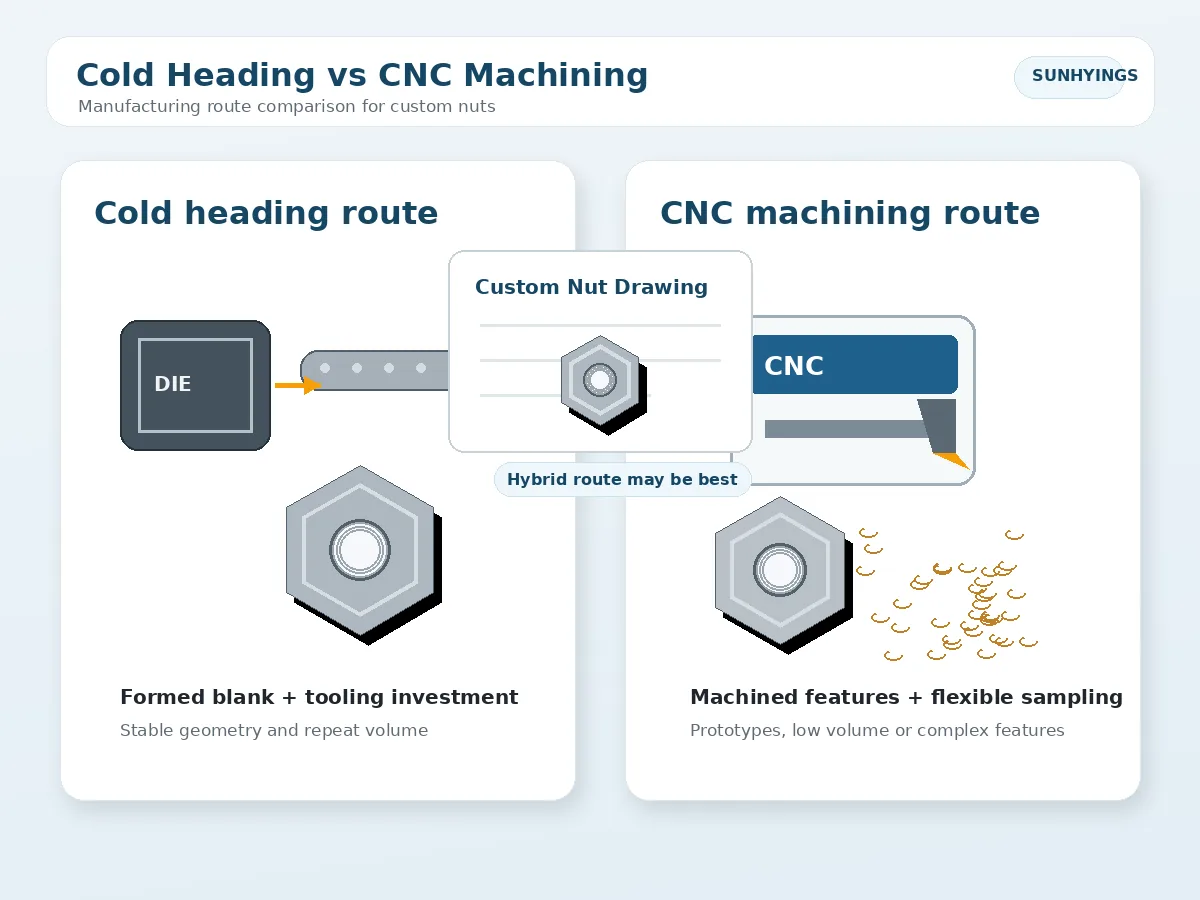
O encruamento a frio geralmente é uma rota de eficiência de produção quando a geometria pode ser conformada e o volume justifica o ferramental. A usinagem CNC geralmente é uma rota de flexibilidade para protótipos, pedidos de baixo volume, projetos em mudança ou recursos complexos. Muitas porcas personalizadas usam uma rota híbrida que combina encruamento a frio com usinagem secundária, rosqueamento, tratamento térmico, revestimento ou inspeção quando necessário.
Encruamento a frio, usinagem CNC e rotas híbridas devem ser selecionados de acordo com geometria, tolerância, volume e estágio de aprovação.
Imagem conceitual da rota de fabricação; não é prova de um modelo de produto específico ou aprovação de processo.
Resposta rápida: Quando as porcas personalizadas devem ser encruadas a frio ou usinadas em CNC?
Escolha o encruamento a frio quando a porca personalizada tiver geometria estável, recursos conformáveis, demanda repetitiva e volume anual que justifique ferramental. Escolha a usinagem CNC quando o projeto precisar de protótipos, produção de baixo volume, mudanças frequentes de design, recursos laterais complexos, recursos usinados locais apertados ou validação rápida de design antes do investimento em ferramental. Escolha uma rota híbrida quando o blank básico puder ser conformado, mas recursos críticos ainda exigirem usinagem, rosqueamento, laminação de rosca ou inspeção pós-processo.
O comprador não deve perguntar apenas “Qual processo é mais barato?” A melhor pergunta é: qual rota de fabricação corresponde ao desenho, função, tolerância, material, revestimento, volume e estágio de aprovação? Uma amostra CNC pode ajudar a verificar o ajuste, mas não representa automaticamente uma peça produzida em massa por encruamento a frio. Um orçamento de encruamento a frio pode reduzir o custo unitário em volume, mas somente se o ferramental, fluxo de material, operações secundárias e requisitos de inspeção forem viáveis.
Encruamento a frioUsinagem CNCRota híbridaCusto de ferramentariaVolume de produção
Por que a Rota de Fabricação Altera Custo, Resistência, Tolerância e Prazo de Entrega
Dois fornecedores podem cotar a mesma porca personalizada de forma diferente porque estão assumindo rotas de fabricação distintas. Um fornecedor pode cotar usinagem CNC para um lote pequeno. Outro pode cotar recartilhamento a frio com ferramentaria para produção futura em massa. Um terceiro fornecedor pode cotar uma rota híbrida que combina um blank conformado com usinagem secundária.
Se o comprador comparar apenas o preço unitário, o resultado pode ser enganoso. Um preço baixo de amostra CNC nem sempre prevê o custo de produção em massa. Uma cotação de recartilhamento a frio pode incluir custos de ferramentaria e setup que tornam o primeiro lote mais caro, mas reduzem o custo unitário posteriormente. Uma rota híbrida pode parecer mais complexa, mas pode ser a forma mais realista de atender tanto aos requisitos de custo quanto aos de características críticas.
Para peças baseadas em desenho, a rota de fabricação deve ser revisada em conjunto com a revisão mais recente do desenho. Isso é especialmente importante para porcas especiais fabricadas sob desenho, onde a rota cotada deve corresponder à geometria real, dimensões críticas e expectativas de aprovação.
Recartilhamento a frio, usinagem CNC e operações secundárias devem ser revisados como um roteiro de processo completo.
Diagrama de fluxo de trabalho para planejamento de processo; a rota real depende do desenho, material, tolerância e volume.
Fator de Decisão
Recravação a Frio Tende a se Adequar Quando…
Usinagem CNC Tende a se Adequar Quando…
Rota Híbrida Tende a se Adequar Quando…
Geometria
A forma externa pode ser formada consistentemente
A peça possui características complexas ou não formáveis
O blank é formável, mas algumas características precisam de usinagem
Volume
A demanda anual pode justificar ferramentas
A quantidade é baixa ou a demanda é incerta
O volume é significativo, mas nem todos os recursos são conformáveis
Maturidade do projeto
O desenho está estável e as dimensões críticas estão confirmadas
O projeto ainda está em mudança ou em revisão de protótipo
O projeto está majoritariamente estável, com recursos críticos selecionados ainda usinados
Estrutura de custos
O custo da ferramentaria pode ser amortizado ao longo da produção repetida
Ferramentas de cabeçote dedicadas não se justificam
A conformação reduz o desperdício de material, enquanto a usinagem controla as características principais
Risco de aprovação
O roteiro de conformação para produção pode ser validado
O roteiro de protótipo é aceitável para verificações iniciais de projeto
O roteiro do processo deve definir claramente as características conformadas e usinadas
Regra de Engenharia
O nome do processo não é suficiente para aprovação. Os compradores devem solicitar o roteiro completo de fabricação: preparação do blank, conformação ou usinagem, rosqueamento, operações secundárias, tratamento térmico, revestimento, inspeção e embalagem, quando necessário.
O que é Recalcagem a Frio para Porcas Personalizadas?
A recalcagem a frio, também chamada de conformação a frio em muitos contextos de fixadores, forma metal à temperatura ambiente forçando arame, barra ou um blank preparado em uma matriz. Em vez de cortar a maior parte do material, o processo desloca o material para a forma necessária. Isso pode ser eficiente para produção de fixadores em alto volume quando a geometria, o material e o projeto da matriz são adequados.
Para porcas personalizadas, a cravação a frio pode criar o blank básico da porca, formato do flange, ressalto, recurso de projeção ou outra geometria formada. A peça pode ainda necessitar de rosqueamento, laminação de rosca, rebarbação, usinagem secundária, tratamento térmico, revestimento e inspeção final, dependendo do desenho.
Como a cravação a frio forma o blank da porca
Em termos simplificados, a cravação a frio usa força controlada e matrizes para deslocar o material e dar forma. O processo depende da conformabilidade do material, tamanho do blank, projeto da matriz, geometria da peça e sequência do processo. Uma porca personalizada com formato externo simples e volume estável pode ser um bom candidato. Uma peça com paredes finas, rebaixos profundos, recursos laterais difíceis ou quantidade muito baixa pode ser menos adequada.
Por que a ferramenta é importante
A ferramenta controla a forma conformada. Uma boa ferramenta pode suportar repetibilidade, mas adiciona custo inicial e trabalho de validação. Se o desenho mudar após a fabricação da ferramenta, o impacto no custo e no prazo pode ser significativo. Os compradores devem congelar a geometria crítica e confirmar o volume esperado antes de escolher a cravação a frio para uma porca personalizada.
Verificações de DFM para cravação a frio
Antes de selecionar a cravação a frio, o fornecedor deve revisar se a geometria da porca pode ser conformada sem criar risco excessivo de fluxo de material, distorção de parede fina, problemas de preenchimento da matriz ou carga de usinagem secundária. A revisão deve incluir conformabilidade do material, tamanho do blank, espessura da parede, geometria do flange ou ressalto, preparação da rosca, tamanho do lote esperado e método de inspeção final.
Item de DFM para Cravação a Frio
Por que é Importante
Necessita confirmação
Conformabilidade do material
Afeta a viabilidade de encabeçamento e risco de trincas
Grau do material, dureza e estoque de entrada do fornecedor
Geometria do blank
Controla o fluxo de material e o comportamento de preenchimento da matriz
Desenho da peça, tamanho do blank e sequência de conformação
Espessura da parede
Áreas finas podem deformar ou exigir usinagem
Dimensões de seção crítica
Preparação da rosca
O método de rosca afeta o ajuste e a resistência
Tamanho da rosca, passo, tolerância e condição do revestimento
Necessidade de operação secundária
Características especiais podem não ser formadas economicamente
Ranhuras, furos laterais, ombros, recursos piloto e faces de apoio
Quando operações secundárias ainda são necessárias
O encabeçamento a frio não completa automaticamente todas as porcas personalizadas. Roscas, planeza crítica, rasgos, furos laterais, superfícies de apoio, recursos piloto ou faces especiais podem exigir operações secundárias. Tratamento térmico ou revestimento também podem ser necessários, dependendo do material, função e especificação do cliente.
O que é Usinagem CNC para Porcas Personalizadas?
A usinagem CNC cria recursos cortando material com ferramentas controladas. Para porcas personalizadas, a CNC pode incluir torneamento, fresamento, furação, mandrilamento, rosqueamento, abertura de rasgos ou faceamento, dependendo da geometria da peça.
A usinagem CNC é especialmente útil quando o comprador precisa de um protótipo, um lote de baixo volume, flexibilidade de design ou recursos difíceis de formar. Também pode ser usada como operação secundária após o encabeçamento a frio.
Usinagem CNC para protótipos e pedidos de baixo volume
Quando um projeto ainda está em fase de design, a usinagem CNC pode fornecer peças rapidamente sem comprometer a ferramentaria de encabeçamento a frio. Isso é útil para verificar ajuste de montagem, engate de rosca, folga do suporte, condição da peça de acoplamento ou espaço de embalagem. Para pedidos de baixo volume, a usinagem CNC pode continuar sendo a melhor opção, pois o custo da ferramentaria para encabeçamento a frio pode não se justificar.
Usinagem CNC para recursos complexos ou não conformáveis
Alguns projetos de porcas incluem ombros, ranhuras, fendas, furos laterais, faces de apoio especiais, rebaixos ou geometria não simétrica. Se esses recursos não puderem ser formados de forma confiável, pode ser necessária a usinagem CNC. Em alguns casos, o blank pode ser primeiro recalcado a frio e depois usinado apenas onde a precisão ou geometria exigir.
Verificações de DFM para usinagem CNC
A usinagem CNC é flexível, mas não é automaticamente a melhor rota de produção. Os compradores devem confirmar se o projeto usinado cria remoção excessiva de material, transições abruptas, seções fracas, tempo de ciclo longo ou inspeção difícil. Um recurso usinado deve suportar a função, não apenas corresponder à aparência.
Boa adequação para CNC
Lotes de protótipo, projetos em mudança, fendas especiais, furos laterais, ombros, peças de serviço de baixo volume e recursos locais críticos.
Risco de custo CNC
Alta remoção de material, tempo de ciclo longo, múltiplas configurações, rebarbação difícil ou grandes volumes anuais.
Risco de aprovação
Uma amostra CNC pode não representar uma rota de produção posterior por recalcamento a frio, a menos que a diferença de rota seja revisada e aceita.
Quando a usinagem se torna muito cara para produção em massa
A usinagem CNC torna-se menos atraente quando cada peça requer ciclo longo, remoção pesada de material ou múltiplas configurações. Na produção de alto volume, o custo do tempo de máquina e sucata pode exceder o benefício da flexibilidade. Nesse ponto, o encabeçamento a frio ou uma rota híbrida deve ser revisada.
Comparação de Custos: Custo de Ferramentas, Custo Unitário e Volume Anual
A comparação de custos deve incluir mais do que o preço unitário cotado. O comprador deve considerar ferramentas, setup, utilização de material, tempo de usinagem, operações secundárias, inspeção, embalagem, documentos de aprovação e volume anual esperado.
O custo de ferramentas, custo unitário e volume anual devem ser comparados antes de escolher uma rota de fabricação.
Matriz conceitual apenas; o custo real de ferramentas e o limite de volume devem ser confirmados por desenho e cotação.
Por que o encabeçamento a frio precisa de investimento em ferramentas
O encabeçamento a frio geralmente requer ferramentas de conformação. Estas podem incluir matrizes, punções e configuração relacionada. Quanto mais complexa a geometria, mais cuidadosamente as ferramentas devem ser projetadas e validadas. Isso torna o encabeçamento a frio menos atraente para projetos instáveis ou quantidades muito pequenas. No entanto, uma vez que as ferramentas são validadas, o encabeçamento a frio pode suportar produção repetitiva eficiente.
Por que a usinagem CNC pode ser mais barata para baixo volume
A usinagem CNC pode ser mais barata para baixo volume porque evita ferramentas de encabeçamento dedicadas. O fornecedor pode programar a peça e usinar um lote pequeno a partir de barra, tubo ou estoque preparado. Isso é útil para protótipos, peças de reposição, amostras de validação ou projetos de curta tiragem. A contrapartida é que o custo unitário pode permanecer alto se a quantidade aumentar.
Como o volume anual altera o orçamento
A mesma peça pode ter dois orçamentos corretos diferentes dependendo do volume. Um orçamento CNC pode ser razoável para um pequeno lote de amostras. Um orçamento de recravamento a frio pode ser mais razoável para produção estável em massa. Um orçamento híbrido pode ser melhor quando a peça precisa tanto de eficiência de conformação quanto de precisão usinada.
Fator de Custo
Impacto no recravamento a frio
Impacto na usinagem CNC
Pergunta do Comprador
Volume anual
Volume maior ajuda a justificar ferramentas
Volume maior aumenta a carga de tempo de máquina
Qual é a demanda anual realista?
Complexidade das ferramentas
Geometria complexa aumenta o custo de ferramental
Menos dependente de ferramental de conformação
O projeto está congelado?
Custo do material
Melhor aproveitamento de material pode ajudar
Remoção excessiva de material aumenta o desperdício
O material é caro ou difícil de usinar?
Operações secundárias
Podem ser necessárias após a conformação
Pode já estar incluído na rota de usinagem
Quais recursos exigem trabalho secundário?
Requisito de tolerância
Questões de validação de ferramentas
A precisão local pode ser mais fácil de usinar
Quais dimensões são críticas?
Documentos de aprovação
Pode exigir evidência de processo com intenção de produção
Evidência de protótipo pode não representar produção em massa
É necessário PPAP ou aprovação do cliente?
Redução de custos: CNC pode ser a rota correta para baixo volume, mesmo quando o preço unitário é mais alto. A recartilhagem a frio pode ser a rota correta para produção em massa, mesmo quando o primeiro orçamento inclui custo de ferramentaria. A comparação correta é o custo total do projeto, incluindo amostra, ferramentaria, produção, inspeção e risco de aprovação.
Comparação de Resistência: Fluxo de Grão, Remoção de Material e Teste Funcional
A resistência não deve ser julgada apenas pelo nome do processo. Uma porca recartilhada a frio não é automaticamente aceitável para toda aplicação. Uma porca usinada em CNC não é automaticamente fraca. A resistência depende do material, geometria, espessura da seção, tratamento térmico, engate da rosca, área de apoio, revestimento e requisito de teste funcional.
Fluxo de material conformado
Em projetos adequados, a recalcagem a frio pode mover o material para dar forma sem cortar a estrutura principal. Isso pode favorecer o fluxo de material e a eficiência de produção, mas não substitui a verificação de material, dureza ou funcionalidade.
Geometria usinada
A resistência usinada depende da seção remanescente após a remoção de material. Cantos vivos, paredes finas, engajamento de rosca insuficiente ou área de apoio reduzida podem criar risco se o desenho não for revisado adequadamente.
Teste específico de função
Dependendo da porca, a aprovação pode exigir carga de prova, torque de arrancamento, arrancamento, push-out, torque predominante, desempenho de solda, dureza ou inspeção de rosca.
Função da Porca
Risco de Resistência / Desempenho
Pergunta sobre rota de processo
Verificação possível
Porca de fixação rosqueada
Descascamento de rosca, carga de prova, engajamento de rosca
Como a rosca será feita e inspecionada?
Calibrador de rosca, carga de prova ou teste exigido por desenho
Geometria de clinchagem, resistência ao empuxo ou torque
O roteiro controla a característica de clinchagem?
Resistência ao empuxo ou torque quando especificado
Por exemplo, porcas autotravantes totalmente metálicas pode envolver requisitos de torque de atrito quando especificado, enquanto projetos de porca de solda podem necessitar de verificações de torque ou empuxo dependendo da junta e do desenho. O escopo do teste deve ser confirmado pelo desenho do comprador e pela norma do cliente.
Comparação de Tolerâncias: Precisão de Formação, Características Usinadas e Dimensões Críticas
A tolerância é específica do recurso. Não é correto dizer que a conformação a frio ou a usinagem CNC são sempre mais precisas para toda a peça. A conformação a frio pode ser estável para dimensões formadas repetíveis após a validação da ferramenta. A usinagem CNC pode ser mais forte para recursos locais apertados, ombros, furos laterais, rebaixos, faces especiais ou recursos que precisam de localização precisa. Algumas porcas personalizadas exigem ambos.
A conformação a frio e a usinagem CNC devem ser comparadas pelo recurso crítico, não apenas pelo nome do processo.
O diagrama usa apenas indicações genéricas; as tolerâncias reais devem seguir o desenho do comprador e o requisito de inspeção.
As tolerâncias conformadas dependem da capacidade do processo
A conformação a frio pode produzir dimensões repetíveis, mas a capacidade depende do material, ferramenta, configuração da máquina, geometria do recurso e método de inspeção. O fornecedor deve confirmar quais recursos são conformados e quais exigem operações secundárias.
Recursos usinados podem controlar dimensões críticas locais
A usinagem CNC pode ser útil quando um desenho tem dimensões críticas locais difíceis de conformar. Por exemplo, um ombro especial, diâmetro piloto, furo lateral ou face plana pode ser usinado após a conformação. Isso pode ajudar a equilibrar custo e precisão. Para linguagem dimensional básica, como tamanho da rosca, entre faces e altura da porca, os compradores também podem revisar o guia de dimensões de porcas sextavadas antes de preparar um RFQ.
O revestimento pode alterar o ajuste da rosca e os resultados da inspeção
O ajuste da rosca deve ser revisado após o revestimento. Galvanoplastia, fosfatização, zinco-níquel, óxido preto, passivação ou outros tratamentos de superfície podem afetar o engajamento da rosca e o comportamento do torque. Se o revestimento for necessário, o comprador deve confirmar a inspeção da rosca pós-revestimento e qualquer tolerância pós-revestimento.
Tipo de Recurso
Consideração para Recalcagem a Frio
Consideração para Usinagem CNC
Decisão Típica
Forma externa do blank
Bom se for maleável e repetível
Possível, mas pode desperdiçar material
Recravamento a frio para volume
Entre faces / altura
Pode ser estável após validação da ferramenta
Pode ser usinado para requisitos especiais
Depende da tolerância e do volume
Tópico
Frequentemente necessita de rosqueamento ou laminação
Pode ser usinado ou rosqueado
Confirme o tamanho da rosca, passo e tolerância
Furo lateral / rasgo
Pode ser difícil de formar
Frequentemente adequado para usinagem
CNC ou usinagem secundária
Ressalto / guia
Pode ser formado se a geometria permitir
A usinagem pode controlar a precisão local
Rota híbrida frequentemente útil
Ajuste de rosca pós-revestimento
Deve ser inspecionado após a pintura/revestimento
Deve ser inspecionado após a pintura/revestimento
Apenas a rota de processo não é suficiente
Lembrete Crítico para a Qualidade
Os compradores devem marcar quais dimensões são críticas para a função antes de solicitar uma recomendação de processo. Uma superfície formada não crítica e um ombro usinado crítico não devem ser tratados da mesma forma. O plano de inspeção deve seguir as características CTQ, não apenas o nome do processo.
Volume e Estágio de Aprovação: Protótipo, Amostra, PPAP e Produção em Massa
A rota correta pode mudar de acordo com o estágio do projeto. A usinagem CNC pode ser a maneira mais rápida de fazer um protótipo. O encabeçamento a frio pode ser a melhor rota para produção em massa. Mas se a peça for usada em uma aplicação automotiva, a rota de amostra e a rota de produção devem ser claramente controladas.
Quando a porca personalizada está vinculada a uma junta funcional, os compradores também devem fornecer o local de montagem, o tipo de junta, a condição da peça de acoplamento e o modo de falha esperado. Esses detalhes podem afetar a carga de prova, arrancamento, torque de saída, torque predominante, retenção de solda, engajamento de rosca e escopo de inspeção final. Os compradores podem comparar esses riscos comuns problemas de montagem automotiva resolvidos por porcas especiais antes de finalizar o escopo do RFQ.
Protótipo CNC para verificação de design
Um protótipo CNC pode ajudar a verificar a intenção do projeto, folga de montagem, condição de peças de encaixe, engate de rosca e geometria básica. É útil antes de investir em ferramentas de conformação. No entanto, um protótipo CNC pode não representar o processo final de produção por recalcamento a frio.
Amostras representativas da produção para aprovação
Se o cliente exigir amostras representativas da produção, o fornecedor deve usar a rota de produção planejada ou explicar claramente qualquer diferença. Isso é especialmente importante para projetos automotivos, onde a rota de processo, dados de inspeção e documentos de aprovação podem precisar estar alinhados. Compradores que avaliam projetos automotivos também podem revisar como porcas especiais personalizadas para OEMs automotivos passar da revisão do projeto para a produção estável em massa.
Por que as alterações de rota devem ser confirmadas antes do PPAP
O PPAP é exigido apenas quando o cliente ou projeto o especifica. Se o PPAP for aplicável, a rota de fabricação, revisão do desenho, material, método de inspeção e processo de produção devem ser confirmados antes da submissão. Uma alteração de rota após a aprovação pode exigir revisão adicional, dependendo dos requisitos do cliente.
Pergunta
Por que é Importante
A amostra foi usinada em CNC, mas a produção será por recalcamento a frio?
A amostra pode não representar as características da produção
A rosca será cortada, machada ou laminada na produção?
O método de rosca pode afetar o ajuste e o desempenho
O tratamento térmico será adicionado após a aprovação da amostra?
A dureza e o comportamento dimensional podem mudar
O revestimento será adicionado após a aprovação da amostra?
O ajuste da rosca e o comportamento do torque podem mudar
As dimensões críticas são formadas ou usinadas?
O plano de inspeção deve corresponder ao roteiro do processo
O volume anual é estável o suficiente para ferramentas?
O investimento em ferramentaria depende da confiança na demanda
O roteiro de produção foi congelado?
A aprovação e a produção em massa não devem ser baseadas em premissas de roteiro pouco claras
Quando um Roteiro Híbrido Faz Mais Sentido
Um roteiro híbrido geralmente oferece o melhor equilíbrio entre custo, função e geometria. Em vez de usinar a porca inteira a partir de barra, o fornecedor pode fazer o forjamento a frio de um blank próximo ao formato final e usinar apenas as características críticas. Em vez de forçar uma porca complexa em um roteiro de conformação difícil, o fornecedor pode usar CNC para características que não podem ser conformadas de forma confiável.
Muitas porcas personalizadas usam um roteiro híbrido para equilibrar a eficiência da conformação com as características críticas usinadas.
As etapas do processo mostradas são condicionais; o roteiro real depende do desenho, material, função e requisito do pedido.
Blank forjado a frio mais usinagem secundária
Esta rota pode ser útil quando o formato básico da porca é adequado para conformação, mas uma ou duas características exigem usinagem. Exemplos podem incluir um rasgo lateral, diâmetro piloto, face controlada, ombro especial ou localização de característica.
Quando a rosqueamento ou laminação de rosca altera a rota
O processo de rosca deve ser confirmado. Algumas porcas podem ser rosqueadas. Algumas roscas externas podem ser laminadas. Algumas formas internas especiais podem exigir um plano de ferramentas ou inspeção específico. O tamanho da rosca, passo, tolerância e condição de revestimento devem ser incluídos no RFQ.
Quando o revestimento ou tratamento térmico altera a inspeção final
O tratamento térmico e o revestimento podem alterar o plano de inspeção final. Se o tratamento térmico for necessário, a dureza e a estabilidade dimensional podem precisar de revisão. Se o revestimento for necessário, o ajuste da rosca pós-revestimento e a condição da superfície devem ser inspecionados.
Exemplo de Rota Híbrida
Por Que Pode Ser Usada
Confirmação do Comprador Necessária
Blanco recalcado a frio + rosqueamento
Formação eficiente do blanco com criação controlada de rosca interna
Tamanho da rosca, passo, tolerância e método de calibragem
Blanco recalcado a frio + recurso lateral CNC
Forma o corpo principal enquanto usina um rasgo, furo lateral ou ressalto
Localização do recurso, controle de rebarbas e método de inspeção
Protótipo CNC + produção por recalcamento a frio
Suporta revisão antecipada do projeto antes do investimento em ferramental
Se amostras para produção são necessárias posteriormente
Conformação + tratamento térmico + revestimento
Usado quando a resistência do material ou a proteção superficial são especificadas
Dureza, revestimento, ajuste de rosca pós-revestimento e escopo de inspeção
Erros Comuns em RFQ ao Comparar Recalcagem a Frio e Usinagem CNC
Muitos problemas de cotação começam porque o comprador e o fornecedor estão comparando premissas diferentes. Um fornecedor cotando protótipos CNC pode parecer caro para produção em massa. Um fornecedor cotando recalcagem a frio pode parecer caro para o primeiro lote porque a ferramentaria está incluída. Um fornecedor cotando uma rota simplificada pode perder operações secundárias.
Comparando diferentes premissas de rota
Uma cotação de amostra CNC e uma cotação de produção por recalcagem a frio respondem a perguntas diferentes. Os compradores devem perguntar pela rota por trás do preço.
Ignorando operações secundárias
Um orçamento que menciona “cabeça fria” pode ainda exigir rosqueamento, laminação de rosca, usinagem, tratamento térmico, revestimento, classificação e embalagem.
Esquecimento do revestimento e ajuste da rosca
Se o RFQ não especificar o revestimento e a tolerância da rosca, a rota cotada pode parecer correta antes do revestimento, mas criar problemas após a galvanização ou tratamento de superfície.
Verificação prática do comprador: solicitar ao fornecedor que separe a rota de protótipo, a rota de amostra e a rota de produção em massa na cotação. Isso evita comparar uma cotação de desenvolvimento CNC com uma cotação de produção por recalcamento a frio como se fossem do mesmo escopo.
Lista de Verificação do RFQ: Dados Necessários Antes que a SUNHYINGS Possa Recomendar uma Rota de Processo
Antes de escolher recalcamento a frio, usinagem CNC ou uma rota híbrida, o fornecedor precisa de dados suficientes para entender a função da peça e o objetivo de produção. Um desenho é o melhor ponto de partida. Se não houver desenho, uma foto da amostra, dimensões aproximadas e descrição da aplicação podem ajudar a iniciar a revisão, mas a cotação final ainda precisa de dados técnicos confirmados.
Um RFQ útil deve definir desenho, rosca, material, tolerância, volume, revestimento, função e requisitos de aprovação.
Gráfico de lista de verificação para preparação do comprador; não representa uma aprovação universal ou garantia de documento.
Dados de desenho e geometria
Envie a revisão do desenho, número da peça, dimensões gerais, tamanho da rosca, passo, tolerância, medida entre faces, altura, diâmetro do flange, dimensões do ressalto, características laterais, furos, rasgos, superfícies de apoio e quaisquer dimensões críticas. Se a peça for fabricada sob desenho, a revisão mais recente do desenho deve controlar a análise.
Dados de volume, montagem e aprovação
Envie a quantidade da amostra, quantidade do primeiro lote, previsão de volume anual e vida útil de produção esperada. Indique também se o projeto é para protótipo, construção de teste, PPAP, produção em massa, peça de reposição ou redução de custo. Se a função da porca estiver vinculada a uma junta soldada, junta rebitada, recurso de travamento, suporte, montagem de chapa metálica ou rosca de suporte de carga, forneça o local da montagem, o tipo de junta, o material ou espessura da peça de acoplamento e o modo de falha que deve ser evitado.
Dados de material, revestimento e teste
Envie o grau do material, dureza ou classe de propriedade, requisito de tratamento térmico, requisito de revestimento, expectativa de ajuste da rosca pós-revestimento, requisito de corrosão se especificado e requisitos de teste funcional, como carga de prova, torque de saída, resistência ao arrancamento, resistência ao empuxo ou torque predominante quando aplicável.
Dados do RFQ
Por que é necessário
Se ausente
Desenho ou foto de amostra
Verifica geometria e conformabilidade
Rota de processo não pode ser confirmada com confiabilidade
Revisão do desenho
Controla a linha de base técnica
Cotação pode ser baseada em projeto desatualizado
Tamanho da rosca, passo e tolerância
Determina o processo de rosca e inspeção
Risco de ajuste de rosca e revestimento permanece incerto
Classe de material e propriedade
Afeta conformabilidade, usinabilidade e resistência
A viabilidade de encabeçamento a frio ou CNC pode ser mal avaliada
Local de montagem e tipo de junta
Esclarece a carga de aperto, retenção de solda, cravação, arrancamento, torque de saída ou risco de torque predominante
O fornecedor pode cotar um formato de peça sem entender o modo de falha funcional
Requisito de tratamento térmico
Afeta a dureza, distorção e aprovação
O comportamento da amostra e da produção pode diferir
Requisito de revestimento
Afeta o ajuste da rosca e a expectativa de corrosão
O escopo da inspeção pós-revestimento pode ser negligenciado
Volume anual
Determina se a ferramenta é justificada
O fornecedor pode cotar a rota errada
Quantidade de amostra
Ajuda a escolher a rota do protótipo
O custo de desenvolvimento pode ser comparado incorretamente
Requisito funcional
Define carga de prova, torque de saída, resistência ao arrancamento, torque predominante ou outros testes
O risco de resistência e desempenho permanece indefinido
Requisito de aprovação
Esclarece PPAP, IMDS, relatório dimensional ou documentos do cliente, se necessário
O roteiro de produção pode não atender aos requisitos de aprovação
Como a SUNHYINGS avalia a conformação a frio versus usinagem CNC para porcas personalizadas
A SUNHYINGS deve revisar as opções de conformação a frio, usinagem CNC e roteiro híbrido a partir do desenho e da aplicação primeiro, não da preferência de processo. O melhor roteiro é aquele que corresponde à geometria da porca, material, tolerância, função, volume e requisito de aprovação.
Revisão de processo baseada no desenho
A revisão começa com o desenho, amostra ou descrição da aplicação. Os pontos-chave incluem tamanho da rosca, passo, tolerância, geometria externa, formato do flange ou ressalto, características laterais, espessura da parede, face de apoio, revestimento e tratamento térmico. Se faltar informação, a resposta correta é “precisa de confirmação”, não uma suposição.
Comparação de roteiros de custo e volume
Para baixa quantidade ou projetos em mudança, a usinagem CNC pode ser o primeiro roteiro prático. Para volume médio ou alto estável, a conformação a frio ou um blank conformado a frio com usinagem secundária pode reduzir o custo unitário. A decisão final depende do custo da ferramenta, material, complexidade das características e demanda anual.
Confirmação do roteiro de amostra e produção
Se o comprador iniciar com amostras CNC, mas esperar produção em massa por encruamento a frio posteriormente, a mudança de rota deve ser revisada antes da aprovação. Para projetos automotivos, a rota de amostras, rota de produção, plano de inspeção e documentos de aprovação devem estar alinhados com os requisitos do cliente.
Solicite uma Revisão de Rota de Fabricação para Sua Porca Personalizada
Para um projeto de porca personalizada, prepare seu desenho ou foto da amostra, tamanho da rosca, material, tolerância, revestimento, volume anual, quantidade de amostras, características críticas, local de montagem, tipo de junta, necessidades de teste funcional e requisitos de aprovação. A SUNHYINGS pode revisar se a rota de encruamento a frio, usinagem CNC ou uma rota híbrida é mais adequada antes do orçamento ou amostragem.
Entrada Recomendada
Por que é Importante
Desenho ou foto de amostra
Confirma geometria, características e conformabilidade
Tamanho da rosca, passo e tolerância
Controla rosqueamento, laminação, usinagem e inspeção
Material e classe de dureza/propriedade
Controla conformabilidade, usinabilidade e resistência funcional
Revestimento e ajuste da rosca pós-revestimento
Controla a inspeção final de rosca e o risco de montagem
Local de montagem e tipo de junta
Esclarece o risco de carga de aperto, retenção de solda, arrancamento, torque de saída, torque predominante ou engajamento de rosca
Volume anual e quantidade de amostra
Determina se a ferramenta é justificada
Necessidades de teste funcional
Esclarece carga de prova, torque de saída, arrancamento, empuxo ou torque predominante, se necessário
Documentos de aprovação, se necessário
Esclarece o escopo de PPAP, IMDS, relatório dimensional ou documento específico do cliente
Referências Técnicas e Contexto de Normas
Use estas referências apenas para contexto. A revisão mais recente do desenho do comprador, o requisito específico do cliente e o contrato de compra permanecem como documentos controladores para o escopo real de aprovação, teste e submissão.
Páginas Públicas do IMDS — contexto do sistema de dados de materiais automotivos quando o relatório de materiais é exigido pelo cliente ou programa.
PERGUNTAS FREQUENTES
A conformação a frio é sempre mais barata que a usinagem CNC para porcas personalizadas?
Não. A estampagem a frio pode reduzir o custo unitário quando a geometria é adequada e o volume justifica a ferramentaria. A usinagem CNC pode ser mais barata para protótipos, pedidos de baixo volume ou projetos que ainda estão em alteração. A comparação correta deve incluir custo de ferramentaria, custo unitário, aproveitamento de material, operações secundárias e volume anual.
Porcas laminadas a frio são mais resistentes do que porcas usinadas em CNC?
Não automaticamente. A recalcagem a frio pode favorecer o fluxo de material quando o material e a geometria são adequados, mas a resistência final depende do material, geometria, tratamento térmico, engate da rosca, revestimento e ensaio funcional. Uma porca usinada em CNC pode ser adequada quando o projeto e o material atendem ao requisito.
Quando devo escolher a usinagem CNC para uma porca personalizada?
Escolha a usinagem CNC quando o pedido for de baixo volume, o design ainda estiver mudando, a peça tiver características complexas ou for necessário um protótipo antes do investimento em ferramentas. A CNC também é útil para usinagem secundária após o encabeçamento a frio.
Um protótipo CNC pode ser aprovado para produção em massa por recalcamento a frio?
Não automaticamente. Um protótipo CNC pode ser útil para verificação do design, mas pode não representar a rota de produção final por encruamento a frio. Se a aprovação depender do processo de produção, o comprador deve confirmar se amostras representativas da produção são necessárias.
Uma porca personalizada pode usar tanto o forjamento a frio quanto a usinagem CNC?
Sim. Muitas porcas personalizadas usam um processo híbrido. O blank pode ser forjado a frio para eficiência de volume, enquanto recursos especiais, como ranhuras, ressaltos, furos laterais ou faces de apoio, podem ser usinados posteriormente.
Qual processo oferece melhor tolerância para porcas personalizadas?
Depende da característica. O encabeçamento a frio pode ser estável para dimensões formadas após a validação da ferramenta. A usinagem CNC pode ser melhor para características locais apertadas. Revestimento, tratamento térmico e inspeção de rosca também podem afetar a tolerância final e o ajuste.
O que devo enviar para um orçamento de conformação a frio vs usinagem CNC?
Envie o desenho ou foto da amostra, revisão do desenho, material, tamanho da rosca e tolerância, dimensões críticas, requisito de revestimento, requisito de tratamento térmico, local de montagem, tipo de junta, quantidade de amostras, volume anual, necessidades de teste funcional e documentos de aprovação, se necessário.
Nota de Revisão Técnica
Este artigo foi preparado para gerentes de sourcing, engenheiros de compras, equipes SQE, engenheiros mecânicos e engenheiros de fixadores que comparam os processos de recalcamento a frio, usinagem CNC e rotas híbridas para porcas personalizadas. A seleção final do processo deve ser confirmada com base na revisão mais recente do desenho, material, geometria, requisito de rosca, revestimento, condição de montagem, volume anual, requisito de aprovação do cliente e contrato de compra.
Escopo revisado: seleção de rota de fabricação de porcas personalizadas, custo de ferramental, custo unitário, volume, utilização de material, limites de resistência, tolerância específica de recurso, risco de rota de amostra, roteamento híbrido, requisitos de entrada de montagem/junta e preparação de RFQ.
Páginas Relacionadas da SUNHYINGS
Consulte páginas relacionadas da SUNHYINGS para tipos personalizados de porcas, função de montagem e preparação dimensional antes de enviar um RFQ.
Nota de padrões e limitações: Este artigo é um guia prático de sourcing e engenharia. Ele não substitui o desenho do cliente, requisitos específicos do cliente, submissão formal de PPAP, requisitos de relatório IMDS, revisão de engenharia qualificada ou aprovação do processo do fornecedor. Requisitos finais para material, dureza, revestimento, tolerância, rota de processo, inspeção, teste funcional, rastreabilidade e retenção de registros devem ser confirmados pela revisão do desenho, padrão do cliente e acordo de compra.