Écrous personnalisés : matriçage à froid vs usinage CNC – coût, résistance, tolérance et volume
Choisir entre le matriçage à froid et l'usinage CNC pour un écrou personnalisé n'est pas une simple question de “ quel procédé est le meilleur ? ”. La bonne voie dépend de la géométrie, du matériau, des exigences de filetage, des tolérances critiques, de l'étape d'échantillonnage, du revêtement, du traitement thermique, du volume annuel et du risque d'approbation.
Le matriçage à froid est généralement une voie d'efficacité de production lorsque la géométrie peut être formée et que le volume justifie l'outillage. L'usinage CNC est généralement une voie de flexibilité pour les prototypes, les commandes de faible volume, les conceptions changeantes ou les caractéristiques complexes. De nombreux écrous personnalisés utilisent une voie hybride qui combine le matriçage à froid avec un usinage secondaire, le filetage, le traitement thermique, le revêtement ou l'inspection si nécessaire.
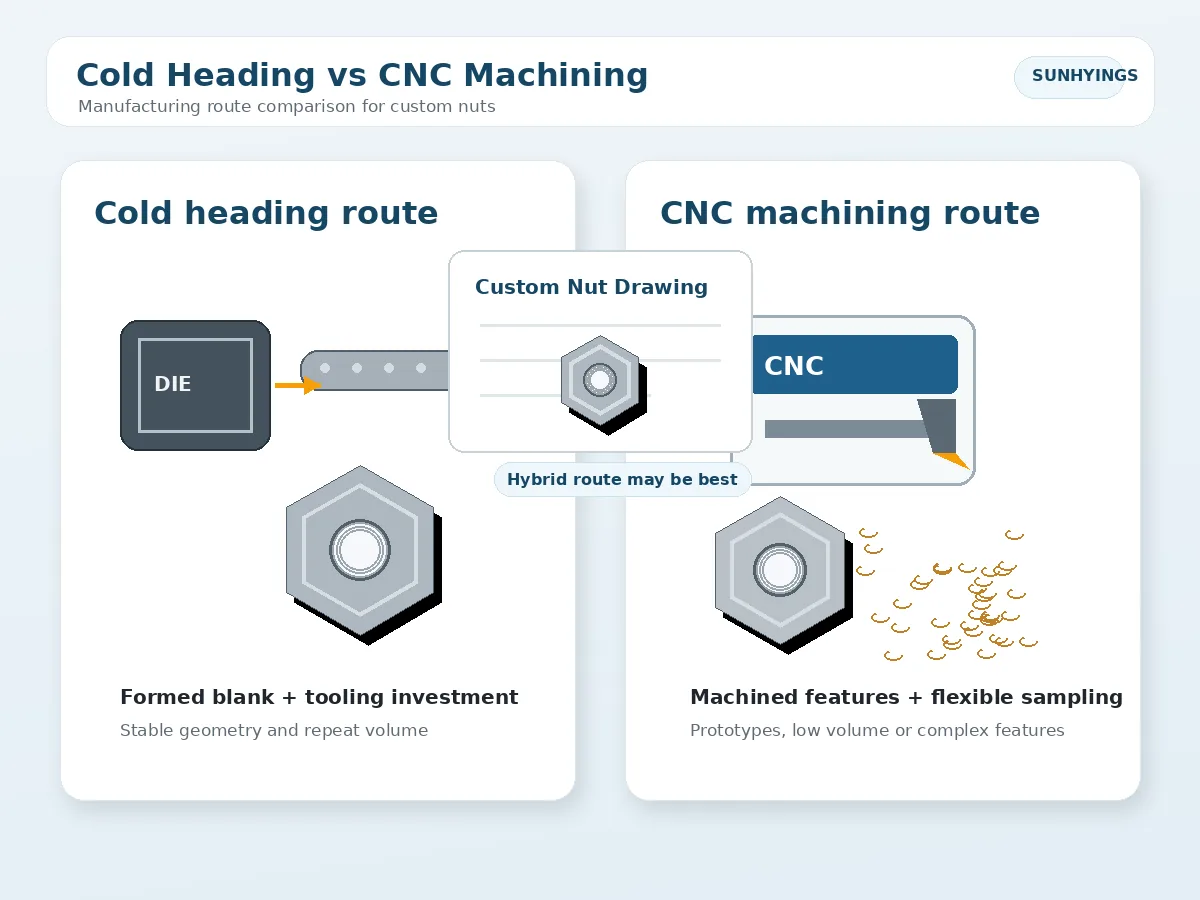
Le matriçage à froid, l'usinage CNC et les voies hybrides doivent être sélectionnés en fonction de la géométrie, de la tolérance, du volume et de l'étape d'approbation.
Image conceptuelle de la voie de fabrication uniquement ; ne constitue pas une preuve d'un modèle de produit spécifique ou d'une approbation de procédé.
Réponse rapide : Quand les écrous personnalisés doivent-ils être refoulés à froid ou usinés par CNC ?
Choisissez le refoulage à froid lorsque l'écrou personnalisé a une géométrie stable, des caractéristiques formables, une demande répétée et un volume annuel pouvant justifier l'outillage. Choisissez l'usinage CNC lorsque le projet nécessite des prototypes, une production en faible volume, des modifications fréquentes de conception, des caractéristiques latérales complexes, des caractéristiques usinées locales serrées, ou une validation rapide de la conception avant l'investissement dans l'outillage. Choisissez un parcours hybride lorsque l'ébauche de base peut être formée mais que des caractéristiques critiques nécessitent encore un usinage, un taraudage, un filetage par laminage ou une inspection post-processus.
L'acheteur ne devrait pas seulement demander “ Quel procédé est le moins cher ? ” La meilleure question est : quel parcours de fabrication correspond au dessin, à la fonction, à la tolérance, au matériau, au revêtement, au volume et à l'étape d'approbation ? Un échantillon CNC peut aider à vérifier l'ajustement, mais il ne représente pas automatiquement une pièce fabriquée en série par matriçage à froid. Un devis de matriçage à froid peut réduire le coût unitaire en volume, mais seulement si l'outillage, le flux de matière, les opérations secondaires et les exigences de contrôle sont réalisables.
Refoulage à froidUsinage CNCParcours hybrideCoût d'outillageVolume de production
Pourquoi la voie de fabrication modifie le coût, la résistance, la tolérance et le délai
Deux fournisseurs peuvent deviser le même écrou personnalisé différemment car ils supposent des voies de fabrication différentes. Un fournisseur peut deviser un usinage CNC pour un petit lot. Un autre peut deviser un matriçage à froid avec outillage pour une production de masse future. Un troisième fournisseur peut deviser une voie hybride combinant une ébauche formée avec un usinage secondaire.
Si l'acheteur compare uniquement le prix unitaire, le résultat peut être trompeur. Un prix CNC bas pour un échantillon ne prédit pas toujours le coût de production de masse. Un devis de matriçage à froid peut inclure l'outillage et les frais de mise en place qui rendent le premier lot plus cher mais réduisent le coût unitaire par la suite. Une voie hybride peut sembler plus complexe, mais elle peut être la manière la plus réaliste de répondre à la fois aux exigences de coût et aux caractéristiques critiques.
Pour les pièces basées sur un plan, la voie de fabrication doit être examinée avec la dernière révision du plan. Ceci est particulièrement important pour écrous spéciaux fabriqués sur plan, où la voie devisée doit correspondre à la géométrie réelle, aux dimensions critiques et aux attentes d'approbation.
Le matriçage à froid, l'usinage CNC et les opérations secondaires doivent être examinés comme un processus complet.
Diagramme de flux pour la planification du processus ; le parcours réel dépend du dessin, du matériau, des tolérances et du volume.
Facteur de décision
Le matriçage à froid est adapté lorsque…
L'usinage CNC est adapté lorsque…
Le parcours hybride est adapté lorsque…
Géométrie
La forme extérieure peut être formée de manière cohérente
La pièce présente des caractéristiques complexes ou non formables
L'ébauche est formable mais certaines caractéristiques nécessitent un usinage
Volume
La demande annuelle peut justifier l'outillage
La quantité est faible ou la demande est incertaine
Le volume est significatif, mais toutes les fonctionnalités ne sont pas formables
Maturité de la conception
Le dessin est stable et les dimensions critiques sont confirmées
La conception est encore en cours de modification ou en cours de révision du prototype
La conception est généralement stable, avec certaines caractéristiques critiques encore usinées
Structure des coûts
Le coût d'outillage peut être amorti sur une production répétée
L'outillage de refoulage dédié n'est pas justifié
Le formage réduit les déchets de matière tandis que l'usinage contrôle les caractéristiques clés
Risque d'approbation
La voie de formage destinée à la production peut être validée
La voie prototype est acceptable pour les vérifications de conception préliminaires
La voie de procédé doit clairement définir les caractéristiques formées et usinées
Règle d'ingénierie
Le nom du processus ne suffit pas pour l'approbation. Les acheteurs doivent demander l'itinéraire de fabrication complet : préparation de l'ébauche, formage ou usinage, filetage, opérations secondaires, traitement thermique, revêtement, inspection et emballage si nécessaire.
Qu'est-ce que le refoulage à froid pour les écrous personnalisés ?
Le refoulage à froid, également appelé formage à froid dans de nombreux contextes de fixation, forme le métal à température ambiante en forçant du fil, une tige ou une ébauche préparée dans une matrice. Au lieu d'enlever la majeure partie du matériau, le processus déplace le matériau dans la forme requise. Cela peut être efficace pour la production en grande série de fixations lorsque la géométrie, le matériau et la conception de l'outillage sont appropriés.
Pour les écrous personnalisés, le refoulage à froid peut créer l'ébauche de base de l'écrou, la forme de la bride, l'épaulement, la caractéristique de saillie ou toute autre géométrie formée. La pièce peut encore nécessiter un taraudage, un laminage de filet, un ébavurage, un usinage secondaire, un traitement thermique, un revêtement et une inspection finale selon le dessin.
Comment le refoulage à froid forme l'ébauche de l'écrou
En termes simplifiés, le refoulage à froid utilise une force contrôlée et des matrices pour déplacer le matériau dans la forme. Le processus dépend de la formabilité du matériau, de la taille de l'ébauche, de la conception de la matrice, de la géométrie de la pièce et de la séquence du processus. Un écrou personnalisé avec une forme externe simple et un volume stable peut être un bon candidat. Une pièce avec des parois minces, des contre-dépouilles profondes, des caractéristiques latérales difficiles ou une très faible quantité peut être moins adaptée.
Pourquoi l'outillage est important
L'outillage contrôle la forme formée. Un bon outillage peut soutenir la répétabilité, mais il ajoute des coûts initiaux et un travail de validation. Si le dessin change après la fabrication de l'outillage, l'impact sur le coût et le délai peut être significatif. Les acheteurs doivent figer la géométrie critique et confirmer le volume prévu avant de choisir le refoulage à froid pour un écrou personnalisé.
Vérifications DFM pour le refoulage à froid
Avant de choisir le refoulage à froid, le fournisseur doit vérifier si la géométrie de l'écrou peut être formée sans créer de risque excessif de flux de matière, de distorsion des parois minces, de problèmes de remplissage de matrice ou de charge d'usinage secondaire. L'examen doit inclure la formabilité du matériau, la taille de l'ébauche, l'épaisseur de paroi, la géométrie de la bride ou de l'épaulement, la préparation du filet, la taille de lot prévue et la méthode d'inspection finale.
Article DFM de refoulage à froid
Pourquoi c'est important
Nécessite confirmation
Formabilité du matériau
Affecte la faisabilité du refoulage et le risque de fissuration
Nuance du matériau, dureté et stock d'entrée du fournisseur
Géométrie de l'ébauche
Contrôle l'écoulement du matériau et le comportement de remplissage de la matrice
Dessin de la pièce, taille de l'ébauche et séquence de formage
Épaisseur de paroi
Les zones minces peuvent se déformer ou nécessiter un usinage
Dimensions des sections critiques
Préparation du filetage
La méthode de filetage affecte l'ajustement et la résistance
Taille, pas, tolérance et état du revêtement du filetage
Besoin d'opération secondaire
Les caractéristiques spéciales peuvent ne pas être formées de manière économique
Fentes, trous latéraux, épaulements, caractéristiques de guidage et faces d'appui
Lorsque des opérations secondaires sont encore nécessaires
Le matriçage à froid ne termine pas automatiquement chaque écrou personnalisé. Les filetages, la planéité critique, les fentes, les trous latéraux, les surfaces d'appui, les caractéristiques de guidage ou les faces spéciales peuvent nécessiter des opérations secondaires. Un traitement thermique ou un revêtement peut également être nécessaire selon le matériau, la fonction et les spécifications du client.
Qu'est-ce que l'usinage CNC pour les écrous personnalisés ?
L'usinage CNC crée des caractéristiques en coupant le matériau avec des outils contrôlés. Pour les écrous personnalisés, la CNC peut inclure le tournage, le fraisage, le perçage, l'alésage, le taraudage, le filetage, la fente ou le surfaçage selon la géométrie de la pièce.
L'usinage CNC est particulièrement utile lorsque l'acheteur a besoin d'un prototype, d'un lot de faible volume, d'une flexibilité de conception ou de caractéristiques difficiles à former. Il peut également être utilisé comme opération secondaire après le matriçage à froid.
Usinage CNC pour prototypes et commandes de faible volume
Lorsqu'un projet est encore en phase de conception, l'usinage CNC peut fournir des pièces rapidement sans s'engager dans l'outillage de matriçage à froid. Ceci est utile pour vérifier l'ajustement d'assemblage, l'engagement du filetage, le dégagement du support, l'état de la pièce d'accouplement ou l'espace d'emballage. Pour les commandes de faible volume, l'usinage CNC peut rester la meilleure voie car le coût d'outillage du matriçage à froid peut ne pas être justifié.
Usinage CNC pour les caractéristiques complexes ou non formables
Certains écrous comportent des épaulements, des gorges, des fentes, des trous latéraux, des faces d'appui spéciales, des contre-alésages ou une géométrie non symétrique. Si ces caractéristiques ne peuvent pas être formées de manière fiable, l'usinage CNC peut être nécessaire. Dans certains cas, l'ébauche peut d'abord être refoulée à froid, puis usinée uniquement là où la précision ou la géométrie l'exige.
Vérifications DFM pour l'usinage CNC
L'usinage CNC est flexible, mais ce n'est pas automatiquement la meilleure voie de production. Les acheteurs doivent confirmer si la conception usinée crée un enlèvement de matière excessif, des transitions brusques, des sections faibles, un temps de cycle long ou un contrôle difficile. Une caractéristique usinée doit soutenir la fonction, pas seulement correspondre à l'apparence.
Bonne adéquation CNC
Lots de prototypes, conceptions changeantes, fentes spéciales, trous latéraux, épaulements, pièces de rechange en faible volume et caractéristiques locales critiques.
Risque de coût CNC
Enlèvement de matière élevé, temps de cycle long, configurations multiples, ébavurage difficile ou grands volumes annuels.
Risque d'approbation
Un échantillon CN peut ne pas représenter une production ultérieure par refoulage à froid, à moins que la différence de procédé ne soit examinée et acceptée.
Lorsque l'usinage devient trop coûteux pour la production de masse
L'usinage CN devient moins intéressant lorsque chaque pièce nécessite un temps de cycle long, un enlèvement de matière important ou plusieurs configurations. En production de grand volume, le coût du temps machine et des rebuts peut dépasser l'avantage de la flexibilité. À ce stade, le refoulage à froid ou un procédé hybride doit être examiné.
Comparaison des coûts : coût d'outillage, coût unitaire et volume annuel
La comparaison des coûts doit inclure plus que le prix unitaire indiqué. L'acheteur doit prendre en compte l'outillage, la configuration, l'utilisation de la matière, le temps d'usinage, les opérations secondaires, l'inspection, l'emballage, les documents d'approbation et le volume annuel prévu.
Le coût d'outillage, le coût unitaire et le volume annuel doivent être comparés avant de choisir un procédé de fabrication.
Matrice conceptuelle uniquement ; le coût d'outillage réel et le seuil de volume doivent être confirmés par dessin et devis.
Pourquoi le refoulage à froid nécessite un investissement en outillage
Le matriçage à froid nécessite généralement des outils de formage. Ceux-ci peuvent inclure des matrices, des poinçons et un réglage associé. Plus la géométrie est complexe, plus l'outillage doit être conçu et validé avec soin. Cela rend le matriçage à froid moins intéressant pour les conceptions instables ou les très petites quantités. Cependant, une fois l'outillage validé, le matriçage à froid peut soutenir une production répétitive efficace.
Pourquoi l'usinage CNC peut être moins cher pour les faibles volumes
L'usinage CNC peut être moins cher pour les petits volumes car il évite l'outillage de refoulage dédié. Le fournisseur peut programmer la pièce et usiner un petit lot à partir de barre, tube ou stock préparé. Ceci est utile pour les prototypes, pièces de rechange, échantillons de validation ou projets de courte série. L'inconvénient est que le coût unitaire peut rester élevé si la quantité augmente.
Comment le volume annuel modifie le devis
La même pièce peut avoir deux devis corrects différents selon le volume. Un devis CNC peut être raisonnable pour un petit lot d'échantillons. Un devis de refoulage à froid peut être plus raisonnable pour une production de masse stable. Un devis hybride peut être le meilleur lorsque la pièce nécessite à la fois une efficacité de formage et une précision d'usinage.
Facteur de coût
Impact sur le refoulage à froid
Impact sur l'usinage CNC
Question de l'acheteur
Volume annuel
Un volume plus élevé aide à justifier l'outillage
Un volume plus élevé augmente la charge de temps machine
Quelle est la demande annuelle réaliste ?
Complexité de l'outillage
La géométrie complexe augmente le coût de l'outillage
Moins dépendant de l'outillage de formage
La conception est-elle figée ?
Coût du matériau
Une meilleure utilisation de la matière peut aider
Un enlèvement de matière important augmente les déchets
Le matériau est-il coûteux ou difficile à usiner ?
Opérations secondaires
Peut être nécessaire après formage
Peut déjà être inclus dans le parcours d'usinage
Quelles caractéristiques nécessitent un travail secondaire ?
Exigence de tolérance
Questions de validation d'outillage
La précision locale peut être plus facile à usiner
Quelles dimensions sont critiques ?
Documents d'approbation
Peut nécessiter une preuve de processus en vue de la production
La preuve du prototype peut ne pas représenter la production en série
Un PPAP ou une approbation client est-il requis ?
Réduction des coûts : L'usinage CNC peut être la bonne voie pour les faibles volumes même si le prix unitaire est plus élevé. Le matriçage à froid peut être la bonne voie pour la production de masse même si le premier devis inclut le coût d'outillage. La bonne comparaison est le coût total du projet, incluant l'échantillon, l'outillage, la production, l'inspection et le risque d'approbation.
Pour une comparaison plus large des fournisseurs, les acheteurs peuvent examiner comment un fournisseur d'écrous spéciaux pour applications automobiles évalue la revue de dessin, la capacité du processus et la documentation avant la production de masse.
Comparaison de résistance : écoulement du grain, enlèvement de matière et essais fonctionnels
La résistance ne doit pas être jugée uniquement sur le nom du procédé. Un écrou matricé à froid n'est pas automatiquement acceptable pour toutes les applications. Un écrou usiné par CNC n'est pas automatiquement faible. La résistance dépend du matériau, de la géométrie, de l'épaisseur de la section, du traitement thermique, de l'engagement du filetage, de la surface d'appui, du revêtement et des exigences d'essai fonctionnel.
Écoulement du matériau formé
Dans les conceptions appropriées, le matricage à froid peut déplacer le matériau pour lui donner une forme sans enlever la structure principale. Cela peut favoriser un écoulement favorable du matériau et une efficacité de production, mais cela ne remplace pas la vérification du matériau, de la dureté ou de la fonctionnalité.
Géométrie usinée
La résistance de l'usinage dépend de la section restante après l'enlèvement de matière. Les angles vifs, les parois minces, un engagement de filetage insuffisant ou une surface d'appui réduite peuvent créer des risques si le dessin n'est pas examiné correctement.
Essais spécifiques à la fonction
Selon l'écrou, l'approbation peut nécessiter une charge d'épreuve, un essai de couple, d'arrachement, de poussée, de couple résistant, de performance de soudure, de dureté ou un contrôle du filetage.
Fonction de l'écrou
Risque de résistance / performance
Question sur le processus de fabrication
Vérification possible
Écrou de fixation fileté
Dénudage du filetage, charge d'épreuve, engagement du filetage
Comment le filetage sera-t-il réalisé et inspecté ?
Calibre de filetage, charge d'épreuve ou essai requis par le dessin
Géométrie de sertissage, poussée ou couple de sortie
Le processus contrôle-t-il la fonction de sertissage ?
Poussée ou couple de sortie selon spécification
Par exemple, écrous autofreinés tout métal peut impliquer des exigences de couple de serrage lorsqu'il est spécifié, tandis que les projets d'écrous soudés peuvent nécessiter des contrôles de résistance à l'arrachement ou à l'extraction selon l'assemblage et le dessin. L'étendue des essais doit être confirmée par le dessin de l'acheteur et la norme du client.
Comparaison des tolérances : précision de formage, caractéristiques usinées et dimensions critiques
La tolérance est spécifique à chaque caractéristique. Il n'est pas correct de dire que le matriçage à froid ou l'usinage CNC est toujours plus précis pour l'ensemble de la pièce. Le matriçage à froid peut être stable pour les dimensions formées répétables après validation de l'outillage. L'usinage CNC peut être plus performant pour les caractéristiques locales serrées, les épaulements, les trous latéraux, les lamages, les faces spéciales ou les caractéristiques nécessitant un positionnement précis. Certains écrous personnalisés nécessitent les deux.
Le matriçage à froid et l'usinage CNC doivent être comparés par caractéristique critique, et non par le seul nom du procédé.
Le diagramme utilise uniquement des repères génériques ; les tolérances réelles doivent suivre le dessin de l'acheteur et l'exigence d'inspection.
Les tolérances de formage dépendent de la capacité du procédé
Le matriçage à froid peut produire des dimensions répétables, mais la capacité dépend du matériau, de l'outillage, du réglage de la machine, de la géométrie de la caractéristique et de la méthode d'inspection. Le fournisseur doit confirmer quelles caractéristiques sont formées et lesquelles nécessitent des opérations secondaires.
Les caractéristiques usinées peuvent contrôler les dimensions critiques locales
L'usinage CNC peut être utile lorsqu'un dessin comporte des dimensions locales critiques difficiles à former. Par exemple, un épaulement spécial, un diamètre de guidage, un trou latéral ou un méplat peut être usiné après formage. Cela peut aider à équilibrer le coût et la précision. Pour les indications dimensionnelles de base telles que la taille du filetage, la dimension sur plats et la hauteur de l'écrou, les acheteurs peuvent également consulter les guide des dimensions des écrous hexagonaux avant de préparer une demande de devis.
Le revêtement peut modifier l'ajustement du filetage et les résultats d'inspection
L'ajustement du filetage doit être vérifié après revêtement. La galvanoplastie, la phosphatation, le zinc-nickel, l'oxydation noire, la passivation ou d'autres traitements de surface peuvent affecter l'engagement du filetage et le comportement du couple. Si un revêtement est requis, l'acheteur doit confirmer l'inspection du filetage après revêtement et toute tolérance post-revêtement.
Type de caractéristique
Considération pour le formage à froid
Considération pour l'usinage CNC
Décision typique
Forme extérieure brute
Bon si formable et répétable
Possible mais peut gaspiller de la matière
Refoulage à froid pour volume
Sur plats / hauteur
Peut être stable après validation de l'outillage
Peut être usiné pour des exigences spéciales
Dépend de la tolérance et du volume
Fil
Nécessite souvent taraudage ou filetage
Peut être usiné ou taraudé
Confirmer la taille, le pas et la tolérance du filetage
Trou latéral / fente
Peut être difficile à former
Souvent adapté à l'usinage
CNC ou usinage secondaire
Épaulement / guidage
Peut être formé si la géométrie le permet
L'usinage peut contrôler la précision locale
La voie hybride est souvent utile
Ajustement du filetage après revêtement
Doit être inspecté après revêtement
Doit être inspecté après revêtement
Le seul procédé ne suffit pas
Rappel des caractéristiques critiques pour la qualité
Les acheteurs doivent indiquer quelles dimensions sont critiques pour la fonction avant de demander une recommandation de procédé. Une surface formée non critique et un épaulement usiné critique ne doivent pas être traités de la même manière. Le plan d'inspection doit suivre les caractéristiques CTQ, pas seulement le nom du procédé.
Volume et stade d'approbation : prototype, échantillon, PPAP et production en série
La route correcte peut changer selon l'étape du projet. L'usinage CNC peut être le moyen le plus rapide de réaliser un prototype. Le refoulage à froid peut être la meilleure route pour la production en série. Mais si la pièce est utilisée dans une application automobile, la route d'échantillonnage et la route de production doivent être clairement contrôlées.
Lorsque l'écrou personnalisé est lié à un joint fonctionnel, les acheteurs doivent également fournir l'emplacement de l'assemblage, le type de joint, l'état de la pièce d'accouplement et le mode de défaillance attendu. Ces détails peuvent affecter la charge de preuve, l'arrachement, le couple de dévissage, le couple résistant, la rétention de soudure, l'engagement du filetage et la portée de l'inspection finale. Les acheteurs peuvent comparer ces risques avec les risques courants. Problèmes d'assemblage automobile résolus par des écrous spéciaux avant de finaliser la portée de la RFQ.
Prototype CNC pour vérification de conception
Un prototype CNC peut aider à vérifier l'intention de conception, le jeu d'assemblage, l'état des pièces d'accouplement, l'engagement du filetage et la géométrie de base. Il est utile avant d'investir dans l'outillage de formage. Cependant, un prototype CNC peut ne pas représenter le processus de production final par refoulage à froid.
Échantillons représentatifs de la production pour approbation
Si le client exige des échantillons représentatifs de la production, le fournisseur doit utiliser le processus de production prévu ou expliquer clairement toute différence. Ceci est particulièrement important pour les projets automobiles, où le processus, les données d'inspection et les documents d'approbation doivent être alignés. Les acheteurs évaluant des projets automobiles peuvent également examiner comment les écrous spéciaux personnalisés pour les équipementiers automobiles passer de la revue de conception à la production de masse stable.
Pourquoi les modifications de processus doivent être confirmées avant le PPAP
Le PPAP n'est requis que lorsque le client ou le projet le spécifie. Si le PPAP s'applique, le processus de fabrication, la révision du dessin, le matériau, la méthode d'inspection et le processus de production doivent être confirmés avant la soumission. Un changement de processus après approbation peut nécessiter un examen supplémentaire en fonction des exigences du client.
Question
Pourquoi c'est important
L'échantillon a-t-il été usiné par CNC alors que la production sera par refoulage à froid ?
L'échantillon peut ne pas représenter les caractéristiques de production
Le filetage sera-t-il coupé, taraudé ou roulé en production ?
La méthode de filetage peut affecter l'ajustement et les performances
Un traitement thermique sera-t-il ajouté après l'approbation de l'échantillon ?
La dureté et le comportement dimensionnel peuvent changer
Un revêtement sera-t-il ajouté après l'approbation de l'échantillon ?
L'ajustement du filetage et le comportement de couple peuvent changer
Les dimensions critiques sont-elles formées ou usinées ?
Le plan d'inspection doit correspondre au processus de fabrication
Le volume annuel est-il suffisamment stable pour l'outillage ?
L'investissement dans l'outillage dépend de la confiance dans la demande
Le processus de production a-t-il été figé ?
L'approbation et la production en série ne doivent pas reposer sur des hypothèses de processus floues
Quand une route hybride a plus de sens
Une route hybride offre souvent le meilleur équilibre entre coût, fonction et géométrie. Au lieu d'usiner l'écrou entier à partir de barres, le fournisseur peut refouler à froid une ébauche quasi nette et usiner uniquement les caractéristiques critiques. Au lieu de forcer un écrou complexe dans une route de formage difficile, le fournisseur peut utiliser la CNC pour les caractéristiques qui ne peuvent pas être formées de manière fiable.
De nombreux écrous personnalisés utilisent une route hybride pour équilibrer l'efficacité du formage avec les caractéristiques usinées critiques.
Les étapes de processus indiquées sont conditionnelles ; le parcours réel dépend du dessin, du matériau, de la fonction et des exigences de la commande.
Ébauche refoulée à froid plus usinage secondaire
Ce parcours peut être utile lorsque la forme de base de l'écrou est adaptée au formage mais qu'une ou deux caractéristiques nécessitent un usinage. Les exemples peuvent inclure une fente latérale, un diamètre de pilotage, une face contrôlée, un épaulement spécial ou un positionnement de caractéristique.
Lorsque le taraudage ou le laminage de filet modifie le parcours
Le processus de filetage doit être confirmé. Certains écrous peuvent être taraudés. Certains filetages extérieurs peuvent être laminés. Certaines formes internes spéciales peuvent nécessiter un outillage ou un plan d'inspection spécifique. La taille du filet, le pas, la tolérance et l'état du revêtement doivent être inclus dans la demande de devis.
Lorsque le revêtement ou le traitement thermique modifie l'inspection finale
Le traitement thermique et le revêtement peuvent modifier le plan d'inspection finale. Si un traitement thermique est requis, la dureté et la stabilité dimensionnelle peuvent nécessiter une révision. Si un revêtement est requis, l'ajustement du filet après revêtement et l'état de surface doivent être inspectés.
Exemple de parcours hybride
Pourquoi il peut être utilisé
Confirmation de l'acheteur nécessaire
Ébauche refoulée à froid + taraudage
Formage efficace de l'ébauche avec création contrôlée du filetage intérieur
Taille de filetage, pas, tolérance et méthode de calibrage
Ébauche refoulée à froid + caractéristique latérale CNC
Forme le corps principal tout en usinant une fente, un trou latéral ou un épaulement
Emplacement de la caractéristique, contrôle des bavures et méthode d'inspection
Production de prototypes CNC + matriçage à froid
Permet une révision précoce de la conception avant l'investissement dans l'outillage
Si des échantillons représentatifs de la production sont requis ultérieurement
Formage + traitement thermique + revêtement
Utilisé lorsque la résistance du matériau ou la protection de surface est spécifiée
Dureté, revêtement, ajustement du filetage après revêtement et périmètre d'inspection
Erreurs courantes dans les demandes de devis lors de la comparaison du matriçage à froid et de l'usinage CNC
De nombreux problèmes de devis surviennent parce que l'acheteur et le fournisseur comparent des hypothèses différentes. Un fournisseur proposant des prototypes CNC peut sembler cher pour une production de masse. Un fournisseur proposant du matriçage à froid peut sembler cher pour un premier lot car l'outillage est inclus. Un fournisseur proposant une voie simplifiée peut omettre des opérations secondaires.
Comparaison de différentes hypothèses de processus
Un devis d'échantillon CNC et un devis de production par refoulage à froid répondent à des questions différentes. Les acheteurs doivent demander le processus derrière le prix.
Ignorer les opérations secondaires
Un devis mentionnant “ matricé à froid ” peut encore nécessiter du taraudage, du roulage de filet, de l'usinage, un traitement thermique, un revêtement, un tri et un emballage.
Oublier le revêtement et l'ajustement du filet
Si le RFQ ne précise pas le revêtement et la tolérance du filet, la route de fabrication indiquée peut sembler correcte avant revêtement mais créer des problèmes après placage ou traitement de surface.
Vérification pratique pour l'acheteur : demander au fournisseur de séparer la route de prototypage, la route d'échantillonnage et la route de production en série dans le devis. Cela évite de comparer un devis d'usinage CNC avec un devis de matricage à froid comme s'ils avaient la même portée.
Liste de contrôle RFQ : Données nécessaires avant que SUNHYINGS puisse recommander une route de fabrication
Avant de choisir le matricage à froid, l'usinage CNC ou une route hybride, le fournisseur a besoin de suffisamment de données pour comprendre la fonction de la pièce et l'objectif de production. Un dessin est le meilleur point de départ. S'il n'y a pas de dessin, une photo de l'échantillon, des dimensions approximatives et une description de l'application peuvent aider à démarrer l'évaluation, mais le devis final nécessite toujours des données techniques confirmées.
Une demande de devis utile doit définir les exigences de dessin, filetage, matière, tolérance, volume, revêtement, fonction et approbation.
Graphique de liste de contrôle pour la préparation de l'acheteur ; il ne représente pas une approbation universelle ni une garantie de document.
Données de dessin et de géométrie
Envoyez la révision du dessin, le numéro de pièce, les dimensions hors tout, la taille du filetage, le pas, la tolérance, la dimension sur plats, la hauteur, le diamètre de la bride, les dimensions d'épaulement, les caractéristiques latérales, les trous, les fentes, les surfaces d'appui et toutes les dimensions critiques. Si la pièce est fabriquée sur plan, la dernière révision du dessin doit contrôler l'examen.
Données de volume, d'assemblage et d'approbation
Envoyez la quantité d'échantillons, la quantité du premier lot, les prévisions de volume annuel et la durée de vie de production prévue. Indiquez également si le projet concerne un prototype, une construction d'essai, un PPAP, une production de masse, une pièce de rechange ou une réduction de coût. Si la fonction de l'écrou est liée à un joint soudé, un joint sertissage, une fonction de verrouillage, un support, un assemblage de tôle ou un filetage porteur, fournissez l'emplacement d'assemblage, le type de joint, la matière ou l'épaisseur de la pièce d'accouplement, et le mode de défaillance à éviter.
Données de matière, de revêtement et d'essai
Envoyez la nuance de matière, la dureté ou la classe de propriété, l'exigence de traitement thermique, l'exigence de revêtement, l'attente d'ajustement du filetage après revêtement, l'exigence de corrosion si spécifiée, et les exigences d'essai fonctionnel telles que la charge d'épreuve, le couple de dévissage, l'arrachement, la poussée ou le couple prédominant le cas échéant.
Données RFQ
Pourquoi c'est nécessaire
Si manquant
Dessin ou photo d'échantillon
Vérifie la géométrie et la formabilité
Le processus ne peut pas être confirmé de manière fiable
Révision du dessin
Contrôle la base technique
Le devis peut être basé sur une conception obsolète
Diamètre de filetage, pas et tolérance
Détermine le processus de filetage et l'inspection
L'ajustement du filetage et le risque de revêtement restent flous
Classe de matériau et de propriété
Affecte la formabilité, l'usinabilité et la résistance
La faisabilité du refoulage à froid ou du CNC peut être mal évaluée
Emplacement d'assemblage et type de joint
Clarifie la charge de serrage, la rétention de soudure, le sertissage, l'arrachement, le couple de dévissage ou le risque de couple résistant
Le fournisseur peut proposer une forme de pièce sans comprendre le mode de défaillance fonctionnel
Exigence de traitement thermique
Affecte la dureté, la déformation et l'approbation
Le comportement de l'échantillon et de la production peut différer
Exigence de revêtement
Affecte l'ajustement du filetage et les attentes en matière de corrosion
Le périmètre d'inspection après revêtement peut être oublié
Volume annuel
Détermine si l'outillage est justifié
Le fournisseur peut proposer la mauvaise voie
Quantité d'échantillon
Aide à choisir la voie de prototypage
Le coût de développement peut être comparé de manière incorrecte
Exigence fonctionnelle
Définit la charge d'épreuve, le couple de dévissage, l'arrachement, le couple résistant ou d'autres essais
Les risques de résistance et de performance restent non définis
Exigence d'approbation
Clarifie les documents PPAP, IMDS, rapport dimensionnel ou documents clients si nécessaire
Le processus de production peut ne pas correspondre aux besoins d'approbation
Comment SUNHYINGS évalue le matriçage à froid par rapport à l'usinage CNC pour les écrous personnalisés
SUNHYINGS doit d'abord examiner les options de matriçage à froid, d'usinage CNC et de route hybride à partir du dessin et de l'application, et non de la préférence de processus. La meilleure route est celle qui correspond à la géométrie de l'écrou, au matériau, à la tolérance, à la fonction, au volume et à l'exigence d'approbation.
Examen du processus basé sur le dessin
L'examen commence par le dessin, l'échantillon ou la description de l'application. Les points clés incluent la taille du filetage, le pas, la tolérance, la géométrie externe, la forme de la bride ou de l'épaulement, les caractéristiques latérales, l'épaisseur de paroi, la face d'appui, le revêtement et le traitement thermique. Si des informations manquent, la réponse correcte est “ nécessite confirmation ”, pas une hypothèse.
Comparaison des routes de coût et de volume
Pour les petites quantités ou les conceptions changeantes, l'usinage CNC peut être la première voie pratique. Pour un volume stable moyen ou élevé, le matriçage à froid ou une ébauche matricée à froid suivie d'un usinage secondaire peut réduire le coût unitaire. La décision finale dépend du coût d'outillage, du matériau, de la complexité des caractéristiques et de la demande annuelle.
Confirmation de l'échantillon et de la voie de production
Si le client commence par des échantillons CNC mais prévoit une production en série par matriçage à froid ultérieurement, le changement de processus doit être examiné avant approbation. Pour les projets automobiles, le processus d'échantillonnage, le processus de production, le plan de contrôle et les documents d'approbation doivent être alignés sur les exigences du client.
Demander une révision du processus de fabrication pour votre écrou personnalisé
Pour un projet d'écrou personnalisé, préparez votre dessin ou photo d'échantillon, la taille du filetage, le matériau, la tolérance, le revêtement, le volume annuel, la quantité d'échantillons, les caractéristiques critiques, l'emplacement d'assemblage, le type de joint, les besoins de test fonctionnel et les exigences d'approbation. SUNHYINGS peut évaluer si le matriçage à froid, l'usinage CNC ou une combinaison des deux est plus approprié avant le devis ou l'échantillonnage.
Entrée recommandée
Pourquoi c'est important
Dessin ou photo d'échantillon
Confirme la géométrie, les caractéristiques et l'aptitude au formage
Diamètre de filetage, pas et tolérance
Contrôle le taraudage, le filetage, l'usinage et l'inspection
Matériau et classe de dureté/propriétés
Contrôle la formabilité, l'usinabilité et la résistance fonctionnelle
Ajustement du filetage avant et après revêtement
Contrôle l'inspection finale du filetage et le risque d'assemblage
Emplacement d'assemblage et type de joint
Précise le risque de charge de serrage, de rétention de soudure, d'arrachement, de couple de dévissage, de couple résistant ou d'engagement du filetage
Volume annuel et quantité d'échantillons
Détermine si l'outillage est justifié
Besoins en tests fonctionnels
Précise la charge d'épreuve, le couple de dévissage, l'arrachement, la poussée ou le couple résistant si nécessaire
Documents d'approbation si nécessaire
Clarifie le périmètre PPAP, IMDS, rapport dimensionnel ou document spécifique client
Références techniques et contexte normatif
Utilisez ces références uniquement pour le contexte. Le dernier plan de révision du client, l'exigence spécifique client et le contrat d'achat restent les documents de référence pour l'approbation réelle du processus, les tests et le périmètre de soumission.
Pages publiques IMDS — contexte du système de données matérielles automobiles lorsque la déclaration des matériaux est exigée par le client ou le programme.
FAQ
Le matriçage à froid est-il toujours moins cher que l'usinage CNC pour les écrous personnalisés ?
Non. Le matriçage à froid peut réduire le coût unitaire lorsque la géométrie est adaptée et que le volume justifie l'outillage. L'usinage CNC peut être moins cher pour les prototypes, les commandes en faible volume ou les conceptions encore en évolution. La bonne comparaison doit inclure le coût d'outillage, le coût unitaire, l'utilisation des matériaux, les opérations secondaires et le volume annuel.
Les écrous obtenus par refoulage à froid sont-ils plus résistants que les écrous usinés par CNC ?
Pas automatiquement. Le matriçage à froid peut favoriser un écoulement favorable du matériau lorsque le matériau et la géométrie sont adaptés, mais la résistance finale dépend du matériau, de la géométrie, du traitement thermique, de l'engagement du filetage, du revêtement et des essais fonctionnels. Un écrou usiné par CNC peut convenir lorsque la conception et le matériau répondent aux exigences.
Quand dois-je choisir l'usinage CNC pour un écrou personnalisé ?
Choisissez l'usinage CNC lorsque la commande est en faible volume, la conception est encore en évolution, la pièce présente des caractéristiques complexes, ou qu'un prototype est nécessaire avant d'investir dans l'outillage. L'usinage CNC est également utile pour l'usinage secondaire après le matriçage à froid.
Un prototype CNC peut-il être approuvé pour la production en série par matriçage à froid ?
Pas automatiquement. Un prototype CNC peut être utile pour la vérification de la conception, mais il peut ne pas représenter la voie de production finale par refoulage à froid. Si l'approbation dépend du processus de production, l'acheteur doit confirmer si des échantillons représentatifs de la production sont nécessaires.
Un écrou personnalisé peut-il utiliser à la fois le matriçage à froid et l'usinage CNC ?
Oui. De nombreux écrous personnalisés utilisent une voie hybride. L'ébauche peut être refoulée à froid pour un rendement en volume, tandis que des caractéristiques spéciales telles que des fentes, des épaulements, des trous latéraux ou des faces d'appui peuvent être usinées ultérieurement.
Quel procédé offre une meilleure tolérance pour les écrous personnalisés ?
Cela dépend de la caractéristique. Le refoulage à froid peut être stable pour les dimensions formées après validation de l'outillage. L'usinage CNC peut être meilleur pour les caractéristiques locales serrées. Le revêtement, le traitement thermique et l'inspection du filetage peuvent également affecter la tolérance finale et l'ajustement.
Que dois-je envoyer pour un devis de matriçage à froid par rapport à un devis d'usinage CNC ?
Envoyez le dessin ou la photo de l'échantillon, la révision du dessin, le matériau, la taille du filetage et la tolérance, les dimensions critiques, l'exigence de revêtement, l'exigence de traitement thermique, l'emplacement d'assemblage, le type de joint, la quantité d'échantillons, le volume annuel, les besoins de tests fonctionnels et les documents d'approbation si nécessaire.
Note de révision technique
Cet article a été préparé pour les responsables achats, les ingénieurs achats, les équipes SQE, les ingénieurs mécaniciens et les ingénieurs en fixation comparant le frappe à froid, l'usinage CNC et les voies de processus hybrides pour les écrous personnalisés. La sélection finale du processus doit être confirmée par rapport au dernier plan de révision, au matériau, à la géométrie, à l'exigence de filetage, au revêtement, aux conditions d'assemblage, au volume annuel, à l'exigence d'approbation client et au contrat d'achat.
Périmètre examiné : sélection de la voie de fabrication d'écrous personnalisés, coût d'outillage, coût unitaire, volume, utilisation des matériaux, limites de résistance, tolérance spécifique aux caractéristiques, risque de voie d'échantillonnage, routage hybride, exigences d'entrée d'assemblage/joint et préparation RFQ.
Pages SUNHYINGS connexes
Consultez les pages SUNHYINGS associées pour les types d'écrous personnalisés, la fonction d'assemblage et la préparation dimensionnelle avant d'envoyer une demande de devis.
Note sur les normes et limitations : Cet article est un guide pratique d'approvisionnement et d'ingénierie. Il ne remplace pas le dessin client, l'exigence spécifique du client, la soumission formelle PPAP, l'exigence de déclaration IMDS, la revue d'ingénierie qualifiée ou l'approbation du processus fournisseur. Les exigences finales concernant le matériau, la dureté, le revêtement, la tolérance, le processus, l'inspection, les tests fonctionnels, la traçabilité et la conservation des enregistrements doivent être confirmées par la révision du dessin, la norme client et le contrat d'achat.